PHILOSOPHY &
CURRENT ISSUES
Topic 5: Metaphysics
By Fadhilah Raihan Lokman
SLAS, Taylor’s University
Learning Outcome
Explain the relationship
between Human and
Nature in the context of
understanding Past
Cosmology and Current
Ecology
Explain the beliefs and
relationship between
Human and God based on
the context of
Theology/Beliefs/Spirituality
Describe the formation and
development of
metaphysical systems
Fadhilah Raihan Lokman
SLAS, Taylor’s University
CONCEPT OF
METAPHYSICS
Metaphysics
Metaphysics
Systems
Human –
Nature –
God
Derived from the Greek meta ta physika ("after the
things of nature"); referring to an idea, doctrine, or
posited reality outside of human sense perception.
Metaphysics is the branch of philosophy
concerned with the nature of existence, being and
the world.
In modern philosophical terminology, metaphysics
refers to the studies of what cannot be reached
through objective studies of material reality.
What is Metaphysics?
meta + physics
• meta = beyond/ above/
transcend;
• physics = material
things/physical nature;
Therefore, metaphysics means something
that transcends physical boundaries
First level: Refers to things or the physical realm.
Second order study or second level thinking is:
• If science is considered to be at the object level
• Hence, the philosophy of science is at the 'meta level' (the level beyond)
Looking at science from 'top' to 'bottom' is a reflection on the
nature of science.
Therefore, metaphysical studies are also free to criticize science,
not only in terms of the content or theory of science but in terms
of the limitations of science and the relationship between
science and other fields of study
The study of Metaphysics is
a second level study:
The term
metaphysics
has two distinct
meanings:
First:
Philosophical
Second:
Religion-based
or supernatural
Metaphysics
from a
Philosophical
Point of View
Example: Chair
The chair has:
Color and place in a space
May have a distinctive smell or
shape
Whether hard or soft and so on
So, if we remove all those attributes,
what is left of the chair?
According
to
Aristotle,
in
his
book
Metaphysics:
Metaphysics is:
A study that is the
most abstract
about a subject
or a phenomenon
relating to nature,
whether natural
or man-made.
Let
us
try
to
think
about
things
like
bodies
(jasad)
/material
things
in
the
broadest
sense.
What is body
(jasad)?
What is the
material?
By rejecting or
denying all of an
object's specified
characteristics,
what is left of the
object?
Refers to specific
phenomena such as:
1) Fire burns paper
There is a concept of cause
and effect linked there
2) The ball is kicked there,
and it lands in the goal.
There is a concept of cause
and effect that is linked
What remains is
SUBSTANCE.
According to Aristotle,
substance is:
• A composite of matter and form
• Combination of the mass and shape
of the object
• Has no distinguishing characteristics
Studying and examining
physical objects on such an
abstract and broad scale.
In Metaphysics:
We do not look for details, or the specific
characteristics of every phenomena
But we asked more abstract questions such as:
• What is the causal relationship in a phenomenon
• What are the consequences of the action
What is studied is cause and effect relationships in
general, not referring to any specific phenomenon
Metaphysics
from a
Religion/
Supernatural
Point of View
A domain beyond ordinary phenomena, outside the
realm of the body that we are familiar with; It refers to
phenomena outside the real world.
All of these are things we cannot confirm through our
senses; cannot be seen, be heard, be touched. It is
impossible to recognize the phenomenon in the usual
way.
But it can be confirmed through other means i.e.,
revelation and so on.
What is generally understood as
Metaphysics is:
The
existence of
god
Life after
death
Life in the
realm of
barzakh
The concept
of heaven
and hell
Metaphysics
Ontology:
The science of Being
Materialism Idealism
Theology:
The science of God
Theism Atheism Agnostics Monotheism Polytheism
Universal Science
Metaphysic Theories
Materialism Idealism
The view that
material objects
exist/ Anything that
can be seen exists
Example:
Mountains, River,
Rock
The view that every
object either is, or
depends for its
existence upon,
mental entities.
Example: God,
Soul, Spirits
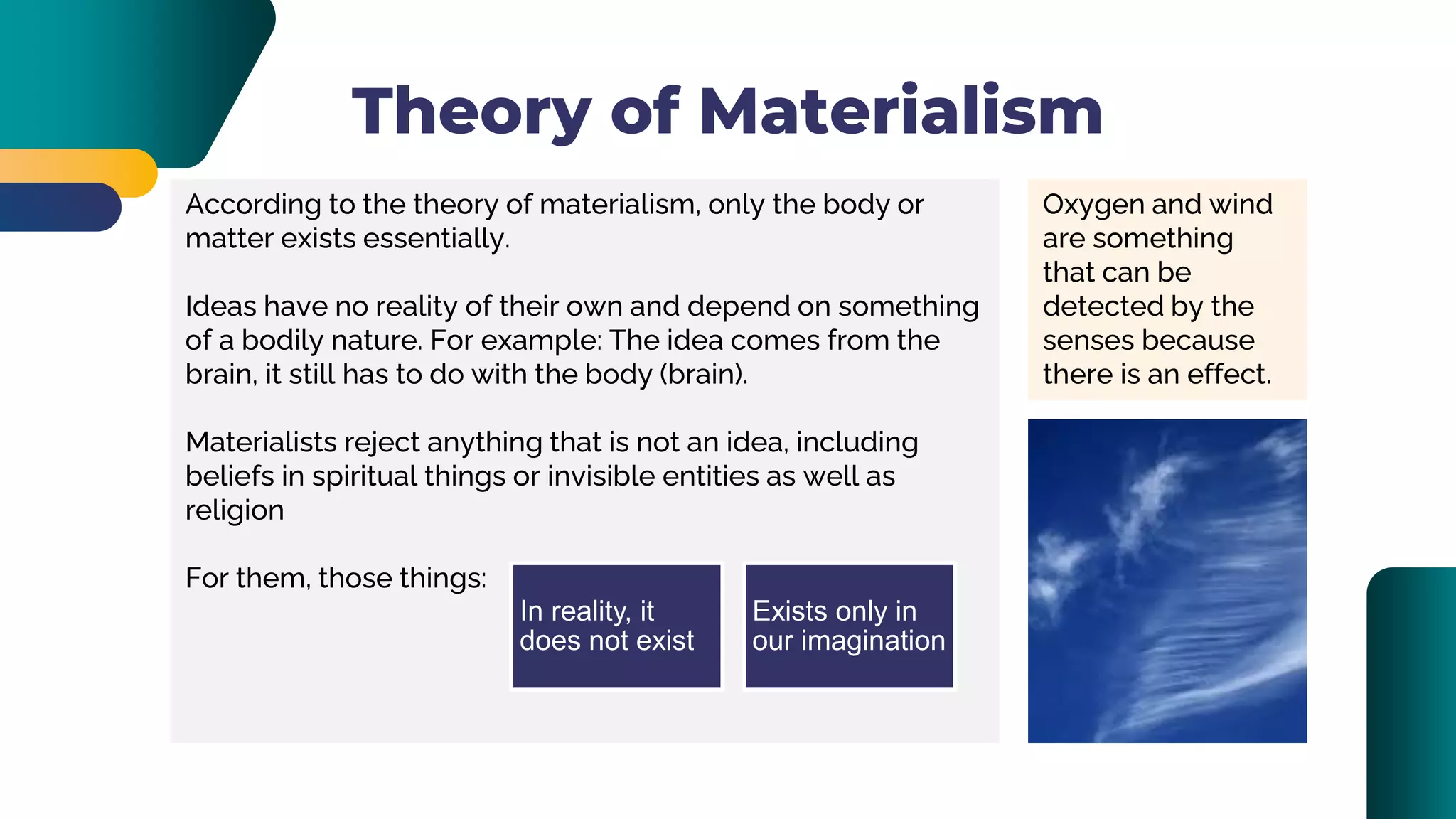
Theory of Materialism
According to the theory of materialism, only the body or
matter exists essentially.
Ideas have no reality of their own and depend on something
of a bodily nature. For example: The idea comes from the
brain, it still has to do with the body (brain).
Materialists reject anything that is not an idea, including
beliefs in spiritual things or invisible entities as well as
religion
For them, those things:
Oxygen and wind
are something
that can be
detected by the
senses because
there is an effect.
In reality, it
does not exist
Exists only in
our imagination
Theory of Idealism
According to the theory of idealism, reality is not
material, but mental or idea/spiritual.
Reality is not perceived directly, but perceived is the
sensation of an object. Only the realm of the mind
exists, and the physical realm is unrecognizable
by directly.
George Berkeley: If you think about it, what do
we know about this universe?
What do we know about
bodies outside our own world?
Reality is not perceived directly
but perceived through the
sensation of an object.
Only the realm
of the mind exist
The physical
realm is not
known directly
Metaphysics & Religion
In religious understanding, it is said that the reality is not only limited to
the bodily nature which can be known through rationalist methods,
empiricism and the like.
But that reality can also consist of something that is not bodily in nature
such as the spirit that is in our body, the existence of angels, jinn and so
on.
In terms of religion, the reality is not limited only to the material nature
or the nature of purely spiritual ideas but encompasses both. The reality
of the religious view involves the body as well as the spiritual.
It is clearly different from the materialist view which rejects spiritual
reality or mental reality.
God
Human
Beings
Nature
God
Theism
Agnostic
Atheism
Theism:
The understanding that the god exists, even if his existence
cannot be traced.
Monotheism - God is one.
Polytheism - there is more than one god.
Atheism:
The understanding of the reality of nature does not exist, which
exists only materially.
Agnostic:
Hesitant
DOES GOD EXIST?
CONCEPTS OF
DIVINITY
ASSOCIATED WITH
METAPHYSICS
A viewpoint that holds that God does not exist
Convinced of the non-existence of God
Reality is only limited to physical things and ideas
The existence of god is denied because:
1. Widespread misery in this world
2. There is no god who has absolute power and is good
3. There is evils everywhere
Besides:
1. Human and machines cannot sense God
2. God has no body and is only an imagination
Human ability to act good or bad does not need god or devil
ATHEISM
A viewpoint that any ultimate reality (such as God) is
unknown and probably unknowable.
Man cannot know that God exists or does not exist
Human understanding of God is limited
This is due to the limitation or constraint of the ability of
human senses and thinking to know
Agnosticism do not deny the existence of God, but:
• Humans do not have the ability
• To know whether god exists or not
Agnosticism believers do not have the confidence to say
that God exist or not as humans do not have the capacity.
AGNOSTICISM
A viewpoint that belief in the existence of a god or gods,
specifically of a creator who intervenes in the universe.
Monotheism
Mono – Single/One
Theos – God
Believes that there is only one God
Example: Islam and Judaism
THEISM
Polytheism
Poly – Many
Theos – God
Believes that there is many Gods
Example: Hinduism and Chinese Gods
In the twentieth century the Logical Positivists argued metaphysics was
irrelevant and that philosophy should be guided by science.
However, metaphysics and science attempt to answer many of the same,
fundamental questions: What are laws of nature? What is causation? What
are natural kinds?
Scientists reject anything that is not verifiable (not verifiable) by experience
and does not have any meaning.
Does Science replace Metaphysics?
THE DEVELOPMENT OF
METAPHYSICAL SCIENCE
Metaphysics goes side by side with science. While science deals with specific
situations, metaphysics deals with general matters.
For example: When a scientist talk about “nature laws”, a metaphysicist will
study what are the characteristics that make a statement to qualify as a law
It attempts to determine what must be the case for the physical world to be
and to function as it does. It seeks to know what things are, not how they
work. Science deals with the latter.
THE DEVELOPMENT OF
METAPHYSICAL SCIENCE
THANK YOU

Falsafah dan Isu Semasa (ENGLISH) - Metaphysics

  • 1.
    PHILOSOPHY & CURRENT ISSUES Topic5: Metaphysics By Fadhilah Raihan Lokman SLAS, Taylor’s University
  • 2.
    Learning Outcome Explain therelationship between Human and Nature in the context of understanding Past Cosmology and Current Ecology Explain the beliefs and relationship between Human and God based on the context of Theology/Beliefs/Spirituality Describe the formation and development of metaphysical systems Fadhilah Raihan Lokman SLAS, Taylor’s University
  • 3.
  • 4.
  • 5.
    Derived from theGreek meta ta physika ("after the things of nature"); referring to an idea, doctrine, or posited reality outside of human sense perception. Metaphysics is the branch of philosophy concerned with the nature of existence, being and the world. In modern philosophical terminology, metaphysics refers to the studies of what cannot be reached through objective studies of material reality. What is Metaphysics?
  • 6.
    meta + physics •meta = beyond/ above/ transcend; • physics = material things/physical nature; Therefore, metaphysics means something that transcends physical boundaries
  • 7.
    First level: Refersto things or the physical realm. Second order study or second level thinking is: • If science is considered to be at the object level • Hence, the philosophy of science is at the 'meta level' (the level beyond) Looking at science from 'top' to 'bottom' is a reflection on the nature of science. Therefore, metaphysical studies are also free to criticize science, not only in terms of the content or theory of science but in terms of the limitations of science and the relationship between science and other fields of study The study of Metaphysics is a second level study:
  • 8.
    The term metaphysics has twodistinct meanings: First: Philosophical Second: Religion-based or supernatural
  • 9.
  • 10.
    Example: Chair The chairhas: Color and place in a space May have a distinctive smell or shape Whether hard or soft and so on So, if we remove all those attributes, what is left of the chair? According to Aristotle, in his book Metaphysics: Metaphysics is: A study that is the most abstract about a subject or a phenomenon relating to nature, whether natural or man-made. Let us try to think about things like bodies (jasad) /material things in the broadest sense. What is body (jasad)? What is the material? By rejecting or denying all of an object's specified characteristics, what is left of the object?
  • 11.
    Refers to specific phenomenasuch as: 1) Fire burns paper There is a concept of cause and effect linked there 2) The ball is kicked there, and it lands in the goal. There is a concept of cause and effect that is linked What remains is SUBSTANCE. According to Aristotle, substance is: • A composite of matter and form • Combination of the mass and shape of the object • Has no distinguishing characteristics Studying and examining physical objects on such an abstract and broad scale.
  • 12.
    In Metaphysics: We donot look for details, or the specific characteristics of every phenomena But we asked more abstract questions such as: • What is the causal relationship in a phenomenon • What are the consequences of the action What is studied is cause and effect relationships in general, not referring to any specific phenomenon
  • 13.
  • 14.
    A domain beyondordinary phenomena, outside the realm of the body that we are familiar with; It refers to phenomena outside the real world. All of these are things we cannot confirm through our senses; cannot be seen, be heard, be touched. It is impossible to recognize the phenomenon in the usual way. But it can be confirmed through other means i.e., revelation and so on. What is generally understood as Metaphysics is: The existence of god Life after death Life in the realm of barzakh The concept of heaven and hell
  • 15.
    Metaphysics Ontology: The science ofBeing Materialism Idealism Theology: The science of God Theism Atheism Agnostics Monotheism Polytheism Universal Science
  • 16.
    Metaphysic Theories Materialism Idealism Theview that material objects exist/ Anything that can be seen exists Example: Mountains, River, Rock The view that every object either is, or depends for its existence upon, mental entities. Example: God, Soul, Spirits
  • 17.
    Theory of Materialism Accordingto the theory of materialism, only the body or matter exists essentially. Ideas have no reality of their own and depend on something of a bodily nature. For example: The idea comes from the brain, it still has to do with the body (brain). Materialists reject anything that is not an idea, including beliefs in spiritual things or invisible entities as well as religion For them, those things: Oxygen and wind are something that can be detected by the senses because there is an effect. In reality, it does not exist Exists only in our imagination
  • 18.
    Theory of Idealism Accordingto the theory of idealism, reality is not material, but mental or idea/spiritual. Reality is not perceived directly, but perceived is the sensation of an object. Only the realm of the mind exists, and the physical realm is unrecognizable by directly. George Berkeley: If you think about it, what do we know about this universe? What do we know about bodies outside our own world? Reality is not perceived directly but perceived through the sensation of an object. Only the realm of the mind exist The physical realm is not known directly
  • 19.
    Metaphysics & Religion Inreligious understanding, it is said that the reality is not only limited to the bodily nature which can be known through rationalist methods, empiricism and the like. But that reality can also consist of something that is not bodily in nature such as the spirit that is in our body, the existence of angels, jinn and so on. In terms of religion, the reality is not limited only to the material nature or the nature of purely spiritual ideas but encompasses both. The reality of the religious view involves the body as well as the spiritual. It is clearly different from the materialist view which rejects spiritual reality or mental reality.
  • 20.
  • 21.
    Theism: The understanding thatthe god exists, even if his existence cannot be traced. Monotheism - God is one. Polytheism - there is more than one god. Atheism: The understanding of the reality of nature does not exist, which exists only materially. Agnostic: Hesitant DOES GOD EXIST?
  • 22.
  • 23.
    A viewpoint thatholds that God does not exist Convinced of the non-existence of God Reality is only limited to physical things and ideas The existence of god is denied because: 1. Widespread misery in this world 2. There is no god who has absolute power and is good 3. There is evils everywhere Besides: 1. Human and machines cannot sense God 2. God has no body and is only an imagination Human ability to act good or bad does not need god or devil ATHEISM
  • 24.
    A viewpoint thatany ultimate reality (such as God) is unknown and probably unknowable. Man cannot know that God exists or does not exist Human understanding of God is limited This is due to the limitation or constraint of the ability of human senses and thinking to know Agnosticism do not deny the existence of God, but: • Humans do not have the ability • To know whether god exists or not Agnosticism believers do not have the confidence to say that God exist or not as humans do not have the capacity. AGNOSTICISM
  • 25.
    A viewpoint thatbelief in the existence of a god or gods, specifically of a creator who intervenes in the universe. Monotheism Mono – Single/One Theos – God Believes that there is only one God Example: Islam and Judaism THEISM Polytheism Poly – Many Theos – God Believes that there is many Gods Example: Hinduism and Chinese Gods
  • 26.
    In the twentiethcentury the Logical Positivists argued metaphysics was irrelevant and that philosophy should be guided by science. However, metaphysics and science attempt to answer many of the same, fundamental questions: What are laws of nature? What is causation? What are natural kinds? Scientists reject anything that is not verifiable (not verifiable) by experience and does not have any meaning. Does Science replace Metaphysics? THE DEVELOPMENT OF METAPHYSICAL SCIENCE
  • 27.
    Metaphysics goes sideby side with science. While science deals with specific situations, metaphysics deals with general matters. For example: When a scientist talk about “nature laws”, a metaphysicist will study what are the characteristics that make a statement to qualify as a law It attempts to determine what must be the case for the physical world to be and to function as it does. It seeks to know what things are, not how they work. Science deals with the latter. THE DEVELOPMENT OF METAPHYSICAL SCIENCE
  • 28.