To receive our Bulletin via email, send your email address to bulletin@savetheredwoods.org
Save-the-Redwoods League 114 Sansome Street • Room 1200 • San Francisco • CA • 94104
(415) 362-2352 voice • (415) 362-7017 fax • www.savetheredwoods.org
9 PRINTED ON RECYCLED PAPER
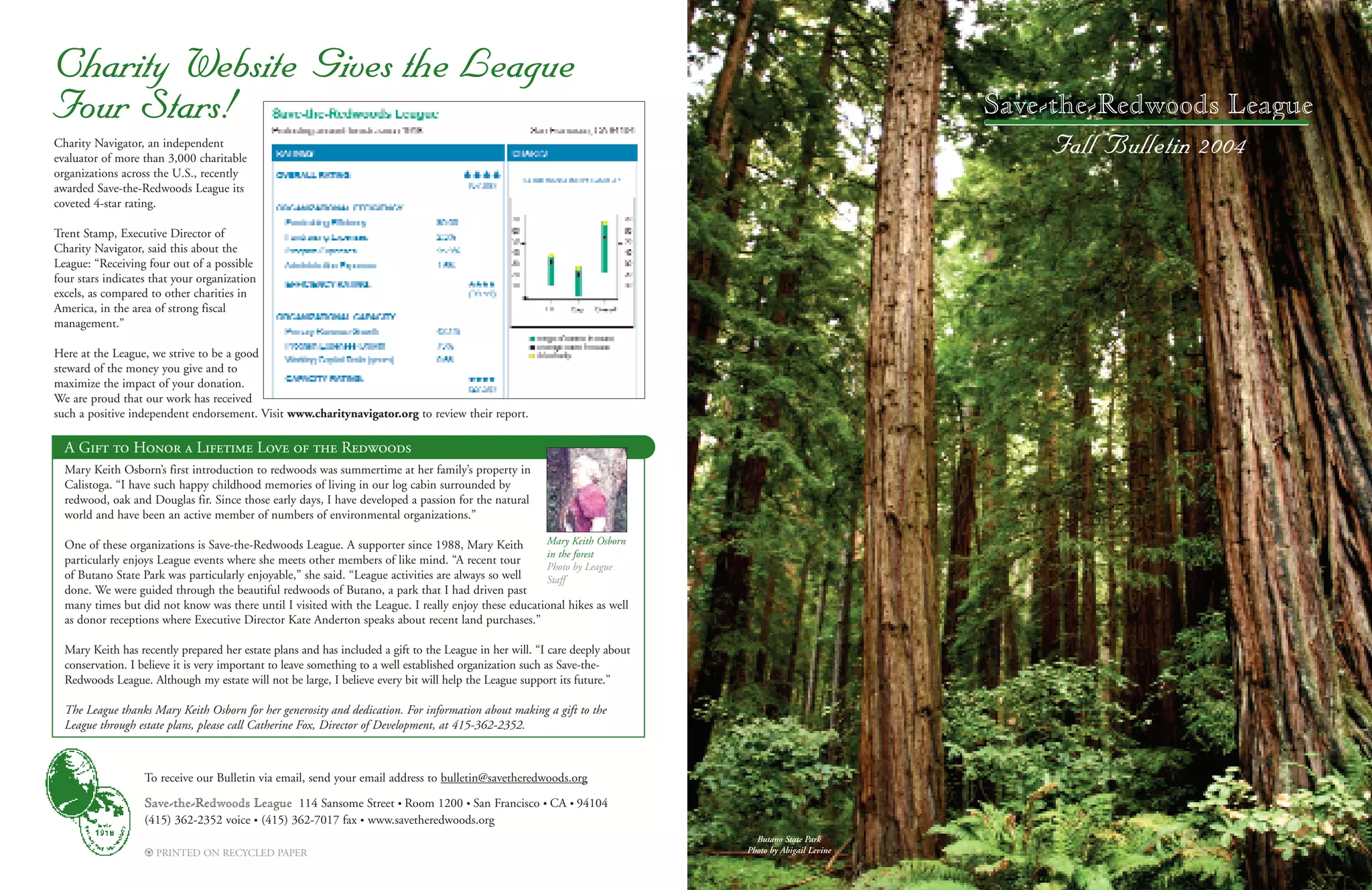
Charity Navigator, an independent
evaluator of more than 3,000 charitable
organizations across the U.S., recently
awarded Save-the-Redwoods League its
coveted 4-star rating.
Trent Stamp, Executive Director of
Charity Navigator, said this about the
League: “Receiving four out of a possible
four stars indicates that your organization
excels, as compared to other charities in
America, in the area of strong fiscal
management.”
Here at the League, we strive to be a good
steward of the money you give and to
maximize the impact of your donation.
We are proud that our work has received
such a positive independent endorsement. Visit www.charitynavigator.org to review their report.
Charity Website Gives the League
Four Stars! Save-the-Redwoods League
Fall Bulletin 2004
Butano State Park
Photo by Abigail Levine
A Gift to Honor a Lifetime Love of the Redwoods
Mary Keith Osborn’s first introduction to redwoods was summertime at her family’s property in
Calistoga. “I have such happy childhood memories of living in our log cabin surrounded by
redwood, oak and Douglas fir. Since those early days, I have developed a passion for the natural
world and have been an active member of numbers of environmental organizations.”
One of these organizations is Save-the-Redwoods League. A supporter since 1988, Mary Keith
particularly enjoys League events where she meets other members of like mind. “A recent tour
of Butano State Park was particularly enjoyable,” she said. “League activities are always so well
done. We were guided through the beautiful redwoods of Butano, a park that I had driven past
many times but did not know was there until I visited with the League. I really enjoy these educational hikes as well
as donor receptions where Executive Director Kate Anderton speaks about recent land purchases.”
Mary Keith has recently prepared her estate plans and has included a gift to the League in her will. “I care deeply about
conservation. I believe it is very important to leave something to a well established organization such as Save-the-
Redwoods League. Although my estate will not be large, I believe every bit will help the League support its future.”
The League thanks Mary Keith Osborn for her generosity and dedication. For information about making a gift to the
League through estate plans, please call Catherine Fox, Director of Development, at 415-362-2352.
Mary Keith Osborn
in the forest
Photo by League
Staff
S a v e - t h e - R e d w o o d s L e a g u e | F a l l B u l l e t i n    Page  S a v e - t h e - R e d w o o d s L e a g u e | F a l l B u l l e t i n     Page 
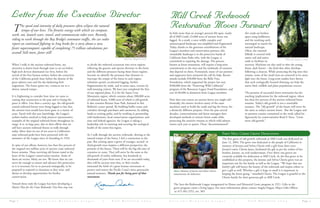
Letter from the Executive Director
The speed and intensity of daily pressures often eclipses the natural
tempo of our lives. The frenetic energy with which we compute,
work, eat, launch wars, travel, and communicate takes over. Recently,
riding to work through the Bay Bridge’s commuter traffic, the car radio
report on continued fighting in Iraq broke for a story about a new,
faster supercomputer capable of completing 75 trillion calculations per
second! Still more, faster still!
When I walk in the ancient redwood forest, my
attention is drawn back through time to an era before
high-tech devices dominated our lives, before the
arrival of the first human settlers, before the extinction
of the California grizzly bear, before the demise of the
great salmon runs and the sky-darkening bird
migrations. The forest quiets me, connects me to a
slower, natural tempo.
It is frightening to consider how close we came to
cutting that connection to the past and to losing the
peace it offers. Less than a century ago, the old-growth
coastal redwood forests were being logged so fast that
the ancient trees would have been gone in a matter of
years. Faced with this sure knowledge, the League’s
earliest leaders resolved to help preserve representative
examples of the original redwood forest throughout its
range. It is, in large part, due to their efforts that we
still have ancient redwood forests to walk through
today. More than six out of ten acres in California’s
state redwood parks have been protected with the
assistance of the League since its founding in 1918.
In spite of our efforts, however, less than five percent of
the original two million acres of ancient coast redwood
forest remains. These surviving old forests stand at the
heart of the League’s conservation mission. Some of
them are secure. Many are not. We know that we can
never do enough to ensure and advance this protection,
so it is necessary for us to proceed strategically, to be
prepared to respond to situations as they arise, and
always to develop opportunities for further
conservation.
Toward those ends the League has been developing a
Master Plan for the Coast Redwoods. Our first step was
to divide the redwood ecosystem into seven regions
reflecting the genetic and species diversity in the forest
and the different pressures facing those forest regions.
Second, we identify the pressures that threaten to
interrupt the tempo of the forest in each region:
suburban sprawl, accelerated logging, further
fragmentation by roads, and in some cases, overuse by
well-meaning visitors. We have just completed the first
of our regional plans. It is for the Santa Cruz
Mountains region, which contains about 200,000 acres
of redwood forest, 9,000 acres of which is old growth.
It also contains Butano State Park, featured in this
Bulletin’s center spread. By building buffer zones and
corridors through purchases and easements, by adding
lands to existing parks, and by working in partnership
with landowners, local conservation organizations, and
state and federal agencies, the League is taking a
leadership role in restoring and securing the ecological
health of the entire bio-region.
As I walk through the ancient redwoods, slowing to the
natural tempo of the forest, I feel a connection to the
past. But coming upon a grove of younger, second- or
third-growth trees inspires a different perspective: the
promise of the future. These will be the big old trees of
centuries to come. They will never be the same as the
old growth of earlier millennia, but hundreds or
thousands of years from now, if we are successful today,
they will be ancient trees that, in their youths,
witnessed the birth of a great human movement to
protect and restore the Pacific Coast’s most spectacular
natural treasures. Thank you for being part of that
movement.
Photo by Abigail Levine
In little more than an average’s person’s life-span, nearly
all of Mill Creek’s 25,000 acres of ancient forest was
logged. As a result, a once wildly complex and
uninterrupted landscape was simplified and fragmented.
Today, thanks to the generous contributions of the
League’s members and conservation partners, this
remarkable landscape is in the protective hands of
California State Parks who, with the League, is
committed to repairing the damage. The process,
known as forest restoration, will require a long-term
commitment to the trees and the multitude of creatures
that depend on them. Fortunately, many of our partners
and supporters have answered the call for help. Recent
awards include $50,000 from the Bella Vista
Foundation, which supported the project last year,
$500,000 from the “Preserving Wild California”
program of the Resources Legacy Fund Foundation, and
over $140,000 in donations from League members.
How does one restore an ancient forest you might ask?
Ironically, the answer involves many of the same
machines used to build the roads and log the forest, for
a distinctly different purpose. Over the past several
decades, conservationists and forest managers have
developed methods to remove forest roads while
protecting the sensitive streams to which wild salmon
return each year to spawn. These “decommissioned”
dirt roads are broken
apart using bulldozers,
and the resulting earth
rearranged to match the
natural landscape.
Often, the restored
hillside is covered with
native soil and native
seeds to facilitate its
recovery. Machines are also used to thin the young,
dense, dark forests – the kind that often develops
following a clearcut. While protecting the big trees that
remain, some of the small trees are removed to let more
light into the forest. Long-term studies have shown
that such ecologically focused thinning can help the
native bird, wildlife and plant populations recover.
The promise of successful forest restoration has far-
reaching implications for the redwood region, where
less than five percent of the ancient redwood forest
remains. Today’s old growth is not a renewable
resource. The “old growth” of the future will never be
the same as today’s ancient forest. But the League and
its partners remain committed to the work called for
figuratively by conservationist Reed F. Noss, “Grow
more old-growth.”
Mill Creek Redwoods
Restoration Moves Forward
Photo by Stephen Corley
First Mill Creek Grove Dedication
The first grove of old growth redwoods at Mill Creek was dedicated on
June 12, 2004. The grove was dedicated to the people of California in
memory of Jerome and Sylvia Cherin with a gift from their trust.
Jerome’s sister, Cherin Jones, facilitated the gift as per the wishes of her
brother, Jerome, an avid outdoorsman. Over thirty one groves are
currently available for dedication at Mill Creek. As the first grove to be
established at this property, the Jerome and Sylvia Cherin grove was an
important one for the family as well as the League. “We hope that our
family’s gift will honor the beauty of the redwoods and inspire others to
give a gift as well. Whether a gift is large or small it is important in
keeping the forest going,” remarked Cherin. The League is grateful to the
Cherin family for their generous gift to Mill Creek.
The Save-the-Redwoods League inaugurated its Honor and Memorial Grove program in 1921. Gifts to the
grove program create a living legacy. For more information please contact Angela Dugan, Major Gifts Officer,
at 415-362-2352, ext. 303.
Above: Relatives of Jerome and Sylvia Cherin
commemorate the dedication.
PhotobyJonesfamilymember
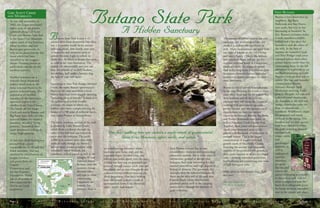
utano State Park is only a 45-
minute drive from downtown Palo Alto,
but it is another world. In its ancient
redwood groves, time bends; eons pass
in moments and moments seem to
endure for eons. Light is reified; its
shafts slice the forest in beams that seem
as solid as the trees themselves. The
sounds are otherworldly too: you can
hear the whoosh of an owl’s feathers;
the shifting duff under a banana slug;
the beat of your own heart.
According to State Park Ranger Michael
Grant, the name Butano (pronounced
Beaut en oh) may stem from a local
Native American word roughly meaning
“gathering place of friends.” Indeed, it is
the gathering of several friendly
ecotones, the zones in which two
habitat types meet, complementing the
beauty of 1,700 acres of redwood forest,
that makes Butano so extraordinary.
The main, northern portion of the park
is divided by Little Butano Creek,
which flows southwest through the
valley it has followed and helped to
carve over the centuries. The park’s
4,000 acres contain more than thirty
miles of trails through six distinct
habitat types: coastal grassland, alder
woodland, vernal wetland, oak
woodland, and chaparral, as well as the
Douglas-fir and
redwood forests.
In some cases the
ecotones change
abruptly when
soil-type or other
constraining
boundaries are
crossed. For
instance, there is
S a v e - t h e - R e d w o o d s L e a g u e | F a l l B u l l e t i n    Page  S a v e - t h e - R e d w o o d s L e a g u e F a l l B u l l e t i n     Page 
As you may remember, in
2002, the League purchased
eighty acres of old-growth
redwoods along Girl Scout
Creek near Butano State Park
in the Santa Cruz Mountain
region south of San Francisco.
Many members and new
donors gave generously to
help secure protection for this
forest which had been
identified by the League’s
Master Planning process as
particularly valuable for the
marbled murrelet.
Marbled murrelets are a
federally-listed threatened
seabird which nests in the
dense structure found in the
ancient redwood forest. The
population of marbled
murrelets in the Santa Cruz
mountain region is the
smallest in the United States.
The forests of Girl Scout
Creek and nearby Butano and
Big Basin State Parks provide
essential habitat for marbled
murrelets, so-called “flying
potatoes,” because of their
squat dimensions and quick,
dodgy flight patterns.
In late June, final funding was
secured from a party
responsible for an oil spill that
killed murrelets. This was
matched by contributions of
League members
and grants from the
Coastal
Conservancy and
the San Francisco
Foundation. Thank
you to all members
who supported the
Girl Scout Creek
acquisition.
Butano is less visited than its
neighbors, Big Basin
Redwoods and Ano Nuevo
state parks, but it is no less
fascinating or beautiful. In
fact, Butano’s seclusion makes
it both superlative wildlife
habitat and a fine place for
humans to seek the solace of
the wild. In the heat of
summer the beautiful Creek
and Nine Bridges trails cover
redwood habitat that’s often
several degrees cooler than the
surrounding areas. In the fall
and winter it is possible to see
steelhead swimming up Little
Butano Creek on their way to
spawn. The rare and beautiful
calypso orchid blooms
February through April.
Mushroom watching is also
great in the park; red caps and
redwood rooter mushrooms
are abundant in the duff and
orange chanterelles color the
floor of adjacent oak
woodland. Wildflowers carpet
the grassland and vernal
wetlands in the spring. Two
hundred and ten bird species
have been identified within
the park, including pileated
woodpeckers,
winter wrens,
and
grasshopper
sparrows, as
well as
endangered
marbled
murrelets,
peregrine
falcons, and
several owl
species. Camping is available
in the park as well, and the
main campground is in the
heart of an old-growth grove;
for better or worse, murrelets
nest in the canopy just above.
Butano StateParkA Hidden Sanctuary
an almost jarring transition where
knobcone pine forest ends and the
redwoods begin. In other cases, one
habitat type melds slowly into the next.
A hiker can start out on grassland and
proceed through coastal scrub, into oak
woodland, and on into Douglas-fir and
redwood habitat without noticing any
sharp boundaries. One day’s walking
here can contain a week’s worth of
quintessential Santa Cruz Mountain
sights, smells, and sounds.
Each Butano ecotone has its own
extraordinary character and outstanding
plants and animals. But it is the areas of
intersection, gradual or abrupt, that
biologists find most interesting for their
unusual associations and high degrees of
biological diversity. The grasslands, for
example, abut the redwood Douglas-fir
forest on the west end of the park near
Canyon Road, where characteristic
grassland species such as the jumping
mouse scurry through the shadows of
giant redwoods.
Visit Butano
This mosaic of habitat types is not only
enjoyable and interesting to hike and
study, it is ecologically significant as
well. Many local animals use more than
one type of habitat to eke out a living
and raise a family. Others, like bobcats
and mountain lions, will use the fire
resistant redwood forest as a temporary
sanctuary when the chaparral ignites.
And in the long term, it is often at these
boundaries between habitat types that
evolution’s adaptive processes are their
most innovative.
Butano is one of several redwood parks
in the area. Planning for a century from
now, when there may be 50 million Bay
Area residents and all the land-use
pressures they will bring, the League is
working with government agencies,
private owners, and non-governmental
organizations to maintain natural
connections between Butano, Big Basin,
and Portola Redwoods state parks, as
well as Pescadero Creek County Park.
Together, these protected areas contain
nearly seven thousand acres of old-
growth and thousands of acres more of
younger forests. This is the largest
concentration of ancient redwood
growth south of Humboldt County.
Ensuring the security and long-term
viability of the protected old-growth in
these parks requires us to act on a larger
scale – securing watershed protection,
and buffering and connecting core areas
of high biological value.
Make plans to visit Butano State Park
this year!
Photos by Abigail Levine
Written by Gordy Slack
Girl Scout Creek
and Murrelets
B
“One day’s walking here can contain a week’s worth of quintessential
Santa Cruz Mountain sights, smells, and sounds.”
S a v e - t h e - R e d w o o d s L e a g u e | F a l l B u l l e t i n     Page S a v e - t h e - R e d w o o d s L e a g u e | F a l l B u l l e t i n    Page 
You can feel the edge before you encounter it, but when you reach the
boundary there is no mistaking the artificial line that has been drawn
across the landscape. In contrast to the natural ecotones (described in the
Butano article), this line is the result of timber harvest. Behind lies the
complex ancient forest and ahead is a young forest plantation, or perhaps a
road or new home cut deep into the heart of the forest. With less than five
percent of the ancient redwood forest remaining, these artificial lines are all
too common.
Scientists are concerned with the ‘edge effects’ these harsh artificial
boundaries have on the ancient forest. League-sponsored studies have
found significant differences in wildlife habitat and forest structure related
to the distance from a timber harvest boundary line. These edge effects
drastically reduce the amount of interior forest habitat available to the
plants and animals that inhabit the ancient forest. Over time, the edge
effect diminishes as the surrounding forest recovers and the young trees
regain some of the stature of the ancient sentinels. However, given the
great height of an ancient coast redwood, these effects can linger 50 years
or more.
The League is working with scientists and foresters to develop techniques
to speed the development of old forest characteristics young forest stands.
Foresters can manipulate a young forest to promote growth of larger trees
with spacing that imitates the ancient forest’s complexity; however, recent
League-sponsored research is unearthing an amazing range of natural
processes and life forms associated uniquely with the ancient forest. For
instance, tiny soil insects are more abundant and diverse beneath old
growth trees than in younger forests. These tiny insects that break down
fallen leaves and enrich the forest soil are particularly sensitive to forest and
soil disturbance. We don’t know how rapidly these tiny insects re-colonize
logged sites and what their absence means for forest health. This
uncertainty underscores the importance of protecting the remaining
ancient redwood forest and the surrounding landscape.
Working on the Edge
The League is pleased to announce the imminent purchase of a significant piece of
property inside Humboldt Redwoods State Park—the largest of California’s
redwood parks, located in southern Humboldt County. This “inholding” is 112
acres located near Myers Flat along the South Fork of the Eel River. This redwood
forest land is recovering from past selective harvesting by the previous owners.
Preventing future logging in perpetuity in the heart of this critical reserve of ancient
redwoods is our objective.
If timber production were to continue, waterways and already fragmented habitats
would be threatened, and the overall ecological process disrupted. Acquisition and
addition to the Park will allow the forest to recover fully, knitting together a seamless
fabric of forest on these slopes visible from Highway 101, the “Redwood Highway.”
Save-the-Redwoods League has received a generous grant of $148,000 to cover the full cost of the acquisition through the
“Preserving Wild California” program of the Resources Legacy Fund Foundation. When purchase of the property is
complete, it will be transferred to California State Parks for permanent stewardship.
Restoring the Fabric
of the Forest
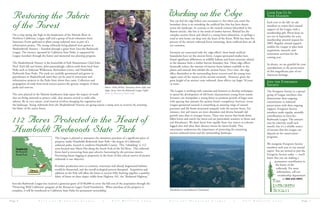
On a crisp spring day high in the headwaters of the Mattole River in
Northern California, League staff and a group of local volunteers from
Sanctuary Forest gathered to plant young redwood trees as part of a
reforestation project. The young redwoods being planted were grown at
Shadowbrook Nursery – founded through a grant from Save-the-Redwoods
League. The nursery, operated by California State Parks, is supported by
League members through the honor and memorial tree planting program.
The Shadowbrook Nursery is the brainchild of Park Maintenance Chief John
Neef. Each fall and winter, John painstakingly collects seeds from local State
Parks such as Sinkyone Wilderness, Richardson Grove, and Humboldt
Redwoods State Parks. The seeds are carefully germinated and grown in
greenhouses at Shadowbrook until they can be used in restoration and
reforestation projects in the Parks from where they came. Collection and
propagation of seeds from local sources protect the genetic integrity of these
parks and reserves.
The trees planted in the Mattole headwaters help repair the impact of roads
that are being removed to protect cold, clear streams critical to wild coho
salmon. By its very nature, road removal involves changing the vegetation and
the landscape. Young redwoods from the Shadowbrook Nursery are giving nature a jump start to recovery by restoring
the fabric of the native forest.
Above: Tasha McKee, Sanctuary Forest (left) and
Angie Avery, Save-the-Redwoods League (right)
Photo by Sanctuary Forest Staff
112 Acres Protected in the Heart of
Humboldt Redwoods State Park
Look For Us In
Your Mailbox
Each year in the fall, we ask
members to renew their annual
support of the League with a
membership gift. Please keep an
eye out in September for your
membership renewal request for
2005. Regular, annual support
enables the League to plan land
acquisition, research, and
restoration activities for the
coming year.
As always, we are grateful for your
contributions to the preservation
of this magnificent part of our
American heritage.
Join the Evergreen
Society
The Evergreen Society is a special
group of League members who
demonstrate their ongoing
commitment to redwood
preservation with their ongoing
support. Evergreen Society
members make regular, monthly
contributions to Save-the-
Redwoods League. The amount
may be relatively small each
month, but it’s a reliable source
of income that the League can
depend on for conservation
programs.
We recognize Evergreen Society
members each year in our annual
report. You are invited to join the
Evergreen Society today — you’ll
know that you are making a
permanent contribution to
the future of the
redwoods. For more
information, call our
membership department
at 888-836-0005.
Humboldt County Industrial Timberland

Fall bulletin 2004 ~ save the redwoods league

  • 1.
    To receive ourBulletin via email, send your email address to bulletin@savetheredwoods.org Save-the-Redwoods League 114 Sansome Street • Room 1200 • San Francisco • CA • 94104 (415) 362-2352 voice • (415) 362-7017 fax • www.savetheredwoods.org 9 PRINTED ON RECYCLED PAPER Charity Navigator, an independent evaluator of more than 3,000 charitable organizations across the U.S., recently awarded Save-the-Redwoods League its coveted 4-star rating. Trent Stamp, Executive Director of Charity Navigator, said this about the League: “Receiving four out of a possible four stars indicates that your organization excels, as compared to other charities in America, in the area of strong fiscal management.” Here at the League, we strive to be a good steward of the money you give and to maximize the impact of your donation. We are proud that our work has received such a positive independent endorsement. Visit www.charitynavigator.org to review their report. Charity Website Gives the League Four Stars! Save-the-Redwoods League Fall Bulletin 2004 Butano State Park Photo by Abigail Levine A Gift to Honor a Lifetime Love of the Redwoods Mary Keith Osborn’s first introduction to redwoods was summertime at her family’s property in Calistoga. “I have such happy childhood memories of living in our log cabin surrounded by redwood, oak and Douglas fir. Since those early days, I have developed a passion for the natural world and have been an active member of numbers of environmental organizations.” One of these organizations is Save-the-Redwoods League. A supporter since 1988, Mary Keith particularly enjoys League events where she meets other members of like mind. “A recent tour of Butano State Park was particularly enjoyable,” she said. “League activities are always so well done. We were guided through the beautiful redwoods of Butano, a park that I had driven past many times but did not know was there until I visited with the League. I really enjoy these educational hikes as well as donor receptions where Executive Director Kate Anderton speaks about recent land purchases.” Mary Keith has recently prepared her estate plans and has included a gift to the League in her will. “I care deeply about conservation. I believe it is very important to leave something to a well established organization such as Save-the- Redwoods League. Although my estate will not be large, I believe every bit will help the League support its future.” The League thanks Mary Keith Osborn for her generosity and dedication. For information about making a gift to the League through estate plans, please call Catherine Fox, Director of Development, at 415-362-2352. Mary Keith Osborn in the forest Photo by League Staff
  • 2.
    S a ve - t h e - R e d w o o d s L e a g u e | F a l l B u l l e t i n    Page  S a v e - t h e - R e d w o o d s L e a g u e | F a l l B u l l e t i n     Page  Letter from the Executive Director The speed and intensity of daily pressures often eclipses the natural tempo of our lives. The frenetic energy with which we compute, work, eat, launch wars, travel, and communicate takes over. Recently, riding to work through the Bay Bridge’s commuter traffic, the car radio report on continued fighting in Iraq broke for a story about a new, faster supercomputer capable of completing 75 trillion calculations per second! Still more, faster still! When I walk in the ancient redwood forest, my attention is drawn back through time to an era before high-tech devices dominated our lives, before the arrival of the first human settlers, before the extinction of the California grizzly bear, before the demise of the great salmon runs and the sky-darkening bird migrations. The forest quiets me, connects me to a slower, natural tempo. It is frightening to consider how close we came to cutting that connection to the past and to losing the peace it offers. Less than a century ago, the old-growth coastal redwood forests were being logged so fast that the ancient trees would have been gone in a matter of years. Faced with this sure knowledge, the League’s earliest leaders resolved to help preserve representative examples of the original redwood forest throughout its range. It is, in large part, due to their efforts that we still have ancient redwood forests to walk through today. More than six out of ten acres in California’s state redwood parks have been protected with the assistance of the League since its founding in 1918. In spite of our efforts, however, less than five percent of the original two million acres of ancient coast redwood forest remains. These surviving old forests stand at the heart of the League’s conservation mission. Some of them are secure. Many are not. We know that we can never do enough to ensure and advance this protection, so it is necessary for us to proceed strategically, to be prepared to respond to situations as they arise, and always to develop opportunities for further conservation. Toward those ends the League has been developing a Master Plan for the Coast Redwoods. Our first step was to divide the redwood ecosystem into seven regions reflecting the genetic and species diversity in the forest and the different pressures facing those forest regions. Second, we identify the pressures that threaten to interrupt the tempo of the forest in each region: suburban sprawl, accelerated logging, further fragmentation by roads, and in some cases, overuse by well-meaning visitors. We have just completed the first of our regional plans. It is for the Santa Cruz Mountains region, which contains about 200,000 acres of redwood forest, 9,000 acres of which is old growth. It also contains Butano State Park, featured in this Bulletin’s center spread. By building buffer zones and corridors through purchases and easements, by adding lands to existing parks, and by working in partnership with landowners, local conservation organizations, and state and federal agencies, the League is taking a leadership role in restoring and securing the ecological health of the entire bio-region. As I walk through the ancient redwoods, slowing to the natural tempo of the forest, I feel a connection to the past. But coming upon a grove of younger, second- or third-growth trees inspires a different perspective: the promise of the future. These will be the big old trees of centuries to come. They will never be the same as the old growth of earlier millennia, but hundreds or thousands of years from now, if we are successful today, they will be ancient trees that, in their youths, witnessed the birth of a great human movement to protect and restore the Pacific Coast’s most spectacular natural treasures. Thank you for being part of that movement. Photo by Abigail Levine In little more than an average’s person’s life-span, nearly all of Mill Creek’s 25,000 acres of ancient forest was logged. As a result, a once wildly complex and uninterrupted landscape was simplified and fragmented. Today, thanks to the generous contributions of the League’s members and conservation partners, this remarkable landscape is in the protective hands of California State Parks who, with the League, is committed to repairing the damage. The process, known as forest restoration, will require a long-term commitment to the trees and the multitude of creatures that depend on them. Fortunately, many of our partners and supporters have answered the call for help. Recent awards include $50,000 from the Bella Vista Foundation, which supported the project last year, $500,000 from the “Preserving Wild California” program of the Resources Legacy Fund Foundation, and over $140,000 in donations from League members. How does one restore an ancient forest you might ask? Ironically, the answer involves many of the same machines used to build the roads and log the forest, for a distinctly different purpose. Over the past several decades, conservationists and forest managers have developed methods to remove forest roads while protecting the sensitive streams to which wild salmon return each year to spawn. These “decommissioned” dirt roads are broken apart using bulldozers, and the resulting earth rearranged to match the natural landscape. Often, the restored hillside is covered with native soil and native seeds to facilitate its recovery. Machines are also used to thin the young, dense, dark forests – the kind that often develops following a clearcut. While protecting the big trees that remain, some of the small trees are removed to let more light into the forest. Long-term studies have shown that such ecologically focused thinning can help the native bird, wildlife and plant populations recover. The promise of successful forest restoration has far- reaching implications for the redwood region, where less than five percent of the ancient redwood forest remains. Today’s old growth is not a renewable resource. The “old growth” of the future will never be the same as today’s ancient forest. But the League and its partners remain committed to the work called for figuratively by conservationist Reed F. Noss, “Grow more old-growth.” Mill Creek Redwoods Restoration Moves Forward Photo by Stephen Corley First Mill Creek Grove Dedication The first grove of old growth redwoods at Mill Creek was dedicated on June 12, 2004. The grove was dedicated to the people of California in memory of Jerome and Sylvia Cherin with a gift from their trust. Jerome’s sister, Cherin Jones, facilitated the gift as per the wishes of her brother, Jerome, an avid outdoorsman. Over thirty one groves are currently available for dedication at Mill Creek. As the first grove to be established at this property, the Jerome and Sylvia Cherin grove was an important one for the family as well as the League. “We hope that our family’s gift will honor the beauty of the redwoods and inspire others to give a gift as well. Whether a gift is large or small it is important in keeping the forest going,” remarked Cherin. The League is grateful to the Cherin family for their generous gift to Mill Creek. The Save-the-Redwoods League inaugurated its Honor and Memorial Grove program in 1921. Gifts to the grove program create a living legacy. For more information please contact Angela Dugan, Major Gifts Officer, at 415-362-2352, ext. 303. Above: Relatives of Jerome and Sylvia Cherin commemorate the dedication. PhotobyJonesfamilymember
  • 3.
    utano State Parkis only a 45- minute drive from downtown Palo Alto, but it is another world. In its ancient redwood groves, time bends; eons pass in moments and moments seem to endure for eons. Light is reified; its shafts slice the forest in beams that seem as solid as the trees themselves. The sounds are otherworldly too: you can hear the whoosh of an owl’s feathers; the shifting duff under a banana slug; the beat of your own heart. According to State Park Ranger Michael Grant, the name Butano (pronounced Beaut en oh) may stem from a local Native American word roughly meaning “gathering place of friends.” Indeed, it is the gathering of several friendly ecotones, the zones in which two habitat types meet, complementing the beauty of 1,700 acres of redwood forest, that makes Butano so extraordinary. The main, northern portion of the park is divided by Little Butano Creek, which flows southwest through the valley it has followed and helped to carve over the centuries. The park’s 4,000 acres contain more than thirty miles of trails through six distinct habitat types: coastal grassland, alder woodland, vernal wetland, oak woodland, and chaparral, as well as the Douglas-fir and redwood forests. In some cases the ecotones change abruptly when soil-type or other constraining boundaries are crossed. For instance, there is S a v e - t h e - R e d w o o d s L e a g u e | F a l l B u l l e t i n    Page  S a v e - t h e - R e d w o o d s L e a g u e F a l l B u l l e t i n     Page  As you may remember, in 2002, the League purchased eighty acres of old-growth redwoods along Girl Scout Creek near Butano State Park in the Santa Cruz Mountain region south of San Francisco. Many members and new donors gave generously to help secure protection for this forest which had been identified by the League’s Master Planning process as particularly valuable for the marbled murrelet. Marbled murrelets are a federally-listed threatened seabird which nests in the dense structure found in the ancient redwood forest. The population of marbled murrelets in the Santa Cruz mountain region is the smallest in the United States. The forests of Girl Scout Creek and nearby Butano and Big Basin State Parks provide essential habitat for marbled murrelets, so-called “flying potatoes,” because of their squat dimensions and quick, dodgy flight patterns. In late June, final funding was secured from a party responsible for an oil spill that killed murrelets. This was matched by contributions of League members and grants from the Coastal Conservancy and the San Francisco Foundation. Thank you to all members who supported the Girl Scout Creek acquisition. Butano is less visited than its neighbors, Big Basin Redwoods and Ano Nuevo state parks, but it is no less fascinating or beautiful. In fact, Butano’s seclusion makes it both superlative wildlife habitat and a fine place for humans to seek the solace of the wild. In the heat of summer the beautiful Creek and Nine Bridges trails cover redwood habitat that’s often several degrees cooler than the surrounding areas. In the fall and winter it is possible to see steelhead swimming up Little Butano Creek on their way to spawn. The rare and beautiful calypso orchid blooms February through April. Mushroom watching is also great in the park; red caps and redwood rooter mushrooms are abundant in the duff and orange chanterelles color the floor of adjacent oak woodland. Wildflowers carpet the grassland and vernal wetlands in the spring. Two hundred and ten bird species have been identified within the park, including pileated woodpeckers, winter wrens, and grasshopper sparrows, as well as endangered marbled murrelets, peregrine falcons, and several owl species. Camping is available in the park as well, and the main campground is in the heart of an old-growth grove; for better or worse, murrelets nest in the canopy just above. Butano StateParkA Hidden Sanctuary an almost jarring transition where knobcone pine forest ends and the redwoods begin. In other cases, one habitat type melds slowly into the next. A hiker can start out on grassland and proceed through coastal scrub, into oak woodland, and on into Douglas-fir and redwood habitat without noticing any sharp boundaries. One day’s walking here can contain a week’s worth of quintessential Santa Cruz Mountain sights, smells, and sounds. Each Butano ecotone has its own extraordinary character and outstanding plants and animals. But it is the areas of intersection, gradual or abrupt, that biologists find most interesting for their unusual associations and high degrees of biological diversity. The grasslands, for example, abut the redwood Douglas-fir forest on the west end of the park near Canyon Road, where characteristic grassland species such as the jumping mouse scurry through the shadows of giant redwoods. Visit Butano This mosaic of habitat types is not only enjoyable and interesting to hike and study, it is ecologically significant as well. Many local animals use more than one type of habitat to eke out a living and raise a family. Others, like bobcats and mountain lions, will use the fire resistant redwood forest as a temporary sanctuary when the chaparral ignites. And in the long term, it is often at these boundaries between habitat types that evolution’s adaptive processes are their most innovative. Butano is one of several redwood parks in the area. Planning for a century from now, when there may be 50 million Bay Area residents and all the land-use pressures they will bring, the League is working with government agencies, private owners, and non-governmental organizations to maintain natural connections between Butano, Big Basin, and Portola Redwoods state parks, as well as Pescadero Creek County Park. Together, these protected areas contain nearly seven thousand acres of old- growth and thousands of acres more of younger forests. This is the largest concentration of ancient redwood growth south of Humboldt County. Ensuring the security and long-term viability of the protected old-growth in these parks requires us to act on a larger scale – securing watershed protection, and buffering and connecting core areas of high biological value. Make plans to visit Butano State Park this year! Photos by Abigail Levine Written by Gordy Slack Girl Scout Creek and Murrelets B “One day’s walking here can contain a week’s worth of quintessential Santa Cruz Mountain sights, smells, and sounds.”
  • 4.
    S a ve - t h e - R e d w o o d s L e a g u e | F a l l B u l l e t i n     Page S a v e - t h e - R e d w o o d s L e a g u e | F a l l B u l l e t i n    Page  You can feel the edge before you encounter it, but when you reach the boundary there is no mistaking the artificial line that has been drawn across the landscape. In contrast to the natural ecotones (described in the Butano article), this line is the result of timber harvest. Behind lies the complex ancient forest and ahead is a young forest plantation, or perhaps a road or new home cut deep into the heart of the forest. With less than five percent of the ancient redwood forest remaining, these artificial lines are all too common. Scientists are concerned with the ‘edge effects’ these harsh artificial boundaries have on the ancient forest. League-sponsored studies have found significant differences in wildlife habitat and forest structure related to the distance from a timber harvest boundary line. These edge effects drastically reduce the amount of interior forest habitat available to the plants and animals that inhabit the ancient forest. Over time, the edge effect diminishes as the surrounding forest recovers and the young trees regain some of the stature of the ancient sentinels. However, given the great height of an ancient coast redwood, these effects can linger 50 years or more. The League is working with scientists and foresters to develop techniques to speed the development of old forest characteristics young forest stands. Foresters can manipulate a young forest to promote growth of larger trees with spacing that imitates the ancient forest’s complexity; however, recent League-sponsored research is unearthing an amazing range of natural processes and life forms associated uniquely with the ancient forest. For instance, tiny soil insects are more abundant and diverse beneath old growth trees than in younger forests. These tiny insects that break down fallen leaves and enrich the forest soil are particularly sensitive to forest and soil disturbance. We don’t know how rapidly these tiny insects re-colonize logged sites and what their absence means for forest health. This uncertainty underscores the importance of protecting the remaining ancient redwood forest and the surrounding landscape. Working on the Edge The League is pleased to announce the imminent purchase of a significant piece of property inside Humboldt Redwoods State Park—the largest of California’s redwood parks, located in southern Humboldt County. This “inholding” is 112 acres located near Myers Flat along the South Fork of the Eel River. This redwood forest land is recovering from past selective harvesting by the previous owners. Preventing future logging in perpetuity in the heart of this critical reserve of ancient redwoods is our objective. If timber production were to continue, waterways and already fragmented habitats would be threatened, and the overall ecological process disrupted. Acquisition and addition to the Park will allow the forest to recover fully, knitting together a seamless fabric of forest on these slopes visible from Highway 101, the “Redwood Highway.” Save-the-Redwoods League has received a generous grant of $148,000 to cover the full cost of the acquisition through the “Preserving Wild California” program of the Resources Legacy Fund Foundation. When purchase of the property is complete, it will be transferred to California State Parks for permanent stewardship. Restoring the Fabric of the Forest On a crisp spring day high in the headwaters of the Mattole River in Northern California, League staff and a group of local volunteers from Sanctuary Forest gathered to plant young redwood trees as part of a reforestation project. The young redwoods being planted were grown at Shadowbrook Nursery – founded through a grant from Save-the-Redwoods League. The nursery, operated by California State Parks, is supported by League members through the honor and memorial tree planting program. The Shadowbrook Nursery is the brainchild of Park Maintenance Chief John Neef. Each fall and winter, John painstakingly collects seeds from local State Parks such as Sinkyone Wilderness, Richardson Grove, and Humboldt Redwoods State Parks. The seeds are carefully germinated and grown in greenhouses at Shadowbrook until they can be used in restoration and reforestation projects in the Parks from where they came. Collection and propagation of seeds from local sources protect the genetic integrity of these parks and reserves. The trees planted in the Mattole headwaters help repair the impact of roads that are being removed to protect cold, clear streams critical to wild coho salmon. By its very nature, road removal involves changing the vegetation and the landscape. Young redwoods from the Shadowbrook Nursery are giving nature a jump start to recovery by restoring the fabric of the native forest. Above: Tasha McKee, Sanctuary Forest (left) and Angie Avery, Save-the-Redwoods League (right) Photo by Sanctuary Forest Staff 112 Acres Protected in the Heart of Humboldt Redwoods State Park Look For Us In Your Mailbox Each year in the fall, we ask members to renew their annual support of the League with a membership gift. Please keep an eye out in September for your membership renewal request for 2005. Regular, annual support enables the League to plan land acquisition, research, and restoration activities for the coming year. As always, we are grateful for your contributions to the preservation of this magnificent part of our American heritage. Join the Evergreen Society The Evergreen Society is a special group of League members who demonstrate their ongoing commitment to redwood preservation with their ongoing support. Evergreen Society members make regular, monthly contributions to Save-the- Redwoods League. The amount may be relatively small each month, but it’s a reliable source of income that the League can depend on for conservation programs. We recognize Evergreen Society members each year in our annual report. You are invited to join the Evergreen Society today — you’ll know that you are making a permanent contribution to the future of the redwoods. For more information, call our membership department at 888-836-0005. Humboldt County Industrial Timberland