Photo by Carrie Grant
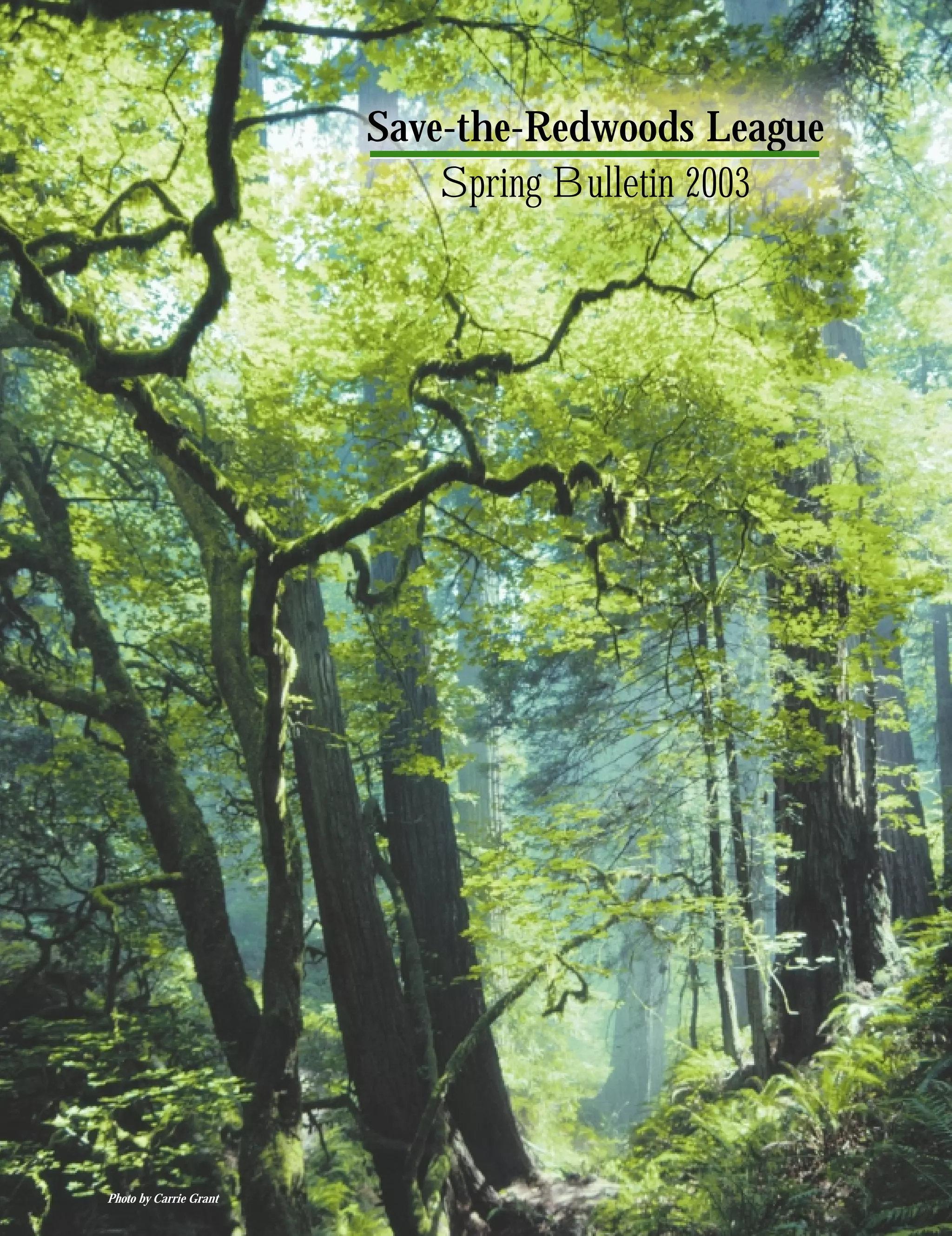
Save-the-Redwoods League
Spring Bulletin 2003
New Strategic Plan Takes Shape
The League has completed a periodic review of its
strategic plan to align the League’s priorities for
effective action. League Directors, Councillors, staff,
and members of the California Department of Parks
and Recreation reflected carefully in a multi-day
process to evaluate accomplishments of the past and
key opportunities of a future with less than 4% of the
ancient redwood forest remaining. The new strategic
plan stresses three areas for continued League
effectiveness.
A Comprehensive Conservation Strategy
The plan endorses refinement and completion of a
scientifically based conservation plan for the forests
throughout the entire range of the redwoods for
evaluation of acquisition, restoration and stewardship
priorities. Increasing pressures from population growth
and logging intensify the risk of fragmentation of the
ancient forest and its ability to support the wildlife that
depend on the ancient forest. Watershed protection and
linkages among protected areas will continue to play a
key role in the League’s strategy.
Public Awareness and Education
Recognizing that broad public support now and in the
future is pivotal to effective long-term preservation of
the redwood forest, the League will continue to expand
environmental education programs focusing on
redwood ecology for students from kindergarten
through high school. To inspire awe in the public at
large through a deepened understanding of the
redwood forest, the League will continue to explore
development of an interpretive center and partnerships
with existing interpretive programs.
League Effectiveness
The League’s effectiveness is fundamentally rooted in
the deepening engagement of our current members and
attracting new members to the League. Strong
volunteer leadership coupled with excellent staff will
continue to be pivotal in future years.
Renewal of the League’s vision has been accompanied
by changes in the Board of Directors.
Thanks for a Job Well Done!
Two long-term Directors, Cynthia Grubb and former
President and Chair Bruce Howard stepped down from
the Board after many years of committed service. Their
wise counsel will be missed. After 7 years of
outstanding leadership as President, Richard Otter was
elected to replace Bruce as Chair of the Board.
New Board Members and Officers
Retirement of two members and expansion of the size
of the Board from seven to nine members created the
opportunity for election of four new Directors who
bring a wealth of expertise and experience to Board
deliberations:
• Jim Larson, Attorney at Law in Fort Bragg,
Mendocino County
• Wally Mark, Professor of Forestry at California
Polytechnic State University – San Luis Obispo &
Director of Cal Poly’s Swanton Pacific Ranch.
• Sarah Connick, senior project manager for Sustainable
Conservation, completing a Ph.D. in Environmental
Science, Policy and Management at UC, Berkeley
• Pete Dangermond of the Dangermond Group,
planning consultants for parks,recreation, wildlife
conservation, and open space preservation and Director
of California State Department of Parks and Recreation
from 1980-1982.
As the League’s new President, together with the rest
of the Board of Directors, I look forward to the
opportunities to implement the strategic plan this year
and in the years ahead. This will be possible only with
the continued support of you, the League’s members in
alI fifty states, for which we are deeply grateful. Thank
you for joining us in meeting the challenges of the
critical work of saving the redwoods.
Message from the President
S a v e - t h e - R e d w o o d s L e a g u e | S p r i n g B u l l e t i n    Page 
The Save-the-Redwoods League’s 84th year has been an eventful one! In
addition to completing the largest acquisition in the League’s history, we have
been working in earnest to develop a clear strategic direction for our future
and have undertaken some significant changes in the Board of Directors.
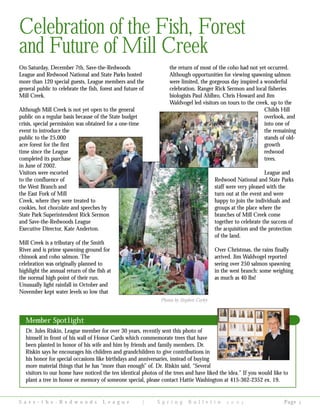
On Saturday, December 7th, Save-the-Redwoods
League and Redwood National and State Parks hosted
more than 120 special guests, League members and the
general public to celebrate the fish, forest and future of
Mill Creek.
Although Mill Creek is not yet open to the general
public on a regular basis because of the State budget
crisis, special permission was obtained for a one-time
event to introduce the
public to the 25,000
acre forest for the first
time since the League
completed its purchase
in June of 2002.
Visitors were escorted
to the confluence of
the West Branch and
the East Fork of Mill
Creek, where they were treated to
cookies, hot chocolate and speeches by
State Park Superintendent Rick Sermon
and Save-the-Redwoods League
Executive Director, Kate Anderton.
Mill Creek is a tributary of the Smith
River and is prime spawning ground for
chinook and coho salmon. The
celebration was originally planned to
highlight the annual return of the fish at
the normal high point of their run.
Unusually light rainfall in October and
November kept water levels so low that
the return of most of the coho had not yet occurred.
Although opportunities for viewing spawning salmon
were limited, the gorgeous day inspired a wonderful
celebration. Ranger Rick Sermon and local fisheries
biologists Paul Ahlbro, Chris Howard and Jim
Waldvogel led visitors on tours to the creek, up to the
Childs Hill
overlook, and
into one of
the remaining
stands of old-
growth
redwood
trees.
League and
Redwood National and State Parks
staff were very pleased with the
turn out at the event and were
happy to join the individuals and
groups at the place where the
branches of Mill Creek come
together to celebrate the success of
the acquisition and the protection
of the land.
Over Christmas, the rains finally
arrived. Jim Waldvogel reported
seeing over 250 salmon spawning
in the west branch: some weighing
as much as 40 lbs!
S a v e - t h e - R e d w o o d s L e a g u e | S p r i n g B u l l e t i n     Page 
Celebration of the Fish, Forest
and Future of Mill Creek
Photos by Stephen Corley
Member Spotlight
Dr. Jules Riskin, League member for over 30 years, recently sent this photo of
himself in front of his wall of Honor Cards which commemorate trees that have
been planted in honor of his wife and him by friends and family members. Dr.
Riskin says he encourages his children and grandchildren to give contributions in
his honor for special occasions like birthdays and anniversaries, instead of buying
more material things that he has “more than enough” of. Dr. Riskin said, “Several
visitors to our home have noticed the ten identical photos of the trees and have liked the idea.” If you would like to
plant a tree in honor or memory of someone special, please contact Hattie Washington at 415-362-2352 ex. 19.
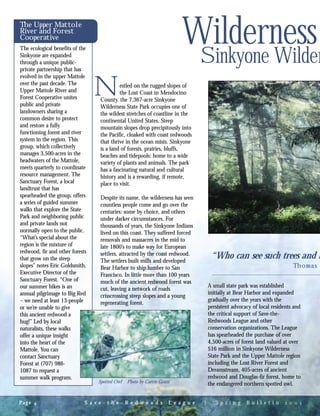
estled on the rugged slopes of
the Lost Coast in Mendocino
County, the 7,367-acre Sinkyone
Wilderness State Park occupies one of
the wildest stretches of coastline in the
continental United States. Steep
mountain slopes drop precipitously into
the Pacific, cloaked with coast redwoods
that thrive in the ocean mists. Sinkyone
is a land of forests, prairies, bluffs,
beaches and tidepools: home to a wide
variety of plants and animals. The park
has a fascinating natural and cultural
history and is a rewarding, if remote,
place to visit.
Despite its name, the wilderness has seen
countless people come and go over the
centuries: some by choice, and others
under darker circumstances. For
thousands of years, the Sinkyone Indians
lived on this coast. They suffered forced
removals and massacres in the mid to
late 1800’s to make way for European
settlers, attracted by the coast redwood.
The settlers built mills and developed
Bear Harbor to ship lumber to San
Francisco. In little more than 100 years
much of the ancient redwood forest was
cut, leaving a network of roads
crisscrossing steep slopes and a young
regenerating forest.
A small state park was established
initially at Bear Harbor and expanded
gradually over the years with the
persistent advocacy of local residents and
the critical support of Save-the-
Redwoods League and other
conservation organizations. The League
has spearheaded the purchase of over
4,500-acres of forest land valued at over
$16 million in Sinkyone Wilderness
State Park and the Upper Mattole region
including the Lost River Forest and
Dreamstream, 405-acres of ancient
redwood and Douglas-fir forest, home to
the endangered northern spotted owl.
Wilderness
Sinkyone Wilder
N
S a v e - t h e - R e d w o o d s L e a g u e | S p r i n g B u l l e t i n    Page 
“Who can see such trees and b
Thomas
The Upper Mattole
River and Forest
Cooperative
The ecological benefits of the
Sinkyone are expanded
through a unique public-
private partnership that has
evolved in the upper Mattole
over the past decade. The
Upper Mattole River and
Forest Cooperative unites
public and private
landowners sharing a
common desire to protect
and restore a fully
functioning forest and river
system in the region. This
group, which collectively
manages 3,500-acres in the
headwaters of the Mattole,
meets quarterly to coordinate
resource management. The
Sanctuary Forest, a local
landtrust that has
spearheaded the group, offers
a series of guided summer
walks that explore the State
Park and neighboring public
and private lands not
normally open to the public.
“What’s special about the
region is the mixture of
redwood, fir and other forests
that grow on the steep
slopes” notes Eric Goldsmith,
Executive Director of the
Sanctuary Forest. “One of
our summer hikes is an
annual pilgrimage to Big Red
– we need at least 13-people
or we’re unable to give
this ancient redwood a
hug!” Led by local
naturalists, these walks
offer a unique insight
into the heart of the
Mattole. You can
contact Sanctuary
Forest at (707) 986-
1087 to request a
summer walk program.
Spotted Owl Photo by Carrie Grant
Reclaimed
rness State Park
The largest remaining grove of ancient
redwoods in the Sinkyone State Park,
rescued from logging in the 1980s, was
named in honor of Sally Bell, a
Sinkyone Indian woman.
Inspired by the environmentalist
movement to protect and preserve North
Coast forests, the InterTribal Sinkyone
Wilderness Council was established in
1986, “to steward the cultural-natural
resources critical to local Indian peoples’
traditional ways of life.” The consortium
of eleven tribes notes,“Our main
emphasis is to provide a natural setting
that encourages and increases traditional
cultural practices among local tribal
members. The Council is using a holistic
approach to wilderness reclamation; our
goal is to restore historic Indian
stewardship to a wilderness area where so
much ecological integrity has been lost.”
In 1997 the Council purchased from
Trust for Public Land 3,845 acres for the
InterTribal Sinkyone Wilderness.
Although this land in the critical
watershed upslope (east) from the State
Park requires restoration, it will enable
the Council to sustain traditional Indian
cultural uses and protect cultural
resources. The Council is working with
State Parks and other entities to ensure
consistent wilderness management of all
Sinkyone lands and to remove many
miles of roads constructed during the
logging boom. With funding support
from the State Coastal Conservancy, the
Council is preparing a plan for future
development of low-impact public
campgrounds and hiking trails within the
InterTribal Wilderness that will link to
the adjacent State Park’s Lost Coast Trail.
The next chapter in the history of
Sinkyone Wilderness State Park is about
to begin with the creation of a General
Plan to guide park management for
coming years. Thomas Merton,
renowned Catholic theologian, sought
spiritual solitude on the Lost Coast in
the late 1960s. Deeply moved by the
ocean and the forest, he wrote, “Who
can see such trees and bear to be away
from them?” Those lucky enough to
travel to the Lost Coast and the
Sinkyone often feel the same.
S a v e - t h e - R e d w o o d s L e a g u e | S p r i n g B u l l e t i n     Page 
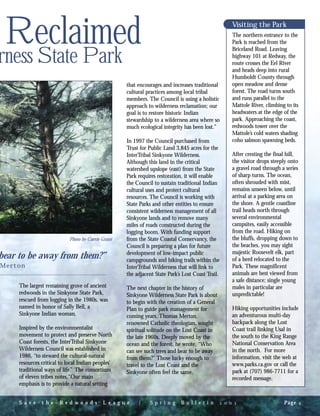
Photo by Carrie Grant
bear to be away from them?”
Merton
Visiting the Park
The northern entrance to the
Park is reached from the
Briceland Road. Leaving
highway 101 at Redway, the
route crosses the Eel River
and heads deep into rural
Humboldt County through
open meadow and dense
forest. The road turns south
and runs parallel to the
Mattole River, climbing to its
headwaters at the edge of the
park. Approaching the coast,
redwoods tower over the
Mattole’s cold waters shading
coho salmon spawning beds.
After cresting the final hill,
the visitor drops steeply onto
a gravel road through a series
of sharp turns. The ocean,
often shrouded with mist,
remains unseen below, until
arrival at a parking area on
the shore. A gentle coastline
trail heads north through
several environmental
campsites, easily accessible
from the road. Hiking on
the bluffs, dropping down to
the beaches, you may sight
majestic Roosevelt elk, part
of a herd relocated to the
Park. These magnificent
animals are best viewed from
a safe distance; single young
males in particular are
unpredictable!
Hiking opportunities include
an adventurous multi-day
backpack along the Lost
Coast trail linking Usal in
the south to the King Range
National Conservation Area
in the north. For more
information, visit the web at
www.parks.ca.gov or call the
park at (707) 986-7711 for a
recorded message.
The Redwood Leadership Society is comprised of donors who have given a total of $1000 or more to League programs between January 1st and December 31st
2002. The following information is accurate to the best of our knowledge, but errors occasionally occur. If you have any corrections, please let us know. If your
name does not appear on this list and should, please contact the League’s office at (888) 836-0005.
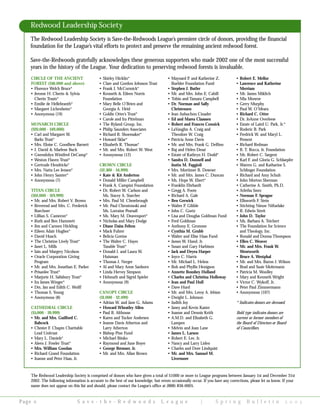
Redwood Leadership Society
CIRCLE OF THE ANCIENT
FOREST ($50,000 and above)
• Florence Welch Bruce*
• Jerome H. Cherin & Sylvia
Cherin Trusts*
• Emilie de Hellebranth*
• Margaret Lichenheim*
• Anonymous (19)
MONARCH CIRCLE
($20,000 - $49,000)
• Carl and Margaret W.
Barks Trust*
• Mrs. Eloise C. Goodhew Barnett
• J. David & Marlene Buck
• Gwendolyn Winifred DeCamp*
• Weston Haven Trust*
• Gertrude Hendricks*
• Mrs. Natta Lee Jensen*
• John Henry Samter*
• Anonymous (7)
TITAN CIRCLE
($10,000 - $19,999)
• Mr. and Mrs. Robert V. Brown
• Reverend and Mrs. C. Frederick
Buechner
• Lillian S. Cameron*
• Ruth and Ben Hammett
• Jim and Carmen Hickling
• Eileen Adair Hughes*
• David Husch
• The Christine Lively Trust*
• Janet L. Mills
• Iain and Margery Nicolson
• Oracle Corporation Giving
Program
• Mr. and Mrs. Jonathan E. Parker
• Prisanlee Trust*
• Marjorie H. Salisbury Trust*
• Ira James Winger*
• Drs. Jan and Edith C. Wolff
• Thomas S. Young
• Anonymous (8)
CATHEDRAL CIRCLE
($5,000 - $9,999)
• Mr. and Mrs. Guilford C.
Babcock
• Chester F. Chapin Charitable
Lead Unitrust
• Mary L. Daniels*
• Aleen J. Fowler Trust*
• Mrs. William Goodan
• Richard Grand Foundation
• Joanne and Peter Haas, Jr.
• Shirley Hicklin*
• Clare and Gordon Johnson Trust
• Frank J. McCormick*
• Kenneth & Eileen Norris
Foundation
• Mary Belle O’Brien and
Georgia A. Heid
• Goldie Otter’s Trust*
• Carole and Ira Pittelman
• The Ryland Group, Inc.
• Philip Saunders Associates
• Richard B. Shoemaker*
• Howard Sklar*
• Elizabeth R. Thomas*
• Mr. and Mrs. Robert W. West
• Anonymous (12)
CROWN CIRCLE
($2,500 - $4,999)
• Kate & Kit Anderton
• Donald Miller Campbell
• Frank A. Campini Foundation
• Dr. Robert W. Carlson and
Ms. Stacey A. Starcher
• Mrs. Paul M. Chesebrough
• Mr. Paul Chrostowski and
Ms. Lorraine Pearsall
• Ms. Mary M. Deavenport*
• Nicholas and Mary Dodge
• Diane Daiss Felton
• Mack Fuhrer
• Belicia Govine
• The Walter C. Hayes
Taxable Trust*
• Donald J. and Laura W.
Huisman
• Thomas J. Nerger
• Al and Mary Anne Sanborn
• Linda Hervey Simpson
• Helmuth and Sigrid Spieler
• Anonymous (9)
CANOPY CIRCLE
($1,000 - $2,499)
• Adrian W. and Jane G. Adams
• Howard Wheatley Allen
• Paul B. Althouse
• Karen and Tucker Andersen
• Jeanne Davis Atherton and
Larry Atherton
• Bishop Pine Fund
• Michael Bitsko
• Raymond and June Boyer
• George Bremser, Jr.
• Mr. and Mrs. Allan Brown
• Maynard P. and Katherine Z.
Buehler Foundation Fund
• Stephen J. Butler
• Mr. and Mrs. John E. Cahill
• Tobin and Tamara Campbell
• Dr. Norman and Sally
Christensen
• Jean Aubuchon Cinader
• Ed and Marea Claassen
• Robert and Frances Connick
• LaVaughn A. Craig and
Theodore W. Craig
• Patricia Anne Davis
• Mr. and Mrs. Frank G. Delfino
• Raj and Helen Desai
• Estate of Kathryn H. Dodd*
• Sandra D. Donnell and
Justin M. Faggioli
• Mrs. Mortimer B. Downer
• Mr. and Mrs. James C. Duncan
• Ms. Hope W. Ebert*
• Franklin Ehrhardt
• Gregg A. Foote
• Richard A. Gale
• Ben Gerwick
• Walter P. Gibble
• John C. Goetz
• Lisa and Douglas Goldman Fund
• Fred Goldman
• Anthony E. Gromme
• Cynthia M. Grubb
• Walter and Elise Haas Fund
• James W. Hand, Jr.
• Susan and Gary Harbison
• Jack and Deyea Harper
• Joyce C. Harris
• Mr. Michael L. Helms
• Bob and Phyllis Henigson
• Annette Boushey Holland
• Charles and Christina Holloway
• Jean and Paul Hull
• Dave Hurd
• Mr. and Mrs. Leroy A. Jebian
• Dwight L. Johnson
• Judith Joy
• Janey and Kevin Kaster
• Joanne and Dennis Keith
• A.M.D. and Elizabeth G.
Lampen
• Melvin and Joan Lane
• James L. Larson
• Robert E. Lee, Jr.
• Nancy and Larry Liden
• Charles and Dore Lindquist
• Mr. and Mrs. Samuel M.
Livermore
• Robert E. Mellor
• Lawrence and Katherine
Merriam
• Mr. James Miklich
• Mia Monroe
• Gerry Murphy
• Paul W. O’Meara
• Richard C. Otter
• Dr. JoAnne Overleese
• Estate of Laird U. Park, Jr.*
• Roderic B. Park
• Fredrick W. and Maryl L.
Pement
• Richard Redman
• B. T. Rocca, Jr. Foundation
• Mr. Robert C. Sargent
• Karl F. and Gloria G. Schlaepfer
• Warren G. and Katharine S.
Schlinger Foundation
• Richard and Amy Schuh
• John Morton Sherman
• Catherine A. Smith, Ph.D.
• Arletha Smrz
• Norman F. Sprague
• Ellsworth F. Stein
• Stichting Nieuw Niftarlake
• R. Edwin Streit
• John D. Taylor
• Ms. Barbara A. Teichert
• The Foundation for Science
and Theology, Inc.
• Ronald and Donna Thompson
• Ellen C. Weaver
• Mr. and Mrs. Frank W.
Wentworth
• Bruce A. Westphal
• Mr. and Mrs. Buron J. Wilson
• Brad and Susie Mohrmann
• Patricia M. Woolley
• Mary and Kenneth Wright
• Victor C. Wykoff, Jr.
• Peter Paul Zimmermann
• Anonymous (107)
* Indicates donors are deceased.
Bold type indicates donors are
current or former members of
the Board of Directors or Board
of Councillors.
S a v e - t h e - R e d w o o d s L e a g u e | S p r i n g B u l l e t i n    Page 
The Redwood Leadership Society is Save-the-Redwoods League’s premiere circle of donors, providing the financial
foundation for the League’s vital efforts to protect and preserve the remaining ancient redwood forest.
Save-the-Redwoods gratefully acknowledges these generous supporters who made 2002 one of the most successful
years in the history of the League. Your dedication to preserving redwood forests is invaluable.
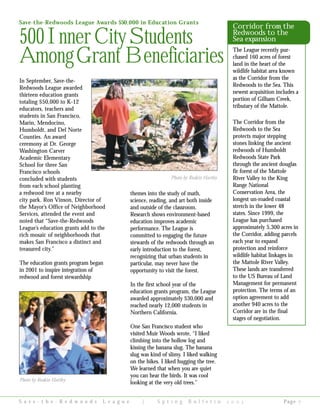
In September, Save-the-
Redwoods League awarded
thirteen education grants
totaling $50,000 to K-12
educators, teachers and
students in San Francisco,
Marin, Mendocino,
Humboldt, and Del Norte
Counties. An award
ceremony at Dr. George
Washington Carver
Academic Elementary
School for three San
Francisco schools
concluded with students
from each school planting
a redwood tree at a nearby
city park. Ron Vinson, Director of
the Mayor’s Office of Neighborhood
Services, attended the event and
noted that “Save-the-Redwoods
League’s education grants add to the
rich mosaic of neighborhoods that
makes San Francisco a distinct and
treasured city.”
The education grants program began
in 2001 to inspire integration of
redwood and forest stewardship
themes into the study of math,
science, reading, and art both inside
and outside of the classroom.
Research shows environment-based
education improves academic
performance. The League is
committed to engaging the future
stewards of the redwoods through an
early introduction to the forest,
recognizing that urban students in
particular, may never have the
opportunity to visit the forest.
In the first school year of the
education grants program, the League
awarded approximately $30,000 and
reached nearly 12,000 students in
Northern California.
One San Francisco student who
visited Muir Woods wrote, “I liked
climbing into the hollow log and
kissing the banana slug. The banana
slug was kind of slimy. I liked walking
on the hikes. I liked hugging the tree.
We learned that when you are quiet
you can hear the birds. It was cool
looking at the very old trees.”
S a v e - t h e - R e d w o o d s L e a g u e | S p r i n g B u l l e t i n     Page 
Save-the-Redwoods League Awards $50,000 in Education Grants
500InnerCityStudents
AmongGrant Beneficiaries
Photo by Ruskin Hartley
Corridor from the
Redwoods to the
Sea expansion
The League recently pur-
chased 160 acres of forest
land in the heart of the
wildlife habitat area known
as the Corridor from the
Redwoods to the Sea. This
newest acquisition includes a
portion of Gilham Creek,
tributary of the Mattole.
The Corridor from the
Redwoods to the Sea
protects major stepping
stones linking the ancient
redwoods of Humboldt
Redwoods State Park
through the ancient douglas
fir forest of the Mattole
River Valley to the King
Range National
Conservation Area, the
longest un-roaded coastal
stretch in the lower 48
states. Since 1999, the
League has purchased
approximately 5,300 acres in
the Corridor, adding parcels
each year to expand
protection and reinforce
wildlife habitat linkages in
the Mattole River Valley.
These lands are transferred
to the US Bureau of Land
Management for permanent
protection. The terms of an
option agreement to add
another 940 acres to the
Corridor are in the final
stages of negotiation.
Photo by Ruskin Hartley
To receive our bulletin via email, send your email address to bulletin@savetheredwoods.org
Save-the-Redwoods League 114 Sansome Street • Room 1200 • San Francisco • CA • 94104
(415) 362-2352 voice • (415) 362-7017 fax • www.savetheredwoods.org
9 PRINTED ON RECYCLED PAPER
Redwood trees can live for over two
thousand years. With your legacy gift, you
can ensure that they can live for centuries
to come. By thinking of the future and
including Save-the-Redwoods League in
your estate planning, you can ensure that
the redwood forest will continue to
flourish and inspire generations to come.
Your planned gift will preserve and
protect these majestic giants so that your
legacy will also be their legacy.
It is simple to add a gift to the League in
your existing will, trust or other estate plan,
or as part of a new plan. Please contact us
for information that can help you with
planning questions. Or if you have already
provided for the League, allow us to
welcome you as a member of the Redwood
Legacy Circle. Please contact Holly
Garrison at 415.362.2352 x20 or at
hgarrison@savetheredwoods.org.
Redwoods is available at no
charge from our website
www.savetheredwoods.org
or by calling the office
(415) 362-2352.
Legacy Gifts
New K-12 Redwood
Education Materials
Available
Save-the-Redwoods League has
released a set of redwood
education materials for students
in grades K-12. Titled Redwoods,
fact sheets are available for grade
ranges: K-2, 3-5, 6-8, and 9-12.
The simple, engaging designs
and easy to read format make
these materials especially
student friendly.
Redwoods includes information
on where redwood trees live,
how tall they grow and their
surrounding environment. They
provide activities for students to
get involved in redwood and
forest education. For students
and teachers wanting to learn
more, additional resources are
also listed.
We are excited to be adding to our grove
program. You can now select your own
honorary grove from the new groves in
Jedediah Smith Redwoods State Park or
Humboldt Redwoods State Park at the
head of the Avenue of the Giants, the
most famous redwood forest in the
world. There will also be groves available
this year at Mill Creek and Big River.
Daly Groves For the first time in
years, groves are available along the
Avenue of the Giants. Set on the banks
of the Eel River, these ancient monarchs
tower above a beautiful apple orchard
and meadow.
Jedediah Smith Groves Nine miles
east of Crescent City on Highway 199,
these groves are a perfect example of the
pristine, lush, primeval redwood forest.
Ground cover is dense and wildlife is
abundant.
Big River Groves Big River is so
named not for the size of the river but
the size of the trees that once carpeted
its shores. At 8.3 miles, it is the longest
undeveloped estuary in northern
California. Big River Groves are
spectacular for bird watching, with over
130 species identified to date.
Mill Creek Groves This 25,000-acre
property connects two prime areas of
ancient forest, Jedediah Smith and Del
Norte Coast Redwoods State Parks. This
forest is home to some of the most
prolific coho salmon spawning grounds
in California and is also valued habitat
for the rare, endangered marbled
murrelet and northern spotted owl.
Memorial and honor groves are a
thoughtful way to pass on to future
generations the beauty of the redwoods,
while setting aside a special place in the
forest where you and your family can
enjoy the trees, rivers and wildlife that
surround them. Contact Holly Garrison
at 415-362-2352 x20 for more information.
New Groves

Spring bulletin 2003 ~ save the redwoods league

  • 1.
    Photo by CarrieGrant Save-the-Redwoods League Spring Bulletin 2003
  • 2.
    New Strategic PlanTakes Shape The League has completed a periodic review of its strategic plan to align the League’s priorities for effective action. League Directors, Councillors, staff, and members of the California Department of Parks and Recreation reflected carefully in a multi-day process to evaluate accomplishments of the past and key opportunities of a future with less than 4% of the ancient redwood forest remaining. The new strategic plan stresses three areas for continued League effectiveness. A Comprehensive Conservation Strategy The plan endorses refinement and completion of a scientifically based conservation plan for the forests throughout the entire range of the redwoods for evaluation of acquisition, restoration and stewardship priorities. Increasing pressures from population growth and logging intensify the risk of fragmentation of the ancient forest and its ability to support the wildlife that depend on the ancient forest. Watershed protection and linkages among protected areas will continue to play a key role in the League’s strategy. Public Awareness and Education Recognizing that broad public support now and in the future is pivotal to effective long-term preservation of the redwood forest, the League will continue to expand environmental education programs focusing on redwood ecology for students from kindergarten through high school. To inspire awe in the public at large through a deepened understanding of the redwood forest, the League will continue to explore development of an interpretive center and partnerships with existing interpretive programs. League Effectiveness The League’s effectiveness is fundamentally rooted in the deepening engagement of our current members and attracting new members to the League. Strong volunteer leadership coupled with excellent staff will continue to be pivotal in future years. Renewal of the League’s vision has been accompanied by changes in the Board of Directors. Thanks for a Job Well Done! Two long-term Directors, Cynthia Grubb and former President and Chair Bruce Howard stepped down from the Board after many years of committed service. Their wise counsel will be missed. After 7 years of outstanding leadership as President, Richard Otter was elected to replace Bruce as Chair of the Board. New Board Members and Officers Retirement of two members and expansion of the size of the Board from seven to nine members created the opportunity for election of four new Directors who bring a wealth of expertise and experience to Board deliberations: • Jim Larson, Attorney at Law in Fort Bragg, Mendocino County • Wally Mark, Professor of Forestry at California Polytechnic State University – San Luis Obispo & Director of Cal Poly’s Swanton Pacific Ranch. • Sarah Connick, senior project manager for Sustainable Conservation, completing a Ph.D. in Environmental Science, Policy and Management at UC, Berkeley • Pete Dangermond of the Dangermond Group, planning consultants for parks,recreation, wildlife conservation, and open space preservation and Director of California State Department of Parks and Recreation from 1980-1982. As the League’s new President, together with the rest of the Board of Directors, I look forward to the opportunities to implement the strategic plan this year and in the years ahead. This will be possible only with the continued support of you, the League’s members in alI fifty states, for which we are deeply grateful. Thank you for joining us in meeting the challenges of the critical work of saving the redwoods. Message from the President S a v e - t h e - R e d w o o d s L e a g u e | S p r i n g B u l l e t i n    Page  The Save-the-Redwoods League’s 84th year has been an eventful one! In addition to completing the largest acquisition in the League’s history, we have been working in earnest to develop a clear strategic direction for our future and have undertaken some significant changes in the Board of Directors.
  • 3.
    On Saturday, December7th, Save-the-Redwoods League and Redwood National and State Parks hosted more than 120 special guests, League members and the general public to celebrate the fish, forest and future of Mill Creek. Although Mill Creek is not yet open to the general public on a regular basis because of the State budget crisis, special permission was obtained for a one-time event to introduce the public to the 25,000 acre forest for the first time since the League completed its purchase in June of 2002. Visitors were escorted to the confluence of the West Branch and the East Fork of Mill Creek, where they were treated to cookies, hot chocolate and speeches by State Park Superintendent Rick Sermon and Save-the-Redwoods League Executive Director, Kate Anderton. Mill Creek is a tributary of the Smith River and is prime spawning ground for chinook and coho salmon. The celebration was originally planned to highlight the annual return of the fish at the normal high point of their run. Unusually light rainfall in October and November kept water levels so low that the return of most of the coho had not yet occurred. Although opportunities for viewing spawning salmon were limited, the gorgeous day inspired a wonderful celebration. Ranger Rick Sermon and local fisheries biologists Paul Ahlbro, Chris Howard and Jim Waldvogel led visitors on tours to the creek, up to the Childs Hill overlook, and into one of the remaining stands of old- growth redwood trees. League and Redwood National and State Parks staff were very pleased with the turn out at the event and were happy to join the individuals and groups at the place where the branches of Mill Creek come together to celebrate the success of the acquisition and the protection of the land. Over Christmas, the rains finally arrived. Jim Waldvogel reported seeing over 250 salmon spawning in the west branch: some weighing as much as 40 lbs! S a v e - t h e - R e d w o o d s L e a g u e | S p r i n g B u l l e t i n     Page  Celebration of the Fish, Forest and Future of Mill Creek Photos by Stephen Corley Member Spotlight Dr. Jules Riskin, League member for over 30 years, recently sent this photo of himself in front of his wall of Honor Cards which commemorate trees that have been planted in honor of his wife and him by friends and family members. Dr. Riskin says he encourages his children and grandchildren to give contributions in his honor for special occasions like birthdays and anniversaries, instead of buying more material things that he has “more than enough” of. Dr. Riskin said, “Several visitors to our home have noticed the ten identical photos of the trees and have liked the idea.” If you would like to plant a tree in honor or memory of someone special, please contact Hattie Washington at 415-362-2352 ex. 19.
  • 4.
    estled on therugged slopes of the Lost Coast in Mendocino County, the 7,367-acre Sinkyone Wilderness State Park occupies one of the wildest stretches of coastline in the continental United States. Steep mountain slopes drop precipitously into the Pacific, cloaked with coast redwoods that thrive in the ocean mists. Sinkyone is a land of forests, prairies, bluffs, beaches and tidepools: home to a wide variety of plants and animals. The park has a fascinating natural and cultural history and is a rewarding, if remote, place to visit. Despite its name, the wilderness has seen countless people come and go over the centuries: some by choice, and others under darker circumstances. For thousands of years, the Sinkyone Indians lived on this coast. They suffered forced removals and massacres in the mid to late 1800’s to make way for European settlers, attracted by the coast redwood. The settlers built mills and developed Bear Harbor to ship lumber to San Francisco. In little more than 100 years much of the ancient redwood forest was cut, leaving a network of roads crisscrossing steep slopes and a young regenerating forest. A small state park was established initially at Bear Harbor and expanded gradually over the years with the persistent advocacy of local residents and the critical support of Save-the- Redwoods League and other conservation organizations. The League has spearheaded the purchase of over 4,500-acres of forest land valued at over $16 million in Sinkyone Wilderness State Park and the Upper Mattole region including the Lost River Forest and Dreamstream, 405-acres of ancient redwood and Douglas-fir forest, home to the endangered northern spotted owl. Wilderness Sinkyone Wilder N S a v e - t h e - R e d w o o d s L e a g u e | S p r i n g B u l l e t i n    Page  “Who can see such trees and b Thomas The Upper Mattole River and Forest Cooperative The ecological benefits of the Sinkyone are expanded through a unique public- private partnership that has evolved in the upper Mattole over the past decade. The Upper Mattole River and Forest Cooperative unites public and private landowners sharing a common desire to protect and restore a fully functioning forest and river system in the region. This group, which collectively manages 3,500-acres in the headwaters of the Mattole, meets quarterly to coordinate resource management. The Sanctuary Forest, a local landtrust that has spearheaded the group, offers a series of guided summer walks that explore the State Park and neighboring public and private lands not normally open to the public. “What’s special about the region is the mixture of redwood, fir and other forests that grow on the steep slopes” notes Eric Goldsmith, Executive Director of the Sanctuary Forest. “One of our summer hikes is an annual pilgrimage to Big Red – we need at least 13-people or we’re unable to give this ancient redwood a hug!” Led by local naturalists, these walks offer a unique insight into the heart of the Mattole. You can contact Sanctuary Forest at (707) 986- 1087 to request a summer walk program. Spotted Owl Photo by Carrie Grant
  • 5.
    Reclaimed rness State Park Thelargest remaining grove of ancient redwoods in the Sinkyone State Park, rescued from logging in the 1980s, was named in honor of Sally Bell, a Sinkyone Indian woman. Inspired by the environmentalist movement to protect and preserve North Coast forests, the InterTribal Sinkyone Wilderness Council was established in 1986, “to steward the cultural-natural resources critical to local Indian peoples’ traditional ways of life.” The consortium of eleven tribes notes,“Our main emphasis is to provide a natural setting that encourages and increases traditional cultural practices among local tribal members. The Council is using a holistic approach to wilderness reclamation; our goal is to restore historic Indian stewardship to a wilderness area where so much ecological integrity has been lost.” In 1997 the Council purchased from Trust for Public Land 3,845 acres for the InterTribal Sinkyone Wilderness. Although this land in the critical watershed upslope (east) from the State Park requires restoration, it will enable the Council to sustain traditional Indian cultural uses and protect cultural resources. The Council is working with State Parks and other entities to ensure consistent wilderness management of all Sinkyone lands and to remove many miles of roads constructed during the logging boom. With funding support from the State Coastal Conservancy, the Council is preparing a plan for future development of low-impact public campgrounds and hiking trails within the InterTribal Wilderness that will link to the adjacent State Park’s Lost Coast Trail. The next chapter in the history of Sinkyone Wilderness State Park is about to begin with the creation of a General Plan to guide park management for coming years. Thomas Merton, renowned Catholic theologian, sought spiritual solitude on the Lost Coast in the late 1960s. Deeply moved by the ocean and the forest, he wrote, “Who can see such trees and bear to be away from them?” Those lucky enough to travel to the Lost Coast and the Sinkyone often feel the same. S a v e - t h e - R e d w o o d s L e a g u e | S p r i n g B u l l e t i n     Page  Photo by Carrie Grant bear to be away from them?” Merton Visiting the Park The northern entrance to the Park is reached from the Briceland Road. Leaving highway 101 at Redway, the route crosses the Eel River and heads deep into rural Humboldt County through open meadow and dense forest. The road turns south and runs parallel to the Mattole River, climbing to its headwaters at the edge of the park. Approaching the coast, redwoods tower over the Mattole’s cold waters shading coho salmon spawning beds. After cresting the final hill, the visitor drops steeply onto a gravel road through a series of sharp turns. The ocean, often shrouded with mist, remains unseen below, until arrival at a parking area on the shore. A gentle coastline trail heads north through several environmental campsites, easily accessible from the road. Hiking on the bluffs, dropping down to the beaches, you may sight majestic Roosevelt elk, part of a herd relocated to the Park. These magnificent animals are best viewed from a safe distance; single young males in particular are unpredictable! Hiking opportunities include an adventurous multi-day backpack along the Lost Coast trail linking Usal in the south to the King Range National Conservation Area in the north. For more information, visit the web at www.parks.ca.gov or call the park at (707) 986-7711 for a recorded message.
  • 6.
    The Redwood LeadershipSociety is comprised of donors who have given a total of $1000 or more to League programs between January 1st and December 31st 2002. The following information is accurate to the best of our knowledge, but errors occasionally occur. If you have any corrections, please let us know. If your name does not appear on this list and should, please contact the League’s office at (888) 836-0005. Redwood Leadership Society CIRCLE OF THE ANCIENT FOREST ($50,000 and above) • Florence Welch Bruce* • Jerome H. Cherin & Sylvia Cherin Trusts* • Emilie de Hellebranth* • Margaret Lichenheim* • Anonymous (19) MONARCH CIRCLE ($20,000 - $49,000) • Carl and Margaret W. Barks Trust* • Mrs. Eloise C. Goodhew Barnett • J. David & Marlene Buck • Gwendolyn Winifred DeCamp* • Weston Haven Trust* • Gertrude Hendricks* • Mrs. Natta Lee Jensen* • John Henry Samter* • Anonymous (7) TITAN CIRCLE ($10,000 - $19,999) • Mr. and Mrs. Robert V. Brown • Reverend and Mrs. C. Frederick Buechner • Lillian S. Cameron* • Ruth and Ben Hammett • Jim and Carmen Hickling • Eileen Adair Hughes* • David Husch • The Christine Lively Trust* • Janet L. Mills • Iain and Margery Nicolson • Oracle Corporation Giving Program • Mr. and Mrs. Jonathan E. Parker • Prisanlee Trust* • Marjorie H. Salisbury Trust* • Ira James Winger* • Drs. Jan and Edith C. Wolff • Thomas S. Young • Anonymous (8) CATHEDRAL CIRCLE ($5,000 - $9,999) • Mr. and Mrs. Guilford C. Babcock • Chester F. Chapin Charitable Lead Unitrust • Mary L. Daniels* • Aleen J. Fowler Trust* • Mrs. William Goodan • Richard Grand Foundation • Joanne and Peter Haas, Jr. • Shirley Hicklin* • Clare and Gordon Johnson Trust • Frank J. McCormick* • Kenneth & Eileen Norris Foundation • Mary Belle O’Brien and Georgia A. Heid • Goldie Otter’s Trust* • Carole and Ira Pittelman • The Ryland Group, Inc. • Philip Saunders Associates • Richard B. Shoemaker* • Howard Sklar* • Elizabeth R. Thomas* • Mr. and Mrs. Robert W. West • Anonymous (12) CROWN CIRCLE ($2,500 - $4,999) • Kate & Kit Anderton • Donald Miller Campbell • Frank A. Campini Foundation • Dr. Robert W. Carlson and Ms. Stacey A. Starcher • Mrs. Paul M. Chesebrough • Mr. Paul Chrostowski and Ms. Lorraine Pearsall • Ms. Mary M. Deavenport* • Nicholas and Mary Dodge • Diane Daiss Felton • Mack Fuhrer • Belicia Govine • The Walter C. Hayes Taxable Trust* • Donald J. and Laura W. Huisman • Thomas J. Nerger • Al and Mary Anne Sanborn • Linda Hervey Simpson • Helmuth and Sigrid Spieler • Anonymous (9) CANOPY CIRCLE ($1,000 - $2,499) • Adrian W. and Jane G. Adams • Howard Wheatley Allen • Paul B. Althouse • Karen and Tucker Andersen • Jeanne Davis Atherton and Larry Atherton • Bishop Pine Fund • Michael Bitsko • Raymond and June Boyer • George Bremser, Jr. • Mr. and Mrs. Allan Brown • Maynard P. and Katherine Z. Buehler Foundation Fund • Stephen J. Butler • Mr. and Mrs. John E. Cahill • Tobin and Tamara Campbell • Dr. Norman and Sally Christensen • Jean Aubuchon Cinader • Ed and Marea Claassen • Robert and Frances Connick • LaVaughn A. Craig and Theodore W. Craig • Patricia Anne Davis • Mr. and Mrs. Frank G. Delfino • Raj and Helen Desai • Estate of Kathryn H. Dodd* • Sandra D. Donnell and Justin M. Faggioli • Mrs. Mortimer B. Downer • Mr. and Mrs. James C. Duncan • Ms. Hope W. Ebert* • Franklin Ehrhardt • Gregg A. Foote • Richard A. Gale • Ben Gerwick • Walter P. Gibble • John C. Goetz • Lisa and Douglas Goldman Fund • Fred Goldman • Anthony E. Gromme • Cynthia M. Grubb • Walter and Elise Haas Fund • James W. Hand, Jr. • Susan and Gary Harbison • Jack and Deyea Harper • Joyce C. Harris • Mr. Michael L. Helms • Bob and Phyllis Henigson • Annette Boushey Holland • Charles and Christina Holloway • Jean and Paul Hull • Dave Hurd • Mr. and Mrs. Leroy A. Jebian • Dwight L. Johnson • Judith Joy • Janey and Kevin Kaster • Joanne and Dennis Keith • A.M.D. and Elizabeth G. Lampen • Melvin and Joan Lane • James L. Larson • Robert E. Lee, Jr. • Nancy and Larry Liden • Charles and Dore Lindquist • Mr. and Mrs. Samuel M. Livermore • Robert E. Mellor • Lawrence and Katherine Merriam • Mr. James Miklich • Mia Monroe • Gerry Murphy • Paul W. O’Meara • Richard C. Otter • Dr. JoAnne Overleese • Estate of Laird U. Park, Jr.* • Roderic B. Park • Fredrick W. and Maryl L. Pement • Richard Redman • B. T. Rocca, Jr. Foundation • Mr. Robert C. Sargent • Karl F. and Gloria G. Schlaepfer • Warren G. and Katharine S. Schlinger Foundation • Richard and Amy Schuh • John Morton Sherman • Catherine A. Smith, Ph.D. • Arletha Smrz • Norman F. Sprague • Ellsworth F. Stein • Stichting Nieuw Niftarlake • R. Edwin Streit • John D. Taylor • Ms. Barbara A. Teichert • The Foundation for Science and Theology, Inc. • Ronald and Donna Thompson • Ellen C. Weaver • Mr. and Mrs. Frank W. Wentworth • Bruce A. Westphal • Mr. and Mrs. Buron J. Wilson • Brad and Susie Mohrmann • Patricia M. Woolley • Mary and Kenneth Wright • Victor C. Wykoff, Jr. • Peter Paul Zimmermann • Anonymous (107) * Indicates donors are deceased. Bold type indicates donors are current or former members of the Board of Directors or Board of Councillors. S a v e - t h e - R e d w o o d s L e a g u e | S p r i n g B u l l e t i n    Page  The Redwood Leadership Society is Save-the-Redwoods League’s premiere circle of donors, providing the financial foundation for the League’s vital efforts to protect and preserve the remaining ancient redwood forest. Save-the-Redwoods gratefully acknowledges these generous supporters who made 2002 one of the most successful years in the history of the League. Your dedication to preserving redwood forests is invaluable.
  • 7.
    In September, Save-the- RedwoodsLeague awarded thirteen education grants totaling $50,000 to K-12 educators, teachers and students in San Francisco, Marin, Mendocino, Humboldt, and Del Norte Counties. An award ceremony at Dr. George Washington Carver Academic Elementary School for three San Francisco schools concluded with students from each school planting a redwood tree at a nearby city park. Ron Vinson, Director of the Mayor’s Office of Neighborhood Services, attended the event and noted that “Save-the-Redwoods League’s education grants add to the rich mosaic of neighborhoods that makes San Francisco a distinct and treasured city.” The education grants program began in 2001 to inspire integration of redwood and forest stewardship themes into the study of math, science, reading, and art both inside and outside of the classroom. Research shows environment-based education improves academic performance. The League is committed to engaging the future stewards of the redwoods through an early introduction to the forest, recognizing that urban students in particular, may never have the opportunity to visit the forest. In the first school year of the education grants program, the League awarded approximately $30,000 and reached nearly 12,000 students in Northern California. One San Francisco student who visited Muir Woods wrote, “I liked climbing into the hollow log and kissing the banana slug. The banana slug was kind of slimy. I liked walking on the hikes. I liked hugging the tree. We learned that when you are quiet you can hear the birds. It was cool looking at the very old trees.” S a v e - t h e - R e d w o o d s L e a g u e | S p r i n g B u l l e t i n     Page  Save-the-Redwoods League Awards $50,000 in Education Grants 500InnerCityStudents AmongGrant Beneficiaries Photo by Ruskin Hartley Corridor from the Redwoods to the Sea expansion The League recently pur- chased 160 acres of forest land in the heart of the wildlife habitat area known as the Corridor from the Redwoods to the Sea. This newest acquisition includes a portion of Gilham Creek, tributary of the Mattole. The Corridor from the Redwoods to the Sea protects major stepping stones linking the ancient redwoods of Humboldt Redwoods State Park through the ancient douglas fir forest of the Mattole River Valley to the King Range National Conservation Area, the longest un-roaded coastal stretch in the lower 48 states. Since 1999, the League has purchased approximately 5,300 acres in the Corridor, adding parcels each year to expand protection and reinforce wildlife habitat linkages in the Mattole River Valley. These lands are transferred to the US Bureau of Land Management for permanent protection. The terms of an option agreement to add another 940 acres to the Corridor are in the final stages of negotiation. Photo by Ruskin Hartley
  • 8.
    To receive ourbulletin via email, send your email address to bulletin@savetheredwoods.org Save-the-Redwoods League 114 Sansome Street • Room 1200 • San Francisco • CA • 94104 (415) 362-2352 voice • (415) 362-7017 fax • www.savetheredwoods.org 9 PRINTED ON RECYCLED PAPER Redwood trees can live for over two thousand years. With your legacy gift, you can ensure that they can live for centuries to come. By thinking of the future and including Save-the-Redwoods League in your estate planning, you can ensure that the redwood forest will continue to flourish and inspire generations to come. Your planned gift will preserve and protect these majestic giants so that your legacy will also be their legacy. It is simple to add a gift to the League in your existing will, trust or other estate plan, or as part of a new plan. Please contact us for information that can help you with planning questions. Or if you have already provided for the League, allow us to welcome you as a member of the Redwood Legacy Circle. Please contact Holly Garrison at 415.362.2352 x20 or at hgarrison@savetheredwoods.org. Redwoods is available at no charge from our website www.savetheredwoods.org or by calling the office (415) 362-2352. Legacy Gifts New K-12 Redwood Education Materials Available Save-the-Redwoods League has released a set of redwood education materials for students in grades K-12. Titled Redwoods, fact sheets are available for grade ranges: K-2, 3-5, 6-8, and 9-12. The simple, engaging designs and easy to read format make these materials especially student friendly. Redwoods includes information on where redwood trees live, how tall they grow and their surrounding environment. They provide activities for students to get involved in redwood and forest education. For students and teachers wanting to learn more, additional resources are also listed. We are excited to be adding to our grove program. You can now select your own honorary grove from the new groves in Jedediah Smith Redwoods State Park or Humboldt Redwoods State Park at the head of the Avenue of the Giants, the most famous redwood forest in the world. There will also be groves available this year at Mill Creek and Big River. Daly Groves For the first time in years, groves are available along the Avenue of the Giants. Set on the banks of the Eel River, these ancient monarchs tower above a beautiful apple orchard and meadow. Jedediah Smith Groves Nine miles east of Crescent City on Highway 199, these groves are a perfect example of the pristine, lush, primeval redwood forest. Ground cover is dense and wildlife is abundant. Big River Groves Big River is so named not for the size of the river but the size of the trees that once carpeted its shores. At 8.3 miles, it is the longest undeveloped estuary in northern California. Big River Groves are spectacular for bird watching, with over 130 species identified to date. Mill Creek Groves This 25,000-acre property connects two prime areas of ancient forest, Jedediah Smith and Del Norte Coast Redwoods State Parks. This forest is home to some of the most prolific coho salmon spawning grounds in California and is also valued habitat for the rare, endangered marbled murrelet and northern spotted owl. Memorial and honor groves are a thoughtful way to pass on to future generations the beauty of the redwoods, while setting aside a special place in the forest where you and your family can enjoy the trees, rivers and wildlife that surround them. Contact Holly Garrison at 415-362-2352 x20 for more information. New Groves