Financial accounting meaning
■Financial accounting definition refers to the process that documents,
classifies, reports, and analyses business transactions to assess the
financial health of an organization. In other words, it’s
a bookkeeping process that captures all sales, purchases, accounts
payables, and receivables transactions.
5.
■ Indian accountantsfollow the Indian
Accounting Standard (Ind AS) to maintain
credibility and uniformity across accounting
processes. These guidelines are at par with
the International Financial
Reporting Standards (IFRS).
■ In the US, financial accountants follow the
Generally Accepted Accounting Principles
(GAAP) principles set by the Financial
Accounting Standards Board (FASB).
6.
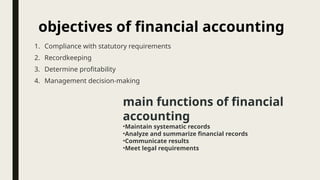
objectives of financialaccounting
1. Compliance with statutory requirements
2. Recordkeeping
3. Determine profitability
4. Management decision-making
main functions of financial
accounting
•Maintain systematic records
•Analyze and summarize financial records
•Communicate results
•Meet legal requirements
7.
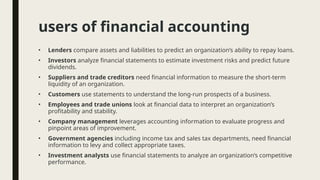
users of financialaccounting
• Lenders compare assets and liabilities to predict an organization’s ability to repay loans.
• Investors analyze financial statements to estimate investment risks and predict future
dividends.
• Suppliers and trade creditors need financial information to measure the short-term
liquidity of an organization.
• Customers use statements to understand the long-run prospects of a business.
• Employees and trade unions look at financial data to interpret an organization’s
profitability and stability.
• Company management leverages accounting information to evaluate progress and
pinpoint areas of improvement.
• Government agencies including income tax and sales tax departments, need financial
information to levy and collect appropriate taxes.
• Investment analysts use financial statements to analyze an organization’s competitive
performance.
8.
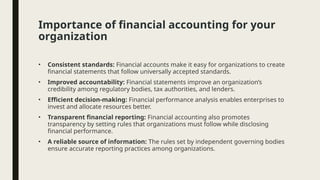
Importance of financialaccounting for your
organization
• Consistent standards: Financial accounts make it easy for organizations to create
financial statements that follow universally accepted standards.
• Improved accountability: Financial statements improve an organization’s
credibility among regulatory bodies, tax authorities, and lenders.
• Efficient decision-making: Financial performance analysis enables enterprises to
invest and allocate resources better.
• Transparent financial reporting: Financial accounting also promotes
transparency by setting rules that organizations must follow while disclosing
financial performance.
• A reliable source of information: The rules set by independent governing bodies
ensure accurate reporting practices among organizations.
10.
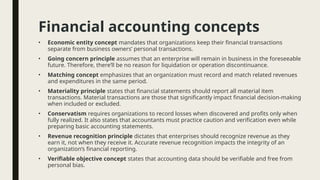
Financial accounting concepts
•Economic entity concept mandates that organizations keep their financial transactions
separate from business owners’ personal transactions.
• Going concern principle assumes that an enterprise will remain in business in the foreseeable
future. Therefore, there’ll be no reason for liquidation or operation discontinuance.
• Matching concept emphasizes that an organization must record and match related revenues
and expenditures in the same period.
• Materiality principle states that financial statements should report all material item
transactions. Material transactions are those that significantly impact financial decision-making
when included or excluded.
• Conservatism requires organizations to record losses when discovered and profits only when
fully realized. It also states that accountants must practice caution and verification even while
preparing basic accounting statements.
• Revenue recognition principle dictates that enterprises should recognize revenue as they
earn it, not when they receive it. Accurate revenue recognition impacts the integrity of an
organization’s financial reporting.
• Verifiable objective concept states that accounting data should be verifiable and free from
personal bias.
13.
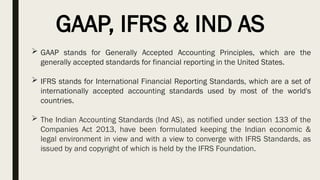
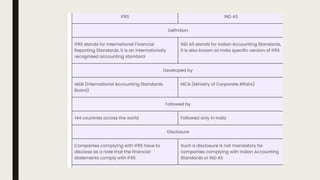
GAAP, IFRS &IND AS
GAAP stands for Generally Accepted Accounting Principles, which are the
generally accepted standards for financial reporting in the United States.
IFRS stands for International Financial Reporting Standards, which are a set of
internationally accepted accounting standards used by most of the world's
countries.
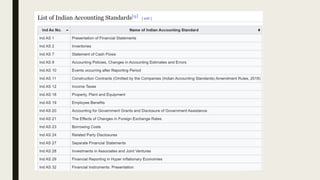
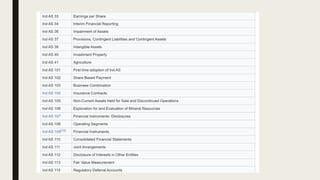
The Indian Accounting Standards (Ind AS), as notified under section 133 of the
Companies Act 2013, have been formulated keeping the Indian economic &
legal environment in view and with a view to converge with IFRS Standards, as
issued by and copyright of which is held by the IFRS Foundation.
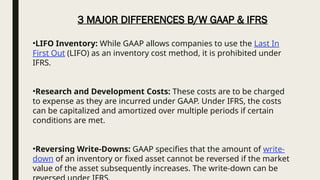
16.
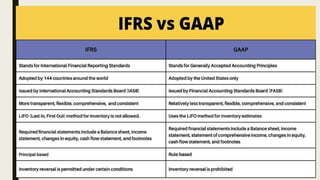
•LIFO Inventory: WhileGAAP allows companies to use the Last In
First Out (LIFO) as an inventory cost method, it is prohibited under
IFRS.
•Research and Development Costs: These costs are to be charged
to expense as they are incurred under GAAP. Under IFRS, the costs
can be capitalized and amortized over multiple periods if certain
conditions are met.
•Reversing Write-Downs: GAAP specifies that the amount of write-
down of an inventory or fixed asset cannot be reversed if the market
value of the asset subsequently increases. The write-down can be
3 MAJOR DIFFERENCES B/W GAAP & IFRS
17.
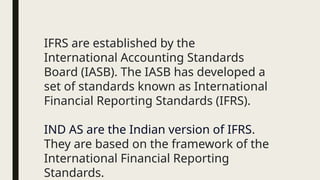
IFRS are establishedby the
International Accounting Standards
Board (IASB). The IASB has developed a
set of standards known as International
Financial Reporting Standards (IFRS).
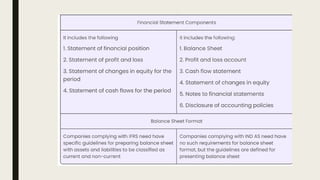
IND AS are the Indian version of IFRS.
They are based on the framework of the
International Financial Reporting
Standards.
18.
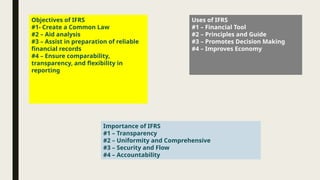
Objectives of IFRS
#1-Create a Common Law
#2 – Aid analysis
#3 – Assist in preparation of reliable
financial records
#4 – Ensure comparability,
transparency, and flexibility in
reporting
Uses of IFRS
#1 – Financial Tool
#2 – Principles and Guide
#3 – Promotes Decision Making
#4 – Improves Economy
Importance of IFRS
#1 – Transparency
#2 – Uniformity and Comprehensive
#3 – Security and Flow
#4 – Accountability
19.
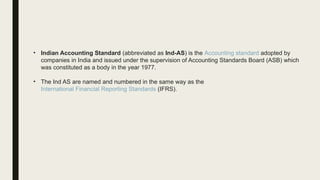
• Indian AccountingStandard (abbreviated as Ind-AS) is the Accounting standard adopted by
companies in India and issued under the supervision of Accounting Standards Board (ASB) which
was constituted as a body in the year 1977.
• The Ind AS are named and numbered in the same way as the
International Financial Reporting Standards (IFRS).
24.
Accounting concepts
■ Accountingconcepts are the basic assumptions on which accounting operates. These
are the following accounting concepts as discussed below:
1. The business entity concept: According to this, the business and owner are separate
entities. Business transactions are recorded in the books of accounts from the
company’s point of view, and not the owner’s. The owners are considered separate from
their business’s point of view and are regarded as creditors to the extent of their capital.
2. The money measurement concept: According to this, transactions and events are
measured in monetary terms in the books of accounts of the enterprise.
3. The going concern concept: Under this concept, it is assumed that the business will
continue for an indefinite period, and there is no intention to close the business or cut
down its operations significantly.
25.
Accounting concepts
4. Theaccounting period concept: According to the accounting period concept, the
life of an enterprise can be broken into smaller periods, usually termed accounting
periods, so that its performance is measured at regular intervals.
5. The cost concept: According to this concept, an asset is recorded in the books of
account at the price paid to acquire it, and the cost is the basis for all following
accounting of the asset.
6. The dual concept: According to the dual aspect concept, every business
transaction entered into by the organisation has two aspects, a debit and an equal
creditor amount. For every debit, there will be an equal amount of credit.
■
26.
Accounting concepts
7. Therevenue recognition concept: According to this concept, revenue is
determined to have been realised when a transaction has been written in the
books and the obligation to receive the amount has been ascertained.
8. The matching concept: Here, it is ascertained that every cost incurred to earn
the revenue should be recognised as an expense in the accounting period when
revenue is earned. In a given accounting period, expenses are matched with the
revenue earned.
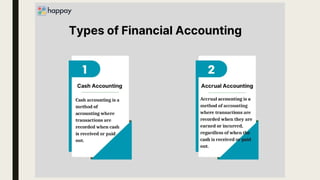
9. The accrual concept: A transaction is said to be accrued if a transaction is
recorded at the time when it takes place and not at the time when the settlement
takes place.
10. The verifiable objective concept: The verifiable objective concept states that
accounting should be free from personal bias.
27.
Accounting conventions
■ Theguidelines that are followed to prepare financial statements are called accounting conventions.
These are as follows:
1. Full disclosure: Convention of full disclosure states that there should be complete reporting on the
financial statements of all important information relating to affairs of the business. All the material
facts are to be disclosed.
2. Consistency: Convention of consistency states that accounting practices, once selected and adopted,
should be followed consistently year after year for a better understanding and comparability of the
accounting information.
3. Prudence concept or conservatism concept: This convention states that we should not anticipate a
profit before its realisable but provide for all possible losses which might occur in the course of
business.
4. Materiality concept: The materiality concept relates to the relative information of an item or an event.
An item is considered material when such knowledge of that could influence the decision of an
investor.
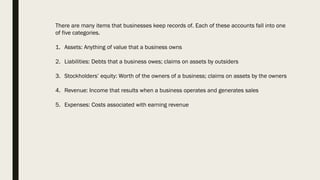
There are manyitems that businesses keep records of. Each of these accounts fall into one
of five categories.
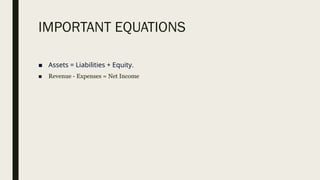
1. Assets: Anything of value that a business owns
2. Liabilities: Debts that a business owes; claims on assets by outsiders
3. Stockholders’ equity: Worth of the owners of a business; claims on assets by the owners
4. Revenue: Income that results when a business operates and generates sales
5. Expenses: Costs associated with earning revenue
EXPENDITURE
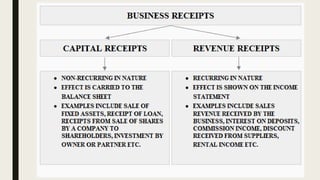
• Capital expenditureis a one-time cost, the benefit of which is expected to
be spread over multiple years.
• Revenue expenditures are usually recurring expenses, the benefits of which
are received during the accounting year. They can be either direct or
indirect expenses.
• Deferred revenue expenditure refers to an advance payment for goods or
services, the benefit of which is to be received only in the future
34.
REEVNUE VS PROFIT
■What each value means: revenue refers to the income a company earns
by providing services or selling products in a given financial year. In
comparison, profit refers to the amount realised by a company after
subtracting the expenses it incurred when providing a service or goods
from the total revenue.
35.
2 types ofrevenue
■ Operating revenue
■ Operating revenue is the income a company earns by conducting its core business operations. It is typically a
company's largest source of income. For example, a hospital might earn its operating revenue by providing medical
services, while a retail store could produce its operating revenue by selling merchandise. Depending on the business
and industry, a company's operating revenue may include various elements. Some examples of operating revenue are:
• Sales revenue: a sale occurs when there is an exchange of goods for currency. For example, a fashion company that
sells clothing could record clothing sales as revenue.
• Service revenue: service revenue occurs when a company or consultant provides professional services to a client. For
example, a marketing firm may record the revenue it earns from providing marketing services to its clients.
■ Nonoperating revenue
■ Nonoperating revenue is the income a company earns by conducting business outside of its core business operations.
Some examples of nonoperating revenue are:
• Rent revenue: rent revenue is the income a company earns from allowing third parties to rent buildings or equipment.
• Interest revenue: this is the income a company earns from an investment. Interest revenue can also include the
interest accrued from accounts receivable.
36.
■ Deferred revenue
■Deferred revenue, or unearned revenue, is the income a company earns before
providing services or goods to a customer. It is an advance payment the company
receives for products or services that it plans to deliver in the future. As your
company delivers goods or services, a portion of its deferred revenue becomes its
earned revenue.
■ Accrued revenue
■ Accrued revenue is the revenue a company earns for delivering goods or services
that a customer has not paid for yet. It is the revenue that a business recognises but
has not yet realised. Accrued revenue is significant because it can help accountants
understand their company's long-term financial performance and review how sales
contribute to the company's profitability and long-term growth.
38.
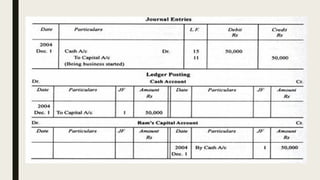
Journalizing Transactions
■ Wenow will come to one of the most important procedures in the recordkeeping process:
journal entries. It involves analyzing and writing down financialt ransactions in a
record book called a journal. Financial events are evaluated and translated into the
language of accounting using the process of journalizing.
39.
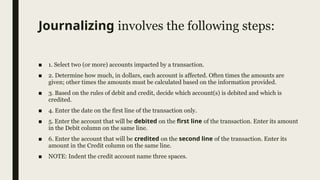
Journalizing involves thefollowing steps:
■ 1. Select two (or more) accounts impacted by a transaction.
■ 2. Determine how much, in dollars, each account is affected. Often times the amounts are
given; other times the amounts must be calculated based on the information provided.
■ 3. Based on the rules of debit and credit, decide which account(s) is debited and which is
credited.
■ 4. Enter the date on the first line of the transaction only.
■ 5. Enter the account that will be debited on the first line of the transaction. Enter its amount
in the Debit column on the same line.
■ 6. Enter the account that will be credited on the second line of the transaction. Enter its
amount in the Credit column on the same line.
■ NOTE: Indent the credit account name three spaces.
40.
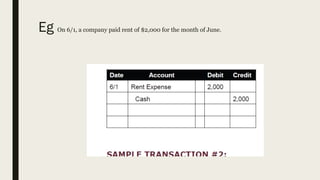
Eg On 6/1,a company paid rent of $2,000 for the month of June.
41.
Ledger
■ The ledgeris the second accounting record book that is a list of a company’s individual
accounts list in order of account category. While the journal lists all types of transactions
chronologically, the ledgers separate this same information out by account and keep a
running balance of each of these accounts.
Objectives of RatioAnalysis
■ 1. To know the areas of the business which need more attention;
■ 2. To know about the potential areas which can be improved with the effort in the
desired direction;
■ 3. To provide a deeper analysis of the profitability, liquidity, solvency and efficiency
levels in the business;
■ 4. To provide information for making cross-sectional analysis by comparing the
performance with the best industry standards; and
■ 5. To provide information derived from financial statements useful for making
projections and estimates for the future.
46.
Advantages of RatioAnalysis
■ 1. Helps to understand efficacy of decisions:
■ 2. Simplify complex figures and establish relationships:
■ 3. Helpful in comparative analysis:
■ 4. Identification of problem areas:
■ 5. Enables SWOT analysis:
47.
TYPES
■ 1. LiquidityRatios: To meet its commitments, business needs liquid funds. The ability of
the business to pay the amount due to stakeholders as and when it is due is known as
liquidity, and the ratios calculated to measure it are known as ‘Liquidity Ratios’. These are
essentially short-term in nature.
■ 2. Solvency Ratios: Solvency of business is determined by its ability to meet its contractual
obligations towards stakeholders, particularly towards external stakeholders, and the
ratios calculated to measure solvency position are known as ‘Solvency Ratios’. These are
essentially long-term in nature.
■ 3. Activity (or Turnover) Ratios: This refers to the ratios that are calculated for measuring
the efficiency of operations of business based on effective utilisation of resources. Hence,
these are also known as ‘Efficiency Ratios’.
■ 4. Profitability Ratios: It refers to the analysis of profits in relation to revenue from
operations or funds (or assets) employed in the business and the ratios calculated to meet
this objective are known as ‘Profitability Ratios’.
48.
Liquidity Ratios- CurrentRatio or Working Capital
Ratio
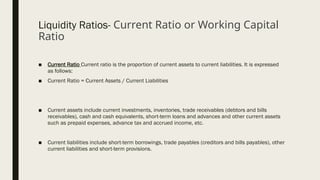
■ Current Ratio Current ratio is the proportion of current assets to current liabilities. It is expressed
as follows:
■ Current Ratio = Current Assets / Current Liabilities
■ Current assets include current investments, inventories, trade receivables (debtors and bills
receivables), cash and cash equivalents, short-term loans and advances and other current assets
such as prepaid expenses, advance tax and accrued income, etc.
■ Current liabilities include short-term borrowings, trade payables (creditors and bills payables), other
current liabilities and short-term provisions.
49.
Quick or LiquidRatio - also known as Acid Test
Ratio
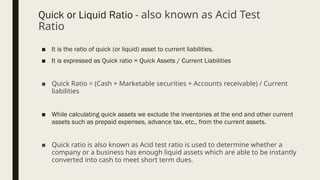
■ It is the ratio of quick (or liquid) asset to current liabilities.
■ It is expressed as Quick ratio = Quick Assets / Current Liabilities
■ Quick Ratio = (Cash + Marketable securities + Accounts receivable) / Current
liabilities
■ While calculating quick assets we exclude the inventories at the end and other current
assets such as prepaid expenses, advance tax, etc., from the current assets.
■ Quick ratio is also known as Acid test ratio is used to determine whether a
company or a business has enough liquid assets which are able to be instantly
converted into cash to meet short term dues.
50.
Cash Ratio alsoknown Cash Asset Ratio or
Absolute Liquidity Ratio
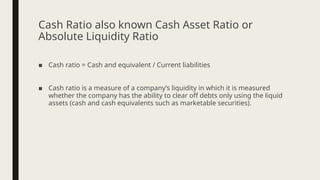
■ Cash ratio = Cash and equivalent / Current liabilities
■ Cash ratio is a measure of a company’s liquidity in which it is measured
whether the company has the ability to clear off debts only using the liquid
assets (cash and cash equivalents such as marketable securities).
51.
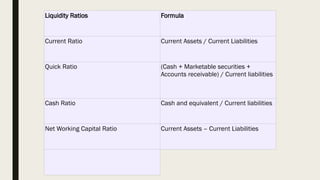
Liquidity Ratios Formula
CurrentRatio Current Assets / Current Liabilities
Quick Ratio (Cash + Marketable securities +
Accounts receivable) / Current liabilities
Cash Ratio Cash and equivalent / Current liabilities
Net Working Capital Ratio Current Assets – Current Liabilities
52.
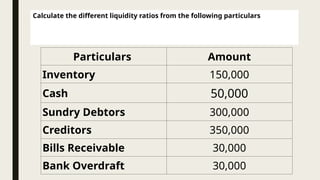
Particulars Amount
Inventory 150,000
Cash50,000
Sundry Debtors 300,000
Creditors 350,000
Bills Receivable 30,000
Bank Overdraft 30,000
Calculate the different liquidity ratios from the following particulars
53.
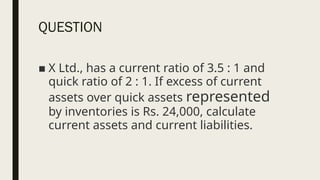
QUESTION
■ X Ltd.,has a current ratio of 3.5 : 1 and
quick ratio of 2 : 1. If excess of current
assets over quick assets represented
by inventories is Rs. 24,000, calculate
current assets and current liabilities.
54.
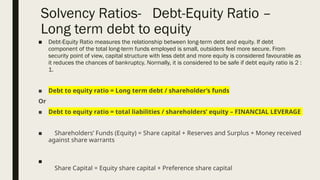
Solvency Ratios- Debt-EquityRatio –
Long term debt to equity
■ Debt-Equity Ratio measures the relationship between long-term debt and equity. If debt
component of the total long-term funds employed is small, outsiders feel more secure. From
security point of view, capital structure with less debt and more equity is considered favourable as
it reduces the chances of bankruptcy. Normally, it is considered to be safe if debt equity ratio is 2 :
1.
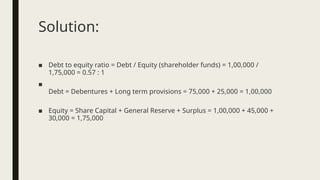
■ Debt to equity ratio = Long term debt / shareholder’s funds
Or
■ Debt to equity ratio = total liabilities / shareholders’ equity – FINANCIAL LEVERAGE
■ Shareholders’ Funds (Equity) = Share capital + Reserves and Surplus + Money received
against share warrants
■
Share Capital = Equity share capital + Preference share capital
55.
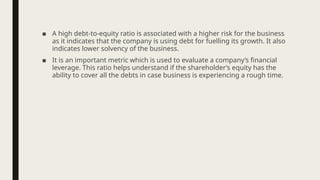
■ A highdebt-to-equity ratio is associated with a higher risk for the business
as it indicates that the company is using debt for fuelling its growth. It also
indicates lower solvency of the business.
■ It is an important metric which is used to evaluate a company’s financial
leverage. This ratio helps understand if the shareholder’s equity has the
ability to cover all the debts in case business is experiencing a rough time.
56.
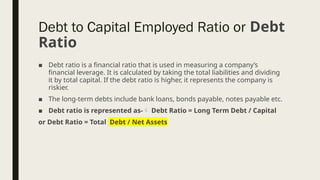
■ Debt ratiois a financial ratio that is used in measuring a company’s
financial leverage. It is calculated by taking the total liabilities and dividing
it by total capital. If the debt ratio is higher, it represents the company is
riskier.
■ The long-term debts include bank loans, bonds payable, notes payable etc.
■ Debt ratio is represented as- Debt Ratio = Long Term Debt / Capital
or Debt Ratio = Total Debt / Net Assets
Debt to Capital Employed Ratio or Debt
Ratio
57.
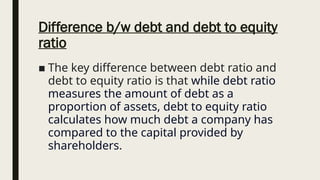
Difference b/w debtand debt to equity
ratio
■ The key difference between debt ratio and
debt to equity ratio is that while debt ratio
measures the amount of debt as a
proportion of assets, debt to equity ratio
calculates how much debt a company has
compared to the capital provided by
shareholders.
58.
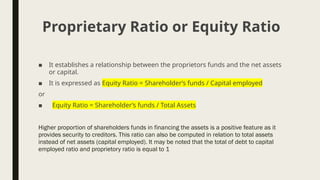
■ It establishesa relationship between the proprietors funds and the net assets
or capital.
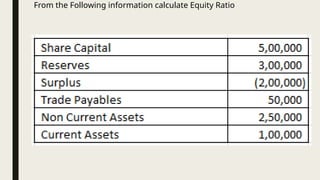
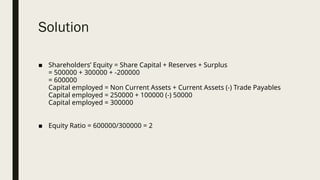
■ It is expressed as Equity Ratio = Shareholder’s funds / Capital employed
or
■ Equity Ratio = Shareholder’s funds / Total Assets
Higher proportion of shareholders funds in financing the assets is a positive feature as it
provides security to creditors. This ratio can also be computed in relation to total assets
instead of net assets (capital employed). It may be noted that the total of debt to capital
employed ratio and proprietory ratio is equal to 1
Proprietary Ratio or Equity Ratio
59.
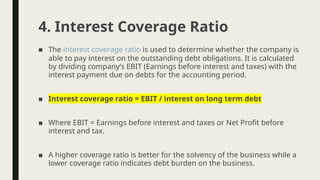
■ The interestcoverage ratio is used to determine whether the company is
able to pay interest on the outstanding debt obligations. It is calculated
by dividing company’s EBIT (Earnings before interest and taxes) with the
interest payment due on debts for the accounting period.
■ Interest coverage ratio = EBIT / interest on long term debt
■ Where EBIT = Earnings before interest and taxes or Net Profit before
interest and tax.
■ A higher coverage ratio is better for the solvency of the business while a
lower coverage ratio indicates debt burden on the business.
4. Interest Coverage Ratio
60.
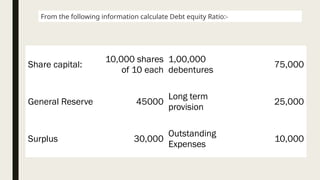
Share capital:
10,000 shares
of10 each
1,00,000
debentures
75,000
General Reserve 45000
Long term
provision
25,000
Surplus 30,000
Outstanding
Expenses
10,000
From the following information calculate Debt equity Ratio:-
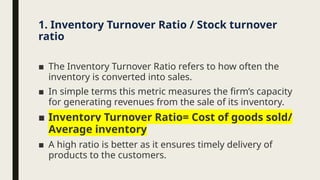
■ The InventoryTurnover Ratio refers to how often the
inventory is converted into sales.
■ In simple terms this metric measures the firm’s capacity
for generating revenues from the sale of its inventory.
■ Inventory Turnover Ratio= Cost of goods sold/
Average inventory
■ A high ratio is better as it ensures timely delivery of
products to the customers.
1. Inventory Turnover Ratio / Stock turnover
ratio
66.
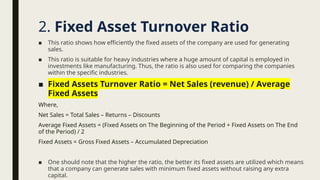
■ This ratioshows how efficiently the fixed assets of the company are used for generating
sales.
■ This ratio is suitable for heavy industries where a huge amount of capital is employed in
investments like manufacturing. Thus, the ratio is also used for comparing the companies
within the specific industries.
■ Fixed Assets Turnover Ratio = Net Sales (revenue) / Average
Fixed Assets
Where,
Net Sales = Total Sales – Returns – Discounts
Average Fixed Assets = (Fixed Assets on The Beginning of the Period + Fixed Assets on The End
of the Period) / 2
Fixed Assets = Gross Fixed Assets – Accumulated Depreciation
■ One should note that the higher the ratio, the better its fixed assets are utilized which means
that a company can generate sales with minimum fixed assets without raising any extra
capital.
2. Fixed Asset Turnover Ratio
67.
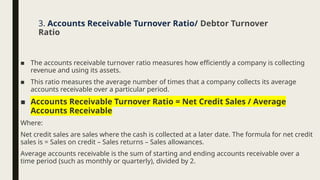
■ The accountsreceivable turnover ratio measures how efficiently a company is collecting
revenue and using its assets.
■ This ratio measures the average number of times that a company collects its average
accounts receivable over a particular period.
■ Accounts Receivable Turnover Ratio = Net Credit Sales / Average
Accounts Receivable
Where:
Net credit sales are sales where the cash is collected at a later date. The formula for net credit
sales is = Sales on credit – Sales returns – Sales allowances.
Average accounts receivable is the sum of starting and ending accounts receivable over a
time period (such as monthly or quarterly), divided by 2.
3. Accounts Receivable Turnover Ratio/ Debtor Turnover
Ratio
68.
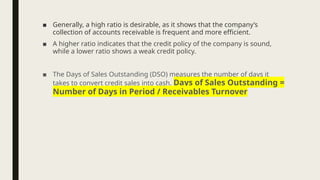
■ Generally, ahigh ratio is desirable, as it shows that the company’s
collection of accounts receivable is frequent and more efficient.
■ A higher ratio indicates that the credit policy of the company is sound,
while a lower ratio shows a weak credit policy.
■ The Days of Sales Outstanding (DSO) measures the number of days it
takes to convert credit sales into cash. Days of Sales Outstanding =
Number of Days in Period / Receivables Turnover
69.
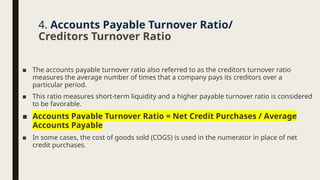
■ The accountspayable turnover ratio also referred to as the creditors turnover ratio
measures the average number of times that a company pays its creditors over a
particular period.
■ This ratio measures short-term liquidity and a higher payable turnover ratio is considered
to be favorable.
■ Accounts Payable Turnover Ratio = Net Credit Purchases / Average
Accounts Payable
■ In some cases, the cost of goods sold (COGS) is used in the numerator in place of net
credit purchases.
4. Accounts Payable Turnover Ratio/
Creditors Turnover Ratio
70.
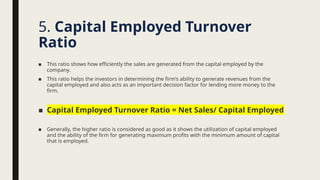
■ This ratioshows how efficiently the sales are generated from the capital employed by the
company.
■ This ratio helps the investors in determining the firm’s ability to generate revenues from the
capital employed and also acts as an important decision factor for lending more money to the
firm.
■ Capital Employed Turnover Ratio = Net Sales/ Capital Employed
■ Generally, the higher ratio is considered as good as it shows the utilization of capital employed
and the ability of the firm for generating maximum profits with the minimum amount of capital
that is employed.
5. Capital Employed Turnover
Ratio
71.
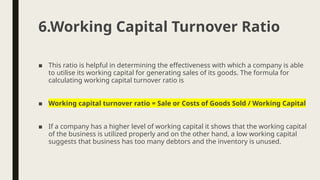
■ This ratiois helpful in determining the effectiveness with which a company is able
to utilise its working capital for generating sales of its goods. The formula for
calculating working capital turnover ratio is
■ Working capital turnover ratio = Sale or Costs of Goods Sold / Working Capital
■ If a company has a higher level of working capital it shows that the working capital
of the business is utilized properly and on the other hand, a low working capital
suggests that business has too many debtors and the inventory is unused.
6.Working Capital Turnover Ratio
72.
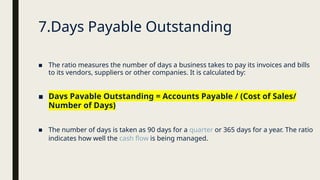
■ The ratiomeasures the number of days a business takes to pay its invoices and bills
to its vendors, suppliers or other companies. It is calculated by:
■ Days Payable Outstanding = Accounts Payable / (Cost of Sales/
Number of Days)
■ The number of days is taken as 90 days for a quarter or 365 days for a year. The ratio
indicates how well the cash flow is being managed.
7.Days Payable Outstanding
73.
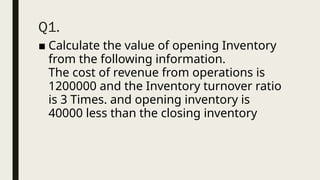
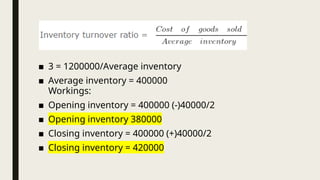
Q1.
■ Calculate thevalue of opening Inventory
from the following information.
The cost of revenue from operations is
1200000 and the Inventory turnover ratio
is 3 Times. and opening inventory is
40000 less than the closing inventory
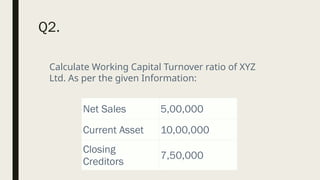
Q2.
Net Sales 5,00,000
CurrentAsset 10,00,000
Closing
Creditors
7,50,000
Calculate Working Capital Turnover ratio of XYZ
Ltd. As per the given Information:
76.
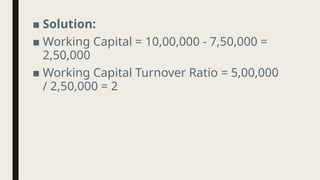
■ Solution:
■ WorkingCapital = 10,00,000 - 7,50,000 =
2,50,000
■ Working Capital Turnover Ratio = 5,00,000
/ 2,50,000 = 2
78.
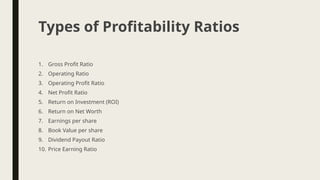
1. Gross ProfitRatio
2. Operating Ratio
3. Operating Profit Ratio
4. Net Profit Ratio
5. Return on Investment (ROI)
6. Return on Net Worth
7. Earnings per share
8. Book Value per share
9. Dividend Payout Ratio
10. Price Earning Ratio
Types of Profitability Ratios
79.
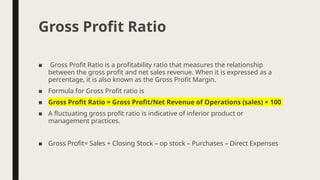
■ Gross ProfitRatio is a profitability ratio that measures the relationship
between the gross profit and net sales revenue. When it is expressed as a
percentage, it is also known as the Gross Profit Margin.
■ Formula for Gross Profit ratio is
■ Gross Profit Ratio = Gross Profit/Net Revenue of Operations (sales) × 100
■ A fluctuating gross profit ratio is indicative of inferior product or
management practices.
■ Gross Profit= Sales + Closing Stock – op stock – Purchases – Direct Expenses
Gross Profit Ratio
80.
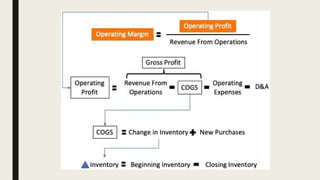
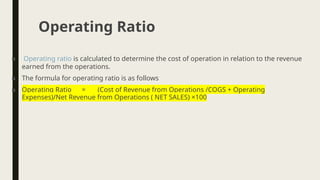
■ Operating ratiois calculated to determine the cost of operation in relation to the revenue
earned from the operations.
■ The formula for operating ratio is as follows
■ Operating Ratio = (Cost of Revenue from Operations /COGS + Operating
Expenses)/Net Revenue from Operations ( NET SALES) ×100
Operating Ratio
81.
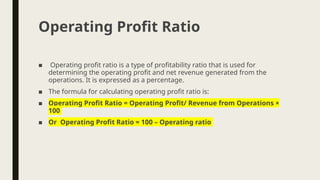
■ Operating profitratio is a type of profitability ratio that is used for
determining the operating profit and net revenue generated from the
operations. It is expressed as a percentage.
■ The formula for calculating operating profit ratio is:
■ Operating Profit Ratio = Operating Profit/ Revenue from Operations ×
100
■ Or Operating Profit Ratio = 100 – Operating ratio
Operating Profit Ratio
82.
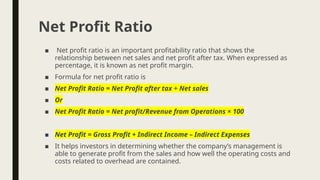
■ Net profitratio is an important profitability ratio that shows the
relationship between net sales and net profit after tax. When expressed as
percentage, it is known as net profit margin.
■ Formula for net profit ratio is
■ Net Profit Ratio = Net Profit after tax ÷ Net sales
■ Or
■ Net Profit Ratio = Net profit/Revenue from Operations × 100
■ Net Profit = Gross Profit + Indirect Income – Indirect Expenses
■ It helps investors in determining whether the company’s management is
able to generate profit from the sales and how well the operating costs and
costs related to overhead are contained.
Net Profit Ratio
83.
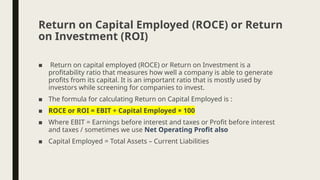
■ Return oncapital employed (ROCE) or Return on Investment is a
profitability ratio that measures how well a company is able to generate
profits from its capital. It is an important ratio that is mostly used by
investors while screening for companies to invest.
■ The formula for calculating Return on Capital Employed is :
■ ROCE or ROI = EBIT ÷ Capital Employed × 100
■ Where EBIT = Earnings before interest and taxes or Profit before interest
and taxes / sometimes we use Net Operating Profit also
■ Capital Employed = Total Assets – Current Liabilities
Return on Capital Employed (ROCE) or Return
on Investment (ROI)
84.
■ This isalso known as Return on Shareholders funds and is used for
determining whether the investment done by the shareholders are able to
generate profitable returns or not.
■ It should always be higher than the return on investment which otherwise
would indicate that the company funds are not utilised properly.
■ The formula for Return on Net Worth is calculated as :
■ Return on Shareholders’ Fund = Profit after Tax / Shareholders’ Funds ×
100
■ Or Return on Net Worth = Profit after Tax / Shareholders’ Funds × 100
Return on equity/ networth
85.
■ Earnings pershare or EPS is a profitability ratio that measures the extent
to which a company earns profit. It is calculated by dividing the net profit
earned by outstanding shares.
■ The formula for calculating EPS is:
■ Earnings per share = Net Profit ÷ Total no. of shares outstanding
■ Having higher EPS translates into more profitability for the company.
Earnings Per Share (EPS)
86.
■ Book valueper share is referred to as the equity that is available to the the
common shareholders divided by the number of outstanding shares
■ Equity can be calculated by:
■ Equity funds = Shareholders funds – Preference share capital
■ The formula for calculating book value per share is:
■ Book Value per Share = (Shareholders’ Equity – Preferred Equity) / Total
Outstanding Common Shares.
Book Value Per Share
87.
■ Dividend payoutratio calculates the amount paid to shareholders as
dividends in relation to the amount of net income generated by the
business.
■ It can be calculated as follows:
■ Dividend Payout Ratio (DPR) : Dividends per share / Earnings per share
Dividend Payout Ratio
88.
■ This isalso known as P/E Ratio. It establishes a relationship between the
stock (share) price of a company and the earnings per share. It is very
helpful for investors as they will be more interested in knowing the
profitability of the shares of the company and how much profitable it will
be in future.
■ P/E ratio is calculated as follows:
■ P/E Ratio = Market value per share ÷ Earnings per share
■ It shows if the company’s stock is overvalued or undervalued.
Price Earning Ratio