 The first playing cards appeared in East
Asia. In China and Korea map was
mentioned already in the XII century. There
are earlier references to games that used the
oblong leaves - they belong to reign in the
ninth century Tang dynasty (618-917,)
 It is assumed that the distribution of playing
cards was as follows: China - India - Persia -
Egypt - Europe. For a long time "import"
through Arab countries, and the
participation of Muslims in the
development of card games, denied.
However, it was later established that the
followers of Islam not only played card
games, but has created its own deck.
Actually, the Arabs (or rather, Arab
merchants and sailors, as a rule, were mere
intermediaries borrowing from China. Map
of the Mamluks in many respects resembled
the Tarot: 56 minor Arcana and 22 major
trumps are divided into 4 suits of Swords,
Staves, Cups and Pentacles (also known as
Disks and Coins).
 Normal
 Тranslation
 Podenas
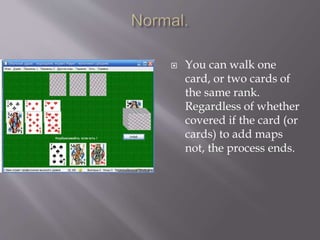
 You can walk one
card, or two cards of
the same rank.
Regardless of whether
covered if the card (or
cards) to add maps
not, the process ends.
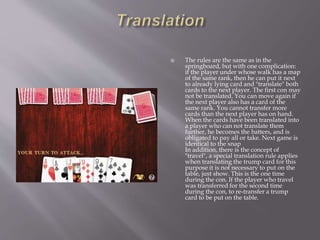
 The rules are the same as in the
springboard, but with one complication:
if the player under whose walk has a map
of the same rank, then he can put it next
to already lying card and "translate" both
cards to the next player. The first con may
not be translated. You can move again if
the next player also has a card of the
same rank. You cannot transfer more
cards than the next player has on hand.
When the cards have been translated into
a player who can not translate them
further, he becomes the batters, and is
obligated to pay all or take. Next game is
identical to the snap
In addition, there is the concept of
"travel", a special translation rule applies
when translating the trump card for this
purpose it is not necessary to put on the
table, just show. This is the one time
during the con. If the player who travel
was transferred for the second time
during the con, to re-transfer a trump
card to be put on the table.
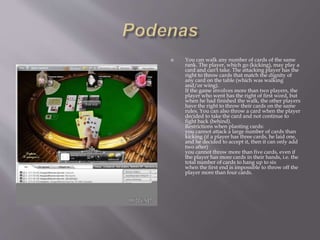
 You can walk any number of cards of the same
rank. The player, which go (kicking), may play a
card and can't take. The attacking player has the
right to throw cards that match the dignity of
any card on the table (which was walking
and/or wing).
If the game involves more than two players, the
player who went has the right of first word, but
when he had finished the walk, the other players
have the right to throw their cards on the same
rules. You can also throw a card when the player
decided to take the card and not continue to
fight back (behind).
Restrictions when planting cards:
you cannot attack a large number of cards than
kicking (if a player has three cards, he laid one,
and he decided to accept it, then it can only add
two after)
you cannot throw more than five cards, even if
the player has more cards in their hands, i.e. the
total number of cards to hang up to six
when the first end is impossible to throw off the
player more than four cards.
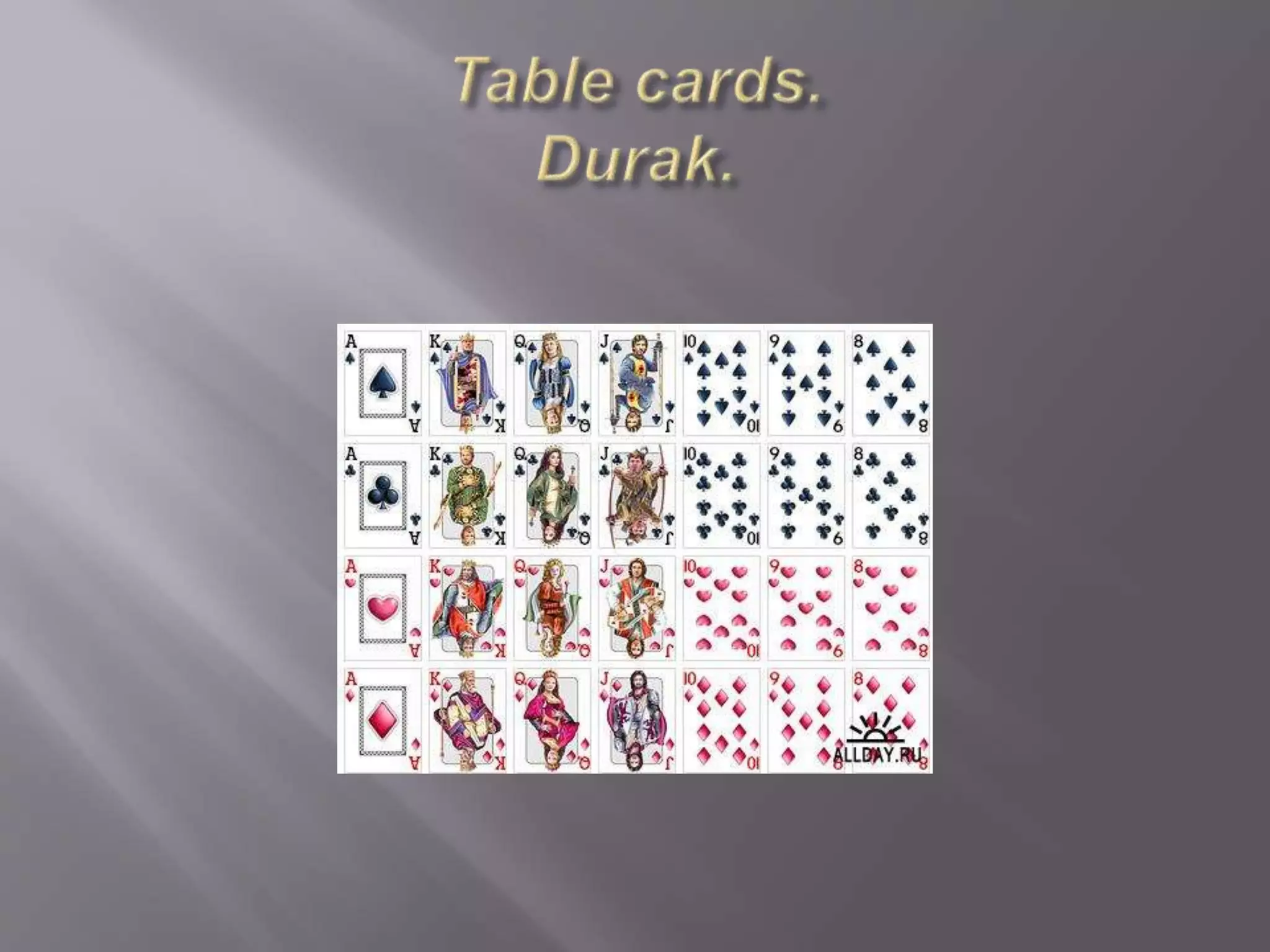
Table cards

Table cards

  • 2.
     The firstplaying cards appeared in East Asia. In China and Korea map was mentioned already in the XII century. There are earlier references to games that used the oblong leaves - they belong to reign in the ninth century Tang dynasty (618-917,)  It is assumed that the distribution of playing cards was as follows: China - India - Persia - Egypt - Europe. For a long time "import" through Arab countries, and the participation of Muslims in the development of card games, denied. However, it was later established that the followers of Islam not only played card games, but has created its own deck. Actually, the Arabs (or rather, Arab merchants and sailors, as a rule, were mere intermediaries borrowing from China. Map of the Mamluks in many respects resembled the Tarot: 56 minor Arcana and 22 major trumps are divided into 4 suits of Swords, Staves, Cups and Pentacles (also known as Disks and Coins).
  • 3.
  • 4.
     You canwalk one card, or two cards of the same rank. Regardless of whether covered if the card (or cards) to add maps not, the process ends.
  • 5.
     The rulesare the same as in the springboard, but with one complication: if the player under whose walk has a map of the same rank, then he can put it next to already lying card and "translate" both cards to the next player. The first con may not be translated. You can move again if the next player also has a card of the same rank. You cannot transfer more cards than the next player has on hand. When the cards have been translated into a player who can not translate them further, he becomes the batters, and is obligated to pay all or take. Next game is identical to the snap In addition, there is the concept of "travel", a special translation rule applies when translating the trump card for this purpose it is not necessary to put on the table, just show. This is the one time during the con. If the player who travel was transferred for the second time during the con, to re-transfer a trump card to be put on the table.
  • 6.
     You canwalk any number of cards of the same rank. The player, which go (kicking), may play a card and can't take. The attacking player has the right to throw cards that match the dignity of any card on the table (which was walking and/or wing). If the game involves more than two players, the player who went has the right of first word, but when he had finished the walk, the other players have the right to throw their cards on the same rules. You can also throw a card when the player decided to take the card and not continue to fight back (behind). Restrictions when planting cards: you cannot attack a large number of cards than kicking (if a player has three cards, he laid one, and he decided to accept it, then it can only add two after) you cannot throw more than five cards, even if the player has more cards in their hands, i.e. the total number of cards to hang up to six when the first end is impossible to throw off the player more than four cards.