How To Guide
                   Facilitating Insightful Focus Groups


                   Executive Summary:

                   This report has been designed to provide practical advice for conducting
                   insightful focus group sessions.

                   Read this brief 6-page report to learn:

                              What are Focus Groups?

                              Focus Group Use Cases

                              Focus Group Best Practices

                              Being an Effective Facilitator

                              Action Plan


                   Review this report to understand the value of customer insights, and
                   how to facilitate successful focus group sessions.


www.demandmetric.com                                                  Call a Principal Analyst:
                                                                              (866) 947-7744
2


                   Table of Contents                             Page


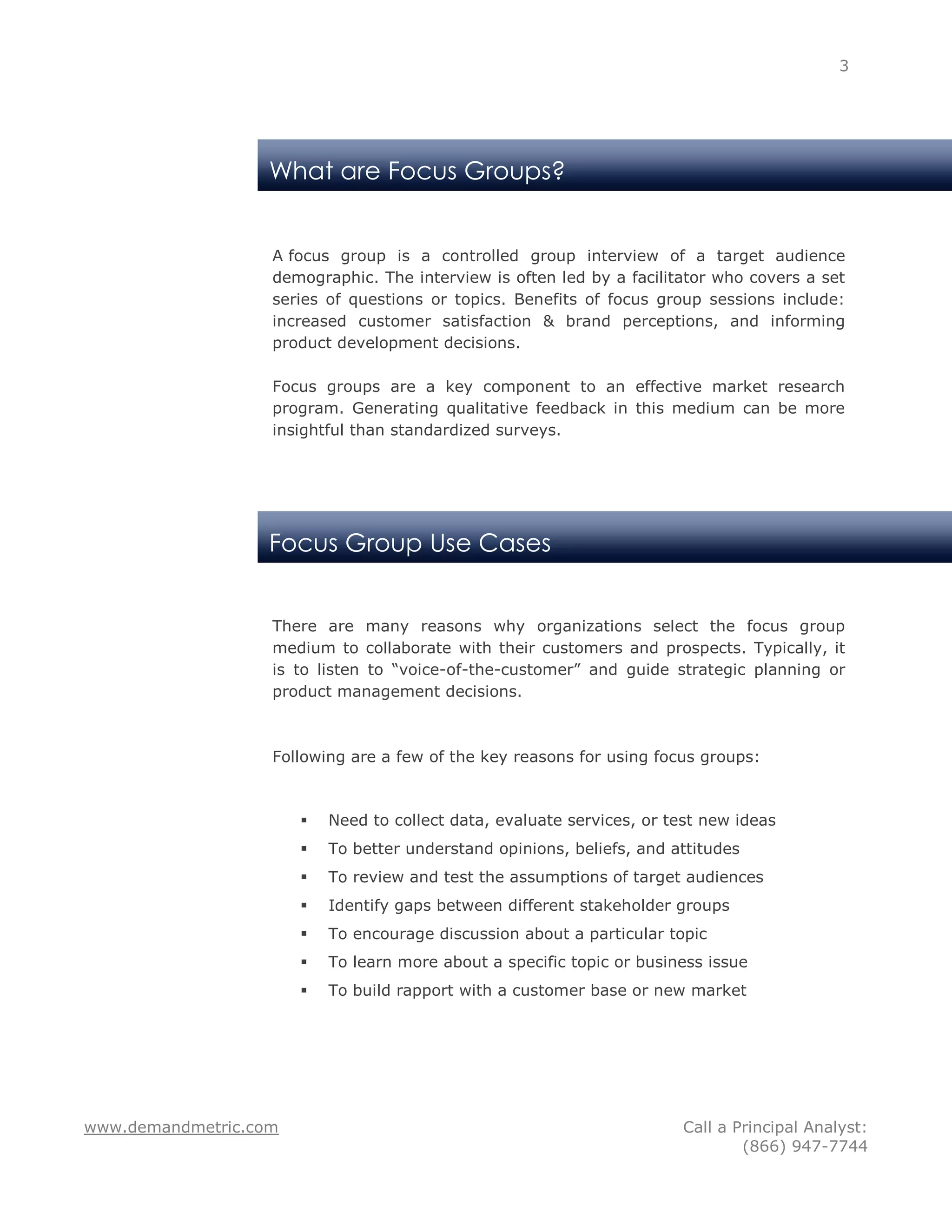
                   What are Focus Groups?                            3

                   Focus Group Use Cases                             3

                   Focus Group Best Practices                        4

                   Being an Effective Facilitator                    5

                   Action Plan                                       5


www.demandmetric.com                                Call a Principal Analyst:
                                                            (866) 947-7744
3


                   What are Focus Groups?


                   A focus group is a controlled group interview of a target audience
                   demographic. The interview is often led by a facilitator who covers a set
                   series of questions or topics. Benefits of focus group sessions include:
                   increased customer satisfaction & brand perceptions, and informing
                   product development decisions.

                   Focus groups are a key component to an effective market research
                   program. Generating qualitative feedback in this medium can be more
                   insightful than standardized surveys.


                   Focus Group Use Cases


                   There are many reasons why organizations select the focus group
                   medium to collaborate with their customers and prospects. Typically, it
                   is to listen to “voice-of-the-customer” and guide strategic planning or
                   product management decisions.


                   Following are a few of the key reasons for using focus groups:


                          Need to collect data, evaluate services, or test new ideas
                          To better understand opinions, beliefs, and attitudes
                          To review and test the assumptions of target audiences
                          Identify gaps between different stakeholder groups
                          To encourage discussion about a particular topic
                          To learn more about a specific topic or business issue
                          To build rapport with a customer base or new market


www.demandmetric.com                                                    Call a Principal Analyst:
                                                                                (866) 947-7744
4


                   Focus Group Best Practices


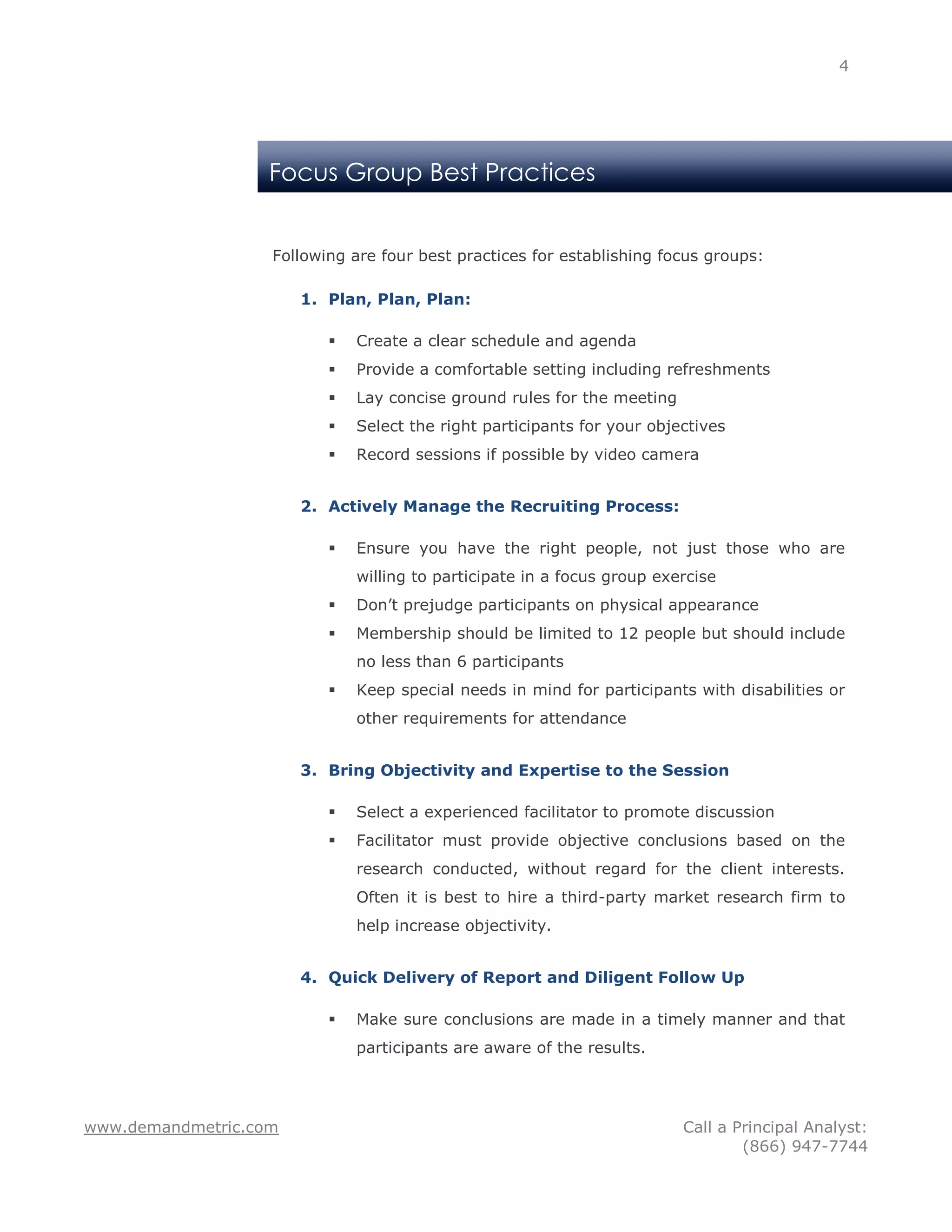
                   Following are four best practices for establishing focus groups:

                       1. Plan, Plan, Plan:

                             Create a clear schedule and agenda
                             Provide a comfortable setting including refreshments
                             Lay concise ground rules for the meeting
                             Select the right participants for your objectives
                             Record sessions if possible by video camera


                       2. Actively Manage the Recruiting Process:

                             Ensure you have the right people, not just those who are
                              willing to participate in a focus group exercise
                             Don’t prejudge participants on physical appearance
                             Membership should be limited to 12 people but should include
                              no less than 6 participants
                             Keep special needs in mind for participants with disabilities or
                              other requirements for attendance


                       3. Bring Objectivity and Expertise to the Session

                             Select a experienced facilitator to promote discussion
                             Facilitator must provide objective conclusions based on the
                              research conducted, without regard for the client interests.
                              Often it is best to hire a third-party market research firm to
                              help increase objectivity.


                       4. Quick Delivery of Report and Diligent Follow Up

                             Make sure conclusions are made in a timely manner and that
                              participants are aware of the results.


www.demandmetric.com                                                     Call a Principal Analyst:
                                                                                 (866) 947-7744
5


                   Being an Effective Facilitator


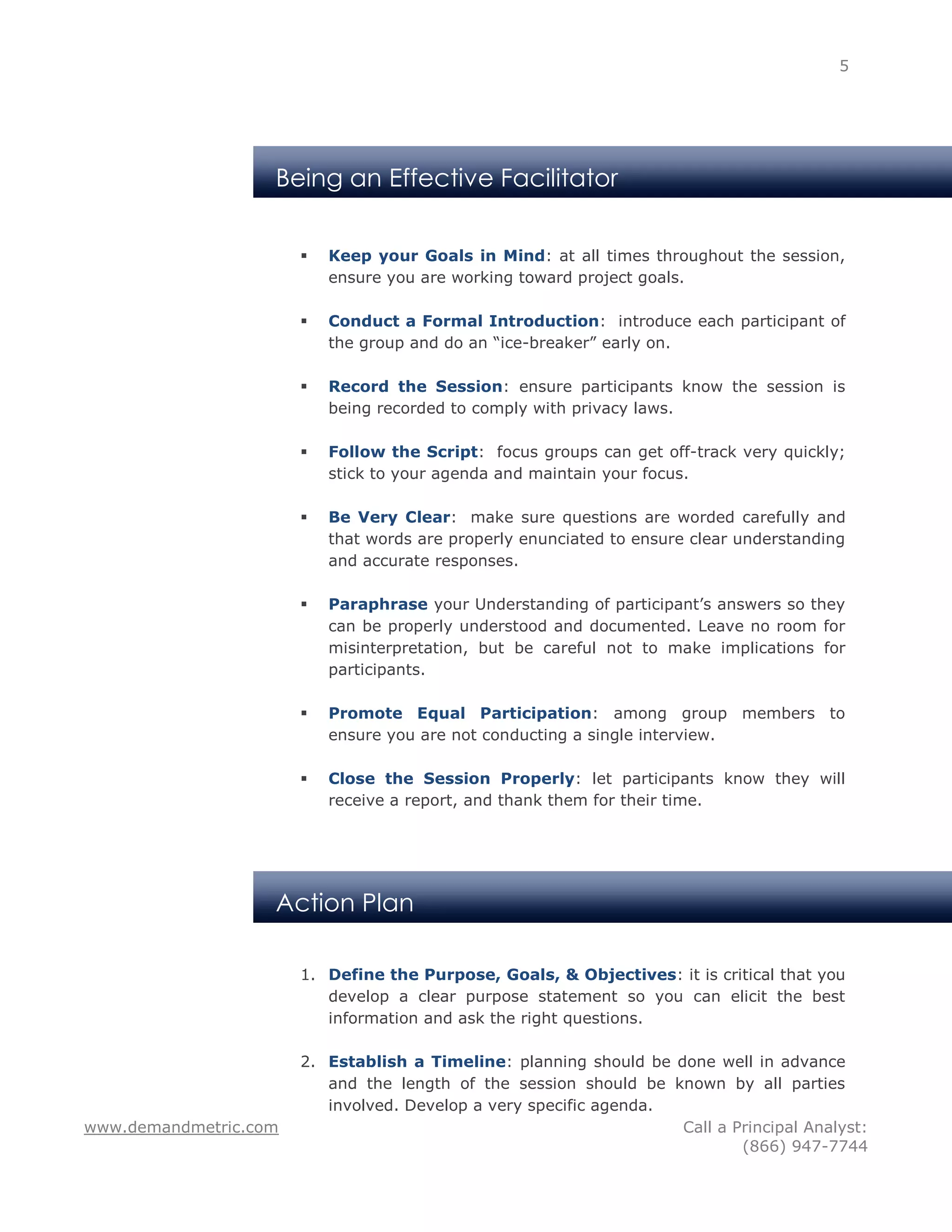
                          Keep your Goals in Mind: at all times throughout the session,
                           ensure you are working toward project goals.

                          Conduct a Formal Introduction: introduce each participant of
                           the group and do an “ice-breaker” early on.

                          Record the Session: ensure participants know the session is
                           being recorded to comply with privacy laws.

                          Follow the Script: focus groups can get off-track very quickly;
                           stick to your agenda and maintain your focus.

                          Be Very Clear: make sure questions are worded carefully and
                           that words are properly enunciated to ensure clear understanding
                           and accurate responses.

                          Paraphrase your Understanding of participant’s answers so they
                           can be properly understood and documented. Leave no room for
                           misinterpretation, but be careful not to make implications for
                           participants.

                          Promote Equal Participation: among group members to
                           ensure you are not conducting a single interview.

                          Close the Session Properly: let participants know they will
                           receive a report, and thank them for their time.


                   Action Plan

                       1. Define the Purpose, Goals, & Objectives: it is critical that you
                          develop a clear purpose statement so you can elicit the best
                          information and ask the right questions.

                       2. Establish a Timeline: planning should be done well in advance
                          and the length of the session should be known by all parties
                          involved. Develop a very specific agenda.
www.demandmetric.com                                                Call a Principal Analyst:
                                                                            (866) 947-7744
6


                       3. Identify Participants: it is important to determine the number
                          of participants required to conduct a thorough evaluation. The
                          homogeneity/heterogeneity of participants should also be
                          evaluated and names & contact information should be secured
                          well in advance.

                       4. Choose the Location: take into account seating and equipment
                          requirements. Arrange refreshments. The location should
                          convenient and comfortable for participants to encourage active
                          participation.

                       5. Invite Participants: send invitations via email, direct mail, or
                          phone appointment, and monitor confirmations.

                       6. Develop Questions: select 4 or 5 questions that relate to the
                          purpose and that will address your major objectives. Questions
                          should be open-ended and should move from general to more
                          specific. Questions should be tested before being used in a live
                          setting.

                       7. Generate a Script: this will ensure your focus group stays on
                          time and remains consistent, especially if you are conducting a
                          number of sessions in sequence.

                       8. Select a Facilitator: a good facilitator will keep the group on
                          track, make sure all participants are heard, and will be able to
                          deal with outspoken members. Strongly consider a market
                          research firm or consultant.

                       9. Conduct the Focus Group: make sure to follow the script and
                          timeline. It is also important to be well prepared: recording
                          devices, equipment, pens, paper, clock, name tags, etc., should
                          be arranged in advance.

                       10. Summarize Conclusions: document the key findings from the
                           session, including perceptions of your organization and products,
                           or other critical feedback.

                       11. Write a Report: create a formal report including background,
                           purpose, session details, results, and conclusions. Present to
                           your Senior Management team.


www.demandmetric.com                                                   Call a Principal Analyst:
                                                                               (866) 947-7744

Facilitating Insightful Focus Groups

  • 1.
    How To Guide Facilitating Insightful Focus Groups Executive Summary: This report has been designed to provide practical advice for conducting insightful focus group sessions. Read this brief 6-page report to learn:  What are Focus Groups?  Focus Group Use Cases  Focus Group Best Practices  Being an Effective Facilitator  Action Plan Review this report to understand the value of customer insights, and how to facilitate successful focus group sessions. www.demandmetric.com Call a Principal Analyst: (866) 947-7744
  • 2.
    2 Table of Contents Page What are Focus Groups? 3 Focus Group Use Cases 3 Focus Group Best Practices 4 Being an Effective Facilitator 5 Action Plan 5 www.demandmetric.com Call a Principal Analyst: (866) 947-7744
  • 3.
    3 What are Focus Groups? A focus group is a controlled group interview of a target audience demographic. The interview is often led by a facilitator who covers a set series of questions or topics. Benefits of focus group sessions include: increased customer satisfaction & brand perceptions, and informing product development decisions. Focus groups are a key component to an effective market research program. Generating qualitative feedback in this medium can be more insightful than standardized surveys. Focus Group Use Cases There are many reasons why organizations select the focus group medium to collaborate with their customers and prospects. Typically, it is to listen to “voice-of-the-customer” and guide strategic planning or product management decisions. Following are a few of the key reasons for using focus groups:  Need to collect data, evaluate services, or test new ideas  To better understand opinions, beliefs, and attitudes  To review and test the assumptions of target audiences  Identify gaps between different stakeholder groups  To encourage discussion about a particular topic  To learn more about a specific topic or business issue  To build rapport with a customer base or new market www.demandmetric.com Call a Principal Analyst: (866) 947-7744
  • 4.
    4 Focus Group Best Practices Following are four best practices for establishing focus groups: 1. Plan, Plan, Plan:  Create a clear schedule and agenda  Provide a comfortable setting including refreshments  Lay concise ground rules for the meeting  Select the right participants for your objectives  Record sessions if possible by video camera 2. Actively Manage the Recruiting Process:  Ensure you have the right people, not just those who are willing to participate in a focus group exercise  Don’t prejudge participants on physical appearance  Membership should be limited to 12 people but should include no less than 6 participants  Keep special needs in mind for participants with disabilities or other requirements for attendance 3. Bring Objectivity and Expertise to the Session  Select a experienced facilitator to promote discussion  Facilitator must provide objective conclusions based on the research conducted, without regard for the client interests. Often it is best to hire a third-party market research firm to help increase objectivity. 4. Quick Delivery of Report and Diligent Follow Up  Make sure conclusions are made in a timely manner and that participants are aware of the results. www.demandmetric.com Call a Principal Analyst: (866) 947-7744
  • 5.
    5 Being an Effective Facilitator  Keep your Goals in Mind: at all times throughout the session, ensure you are working toward project goals.  Conduct a Formal Introduction: introduce each participant of the group and do an “ice-breaker” early on.  Record the Session: ensure participants know the session is being recorded to comply with privacy laws.  Follow the Script: focus groups can get off-track very quickly; stick to your agenda and maintain your focus.  Be Very Clear: make sure questions are worded carefully and that words are properly enunciated to ensure clear understanding and accurate responses.  Paraphrase your Understanding of participant’s answers so they can be properly understood and documented. Leave no room for misinterpretation, but be careful not to make implications for participants.  Promote Equal Participation: among group members to ensure you are not conducting a single interview.  Close the Session Properly: let participants know they will receive a report, and thank them for their time. Action Plan 1. Define the Purpose, Goals, & Objectives: it is critical that you develop a clear purpose statement so you can elicit the best information and ask the right questions. 2. Establish a Timeline: planning should be done well in advance and the length of the session should be known by all parties involved. Develop a very specific agenda. www.demandmetric.com Call a Principal Analyst: (866) 947-7744
  • 6.
    6 3. Identify Participants: it is important to determine the number of participants required to conduct a thorough evaluation. The homogeneity/heterogeneity of participants should also be evaluated and names & contact information should be secured well in advance. 4. Choose the Location: take into account seating and equipment requirements. Arrange refreshments. The location should convenient and comfortable for participants to encourage active participation. 5. Invite Participants: send invitations via email, direct mail, or phone appointment, and monitor confirmations. 6. Develop Questions: select 4 or 5 questions that relate to the purpose and that will address your major objectives. Questions should be open-ended and should move from general to more specific. Questions should be tested before being used in a live setting. 7. Generate a Script: this will ensure your focus group stays on time and remains consistent, especially if you are conducting a number of sessions in sequence. 8. Select a Facilitator: a good facilitator will keep the group on track, make sure all participants are heard, and will be able to deal with outspoken members. Strongly consider a market research firm or consultant. 9. Conduct the Focus Group: make sure to follow the script and timeline. It is also important to be well prepared: recording devices, equipment, pens, paper, clock, name tags, etc., should be arranged in advance. 10. Summarize Conclusions: document the key findings from the session, including perceptions of your organization and products, or other critical feedback. 11. Write a Report: create a formal report including background, purpose, session details, results, and conclusions. Present to your Senior Management team. www.demandmetric.com Call a Principal Analyst: (866) 947-7744