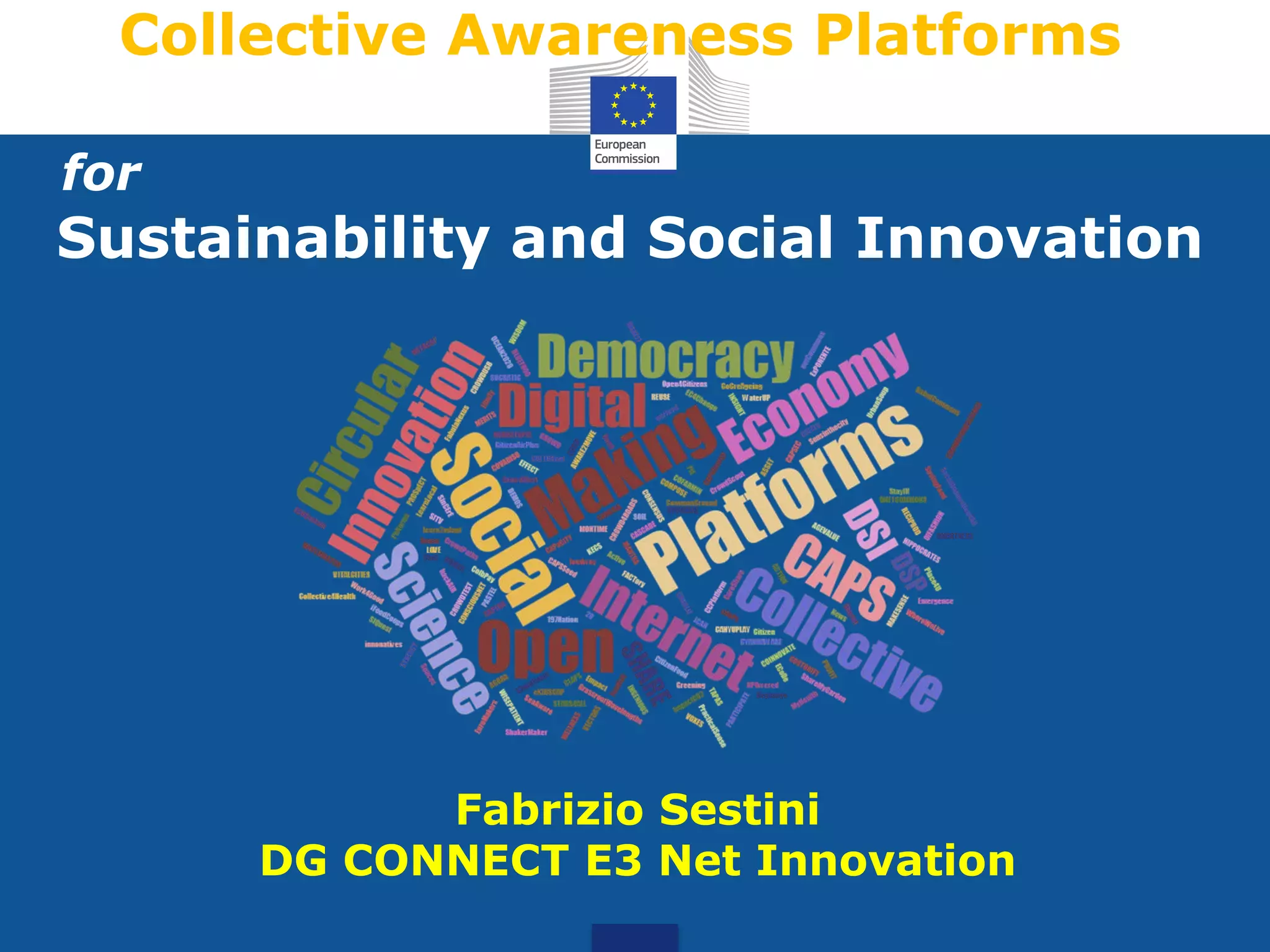
Collective Awareness Platforms
for .
Sustainability and Social Innovation
Fabrizio Sestini
DG CONNECT E3 Net Innovation
••• 2
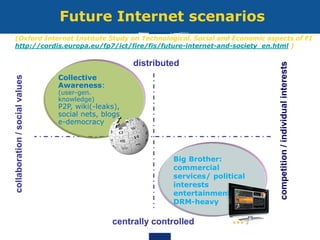
collaboration/socialvalues
competition/individualinterests
distributed
centrally controlled
Future Internet scenarios
(Oxford Internet Institute Study on Technological, Social and Economic aspects of FI
http://cordis.europa.eu/fp7/ict/fire/fis/future-internet-and-society_en.html )
Big Brother:
commercial
services/ political
interests
entertainment
DRM-heavy
Collective
Awareness:
(user-gen.
knowledge)
P2P, wiki(-leaks),
social nets, blogs
e-democracy
••• 3
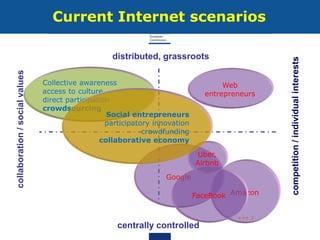
collaboration/socialvalues
competition/individualinterests
distributed, grassroots
centrally controlled
Current Internet scenarios
Collective awareness
access to culture
direct participation
crowdsourcing
Google
AmazonFaceBook
Web
entrepreneurs
Uber,
Airbnb
Social entrepreneurs
participatory innovation
crowdfunding
collaborative economy
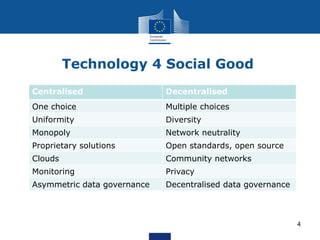
Technology 4 Social Good
4
Centralised Decentralised
One choice Multiple choices
Uniformity Diversity
Monopoly Network neutrality
Proprietary solutions Open standards, open source
Clouds Community networks
Monitoring Privacy
Asymmetric data governance Decentralised data governance
Fixing asymmetry in data governance
• Vision: a distributed architecture where each
piece of user-generated information remains
under the full control of the user who
generated it
• on personal data spaces at local level
• subject to on-demand aggregation by third
parties
• enabling decentralised data governance
5
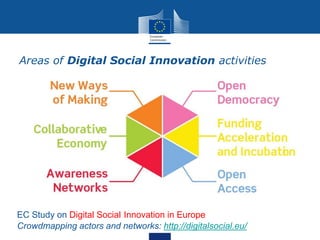
Areas of Digital Social Innovation activities
EC Study on Digital Social Innovation in Europe
Crowdmapping actors and networks: http://digitalsocial.eu/
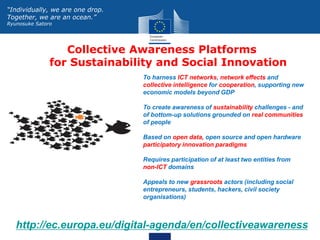
Collective Awareness Platforms
for Sustainability and Social Innovation
http://ec.europa.eu/digital-agenda/en/collectiveawareness
“Individually, we are one drop.
Together, we are an ocean.”
Ryunosuke Satoro
To harness ICT networks, network effects and
collective intelligence for cooperation, supporting new
economic models beyond GDP
To create awareness of sustainability challenges - and
of bottom-up solutions grounded on real communities
of people
Based on open data, open source and open hardware
participatory innovation paradigms
Requires participation of at least two entities from
non-ICT domains
Appeals to new grassroots actors (including social
entrepreneurs, students, hackers, civil society
organisations)
8
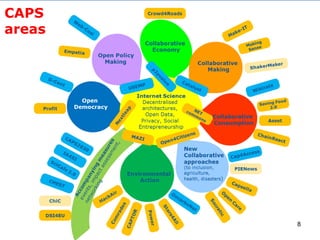
CAPS
areas
wp 2017
• CAPS:
• demonstrating new forms of bottom-up innovation and social
collaboration exploiting digital hyper-connectivity and collaborative
tools based on open data, open knowledge and open source and
hardware:
• New innovation models for economy and society
• Solutions for sustainable lifestyles such as collaborative
consumption and production, smart reuse and low carbon
approaches
• Emerging ethics of digital innovation, such as social
entrepreneurship, direct democracy and digital rights
Good to know
Workshop "Blockchains for Social Good"
Brussels, 21st June 2016
https://ec.europa.eu/digital-single-market/en/news/blockchains-
social-good
Workshop "Digital Social Innovation in Europe"
Brussels, 29th June 2016
https://www.eventbrite.nl/e/dsi4eu-shaping-the-future-of-digital-
social-innovation-in-europe-tickets-24925801744
ICT-11-2017 (CAPS)
 Submission deadline: 25 April 2017
 Budget: 10 M€
Website (background docs, projects, examples, etc.):
http://ec.europa.eu/digital-single-market/en/collectiveawareness
Crowdmapping DSI actors and networks: http://digitalsocial.eu
fabrizio.sestini@ec.europa.eu
CAPS @ DG Connect
THANK
YOU!
fabrizio.sestini@ec.europa.eu
loretta.anania@ec.europa.eu
johanna.schepers@ec.europa.eu
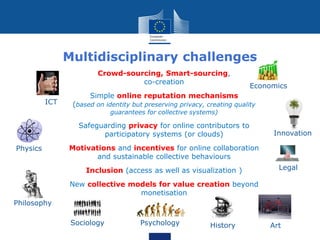
Multidisciplinary challenges
Legal
Physics
Sociology
Innovation
Economics
ArtPsychology
Philosophy
History
ICT
• Crowd-sourcing, Smart-sourcing,
co-creation
• Simple online reputation mechanisms
(based on identity but preserving privacy, creating quality
guarantees for collective systems)
• Safeguarding privacy for online contributors to
participatory systems (or clouds)
• Motivations and incentives for online collaboration
and sustainable collective behaviours
• Inclusion (access as well as visualization )
• New collective models for value creation beyond
monetisation
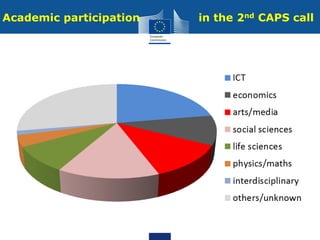
Academic participation in the 2nd CAPS call
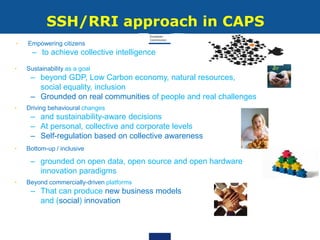
SSH/RRI approach in CAPS
• Sustainability as a goal
– beyond GDP, Low Carbon economy, natural resources,
social equality, inclusion
– Grounded on real communities of people and real challenges
• Driving behavioural changes
– and sustainability-aware decisions
– At personal, collective and corporate levels
– Self-regulation based on collective awareness
• Bottom-up / inclusive
– grounded on open data, open source and open hardware
innovation paradigms
• Beyond commercially-driven platforms
– That can produce new business models
and (social) innovation
• Empowering citizens
– to achieve collective intelligence
What do we NOT want?
15
• Proposals without a clear existing (and physical) community of
motivated users
 No "virtual" solution
• Proposals technology-driven, or aiming at purely commercial
solutions
 Rather integrating existing technologies
• Consortia without at least two partners which are focused on non-
ICT disciplines
 Be multidisciplinary!

Fabrizio Sestini - Collective awareness platforms

  • 1.
    Collective Awareness Platforms for. Sustainability and Social Innovation Fabrizio Sestini DG CONNECT E3 Net Innovation
  • 2.
    ••• 2 collaboration/socialvalues competition/individualinterests distributed centrally controlled FutureInternet scenarios (Oxford Internet Institute Study on Technological, Social and Economic aspects of FI http://cordis.europa.eu/fp7/ict/fire/fis/future-internet-and-society_en.html ) Big Brother: commercial services/ political interests entertainment DRM-heavy Collective Awareness: (user-gen. knowledge) P2P, wiki(-leaks), social nets, blogs e-democracy
  • 3.
    ••• 3 collaboration/socialvalues competition/individualinterests distributed, grassroots centrallycontrolled Current Internet scenarios Collective awareness access to culture direct participation crowdsourcing Google AmazonFaceBook Web entrepreneurs Uber, Airbnb Social entrepreneurs participatory innovation crowdfunding collaborative economy
  • 4.
    Technology 4 SocialGood 4 Centralised Decentralised One choice Multiple choices Uniformity Diversity Monopoly Network neutrality Proprietary solutions Open standards, open source Clouds Community networks Monitoring Privacy Asymmetric data governance Decentralised data governance
  • 5.
    Fixing asymmetry indata governance • Vision: a distributed architecture where each piece of user-generated information remains under the full control of the user who generated it • on personal data spaces at local level • subject to on-demand aggregation by third parties • enabling decentralised data governance 5
  • 6.
    Areas of DigitalSocial Innovation activities EC Study on Digital Social Innovation in Europe Crowdmapping actors and networks: http://digitalsocial.eu/
  • 7.
    Collective Awareness Platforms forSustainability and Social Innovation http://ec.europa.eu/digital-agenda/en/collectiveawareness “Individually, we are one drop. Together, we are an ocean.” Ryunosuke Satoro To harness ICT networks, network effects and collective intelligence for cooperation, supporting new economic models beyond GDP To create awareness of sustainability challenges - and of bottom-up solutions grounded on real communities of people Based on open data, open source and open hardware participatory innovation paradigms Requires participation of at least two entities from non-ICT domains Appeals to new grassroots actors (including social entrepreneurs, students, hackers, civil society organisations)
  • 8.
  • 9.
    wp 2017 • CAPS: •demonstrating new forms of bottom-up innovation and social collaboration exploiting digital hyper-connectivity and collaborative tools based on open data, open knowledge and open source and hardware: • New innovation models for economy and society • Solutions for sustainable lifestyles such as collaborative consumption and production, smart reuse and low carbon approaches • Emerging ethics of digital innovation, such as social entrepreneurship, direct democracy and digital rights
  • 10.
    Good to know Workshop"Blockchains for Social Good" Brussels, 21st June 2016 https://ec.europa.eu/digital-single-market/en/news/blockchains- social-good Workshop "Digital Social Innovation in Europe" Brussels, 29th June 2016 https://www.eventbrite.nl/e/dsi4eu-shaping-the-future-of-digital- social-innovation-in-europe-tickets-24925801744 ICT-11-2017 (CAPS)  Submission deadline: 25 April 2017  Budget: 10 M€ Website (background docs, projects, examples, etc.): http://ec.europa.eu/digital-single-market/en/collectiveawareness Crowdmapping DSI actors and networks: http://digitalsocial.eu fabrizio.sestini@ec.europa.eu
  • 11.
    CAPS @ DGConnect THANK YOU! fabrizio.sestini@ec.europa.eu loretta.anania@ec.europa.eu johanna.schepers@ec.europa.eu
  • 12.
    Multidisciplinary challenges Legal Physics Sociology Innovation Economics ArtPsychology Philosophy History ICT • Crowd-sourcing,Smart-sourcing, co-creation • Simple online reputation mechanisms (based on identity but preserving privacy, creating quality guarantees for collective systems) • Safeguarding privacy for online contributors to participatory systems (or clouds) • Motivations and incentives for online collaboration and sustainable collective behaviours • Inclusion (access as well as visualization ) • New collective models for value creation beyond monetisation
  • 13.
    Academic participation inthe 2nd CAPS call
  • 14.
    SSH/RRI approach inCAPS • Sustainability as a goal – beyond GDP, Low Carbon economy, natural resources, social equality, inclusion – Grounded on real communities of people and real challenges • Driving behavioural changes – and sustainability-aware decisions – At personal, collective and corporate levels – Self-regulation based on collective awareness • Bottom-up / inclusive – grounded on open data, open source and open hardware innovation paradigms • Beyond commercially-driven platforms – That can produce new business models and (social) innovation • Empowering citizens – to achieve collective intelligence
  • 15.
    What do weNOT want? 15 • Proposals without a clear existing (and physical) community of motivated users  No "virtual" solution • Proposals technology-driven, or aiming at purely commercial solutions  Rather integrating existing technologies • Consortia without at least two partners which are focused on non- ICT disciplines  Be multidisciplinary!