F904a Auditor Checklist & Site Self-Assessment Tool (English) BRCGS Global Standard Food Safety, Issue 9
Version 1 01/08/2022 Page 1 of 117
Global Standard Food Safety, Issue 9
F904a: Auditor Checklist & Site Self-Assessment
Tool
Welcome to the BRCGS Auditor Checklist & Site Self-Assessment tool
We hope that you will find this useful when preparing your site for an audit against the BRCGS Global
Standard for Food Safety, Issue 9.
How to use the BRCGS Auditor Checklist & Site Self-Assessment tool?
This tool is designed to help you assess your operation against the requirements of the Standard and
help prepare you for your certification audit.
The checklist covers each of the requirements of the Standard and may be used to check your site’s
compliance with each of these requirements. The checklist also allows you to add comments or
identify areas of improvement in the empty boxes provided at the end of each section.
While we hope that this tool is useful in helping you prepare for your audit it should not be considered
as evidence of an internal audit and will not be accepted by auditors during an audit.
Training
The BRCGS Training Academy has courses available to improve the understanding of the requirements
for the BRCGS Global Standard Food Safety Issue 9 and may be useful for the person using the BRCGS
Self-Assessment Tool. For further information on the courses available please visit the website.
Further Information
If you have any further questions about the BRCGS Self-Assessment Tool or the BRCGS Global
Standard Food Safety Issue 9, please do not hesitate to contact the BRCGS team.
Email – enquiries@brcgs.com
F904a Auditor Checklist & Site Self-Assessment Tool (English) BRCGS Global Standard Food Safety, Issue 9
Version 1 01/08/2022 Page 2 of 117
Change log:
Version no. Date Description
1 01/08/2022 New for Issue 9
F904a Auditor Checklist & Site Self-Assessment Tool (English) BRCGS Global Standard Food Safety, Issue 9
Version 1 01/08/2022 Page 3 of 117
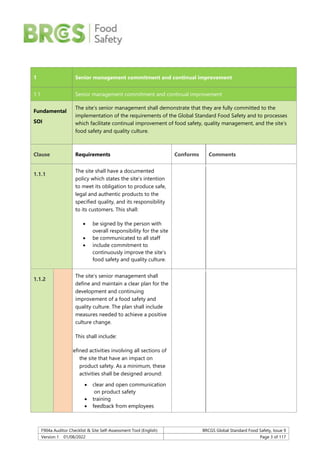
1 Senior management commitment and continual improvement
1.1 Senior management commitment and continual improvement
Fundamental
SOI
The site’s senior management shall demonstrate that they are fully committed to the
implementation of the requirements of the Global Standard Food Safety and to processes
which facilitate continual improvement of food safety, quality management, and the site’s
food safety and quality culture.
Clause Requirements Conforms Comments
1.1.1
The site shall have a documented
policy which states the site’s intention
to meet its obligation to produce safe,
legal and authentic products to the
specified quality, and its responsibility
to its customers. This shall:
 be signed by the person with
overall responsibility for the site
 be communicated to all staff
 include commitment to
continuously improve the site’s
food safety and quality culture.
1.1.2
The site’s senior management shall
define and maintain a clear plan for the
development and continuing
improvement of a food safety and
quality culture. The plan shall include
measures needed to achieve a positive
culture change.
This shall include:
defined activities involving all sections of
the site that have an impact on
product safety. As a minimum, these
activities shall be designed around:
 clear and open communication
on product safety
 training
 feedback from employees
F904a Auditor Checklist & Site Self-Assessment Tool (English) BRCGS Global Standard Food Safety, Issue 9
Version 1 01/08/2022 Page 4 of 117
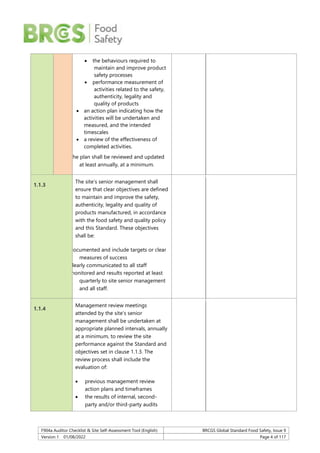
 the behaviours required to
maintain and improve product
safety processes
 performance measurement of
activities related to the safety,
authenticity, legality and
quality of products
 an action plan indicating how the
activities will be undertaken and
measured, and the intended
timescales
 a review of the effectiveness of
completed activities.
The plan shall be reviewed and updated
at least annually, at a minimum.
1.1.3
The site’s senior management shall
ensure that clear objectives are defined
to maintain and improve the safety,
authenticity, legality and quality of
products manufactured, in accordance
with the food safety and quality policy
and this Standard. These objectives
shall be:
documented and include targets or clear
measures of success
clearly communicated to all staff
monitored and results reported at least
quarterly to site senior management
and all staff.
1.1.4
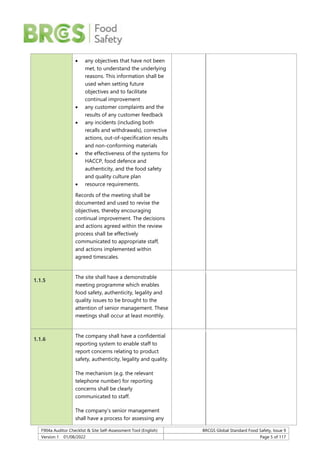
Management review meetings
attended by the site’s senior
management shall be undertaken at
appropriate planned intervals, annually
at a minimum, to review the site
performance against the Standard and
objectives set in clause 1.1.3. The
review process shall include the
evaluation of:
 previous management review
action plans and timeframes
 the results of internal, second-
party and/or third-party audits
F904a Auditor Checklist & Site Self-Assessment Tool (English) BRCGS Global Standard Food Safety, Issue 9
Version 1 01/08/2022 Page 5 of 117
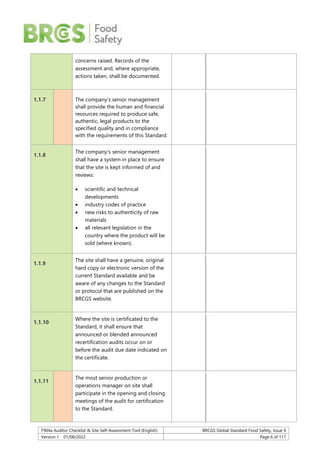
 any objectives that have not been
met, to understand the underlying
reasons. This information shall be
used when setting future
objectives and to facilitate
continual improvement
 any customer complaints and the
results of any customer feedback
 any incidents (including both
recalls and withdrawals), corrective
actions, out-of-specification results
and non-conforming materials
 the effectiveness of the systems for
HACCP, food defence and
authenticity, and the food safety
and quality culture plan
 resource requirements.
Records of the meeting shall be
documented and used to revise the
objectives, thereby encouraging
continual improvement. The decisions
and actions agreed within the review
process shall be effectively
communicated to appropriate staff,
and actions implemented within
agreed timescales.
1.1.5
The site shall have a demonstrable
meeting programme which enables
food safety, authenticity, legality and
quality issues to be brought to the
attention of senior management. These
meetings shall occur at least monthly.
1.1.6
The company shall have a confidential
reporting system to enable staff to
report concerns relating to product
safety, authenticity, legality and quality.
The mechanism (e.g. the relevant
telephone number) for reporting
concerns shall be clearly
communicated to staff.
The company’s senior management
shall have a process for assessing any
F904a Auditor Checklist & Site Self-Assessment Tool (English) BRCGS Global Standard Food Safety, Issue 9
Version 1 01/08/2022 Page 6 of 117
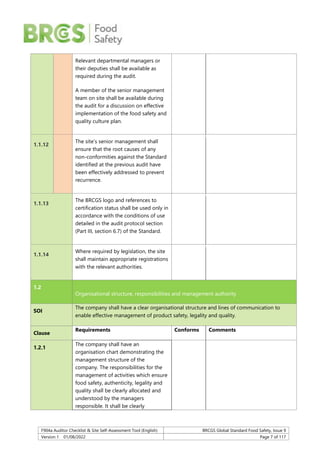
concerns raised. Records of the
assessment and, where appropriate,
actions taken, shall be documented.
1.1.7 The company’s senior management
shall provide the human and financial
resources required to produce safe,
authentic, legal products to the
specified quality and in compliance
with the requirements of this Standard.
1.1.8
The company’s senior management
shall have a system in place to ensure
that the site is kept informed of and
reviews:
 scientific and technical
developments
 industry codes of practice
 new risks to authenticity of raw
materials
 all relevant legislation in the
country where the product will be
sold (where known).
1.1.9
The site shall have a genuine, original
hard copy or electronic version of the
current Standard available and be
aware of any changes to the Standard
or protocol that are published on the
BRCGS website.
1.1.10
Where the site is certificated to the
Standard, it shall ensure that
announced or blended announced
recertification audits occur on or
before the audit due date indicated on
the certificate.
1.1.11
The most senior production or
operations manager on site shall
participate in the opening and closing
meetings of the audit for certification
to the Standard.
F904a Auditor Checklist & Site Self-Assessment Tool (English) BRCGS Global Standard Food Safety, Issue 9
Version 1 01/08/2022 Page 7 of 117
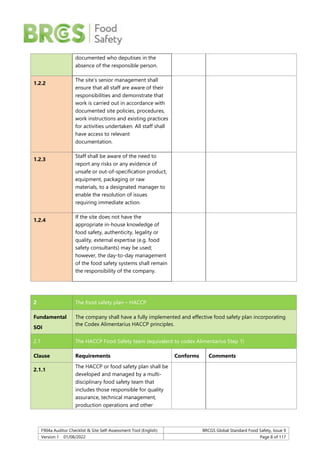
Relevant departmental managers or
their deputies shall be available as
required during the audit.
A member of the senior management
team on site shall be available during
the audit for a discussion on effective
implementation of the food safety and
quality culture plan.
1.1.12
The site’s senior management shall
ensure that the root causes of any
non-conformities against the Standard
identified at the previous audit have
been effectively addressed to prevent
recurrence.
1.1.13
The BRCGS logo and references to
certification status shall be used only in
accordance with the conditions of use
detailed in the audit protocol section
(Part III, section 6.7) of the Standard.
1.1.14
Where required by legislation, the site
shall maintain appropriate registrations
with the relevant authorities.
1.2
Organisational structure, responsibilities and management authority
SOI
The company shall have a clear organisational structure and lines of communication to
enable effective management of product safety, legality and quality.
Clause
Requirements Conforms Comments
1.2.1
The company shall have an
organisation chart demonstrating the
management structure of the
company. The responsibilities for the
management of activities which ensure
food safety, authenticity, legality and
quality shall be clearly allocated and
understood by the managers
responsible. It shall be clearly
F904a Auditor Checklist & Site Self-Assessment Tool (English) BRCGS Global Standard Food Safety, Issue 9
Version 1 01/08/2022 Page 8 of 117
documented who deputises in the
absence of the responsible person.
1.2.2
The site’s senior management shall
ensure that all staff are aware of their
responsibilities and demonstrate that
work is carried out in accordance with
documented site policies, procedures,
work instructions and existing practices
for activities undertaken. All staff shall
have access to relevant
documentation.
1.2.3
Staff shall be aware of the need to
report any risks or any evidence of
unsafe or out-of-specification product,
equipment, packaging or raw
materials, to a designated manager to
enable the resolution of issues
requiring immediate action.
1.2.4
If the site does not have the
appropriate in-house knowledge of
food safety, authenticity, legality or
quality, external expertise (e.g. food
safety consultants) may be used;
however, the day-to-day management
of the food safety systems shall remain
the responsibility of the company.
2 The food safety plan – HACCP
Fundamental
SOI
The company shall have a fully implemented and effective food safety plan incorporating
the Codex Alimentarius HACCP principles.
2.1 The HACCP Food Safety team (equivalent to codex Alimentarius Step 1)
Clause Requirements Conforms Comments
2.1.1
The HACCP or food safety plan shall be
developed and managed by a multi-
disciplinary food safety team that
includes those responsible for quality
assurance, technical management,
production operations and other
F904a Auditor Checklist & Site Self-Assessment Tool (English) BRCGS Global Standard Food Safety, Issue 9
Version 1 01/08/2022 Page 9 of 117
relevant functions (e.g. engineering,
hygiene).
The team leader shall have an in-depth
knowledge of Codex HACCP principles
(or equivalent) and be able to
demonstrate competence, experience
and training. Where there is a legal
requirement for specific training, this
shall be in place.
The team members shall have specific
knowledge of HACCP and relevant
knowledge of products, processes and
associated hazards.
2.1.2
The scope of each HACCP or food
safety plan, including the products and
processes covered, shall be defined.
2.2 Prerequisite programmes
Clause Requirements Conforms Comments
2.2.1
The site shall establish and maintain
environmental and operational
programmes necessary to create an
environment suitable to produce safe
and legal food products (prerequisite
programmes). As a guide these may
include the following, although this is
not an exhaustive list:
 cleaning and disinfection (see
section 4.11)
 pest management (see section
4.14)
 maintenance programmes for
equipment and buildings (see
sections 4.4 and 4.6)
 personal hygiene requirements
(see section 7.2)
 staff training (see section 7.1)
 supplier approval and purchasing
(see section 3.5.1)
 transportation arrangements (see
section 4.16)
F904a Auditor Checklist & Site Self-Assessment Tool (English) BRCGS Global Standard Food Safety, Issue 9
Version 1 01/08/2022 Page 10 of 117
 processes to prevent cross-
contamination (see sections 4.9
and 4.10)
 allergen management (see section
5.3).
The prerequisite programmes for the
particular areas of the site shall take
into account the production risk
zoning (see clause 4.3.1).
The control measures and monitoring
procedures for the prerequisite
programmes shall be clearly
documented and shall be included
within the development and reviews of
the HACCP or food safety plan.
2.3 Describe the product (equivalent to Codex Alimentarius Step 2)
Clause Requirements Conforms Comments
2.3.1
A full description for each product or
group of products shall be developed,
which includes all relevant information
on food safety. As a guide, this may
include the following, although this is
not an exhaustive list:
 composition (e.g. raw materials,
ingredients, allergens, recipe)
 origin of ingredients
 physical or chemical properties
that impact food safety (e.g. pH,
aw)
 treatment and processing (e.g.
cooking, cooling)
 packaging system (e.g. modified
atmosphere, vacuum)
 storage and distribution conditions
(e.g. chilled, ambient)
 maximum safe shelf life under
prescribed storage and usage
conditions.
2.3.2
All relevant information needed to
conduct the hazard analysis shall be
collected, maintained, documented
and updated. The company shall
ensure that the HACCP or food safety
F904a Auditor Checklist & Site Self-Assessment Tool (English) BRCGS Global Standard Food Safety, Issue 9
Version 1 01/08/2022 Page 11 of 117
plan is based on comprehensive
information sources, which are
referenced and available on request. As
a guide, this may include the following,
although this is not an exhaustive list:
 the latest scientific literature
 historical and known hazards
associated with specific food
products
 relevant codes of practice
 recognised guidelines
 food safety legislation relevant for
the production and sale of
products
 customer requirements
 a copy of any existing site HACCP
plans (e.g. for products already in
production at the site)
 a map of the premises and
equipment layout (see clause 4.3.2)
 a water distribution diagram for
the site (see clause 4.5.2)
indication of any areas (zones) where
high-risk, high-care or ambient high-
care production facilities are required
(see clause 4.3.1).
2.4 Identify intended use (equivalent to Codex Alimentarius Step 3)
Clause Requirements Conforms Comments
2.4.1 The intended use of the product by the
customer, and expected alternative
uses, shall be described, defining the
consumer target groups, including the
suitability of the product for vulnerable
groups of the population (e.g. infants,
elderly, allergy sufferers).
2.5 Construct a process flow diagram (equivalent to Codex Alimentarius Step 4)
Clause Requirements Conforms Comments
2.5.1
A flow diagram shall be prepared to
cover each product, product category
or process. This shall set out all aspects
of the food process operation within
the HACCP or food safety plan scope,
from raw material receipt through to
F904a Auditor Checklist & Site Self-Assessment Tool (English) BRCGS Global Standard Food Safety, Issue 9
Version 1 01/08/2022 Page 12 of 117
processing, storage and distribution.
As a guide, this should include the
following, although this is not an
exhaustive list:
 plan of premises and equipment
layout
 raw materials, including
introduction of utilities and other
contact materials (e.g. water,
packaging)
 sequence and interaction of all
process steps
 outsourced processes and
subcontracted work
 potential for process delay
 rework and recycling
 low-risk/high-risk/high-care area
segregation
 finished products,
intermediate/semi-processed
products, by-products and waste.
2.6 Verify flow diagram (equivalent to Codex Alimentarius Step 5)
Clause Requirements Conforms Comments
2.6.1
The HACCP food safety team shall verify
the accuracy of the flow diagrams by
on-site audit at least annually, and
whenever there are changes to the
process, to ensure any changes have
been considered as a part of the
HACCP or food safety plan. Daily and
seasonal variations shall be
considered and evaluated. Records of
verified flow diagrams shall be
maintained.
2.7 List all potential hazards associated with each process step, conduct a hazard analysis and
consider any measures to control identified hazards (equivalent to Codex Alimentarius Step
6, Principle 1)
Clause Requirements Conforms Comments
2.7.1
The HACCP food safety team shall
identify and record all the potential
hazards that are reasonably expected
to occur at each step in relation to
product, process and facilities. This
F904a Auditor Checklist & Site Self-Assessment Tool (English) BRCGS Global Standard Food Safety, Issue 9
Version 1 01/08/2022 Page 13 of 117
shall include hazards present in raw
materials, those introduced during the
process or surviving the process steps,
and consideration of the following
types of hazard:
 microbiological
 physical contamination
 chemical and radiological
contamination
 fraud (e.g. substitution or
deliberate/intentional adulteration)
(see section 5.4)
 malicious contamination of
products (see section 4.2)
 allergen risks (see section 5.3).
It shall also take account of the
preceding and following steps in the
process chain.
2.7.2
The HACCP food safety team shall
conduct a hazard analysis to identify
the significant hazards (i.e. those
hazards that are reasonably likely to
occur at an unacceptable level), which
need to be prevented, eliminated or
reduced to acceptable levels.
Consideration shall be given to the
following:
 likely occurrence of hazard
 severity of the effects on consumer
safety
 vulnerability of those exposed
 survival and multiplication of
micro-organisms of specific
concern to the product
 presence or production of toxins,
chemicals or foreign bodies
 contamination of raw materials,
intermediate/semi-processed
product, or finished product.
Where elimination of the hazard is not
practical, justification for acceptable
levels of the hazard in the finished
F904a Auditor Checklist & Site Self-Assessment Tool (English) BRCGS Global Standard Food Safety, Issue 9
Version 1 01/08/2022 Page 14 of 117
product shall be determined and
documented.
2.7.3
The HACCP food safety team shall
consider the control measures
necessary to prevent or eliminate a
food safety hazard or reduce it to an
acceptable level.
Consideration may be given to using
more than one control measure.
2.7.4
Where the control of a specific food
safety hazard is achieved through
prerequisite programmes (see section
2.2) or control measures other than
critical control points (CCPs; see clause
2.8.1), this shall be stated and the
adequacy of the programme to control
the specific hazard validated.
2.8 Determine the critical control points (CCPs) (equivalent to Codex Alimentarius Step 7,
Principle 2)
Clause Requirements Conforms Comments
2.8.1 For each hazard that requires control,
control points shall be reviewed to
identify those that are critical. This
requires a logical approach and may
be facilitated by use of a decision tree.
CCPs shall be those control points
which are required in order to prevent
or eliminate a food safety hazard or
reduce it to an acceptable level. If a
hazard is identified at a step where
control is necessary for safety but the
control does not exist, the product or
process shall be modified at that step,
or at an earlier step, to provide a
control measure.
2.9 Establish validated critical limits for each CCP (equivalent to Codex Alimentarius Step 8,
Principle 3)
Clause Requirements Conforms Comments
2.9.1
For each CCP, the appropriate critical
limits shall be defined in order to
identify clearly whether the process is
F904a Auditor Checklist & Site Self-Assessment Tool (English) BRCGS Global Standard Food Safety, Issue 9
Version 1 01/08/2022 Page 15 of 117
in or out of control. Critical limits shall
be:
 measurable wherever possible (e.g.
time, temperature, pH)
 supported by clear guidance or
examples where measures are
subjective (e.g. photographs).
2.9.2
The HACCP food safety team shall
validate each CCP, including critical
limits. Documented evidence shall
show that the control measures
selected and critical limits identified
are capable of consistently controlling
the hazard to the specified acceptable
level.
2.10 Establish a monitoring system for each CCP (equivalent to Codex Alimentarius Step 9,
Principle 4)
Clause Requirements Conforms
2.10.1
A monitoring procedure shall be
established for each CCP to ensure
compliance with critical limits. The
monitoring system shall be able to
detect loss of control of CCPs and,
wherever possible, provide information
in time for corrective action to be
taken. As a guide, consideration may
be given to the following, although
this is not an exhaustive list:
 online measurement
 offline measurement
 continuous measurement (e.g.
thermographs, pH meters).
Where discontinuous measurement is
used, the system shall ensure that the
sample taken is representative of the
batch of product.
2.10.2
Records associated with the
monitoring of each CCP shall include
the date, time and result of
measurement, and shall be signed by
the person responsible for the
monitoring and verified, when
appropriate, by a suitably competent
F904a Auditor Checklist & Site Self-Assessment Tool (English) BRCGS Global Standard Food Safety, Issue 9
Version 1 01/08/2022 Page 16 of 117
and authorised person. Where records
are in electronic form, there shall be
evidence that records have been
checked and verified.
2.11 Establish a corrective action plan (equivalent to Codex Alimentarius Step 10, Principle 5)
Clause Requirements Conforms Comments
2.11.1 The HACCP food safety team shall
specify and document the corrective
action to be taken when monitored
results indicate a failure to meet a
control limit, or when monitored
results indicate a trend towards loss of
control. This shall include the action to
be taken by nominated personnel with
regard to any products that have been
manufactured during the period when
the process was out of control.
2.12 Validate the HACCP plan and establish verification procedures (equivalent to Codex
Alimentarius Step 11, Principle 6)
Clause Requirements Conforms Comments
2.12.1
HACCP or food safety plans shall be
validated prior to any changes which
may affect product safety, to ensure
that the plan will effectively control the
identified hazards before
implementation.
For existing HACCP or food safety
plans, this may be achieved using the
established processes detailed in
clauses 2.12.2 and 2.12.3.
2.12.2
Procedures of verification shall be
established to confirm that the HACCP
or food safety plan, including controls
managed by prerequisite programmes,
continues to be effective. Examples of
verification activities include:
 internal audits
 review of records where acceptable
limits have been exceeded
 review of complaints by
enforcement authorities or
customers
F904a Auditor Checklist & Site Self-Assessment Tool (English) BRCGS Global Standard Food Safety, Issue 9
Version 1 01/08/2022 Page 17 of 117
 review of incidents of product
withdrawal or recall.
Results of verification shall be recorded
and communicated to the HACCP food
safety team.
2.12.3
The HACCP food safety team shall
review the HACCP or food safety plan
and prerequisite programmes at least
annually and prior to any changes
which may affect food safety. As a
guide, these may include the following,
although this is not an exhaustive list:
 change in raw materials or supplier
of raw materials
 change in ingredients/recipe
 change in processing conditions,
cleaning and disinfection
procedures, process flow or
equipment
 change in packaging, storage or
distribution conditions
 change in consumer use
 emergence of a new risk (e.g.
known adulteration of an
ingredient or other relevant,
published information, such as the
recall of a similar product)
 review following a significant
product safety incident (e.g. a
product recall)
 new developments in scientific
information associated with
ingredients, process, packaging or
product.
Appropriate changes resulting from
the review shall be incorporated into
the HACCP or food safety plan and/or
prerequisite programmes. Changes
shall be fully documented, and the
validation shall be recorded.
Where appropriate, the changes shall
also be reflected in the company’s
F904a Auditor Checklist & Site Self-Assessment Tool (English) BRCGS Global Standard Food Safety, Issue 9
Version 1 01/08/2022 Page 18 of 117
product safety policy and food safety
objectives.
2.13 HACCP documentation and record-keeping (equivalent to Codex Alimentarius Step 12,
Principle 7)
Clause Requirements Conforms Comments
2.13.1
Documentation and record-keeping
shall be sufficient to enable the site to
verify that the HACCP and food safety
controls, including controls managed
by prerequisite programmes, are in
place and maintained.
3 Food safety and quality management system
3.1 Food safety and quality manual
SOI
The company’s processes and procedures to meet the requirements of this Standard shall
be documented to allow effective, consistent application, facilitate training, and support due
diligence in the production of a safe product.
Clause Requirements Conforms Comments
3.1.1 The site’s procedures, working
methods and practices shall be
collated in the form of a printed or
electronic quality manual.
3.1.2 The food safety and quality manual
shall be fully implemented and the
manual or relevant components shall
be readily available to relevant staff.
3.1.3 All procedures and work instructions
shall be clearly legible, unambiguous,
in appropriate languages and
sufficiently detailed to enable their
correct application by appropriate
staff. This should include the use of
photographs, diagrams or other
pictorial instructions where written
communication alone is not sufficient
(e.g. there are issues of literacy or
foreign language).
3.2 Document control
F904a Auditor Checklist & Site Self-Assessment Tool (English) BRCGS Global Standard Food Safety, Issue 9
Version 1 01/08/2022 Page 19 of 117
SOI
The company shall operate an effective document control system to ensure that only the
correct versions of documents, including recording forms, are available and in use.
Clause Requirements Conforms Comments
3.2.1
The company shall have a procedure to
manage documents which form part of
the food safety and quality system.
This shall include:
 a list of all controlled documents
indicating the latest version
number
 the method for the identification
and authorisation of controlled
documents
 a record of the reason for any
changes or amendments to
documents
 the system for the replacement of
existing documents when these are
updated.
Where documents are stored in
electronic form these shall also be:
 stored securely (e.g. with
authorised access, control of
amendments, or password
protection)
 backed up to prevent loss.
3.3 Record completion and maintenance
SOI
The site shall maintain genuine records to demonstrate the effective control of product
safety, legality and quality.
Clause Requirements Conforms Comments
3.3.1
Records shall be legible, maintained in
good condition and retrievable. Any
alterations to records shall be
authorised and justification for the
alteration shall be recorded. Where
records are in electronic form these
shall also be:
 stored securely (e.g. with
authorised access, control of
F904a Auditor Checklist & Site Self-Assessment Tool (English) BRCGS Global Standard Food Safety, Issue 9
Version 1 01/08/2022 Page 20 of 117
amendments, or password
protection)
 suitably backed up to prevent loss.
3.3.2
Records shall be retained for a defined
period with consideration given to:
 any legal or customer
requirements
 the shelf life of the product.
This shall take into account, where it is
specified on the label, the possibility
that shelf life may be extended by the
consumer (e.g. by freezing).
At a minimum, records shall be
retained for the shelf life of the
product plus 12 months.
3.4 Internal audits
Fundamental
SOI
The company shall be able to demonstrate that it verifies the effective application of the
food safety plan, and the implementation of the requirements of the Global Standard Food
Safety and the site’s food safety and quality management system.
Clause Requirements Conforms Comments
3.4.1
There shall be a scheduled programme
of internal audits.
At a minimum, the programme shall
include at least four different audit
dates spread throughout the year. The
frequency at which each activity is
audited shall be established in relation
to the risks associated with the activity
and previous audit performance. All
activities that form a part of the site’s
food safety and quality systems,
including those relevant to food safety,
authenticity, legality and quality, shall
be covered at least once each year.
The scope of the internal audit
programme shall include, although this
is not an exhaustive list:
 HACCP or food safety plan,
including the activities to
F904a Auditor Checklist & Site Self-Assessment Tool (English) BRCGS Global Standard Food Safety, Issue 9
Version 1 01/08/2022 Page 21 of 117
implement it (e.g. supplier
approval, corrective actions and
verification)
 prerequisite programmes (e.g.
hygiene, pest management)
 food defence and food fraud
prevention plans
 procedures implemented to
achieve the Standard.
Each internal audit within the
programme shall have a defined scope
and consider a specific activity or a
section of the HACCP or food safety
plan.
3.4.2
Internal audits shall be carried out by
appropriately trained, competent
auditors. Auditors shall be
independent (i.e. not audit their own
work).
3.4.3
The internal audit programme shall be
fully implemented. Internal audit
reports shall identify conformity as well
as non-conformity and include
objective evidence of the findings.
The results shall be reported to the
personnel responsible for the activity
audited.
Corrective and preventive actions, and
timescales for their implementation,
shall be agreed and their completion
verified. All non-conformities shall be
handled as detailed in section 3.7. A
summary of the results shall be
reviewed in the management review
meetings (see clause 1.1.4).
3.4.4
In addition to the internal audit
programme, there shall be a separate
programme of documented
inspections to ensure that the factory
environment and processing
equipment are maintained in a suitable
condition for food production. At a
F904a Auditor Checklist & Site Self-Assessment Tool (English) BRCGS Global Standard Food Safety, Issue 9
Version 1 01/08/2022 Page 22 of 117
minimum, these inspections shall
include:
 hygiene inspections to assess
cleaning and housekeeping
performance
 fabrication inspections (e.g. doors,
walls, facilities and equipment) to
identify risks to the product from
the building or equipment.
The frequency of these inspections
shall be based on risk and on any
changes that may affect food safety,
but shall be no less than once per
month in open product areas.
The results shall be reported to the
personnel responsible for the activity
or area audited.
Corrective actions, and timescales for
their implementation, shall be agreed
and their completion verified.
A summary of the results shall be
reviewed in the management review
meetings (see clause 1.1.4).
3.5 Supplier and raw material approval and performance monitoring
3.5.1 Management of suppliers of raw materials and packaging
Fundamental
SOI
The company shall have an effective supplier approval and monitoring system to ensure that
any potential risks from raw materials (including primary packaging) to the safety,
authenticity, legality and quality of the final product are understood and managed.
Clause Requirements Conforms Comments
3.5.1.1 The company shall undertake a
documented risk assessment of each
raw material or group of raw materials,
including primary packaging, to
identify potential risks to product
safety, authenticity, legality and quality.
This shall take into account the
potential for:
 allergens (allergen content and
potential contamination)
F904a Auditor Checklist & Site Self-Assessment Tool (English) BRCGS Global Standard Food Safety, Issue 9
Version 1 01/08/2022 Page 23 of 117
 foreign-body risks
 microbiological contamination
 chemical contamination
 variety or species cross-
contamination
 substitution or fraud (see clause
5.4.2)
 any risks associated with raw
materials which are subject to
legislative control or customer
requirements.
Consideration shall also be given to
the significance of a raw material to
the quality of the final product.
The risk assessment shall form the
basis for the raw material acceptance
and testing procedure and for the
processes adopted for supplier
approval and monitoring.
The risk assessment for a raw material
shall be updated:
 when there is a change in a raw
material, the processing of a raw
material, or the supplier of a raw
material
 if a new risk emerges
 following a product recall or
withdrawal, where a specific raw
material has been implicated
 at least every 3 years.
3.5.1.2 The company shall have a documented
supplier approval procedure to ensure
that all suppliers of raw materials,
including primary packaging,
effectively manage risks to raw
material quality and safety and are
operating effective traceability
processes. The approval procedure
shall be based on risk and include
either one or a combination of:
 a valid certification to the
applicable BRCGS Standard or
GFSI-benchmarked standard. The
F904a Auditor Checklist & Site Self-Assessment Tool (English) BRCGS Global Standard Food Safety, Issue 9
Version 1 01/08/2022 Page 24 of 117
scope of the certification shall
include the raw materials
purchased
or
 supplier audits, with a scope to
include product safety, traceability,
HACCP review, the product
security and food defence plan,
the product authenticity plan and
good manufacturing practices. The
audit shall ensure that these plans
form part of the supplier’s product
safety management system and
that any resultant actions are
implemented. The supplier audit
shall be undertaken by an
experienced and demonstrably
competent product safety auditor.
Where the supplier audit is
completed by a second or third
party, the company shall be able
to:
 demonstrate the competency
of the auditor
 confirm that the scope of the
audit includes product safety,
product security and food
defence plan, product
authenticity, traceability,
HACCP review and good
manufacturing practices
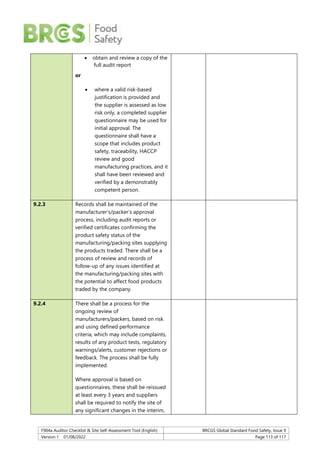
 obtain and review a copy of the
full audit report
or
where a valid risk-based justification is
provided and the supplier is assessed
as low risk only, a completed supplier
questionnaire may be used for initial
approval. At a minimum, the
questionnaire shall have a scope that
includes product safety, product
security and food defence, product
authenticity, traceability, HACCP
review and good manufacturing
practices. The questionnaire shall
F904a Auditor Checklist & Site Self-Assessment Tool (English) BRCGS Global Standard Food Safety, Issue 9
Version 1 01/08/2022 Page 25 of 117
have been reviewed and verified by a
demonstrably competent person.
3.5.1.3 There shall be a documented process
for ongoing supplier performance
review, based on risk and defined
performance criteria. The process shall
be fully implemented.
Where approval is based on
questionnaires, these shall be reissued
at least every 3 years and suppliers
shall be required to notify the site of
any significant changes in the interim,
including any change in certification
status.
Records of the review shall be kept.
3.5.1.4 The site shall have an up-to-date list or
database of approved suppliers. This
may be on paper (hard copy) or it may
be controlled on an electronic system.
The list or relevant components of the
database shall be readily available to
the relevant staff (e.g. at goods
receipt).
3.5.1.5 Where raw materials (including primary
packaging) are purchased from
companies that are not the
manufacturer, packer or consolidator
(e.g. purchased from an agent, broker
or wholesaler), the site shall know the
identity of the last manufacturer or
packer, or for bulk commodity
products the consolidation place of the
raw material.
Information to enable the approval of
the manufacturer, packer or
consolidator, as in clauses 3.5.1.1 and
3.5.1.2, shall be obtained from the
agent/broker or directly from the
supplier, unless the agent/broker is
themselves certificated to a BRCGS
Standard (e.g. Global Standard Agents
F904a Auditor Checklist & Site Self-Assessment Tool (English) BRCGS Global Standard Food Safety, Issue 9
Version 1 01/08/2022 Page 26 of 117
and Brokers) or a standard
benchmarked by GFSI.
3.5.1.6 The company shall ensure that its
suppliers of raw materials (including
primary packaging) have an effective
traceability system. Where a supplier
has been approved based on a
questionnaire instead of certification or
audit, verification of the supplier’s
traceability system shall be carried out
on first approval and then at least
every 3 years. This may be achieved by
a traceability test.
Where the supplier is not the
manufacturer, packer or consolidator
of the raw material (e.g. purchased
from an agent, broker or wholesaler)
and approval is based on a
questionnaire instead of certification or
audit, the verification of the traceability
system shall be carried out on the last
manufacturer, packer or consolidator
of the raw material.
Where a raw material is received
directly from a farm or fish farm,
further verification of the farm’s
traceability system is not mandatory.
3.5.1.7 The procedures shall define the actions
required in either of the following
circumstances:
 an exception to the supplier
approval processes in clause
3.5.1.2 occurs (e.g. where raw
material suppliers are prescribed
by a customer)
 information for effective supplier
approval is not available (e.g. bulk
agricultural commodity products).
In both the above situations, product
testing is used to verify product quality
and safety.
F904a Auditor Checklist & Site Self-Assessment Tool (English) BRCGS Global Standard Food Safety, Issue 9
Version 1 01/08/2022 Page 27 of 117
When a site produces customer-
branded product, the customer shall
be made aware of the relevant
exceptions.
3.5.2 Raw material and packaging acceptance, monitoring and management procedures
SOI Controls on the acceptance of raw materials (including primary packaging) shall ensure that
these do not compromise the safety, legality or quality of products and, where appropriate,
any claims of authenticity.
Clause Requirements Conforms Comments
3.5.2.1 The company shall have a procedure
for the acceptance of raw materials
and primary packaging on receipt
based upon the risk assessment (clause
3.5.1.1). Acceptance of raw materials
(including primary packaging) and
their release for use shall be based on
either one or a combination of:
 product sampling and testing
 visual inspection on receipt
 certificates of analysis (specific to
the consignment)
 certificates of conformance.
A list of raw materials (including
primary packaging) and the
requirements to be met for acceptance
shall be available. The parameters for
acceptance and frequency of testing
shall be clearly defined, implemented
and reviewed.
3.5.2.2 Procedures shall be in place to ensure
that approved changes to raw
materials (including primary
packaging) are communicated to
goods receipt personnel and that only
the correct version of the raw material
is accepted. For example, when labels
or printed packaging have been
amended, only the correct version
should be accepted and released into
production.
F904a Auditor Checklist & Site Self-Assessment Tool (English) BRCGS Global Standard Food Safety, Issue 9
Version 1 01/08/2022 Page 28 of 117
3.5.3 Management of suppliers of services
SOI The company shall be able to demonstrate that where services are outsourced, the service is
appropriate and any risks presented to food safety, authenticity, legality and quality have
been evaluated to ensure effective controls are in place.
Clause Requirements Conforms Comments
3.5.3.1 There shall be a procedure for the
approval and monitoring of suppliers
of services. Such services shall include,
as appropriate:
 pest control
 laundry services
 contracted cleaning
 contracted servicing and
maintenance of equipment
 transport and distribution
 off-site storage of ingredients or
packaging (other than at the
supplier’s facilities) prior to
delivery to the site
 off-site packing of products
 laboratory testing
 catering services
 waste management
 providers of product safety
training
 product safety consultants.
This approval and monitoring process
shall be risk-based and take into
consideration:
 risk to the safety and quality of
products
 compliance with any specific legal
requirements
 potential risks to the security of
the product (i.e. risks identified in
the vulnerability and food defence
assessments).
3.5.3.2 Contracts or formal agreements shall
exist with the suppliers of services that
clearly define service expectations and
ensure that the potential food safety
F904a Auditor Checklist & Site Self-Assessment Tool (English) BRCGS Global Standard Food Safety, Issue 9
Version 1 01/08/2022 Page 29 of 117
risks associated with the service have
been addressed.
3.5.3.3 There shall be a documented process
for ongoing performance review of
suppliers of services, based on risk and
defined performance criteria. The
process shall be fully implemented.
Records of the review shall be kept.
3.5.4 Management of outsourced processing
Explaining
outsourced
processing
Outsourced processing (also referred to as ‘subcontracted processing’) is defined as where
intermediate production, processing, storage or any intermediate step in the manufacture of
a product is completed at another company or another site.
It should be noted that outsourced processing refers to an intermediate step – therefore
during outsourced processing the product or partly processed product leaves the site being
audited for the completion of the outsourced processing, before returning to the site. The
audited site may or may not complete additional packing or processing steps on the
product.
Where there is additional storage or processing of raw materials prior to their initial arrival
on site, this is not considered outsourced processing, but should be managed by the site
using supplier approval, raw material risk assessments and raw material specifications.
Where a product leaves the site and does not return to it, this is not outsourced processing,
and the activities completed off site are outside the scope of the audit.
SOI Where any intermediate process step (including production, processing or storage) in the
manufacture of a product is outsourced to a third party or undertaken at another site, and
subsequently returned to the site, this shall be managed to ensure it does not compromise
the product safety, authenticity, legality or quality.
Clause Requirements Conforms Comments
3.5.4.1 The company shall be able to
demonstrate that, where part of the
production process (i.e. any
intermediate process step) is
outsourced or undertaken off site, and
subsequently returned to the site, this
has been declared to the customer
and, where required, approval granted.
3.5.4.2 The company shall ensure that
outsourced processors are approved
and monitored, to ensure that they
F904a Auditor Checklist & Site Self-Assessment Tool (English) BRCGS Global Standard Food Safety, Issue 9
Version 1 01/08/2022 Page 30 of 117
effectively manage risks to product
safety and quality and are operating
effective traceability processes.
The approval and monitoring
procedure shall be based on risk and
include either one or a combination of:
 a valid certification to the
applicable BRCGS Standard or
GFSI-benchmarked standard. The
scope of the certification shall
include the activities completed for
the site
or
 supplier audits, with a scope to
include product safety, traceability,
HACCP review, product security
and food defence plan, product
authenticity plan and good
manufacturing practices. The audit
shall ensure that these plans form
part of the supplier’s product
safety management system and
that any resultant actions are
implemented. The supplier audit
shall be undertaken by an
experienced and demonstrably
competent product safety auditor.
Where this supplier audit is
completed by a second or third
party, the company shall be able
to:
 demonstrate the competency
of the auditor
 confirm that the scope of the
audit includes product safety,
traceability, HACCP review,
product security and food
defence plan, product
authenticity plan and good
manufacturing practices
 obtain and review a copy of the
full audit report.
There shall be a documented process
for ongoing supplier performance
review, based on risk and defined
F904a Auditor Checklist & Site Self-Assessment Tool (English) BRCGS Global Standard Food Safety, Issue 9
Version 1 01/08/2022 Page 31 of 117
performance criteria. The process shall
be fully implemented. Records of the
review shall be kept.
3.5.4.3 Where any processes are outsourced,
including production, manufacture,
processing or storage, the risks to the
product safety, authenticity and
legality shall form part of the site’s
food safety plan (HACCP plan).
3.5.4.4 Requirements for outsourced
processing shall be agreed and
documented in a service specification
(similar to a finished product
specification). This shall include any
specific handling requirements for the
products.
3.5.4.5 Any outsourced processing operations
shall:
 be undertaken in accordance with
established contracts which clearly
define any processing
requirements
 maintain product traceability.
3.5.4.6 The company shall establish inspection
and test procedures for products
where part of the processing has been
outsourced, including visual, chemical
and/or microbiological testing.
The frequency and methods of
inspection or testing shall depend on
risk assessment.
3.6 Specifications
SOI Specifications shall exist for raw materials (including primary packaging), finished products
and any product or service which could affect the integrity of the finished product.
Clause Requirements Conforms Comments
3.6.1 Specifications for raw materials and
primary packaging shall be adequate
and accurate and ensure compliance
with relevant safety and legislative
requirements. The specifications shall
F904a Auditor Checklist & Site Self-Assessment Tool (English) BRCGS Global Standard Food Safety, Issue 9
Version 1 01/08/2022 Page 32 of 117
include defined limits for relevant
attributes of the material which may
affect the quality or safety of the final
products (e.g. chemical,
microbiological, physical or allergen
standards).
3.6.2 Accurate, up-to-date specifications
shall be available for all finished
products. These may be in the form of
a printed or electronic document, or
part of an online specification system.
They shall include key data to meet
customer and legal requirements and
assist the user in the safe usage of the
product.
3.6.3 Where the company is manufacturing
customer-branded products, it shall
seek formal agreement of the finished
product specifications. Where
specifications are not formally agreed,
the company shall be able to
demonstrate that it has taken steps to
ensure formal agreement is in place.
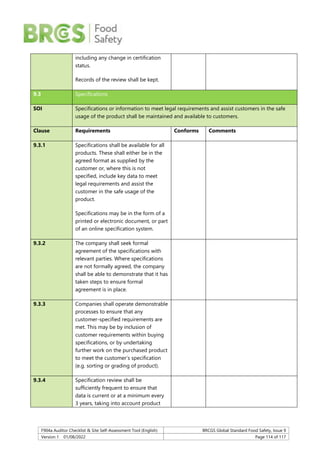
3.6.4 Specification review shall be
sufficiently frequent to ensure that
data is current or at a minimum every 3
years, taking into account product
changes, suppliers, regulations and
other risks.
Reviews and changes shall be
documented.
3.7 Corrective and preventive actions
Fundamental
SOI
The site shall be able to demonstrate that it uses the information from identified issues in
the food safety and quality management system (e.g. non-conforming products, internal
audits, complaints, product recalls, product testing, second- and third-party audits and
online reviews) to complete necessary corrective actions and prevent recurrence.
Clause Requirements Conforms
3.7.1 The site shall have a procedure for
handling and correcting issues
F904a Auditor Checklist & Site Self-Assessment Tool (English) BRCGS Global Standard Food Safety, Issue 9
Version 1 01/08/2022 Page 33 of 117
identified in the food safety and
quality management system.
The site procedures shall include the
completion of root cause analysis and
implementation of preventive action.
3.7.2 Where a non-conformity places the
safety, authenticity or legality of a
product at risk, or where there is an
adverse trend in quality, this shall be
investigated and recorded including:
 clear documentation of the non-
conformity
 assessment of consequences by a
suitably competent and authorised
person
 the corrective action to address
the immediate issue
 completion of root cause analysis
to identify the fundamental cause
(root cause) of the non-conformity
 appropriate timescales for
corrective and preventive actions
 the person(s) responsible for
corrective and preventive actions
 verification that the corrective and
preventive actions have been
implemented and are effective.
Root cause analysis shall also be used to
prevent recurrence of non-
conformities, and to implement
ongoing improvements when
analysis of non-conformities for
trends shows there has been a
significant increase in a type of non-
conformity.
3.8 Control of non-conforming product
SOI The site shall ensure that any out-of-specification product is effectively managed to prevent
unauthorised release.
Clause Requirements Conforms Comments
F904a Auditor Checklist & Site Self-Assessment Tool (English) BRCGS Global Standard Food Safety, Issue 9
Version 1 01/08/2022 Page 34 of 117
3.8.1 There shall be procedures for
managing non-conforming products.
These procedures shall include:
 the requirement for staff to
identify and report a potentially
non-conforming product
 clear identification of a non-
conforming product (e.g. direct
labelling or the use of IT systems)
 secure storage to prevent
accidental release (e.g. physical or
computer-based isolation)
 management of any product
returned to the site
 referral to the brand owner where
required
 defined responsibilities for
decision-making on the use or
disposal of products appropriate
to the issue (e.g. destruction,
reworking, downgrading to an
alternative label or acceptance by
concession)
 records of the decision on the use
or disposal of the product
 records of destruction where a
product is destroyed for food
safety reasons.
3.9 Traceability
Fundamental
SOI
The site shall be able to trace all raw material product lots (including primary packaging)
from its suppliers through all stages of processing and dispatch to its customers and vice
versa.
Clause Requirements Conforms Comments
3.9.1 The site shall have a documented
traceability procedure designed to
maintain traceability throughout the
site’s processes. At a minimum this
shall include:
 how the traceability system works
 the labelling and records required.
F904a Auditor Checklist & Site Self-Assessment Tool (English) BRCGS Global Standard Food Safety, Issue 9
Version 1 01/08/2022 Page 35 of 117
Where applicable, the traceability system
shall meet the legal requirements in
the country of sale or intended use.
3.9.2 Identification of raw materials
(including primary packaging),
intermediate/semi-processed products,
part-used materials, finished products
and materials pending investigation
shall be adequate to ensure
traceability.
3.9.3 The site shall test the traceability
system across the range of product
groups to ensure traceability can be
determined from the supplier of raw
material (including primary packaging)
to the finished product and vice versa.
For food raw materials and finished
products (i.e. including printed
packaging and labels with food safety
and legal information), the test of the
traceability system shall include a
quantity check/mass balance.
The traceability test shall include a
summary of the documents that
should be referenced during the test,
and clearly show the links between
them. The test shall occur at a
predetermined frequency, at a
minimum annually, and results shall be
retained for inspection. Traceability
should be achievable within 4 hours.
3.9.4 Where rework or any reworking
operation is performed, traceability
shall be maintained.
3.10 Complaint-handling
SOI Customer complaints shall be handled effectively and information used to reduce recurring
complaint levels.
Clause Requirements Conforms Comments
3.10.1 All complaints shall be recorded and
investigated, and the results of the
investigation of the issue recorded
F904a Auditor Checklist & Site Self-Assessment Tool (English) BRCGS Global Standard Food Safety, Issue 9
Version 1 01/08/2022 Page 36 of 117
where sufficient information is
provided. Actions appropriate to the
seriousness and frequency of the
problems identified shall be carried out
promptly and effectively by
appropriately trained staff.
3.10.2 Complaint data shall be analysed for
significant trends. Where there has
been a significant increase in a
complaint, or a serious complaint, root
cause analysis shall be used to
implement ongoing improvements to
product safety, legality and quality, and
to avoid recurrence. This analysis shall
be made available to relevant staff.
3.11 Management of incidents, product withdrawal and product recall
SOI The company shall have a plan and system in place to manage incidents effectively and
enable the withdrawal and recall of products should this be required.
Clause Requirements Conforms Comments
3.11.1 The company shall have procedures
designed to report and effectively
manage incidents and potential
emergency situations that impact food
safety, authenticity, legality or quality.
This shall include consideration of
contingency plans to maintain product
safety, authenticity, legality and quality.
Incidents may include:
 disruption to key services such as
water, energy, transport,
refrigeration processes, staff
availability and communications
 events such as fire, flood or natural
disaster
 malicious contamination or
sabotage
 product contamination indicating a
product may be unsafe or illegal
 failure of, or attacks against, digital
cyber-security.
Where products which have been
released from the site may be affected
F904a Auditor Checklist & Site Self-Assessment Tool (English) BRCGS Global Standard Food Safety, Issue 9
Version 1 01/08/2022 Page 37 of 117
by an incident, consideration shall be
given to the need to withdraw or recall
products.
3.11.2 The company shall have a documented
product withdrawal and recall
procedure. This shall include, at a
minimum:
 identification of key personnel
constituting the recall
management team, with clearly
identified responsibilities
 guidelines for deciding whether a
product needs to be recalled or
withdrawn and the records to be
maintained
 an up-to-date list of key contacts
(including out-of-hours contact
details) or reference to the location
of such a list (e.g. recall
management team, emergency
services, suppliers, customers,
certification body, regulatory
authority)
 a communication plan including
the provision of information to
customers, consumers and
regulatory authorities in a timely
manner
 details of external agencies
providing advice and support as
necessary (e.g. specialist
laboratories, regulatory authority
and legal expertise)
 a plan to handle the logistics of
product traceability, recovery or
disposal of affected product, and
stock reconciliation
 a plan to record timings of key
activities
 a plan to conduct root cause
analysis and to implement
ongoing improvements, to avoid
recurrence.
The procedure shall be capable of
being operated at any time.
F904a Auditor Checklist & Site Self-Assessment Tool (English) BRCGS Global Standard Food Safety, Issue 9
Version 1 01/08/2022 Page 38 of 117
3.11.3 The incident management procedures
(including those for product recall and
withdrawal) shall be tested, at least
annually, in a way that ensures their
effective operation. Results of the test
shall be retained and shall include
timings of key activities. The results of
the test and of any actual recall shall
be used to review the procedure and
implement improvements as necessary.
3.11.4 In the event of a significant food
safety, authenticity or legality incident,
including a product recall, regulatory
food safety non-conformity (e.g. a
regulatory enforcement notice) or food
safety-related withdrawal, the
certification body issuing the current
certificate for the site against this
Standard shall be notified within 3
working days.
The company shall then provide
sufficient information to enable the
certification body to assess any effects
of the incident on the ongoing validity
of the current certificate within 21
calendar days. As a minimum, this shall
include corrective action, root cause
analysis and a preventive action plan.
4 Site standards
4.1 External standards and site security
SOI
The production site shall be of suitable size, location and construction, and be maintained
to reduce the risk of contamination and facilitate the production of safe and legal finished
products.
Clause Requirements Conforms Comments
4.1.1 Consideration shall be given to local
activities and the site environment,
which may have an adverse impact on
finished product integrity, and
measures shall be taken to prevent
contamination. Where measures have
F904a Auditor Checklist & Site Self-Assessment Tool (English) BRCGS Global Standard Food Safety, Issue 9
Version 1 01/08/2022 Page 39 of 117
been put into place to protect the site
(from potential contaminants, flooding
etc.), they shall be reviewed in
response to any changes.
4.1.2 The external areas shall be maintained
in good order. Where grassed or
planted areas are located near
buildings, they shall be regularly
tended and well maintained. External
traffic routes under site control shall
be suitably surfaced and maintained in
good repair to mitigate the risk of
contamination of the product.
4.1.3 The building fabric shall be maintained
to minimise potential for product
contamination (e.g. elimination of
bird-roosting sites, sealing gaps
around pipes to prevent pest entry,
ingress of water and other
contaminants).
4.1.4 Policies and systems shall be in place
to ensure that access to the site by
staff, contractors and visitors is
controlled. A visitor recording system
shall be in place.
Contractors and visitors, including
drivers, shall be made aware of the
procedures for access to the site.
Only authorised personnel shall have
access to production and storage
areas. Contractors working in product
processing or storage areas shall be
the responsibility of a nominated
person.
Staff shall be trained in site security
procedures.
4.2 Food Defence
SOI
Systems shall protect products, premises and brands from malicious actions while under
the control of the site.
F904a Auditor Checklist & Site Self-Assessment Tool (English) BRCGS Global Standard Food Safety, Issue 9
Version 1 01/08/2022 Page 40 of 117
Clause Requirements Conforms Comments
4.2.1
Where personnel are engaged in
threat assessments and food defence
plans, the individual or team
responsible shall understand potential
food defence risks at the site. This
shall include knowledge of both the
site and the principles of food
defence.
Where there is a legal requirement for
specific training, this shall be in place.
4.2.2 The company shall undertake a
documented risk assessment (threat
assessment) of the potential risks to
products from any deliberate attempt
to inflict contamination or damage.
This threat assessment shall include
both internal and external threats.
The output from this assessment shall
be a documented food defence plan.
This plan shall be kept under review to
reflect changing circumstances and
market intelligence. It shall be formally
reviewed at least annually and
whenever:
 a new risk emerges (e.g. a new
threat is publicised or identified)
 an incident occurs where product
security or food defence is
implicated.
Where applicable, the food defence
plan shall meet the legal requirements
in the country of sale or intended use.
4.2.3 Where raw materials or products are
identified as being at particular risk,
the food defence plan shall include
controls to mitigate these risks. Where
prevention is not sufficient or possible,
systems shall be in place to identify
any tampering.
F904a Auditor Checklist & Site Self-Assessment Tool (English) BRCGS Global Standard Food Safety, Issue 9
Version 1 01/08/2022 Page 41 of 117
These controls shall be monitored, the
results documented, and the controls
reviewed at least annually.
4.2.4 Areas where a significant risk is
identified shall be defined in the food
defence plan, monitored and
controlled. These shall include external
storage and intake points for products
and raw materials (including
packaging).
Staff shall be trained in food defence
procedures.
4.3 Layout, product flow and segregation
Fundamental
SOI
The factory layout, flow of processes and movement of personnel shall be sufficient to
prevent the risk of product contamination and to comply with relevant legislation.
Clause Requirements Conforms Comments
4.3.1
The site shall assess the production risk
zones required for the products
manufactured, processed or packed
at the site, using the definitions in
Appendix 2 of the Standard.
4.3.2
There shall be a map of the site. At a
minimum, this map shall define:
 production risk zones, where
product is at different levels of risk
from pathogen contamination –
for example, high-risk, high-care,
ambient high-care, low-risk and
enclosed product areas (see clause
4.3.1 and Appendix 2)
 access points for personnel
 access points for raw materials
(including packaging), semi-
finished products and open
products
 routes of movement for personnel
 routes of movement for raw
materials (including packaging)
 routes for the removal of waste
 routes for the movement of
rework
F904a Auditor Checklist & Site Self-Assessment Tool (English) BRCGS Global Standard Food Safety, Issue 9
Version 1 01/08/2022 Page 42 of 117
 location of any staff facilities,
including changing rooms, toilets,
canteens and smoking areas
 production process flows
 any areas where time segregation
is used to complete different
activities (for example, time
segregation for high-care areas).
4.3.3
Contractors and visitors, including
drivers, shall be made aware of the
requirements of the areas they are
visiting, with special reference to
hazards and potential product
contamination.
4.3.4
The movement of personnel, raw
materials, packaging, rework and/or
waste shall not compromise the safety
of products. The process flow,
together with the use of demonstrably
effective procedures, shall be in place
to minimise the risk of the
contamination of raw materials,
intermediate/semi-processed
products, packaging and finished
products.
4.3.5
Premises shall allow sufficient working
space and storage capacity to enable
all operations to be carried out
properly under safe hygienic
conditions.
4.3.6
Temporary structures constructed
during building work or refurbishment
etc. shall be designed and located to
avoid pest harbourage and ensure the
safety and quality of products.
4.4 Building fabric, raw material handling, preparation, processing, packing and storage areas
SOI
The fabrication of the site, buildings and facilities shall be suitable for the intended
purpose.
Clause Requirements Conforms Comments
4.4.1
Walls shall be finished and maintained
to prevent the accumulation of dirt,
F904a Auditor Checklist & Site Self-Assessment Tool (English) BRCGS Global Standard Food Safety, Issue 9
Version 1 01/08/2022 Page 43 of 117
minimise condensation and mould
growth, and facilitate cleaning.
4.4.2
Floors shall be suitably hard-wearing
to meet the demands of the process,
and withstand cleaning materials and
methods. They shall be impervious, be
maintained in good repair and
facilitate cleaning.
4.4.3
Drainage, where provided, shall be
sited, designed and maintained to
minimise risk of product
contamination and not compromise
product safety. Machinery and piping
shall be arranged so that, wherever
feasible, process waste water goes
directly to drain. Where significant
amounts of water are used, or direct
piping to drain is not feasible, floors
shall have adequate falls to cope with
the flow of any water or effluent
towards suitable drainage.
4.4.4
Ceilings and overheads shall be
constructed, finished and maintained
to prevent the risk of product
contamination.
4.4.5
Where suspended ceilings or roof
voids are present, adequate access to
the void shall be provided to facilitate
inspection for pest activity, unless the
void is fully sealed.
4.4.6
Where elevated walkways, access steps
or mezzanine floors are adjacent to or
pass over production lines which have
open products, they shall be:
designed to prevent contamination of
products and production lines
easy to clean
correctly maintained.
4.4.7
Where there is a risk to product,
windows and roof glazing which are
designed to be opened for ventilation
F904a Auditor Checklist & Site Self-Assessment Tool (English) BRCGS Global Standard Food Safety, Issue 9
Version 1 01/08/2022 Page 44 of 117
purposes shall be adequately screened
to prevent the ingress of pests.
4.4.8
Doors (both internal and external)
shall be maintained in good condition.
At a minimum:
 external doors and dock levellers
shall be close fitting or adequately
proofed
 external doors to open product
areas shall not be opened during
production periods except in
emergencies
 where external doors to enclosed
product areas are opened, suitable
precautions shall be taken to
prevent pest ingress.
4.4.9
Suitable and sufficient lighting shall be
provided for correct operation of
processes, inspection of product and
effective cleaning.
4.4.10
Adequate ventilation and extraction
shall be provided in product storage
and processing environments to
prevent condensation or excessive
dust.
4.4.11
Where plastic strip curtains are
present, these shall be maintained in
good condition, clean, fitted correctly
(e.g. to prevent pest ingress or for
temperature control), and shall not
pose a food safety risk.
4.5 Utilities – water, ice, air and other gases
SOI
Utilities used within the production and storage areas shall be monitored to effectively
control the risk of product contamination.
Clause Requirements Conforms Comments
4.5.1 All water (including ice and steam)
used as a raw material in the
manufacture of processed food, the
preparation of product, hand-washing
or equipment or plant cleaning shall
F904a Auditor Checklist & Site Self-Assessment Tool (English) BRCGS Global Standard Food Safety, Issue 9
Version 1 01/08/2022 Page 45 of 117
be supplied in sufficient quantity, be
potable at point of use, be fit for
purpose and pose no risk of
contamination according to applicable
legislation.
Where water is stored and handled on
site (e.g. in storage or holding tanks),
these shall be managed to minimise
food safety risks.
The microbiological and chemical
quality of water shall be analysed as
required by legislation or at least
annually. The sampling points, scope
of the test and frequency of analysis
shall be based on risk, taking into
account the source of the water, on-
site storage and distribution facilities,
previous sample history and usage.
4.5.2 An up-to-date schematic diagram
shall be available of the water
distribution system on site, including
water source, holding tanks, water
treatment and water recycling as
appropriate. The diagram shall be
used as a basis for water sampling and
the management of water quality.
4.5.3 Air and other gases used as an
ingredient or that are in direct contact
with products shall be monitored to
ensure this does not represent a
contamination risk. Compressed air
that is in direct contact with the
product shall be filtered at point of
use.
4.6 Equipment
SOI All production and product-handling equipment shall be suitable for the intended purpose
and shall be used to minimise the risk of contamination of product.
Clause Requirements Conforms Comments
4.6.1 There shall be a documented purchase
specification for any new equipment
detailing the site requirements for the
F904a Auditor Checklist & Site Self-Assessment Tool (English) BRCGS Global Standard Food Safety, Issue 9
Version 1 01/08/2022 Page 46 of 117
equipment. This may, for example,
include:
 any relevant legislation
 where applicable, requirements for
food contact surfaces to meet
legal requirements
 details of intended use of the
equipment and the type of
materials it will be handling.
Depending on its intended use, new
equipment to site (including second-
hand equipment) may require
authorisation from a multi-disciplinary
team.
The supplier should provide evidence
that equipment meets these site
requirements prior to supply.
4.6.2 The design and construction of
equipment shall be based on risk, to
prevent product contamination. For
example, the use of the correct seals,
impervious surfaces or smooth welds
and joints, where they are exposed to
product and could otherwise result in
foreign-body, microbiological or
allergen contamination of the product.
Equipment that is in direct contact
with food shall be suitable for food
contact and meet legal requirements
where applicable.
4.6.3 A documented, risk-based
commissioning procedure shall be in
place to ensure that food safety and
integrity is maintained during the
installation of new equipment to site.
Installation work shall be followed by a
documented hygiene clearance
procedure.
New equipment to site shall be
inspected by an authorised member of
F904a Auditor Checklist & Site Self-Assessment Tool (English) BRCGS Global Standard Food Safety, Issue 9
Version 1 01/08/2022 Page 47 of 117
staff before being accepted into
operation.
The commissioning procedure shall
include the update of any other site
procedures that are affected by the
new equipment, for example, training,
operating procedures, cleaning,
environmental monitoring,
maintenance schedules or internal
audits.
The design and placement of
equipment shall ensure that it can be
effectively cleaned and maintained.
4.6.4 A procedure shall be in place to
manage the movement of static
equipment in production areas, to
ensure that food safety is managed
and the integrity of the equipment is
maintained.
4.6.5 Equipment that is not used or is taken
out of service shall be cleaned and
stored in a manner that does not pose
a risk to the product.
Equipment stored in internal
production and storage areas shall be
kept clean.
Food contact equipment that has been
stored but is not in daily use shall be
cleaned and, where necessary,
disinfected prior to use.
4.6.6 Mobile equipment (e.g. forklift trucks,
pallet trucks, scissor lifts and ladders)
used in open product areas shall not
pose a risk to the product.
Where the use of mobile equipment in
external areas cannot be avoided and
poses a risk to the product, the
equipment shall be cleaned and
disinfected prior to entering
production areas.
F904a Auditor Checklist & Site Self-Assessment Tool (English) BRCGS Global Standard Food Safety, Issue 9
Version 1 01/08/2022 Page 48 of 117
4.6.7 Battery-charging equipment shall not
be stored in open product areas
(unless the batteries are fully sealed
and/or maintenance-free) or where
there is a risk to products.
4.7 Maintenance
SOI An effective maintenance programme shall be in operation for plant and equipment to
prevent contamination and reduce the potential for breakdowns.
Clause Requirements Conforms Comments
4.7.1 There shall be a planned preventive
maintenance schedule or condition
monitoring system which includes all
plant, processing equipment and
mobile equipment. The maintenance
requirements shall be defined when
commissioning new equipment and
reviewed after repairing existing
equipment.
4.7.2 In addition to any planned
maintenance programme, where there
is a risk of product contamination by
foreign bodies arising from equipment
damage, the equipment shall be
inspected at predetermined intervals,
the inspection results documented
and appropriate action taken.
4.7.3 Where temporary repairs are made,
these shall be documented and
controlled to ensure that the safety or
legality of products is not jeopardised.
These temporary measures shall be
permanently repaired as soon as
practicable and within a defined
timescale.
4.7.4 The site shall ensure that the safety or
legality of products is not jeopardised
during maintenance and subsequent
cleaning operations. Maintenance
work shall be followed by a
documented hygiene clearance
procedure.
F904a Auditor Checklist & Site Self-Assessment Tool (English) BRCGS Global Standard Food Safety, Issue 9
Version 1 01/08/2022 Page 49 of 117
Equipment and machinery shall be
inspected by an authorised member of
staff to confirm the removal of
contamination hazards, before being
accepted back into operation.
4.7.5 Materials and parts used for
equipment and plant maintenance
shall be of an appropriate grade or
quality.
Those materials (such as lubricating
oil) that pose a risk by direct or
indirect contact with raw materials
(including primary packaging),
intermediate products and finished
products shall be food grade and of a
known allergen status.
4.7.6 Engineering workshops shall be kept
clean and tidy, and controls shall be in
place to prevent transfer of
engineering debris to production or
storage areas.
4.8 Staff facilities
SOI Staff facilities shall be sufficient to accommodate the required number of personnel, and
shall be designed and operated to minimise the risk of product contamination. The
facilities shall be maintained in good and clean condition.
Clause Requirements Conforms Comments
4.8.1 Designated changing facilities shall be
provided for all personnel, whether
staff, visitor or contractor. These shall
be sited to allow direct access to the
production, packing or storage areas
without recourse to any external area.
Where this is not possible, a risk
assessment shall be carried out and
procedures implemented accordingly
(e.g. the provision of cleaning facilities
for footwear).
4.8.2 Storage facilities of sufficient size to
accommodate personal items shall be
provided for all personnel who work in
F904a Auditor Checklist & Site Self-Assessment Tool (English) BRCGS Global Standard Food Safety, Issue 9
Version 1 01/08/2022 Page 50 of 117
raw material-handling, preparation,
processing, packing and storage areas.
4.8.3 Outdoor clothing and other personal
items shall be stored separately from
production clothing within the
changing facilities. Facilities shall be
available to separate clean and dirty
production clothing.
4.8.4 Suitable and sufficient hand-washing
facilities shall be provided at access to,
and at other appropriate points within,
production areas. Such hand-washing
facilities shall provide, at a minimum:
 advisory signs to prompt hand-
washing
 a sufficient quantity of water at a
suitable temperature
 water taps with hands-free
operation
 liquid/foam soap
 single-use towels or suitably
designed and located air driers.
4.8.5 Toilets shall be adequately segregated
and shall not open directly into
production or packing areas. Toilets
shall be provided with hand-washing
facilities comprising:
 basins with soap and water at a
suitable temperature
 adequate hand-drying facilities
 advisory signs to prompt hand-
washing.
Where hand-washing facilities within
toilets are the only hand-washing
facilities provided before re-entering
production, the requirements of clause
4.8.4 shall apply and signs shall be in
place to direct people to hand-
washing facilities before entering
production.
4.8.6 Where smoking is allowed under
national law, designated controlled
smoking areas shall be provided which
F904a Auditor Checklist & Site Self-Assessment Tool (English) BRCGS Global Standard Food Safety, Issue 9
Version 1 01/08/2022 Page 51 of 117
are both isolated from production
areas to an extent that ensures smoke
cannot reach the product and fitted
with sufficient extraction to the
exterior of the building. Adequate
arrangements for dealing with
smokers’ waste shall be provided at
smoking facilities, both inside and at
exterior locations. Electronic cigarettes
shall not be permitted to be used or
brought into production or storage
areas.
4.8.7 All food brought into manufacturing
premises by staff shall be
appropriately stored in a clean and
hygienic state. No food shall be taken
into storage, processing or production
areas. Where eating of food is allowed
outside during breaks, this shall be in
suitable designated areas with
appropriate control of waste.
4.8.8 Where catering facilities (including
vending machines) are provided on
the premises, they shall be suitably
controlled to prevent contamination of
products (e.g. as a source of food
poisoning, the use of allergenic
ingredients or introduction of new
allergenic material to the site).
4.9 Chemical and physical product contamination control: raw material-handling, preparation,
processing, packing and storage areas
SOI Appropriate facilities and procedures shall be in place to control the risk of chemical or
physical contamination of product.
4.9.1 Chemical control
Clause Requirements Conforms Comments
4.9.1.1 Processes shall be in place to manage
the use, storage and handling of non-
food chemicals to prevent chemical
contamination. These shall include, at
a minimum:
F904a Auditor Checklist & Site Self-Assessment Tool (English) BRCGS Global Standard Food Safety, Issue 9
Version 1 01/08/2022 Page 52 of 117
 an approved list of chemicals for
purchase
 availability of material safety data
sheets and specifications
 confirmation of suitability for use
in a food-processing environment
 avoidance of strongly scented
products
 the labelling and/or identification
of containers of chemicals at all
times
 a designated storage area
(separate from chemicals used as
raw materials in products) with
access restricted to authorised
personnel
 use by trained personnel only
 procedures to manage any spills
 procedures for the safe, legal
disposal or return of obsolete or
out-of-date chemicals and empty
chemical containers.
4.9.1.2 Where strongly scented or taint-
forming materials have to be used, for
instance for building work, procedures
shall be in place to prevent the risk of
taint contamination of products.
4.9.2 Metal control
Clause Requirements Conforms Comments
4.9.2.1 There shall be a documented policy
for the controlled use and storage of
sharp metal implements including
knives, cutting blades on equipment,
needles and wires. This shall include a
record of inspection for damage and
the investigation of any lost items.
Snap-off blade knives shall not be
used.
4.9.2.2 The purchase of ingredients and
packaging which use staples or other
foreign-body hazards as part of the
packaging materials shall be avoided.
F904a Auditor Checklist & Site Self-Assessment Tool (English) BRCGS Global Standard Food Safety, Issue 9
Version 1 01/08/2022 Page 53 of 117
Staples, paper clips and drawing pins
shall not be used in open product
areas.
Where staples or other items are
present as packaging materials or
closures, appropriate precautions shall
be taken to minimise the risk of
product contamination.
4.9.3 Glass, brittle plastic, ceramics and similar materials
Clause Requirements Conforms Comments
4.9.3.1 Glass or other brittle materials shall be
excluded or protected against
breakage in areas where open
products are handled or there is a risk
of product contamination.
4.9.3.2 Procedures for handling glass and
other brittle materials (other than
product packaging) shall be in place
where open products are handled or
there is a risk of product
contamination. These procedures shall
include, at a minimum:
 a list of items detailing location,
number, type and condition
 recorded checks of the condition
of items, carried out at a specified
frequency that is based on the
level of risk to the product
 details on cleaning or replacing
items to minimise the potential for
product contamination.
4.9.3.3 Procedures detailing the action to be
taken in the event of breakage of glass
or other brittle items shall be
implemented and include the
following:
 training of staff in the correct
procedure
 quarantining the products and
production area that were
potentially affected
F904a Auditor Checklist & Site Self-Assessment Tool (English) BRCGS Global Standard Food Safety, Issue 9
Version 1 01/08/2022 Page 54 of 117
 cleaning the production area
 inspecting the production area
and authorising production to
continue
 changing of workwear and
inspection of footwear
 specifying those staff authorised
to carry out the above points
 recording the breakage incident
 safely disposing of contaminated
product.
4.9.3.4 Where they pose a risk to product,
glass windows shall be protected
against breakage.
4.9.3.5 Where they pose a risk to product,
bulbs and strip lights (including those
on electric fly-killer devices) shall be
adequately protected. Where full
protection cannot be provided,
alternative management such as wire-
mesh screens or monitoring
procedures shall be in place.
4.9.4 Products packed into glass or other brittle containers
Clause Requirements Conforms Comments
4.9.4.1 The storage of the containers shall be
segregated from the storage of raw
materials, product or other packaging.
4.9.4.2 Systems shall be in place to manage
container breakages between the
container-cleaning/inspection point
and container closure. This shall
include, as a minimum, documented
instructions which ensure:
 the removal and disposal of at-risk
products in the vicinity of the
breakage; this may be specific for
different equipment or areas of
the production line
 the effective cleaning of the line or
equipment which may be
contaminated by fragments of the
container; cleaning shall not result
F904a Auditor Checklist & Site Self-Assessment Tool (English) BRCGS Global Standard Food Safety, Issue 9
Version 1 01/08/2022 Page 55 of 117
in the further dispersal of
fragments, for instance by the use
of high-pressure water or air
 the use of dedicated, clearly
identifiable cleaning equipment
(e.g. colour-coded) for removal of
container breakages; such
equipment shall be stored
separately from other cleaning
equipment
 the use of dedicated, accessible,
lidded waste containers for the
collection of damaged containers
and fragments
 a documented inspection of
production equipment is
undertaken following the cleaning
of a breakage, to ensure cleaning
has effectively removed any risk of
further contamination
 authorisation given for production
to restart following cleaning
 the area around the line being
kept clear of broken glass.
4.9.4.3 Records shall be maintained of all
container breakages on the line.
Where no breakages have occurred
during a production period, this shall
also be recorded. This record shall be
reviewed to identify trends and
potential line or container
improvements.
4.9.5 Wood
Clause Requirements Conforms
4.9.5.1 Wood should not be used in open
product areas except where this is a
process requirement (e.g. maturation
of products in wood). Where the use
of wood cannot be avoided, its
condition shall be monitored on a risk-
based frequency to ensure it is in
good condition and free from damage
or splinters which could contaminate
products.
F904a Auditor Checklist & Site Self-Assessment Tool (English) BRCGS Global Standard Food Safety, Issue 9
Version 1 01/08/2022 Page 56 of 117
Wood used for food contact purposes
shall be fit for purpose (e.g. free from
damage or splinters, free from taint;
and wood treatments, where used, are
used only in accordance with
legislation and approved for food use).
4.9.6 Other physical contaminants
Clause Requirements Conforms Comments
4.9.6.1 Procedures shall be in place to prevent
physical contamination of raw
materials by raw material packaging
(e.g. during debagging and deboxing
procedures to remove the packaging).
4.9.6.2 Portable handheld equipment, e.g.
stationery items (pens, pencils etc.),
mobile phones, tablets and similar
portable items used in open product
areas, shall be controlled by the site to
minimise the risk of physical
contamination. The site may consider,
for example:
 excluding non-approved items
 restricting the use to site-issued
equipment
 ensuring stationery items such as
pens are designed without small
external parts and are detectable
by foreign-body detection
equipment, or are used in
designated areas where
contamination is prevented.
4.9.6.3 Based on risk, procedures shall be
implemented to minimise other types
of foreign-body contamination (i.e.
types of contamination that are not
specifically covered in section 4.9).
4.10 Foreign-body detection and removal equipment
SOI
The risk of product contamination shall be reduced or eliminated by the effective use of
equipment to remove or detect foreign bodies
4.10.1 Selection and operation of foreign-body detection and removal equipment
F904a Auditor Checklist & Site Self-Assessment Tool (English) BRCGS Global Standard Food Safety, Issue 9
Version 1 01/08/2022 Page 57 of 117
Clause Requirements Conforms Comments
4.10.1.1 A documented assessment in
association with the food safety plan
(see section 2 – The food safety plan)
shall be carried out on each
production process to identify the
potential use of equipment to detect
or remove foreign-body
contamination. Typical equipment to
be considered may include:
 filters and sieves
 metal detection and X-ray
detection equipment
 magnets
 optical sorting equipment
 other physical separation
equipment (e.g. gravity separation,
fluid bed technology).
4.10.1.2 The type, location and sensitivity of
the detection and/or removal method
shall be specified as part of the site’s
documented system. Industry best
practice shall be applied with regard
to the nature of the ingredient,
material, product and/or packed
product. The location of the
equipment or any other factors
influencing the sensitivity of the
equipment shall be validated and
justified.
4.10.1.3 The site shall ensure that the
frequency of the testing of the
foreign-body detection and/or
removal equipment is defined and
takes into consideration:
 specific customer requirements
 the site’s ability to identify, hold
and prevent the release of any
affected materials, should the
equipment fail.
The site shall establish and implement
corrective action and reporting
procedures in the event of a failure of
the foreign-body detector and/or
F904a Auditor Checklist & Site Self-Assessment Tool (English) BRCGS Global Standard Food Safety, Issue 9
Version 1 01/08/2022 Page 58 of 117
removal equipment. Action shall
include a combination of isolation,
quarantining and re-inspection of all
products produced since the last
successful test or inspection.
4.10.1.4 Where foreign material is detected or
removed by the equipment, the source
of any unexpected material shall be
investigated. Information on rejected
materials shall be used to identify
trends and, where possible, instigate
preventive action to reduce the
occurrence of contamination by the
foreign material.
4.10.2 Filters and sieves
Clause Requirements Conforms Comments
4.10.2.1
Filters and sieves used for foreign-
body control shall be of a specified
mesh size or gauge and designed to
provide the maximum practical
protection for the product.
4.10.2.2 Filters and sieves shall be regularly
inspected or tested for damage at a
documented frequency based on risk.
Records shall be maintained of the
checks. Where defective filters or
sieves are identified, this shall be
recorded and the potential for
contamination of products
investigated and appropriate action
taken.
4.10.3 Metal detectors and X-ray equipment
Clause Requirements Conforms Comments
4.10.3.1
Metal detection equipment shall be in
place unless risk assessment
demonstrates that this does not
improve food safety. Where metal
detectors are not used, justification
shall be documented. The absence of
metal detection would only normally
be based on the use of an alternative,
F904a Auditor Checklist & Site Self-Assessment Tool (English) BRCGS Global Standard Food Safety, Issue 9
Version 1 01/08/2022 Page 59 of 117
more effective method of protection
(e.g. use of X-ray, fine sieves or
filtration of products).
4.10.3.2 The metal detector or X-ray
equipment shall incorporate one of
the following:
 an automatic rejection device, for
continuous in-line systems, which
shall divert contaminated product
either out of the product flow or
to a secure unit accessible only to
authorised personnel
 a belt stop system with an alarm
where the product cannot be
automatically rejected (e.g. for
very large packs)
 in-line detectors which identify the
location of the contaminant to
allow effective segregation of the
affected product.
4.10.3.3 The site shall establish and implement
procedures for the operation and
testing of the metal detection or X-ray
equipment. This shall include, at a
minimum:
 responsibilities for the testing of
equipment
 the operating effectiveness and
sensitivity of the equipment and
any variation to this for particular
products
 the methods and frequency of
checking the detector
 recording of the results of checks.
4.10.3.4 Metal detector testing procedures
shall, at a minimum, include:
 use of test pieces incorporating a
sphere of metal of a known
diameter selected on the basis of
risk. The test pieces shall be
marked with the size and type of
test material contained
F904a Auditor Checklist & Site Self-Assessment Tool (English) BRCGS Global Standard Food Safety, Issue 9
Version 1 01/08/2022 Page 60 of 117
 tests carried out using separate
test pieces containing ferrous
metal, stainless steel and typically
non-ferrous metal, unless the
product is within a foil container
where a ferrous-only test may be
applicable
 a test to prove that both the
detection and rejection
mechanisms are working
effectively under normal working
conditions
 tests of the metal detector by
passing successive test packs
through the unit at typical line
operating speed
 checks of failsafe systems fitted to
the detection and rejection
systems.
In addition, where metal detectors are
incorporated on conveyors, the test
piece shall be passed as close as
possible to the least sensitive area of
the metal detector (usually the centre
of the metal detector aperture).
Wherever possible, the test piece shall
be inserted within a clearly identified
sample pack of the food being
produced at the time of the test.
Where in-line metal detectors are
used, the test piece shall be placed in
the product flow wherever this is
possible, and the correct timing of the
rejection system to remove identified
contamination shall be validated.
Testing of in-line metal detectors shall
be completed during both line start-
up and at the end of the production
period.
4.10.3.5 X-ray equipment testing procedures
shall, at a minimum, include:
 use of test pieces incorporating a
sphere of suitable material (e.g. a
typical contaminant) of a known
diameter selected on the basis of
F904a Auditor Checklist & Site Self-Assessment Tool (English) BRCGS Global Standard Food Safety, Issue 9
Version 1 01/08/2022 Page 61 of 117
risk. The test pieces shall be
marked with the size and type of
test material contained
 tests carried out using separate
test pieces
 a test to prove that both the
detection and rejection
mechanisms are working
effectively under normal working
conditions
 tests of the X-ray equipment by
passing successive test packs
through the unit at typical line
operating speed
 checks of failsafe systems fitted to
the detection and rejection
systems.
In addition, where X-ray equipment is
incorporated on conveyors, the test
piece shall be passed as close as
possible to the least sensitive area of
the X-ray equipment (e.g. this may be
close to the X-ray source or close to
the X-ray equipment). Wherever
possible, the test piece shall be
inserted into a clearly identified
sample pack of the food being
produced at the time of the test.
Where in-line X-ray equipment is used,
the test piece shall be placed in the
product flow wherever this is possible,
and the correct timing of the rejection
system to remove identified
contamination shall be validated.
Testing of in-line equipment shall be
completed both during line start-up
and at the end of the production
period.
4.10.4 Magnets
Clause Requirements Conforms Comments
4.10.4.1
The type, location and strength of
magnets shall be fully documented.
F904a Auditor Checklist & Site Self-Assessment Tool (English) BRCGS Global Standard Food Safety, Issue 9
Version 1 01/08/2022 Page 62 of 117
Procedures shall be in place for the
inspection, cleaning, strength testing
and integrity checks of magnets used
for food safety purposes, including
final product testing, e.g. to remove
product contamination. Records of all
checks shall be maintained.
4.10.5 Optical sorting equipment
Clause Requirements Conforms Comments
4.10.5.1 Optical sorting equipment used for
final product testing shall be checked
in accordance with the manufacturer’s
instructions or recommendations.
Checks shall be documented.
4.10.6 Container cleanliness – glass jars, cans and other rigid containers
Clause Requirements Conforms Comments
4.10.6.1 Based on risk assessment, procedures
shall be implemented to minimise
foreign-body contamination
originating from the packaging
container (e.g. jars, cans and other
pre-formed rigid containers). This may
include the use of covered conveyors,
container inversion and foreign-body
removal through rinsing with water or
air jets.
4.10.6.2 The effectiveness of the container-
cleaning equipment shall be checked
and recorded during each production.
Where the system incorporates a
rejection system for dirty or damaged
containers, the check shall incorporate
a test of both the detection and
effective rejection of the test
container.
4.10.7 Other foreign-body detection and removal equipment
Clause Requirements Conforms Comments
4.10.7.1 Other foreign-body detection and
removal equipment, such as gravity
F904a Auditor Checklist & Site Self-Assessment Tool (English) BRCGS Global Standard Food Safety, Issue 9
Version 1 01/08/2022 Page 63 of 117
separation, fluid bed technology or
aspirators, shall be checked in
accordance with the manufacturer’s
instructions or recommendations.
Checks shall be documented.
4.11 Housekeeping and hygiene
Fundamental
SOI
Housekeeping and cleaning systems shall be in place which ensure appropriate standards
of hygiene are maintained at all times and the risk of product contamination is minimised.
Clause Requirements Conforms Comments
4.11.1 The premises and equipment shall be
maintained in a clean and hygienic
condition.
4.11.2 Documented cleaning and disinfection
procedures shall be in place and
maintained for the building, plant and
all equipment. Cleaning procedures
for the processing equipment and
food contact surfaces shall, at a
minimum, include:
 responsibility for cleaning
 item/area to be cleaned
 frequency of cleaning
 method of cleaning, including
dismantling equipment for
cleaning purposes where required
 cleaning chemicals and
concentrations
 cleaning materials to be used
 cleaning records (including
records for completion and sign-
off) and responsibility for
verification.
The frequency and methods of
cleaning shall be based on risk.
The procedures shall be implemented
to ensure appropriate standards of
cleaning are achieved.
4.11.3 Limits of acceptable and unacceptable
cleaning performance shall be defined
F904a Auditor Checklist & Site Self-Assessment Tool (English) BRCGS Global Standard Food Safety, Issue 9
Version 1 01/08/2022 Page 64 of 117
for food contact surfaces and
processing equipment. These limits
shall be based on the potential
hazards relevant to the product or
processing area (e.g. microbiological,
allergen, foreign-body or product-to-
product contamination). Therefore,
acceptable levels of cleaning may be
defined by visual appearance, ATP
bioluminescence techniques (see
glossary), microbiological testing,
allergen testing or chemical testing as
appropriate.
The site shall define the corrective
action to be taken when monitored
results are outside of the acceptable
limits.
Where cleaning procedures are part of
a defined prerequisite plan to control
the risk of a specific hazard, the
cleaning and disinfection procedures
and their frequency shall be validated
and records maintained. This shall
include the risk from cleaning
chemical residues on food contact
surfaces.
4.11.4 The resources for undertaking
cleaning shall be available. Where it is
necessary to dismantle equipment for
cleaning purposes or to enter large
equipment for cleaning, this shall be
appropriately scheduled and, where
necessary, planned for non-production
periods. Cleaning staff shall be
adequately trained or engineering
support provided where access within
equipment is required for cleaning.
4.11.5 The cleanliness of equipment shall be
checked before equipment is released
back into production. The results of
checks on cleaning, including visual,
analytical and microbiological checks,
shall be recorded and used to identify
trends in cleaning performance and to
F904a Auditor Checklist & Site Self-Assessment Tool (English) BRCGS Global Standard Food Safety, Issue 9
Version 1 01/08/2022 Page 65 of 117
instigate improvements where
required.
4.11.6 Cleaning equipment shall be:
 hygienically designed and fit for
purpose
 suitably identified for intended use
(e.g. colour-coded or labelled)
 cleaned and stored in a hygienic
manner to prevent contamination.
4.11.7 Cleaning in place (CIP)
Clause Requirements Conforms Comments
4.11.7.1 All CIP equipment shall be designed
and constructed to ensure effective
operation. This shall include:
 validation confirming the correct
design and operation of the
system
 an up-to-date schematic diagram
of the layout of the CIP system
 where rinse solutions are
recovered and re-used, an
assessment of the risk of cross-
contamination (e.g. due to the re-
introduction of an allergen or the
existence of different production
risk zones within the site).
Alterations or additions to the CIP
system shall be authorised by a
suitably competent individual before
changes are made. A record of
changes shall be maintained.
The system shall be revalidated at a
frequency based on risk, and following
any alteration or addition.
4.11.7.2 Limits of acceptable and unacceptable
performance for key process
parameters shall be defined to ensure
the removal of target hazards (e.g. soil,
allergens, micro-organisms, spores). At
F904a Auditor Checklist & Site Self-Assessment Tool (English) BRCGS Global Standard Food Safety, Issue 9
Version 1 01/08/2022 Page 66 of 117
a minimum these parameters shall
include:
 times for each stage
 detergent concentrations
 flow rate and pressure
 temperatures.
These shall be validated and records
of the validation maintained.
4.11.7.3 The CIP equipment shall be
maintained by suitably trained staff to
ensure effective cleaning is carried out.
This shall include:
 routine checking of detergent
concentrations
 monitoring of recovered post-
rinse solutions for build-up of
carry-over from the detergent
tanks
 cleaning and inspection of filters,
where fitted, at a defined
frequency
 storing flexible hoses (where used)
hygienically when not in use, and
inspecting them at a defined
frequency to ensure that they are
in good condition.
4.11.7.4 CIP facilities, where used, shall be
monitored at a defined frequency
based on risk. This may include:
 monitoring of process parameters
defined in clause 4.11.7.2
 ensuring correct connections,
piping and settings are in place
 confirming the process is
operating correctly (e.g. valves are
opening/closing sequentially,
spray balls are operating correctly)
 ensuring effective completion of
the cleaning cycle
 monitoring for effective results,
including draining where required.
Procedures shall define the action to
be taken if monitoring indicates that
F904a Auditor Checklist & Site Self-Assessment Tool (English) BRCGS Global Standard Food Safety, Issue 9
Version 1 01/08/2022 Page 67 of 117
processing is outside the defined
limits.
4.11.8 Environmental monitoring
SOI Risk-based environmental monitoring programmes shall be in place for relevant pathogens
or spoilage organisms. At a minimum, these shall include all production areas with open
and/or ready-to-eat products.
Clause Requirements Conforms Comments
4.11.8.1 The design of the environmental
monitoring programme shall be based
on risk, and at a minimum include:
 sampling procedures
 identification of sample locations
 frequency of tests
 target organism(s) (e.g.
pathogens, spoilage organisms
and/or indicator organisms)
 test methods (e.g. settle plates,
rapid testing and swabs)
 recording and evaluation of
results.
The programme and its associated
procedures shall be documented.
4.11.8.2 Appropriate control or action limits
shall be defined for the environmental
monitoring programme.
The company shall document the
corrective action to be taken when
monitored results indicate a failure to
meet a control limit, or when
monitored results indicate an upward
trend of positive results (i.e. a trend
towards a control or action limit).
4.11.8.3 The company shall review the
environmental monitoring programme
at least annually and whenever there
are:
 changes in processing conditions,
process flow or equipment which
could impact the environmental
monitoring programme
F904a Auditor Checklist & Site Self-Assessment Tool (English) BRCGS Global Standard Food Safety, Issue 9
Version 1 01/08/2022 Page 68 of 117
 new developments in scientific
information (e.g. new pathogens
of concern)
 failures of the programme to
identify a significant issue (e.g.
regulatory authority tests
identifying positive results which
the site programme did not)
 product failures (products with
positive tests)
 consistently negative results (e.g. a
site with a long history of negative
results should review its
programme to consider whether
the correct parts of the factory are
being tested, whether the testing
is being conducted correctly,
whether the tests are for the
appropriate organisms, etc.).
4.12 Waste and waste disposal
SOI Waste disposal shall be managed in accordance with legal requirements and to prevent
accumulation, risk of contamination and the attraction of pests.
Clause Requirements Conforms Comments
4.12.1 Where licensing is required by law for
the removal of waste, it shall be
removed by licensed contractors and
records of removal shall be maintained
and available for audit.
4.12.2 Internal and external waste collection
containers and rooms housing waste
facilities shall be managed to minimise
risk. These shall be:
 clearly identified
 designed for ease of use and
effective cleaning
 well maintained to allow cleaning
and, where required, disinfection
 emptied at appropriate
frequencies.
External waste containers shall be
covered or doors kept closed as
appropriate.
F904a Auditor Checklist & Site Self-Assessment Tool (English) BRCGS Global Standard Food Safety, Issue 9
Version 1 01/08/2022 Page 69 of 117
4.12.3 Waste removal from open product
areas shall be managed to ensure that
it does not compromise product
safety.
4.12.4 If unsafe products or substandard
trademarked materials are transferred
to a third party for destruction or
disposal, that third party shall be a
specialist in secure product or waste
disposal and shall provide records
which include the quantity of waste
collected for destruction or disposal.
4.13 Management of surplus food and products for animal feed
SOI Effective processes shall be in place to ensure the safety and legality of by-products of the
primary processing activity of the site.
Clause Requirements Conforms Comments
4.13.1 Surplus customer-branded products
shall be disposed of in accordance
with customer-specific requirements.
Customer brand names shall be
removed from packed surplus
products under the control of the
factory before the product enters the
supply chain, unless otherwise
authorised by the customer.
4.13.2 Where customer-branded products
which do not meet specifications are
sold to staff or passed on to charities
or other organisations, this shall be
with the prior consent of the brand
owner.
Processes shall be in place to ensure
that all products (own-branded and
customer-branded) which are sold to
staff or passed on to charities or other
organisations are fit for consumption
and meet legal requirements, and that
their traceability is maintained.
4.13.3 By-products and downgraded/surplus
products intended for animal feed
shall be segregated from waste and
F904a Auditor Checklist & Site Self-Assessment Tool (English) BRCGS Global Standard Food Safety, Issue 9
Version 1 01/08/2022 Page 70 of 117
protected from contamination during
storage. Products for animal feed shall
be managed in accordance with the
relevant legislative requirements.
4.14 Pest management
SOI The whole site shall have an effective preventive pest management programme in place to
minimise the risk of pest presence, and resources shall be available to respond rapidly to
any issues which occur to prevent risk to products.
Pest management programmes shall comply with all applicable legislation.
Clause Requirements Conforms Comments
4.14.1 If pest activity is identified, it shall not
present a risk of contamination to
products, raw materials or packaging.
The presence of any infestation on site
shall be documented in pest
management records and be part of
an effective pest management
programme to eliminate or manage
the infestation so that it does not
present a risk to products, raw
materials or packaging.
4.14.2 The site shall either contract the
services of a competent pest
management organisation or have
appropriately trained staff for the
regular inspection and treatment of
the site to deter and eradicate
infestation.
The frequency of inspections shall be
determined by risk assessment and
shall be documented. The risk
assessment shall be reviewed
whenever:
 there are changes to the building
or production processes which
could have an impact on the pest
management programme
 there has been a significant pest
issue.
F904a Auditor Checklist & Site Self-Assessment Tool (English) BRCGS Global Standard Food Safety, Issue 9
Version 1 01/08/2022 Page 71 of 117
Where the services of a pest
management contractor are
employed, the service scope shall be
clearly defined and reflect the
activities of the site.
Service provision, regardless of the
source, shall meet with all applicable
regulatory requirements.
4.14.3 Where a site undertakes its own pest
management, it shall be able to
effectively demonstrate that:
 pest management operations are
undertaken by trained and
competent staff with sufficient
knowledge to select appropriate
pest control chemicals and
proofing methods and understand
the limitations of use, relevant to
the biology of the pests associated
with the site
 staff undertaking pest
management activities meet any
legal requirements for training or
registration
 sufficient resources are available
to respond to any infestation
issues
 there is ready access to specialist
technical knowledge when
required
 legislation governing the use of
pest control products is
understood and complied with
 dedicated locked facilities are
used for the storage of pesticides.
4.14.4 Pest management documentation and
records shall be maintained. At a
minimum, this shall include:
 an up-to-date plan of the full site,
identifying pest control devices
and their locations
 identification of the baits and/or
monitoring devices on site
F904a Auditor Checklist & Site Self-Assessment Tool (English) BRCGS Global Standard Food Safety, Issue 9
Version 1 01/08/2022 Page 72 of 117
 clearly defined responsibilities for
the site management and the
contractor
 details of pest control products
used, including instructions for
their effective use and action to be
taken in the event of an
emergency
 any observed pest activity
 details of pest control treatments
undertaken.
Records may be on paper (hard copy)
or controlled on an electronic system
(e.g. an online reporting system).
4.14.5 Bait stations or other rodent
monitoring or control devices shall be
appropriately located and maintained
to prevent contamination risk to
product. Toxic rodent baits shall not
be used within production or storage
areas where open product is present
except when treating an active
infestation. Where toxic baits are used,
these shall be secured.
Any missing bait stations shall be
recorded, reviewed and investigated.
4.14.6 Insect-killing devices, pheromone
traps and/or other insect-monitoring
devices shall be appropriately sited
and operational. If there is a danger of
insects being expelled from a fly-
killing extermination device and
contaminating the product, alternative
systems and equipment shall be used.
4.14.7 The site shall have adequate measures
in place to prevent birds from entering
buildings or roosting above loading or
unloading areas.
4.14.8 In the event of infestation, or evidence
of pest activity, immediate action shall
be taken to identify at-risk products
and to minimise the risk of product
contamination. Any potentially
F904a Auditor Checklist & Site Self-Assessment Tool (English) BRCGS Global Standard Food Safety, Issue 9
Version 1 01/08/2022 Page 73 of 117
affected products should be subject to
the non-conforming product
procedure.
4.14.9 Records of pest management
inspections, pest proofing and hygiene
recommendations and actions taken
shall be maintained. It shall be the
responsibility of the site to ensure that
all of the relevant recommendations
made by its contractor or in-house
expert are carried out in a timely
manner.
4.14.10 An in-depth, documented pest
management assessment shall be
undertaken at a frequency based on
risk, but at least annually, by a pest
management expert to review the pest
management measures in place. The
assessment shall:
 include an in-depth inspection of
the site, equipment and facilities
for pest activity
 review the existing pest
management measures in place
and make any recommendations
for change.
The assessment shall be timed to allow
access to equipment for inspection
where a risk of stored product insect
infestation exists.
4.14.11 Results of pest management
inspections shall be assessed and
analysed for trends on a regular basis.
At a minimum, results of inspections
shall be analysed:
 annually or
 in the event of an infestation.
The analysis shall include results from
trapping and monitoring devices to
identify problem areas. The analysis
shall be used as a basis for improving
the pest management procedures.
F904a Auditor Checklist & Site Self-Assessment Tool (English) BRCGS Global Standard Food Safety, Issue 9
Version 1 01/08/2022 Page 74 of 117
4.14.12 Staff shall understand the signs of pest
activity and be aware of the need to
report any evidence of such activity to
a designated manager.
4.15 Storage facilities
SOI All facilities used for the storage of raw materials, packaging, in-process products and
finished products shall be suitable for purpose.
Clause Requirements Conforms Comments
4.15.1 Procedures to maintain product safety
and quality during storage shall be
developed on the basis of risk
assessment, understood by relevant
staff and implemented accordingly.
These may include, as appropriate:
 managing chilled and frozen
product transfer between
temperature-controlled areas
 segregation of products where
necessary to avoid cross-
contamination (physical,
microbiological or allergens) or
taint uptake
 storing materials off the floor and
away from walls
 specific handling or stacking
requirements to prevent product
damage.
4.15.2 Where appropriate, packaging shall be
stored away from other raw materials
and finished product. Any part-used
packaging materials suitable for use
shall be effectively protected from
contamination and clearly identified to
maintain traceability before being
returned to an appropriate storage
area.
4.15.3 Where temperature control is required
(e.g. for raw materials, semi-finished
materials or final products), the
storage area shall be capable of
maintaining product temperature
within specification and operated to
F904a Auditor Checklist & Site Self-Assessment Tool (English) BRCGS Global Standard Food Safety, Issue 9
Version 1 01/08/2022 Page 75 of 117
ensure specified temperatures are
maintained. Temperature recording
equipment with suitable temperature
alarms shall be fitted to all storage
facilities or there shall be a system of
recorded manual temperature checks,
typically on at least a 4-hourly basis or
at a frequency which allows for
intervention before product
temperatures exceed defined limits for
the safety, legality or quality of
products.
4.15.4 Where controlled atmosphere storage
is required, the storage conditions
shall be specified and effectively
controlled. Records shall be
maintained of the storage conditions.
4.15.5 Where storage outside is necessary,
items shall be protected from
contamination and deterioration.
Items shall be checked for suitability
before being brought into the factory.
4.15.6 The site shall facilitate correct stock
rotation of raw materials, intermediate
products and finished products in
storage and ensure that materials are
used in the correct order in relation to
their manufacturing date and within
the prescribed shelf life.
4.16 Dispatch and transport
SOI Procedures shall be in place to ensure that the management of dispatch and of the vehicles
and containers used for transporting products from the site do not present a risk to the
safety, security or quality of the products.
Clause Requirements Conforms Comments
4.16.1 Procedures to maintain product safety
and quality during loading and
transportation shall be developed and
implemented. These may include, as
appropriate:
 controlling temperature of loading
dock areas and vehicles
F904a Auditor Checklist & Site Self-Assessment Tool (English) BRCGS Global Standard Food Safety, Issue 9
Version 1 01/08/2022 Page 76 of 117
 the use of covered bays for vehicle
loading or unloading
 securing loads on pallets to
prevent movement during transit
 inspection of loads prior to
dispatch.
4.16.2 All vehicles or containers used for the
transport of raw materials and the
dispatch of products shall be fit for
purpose. This shall ensure that they
are:
 in a clean condition
 free from strong odours which
may cause taint to products
 in a suitable condition to prevent
damage to products during transit
 equipped to ensure any
temperature requirements can be
maintained throughout
transportation.
Records of inspections shall be
maintained.
4.16.3 Where temperature control is
required, the transport shall be
capable of maintaining product
temperature within specification,
under minimum and maximum load.
Temperature data-logging devices
which can be interrogated to confirm
time/temperature conditions, or a
system to monitor and record at
predetermined frequencies the correct
operation of refrigeration equipment,
shall be used and records maintained.
4.16.4 Maintenance systems and
documented cleaning procedures shall
be available for all vehicles and
equipment used for
loading/unloading. There shall be
records of the measures taken.
4.16.5 The company shall have procedures
for the transport of products, which
shall include:
F904a Auditor Checklist & Site Self-Assessment Tool (English) BRCGS Global Standard Food Safety, Issue 9
Version 1 01/08/2022 Page 77 of 117
 any restrictions on the use of
mixed loads
 requirements for the security of
products during transit,
particularly when vehicles are
parked and unattended
 clear instructions in the event of
vehicle breakdown, accident or
failure of refrigeration systems,
which ensure that the safety of the
products is assessed and records
maintained.
4.16.6 Where the company uses contractors,
it shall have a documented supplier
approval procedure to ensure risks to
food quality and safety are effectively
managed during dispatch and
transport operations. The approval
procedure shall be based on risk and
include either one or a combination of:
 a valid certification to the
applicable BRCGS Standard (e.g.
Global Standard Storage and
Distribution) or GFSI-
benchmarked standard
or
 a completed contract or terms and
conditions. At a minimum, this shall
include all the requirements of
clauses 4.16.1 to 4.16.5. This shall
have been reviewed and verified by
a demonstrably competent person.
5 Product control
5.1 Product design/development
SOI
Product design and development procedures shall be in place for new products or
processes and any changes to product, packaging or manufacturing processes to ensure
that safe and legal products are produced.
Clause Requirements Conforms Comments
F904a Auditor Checklist & Site Self-Assessment Tool (English) BRCGS Global Standard Food Safety, Issue 9
Version 1 01/08/2022 Page 78 of 117
5.1.1 The company shall have a procedure
for new product development and
changes to existing product, packaging
and manufacturing processes.
This procedure shall include any
restrictions to the scope of new product
development to control the
introduction of hazards which would be
unacceptable to the site or customers
(e.g. the introduction of allergens, glass
packaging, microbiological risks or the
introduction of ingredients that may
affect product claims).
5.1.2 All new products and changes to
product formulation, packaging or
methods of processing shall be formally
approved by the HACCP team leader or
an authorised HACCP team member.
This shall ensure that hazards have
been assessed and suitable controls,
identified through the HACCP system,
are implemented. This approval shall be
granted before products are introduced
into the factory environment.
5.1.3 Trials using production equipment shall
be carried out where it is necessary to
validate that product formulation and
manufacturing processes are capable of
producing a safe product of the
required quality.
5.1.4 Initial shelf-life trials shall be
undertaken using documented
protocols that reflect conditions
expected during manufacture, storage,
transport/distribution, use and handling
to determine product shelf life.
Results shall be recorded and retained
and shall confirm compliance with the
relevant microbiological, chemical and
organoleptic criteria or sensory analysis.
Where shelf-life trials prior to
production are impractical, for instance
for some long-life products, a
F904a Auditor Checklist & Site Self-Assessment Tool (English) BRCGS Global Standard Food Safety, Issue 9
Version 1 01/08/2022 Page 79 of 117
documented science-based justification
for the assigned shelf life shall be
produced.
5.2 Product labelling
SOI
Product labelling shall comply with the appropriate legal requirements and contain
information to enable the safe handling, display, storage and preparation of the product
within the food supply chain or by the customer.
Clause Requirements Conforms Comments
5.2.1
All products shall be labelled to meet
legal requirements for the designated
country of use and shall include
information to allow the safe handling,
display, storage, preparation and use of
the product within the food supply
chain or by the customer.
There shall be a process to verify that
ingredient and allergen labelling is
correct based on the product recipe
and ingredient specifications.
The company shall have a procedure
for artwork approval and sign-off.
5.2.2 There shall be effective processes in
place to ensure that labelling
information is reviewed whenever
changes occur to:
 the product recipe
 raw materials
 the supplier of raw materials
 the country of origin of raw
materials
 legislation.
5.2.3 Where the label information is the
responsibility of a customer or a
nominated second or third party, the
company shall provide information:
 to enable the label to be accurately
created
 whenever a change occurs which
may affect the label information.
F904a Auditor Checklist & Site Self-Assessment Tool (English) BRCGS Global Standard Food Safety, Issue 9
Version 1 01/08/2022 Page 80 of 117
5.2.4 Where cooking instructions are
provided to ensure product safety, they
shall be fully validated to ensure that,
when the product is cooked according
to the instructions, a safe, ready-to-eat
product is consistently produced.
5.3 Management of allergens
Pet food and animal feed manufacturers certificated to the Standard are required to meet
the appropriate allergen management legislation in the country of intended sale of the
products. Therefore, if there is no legislation relating to allergens in pet food/animal feed,
this section of the Standard may be considered ‘not applicable’ for pet food or animal feed
destined for those countries.
In some parts of the world, allergen claims (e g. gluten- or dairy-free) are made on pet food
or animal feed products. Therefore, where a site makes an allergen claim on a pet food or
animal feed, it is required to meet all of the requirements within section 5.3.
Fundamental
SOI
The site shall have a system for the management of allergenic materials which minimises the
risk of allergen contamination (cross-contact) of products and meets legal requirements for
labelling in the country of sale.
Clause Requirements Conforms Comments
5.3.1
The site shall carry out an assessment
of raw materials to establish the
presence and likelihood of
contamination (cross-contact) by
allergens. This shall include a review of
the raw material specifications and,
where required, the acquisition of
additional information from suppliers
(e.g. through questionnaires to
understand the allergen profile of the
raw material, its ingredients and the
factory in which it is produced).
5.3.2
The company shall identify and list
allergen-containing materials handled
on site. This shall include raw materials,
processing aids, intermediate and
finished products, and any new product
development ingredients or products.
5.3.3
A documented risk assessment shall be
carried out to identify routes of
contamination (cross-contact) and
establish documented policies, and
F904a Auditor Checklist & Site Self-Assessment Tool (English) BRCGS Global Standard Food Safety, Issue 9
Version 1 01/08/2022 Page 81 of 117
procedures for handling raw materials
and intermediate and finished products,
to ensure cross-contamination (cross-
contact) is avoided. This assessment
shall include:
 consideration of the physical state
of the allergenic material (e.g.
powder, liquid, particulate)
 identification of potential points of
cross-contamination (cross-contact)
through the process flow
 assessment of the risk of allergen
cross-contamination (cross-contact)
at each process step
 identification of suitable controls to
reduce or eliminate the risk of
cross-contamination (cross-
contact).
5.3.4
Procedures shall be established to
ensure the effective management of
allergenic materials to prevent cross-
contamination (cross-contact) of
products not containing the allergen.
These shall include, as appropriate:
 physical or time segregation while
allergen-containing materials are
being stored, processed or packed
 the use of separate or additional
protective overclothing when
handling allergenic materials
 use of identified, dedicated
equipment and utensils for
processing
 scheduling of production to reduce
changes between products
containing an allergen and
products not containing the
allergen
 systems to restrict the movement
of airborne dust containing
allergenic material
 waste handling and spillage
controls
F904a Auditor Checklist & Site Self-Assessment Tool (English) BRCGS Global Standard Food Safety, Issue 9
Version 1 01/08/2022 Page 82 of 117
 restrictions on food brought onto
site by staff, visitors and contractors
and for catering purposes.
5.3.5
Where rework is used, or reworking
operations are carried out, procedures
shall be implemented to ensure rework
containing allergens is not used in
products that do not already contain
the allergen.
5.3.6
Where a justified, risk-based
assessment demonstrates that the
nature of the production process is
such that cross-contamination (cross-
contact) from an allergen cannot be
prevented, a warning should be
included on the label. Legislation,
national guidelines or codes of practice
shall be used when making such a
warning statement.
5.3.7
Where a claim is made regarding the
suitability of a food for individuals with
a food allergy or food sensitivity
(sometimes referred to as a ‘food
hyper-sensitivity’), the site shall ensure
that the production process is fully
validated to meet the stated claim and
the effectiveness of the process is
routinely verified. This shall be
documented.
5.3.8
Equipment or area-cleaning procedures
shall be designed to remove or reduce
to acceptable levels any potential cross-
contamination (cross-contact) by
allergens. The cleaning methods shall
be validated to ensure that they are
effective and the effectiveness of the
procedure routinely verified. Cleaning
equipment used to clean allergenic
materials shall either be:
 identifiable and specific for allergen
use
 single use
 effectively cleaned after use.
F904a Auditor Checklist & Site Self-Assessment Tool (English) BRCGS Global Standard Food Safety, Issue 9
Version 1 01/08/2022 Page 83 of 117
5.4 Product authenticity, claims and chain of custody
SOI
Systems shall be in place to minimise the risk of purchasing fraudulent or adulterated food
raw materials and to ensure that all product descriptions and claims are legal, accurate and
verified.
Clause Requirements Conforms Comments
5.4.1
Where personnel are engaged in
vulnerability assessments, the individual
or team responsible shall understand
potential food fraud risks. This shall
include knowledge of raw materials
used by the site and the principles of
vulnerability assessment.
5.4.2
The company shall have processes in
place to access information on
historical and developing threats to the
supply chain which may present a risk
of adulteration or substitution of raw
materials (i.e. fraudulent raw materials).
Such information may come from, for
example:
 trade associations
 government sources
 private resource centres
 activities completed for clause
1.1.8.
5.4.3
A documented vulnerability assessment
shall be carried out on all food raw
materials or groups of raw materials to
assess the potential risk of adulteration
or substitution. This shall take into
account:
 historical evidence of substitution
or adulteration
 economic factors which may make
adulteration or substitution more
attractive
 ease of access to raw materials
through the supply chain
 sophistication of routine testing to
identify adulterants
 the nature of the raw material.
F904a Auditor Checklist & Site Self-Assessment Tool (English) BRCGS Global Standard Food Safety, Issue 9
Version 1 01/08/2022 Page 84 of 117
The output from this assessment shall
be a documented vulnerability
assessment plan.
This plan shall be kept under review to
reflect changing economic
circumstances and market intelligence
which may alter the potential risks. It
shall be reviewed annually and
whenever there is:
 a change in raw materials or a
supplier of raw materials
 emergence of a new risk (e.g.
known adulteration of an
ingredient or developments in
scientific information associated
with authenticity of the site’s
products or raw materials, for
example, information obtained as
part of clause 1.1.8)
 following a significant product
safety incident (e.g. a product
recall) where the authenticity of the
site’s products or raw materials is
implicated.
5.4.4
Where raw materials are identified as
being at particular risk of adulteration
or substitution, the vulnerability
assessment plan shall include
appropriate assurance and/or testing
processes to mitigate the identified
risks.
5.4.5
Where products are labelled or claims
are made on finished packs which are
dependent on the status of a raw
material, the status of each batch of the
raw material shall be verified. These
claims include:
 specific provenance or origin
 breed/varietal claims
 assured status (e.g. GLOBALG.A.P.)
 genetically modified organism
(GMO) status
 identity preserved
F904a Auditor Checklist & Site Self-Assessment Tool (English) BRCGS Global Standard Food Safety, Issue 9
Version 1 01/08/2022 Page 85 of 117
 named specific trademarked
ingredients.
The facility shall maintain purchasing
records, traceability of raw material
usage and final product packing
records to substantiate claims. The site
shall undertake documented mass
balance tests at a frequency to meet
the particular requirements of any
scheme it is certificated to, or in the
absence of a scheme-specific
requirement, at least one mass balance
test every 6 months.
5.4.6
Where claims are made about the
methods of production (e.g. organic,
halal, kosher), the site shall maintain the
necessary certification status in order to
make such a claim.
5.4.7
Where a product is designed to enable
a claim to be made, the company shall
ensure that all claims are substantiated,
and product formulation and the
production process are fully validated
to meet the stated claim and any legal
requirements (in the country of
intended sale) relating to the claim.
The process flow (see clause 2.5.1) for
the production of products where
claims are made shall be documented
and potential areas for contamination
or loss of identity identified.
Appropriate controls shall be
established to ensure the integrity of
the product claims.
5.5 Product Packaging
SOI
Product packaging and processes for the purchase of product packaging shall be
appropriate for the intended use. Packaging shall be stored under conditions to prevent
contamination and minimise deterioration.
Clause Requirements Conforms Comments
5.5.1 When purchasing or specifying primary
packaging, the supplier of packaging
F904a Auditor Checklist & Site Self-Assessment Tool (English) BRCGS Global Standard Food Safety, Issue 9
Version 1 01/08/2022 Page 86 of 117
materials shall be made aware of any
particular characteristics of the food or
existing packaging (e.g. high fat
content, pH, usage conditions such as
microwaving, other packaging used on
the product, use of recyclable or
reusable packaging materials) which
may affect packaging suitability.
Certificates of conformity or other
evidence shall be available for primary
packaging to confirm it complies with
applicable food safety legislation and is
suitable for its intended use.
5.5.2 Product liners and bags purchased by
the company for use in direct contact
with ingredients, or work in process,
shall be appropriately coloured (e.g.
contrasting colour to the product) and
resistant to tearing to prevent
accidental contamination.
5.5.3 The company shall have a procedure to
manage obsolete packaging (including
labels). This shall include:
 mechanisms to prevent accidental
use of obsolete packaging
 control and disposal of obsolete
packaging
 appropriate procedures for the
disposal of obsolete printed
materials (e.g. rendering
trademarked materials unusable).
5.6 Product inspection, on-site product testing and laboratory analysis
SOI The company shall undertake or subcontract inspection and analyses which are critical to
confirm product safety, authenticity, legality and quality, using appropriate procedures,
facilities and standards.
Clause Requirements Conforms Comments
5.6.1 There shall be a scheduled programme
of product testing which may include
microbiological, chemical, physical and
organoleptic testing according to risk.
The methods, processes for obtaining
F904a Auditor Checklist & Site Self-Assessment Tool (English) BRCGS Global Standard Food Safety, Issue 9
Version 1 01/08/2022 Page 87 of 117
product samples (including, where
appropriate, their delivery to a
laboratory), frequency and specified
limits shall be documented.
5.6.2 Test and inspection results shall be
recorded and reviewed regularly to
identify trends.
The significance of on-site and
laboratory results shall be understood
and acted upon accordingly.
Appropriate actions shall be
implemented promptly to address any
unsatisfactory results or trends.
Where legal limits apply, these shall be
understood and appropriate action
taken promptly to address any
exceedance of these limits.
Where applicable, the measurement
uncertainty associated with laboratory
test results shall be considered.
5.6.3 The site shall ensure that a system of
validation and ongoing verification of
the shelf life is in place. This shall be
based on risk and shall include sensory
analysis and, as applicable,
microbiological testing and relevant
chemical factors such as pH and aw.
Records and results from shelf-life tests
shall verify the shelf-life period
indicated on the product.
5.6.4 Pathogen testing (including pathogens
tested as part of the site’s
environmental monitoring programme)
shall be subcontracted to an external
laboratory or, where conducted
internally, the laboratory facility shall be
fully segregated from the production
and storage areas and have operating
procedures to prevent any risk of
contamination of products or
production areas.
F904a Auditor Checklist & Site Self-Assessment Tool (English) BRCGS Global Standard Food Safety, Issue 9
Version 1 01/08/2022 Page 88 of 117
5.6.5 Where testing laboratories are present
on a manufacturing site, they shall be
located, designed and operated to
eliminate potential risks to product
safety. Controls shall be documented
and implemented, and include
consideration of:
 operating procedures to contain
laboratory activities, including the
design and operation of drainage
and ventilation systems
 access and security of the facility
 movement of laboratory personnel
 hygiene and protective clothing
arrangements
 movement of materials that may
pose a risk to products, raw
materials or the production area,
into and out of the laboratory,
including the disposal of laboratory
waste
 the management and monitoring
of laboratory equipment.
Where testing activities are performed
in production or storage areas (e.g. at
the line tests or rapid tests), these shall
be located, designed and operated to
prevent product contamination.
5.6.6 Where the company undertakes or
subcontracts analyses which are critical
to product safety, authenticity or
legality, the laboratory or
subcontractors shall have gained
recognised laboratory accreditation or
operate in accordance with the
requirements and principles of ISO/IEC
17025, including proficiency testing
where applicable. Documented
justification shall be available where
accredited methods are not
undertaken.
5.6.7 Procedures shall be in place to ensure
reliability of laboratory results, other
than those critical to safety and legality
F904a Auditor Checklist & Site Self-Assessment Tool (English) BRCGS Global Standard Food Safety, Issue 9
Version 1 01/08/2022 Page 89 of 117
specified in clause 5.6.6. These shall
include:
 use of recognised test methods,
where available
 documented testing procedures
 ensuring staff are suitably qualified
and/or trained and competent to
carry out the analysis required
 use of a system to verify the
accuracy of test results (e.g.
proficiency testing where
applicable)
 use of appropriately calibrated and
maintained equipment.
5.7 Product release
SOI The site shall ensure that finished product is not released unless all agreed procedures have
been followed.
Clause Requirements Conforms Comments
5.7.1 Where products require positive
release, procedures shall be in place to
ensure that release does not occur until
all release criteria have been completed
and the release has been authorised.
5.8 Pet food and animal feed
Where a site produces pet food or animal feed, all the relevant requirements from sections
1–7 of the Standard must be fulfilled in addition to the requirements in this section.
SOI The site shall ensure that pet food and animal feed products are safe and fit for intended
use.
Clause Requirements Conforms Comments
5.8.1 The site shall ensure that pet food and
animal feed is formulated/designed for
the intended use (e.g. where products
are designed for complete diet or as a
complementary product).
5.8.2 Where a site’s product range includes
pet food or animal feed products for
different animal species, the site shall
have specific procedures for the
management of any ingredients, raw
F904a Auditor Checklist & Site Self-Assessment Tool (English) BRCGS Global Standard Food Safety, Issue 9
Version 1 01/08/2022 Page 90 of 117
materials, products or rework that
could be harmful to unintended
recipients.
5.8.3 Where the site manufactures, processes
or packs pet food or animal feed
products that contain medicinal
substances, the site shall have specific
procedures for the management of the
medicated raw materials and finished
products. At a minimum, these
procedures shall include:
 identification of medication-
containing materials handled on
site. These can be raw materials,
processing aids, intermediate and
finished products, rework or any
new product or product
development ingredients
 supplier approval equivalent to
section 3.5.1 for all medicated raw
materials
 specific staff training on the correct
handling of medicated materials
 mechanisms to ensure the correct
concentrations of medicinal
substances in finished products
 procedures (e.g. cleaning
procedures) to prevent
contamination of non-medicated
pet food or animal feed with
materials containing medicinal
substances
 specific procedures to ensure the
correct labelling of medicated pet
food or animal feed
 waste disposal mechanisms (see
section 4.12) that include the safe
and legal disposal of medicated
raw materials and products.
5.8.4 Site procedures shall be designed and
implemented to meet the relevant pet
food and animal feed product safety
legislation (both in the country of
production and in the country of sale).
F904a Auditor Checklist & Site Self-Assessment Tool (English) BRCGS Global Standard Food Safety, Issue 9
Version 1 01/08/2022 Page 91 of 117
5.9 Animal primary conversion
Where a site completes animal primary conversion (e.g. for red meat, poultry or fish), the
following requirements apply, in addition to those within the rest of the Standard.
SOI For animal primary conversion, the site shall operate controlled processes that ensure
products are safe and fit for intended use.
Clause Requirements Conforms Comments
5.9.1 The company shall undertake a risk
assessment for potential prohibited
substances (i.e. those prohibited by
legislation in the country of operation
or intended country of sale). Example
substances include pharmaceuticals,
veterinary medicines (e.g. growth
hormones), heavy metals and
pesticides.
The risk assessment may be completed
as part of clause 3.5.1.1 or as a separate
activity.
The results of the risk assessment shall
be included in raw material acceptance
and testing procedures and in the
processes adopted for supplier
approval and monitoring (see clauses
3.5.1.2–3.5.2.2).
5.9.2 Where the site is in receipt of live
animals, there shall be an inspection by
a suitably competent individual at
lairage and post-mortem to ensure that
the animals are fit for human
consumption.
5.9.3 The site shall operate procedures to
ensure that the traceability of all edible
parts of the carcass (i.e. all parts that
are intended for the human food
supply chain) is maintained.
5.9.4 The site shall establish defined time and
temperature requirements for all post-
slaughter processes (for example, post-
slaughter cooling, processing, storage
and distribution). These requirements
F904a Auditor Checklist & Site Self-Assessment Tool (English) BRCGS Global Standard Food Safety, Issue 9
Version 1 01/08/2022 Page 92 of 117
shall be defined for all chilled or frozen,
edible parts of the carcass.
6 Process control
6.1 Control of operations
Fundamental
SOI
The site shall operate to process specifications and work instructions/procedures that ensure
the production of consistently safe and legal product with the desired quality characteristics,
in full compliance with the HACCP or food safety plan.
Clause Requirements Conforms Comments
6.1.1 Documented process specifications
and work instructions/procedures shall
be available for the key processes in
the production of products to ensure
product safety, legality and quality. The
process specifications and work
instructions/procedures (as
appropriate) shall include:
 recipes – including identification of
any allergens
 mixing instructions, speed, time
 equipment process settings
 cooking times and temperatures
 cooling times and temperatures
 labelling instructions
 coding and shelf-life marking
 storage conditions (e.g. storage
temperatures)
 any additional critical control
points identified in the HACCP or
food safety plan.
Process specifications shall be in
accordance with the agreed finished
product specification.
The site shall review the process
specifications and work
instructions/procedures prior to any
changes which may affect food safety,
legality and quality.
6.1.2 Where equipment settings are critical
to the safety or legality of the product,
F904a Auditor Checklist & Site Self-Assessment Tool (English) BRCGS Global Standard Food Safety, Issue 9
Version 1 01/08/2022 Page 93 of 117
changes to the equipment settings
shall only be completed by trained and
authorised staff. Where applicable,
controls shall be password-protected
or otherwise restricted.
6.1.3 Process monitoring, such as
temperature, time, pressure and
chemical properties, shall be
implemented, adequately controlled
and recorded to ensure that product is
produced within the required process
specification.
6.1.4 In circumstances where process
parameters or product quality are
controlled by in-line monitoring
devices, these shall be linked to a
suitable failure alert system that is
routinely tested.
6.1.5 Where variation in processing
conditions may occur within
equipment critical to the safety or
quality of products, the processing
characteristics shall be validated and
verified at a frequency based on risk
and performance of equipment (e.g.
heat distribution in retorts, ovens and
processing vessels; temperature
distribution in freezers and cold
stores).
6.1.6 In the event of equipment failure or
deviation of the process from
specification, procedures shall be in
place to establish the safety status and
quality of the product to determine the
action to be taken.
6.1.7 Where a site handles products or
materials (e.g. by-products from
production processes) that are outside
the scope of the audit, these shall be
controlled to ensure that they do not
create a product safety, authenticity or
legality risk to products within the
scope.
F904a Auditor Checklist & Site Self-Assessment Tool (English) BRCGS Global Standard Food Safety, Issue 9
Version 1 01/08/2022 Page 94 of 117
6.2 Labelling and pack control
Fundamental
SOI
The management controls of product labelling activities shall ensure that products will be
correctly labelled and coded.
Clause Requirements Conforms Comments
6.2.1 There shall be a formal process for the
allocation of packaging materials to
packing lines and control in the
packing area which ensures that only
the packaging for immediate use is
available to the packing machines.
Where offline coding or printing of
packaging materials occurs:
 setting and amendments to the
printer parameters (e.g. the input
of, or changes to, date codes) shall
only be completed by an
authorised member of staff
 controls shall be in place to ensure
that only correctly printed material
is available at the packing
machines.
Processes shall be in place to check
label use is reconciled with expected
use and the cause of any
inconsistencies investigated.
6.2.2 Documented checks of the production
line shall be carried out before
commencing production and following
changes of product. These shall ensure
that lines have been suitably cleared
and are ready for production.
Documented checks shall be carried
out at product changes to ensure that
all products and printed packaging
and labels from the previous
production have been removed from
the line before changing to the next
production.
6.2.3 Procedures shall be in place to ensure
that all products are packed into the
F904a Auditor Checklist & Site Self-Assessment Tool (English) BRCGS Global Standard Food Safety, Issue 9
Version 1 01/08/2022 Page 95 of 117
correct packaging and correctly
labelled. These shall include checks:
 at the start of packing
 during the packing run (e.g. at
predefined intervals and when
printed packaging or labels are
brought to the line during the
production run)
 when changing batches of
packaging materials
 at the end of each production run.
The checks shall also include
verification of any printing carried out
at the packing stage including, as
appropriate:
 date coding
 batch coding
 quantity indication
 pricing information
 bar coding
 country of origin
 allergen information.
6.2.4 Where online verification equipment
(e.g. bar code scanners) is used to
check product labels and printing, the
site shall establish and implement
procedures for the operation and
testing of the equipment to ensure
that the system is correctly set up and
capable of alerting or rejecting product
when packaging information is out of
specification.
At a minimum, testing of the
equipment shall be completed at:
 the start of the packing run
 the end of the packing run
 a frequency based on the site’s
ability to identify, hold and prevent
the release of any implicated
materials should the equipment
fail (e.g. during the packing run or
when changing batches of
packaging materials).
F904a Auditor Checklist & Site Self-Assessment Tool (English) BRCGS Global Standard Food Safety, Issue 9
Version 1 01/08/2022 Page 96 of 117
The site shall establish and implement
procedures in the event of a failure in
the online verification equipment (e.g.
a documented and trained manual
checking procedure).
6.3 Quantity – weight, volume and number control
SOI The site shall operate a quantity control system which conforms to legal requirements in the
country where the product is sold and any additional industry sector codes or specified
customer requirements.
Clause Requirements Conforms Comments
6.3.1 The frequency and methodology of
quantity checking shall meet the
requirements of the appropriate
legislation governing quantity
verification, and records of checks shall
be retained.
6.3.2 Where the quantity of the product is
not governed by legislative
requirements (e.g. bulk quantity), the
product shall conform to customer
requirements and records shall be
maintained.
6.3.3 Where used, the site shall establish
procedures for the operation and
testing of online check weighers. At a
minimum, this shall include:
 consideration of any legal
requirements
 responsibilities for testing the
equipment
 operating effectiveness and any
variations for particular products
 methods and frequency of testing
the check weighers
 processes for handling rejected
packs
 records of the test results.
6.4 Calibration and control of measuring and monitoring devices
F904a Auditor Checklist & Site Self-Assessment Tool (English) BRCGS Global Standard Food Safety, Issue 9
Version 1 01/08/2022 Page 97 of 117
SOI The site shall be able to demonstrate that measuring equipment is sufficiently accurate and
reliable to provide confidence in measurement results.
Clause Requirements Conforms Comments
6.4.1 The site shall identify and control
measuring equipment used to monitor
critical control points and product
safety, legality and quality. This shall
include, at a minimum:
 a documented list of equipment
and its location
 an identification code and
calibration due date
 prevention from adjustment by
unauthorised staff
 protection from damage,
deterioration or misuse.
6.4.2 All identified measuring devices,
including new equipment, shall be
checked and, where necessary,
adjusted:
 at a predetermined frequency,
based on risk assessment
 to a defined method traceable to a
recognised national or
international standard where
possible.
Results shall be documented.
Equipment shall be readable and be of
a suitable accuracy for the
measurements it is required to
perform.
6.4.3 Reference measuring equipment shall
be calibrated and traceable to a
recognised national or international
standard and records maintained. The
uncertainty of calibration shall be
considered when equipment is used to
assess critical limits.
6.4.4 Procedures shall be in place to record
actions to be taken when the
prescribed measuring devices are
found not to be operating within
F904a Auditor Checklist & Site Self-Assessment Tool (English) BRCGS Global Standard Food Safety, Issue 9
Version 1 01/08/2022 Page 98 of 117
specified limits. Where the safety or
legality of products is based on
equipment found to be inaccurate,
action shall be taken to ensure at-risk
product is not offered for sale.
7 Personnel
7.1 Training: raw material handling, preparation, processing, packing and storage areas
Fundamental
SOI
The company shall ensure that all personnel performing work that affects product safety,
legality and quality are demonstrably competent to carry out their activity, through training,
work experience or qualification.
Clause Requirements Conforms Comments
7.1.1 All personnel, including agency-
supplied staff, temporary staff and
contractors, shall be appropriately
trained prior to commencing work and
adequately supervised throughout the
working period.
7.1.2 Where personnel are engaged in
activities relating to control measures
and critical control points, relevant
training and competency assessment
shall be in place.
7.1.3 The site shall put in place documented
programmes covering the training
needs of personnel. These shall
include, at a minimum:
 identifying the necessary
competencies for specific roles
 providing training or other action
to ensure staff have the necessary
competencies
 reviewing the effectiveness of
training
 delivery of training in the
appropriate language of trainees.
7.1.4 All personnel, including engineers,
agency-supplied staff, temporary staff
and contractors, shall have received
general allergen awareness training
F904a Auditor Checklist & Site Self-Assessment Tool (English) BRCGS Global Standard Food Safety, Issue 9
Version 1 01/08/2022 Page 99 of 117
and be trained in the site’s allergen-
handling procedures.
7.1.5 All relevant personnel (including
relevant agency-supplied staff,
temporary staff and contractors) shall
have received training on the site’s
labelling and packing processes which
are designed to ensure the correct
labelling and packing of products.
7.1.6 Records of all training shall be
available. These shall include, at a
minimum:
 the name of the trainee and
confirmation of attendance
 the date and duration of the
training
 the title or course contents, as
appropriate
 the training provider
 for internal courses, a reference to
the material, work instruction or
procedure that is used in the
training.
Where training is undertaken by
agencies on behalf of the company,
records of the training shall be
available.
7.1.7 The company shall routinely review the
competencies of its staff. As
appropriate, it shall provide relevant
training. This may be in the form of
training, refresher training, coaching,
mentoring or on-the-job experience.
7.2 Personal hygiene: raw material handling, preparation, processing, packing and storage areas
SOI
The site’s personal hygiene standards shall be developed to minimise the risk of product
contamination from personnel, be appropriate to the products produced and be adopted by
all personnel, including agency-supplied staff, contractors and visitors to the production
facility.
Clause Requirements Conforms Comments
7.2.1
The requirements for personal hygiene
shall be documented and
F904a Auditor Checklist & Site Self-Assessment Tool (English) BRCGS Global Standard Food Safety, Issue 9
Version 1 01/08/2022 Page 100 of 117
communicated to all personnel. These
shall include, at a minimum, the
following:
 watches and similar wearable
devices shall not be worn
 jewellery shall not be worn, with
the exception of a single, plain
wedding ring, wedding wristband
or medical alert jewellery
 rings and studs in exposed parts of
the body, such as ears, noses and
eyebrows, shall not be worn
 fingernails shall be kept short,
clean and unvarnished
 false fingernails and nail art shall
not be permitted
 excessive perfume or aftershave
shall not be worn.
Compliance with the requirements
shall be checked routinely.
7.2.2
Hand-washing shall be performed on
entry to the production areas and at a
frequency that is appropriate to
minimise the risk of product
contamination.
7.2.3
All cuts and grazes on exposed skin
shall be covered by an appropriately
coloured plaster that is different from
the product colour (preferably blue)
and contains a metal detectable strip.
These shall be site-issued and
monitored. Where appropriate, in
addition to the plaster, a glove shall be
worn.
7.2.4
Where metal detection equipment is
used, a sample from each batch of
plasters shall be successfully tested
through the equipment and records
shall be kept.
7.2.5
Processes and written instructions for
staff shall be in place to control the use
and storage of personal medicines, so
F904a Auditor Checklist & Site Self-Assessment Tool (English) BRCGS Global Standard Food Safety, Issue 9
Version 1 01/08/2022 Page 101 of 117
as to minimise the risk of product
contamination.
7.3 Medical screening
SOI
The company shall have procedures in place to ensure that staff, agency staff, contractors or
visitors are not a source of transmission of infections, diseases (including food-borne
diseases) or conditions to products.
Clause Requirements Conforms Comments
7.3.1 The site shall make staff aware of the
symptoms of infection, disease or
condition which would prevent a
person working with open food. The
site shall have a procedure which
enables notification by staff (including
temporary employees), contractors and
visitors to the site, of any relevant
symptoms, infection, disease or
condition which they may have been in
contact with or may be suffering from.
7.3.2 Where there may be a risk to product
safety, visitors and contractors shall be
made aware of the types of symptoms,
infection, disease or condition which
would prevent a person visiting areas
with open food. Where permitted by
law, visitors shall be required to
complete a health questionnaire or
otherwise confirm that they are not
suffering from any symptoms which
may put product safety at risk, prior to
entering the raw material, preparation,
processing, packing and storage areas.
7.3.3 There shall be procedures for staff
(including temporary employees),
contractors and visitors relating to
action to be taken where they may be
suffering from or have been in contact
with an infectious disease. Expert
medical advice shall be sought where
required.
7.4 Protective clothing: staff or visitors to production areas
F904a Auditor Checklist & Site Self-Assessment Tool (English) BRCGS Global Standard Food Safety, Issue 9
Version 1 01/08/2022 Page 102 of 117
SOI
Suitable site-issued protective clothing shall be worn by staff, contractors or visitors working
in or entering production areas.
Clause Requirements Conforms Comments
7.4.1
The company shall document and
communicate to all staff (including
agency and temporary personnel),
contractors and visitors the rules
regarding the wearing of protective
clothing in specified work areas (e.g.
production areas, storage areas). This
shall also include policies relating to
the wearing of protective clothing
away from the production environment
(e.g. removal before entering toilets,
and use of canteen and smoking
areas).
7.4.2 Protective clothing shall be available
that:
 is provided in sufficient numbers
for each employee
 is of suitable design to prevent
contamination of the product (at a
minimum containing no external
pockets above the waist or sewn-
on buttons)
 fully contains all scalp hair to
prevent product contamination
 includes snoods for beards and
moustaches, where required, to
prevent product contamination.
7.4.3 Protective clothing shall be laundered
by an approved contracted or in-house
laundry using defined criteria to
validate the effectiveness of the
laundering process. The laundry must
operate procedures which ensure:
 adequate segregation between
dirty and cleaned clothes
 effective cleaning of the protective
clothing
 cleaned clothes are supplied
protected from contamination until
F904a Auditor Checklist & Site Self-Assessment Tool (English) BRCGS Global Standard Food Safety, Issue 9
Version 1 01/08/2022 Page 103 of 117
use (e.g. by the use of covers or
bags).
Washing of protective clothing by the
employee is exceptional but shall be
acceptable where:
 the protective clothing is not used
for product safety purposes; for
example, it is used to protect the
employee from the products
handled
and
 the protective clothing is worn in
enclosed product or low-risk areas
only.
7.4.4 Protective clothing shall be changed at
an appropriate frequency, based on
risk.
7.4.5 If gloves are used, they shall be
replaced regularly. Where appropriate,
gloves shall be suitable for food use, of
a disposable type, of a distinctive
colour (blue where possible) and intact,
and shall not shed loose fibres.
7.4.6 Where items of protective clothing that
are not suitable for laundering are
provided (such as chain mail, gloves
and aprons), these shall be cleaned
and disinfected at a frequency based
on risk.
8 Production risk zones – high risk, high care and ambient high care
Where a site produces products where the production process, or part of it, requires high-
risk, high-care and/or ambient high-care production zones (see clause 4.3.1 for this
assessment and Appendix 2 for the definition of these production zones), all the relevant
requirements from sections 1–7 of the Standard must be fulfilled in addition to the
requirements in this section.
SOI
The site shall be able to demonstrate that production facilities and controls are suitable to
prevent pathogen contamination of products.
F904a Auditor Checklist & Site Self-Assessment Tool (English) BRCGS Global Standard Food Safety, Issue 9
Version 1 01/08/2022 Page 104 of 117
8.1
Layout, product flow and segregation in high-risk, high-care and ambient high-care zones
Clause Requirements Conforms Comments
8.1.1
The map of the site (see clause 4.3.2)
shall include the location of the
pathogen control step(s).
8.1.2 Where high-risk areas are part of the
manufacturing site, there shall be
physical segregation between these
areas and other parts of the site.
Segregation shall take into account the
flow of product, the nature of the
materials (including packaging), the
equipment, the personnel, the
chemicals, the disposal of waste, the
flow of air, the air quality and the
provision of utilities (including drains).
The location of transfer points shall not
compromise the segregation between
high-risk areas and other areas of the
factory. Practices shall be in place to
minimise the risk of product
contamination (e.g. the disinfection of
materials on entry).
8.1.3 Where high-care areas are part of the
manufacturing site, there should be
physical segregation between these
areas and other parts of the site.
Segregation shall take into account the
flow of product, the nature of materials
(including packaging), the equipment,
the personnel, the chemicals, the
disposal of waste, the flow of air, the
air quality and the provision of utilities
(including drains).
Where physical barriers are not in
place, the site shall have undertaken a
documented risk assessment of the
potential for cross-contamination, and
effective, validated processes shall be
in place to protect products from
contamination, including the
procedures for changeover from low-
risk to high-care.
F904a Auditor Checklist & Site Self-Assessment Tool (English) BRCGS Global Standard Food Safety, Issue 9
Version 1 01/08/2022 Page 105 of 117
8.1.4 Where ambient high-care areas are
required, a documented risk
assessment shall be completed to
determine the risk of cross-
contamination with pathogens. The
risk assessment shall take into account
the potential sources of
microbiological contamination and
include:
 the raw materials and products
 the flow of raw materials,
packaging, products, equipment,
personnel and waste
 air flow and quality
 the provision and location of
utilities (including drains).
Effective processes shall be in place to
protect the final product from
microbiological contamination. These
processes may include segregation,
management of process flow or other
controls.
8.2 Building fabric in high-risk and high-care zones
Clause Requirements Conforms Comments
8.2.1
Where sites include high-risk or high-
care facilities, there shall be a map of
the drains for these areas which shows
the direction of flow and the location
of any equipment fitted to prevent the
backup of waste water. The flow from
drains shall not present a risk of
contamination to the high-risk/care
area.
8.2.2
High-risk areas shall be supplied with
sufficient changes of filtered air. The
filter specification used and frequency
of air changes shall be documented,
based on a risk assessment that takes
into account the source of the air and
the requirement to maintain a positive
air pressure relative to the surrounding
areas.
F904a Auditor Checklist & Site Self-Assessment Tool (English) BRCGS Global Standard Food Safety, Issue 9
Version 1 01/08/2022 Page 106 of 117
8.2.3
Where sites include removable walls as
part of the design of the high-risk or
high-care area (e.g. to allow occasional
movement of large items or specialist
maintenance equipment), procedures
shall be in place to ensure:
 removable walls are tight fitting
 their use is managed
 movement of the walls is
authorised and is completed only
by trained and authorised staff
 cleaning and reconditioning
procedures are in place and
completed prior to production.
8.3 Equipment and maintenance in high-risk and high-care zones
Clause Requirements Conforms Comments
8.3.1 Maintenance activities undertaken in
high-risk and high-care areas shall
respect the segregation requirements
of the area. Wherever possible, tools
and equipment shall be dedicated for
use in that area and retained there.
8.3.2 Where equipment is removed from the
high-risk or high-care area, the site
shall have a procedure to ensure the
cleanliness and removal of
contamination hazards before the
equipment is accepted back into the
area.
Records of acceptance back into the
area shall be maintained.
8.3.3 Where portable equipment (e.g.
handheld devices) and battery-
charging equipment is used in high-
risk or high-care areas, these items
shall either:
 be visually distinctive and
dedicated for use in that area, or
 have specific procedures (e.g. a full
clean) to ensure that their use
does not result in contamination.
F904a Auditor Checklist & Site Self-Assessment Tool (English) BRCGS Global Standard Food Safety, Issue 9
Version 1 01/08/2022 Page 107 of 117
8.4 Staff facilities for high-risk and high-care zones
Clause Requirements Conforms Comments
8.4.1 Where an operation includes a high-
risk or high-care area, personnel shall
enter via a specially designated
changing facility at the entrance to the
area. The changing facilities shall
incorporate the following:
 clear instructions for the order of
changing into and out of
dedicated protective clothes to
prevent the contamination of clean
clothing
 protective clothing that is visually
distinct from that worn in other
areas and which shall not be worn
outside the area
 a hand-washing routine during the
changing procedure to prevent
contamination of the clean
clothing (i.e. hand-washing after
hair covering and footwear have
been put on, but before handling
clean protective clothing)
 hand-washing and disinfection
facilities that shall, as a minimum,
be situated:
 prior to entry for high-risk
areas
 on entry for high-care areas
 dedicated site footwear that is
provided by the site and which
shall not be worn outside the
factory
 an effective control of footwear to
prevent the introduction of
pathogens into the area. Control
may be by segregation and a
controlled change of footwear
before entering the area (such as a
barrier or bench system), or by the
use of controlled and managed
boot-wash facilities where these
demonstrably provide an effective
control of footwear to prevent the
F904a Auditor Checklist & Site Self-Assessment Tool (English) BRCGS Global Standard Food Safety, Issue 9
Version 1 01/08/2022 Page 108 of 117
introduction of pathogens into the
area.
A programme of environmental
monitoring shall be used to assess the
effectiveness of footwear controls.
8.5 Housekeeping and hygiene in high-risk and high-care zones
Clause Requirements Conforms Comments
8.5.1 Environmental cleaning procedures in
high-care/high-risk areas shall
consider the different microbiological
risks associated with each production
risk zone.
At a minimum, cleaning procedures in
high-risk and high-care areas shall
include all of the requirements in
clause 4.11.2. The frequency and
methods of cleaning shall be based on
risk, and the procedures shall be
implemented to ensure that
appropriate standards of cleaning are
achieved.
8.5.2 Microbiological limits for acceptable
and unacceptable cleaning
performance shall be defined for high-
risk/high-care production risk zones.
These limits shall be based on the
potential hazards relevant to the
product or processing area. Therefore,
acceptable levels of cleaning shall be
defined, for example, by visual
appearance, ATP bioluminescence
techniques (see glossary),
microbiological testing or chemical
testing as appropriate. The site shall
define the corrective action to be
taken when monitored results are
outside of the acceptable limits.
Where cleaning and disinfection
procedures are part of a defined
prerequisite plan to control the risk of
a specific hazard, the procedures and
F904a Auditor Checklist & Site Self-Assessment Tool (English) BRCGS Global Standard Food Safety, Issue 9
Version 1 01/08/2022 Page 109 of 117
frequencies shall be validated and
records maintained. This shall include
the risk from cleaning chemical
residues on food contact surfaces.
8.5.3 Equipment used for cleaning in high-
care and high-risk areas shall be:
 visually distinctive and dedicated
for use in that area
 hygienically designed and fit for
purpose
 cleaned and stored in a hygienic
manner to prevent contamination
(for example, storing equipment in
designated locations, off the floor,
when not in use).
8.5.4 Where the site uses CIP equipment,
either this shall be for a specific area
only (i.e. separate equipment for high-
risk, high-care and other production
areas) or the CIP system shall be
designed and controlled so that it does
not present a risk of contamination to
the high-risk/high-care area (i.e.
controlling direction of flow from high-
risk/high-care to low-risk areas,
preventing the recycling or re-use of
rinse solutions from one area to
another).
8.6 Waste and waste disposal in high-risk, high-care zones
Clause Requirements Conforms Comments
8.6.1 Waste disposal systems shall ensure
that the risk of contamination of
products is minimised through the
control of potential cross-
contamination.
Risk assessment shall consider the
movement and flow of waste and
waste containers. For example, waste
bins should be dedicated to either
high-risk or high-care areas and not be
F904a Auditor Checklist & Site Self-Assessment Tool (English) BRCGS Global Standard Food Safety, Issue 9
Version 1 01/08/2022 Page 110 of 117
moved between different production
risk zones.
8.7 Protective clothing in high-risk and high-care zones
Clause Requirements Conforms Comments
8.7.1 Laundering of protective clothing for
high-risk and high-care areas shall be
done by an approved contracted or in-
house laundry using defined criteria to
validate the effectiveness of the
laundering process. The laundry must
operate procedures which ensure:
 adequate segregation between
dirty and cleaned clothes
 adequate segregation between
clothes for high-risk, high-care and
low-risk areas etc.
 effective cleaning of the protective
clothing
 commercial sterilisation of the
protective clothing following the
washing and drying process
 protection of the cleaned clothes
from contamination until use.
8.7.2 Where protective clothing for high-
care or high-risk areas is cleaned by a
contracted or in-house laundry, the
laundry shall be audited either directly
or by a third party. The frequency of
these audits shall be based on risk.
8.7.3 Protective clothing for use in high-risk
and high-care areas shall be changed
at an appropriate frequency based on
risk, and at a minimum daily.
9 Requirements for traded products
Traded products are defined as food products that would normally fall within the scope of
the Standard and are stored at the facilities of the site being audited, but that are not
manufactured, processed, reworked, packed or labelled at that site.
The site’s management of these products is covered by the requirements in this section.
F904a Auditor Checklist & Site Self-Assessment Tool (English) BRCGS Global Standard Food Safety, Issue 9
Version 1 01/08/2022 Page 111 of 117
All the relevant requirements from sections 1 to 8 must also be fulfilled in addition to the
requirements outlined in this section.
Where a site wishes to be audited against section 9 of the Standard, all of the food products
and food raw materials traded must be included in the audit scope. It is not permitted to
include some traded food products or food raw materials and exclude others.
Non-conformities against clauses within section 9 of the Standard will be recorded on the
audit report and included in the calculation of the site’s grade.
Where a site has traded food products or food raw materials on site but wishes them to be
excluded from the scope of the audit, this will be recorded as an exclusion from scope on
the audit report.
9.1 The food safety plan – HACCP
SOI The site shall operate a HACCP or food safety plan for the processes for which it is
responsible.
Clause Requirements Conforms Comments
9.1.1 The company shall either:
 have a HACCP or food safety plan
specifically for the traded products
handled on site, or
 incorporate the traded products
into its existing HACCP or food
safety plans (see section 2).
The scope of traded products HACCP
or food safety plan shall include the
products and the processes for which
the site is responsible. At a minimum,
this shall include goods receipt,
storage and dispatch.
9.2 Approval and performance monitoring of manufacturers/packers of traded food products
SOI The company shall operate procedures for approval of the last manufacturer or packer of
food products which are traded to ensure that traded food products are safe, legal and
manufactured in accordance with any defined product specifications.
Clause Requirements Conforms Comments
9.2.1 The company shall have a documented
supplier approval procedure which
identifies the process for initial and
ongoing approval of suppliers and the
manufacturer/processor of each
product traded. The requirements shall
F904a Auditor Checklist & Site Self-Assessment Tool (English) BRCGS Global Standard Food Safety, Issue 9
Version 1 01/08/2022 Page 112 of 117
be based on the results of a risk
assessment which shall include
consideration of:
 the nature of the product and
associated risks
 customer-specific requirements
 legislative requirements in the
country of sale or importation of
the product
 source or country of origin
 potential for adulteration or fraud
 potential risks in the supply chain
to the point of receipt of the
goods by the company
 the brand identity of products (i.e.
customer own brand or branded
product).
9.2.2 The company shall have a procedure
for the initial and ongoing approval of
manufacturers of products. This
approval procedure shall be based on
risk and include either one or a
combination of:
 a valid certification to the
applicable BRCGS Standard or
GFSI-benchmarked standard. The
scope of the certification shall
include the products purchased
 supplier audits, with a scope to
include product safety, traceability,
HACCP review and good
manufacturing practices,
undertaken by an experienced and
demonstrably competent product
safety auditor. Where this supplier
audit is completed by a second or
third party, the company shall be
able to:
 demonstrate the competency
of the auditor
 confirm that the scope of the
audit includes product safety,
traceability, HACCP review and
good manufacturing practices
F904a Auditor Checklist & Site Self-Assessment Tool (English) BRCGS Global Standard Food Safety, Issue 9
Version 1 01/08/2022 Page 113 of 117
 obtain and review a copy of the
full audit report
or
 where a valid risk-based
justification is provided and
the supplier is assessed as low
risk only, a completed supplier
questionnaire may be used for
initial approval. The
questionnaire shall have a
scope that includes product
safety, traceability, HACCP
review and good
manufacturing practices, and it
shall have been reviewed and
verified by a demonstrably
competent person.
9.2.3 Records shall be maintained of the
manufacturer’s/packer’s approval
process, including audit reports or
verified certificates confirming the
product safety status of the
manufacturing/packing sites supplying
the products traded. There shall be a
process of review and records of
follow-up of any issues identified at
the manufacturing/packing sites with
the potential to affect food products
traded by the company.
9.2.4 There shall be a process for the
ongoing review of
manufacturers/packers, based on risk
and using defined performance
criteria, which may include complaints,
results of any product tests, regulatory
warnings/alerts, customer rejections or
feedback. The process shall be fully
implemented.
Where approval is based on
questionnaires, these shall be reissued
at least every 3 years and suppliers
shall be required to notify the site of
any significant changes in the interim,
F904a Auditor Checklist & Site Self-Assessment Tool (English) BRCGS Global Standard Food Safety, Issue 9
Version 1 01/08/2022 Page 114 of 117
including any change in certification
status.
Records of the review shall be kept.
9.3 Specifications
SOI Specifications or information to meet legal requirements and assist customers in the safe
usage of the product shall be maintained and available to customers.
Clause Requirements Conforms Comments
9.3.1 Specifications shall be available for all
products. These shall either be in the
agreed format as supplied by the
customer or, where this is not
specified, include key data to meet
legal requirements and assist the
customer in the safe usage of the
product.
Specifications may be in the form of a
printed or electronic document, or part
of an online specification system.
9.3.2 The company shall seek formal
agreement of the specifications with
relevant parties. Where specifications
are not formally agreed, the company
shall be able to demonstrate that it has
taken steps to ensure formal
agreement is in place.
9.3.3 Companies shall operate demonstrable
processes to ensure that any
customer-specified requirements are
met. This may be by inclusion of
customer requirements within buying
specifications, or by undertaking
further work on the purchased product
to meet the customer’s specification
(e.g. sorting or grading of product).
9.3.4 Specification review shall be
sufficiently frequent to ensure that
data is current or at a minimum every
3 years, taking into account product
F904a Auditor Checklist & Site Self-Assessment Tool (English) BRCGS Global Standard Food Safety, Issue 9
Version 1 01/08/2022 Page 115 of 117
changes, suppliers, regulations and
other risks.
Reviews and changes shall be
documented.
9.4 Product inspection and laboratory testing
SOI The site shall operate processes to ensure that the products received comply with buying
specifications and that the supplied product is in accordance with any customer
specification.
Clause Requirements Conforms Comments
9.4.1 The site shall have a product sampling
or assurance programme to verify that
the products are in accordance with
buying specifications and meet legal
and safety requirements.
Where verification is based on
sampling, the sample rate and
assessment process shall be risk-
based.
Records of the results of assessments
or analysis shall be maintained.
9.4.2 Where verification of conformity is
provided by the supplier (e.g.
certificates of conformity or analysis),
the level of confidence in the
information provided shall be
supported by commissioning periodic
independent product analysis.
9.4.3 Where claims are made about the
products being handled, including the
provenance, chain of custody and
assured or ‘identity preserved’ status
of a product or raw materials used,
supporting information shall be
available from the supplier or
independently to verify the claim.
9.4.4 Where the company undertakes or
subcontracts analyses which are critical
to product safety or legality, the
laboratory or subcontractors shall have
F904a Auditor Checklist & Site Self-Assessment Tool (English) BRCGS Global Standard Food Safety, Issue 9
Version 1 01/08/2022 Page 116 of 117
gained recognised laboratory
accreditation or operate in accordance
with the requirements and principles
of ISO/IEC 17025. Documented
justification shall be available where
non-accredited test methods are used.
9.4.5 Test and inspection results shall be
retained and reviewed to identify
trends. Appropriate actions shall be
implemented promptly to address any
unsatisfactory results or trends.
9.5 Product legality
SOI The company shall have processes in place to ensure that the food products traded comply
with the legal requirements in the country of sale where known.
Clause Requirements Conforms Comments
9.5.1 The company shall have documented
processes to verify the legality of
products which are traded. These
processes shall include as appropriate:
 labelling information
 compliance with relevant legal
compositional requirements
 compliance with quantity or
volume requirements.
Where such responsibilities are
undertaken by the customer, this shall
be clearly stated in contracts.
9.6 Traceability
SOI The company shall be able to trace all product lots back to the last manufacturer and
forward to the customer of the company.
Clause Requirements Conforms Comments
9.6.1 The site’s traceability procedure (see
clause 3.9.1) shall include details of the
system used for the traceability of
traded products.
The traceability system shall ensure
that, for all batches of product, the site
can identify the last manufacturer or,
in the case of primary agricultural
F904a Auditor Checklist & Site Self-Assessment Tool (English) BRCGS Global Standard Food Safety, Issue 9
Version 1 01/08/2022 Page 117 of 117
products, the packer or place of last
significant change to the product.
Records shall also be maintained to
identify the recipient of each batch of
product from the company.
9.6.2 The company shall test the traceability
system at least annually to ensure that
traceability can be determined back to
the last manufacturer and forward to
the recipient of the product from the
company. This shall include
identification of the movement of the
product through the chain from the
manufacturer to receipt by the
company (e.g. each movement and
intermediate place of storage).
9.6.3 The traceability test shall include the
reconciliation of quantities of product
received by the company for the
chosen batch or product lot.
Traceability should be achievable
within 4 hours (1 day when
information is required from external
parties).
Copyright © BRCGS 2022 protected under UK and international law.

f904a-auditor-checklist-site-self-assessment-tool-english-v1.docx

  • 1.
    F904a Auditor Checklist& Site Self-Assessment Tool (English) BRCGS Global Standard Food Safety, Issue 9 Version 1 01/08/2022 Page 1 of 117 Global Standard Food Safety, Issue 9 F904a: Auditor Checklist & Site Self-Assessment Tool Welcome to the BRCGS Auditor Checklist & Site Self-Assessment tool We hope that you will find this useful when preparing your site for an audit against the BRCGS Global Standard for Food Safety, Issue 9. How to use the BRCGS Auditor Checklist & Site Self-Assessment tool? This tool is designed to help you assess your operation against the requirements of the Standard and help prepare you for your certification audit. The checklist covers each of the requirements of the Standard and may be used to check your site’s compliance with each of these requirements. The checklist also allows you to add comments or identify areas of improvement in the empty boxes provided at the end of each section. While we hope that this tool is useful in helping you prepare for your audit it should not be considered as evidence of an internal audit and will not be accepted by auditors during an audit. Training The BRCGS Training Academy has courses available to improve the understanding of the requirements for the BRCGS Global Standard Food Safety Issue 9 and may be useful for the person using the BRCGS Self-Assessment Tool. For further information on the courses available please visit the website. Further Information If you have any further questions about the BRCGS Self-Assessment Tool or the BRCGS Global Standard Food Safety Issue 9, please do not hesitate to contact the BRCGS team. Email – enquiries@brcgs.com
  • 2.
    F904a Auditor Checklist& Site Self-Assessment Tool (English) BRCGS Global Standard Food Safety, Issue 9 Version 1 01/08/2022 Page 2 of 117 Change log: Version no. Date Description 1 01/08/2022 New for Issue 9
  • 3.
    F904a Auditor Checklist& Site Self-Assessment Tool (English) BRCGS Global Standard Food Safety, Issue 9 Version 1 01/08/2022 Page 3 of 117 1 Senior management commitment and continual improvement 1.1 Senior management commitment and continual improvement Fundamental SOI The site’s senior management shall demonstrate that they are fully committed to the implementation of the requirements of the Global Standard Food Safety and to processes which facilitate continual improvement of food safety, quality management, and the site’s food safety and quality culture. Clause Requirements Conforms Comments 1.1.1 The site shall have a documented policy which states the site’s intention to meet its obligation to produce safe, legal and authentic products to the specified quality, and its responsibility to its customers. This shall:  be signed by the person with overall responsibility for the site  be communicated to all staff  include commitment to continuously improve the site’s food safety and quality culture. 1.1.2 The site’s senior management shall define and maintain a clear plan for the development and continuing improvement of a food safety and quality culture. The plan shall include measures needed to achieve a positive culture change. This shall include: defined activities involving all sections of the site that have an impact on product safety. As a minimum, these activities shall be designed around:  clear and open communication on product safety  training  feedback from employees
  • 4.
    F904a Auditor Checklist& Site Self-Assessment Tool (English) BRCGS Global Standard Food Safety, Issue 9 Version 1 01/08/2022 Page 4 of 117  the behaviours required to maintain and improve product safety processes  performance measurement of activities related to the safety, authenticity, legality and quality of products  an action plan indicating how the activities will be undertaken and measured, and the intended timescales  a review of the effectiveness of completed activities. The plan shall be reviewed and updated at least annually, at a minimum. 1.1.3 The site’s senior management shall ensure that clear objectives are defined to maintain and improve the safety, authenticity, legality and quality of products manufactured, in accordance with the food safety and quality policy and this Standard. These objectives shall be: documented and include targets or clear measures of success clearly communicated to all staff monitored and results reported at least quarterly to site senior management and all staff. 1.1.4 Management review meetings attended by the site’s senior management shall be undertaken at appropriate planned intervals, annually at a minimum, to review the site performance against the Standard and objectives set in clause 1.1.3. The review process shall include the evaluation of:  previous management review action plans and timeframes  the results of internal, second- party and/or third-party audits
  • 5.
    F904a Auditor Checklist& Site Self-Assessment Tool (English) BRCGS Global Standard Food Safety, Issue 9 Version 1 01/08/2022 Page 5 of 117  any objectives that have not been met, to understand the underlying reasons. This information shall be used when setting future objectives and to facilitate continual improvement  any customer complaints and the results of any customer feedback  any incidents (including both recalls and withdrawals), corrective actions, out-of-specification results and non-conforming materials  the effectiveness of the systems for HACCP, food defence and authenticity, and the food safety and quality culture plan  resource requirements. Records of the meeting shall be documented and used to revise the objectives, thereby encouraging continual improvement. The decisions and actions agreed within the review process shall be effectively communicated to appropriate staff, and actions implemented within agreed timescales. 1.1.5 The site shall have a demonstrable meeting programme which enables food safety, authenticity, legality and quality issues to be brought to the attention of senior management. These meetings shall occur at least monthly. 1.1.6 The company shall have a confidential reporting system to enable staff to report concerns relating to product safety, authenticity, legality and quality. The mechanism (e.g. the relevant telephone number) for reporting concerns shall be clearly communicated to staff. The company’s senior management shall have a process for assessing any
  • 6.
    F904a Auditor Checklist& Site Self-Assessment Tool (English) BRCGS Global Standard Food Safety, Issue 9 Version 1 01/08/2022 Page 6 of 117 concerns raised. Records of the assessment and, where appropriate, actions taken, shall be documented. 1.1.7 The company’s senior management shall provide the human and financial resources required to produce safe, authentic, legal products to the specified quality and in compliance with the requirements of this Standard. 1.1.8 The company’s senior management shall have a system in place to ensure that the site is kept informed of and reviews:  scientific and technical developments  industry codes of practice  new risks to authenticity of raw materials  all relevant legislation in the country where the product will be sold (where known). 1.1.9 The site shall have a genuine, original hard copy or electronic version of the current Standard available and be aware of any changes to the Standard or protocol that are published on the BRCGS website. 1.1.10 Where the site is certificated to the Standard, it shall ensure that announced or blended announced recertification audits occur on or before the audit due date indicated on the certificate. 1.1.11 The most senior production or operations manager on site shall participate in the opening and closing meetings of the audit for certification to the Standard.
  • 7.
    F904a Auditor Checklist& Site Self-Assessment Tool (English) BRCGS Global Standard Food Safety, Issue 9 Version 1 01/08/2022 Page 7 of 117 Relevant departmental managers or their deputies shall be available as required during the audit. A member of the senior management team on site shall be available during the audit for a discussion on effective implementation of the food safety and quality culture plan. 1.1.12 The site’s senior management shall ensure that the root causes of any non-conformities against the Standard identified at the previous audit have been effectively addressed to prevent recurrence. 1.1.13 The BRCGS logo and references to certification status shall be used only in accordance with the conditions of use detailed in the audit protocol section (Part III, section 6.7) of the Standard. 1.1.14 Where required by legislation, the site shall maintain appropriate registrations with the relevant authorities. 1.2 Organisational structure, responsibilities and management authority SOI The company shall have a clear organisational structure and lines of communication to enable effective management of product safety, legality and quality. Clause Requirements Conforms Comments 1.2.1 The company shall have an organisation chart demonstrating the management structure of the company. The responsibilities for the management of activities which ensure food safety, authenticity, legality and quality shall be clearly allocated and understood by the managers responsible. It shall be clearly
  • 8.
    F904a Auditor Checklist& Site Self-Assessment Tool (English) BRCGS Global Standard Food Safety, Issue 9 Version 1 01/08/2022 Page 8 of 117 documented who deputises in the absence of the responsible person. 1.2.2 The site’s senior management shall ensure that all staff are aware of their responsibilities and demonstrate that work is carried out in accordance with documented site policies, procedures, work instructions and existing practices for activities undertaken. All staff shall have access to relevant documentation. 1.2.3 Staff shall be aware of the need to report any risks or any evidence of unsafe or out-of-specification product, equipment, packaging or raw materials, to a designated manager to enable the resolution of issues requiring immediate action. 1.2.4 If the site does not have the appropriate in-house knowledge of food safety, authenticity, legality or quality, external expertise (e.g. food safety consultants) may be used; however, the day-to-day management of the food safety systems shall remain the responsibility of the company. 2 The food safety plan – HACCP Fundamental SOI The company shall have a fully implemented and effective food safety plan incorporating the Codex Alimentarius HACCP principles. 2.1 The HACCP Food Safety team (equivalent to codex Alimentarius Step 1) Clause Requirements Conforms Comments 2.1.1 The HACCP or food safety plan shall be developed and managed by a multi- disciplinary food safety team that includes those responsible for quality assurance, technical management, production operations and other
  • 9.
    F904a Auditor Checklist& Site Self-Assessment Tool (English) BRCGS Global Standard Food Safety, Issue 9 Version 1 01/08/2022 Page 9 of 117 relevant functions (e.g. engineering, hygiene). The team leader shall have an in-depth knowledge of Codex HACCP principles (or equivalent) and be able to demonstrate competence, experience and training. Where there is a legal requirement for specific training, this shall be in place. The team members shall have specific knowledge of HACCP and relevant knowledge of products, processes and associated hazards. 2.1.2 The scope of each HACCP or food safety plan, including the products and processes covered, shall be defined. 2.2 Prerequisite programmes Clause Requirements Conforms Comments 2.2.1 The site shall establish and maintain environmental and operational programmes necessary to create an environment suitable to produce safe and legal food products (prerequisite programmes). As a guide these may include the following, although this is not an exhaustive list:  cleaning and disinfection (see section 4.11)  pest management (see section 4.14)  maintenance programmes for equipment and buildings (see sections 4.4 and 4.6)  personal hygiene requirements (see section 7.2)  staff training (see section 7.1)  supplier approval and purchasing (see section 3.5.1)  transportation arrangements (see section 4.16)
  • 10.
    F904a Auditor Checklist& Site Self-Assessment Tool (English) BRCGS Global Standard Food Safety, Issue 9 Version 1 01/08/2022 Page 10 of 117  processes to prevent cross- contamination (see sections 4.9 and 4.10)  allergen management (see section 5.3). The prerequisite programmes for the particular areas of the site shall take into account the production risk zoning (see clause 4.3.1). The control measures and monitoring procedures for the prerequisite programmes shall be clearly documented and shall be included within the development and reviews of the HACCP or food safety plan. 2.3 Describe the product (equivalent to Codex Alimentarius Step 2) Clause Requirements Conforms Comments 2.3.1 A full description for each product or group of products shall be developed, which includes all relevant information on food safety. As a guide, this may include the following, although this is not an exhaustive list:  composition (e.g. raw materials, ingredients, allergens, recipe)  origin of ingredients  physical or chemical properties that impact food safety (e.g. pH, aw)  treatment and processing (e.g. cooking, cooling)  packaging system (e.g. modified atmosphere, vacuum)  storage and distribution conditions (e.g. chilled, ambient)  maximum safe shelf life under prescribed storage and usage conditions. 2.3.2 All relevant information needed to conduct the hazard analysis shall be collected, maintained, documented and updated. The company shall ensure that the HACCP or food safety
  • 11.
    F904a Auditor Checklist& Site Self-Assessment Tool (English) BRCGS Global Standard Food Safety, Issue 9 Version 1 01/08/2022 Page 11 of 117 plan is based on comprehensive information sources, which are referenced and available on request. As a guide, this may include the following, although this is not an exhaustive list:  the latest scientific literature  historical and known hazards associated with specific food products  relevant codes of practice  recognised guidelines  food safety legislation relevant for the production and sale of products  customer requirements  a copy of any existing site HACCP plans (e.g. for products already in production at the site)  a map of the premises and equipment layout (see clause 4.3.2)  a water distribution diagram for the site (see clause 4.5.2) indication of any areas (zones) where high-risk, high-care or ambient high- care production facilities are required (see clause 4.3.1). 2.4 Identify intended use (equivalent to Codex Alimentarius Step 3) Clause Requirements Conforms Comments 2.4.1 The intended use of the product by the customer, and expected alternative uses, shall be described, defining the consumer target groups, including the suitability of the product for vulnerable groups of the population (e.g. infants, elderly, allergy sufferers). 2.5 Construct a process flow diagram (equivalent to Codex Alimentarius Step 4) Clause Requirements Conforms Comments 2.5.1 A flow diagram shall be prepared to cover each product, product category or process. This shall set out all aspects of the food process operation within the HACCP or food safety plan scope, from raw material receipt through to
  • 12.
    F904a Auditor Checklist& Site Self-Assessment Tool (English) BRCGS Global Standard Food Safety, Issue 9 Version 1 01/08/2022 Page 12 of 117 processing, storage and distribution. As a guide, this should include the following, although this is not an exhaustive list:  plan of premises and equipment layout  raw materials, including introduction of utilities and other contact materials (e.g. water, packaging)  sequence and interaction of all process steps  outsourced processes and subcontracted work  potential for process delay  rework and recycling  low-risk/high-risk/high-care area segregation  finished products, intermediate/semi-processed products, by-products and waste. 2.6 Verify flow diagram (equivalent to Codex Alimentarius Step 5) Clause Requirements Conforms Comments 2.6.1 The HACCP food safety team shall verify the accuracy of the flow diagrams by on-site audit at least annually, and whenever there are changes to the process, to ensure any changes have been considered as a part of the HACCP or food safety plan. Daily and seasonal variations shall be considered and evaluated. Records of verified flow diagrams shall be maintained. 2.7 List all potential hazards associated with each process step, conduct a hazard analysis and consider any measures to control identified hazards (equivalent to Codex Alimentarius Step 6, Principle 1) Clause Requirements Conforms Comments 2.7.1 The HACCP food safety team shall identify and record all the potential hazards that are reasonably expected to occur at each step in relation to product, process and facilities. This
  • 13.
    F904a Auditor Checklist& Site Self-Assessment Tool (English) BRCGS Global Standard Food Safety, Issue 9 Version 1 01/08/2022 Page 13 of 117 shall include hazards present in raw materials, those introduced during the process or surviving the process steps, and consideration of the following types of hazard:  microbiological  physical contamination  chemical and radiological contamination  fraud (e.g. substitution or deliberate/intentional adulteration) (see section 5.4)  malicious contamination of products (see section 4.2)  allergen risks (see section 5.3). It shall also take account of the preceding and following steps in the process chain. 2.7.2 The HACCP food safety team shall conduct a hazard analysis to identify the significant hazards (i.e. those hazards that are reasonably likely to occur at an unacceptable level), which need to be prevented, eliminated or reduced to acceptable levels. Consideration shall be given to the following:  likely occurrence of hazard  severity of the effects on consumer safety  vulnerability of those exposed  survival and multiplication of micro-organisms of specific concern to the product  presence or production of toxins, chemicals or foreign bodies  contamination of raw materials, intermediate/semi-processed product, or finished product. Where elimination of the hazard is not practical, justification for acceptable levels of the hazard in the finished
  • 14.
    F904a Auditor Checklist& Site Self-Assessment Tool (English) BRCGS Global Standard Food Safety, Issue 9 Version 1 01/08/2022 Page 14 of 117 product shall be determined and documented. 2.7.3 The HACCP food safety team shall consider the control measures necessary to prevent or eliminate a food safety hazard or reduce it to an acceptable level. Consideration may be given to using more than one control measure. 2.7.4 Where the control of a specific food safety hazard is achieved through prerequisite programmes (see section 2.2) or control measures other than critical control points (CCPs; see clause 2.8.1), this shall be stated and the adequacy of the programme to control the specific hazard validated. 2.8 Determine the critical control points (CCPs) (equivalent to Codex Alimentarius Step 7, Principle 2) Clause Requirements Conforms Comments 2.8.1 For each hazard that requires control, control points shall be reviewed to identify those that are critical. This requires a logical approach and may be facilitated by use of a decision tree. CCPs shall be those control points which are required in order to prevent or eliminate a food safety hazard or reduce it to an acceptable level. If a hazard is identified at a step where control is necessary for safety but the control does not exist, the product or process shall be modified at that step, or at an earlier step, to provide a control measure. 2.9 Establish validated critical limits for each CCP (equivalent to Codex Alimentarius Step 8, Principle 3) Clause Requirements Conforms Comments 2.9.1 For each CCP, the appropriate critical limits shall be defined in order to identify clearly whether the process is
  • 15.
    F904a Auditor Checklist& Site Self-Assessment Tool (English) BRCGS Global Standard Food Safety, Issue 9 Version 1 01/08/2022 Page 15 of 117 in or out of control. Critical limits shall be:  measurable wherever possible (e.g. time, temperature, pH)  supported by clear guidance or examples where measures are subjective (e.g. photographs). 2.9.2 The HACCP food safety team shall validate each CCP, including critical limits. Documented evidence shall show that the control measures selected and critical limits identified are capable of consistently controlling the hazard to the specified acceptable level. 2.10 Establish a monitoring system for each CCP (equivalent to Codex Alimentarius Step 9, Principle 4) Clause Requirements Conforms 2.10.1 A monitoring procedure shall be established for each CCP to ensure compliance with critical limits. The monitoring system shall be able to detect loss of control of CCPs and, wherever possible, provide information in time for corrective action to be taken. As a guide, consideration may be given to the following, although this is not an exhaustive list:  online measurement  offline measurement  continuous measurement (e.g. thermographs, pH meters). Where discontinuous measurement is used, the system shall ensure that the sample taken is representative of the batch of product. 2.10.2 Records associated with the monitoring of each CCP shall include the date, time and result of measurement, and shall be signed by the person responsible for the monitoring and verified, when appropriate, by a suitably competent
  • 16.
    F904a Auditor Checklist& Site Self-Assessment Tool (English) BRCGS Global Standard Food Safety, Issue 9 Version 1 01/08/2022 Page 16 of 117 and authorised person. Where records are in electronic form, there shall be evidence that records have been checked and verified. 2.11 Establish a corrective action plan (equivalent to Codex Alimentarius Step 10, Principle 5) Clause Requirements Conforms Comments 2.11.1 The HACCP food safety team shall specify and document the corrective action to be taken when monitored results indicate a failure to meet a control limit, or when monitored results indicate a trend towards loss of control. This shall include the action to be taken by nominated personnel with regard to any products that have been manufactured during the period when the process was out of control. 2.12 Validate the HACCP plan and establish verification procedures (equivalent to Codex Alimentarius Step 11, Principle 6) Clause Requirements Conforms Comments 2.12.1 HACCP or food safety plans shall be validated prior to any changes which may affect product safety, to ensure that the plan will effectively control the identified hazards before implementation. For existing HACCP or food safety plans, this may be achieved using the established processes detailed in clauses 2.12.2 and 2.12.3. 2.12.2 Procedures of verification shall be established to confirm that the HACCP or food safety plan, including controls managed by prerequisite programmes, continues to be effective. Examples of verification activities include:  internal audits  review of records where acceptable limits have been exceeded  review of complaints by enforcement authorities or customers
  • 17.
    F904a Auditor Checklist& Site Self-Assessment Tool (English) BRCGS Global Standard Food Safety, Issue 9 Version 1 01/08/2022 Page 17 of 117  review of incidents of product withdrawal or recall. Results of verification shall be recorded and communicated to the HACCP food safety team. 2.12.3 The HACCP food safety team shall review the HACCP or food safety plan and prerequisite programmes at least annually and prior to any changes which may affect food safety. As a guide, these may include the following, although this is not an exhaustive list:  change in raw materials or supplier of raw materials  change in ingredients/recipe  change in processing conditions, cleaning and disinfection procedures, process flow or equipment  change in packaging, storage or distribution conditions  change in consumer use  emergence of a new risk (e.g. known adulteration of an ingredient or other relevant, published information, such as the recall of a similar product)  review following a significant product safety incident (e.g. a product recall)  new developments in scientific information associated with ingredients, process, packaging or product. Appropriate changes resulting from the review shall be incorporated into the HACCP or food safety plan and/or prerequisite programmes. Changes shall be fully documented, and the validation shall be recorded. Where appropriate, the changes shall also be reflected in the company’s
  • 18.
    F904a Auditor Checklist& Site Self-Assessment Tool (English) BRCGS Global Standard Food Safety, Issue 9 Version 1 01/08/2022 Page 18 of 117 product safety policy and food safety objectives. 2.13 HACCP documentation and record-keeping (equivalent to Codex Alimentarius Step 12, Principle 7) Clause Requirements Conforms Comments 2.13.1 Documentation and record-keeping shall be sufficient to enable the site to verify that the HACCP and food safety controls, including controls managed by prerequisite programmes, are in place and maintained. 3 Food safety and quality management system 3.1 Food safety and quality manual SOI The company’s processes and procedures to meet the requirements of this Standard shall be documented to allow effective, consistent application, facilitate training, and support due diligence in the production of a safe product. Clause Requirements Conforms Comments 3.1.1 The site’s procedures, working methods and practices shall be collated in the form of a printed or electronic quality manual. 3.1.2 The food safety and quality manual shall be fully implemented and the manual or relevant components shall be readily available to relevant staff. 3.1.3 All procedures and work instructions shall be clearly legible, unambiguous, in appropriate languages and sufficiently detailed to enable their correct application by appropriate staff. This should include the use of photographs, diagrams or other pictorial instructions where written communication alone is not sufficient (e.g. there are issues of literacy or foreign language). 3.2 Document control
  • 19.
    F904a Auditor Checklist& Site Self-Assessment Tool (English) BRCGS Global Standard Food Safety, Issue 9 Version 1 01/08/2022 Page 19 of 117 SOI The company shall operate an effective document control system to ensure that only the correct versions of documents, including recording forms, are available and in use. Clause Requirements Conforms Comments 3.2.1 The company shall have a procedure to manage documents which form part of the food safety and quality system. This shall include:  a list of all controlled documents indicating the latest version number  the method for the identification and authorisation of controlled documents  a record of the reason for any changes or amendments to documents  the system for the replacement of existing documents when these are updated. Where documents are stored in electronic form these shall also be:  stored securely (e.g. with authorised access, control of amendments, or password protection)  backed up to prevent loss. 3.3 Record completion and maintenance SOI The site shall maintain genuine records to demonstrate the effective control of product safety, legality and quality. Clause Requirements Conforms Comments 3.3.1 Records shall be legible, maintained in good condition and retrievable. Any alterations to records shall be authorised and justification for the alteration shall be recorded. Where records are in electronic form these shall also be:  stored securely (e.g. with authorised access, control of
  • 20.
    F904a Auditor Checklist& Site Self-Assessment Tool (English) BRCGS Global Standard Food Safety, Issue 9 Version 1 01/08/2022 Page 20 of 117 amendments, or password protection)  suitably backed up to prevent loss. 3.3.2 Records shall be retained for a defined period with consideration given to:  any legal or customer requirements  the shelf life of the product. This shall take into account, where it is specified on the label, the possibility that shelf life may be extended by the consumer (e.g. by freezing). At a minimum, records shall be retained for the shelf life of the product plus 12 months. 3.4 Internal audits Fundamental SOI The company shall be able to demonstrate that it verifies the effective application of the food safety plan, and the implementation of the requirements of the Global Standard Food Safety and the site’s food safety and quality management system. Clause Requirements Conforms Comments 3.4.1 There shall be a scheduled programme of internal audits. At a minimum, the programme shall include at least four different audit dates spread throughout the year. The frequency at which each activity is audited shall be established in relation to the risks associated with the activity and previous audit performance. All activities that form a part of the site’s food safety and quality systems, including those relevant to food safety, authenticity, legality and quality, shall be covered at least once each year. The scope of the internal audit programme shall include, although this is not an exhaustive list:  HACCP or food safety plan, including the activities to
  • 21.
    F904a Auditor Checklist& Site Self-Assessment Tool (English) BRCGS Global Standard Food Safety, Issue 9 Version 1 01/08/2022 Page 21 of 117 implement it (e.g. supplier approval, corrective actions and verification)  prerequisite programmes (e.g. hygiene, pest management)  food defence and food fraud prevention plans  procedures implemented to achieve the Standard. Each internal audit within the programme shall have a defined scope and consider a specific activity or a section of the HACCP or food safety plan. 3.4.2 Internal audits shall be carried out by appropriately trained, competent auditors. Auditors shall be independent (i.e. not audit their own work). 3.4.3 The internal audit programme shall be fully implemented. Internal audit reports shall identify conformity as well as non-conformity and include objective evidence of the findings. The results shall be reported to the personnel responsible for the activity audited. Corrective and preventive actions, and timescales for their implementation, shall be agreed and their completion verified. All non-conformities shall be handled as detailed in section 3.7. A summary of the results shall be reviewed in the management review meetings (see clause 1.1.4). 3.4.4 In addition to the internal audit programme, there shall be a separate programme of documented inspections to ensure that the factory environment and processing equipment are maintained in a suitable condition for food production. At a
  • 22.
    F904a Auditor Checklist& Site Self-Assessment Tool (English) BRCGS Global Standard Food Safety, Issue 9 Version 1 01/08/2022 Page 22 of 117 minimum, these inspections shall include:  hygiene inspections to assess cleaning and housekeeping performance  fabrication inspections (e.g. doors, walls, facilities and equipment) to identify risks to the product from the building or equipment. The frequency of these inspections shall be based on risk and on any changes that may affect food safety, but shall be no less than once per month in open product areas. The results shall be reported to the personnel responsible for the activity or area audited. Corrective actions, and timescales for their implementation, shall be agreed and their completion verified. A summary of the results shall be reviewed in the management review meetings (see clause 1.1.4). 3.5 Supplier and raw material approval and performance monitoring 3.5.1 Management of suppliers of raw materials and packaging Fundamental SOI The company shall have an effective supplier approval and monitoring system to ensure that any potential risks from raw materials (including primary packaging) to the safety, authenticity, legality and quality of the final product are understood and managed. Clause Requirements Conforms Comments 3.5.1.1 The company shall undertake a documented risk assessment of each raw material or group of raw materials, including primary packaging, to identify potential risks to product safety, authenticity, legality and quality. This shall take into account the potential for:  allergens (allergen content and potential contamination)
  • 23.
    F904a Auditor Checklist& Site Self-Assessment Tool (English) BRCGS Global Standard Food Safety, Issue 9 Version 1 01/08/2022 Page 23 of 117  foreign-body risks  microbiological contamination  chemical contamination  variety or species cross- contamination  substitution or fraud (see clause 5.4.2)  any risks associated with raw materials which are subject to legislative control or customer requirements. Consideration shall also be given to the significance of a raw material to the quality of the final product. The risk assessment shall form the basis for the raw material acceptance and testing procedure and for the processes adopted for supplier approval and monitoring. The risk assessment for a raw material shall be updated:  when there is a change in a raw material, the processing of a raw material, or the supplier of a raw material  if a new risk emerges  following a product recall or withdrawal, where a specific raw material has been implicated  at least every 3 years. 3.5.1.2 The company shall have a documented supplier approval procedure to ensure that all suppliers of raw materials, including primary packaging, effectively manage risks to raw material quality and safety and are operating effective traceability processes. The approval procedure shall be based on risk and include either one or a combination of:  a valid certification to the applicable BRCGS Standard or GFSI-benchmarked standard. The
  • 24.
    F904a Auditor Checklist& Site Self-Assessment Tool (English) BRCGS Global Standard Food Safety, Issue 9 Version 1 01/08/2022 Page 24 of 117 scope of the certification shall include the raw materials purchased or  supplier audits, with a scope to include product safety, traceability, HACCP review, the product security and food defence plan, the product authenticity plan and good manufacturing practices. The audit shall ensure that these plans form part of the supplier’s product safety management system and that any resultant actions are implemented. The supplier audit shall be undertaken by an experienced and demonstrably competent product safety auditor. Where the supplier audit is completed by a second or third party, the company shall be able to:  demonstrate the competency of the auditor  confirm that the scope of the audit includes product safety, product security and food defence plan, product authenticity, traceability, HACCP review and good manufacturing practices  obtain and review a copy of the full audit report or where a valid risk-based justification is provided and the supplier is assessed as low risk only, a completed supplier questionnaire may be used for initial approval. At a minimum, the questionnaire shall have a scope that includes product safety, product security and food defence, product authenticity, traceability, HACCP review and good manufacturing practices. The questionnaire shall
  • 25.
    F904a Auditor Checklist& Site Self-Assessment Tool (English) BRCGS Global Standard Food Safety, Issue 9 Version 1 01/08/2022 Page 25 of 117 have been reviewed and verified by a demonstrably competent person. 3.5.1.3 There shall be a documented process for ongoing supplier performance review, based on risk and defined performance criteria. The process shall be fully implemented. Where approval is based on questionnaires, these shall be reissued at least every 3 years and suppliers shall be required to notify the site of any significant changes in the interim, including any change in certification status. Records of the review shall be kept. 3.5.1.4 The site shall have an up-to-date list or database of approved suppliers. This may be on paper (hard copy) or it may be controlled on an electronic system. The list or relevant components of the database shall be readily available to the relevant staff (e.g. at goods receipt). 3.5.1.5 Where raw materials (including primary packaging) are purchased from companies that are not the manufacturer, packer or consolidator (e.g. purchased from an agent, broker or wholesaler), the site shall know the identity of the last manufacturer or packer, or for bulk commodity products the consolidation place of the raw material. Information to enable the approval of the manufacturer, packer or consolidator, as in clauses 3.5.1.1 and 3.5.1.2, shall be obtained from the agent/broker or directly from the supplier, unless the agent/broker is themselves certificated to a BRCGS Standard (e.g. Global Standard Agents
  • 26.
    F904a Auditor Checklist& Site Self-Assessment Tool (English) BRCGS Global Standard Food Safety, Issue 9 Version 1 01/08/2022 Page 26 of 117 and Brokers) or a standard benchmarked by GFSI. 3.5.1.6 The company shall ensure that its suppliers of raw materials (including primary packaging) have an effective traceability system. Where a supplier has been approved based on a questionnaire instead of certification or audit, verification of the supplier’s traceability system shall be carried out on first approval and then at least every 3 years. This may be achieved by a traceability test. Where the supplier is not the manufacturer, packer or consolidator of the raw material (e.g. purchased from an agent, broker or wholesaler) and approval is based on a questionnaire instead of certification or audit, the verification of the traceability system shall be carried out on the last manufacturer, packer or consolidator of the raw material. Where a raw material is received directly from a farm or fish farm, further verification of the farm’s traceability system is not mandatory. 3.5.1.7 The procedures shall define the actions required in either of the following circumstances:  an exception to the supplier approval processes in clause 3.5.1.2 occurs (e.g. where raw material suppliers are prescribed by a customer)  information for effective supplier approval is not available (e.g. bulk agricultural commodity products). In both the above situations, product testing is used to verify product quality and safety.
  • 27.
    F904a Auditor Checklist& Site Self-Assessment Tool (English) BRCGS Global Standard Food Safety, Issue 9 Version 1 01/08/2022 Page 27 of 117 When a site produces customer- branded product, the customer shall be made aware of the relevant exceptions. 3.5.2 Raw material and packaging acceptance, monitoring and management procedures SOI Controls on the acceptance of raw materials (including primary packaging) shall ensure that these do not compromise the safety, legality or quality of products and, where appropriate, any claims of authenticity. Clause Requirements Conforms Comments 3.5.2.1 The company shall have a procedure for the acceptance of raw materials and primary packaging on receipt based upon the risk assessment (clause 3.5.1.1). Acceptance of raw materials (including primary packaging) and their release for use shall be based on either one or a combination of:  product sampling and testing  visual inspection on receipt  certificates of analysis (specific to the consignment)  certificates of conformance. A list of raw materials (including primary packaging) and the requirements to be met for acceptance shall be available. The parameters for acceptance and frequency of testing shall be clearly defined, implemented and reviewed. 3.5.2.2 Procedures shall be in place to ensure that approved changes to raw materials (including primary packaging) are communicated to goods receipt personnel and that only the correct version of the raw material is accepted. For example, when labels or printed packaging have been amended, only the correct version should be accepted and released into production.
  • 28.
    F904a Auditor Checklist& Site Self-Assessment Tool (English) BRCGS Global Standard Food Safety, Issue 9 Version 1 01/08/2022 Page 28 of 117 3.5.3 Management of suppliers of services SOI The company shall be able to demonstrate that where services are outsourced, the service is appropriate and any risks presented to food safety, authenticity, legality and quality have been evaluated to ensure effective controls are in place. Clause Requirements Conforms Comments 3.5.3.1 There shall be a procedure for the approval and monitoring of suppliers of services. Such services shall include, as appropriate:  pest control  laundry services  contracted cleaning  contracted servicing and maintenance of equipment  transport and distribution  off-site storage of ingredients or packaging (other than at the supplier’s facilities) prior to delivery to the site  off-site packing of products  laboratory testing  catering services  waste management  providers of product safety training  product safety consultants. This approval and monitoring process shall be risk-based and take into consideration:  risk to the safety and quality of products  compliance with any specific legal requirements  potential risks to the security of the product (i.e. risks identified in the vulnerability and food defence assessments). 3.5.3.2 Contracts or formal agreements shall exist with the suppliers of services that clearly define service expectations and ensure that the potential food safety
  • 29.
    F904a Auditor Checklist& Site Self-Assessment Tool (English) BRCGS Global Standard Food Safety, Issue 9 Version 1 01/08/2022 Page 29 of 117 risks associated with the service have been addressed. 3.5.3.3 There shall be a documented process for ongoing performance review of suppliers of services, based on risk and defined performance criteria. The process shall be fully implemented. Records of the review shall be kept. 3.5.4 Management of outsourced processing Explaining outsourced processing Outsourced processing (also referred to as ‘subcontracted processing’) is defined as where intermediate production, processing, storage or any intermediate step in the manufacture of a product is completed at another company or another site. It should be noted that outsourced processing refers to an intermediate step – therefore during outsourced processing the product or partly processed product leaves the site being audited for the completion of the outsourced processing, before returning to the site. The audited site may or may not complete additional packing or processing steps on the product. Where there is additional storage or processing of raw materials prior to their initial arrival on site, this is not considered outsourced processing, but should be managed by the site using supplier approval, raw material risk assessments and raw material specifications. Where a product leaves the site and does not return to it, this is not outsourced processing, and the activities completed off site are outside the scope of the audit. SOI Where any intermediate process step (including production, processing or storage) in the manufacture of a product is outsourced to a third party or undertaken at another site, and subsequently returned to the site, this shall be managed to ensure it does not compromise the product safety, authenticity, legality or quality. Clause Requirements Conforms Comments 3.5.4.1 The company shall be able to demonstrate that, where part of the production process (i.e. any intermediate process step) is outsourced or undertaken off site, and subsequently returned to the site, this has been declared to the customer and, where required, approval granted. 3.5.4.2 The company shall ensure that outsourced processors are approved and monitored, to ensure that they
  • 30.
    F904a Auditor Checklist& Site Self-Assessment Tool (English) BRCGS Global Standard Food Safety, Issue 9 Version 1 01/08/2022 Page 30 of 117 effectively manage risks to product safety and quality and are operating effective traceability processes. The approval and monitoring procedure shall be based on risk and include either one or a combination of:  a valid certification to the applicable BRCGS Standard or GFSI-benchmarked standard. The scope of the certification shall include the activities completed for the site or  supplier audits, with a scope to include product safety, traceability, HACCP review, product security and food defence plan, product authenticity plan and good manufacturing practices. The audit shall ensure that these plans form part of the supplier’s product safety management system and that any resultant actions are implemented. The supplier audit shall be undertaken by an experienced and demonstrably competent product safety auditor. Where this supplier audit is completed by a second or third party, the company shall be able to:  demonstrate the competency of the auditor  confirm that the scope of the audit includes product safety, traceability, HACCP review, product security and food defence plan, product authenticity plan and good manufacturing practices  obtain and review a copy of the full audit report. There shall be a documented process for ongoing supplier performance review, based on risk and defined
  • 31.
    F904a Auditor Checklist& Site Self-Assessment Tool (English) BRCGS Global Standard Food Safety, Issue 9 Version 1 01/08/2022 Page 31 of 117 performance criteria. The process shall be fully implemented. Records of the review shall be kept. 3.5.4.3 Where any processes are outsourced, including production, manufacture, processing or storage, the risks to the product safety, authenticity and legality shall form part of the site’s food safety plan (HACCP plan). 3.5.4.4 Requirements for outsourced processing shall be agreed and documented in a service specification (similar to a finished product specification). This shall include any specific handling requirements for the products. 3.5.4.5 Any outsourced processing operations shall:  be undertaken in accordance with established contracts which clearly define any processing requirements  maintain product traceability. 3.5.4.6 The company shall establish inspection and test procedures for products where part of the processing has been outsourced, including visual, chemical and/or microbiological testing. The frequency and methods of inspection or testing shall depend on risk assessment. 3.6 Specifications SOI Specifications shall exist for raw materials (including primary packaging), finished products and any product or service which could affect the integrity of the finished product. Clause Requirements Conforms Comments 3.6.1 Specifications for raw materials and primary packaging shall be adequate and accurate and ensure compliance with relevant safety and legislative requirements. The specifications shall
  • 32.
    F904a Auditor Checklist& Site Self-Assessment Tool (English) BRCGS Global Standard Food Safety, Issue 9 Version 1 01/08/2022 Page 32 of 117 include defined limits for relevant attributes of the material which may affect the quality or safety of the final products (e.g. chemical, microbiological, physical or allergen standards). 3.6.2 Accurate, up-to-date specifications shall be available for all finished products. These may be in the form of a printed or electronic document, or part of an online specification system. They shall include key data to meet customer and legal requirements and assist the user in the safe usage of the product. 3.6.3 Where the company is manufacturing customer-branded products, it shall seek formal agreement of the finished product specifications. Where specifications are not formally agreed, the company shall be able to demonstrate that it has taken steps to ensure formal agreement is in place. 3.6.4 Specification review shall be sufficiently frequent to ensure that data is current or at a minimum every 3 years, taking into account product changes, suppliers, regulations and other risks. Reviews and changes shall be documented. 3.7 Corrective and preventive actions Fundamental SOI The site shall be able to demonstrate that it uses the information from identified issues in the food safety and quality management system (e.g. non-conforming products, internal audits, complaints, product recalls, product testing, second- and third-party audits and online reviews) to complete necessary corrective actions and prevent recurrence. Clause Requirements Conforms 3.7.1 The site shall have a procedure for handling and correcting issues
  • 33.
    F904a Auditor Checklist& Site Self-Assessment Tool (English) BRCGS Global Standard Food Safety, Issue 9 Version 1 01/08/2022 Page 33 of 117 identified in the food safety and quality management system. The site procedures shall include the completion of root cause analysis and implementation of preventive action. 3.7.2 Where a non-conformity places the safety, authenticity or legality of a product at risk, or where there is an adverse trend in quality, this shall be investigated and recorded including:  clear documentation of the non- conformity  assessment of consequences by a suitably competent and authorised person  the corrective action to address the immediate issue  completion of root cause analysis to identify the fundamental cause (root cause) of the non-conformity  appropriate timescales for corrective and preventive actions  the person(s) responsible for corrective and preventive actions  verification that the corrective and preventive actions have been implemented and are effective. Root cause analysis shall also be used to prevent recurrence of non- conformities, and to implement ongoing improvements when analysis of non-conformities for trends shows there has been a significant increase in a type of non- conformity. 3.8 Control of non-conforming product SOI The site shall ensure that any out-of-specification product is effectively managed to prevent unauthorised release. Clause Requirements Conforms Comments
  • 34.
    F904a Auditor Checklist& Site Self-Assessment Tool (English) BRCGS Global Standard Food Safety, Issue 9 Version 1 01/08/2022 Page 34 of 117 3.8.1 There shall be procedures for managing non-conforming products. These procedures shall include:  the requirement for staff to identify and report a potentially non-conforming product  clear identification of a non- conforming product (e.g. direct labelling or the use of IT systems)  secure storage to prevent accidental release (e.g. physical or computer-based isolation)  management of any product returned to the site  referral to the brand owner where required  defined responsibilities for decision-making on the use or disposal of products appropriate to the issue (e.g. destruction, reworking, downgrading to an alternative label or acceptance by concession)  records of the decision on the use or disposal of the product  records of destruction where a product is destroyed for food safety reasons. 3.9 Traceability Fundamental SOI The site shall be able to trace all raw material product lots (including primary packaging) from its suppliers through all stages of processing and dispatch to its customers and vice versa. Clause Requirements Conforms Comments 3.9.1 The site shall have a documented traceability procedure designed to maintain traceability throughout the site’s processes. At a minimum this shall include:  how the traceability system works  the labelling and records required.
  • 35.
    F904a Auditor Checklist& Site Self-Assessment Tool (English) BRCGS Global Standard Food Safety, Issue 9 Version 1 01/08/2022 Page 35 of 117 Where applicable, the traceability system shall meet the legal requirements in the country of sale or intended use. 3.9.2 Identification of raw materials (including primary packaging), intermediate/semi-processed products, part-used materials, finished products and materials pending investigation shall be adequate to ensure traceability. 3.9.3 The site shall test the traceability system across the range of product groups to ensure traceability can be determined from the supplier of raw material (including primary packaging) to the finished product and vice versa. For food raw materials and finished products (i.e. including printed packaging and labels with food safety and legal information), the test of the traceability system shall include a quantity check/mass balance. The traceability test shall include a summary of the documents that should be referenced during the test, and clearly show the links between them. The test shall occur at a predetermined frequency, at a minimum annually, and results shall be retained for inspection. Traceability should be achievable within 4 hours. 3.9.4 Where rework or any reworking operation is performed, traceability shall be maintained. 3.10 Complaint-handling SOI Customer complaints shall be handled effectively and information used to reduce recurring complaint levels. Clause Requirements Conforms Comments 3.10.1 All complaints shall be recorded and investigated, and the results of the investigation of the issue recorded
  • 36.
    F904a Auditor Checklist& Site Self-Assessment Tool (English) BRCGS Global Standard Food Safety, Issue 9 Version 1 01/08/2022 Page 36 of 117 where sufficient information is provided. Actions appropriate to the seriousness and frequency of the problems identified shall be carried out promptly and effectively by appropriately trained staff. 3.10.2 Complaint data shall be analysed for significant trends. Where there has been a significant increase in a complaint, or a serious complaint, root cause analysis shall be used to implement ongoing improvements to product safety, legality and quality, and to avoid recurrence. This analysis shall be made available to relevant staff. 3.11 Management of incidents, product withdrawal and product recall SOI The company shall have a plan and system in place to manage incidents effectively and enable the withdrawal and recall of products should this be required. Clause Requirements Conforms Comments 3.11.1 The company shall have procedures designed to report and effectively manage incidents and potential emergency situations that impact food safety, authenticity, legality or quality. This shall include consideration of contingency plans to maintain product safety, authenticity, legality and quality. Incidents may include:  disruption to key services such as water, energy, transport, refrigeration processes, staff availability and communications  events such as fire, flood or natural disaster  malicious contamination or sabotage  product contamination indicating a product may be unsafe or illegal  failure of, or attacks against, digital cyber-security. Where products which have been released from the site may be affected
  • 37.
    F904a Auditor Checklist& Site Self-Assessment Tool (English) BRCGS Global Standard Food Safety, Issue 9 Version 1 01/08/2022 Page 37 of 117 by an incident, consideration shall be given to the need to withdraw or recall products. 3.11.2 The company shall have a documented product withdrawal and recall procedure. This shall include, at a minimum:  identification of key personnel constituting the recall management team, with clearly identified responsibilities  guidelines for deciding whether a product needs to be recalled or withdrawn and the records to be maintained  an up-to-date list of key contacts (including out-of-hours contact details) or reference to the location of such a list (e.g. recall management team, emergency services, suppliers, customers, certification body, regulatory authority)  a communication plan including the provision of information to customers, consumers and regulatory authorities in a timely manner  details of external agencies providing advice and support as necessary (e.g. specialist laboratories, regulatory authority and legal expertise)  a plan to handle the logistics of product traceability, recovery or disposal of affected product, and stock reconciliation  a plan to record timings of key activities  a plan to conduct root cause analysis and to implement ongoing improvements, to avoid recurrence. The procedure shall be capable of being operated at any time.
  • 38.
    F904a Auditor Checklist& Site Self-Assessment Tool (English) BRCGS Global Standard Food Safety, Issue 9 Version 1 01/08/2022 Page 38 of 117 3.11.3 The incident management procedures (including those for product recall and withdrawal) shall be tested, at least annually, in a way that ensures their effective operation. Results of the test shall be retained and shall include timings of key activities. The results of the test and of any actual recall shall be used to review the procedure and implement improvements as necessary. 3.11.4 In the event of a significant food safety, authenticity or legality incident, including a product recall, regulatory food safety non-conformity (e.g. a regulatory enforcement notice) or food safety-related withdrawal, the certification body issuing the current certificate for the site against this Standard shall be notified within 3 working days. The company shall then provide sufficient information to enable the certification body to assess any effects of the incident on the ongoing validity of the current certificate within 21 calendar days. As a minimum, this shall include corrective action, root cause analysis and a preventive action plan. 4 Site standards 4.1 External standards and site security SOI The production site shall be of suitable size, location and construction, and be maintained to reduce the risk of contamination and facilitate the production of safe and legal finished products. Clause Requirements Conforms Comments 4.1.1 Consideration shall be given to local activities and the site environment, which may have an adverse impact on finished product integrity, and measures shall be taken to prevent contamination. Where measures have
  • 39.
    F904a Auditor Checklist& Site Self-Assessment Tool (English) BRCGS Global Standard Food Safety, Issue 9 Version 1 01/08/2022 Page 39 of 117 been put into place to protect the site (from potential contaminants, flooding etc.), they shall be reviewed in response to any changes. 4.1.2 The external areas shall be maintained in good order. Where grassed or planted areas are located near buildings, they shall be regularly tended and well maintained. External traffic routes under site control shall be suitably surfaced and maintained in good repair to mitigate the risk of contamination of the product. 4.1.3 The building fabric shall be maintained to minimise potential for product contamination (e.g. elimination of bird-roosting sites, sealing gaps around pipes to prevent pest entry, ingress of water and other contaminants). 4.1.4 Policies and systems shall be in place to ensure that access to the site by staff, contractors and visitors is controlled. A visitor recording system shall be in place. Contractors and visitors, including drivers, shall be made aware of the procedures for access to the site. Only authorised personnel shall have access to production and storage areas. Contractors working in product processing or storage areas shall be the responsibility of a nominated person. Staff shall be trained in site security procedures. 4.2 Food Defence SOI Systems shall protect products, premises and brands from malicious actions while under the control of the site.
  • 40.
    F904a Auditor Checklist& Site Self-Assessment Tool (English) BRCGS Global Standard Food Safety, Issue 9 Version 1 01/08/2022 Page 40 of 117 Clause Requirements Conforms Comments 4.2.1 Where personnel are engaged in threat assessments and food defence plans, the individual or team responsible shall understand potential food defence risks at the site. This shall include knowledge of both the site and the principles of food defence. Where there is a legal requirement for specific training, this shall be in place. 4.2.2 The company shall undertake a documented risk assessment (threat assessment) of the potential risks to products from any deliberate attempt to inflict contamination or damage. This threat assessment shall include both internal and external threats. The output from this assessment shall be a documented food defence plan. This plan shall be kept under review to reflect changing circumstances and market intelligence. It shall be formally reviewed at least annually and whenever:  a new risk emerges (e.g. a new threat is publicised or identified)  an incident occurs where product security or food defence is implicated. Where applicable, the food defence plan shall meet the legal requirements in the country of sale or intended use. 4.2.3 Where raw materials or products are identified as being at particular risk, the food defence plan shall include controls to mitigate these risks. Where prevention is not sufficient or possible, systems shall be in place to identify any tampering.
  • 41.
    F904a Auditor Checklist& Site Self-Assessment Tool (English) BRCGS Global Standard Food Safety, Issue 9 Version 1 01/08/2022 Page 41 of 117 These controls shall be monitored, the results documented, and the controls reviewed at least annually. 4.2.4 Areas where a significant risk is identified shall be defined in the food defence plan, monitored and controlled. These shall include external storage and intake points for products and raw materials (including packaging). Staff shall be trained in food defence procedures. 4.3 Layout, product flow and segregation Fundamental SOI The factory layout, flow of processes and movement of personnel shall be sufficient to prevent the risk of product contamination and to comply with relevant legislation. Clause Requirements Conforms Comments 4.3.1 The site shall assess the production risk zones required for the products manufactured, processed or packed at the site, using the definitions in Appendix 2 of the Standard. 4.3.2 There shall be a map of the site. At a minimum, this map shall define:  production risk zones, where product is at different levels of risk from pathogen contamination – for example, high-risk, high-care, ambient high-care, low-risk and enclosed product areas (see clause 4.3.1 and Appendix 2)  access points for personnel  access points for raw materials (including packaging), semi- finished products and open products  routes of movement for personnel  routes of movement for raw materials (including packaging)  routes for the removal of waste  routes for the movement of rework
  • 42.
    F904a Auditor Checklist& Site Self-Assessment Tool (English) BRCGS Global Standard Food Safety, Issue 9 Version 1 01/08/2022 Page 42 of 117  location of any staff facilities, including changing rooms, toilets, canteens and smoking areas  production process flows  any areas where time segregation is used to complete different activities (for example, time segregation for high-care areas). 4.3.3 Contractors and visitors, including drivers, shall be made aware of the requirements of the areas they are visiting, with special reference to hazards and potential product contamination. 4.3.4 The movement of personnel, raw materials, packaging, rework and/or waste shall not compromise the safety of products. The process flow, together with the use of demonstrably effective procedures, shall be in place to minimise the risk of the contamination of raw materials, intermediate/semi-processed products, packaging and finished products. 4.3.5 Premises shall allow sufficient working space and storage capacity to enable all operations to be carried out properly under safe hygienic conditions. 4.3.6 Temporary structures constructed during building work or refurbishment etc. shall be designed and located to avoid pest harbourage and ensure the safety and quality of products. 4.4 Building fabric, raw material handling, preparation, processing, packing and storage areas SOI The fabrication of the site, buildings and facilities shall be suitable for the intended purpose. Clause Requirements Conforms Comments 4.4.1 Walls shall be finished and maintained to prevent the accumulation of dirt,
  • 43.
    F904a Auditor Checklist& Site Self-Assessment Tool (English) BRCGS Global Standard Food Safety, Issue 9 Version 1 01/08/2022 Page 43 of 117 minimise condensation and mould growth, and facilitate cleaning. 4.4.2 Floors shall be suitably hard-wearing to meet the demands of the process, and withstand cleaning materials and methods. They shall be impervious, be maintained in good repair and facilitate cleaning. 4.4.3 Drainage, where provided, shall be sited, designed and maintained to minimise risk of product contamination and not compromise product safety. Machinery and piping shall be arranged so that, wherever feasible, process waste water goes directly to drain. Where significant amounts of water are used, or direct piping to drain is not feasible, floors shall have adequate falls to cope with the flow of any water or effluent towards suitable drainage. 4.4.4 Ceilings and overheads shall be constructed, finished and maintained to prevent the risk of product contamination. 4.4.5 Where suspended ceilings or roof voids are present, adequate access to the void shall be provided to facilitate inspection for pest activity, unless the void is fully sealed. 4.4.6 Where elevated walkways, access steps or mezzanine floors are adjacent to or pass over production lines which have open products, they shall be: designed to prevent contamination of products and production lines easy to clean correctly maintained. 4.4.7 Where there is a risk to product, windows and roof glazing which are designed to be opened for ventilation
  • 44.
    F904a Auditor Checklist& Site Self-Assessment Tool (English) BRCGS Global Standard Food Safety, Issue 9 Version 1 01/08/2022 Page 44 of 117 purposes shall be adequately screened to prevent the ingress of pests. 4.4.8 Doors (both internal and external) shall be maintained in good condition. At a minimum:  external doors and dock levellers shall be close fitting or adequately proofed  external doors to open product areas shall not be opened during production periods except in emergencies  where external doors to enclosed product areas are opened, suitable precautions shall be taken to prevent pest ingress. 4.4.9 Suitable and sufficient lighting shall be provided for correct operation of processes, inspection of product and effective cleaning. 4.4.10 Adequate ventilation and extraction shall be provided in product storage and processing environments to prevent condensation or excessive dust. 4.4.11 Where plastic strip curtains are present, these shall be maintained in good condition, clean, fitted correctly (e.g. to prevent pest ingress or for temperature control), and shall not pose a food safety risk. 4.5 Utilities – water, ice, air and other gases SOI Utilities used within the production and storage areas shall be monitored to effectively control the risk of product contamination. Clause Requirements Conforms Comments 4.5.1 All water (including ice and steam) used as a raw material in the manufacture of processed food, the preparation of product, hand-washing or equipment or plant cleaning shall
  • 45.
    F904a Auditor Checklist& Site Self-Assessment Tool (English) BRCGS Global Standard Food Safety, Issue 9 Version 1 01/08/2022 Page 45 of 117 be supplied in sufficient quantity, be potable at point of use, be fit for purpose and pose no risk of contamination according to applicable legislation. Where water is stored and handled on site (e.g. in storage or holding tanks), these shall be managed to minimise food safety risks. The microbiological and chemical quality of water shall be analysed as required by legislation or at least annually. The sampling points, scope of the test and frequency of analysis shall be based on risk, taking into account the source of the water, on- site storage and distribution facilities, previous sample history and usage. 4.5.2 An up-to-date schematic diagram shall be available of the water distribution system on site, including water source, holding tanks, water treatment and water recycling as appropriate. The diagram shall be used as a basis for water sampling and the management of water quality. 4.5.3 Air and other gases used as an ingredient or that are in direct contact with products shall be monitored to ensure this does not represent a contamination risk. Compressed air that is in direct contact with the product shall be filtered at point of use. 4.6 Equipment SOI All production and product-handling equipment shall be suitable for the intended purpose and shall be used to minimise the risk of contamination of product. Clause Requirements Conforms Comments 4.6.1 There shall be a documented purchase specification for any new equipment detailing the site requirements for the
  • 46.
    F904a Auditor Checklist& Site Self-Assessment Tool (English) BRCGS Global Standard Food Safety, Issue 9 Version 1 01/08/2022 Page 46 of 117 equipment. This may, for example, include:  any relevant legislation  where applicable, requirements for food contact surfaces to meet legal requirements  details of intended use of the equipment and the type of materials it will be handling. Depending on its intended use, new equipment to site (including second- hand equipment) may require authorisation from a multi-disciplinary team. The supplier should provide evidence that equipment meets these site requirements prior to supply. 4.6.2 The design and construction of equipment shall be based on risk, to prevent product contamination. For example, the use of the correct seals, impervious surfaces or smooth welds and joints, where they are exposed to product and could otherwise result in foreign-body, microbiological or allergen contamination of the product. Equipment that is in direct contact with food shall be suitable for food contact and meet legal requirements where applicable. 4.6.3 A documented, risk-based commissioning procedure shall be in place to ensure that food safety and integrity is maintained during the installation of new equipment to site. Installation work shall be followed by a documented hygiene clearance procedure. New equipment to site shall be inspected by an authorised member of
  • 47.
    F904a Auditor Checklist& Site Self-Assessment Tool (English) BRCGS Global Standard Food Safety, Issue 9 Version 1 01/08/2022 Page 47 of 117 staff before being accepted into operation. The commissioning procedure shall include the update of any other site procedures that are affected by the new equipment, for example, training, operating procedures, cleaning, environmental monitoring, maintenance schedules or internal audits. The design and placement of equipment shall ensure that it can be effectively cleaned and maintained. 4.6.4 A procedure shall be in place to manage the movement of static equipment in production areas, to ensure that food safety is managed and the integrity of the equipment is maintained. 4.6.5 Equipment that is not used or is taken out of service shall be cleaned and stored in a manner that does not pose a risk to the product. Equipment stored in internal production and storage areas shall be kept clean. Food contact equipment that has been stored but is not in daily use shall be cleaned and, where necessary, disinfected prior to use. 4.6.6 Mobile equipment (e.g. forklift trucks, pallet trucks, scissor lifts and ladders) used in open product areas shall not pose a risk to the product. Where the use of mobile equipment in external areas cannot be avoided and poses a risk to the product, the equipment shall be cleaned and disinfected prior to entering production areas.
  • 48.
    F904a Auditor Checklist& Site Self-Assessment Tool (English) BRCGS Global Standard Food Safety, Issue 9 Version 1 01/08/2022 Page 48 of 117 4.6.7 Battery-charging equipment shall not be stored in open product areas (unless the batteries are fully sealed and/or maintenance-free) or where there is a risk to products. 4.7 Maintenance SOI An effective maintenance programme shall be in operation for plant and equipment to prevent contamination and reduce the potential for breakdowns. Clause Requirements Conforms Comments 4.7.1 There shall be a planned preventive maintenance schedule or condition monitoring system which includes all plant, processing equipment and mobile equipment. The maintenance requirements shall be defined when commissioning new equipment and reviewed after repairing existing equipment. 4.7.2 In addition to any planned maintenance programme, where there is a risk of product contamination by foreign bodies arising from equipment damage, the equipment shall be inspected at predetermined intervals, the inspection results documented and appropriate action taken. 4.7.3 Where temporary repairs are made, these shall be documented and controlled to ensure that the safety or legality of products is not jeopardised. These temporary measures shall be permanently repaired as soon as practicable and within a defined timescale. 4.7.4 The site shall ensure that the safety or legality of products is not jeopardised during maintenance and subsequent cleaning operations. Maintenance work shall be followed by a documented hygiene clearance procedure.
  • 49.
    F904a Auditor Checklist& Site Self-Assessment Tool (English) BRCGS Global Standard Food Safety, Issue 9 Version 1 01/08/2022 Page 49 of 117 Equipment and machinery shall be inspected by an authorised member of staff to confirm the removal of contamination hazards, before being accepted back into operation. 4.7.5 Materials and parts used for equipment and plant maintenance shall be of an appropriate grade or quality. Those materials (such as lubricating oil) that pose a risk by direct or indirect contact with raw materials (including primary packaging), intermediate products and finished products shall be food grade and of a known allergen status. 4.7.6 Engineering workshops shall be kept clean and tidy, and controls shall be in place to prevent transfer of engineering debris to production or storage areas. 4.8 Staff facilities SOI Staff facilities shall be sufficient to accommodate the required number of personnel, and shall be designed and operated to minimise the risk of product contamination. The facilities shall be maintained in good and clean condition. Clause Requirements Conforms Comments 4.8.1 Designated changing facilities shall be provided for all personnel, whether staff, visitor or contractor. These shall be sited to allow direct access to the production, packing or storage areas without recourse to any external area. Where this is not possible, a risk assessment shall be carried out and procedures implemented accordingly (e.g. the provision of cleaning facilities for footwear). 4.8.2 Storage facilities of sufficient size to accommodate personal items shall be provided for all personnel who work in
  • 50.
    F904a Auditor Checklist& Site Self-Assessment Tool (English) BRCGS Global Standard Food Safety, Issue 9 Version 1 01/08/2022 Page 50 of 117 raw material-handling, preparation, processing, packing and storage areas. 4.8.3 Outdoor clothing and other personal items shall be stored separately from production clothing within the changing facilities. Facilities shall be available to separate clean and dirty production clothing. 4.8.4 Suitable and sufficient hand-washing facilities shall be provided at access to, and at other appropriate points within, production areas. Such hand-washing facilities shall provide, at a minimum:  advisory signs to prompt hand- washing  a sufficient quantity of water at a suitable temperature  water taps with hands-free operation  liquid/foam soap  single-use towels or suitably designed and located air driers. 4.8.5 Toilets shall be adequately segregated and shall not open directly into production or packing areas. Toilets shall be provided with hand-washing facilities comprising:  basins with soap and water at a suitable temperature  adequate hand-drying facilities  advisory signs to prompt hand- washing. Where hand-washing facilities within toilets are the only hand-washing facilities provided before re-entering production, the requirements of clause 4.8.4 shall apply and signs shall be in place to direct people to hand- washing facilities before entering production. 4.8.6 Where smoking is allowed under national law, designated controlled smoking areas shall be provided which
  • 51.
    F904a Auditor Checklist& Site Self-Assessment Tool (English) BRCGS Global Standard Food Safety, Issue 9 Version 1 01/08/2022 Page 51 of 117 are both isolated from production areas to an extent that ensures smoke cannot reach the product and fitted with sufficient extraction to the exterior of the building. Adequate arrangements for dealing with smokers’ waste shall be provided at smoking facilities, both inside and at exterior locations. Electronic cigarettes shall not be permitted to be used or brought into production or storage areas. 4.8.7 All food brought into manufacturing premises by staff shall be appropriately stored in a clean and hygienic state. No food shall be taken into storage, processing or production areas. Where eating of food is allowed outside during breaks, this shall be in suitable designated areas with appropriate control of waste. 4.8.8 Where catering facilities (including vending machines) are provided on the premises, they shall be suitably controlled to prevent contamination of products (e.g. as a source of food poisoning, the use of allergenic ingredients or introduction of new allergenic material to the site). 4.9 Chemical and physical product contamination control: raw material-handling, preparation, processing, packing and storage areas SOI Appropriate facilities and procedures shall be in place to control the risk of chemical or physical contamination of product. 4.9.1 Chemical control Clause Requirements Conforms Comments 4.9.1.1 Processes shall be in place to manage the use, storage and handling of non- food chemicals to prevent chemical contamination. These shall include, at a minimum:
  • 52.
    F904a Auditor Checklist& Site Self-Assessment Tool (English) BRCGS Global Standard Food Safety, Issue 9 Version 1 01/08/2022 Page 52 of 117  an approved list of chemicals for purchase  availability of material safety data sheets and specifications  confirmation of suitability for use in a food-processing environment  avoidance of strongly scented products  the labelling and/or identification of containers of chemicals at all times  a designated storage area (separate from chemicals used as raw materials in products) with access restricted to authorised personnel  use by trained personnel only  procedures to manage any spills  procedures for the safe, legal disposal or return of obsolete or out-of-date chemicals and empty chemical containers. 4.9.1.2 Where strongly scented or taint- forming materials have to be used, for instance for building work, procedures shall be in place to prevent the risk of taint contamination of products. 4.9.2 Metal control Clause Requirements Conforms Comments 4.9.2.1 There shall be a documented policy for the controlled use and storage of sharp metal implements including knives, cutting blades on equipment, needles and wires. This shall include a record of inspection for damage and the investigation of any lost items. Snap-off blade knives shall not be used. 4.9.2.2 The purchase of ingredients and packaging which use staples or other foreign-body hazards as part of the packaging materials shall be avoided.
  • 53.
    F904a Auditor Checklist& Site Self-Assessment Tool (English) BRCGS Global Standard Food Safety, Issue 9 Version 1 01/08/2022 Page 53 of 117 Staples, paper clips and drawing pins shall not be used in open product areas. Where staples or other items are present as packaging materials or closures, appropriate precautions shall be taken to minimise the risk of product contamination. 4.9.3 Glass, brittle plastic, ceramics and similar materials Clause Requirements Conforms Comments 4.9.3.1 Glass or other brittle materials shall be excluded or protected against breakage in areas where open products are handled or there is a risk of product contamination. 4.9.3.2 Procedures for handling glass and other brittle materials (other than product packaging) shall be in place where open products are handled or there is a risk of product contamination. These procedures shall include, at a minimum:  a list of items detailing location, number, type and condition  recorded checks of the condition of items, carried out at a specified frequency that is based on the level of risk to the product  details on cleaning or replacing items to minimise the potential for product contamination. 4.9.3.3 Procedures detailing the action to be taken in the event of breakage of glass or other brittle items shall be implemented and include the following:  training of staff in the correct procedure  quarantining the products and production area that were potentially affected
  • 54.
    F904a Auditor Checklist& Site Self-Assessment Tool (English) BRCGS Global Standard Food Safety, Issue 9 Version 1 01/08/2022 Page 54 of 117  cleaning the production area  inspecting the production area and authorising production to continue  changing of workwear and inspection of footwear  specifying those staff authorised to carry out the above points  recording the breakage incident  safely disposing of contaminated product. 4.9.3.4 Where they pose a risk to product, glass windows shall be protected against breakage. 4.9.3.5 Where they pose a risk to product, bulbs and strip lights (including those on electric fly-killer devices) shall be adequately protected. Where full protection cannot be provided, alternative management such as wire- mesh screens or monitoring procedures shall be in place. 4.9.4 Products packed into glass or other brittle containers Clause Requirements Conforms Comments 4.9.4.1 The storage of the containers shall be segregated from the storage of raw materials, product or other packaging. 4.9.4.2 Systems shall be in place to manage container breakages between the container-cleaning/inspection point and container closure. This shall include, as a minimum, documented instructions which ensure:  the removal and disposal of at-risk products in the vicinity of the breakage; this may be specific for different equipment or areas of the production line  the effective cleaning of the line or equipment which may be contaminated by fragments of the container; cleaning shall not result
  • 55.
    F904a Auditor Checklist& Site Self-Assessment Tool (English) BRCGS Global Standard Food Safety, Issue 9 Version 1 01/08/2022 Page 55 of 117 in the further dispersal of fragments, for instance by the use of high-pressure water or air  the use of dedicated, clearly identifiable cleaning equipment (e.g. colour-coded) for removal of container breakages; such equipment shall be stored separately from other cleaning equipment  the use of dedicated, accessible, lidded waste containers for the collection of damaged containers and fragments  a documented inspection of production equipment is undertaken following the cleaning of a breakage, to ensure cleaning has effectively removed any risk of further contamination  authorisation given for production to restart following cleaning  the area around the line being kept clear of broken glass. 4.9.4.3 Records shall be maintained of all container breakages on the line. Where no breakages have occurred during a production period, this shall also be recorded. This record shall be reviewed to identify trends and potential line or container improvements. 4.9.5 Wood Clause Requirements Conforms 4.9.5.1 Wood should not be used in open product areas except where this is a process requirement (e.g. maturation of products in wood). Where the use of wood cannot be avoided, its condition shall be monitored on a risk- based frequency to ensure it is in good condition and free from damage or splinters which could contaminate products.
  • 56.
    F904a Auditor Checklist& Site Self-Assessment Tool (English) BRCGS Global Standard Food Safety, Issue 9 Version 1 01/08/2022 Page 56 of 117 Wood used for food contact purposes shall be fit for purpose (e.g. free from damage or splinters, free from taint; and wood treatments, where used, are used only in accordance with legislation and approved for food use). 4.9.6 Other physical contaminants Clause Requirements Conforms Comments 4.9.6.1 Procedures shall be in place to prevent physical contamination of raw materials by raw material packaging (e.g. during debagging and deboxing procedures to remove the packaging). 4.9.6.2 Portable handheld equipment, e.g. stationery items (pens, pencils etc.), mobile phones, tablets and similar portable items used in open product areas, shall be controlled by the site to minimise the risk of physical contamination. The site may consider, for example:  excluding non-approved items  restricting the use to site-issued equipment  ensuring stationery items such as pens are designed without small external parts and are detectable by foreign-body detection equipment, or are used in designated areas where contamination is prevented. 4.9.6.3 Based on risk, procedures shall be implemented to minimise other types of foreign-body contamination (i.e. types of contamination that are not specifically covered in section 4.9). 4.10 Foreign-body detection and removal equipment SOI The risk of product contamination shall be reduced or eliminated by the effective use of equipment to remove or detect foreign bodies 4.10.1 Selection and operation of foreign-body detection and removal equipment
  • 57.
    F904a Auditor Checklist& Site Self-Assessment Tool (English) BRCGS Global Standard Food Safety, Issue 9 Version 1 01/08/2022 Page 57 of 117 Clause Requirements Conforms Comments 4.10.1.1 A documented assessment in association with the food safety plan (see section 2 – The food safety plan) shall be carried out on each production process to identify the potential use of equipment to detect or remove foreign-body contamination. Typical equipment to be considered may include:  filters and sieves  metal detection and X-ray detection equipment  magnets  optical sorting equipment  other physical separation equipment (e.g. gravity separation, fluid bed technology). 4.10.1.2 The type, location and sensitivity of the detection and/or removal method shall be specified as part of the site’s documented system. Industry best practice shall be applied with regard to the nature of the ingredient, material, product and/or packed product. The location of the equipment or any other factors influencing the sensitivity of the equipment shall be validated and justified. 4.10.1.3 The site shall ensure that the frequency of the testing of the foreign-body detection and/or removal equipment is defined and takes into consideration:  specific customer requirements  the site’s ability to identify, hold and prevent the release of any affected materials, should the equipment fail. The site shall establish and implement corrective action and reporting procedures in the event of a failure of the foreign-body detector and/or
  • 58.
    F904a Auditor Checklist& Site Self-Assessment Tool (English) BRCGS Global Standard Food Safety, Issue 9 Version 1 01/08/2022 Page 58 of 117 removal equipment. Action shall include a combination of isolation, quarantining and re-inspection of all products produced since the last successful test or inspection. 4.10.1.4 Where foreign material is detected or removed by the equipment, the source of any unexpected material shall be investigated. Information on rejected materials shall be used to identify trends and, where possible, instigate preventive action to reduce the occurrence of contamination by the foreign material. 4.10.2 Filters and sieves Clause Requirements Conforms Comments 4.10.2.1 Filters and sieves used for foreign- body control shall be of a specified mesh size or gauge and designed to provide the maximum practical protection for the product. 4.10.2.2 Filters and sieves shall be regularly inspected or tested for damage at a documented frequency based on risk. Records shall be maintained of the checks. Where defective filters or sieves are identified, this shall be recorded and the potential for contamination of products investigated and appropriate action taken. 4.10.3 Metal detectors and X-ray equipment Clause Requirements Conforms Comments 4.10.3.1 Metal detection equipment shall be in place unless risk assessment demonstrates that this does not improve food safety. Where metal detectors are not used, justification shall be documented. The absence of metal detection would only normally be based on the use of an alternative,
  • 59.
    F904a Auditor Checklist& Site Self-Assessment Tool (English) BRCGS Global Standard Food Safety, Issue 9 Version 1 01/08/2022 Page 59 of 117 more effective method of protection (e.g. use of X-ray, fine sieves or filtration of products). 4.10.3.2 The metal detector or X-ray equipment shall incorporate one of the following:  an automatic rejection device, for continuous in-line systems, which shall divert contaminated product either out of the product flow or to a secure unit accessible only to authorised personnel  a belt stop system with an alarm where the product cannot be automatically rejected (e.g. for very large packs)  in-line detectors which identify the location of the contaminant to allow effective segregation of the affected product. 4.10.3.3 The site shall establish and implement procedures for the operation and testing of the metal detection or X-ray equipment. This shall include, at a minimum:  responsibilities for the testing of equipment  the operating effectiveness and sensitivity of the equipment and any variation to this for particular products  the methods and frequency of checking the detector  recording of the results of checks. 4.10.3.4 Metal detector testing procedures shall, at a minimum, include:  use of test pieces incorporating a sphere of metal of a known diameter selected on the basis of risk. The test pieces shall be marked with the size and type of test material contained
  • 60.
    F904a Auditor Checklist& Site Self-Assessment Tool (English) BRCGS Global Standard Food Safety, Issue 9 Version 1 01/08/2022 Page 60 of 117  tests carried out using separate test pieces containing ferrous metal, stainless steel and typically non-ferrous metal, unless the product is within a foil container where a ferrous-only test may be applicable  a test to prove that both the detection and rejection mechanisms are working effectively under normal working conditions  tests of the metal detector by passing successive test packs through the unit at typical line operating speed  checks of failsafe systems fitted to the detection and rejection systems. In addition, where metal detectors are incorporated on conveyors, the test piece shall be passed as close as possible to the least sensitive area of the metal detector (usually the centre of the metal detector aperture). Wherever possible, the test piece shall be inserted within a clearly identified sample pack of the food being produced at the time of the test. Where in-line metal detectors are used, the test piece shall be placed in the product flow wherever this is possible, and the correct timing of the rejection system to remove identified contamination shall be validated. Testing of in-line metal detectors shall be completed during both line start- up and at the end of the production period. 4.10.3.5 X-ray equipment testing procedures shall, at a minimum, include:  use of test pieces incorporating a sphere of suitable material (e.g. a typical contaminant) of a known diameter selected on the basis of
  • 61.
    F904a Auditor Checklist& Site Self-Assessment Tool (English) BRCGS Global Standard Food Safety, Issue 9 Version 1 01/08/2022 Page 61 of 117 risk. The test pieces shall be marked with the size and type of test material contained  tests carried out using separate test pieces  a test to prove that both the detection and rejection mechanisms are working effectively under normal working conditions  tests of the X-ray equipment by passing successive test packs through the unit at typical line operating speed  checks of failsafe systems fitted to the detection and rejection systems. In addition, where X-ray equipment is incorporated on conveyors, the test piece shall be passed as close as possible to the least sensitive area of the X-ray equipment (e.g. this may be close to the X-ray source or close to the X-ray equipment). Wherever possible, the test piece shall be inserted into a clearly identified sample pack of the food being produced at the time of the test. Where in-line X-ray equipment is used, the test piece shall be placed in the product flow wherever this is possible, and the correct timing of the rejection system to remove identified contamination shall be validated. Testing of in-line equipment shall be completed both during line start-up and at the end of the production period. 4.10.4 Magnets Clause Requirements Conforms Comments 4.10.4.1 The type, location and strength of magnets shall be fully documented.
  • 62.
    F904a Auditor Checklist& Site Self-Assessment Tool (English) BRCGS Global Standard Food Safety, Issue 9 Version 1 01/08/2022 Page 62 of 117 Procedures shall be in place for the inspection, cleaning, strength testing and integrity checks of magnets used for food safety purposes, including final product testing, e.g. to remove product contamination. Records of all checks shall be maintained. 4.10.5 Optical sorting equipment Clause Requirements Conforms Comments 4.10.5.1 Optical sorting equipment used for final product testing shall be checked in accordance with the manufacturer’s instructions or recommendations. Checks shall be documented. 4.10.6 Container cleanliness – glass jars, cans and other rigid containers Clause Requirements Conforms Comments 4.10.6.1 Based on risk assessment, procedures shall be implemented to minimise foreign-body contamination originating from the packaging container (e.g. jars, cans and other pre-formed rigid containers). This may include the use of covered conveyors, container inversion and foreign-body removal through rinsing with water or air jets. 4.10.6.2 The effectiveness of the container- cleaning equipment shall be checked and recorded during each production. Where the system incorporates a rejection system for dirty or damaged containers, the check shall incorporate a test of both the detection and effective rejection of the test container. 4.10.7 Other foreign-body detection and removal equipment Clause Requirements Conforms Comments 4.10.7.1 Other foreign-body detection and removal equipment, such as gravity
  • 63.
    F904a Auditor Checklist& Site Self-Assessment Tool (English) BRCGS Global Standard Food Safety, Issue 9 Version 1 01/08/2022 Page 63 of 117 separation, fluid bed technology or aspirators, shall be checked in accordance with the manufacturer’s instructions or recommendations. Checks shall be documented. 4.11 Housekeeping and hygiene Fundamental SOI Housekeeping and cleaning systems shall be in place which ensure appropriate standards of hygiene are maintained at all times and the risk of product contamination is minimised. Clause Requirements Conforms Comments 4.11.1 The premises and equipment shall be maintained in a clean and hygienic condition. 4.11.2 Documented cleaning and disinfection procedures shall be in place and maintained for the building, plant and all equipment. Cleaning procedures for the processing equipment and food contact surfaces shall, at a minimum, include:  responsibility for cleaning  item/area to be cleaned  frequency of cleaning  method of cleaning, including dismantling equipment for cleaning purposes where required  cleaning chemicals and concentrations  cleaning materials to be used  cleaning records (including records for completion and sign- off) and responsibility for verification. The frequency and methods of cleaning shall be based on risk. The procedures shall be implemented to ensure appropriate standards of cleaning are achieved. 4.11.3 Limits of acceptable and unacceptable cleaning performance shall be defined
  • 64.
    F904a Auditor Checklist& Site Self-Assessment Tool (English) BRCGS Global Standard Food Safety, Issue 9 Version 1 01/08/2022 Page 64 of 117 for food contact surfaces and processing equipment. These limits shall be based on the potential hazards relevant to the product or processing area (e.g. microbiological, allergen, foreign-body or product-to- product contamination). Therefore, acceptable levels of cleaning may be defined by visual appearance, ATP bioluminescence techniques (see glossary), microbiological testing, allergen testing or chemical testing as appropriate. The site shall define the corrective action to be taken when monitored results are outside of the acceptable limits. Where cleaning procedures are part of a defined prerequisite plan to control the risk of a specific hazard, the cleaning and disinfection procedures and their frequency shall be validated and records maintained. This shall include the risk from cleaning chemical residues on food contact surfaces. 4.11.4 The resources for undertaking cleaning shall be available. Where it is necessary to dismantle equipment for cleaning purposes or to enter large equipment for cleaning, this shall be appropriately scheduled and, where necessary, planned for non-production periods. Cleaning staff shall be adequately trained or engineering support provided where access within equipment is required for cleaning. 4.11.5 The cleanliness of equipment shall be checked before equipment is released back into production. The results of checks on cleaning, including visual, analytical and microbiological checks, shall be recorded and used to identify trends in cleaning performance and to
  • 65.
    F904a Auditor Checklist& Site Self-Assessment Tool (English) BRCGS Global Standard Food Safety, Issue 9 Version 1 01/08/2022 Page 65 of 117 instigate improvements where required. 4.11.6 Cleaning equipment shall be:  hygienically designed and fit for purpose  suitably identified for intended use (e.g. colour-coded or labelled)  cleaned and stored in a hygienic manner to prevent contamination. 4.11.7 Cleaning in place (CIP) Clause Requirements Conforms Comments 4.11.7.1 All CIP equipment shall be designed and constructed to ensure effective operation. This shall include:  validation confirming the correct design and operation of the system  an up-to-date schematic diagram of the layout of the CIP system  where rinse solutions are recovered and re-used, an assessment of the risk of cross- contamination (e.g. due to the re- introduction of an allergen or the existence of different production risk zones within the site). Alterations or additions to the CIP system shall be authorised by a suitably competent individual before changes are made. A record of changes shall be maintained. The system shall be revalidated at a frequency based on risk, and following any alteration or addition. 4.11.7.2 Limits of acceptable and unacceptable performance for key process parameters shall be defined to ensure the removal of target hazards (e.g. soil, allergens, micro-organisms, spores). At
  • 66.
    F904a Auditor Checklist& Site Self-Assessment Tool (English) BRCGS Global Standard Food Safety, Issue 9 Version 1 01/08/2022 Page 66 of 117 a minimum these parameters shall include:  times for each stage  detergent concentrations  flow rate and pressure  temperatures. These shall be validated and records of the validation maintained. 4.11.7.3 The CIP equipment shall be maintained by suitably trained staff to ensure effective cleaning is carried out. This shall include:  routine checking of detergent concentrations  monitoring of recovered post- rinse solutions for build-up of carry-over from the detergent tanks  cleaning and inspection of filters, where fitted, at a defined frequency  storing flexible hoses (where used) hygienically when not in use, and inspecting them at a defined frequency to ensure that they are in good condition. 4.11.7.4 CIP facilities, where used, shall be monitored at a defined frequency based on risk. This may include:  monitoring of process parameters defined in clause 4.11.7.2  ensuring correct connections, piping and settings are in place  confirming the process is operating correctly (e.g. valves are opening/closing sequentially, spray balls are operating correctly)  ensuring effective completion of the cleaning cycle  monitoring for effective results, including draining where required. Procedures shall define the action to be taken if monitoring indicates that
  • 67.
    F904a Auditor Checklist& Site Self-Assessment Tool (English) BRCGS Global Standard Food Safety, Issue 9 Version 1 01/08/2022 Page 67 of 117 processing is outside the defined limits. 4.11.8 Environmental monitoring SOI Risk-based environmental monitoring programmes shall be in place for relevant pathogens or spoilage organisms. At a minimum, these shall include all production areas with open and/or ready-to-eat products. Clause Requirements Conforms Comments 4.11.8.1 The design of the environmental monitoring programme shall be based on risk, and at a minimum include:  sampling procedures  identification of sample locations  frequency of tests  target organism(s) (e.g. pathogens, spoilage organisms and/or indicator organisms)  test methods (e.g. settle plates, rapid testing and swabs)  recording and evaluation of results. The programme and its associated procedures shall be documented. 4.11.8.2 Appropriate control or action limits shall be defined for the environmental monitoring programme. The company shall document the corrective action to be taken when monitored results indicate a failure to meet a control limit, or when monitored results indicate an upward trend of positive results (i.e. a trend towards a control or action limit). 4.11.8.3 The company shall review the environmental monitoring programme at least annually and whenever there are:  changes in processing conditions, process flow or equipment which could impact the environmental monitoring programme
  • 68.
    F904a Auditor Checklist& Site Self-Assessment Tool (English) BRCGS Global Standard Food Safety, Issue 9 Version 1 01/08/2022 Page 68 of 117  new developments in scientific information (e.g. new pathogens of concern)  failures of the programme to identify a significant issue (e.g. regulatory authority tests identifying positive results which the site programme did not)  product failures (products with positive tests)  consistently negative results (e.g. a site with a long history of negative results should review its programme to consider whether the correct parts of the factory are being tested, whether the testing is being conducted correctly, whether the tests are for the appropriate organisms, etc.). 4.12 Waste and waste disposal SOI Waste disposal shall be managed in accordance with legal requirements and to prevent accumulation, risk of contamination and the attraction of pests. Clause Requirements Conforms Comments 4.12.1 Where licensing is required by law for the removal of waste, it shall be removed by licensed contractors and records of removal shall be maintained and available for audit. 4.12.2 Internal and external waste collection containers and rooms housing waste facilities shall be managed to minimise risk. These shall be:  clearly identified  designed for ease of use and effective cleaning  well maintained to allow cleaning and, where required, disinfection  emptied at appropriate frequencies. External waste containers shall be covered or doors kept closed as appropriate.
  • 69.
    F904a Auditor Checklist& Site Self-Assessment Tool (English) BRCGS Global Standard Food Safety, Issue 9 Version 1 01/08/2022 Page 69 of 117 4.12.3 Waste removal from open product areas shall be managed to ensure that it does not compromise product safety. 4.12.4 If unsafe products or substandard trademarked materials are transferred to a third party for destruction or disposal, that third party shall be a specialist in secure product or waste disposal and shall provide records which include the quantity of waste collected for destruction or disposal. 4.13 Management of surplus food and products for animal feed SOI Effective processes shall be in place to ensure the safety and legality of by-products of the primary processing activity of the site. Clause Requirements Conforms Comments 4.13.1 Surplus customer-branded products shall be disposed of in accordance with customer-specific requirements. Customer brand names shall be removed from packed surplus products under the control of the factory before the product enters the supply chain, unless otherwise authorised by the customer. 4.13.2 Where customer-branded products which do not meet specifications are sold to staff or passed on to charities or other organisations, this shall be with the prior consent of the brand owner. Processes shall be in place to ensure that all products (own-branded and customer-branded) which are sold to staff or passed on to charities or other organisations are fit for consumption and meet legal requirements, and that their traceability is maintained. 4.13.3 By-products and downgraded/surplus products intended for animal feed shall be segregated from waste and
  • 70.
    F904a Auditor Checklist& Site Self-Assessment Tool (English) BRCGS Global Standard Food Safety, Issue 9 Version 1 01/08/2022 Page 70 of 117 protected from contamination during storage. Products for animal feed shall be managed in accordance with the relevant legislative requirements. 4.14 Pest management SOI The whole site shall have an effective preventive pest management programme in place to minimise the risk of pest presence, and resources shall be available to respond rapidly to any issues which occur to prevent risk to products. Pest management programmes shall comply with all applicable legislation. Clause Requirements Conforms Comments 4.14.1 If pest activity is identified, it shall not present a risk of contamination to products, raw materials or packaging. The presence of any infestation on site shall be documented in pest management records and be part of an effective pest management programme to eliminate or manage the infestation so that it does not present a risk to products, raw materials or packaging. 4.14.2 The site shall either contract the services of a competent pest management organisation or have appropriately trained staff for the regular inspection and treatment of the site to deter and eradicate infestation. The frequency of inspections shall be determined by risk assessment and shall be documented. The risk assessment shall be reviewed whenever:  there are changes to the building or production processes which could have an impact on the pest management programme  there has been a significant pest issue.
  • 71.
    F904a Auditor Checklist& Site Self-Assessment Tool (English) BRCGS Global Standard Food Safety, Issue 9 Version 1 01/08/2022 Page 71 of 117 Where the services of a pest management contractor are employed, the service scope shall be clearly defined and reflect the activities of the site. Service provision, regardless of the source, shall meet with all applicable regulatory requirements. 4.14.3 Where a site undertakes its own pest management, it shall be able to effectively demonstrate that:  pest management operations are undertaken by trained and competent staff with sufficient knowledge to select appropriate pest control chemicals and proofing methods and understand the limitations of use, relevant to the biology of the pests associated with the site  staff undertaking pest management activities meet any legal requirements for training or registration  sufficient resources are available to respond to any infestation issues  there is ready access to specialist technical knowledge when required  legislation governing the use of pest control products is understood and complied with  dedicated locked facilities are used for the storage of pesticides. 4.14.4 Pest management documentation and records shall be maintained. At a minimum, this shall include:  an up-to-date plan of the full site, identifying pest control devices and their locations  identification of the baits and/or monitoring devices on site
  • 72.
    F904a Auditor Checklist& Site Self-Assessment Tool (English) BRCGS Global Standard Food Safety, Issue 9 Version 1 01/08/2022 Page 72 of 117  clearly defined responsibilities for the site management and the contractor  details of pest control products used, including instructions for their effective use and action to be taken in the event of an emergency  any observed pest activity  details of pest control treatments undertaken. Records may be on paper (hard copy) or controlled on an electronic system (e.g. an online reporting system). 4.14.5 Bait stations or other rodent monitoring or control devices shall be appropriately located and maintained to prevent contamination risk to product. Toxic rodent baits shall not be used within production or storage areas where open product is present except when treating an active infestation. Where toxic baits are used, these shall be secured. Any missing bait stations shall be recorded, reviewed and investigated. 4.14.6 Insect-killing devices, pheromone traps and/or other insect-monitoring devices shall be appropriately sited and operational. If there is a danger of insects being expelled from a fly- killing extermination device and contaminating the product, alternative systems and equipment shall be used. 4.14.7 The site shall have adequate measures in place to prevent birds from entering buildings or roosting above loading or unloading areas. 4.14.8 In the event of infestation, or evidence of pest activity, immediate action shall be taken to identify at-risk products and to minimise the risk of product contamination. Any potentially
  • 73.
    F904a Auditor Checklist& Site Self-Assessment Tool (English) BRCGS Global Standard Food Safety, Issue 9 Version 1 01/08/2022 Page 73 of 117 affected products should be subject to the non-conforming product procedure. 4.14.9 Records of pest management inspections, pest proofing and hygiene recommendations and actions taken shall be maintained. It shall be the responsibility of the site to ensure that all of the relevant recommendations made by its contractor or in-house expert are carried out in a timely manner. 4.14.10 An in-depth, documented pest management assessment shall be undertaken at a frequency based on risk, but at least annually, by a pest management expert to review the pest management measures in place. The assessment shall:  include an in-depth inspection of the site, equipment and facilities for pest activity  review the existing pest management measures in place and make any recommendations for change. The assessment shall be timed to allow access to equipment for inspection where a risk of stored product insect infestation exists. 4.14.11 Results of pest management inspections shall be assessed and analysed for trends on a regular basis. At a minimum, results of inspections shall be analysed:  annually or  in the event of an infestation. The analysis shall include results from trapping and monitoring devices to identify problem areas. The analysis shall be used as a basis for improving the pest management procedures.
  • 74.
    F904a Auditor Checklist& Site Self-Assessment Tool (English) BRCGS Global Standard Food Safety, Issue 9 Version 1 01/08/2022 Page 74 of 117 4.14.12 Staff shall understand the signs of pest activity and be aware of the need to report any evidence of such activity to a designated manager. 4.15 Storage facilities SOI All facilities used for the storage of raw materials, packaging, in-process products and finished products shall be suitable for purpose. Clause Requirements Conforms Comments 4.15.1 Procedures to maintain product safety and quality during storage shall be developed on the basis of risk assessment, understood by relevant staff and implemented accordingly. These may include, as appropriate:  managing chilled and frozen product transfer between temperature-controlled areas  segregation of products where necessary to avoid cross- contamination (physical, microbiological or allergens) or taint uptake  storing materials off the floor and away from walls  specific handling or stacking requirements to prevent product damage. 4.15.2 Where appropriate, packaging shall be stored away from other raw materials and finished product. Any part-used packaging materials suitable for use shall be effectively protected from contamination and clearly identified to maintain traceability before being returned to an appropriate storage area. 4.15.3 Where temperature control is required (e.g. for raw materials, semi-finished materials or final products), the storage area shall be capable of maintaining product temperature within specification and operated to
  • 75.
    F904a Auditor Checklist& Site Self-Assessment Tool (English) BRCGS Global Standard Food Safety, Issue 9 Version 1 01/08/2022 Page 75 of 117 ensure specified temperatures are maintained. Temperature recording equipment with suitable temperature alarms shall be fitted to all storage facilities or there shall be a system of recorded manual temperature checks, typically on at least a 4-hourly basis or at a frequency which allows for intervention before product temperatures exceed defined limits for the safety, legality or quality of products. 4.15.4 Where controlled atmosphere storage is required, the storage conditions shall be specified and effectively controlled. Records shall be maintained of the storage conditions. 4.15.5 Where storage outside is necessary, items shall be protected from contamination and deterioration. Items shall be checked for suitability before being brought into the factory. 4.15.6 The site shall facilitate correct stock rotation of raw materials, intermediate products and finished products in storage and ensure that materials are used in the correct order in relation to their manufacturing date and within the prescribed shelf life. 4.16 Dispatch and transport SOI Procedures shall be in place to ensure that the management of dispatch and of the vehicles and containers used for transporting products from the site do not present a risk to the safety, security or quality of the products. Clause Requirements Conforms Comments 4.16.1 Procedures to maintain product safety and quality during loading and transportation shall be developed and implemented. These may include, as appropriate:  controlling temperature of loading dock areas and vehicles
  • 76.
    F904a Auditor Checklist& Site Self-Assessment Tool (English) BRCGS Global Standard Food Safety, Issue 9 Version 1 01/08/2022 Page 76 of 117  the use of covered bays for vehicle loading or unloading  securing loads on pallets to prevent movement during transit  inspection of loads prior to dispatch. 4.16.2 All vehicles or containers used for the transport of raw materials and the dispatch of products shall be fit for purpose. This shall ensure that they are:  in a clean condition  free from strong odours which may cause taint to products  in a suitable condition to prevent damage to products during transit  equipped to ensure any temperature requirements can be maintained throughout transportation. Records of inspections shall be maintained. 4.16.3 Where temperature control is required, the transport shall be capable of maintaining product temperature within specification, under minimum and maximum load. Temperature data-logging devices which can be interrogated to confirm time/temperature conditions, or a system to monitor and record at predetermined frequencies the correct operation of refrigeration equipment, shall be used and records maintained. 4.16.4 Maintenance systems and documented cleaning procedures shall be available for all vehicles and equipment used for loading/unloading. There shall be records of the measures taken. 4.16.5 The company shall have procedures for the transport of products, which shall include:
  • 77.
    F904a Auditor Checklist& Site Self-Assessment Tool (English) BRCGS Global Standard Food Safety, Issue 9 Version 1 01/08/2022 Page 77 of 117  any restrictions on the use of mixed loads  requirements for the security of products during transit, particularly when vehicles are parked and unattended  clear instructions in the event of vehicle breakdown, accident or failure of refrigeration systems, which ensure that the safety of the products is assessed and records maintained. 4.16.6 Where the company uses contractors, it shall have a documented supplier approval procedure to ensure risks to food quality and safety are effectively managed during dispatch and transport operations. The approval procedure shall be based on risk and include either one or a combination of:  a valid certification to the applicable BRCGS Standard (e.g. Global Standard Storage and Distribution) or GFSI- benchmarked standard or  a completed contract or terms and conditions. At a minimum, this shall include all the requirements of clauses 4.16.1 to 4.16.5. This shall have been reviewed and verified by a demonstrably competent person. 5 Product control 5.1 Product design/development SOI Product design and development procedures shall be in place for new products or processes and any changes to product, packaging or manufacturing processes to ensure that safe and legal products are produced. Clause Requirements Conforms Comments
  • 78.
    F904a Auditor Checklist& Site Self-Assessment Tool (English) BRCGS Global Standard Food Safety, Issue 9 Version 1 01/08/2022 Page 78 of 117 5.1.1 The company shall have a procedure for new product development and changes to existing product, packaging and manufacturing processes. This procedure shall include any restrictions to the scope of new product development to control the introduction of hazards which would be unacceptable to the site or customers (e.g. the introduction of allergens, glass packaging, microbiological risks or the introduction of ingredients that may affect product claims). 5.1.2 All new products and changes to product formulation, packaging or methods of processing shall be formally approved by the HACCP team leader or an authorised HACCP team member. This shall ensure that hazards have been assessed and suitable controls, identified through the HACCP system, are implemented. This approval shall be granted before products are introduced into the factory environment. 5.1.3 Trials using production equipment shall be carried out where it is necessary to validate that product formulation and manufacturing processes are capable of producing a safe product of the required quality. 5.1.4 Initial shelf-life trials shall be undertaken using documented protocols that reflect conditions expected during manufacture, storage, transport/distribution, use and handling to determine product shelf life. Results shall be recorded and retained and shall confirm compliance with the relevant microbiological, chemical and organoleptic criteria or sensory analysis. Where shelf-life trials prior to production are impractical, for instance for some long-life products, a
  • 79.
    F904a Auditor Checklist& Site Self-Assessment Tool (English) BRCGS Global Standard Food Safety, Issue 9 Version 1 01/08/2022 Page 79 of 117 documented science-based justification for the assigned shelf life shall be produced. 5.2 Product labelling SOI Product labelling shall comply with the appropriate legal requirements and contain information to enable the safe handling, display, storage and preparation of the product within the food supply chain or by the customer. Clause Requirements Conforms Comments 5.2.1 All products shall be labelled to meet legal requirements for the designated country of use and shall include information to allow the safe handling, display, storage, preparation and use of the product within the food supply chain or by the customer. There shall be a process to verify that ingredient and allergen labelling is correct based on the product recipe and ingredient specifications. The company shall have a procedure for artwork approval and sign-off. 5.2.2 There shall be effective processes in place to ensure that labelling information is reviewed whenever changes occur to:  the product recipe  raw materials  the supplier of raw materials  the country of origin of raw materials  legislation. 5.2.3 Where the label information is the responsibility of a customer or a nominated second or third party, the company shall provide information:  to enable the label to be accurately created  whenever a change occurs which may affect the label information.
  • 80.
    F904a Auditor Checklist& Site Self-Assessment Tool (English) BRCGS Global Standard Food Safety, Issue 9 Version 1 01/08/2022 Page 80 of 117 5.2.4 Where cooking instructions are provided to ensure product safety, they shall be fully validated to ensure that, when the product is cooked according to the instructions, a safe, ready-to-eat product is consistently produced. 5.3 Management of allergens Pet food and animal feed manufacturers certificated to the Standard are required to meet the appropriate allergen management legislation in the country of intended sale of the products. Therefore, if there is no legislation relating to allergens in pet food/animal feed, this section of the Standard may be considered ‘not applicable’ for pet food or animal feed destined for those countries. In some parts of the world, allergen claims (e g. gluten- or dairy-free) are made on pet food or animal feed products. Therefore, where a site makes an allergen claim on a pet food or animal feed, it is required to meet all of the requirements within section 5.3. Fundamental SOI The site shall have a system for the management of allergenic materials which minimises the risk of allergen contamination (cross-contact) of products and meets legal requirements for labelling in the country of sale. Clause Requirements Conforms Comments 5.3.1 The site shall carry out an assessment of raw materials to establish the presence and likelihood of contamination (cross-contact) by allergens. This shall include a review of the raw material specifications and, where required, the acquisition of additional information from suppliers (e.g. through questionnaires to understand the allergen profile of the raw material, its ingredients and the factory in which it is produced). 5.3.2 The company shall identify and list allergen-containing materials handled on site. This shall include raw materials, processing aids, intermediate and finished products, and any new product development ingredients or products. 5.3.3 A documented risk assessment shall be carried out to identify routes of contamination (cross-contact) and establish documented policies, and
  • 81.
    F904a Auditor Checklist& Site Self-Assessment Tool (English) BRCGS Global Standard Food Safety, Issue 9 Version 1 01/08/2022 Page 81 of 117 procedures for handling raw materials and intermediate and finished products, to ensure cross-contamination (cross- contact) is avoided. This assessment shall include:  consideration of the physical state of the allergenic material (e.g. powder, liquid, particulate)  identification of potential points of cross-contamination (cross-contact) through the process flow  assessment of the risk of allergen cross-contamination (cross-contact) at each process step  identification of suitable controls to reduce or eliminate the risk of cross-contamination (cross- contact). 5.3.4 Procedures shall be established to ensure the effective management of allergenic materials to prevent cross- contamination (cross-contact) of products not containing the allergen. These shall include, as appropriate:  physical or time segregation while allergen-containing materials are being stored, processed or packed  the use of separate or additional protective overclothing when handling allergenic materials  use of identified, dedicated equipment and utensils for processing  scheduling of production to reduce changes between products containing an allergen and products not containing the allergen  systems to restrict the movement of airborne dust containing allergenic material  waste handling and spillage controls
  • 82.
    F904a Auditor Checklist& Site Self-Assessment Tool (English) BRCGS Global Standard Food Safety, Issue 9 Version 1 01/08/2022 Page 82 of 117  restrictions on food brought onto site by staff, visitors and contractors and for catering purposes. 5.3.5 Where rework is used, or reworking operations are carried out, procedures shall be implemented to ensure rework containing allergens is not used in products that do not already contain the allergen. 5.3.6 Where a justified, risk-based assessment demonstrates that the nature of the production process is such that cross-contamination (cross- contact) from an allergen cannot be prevented, a warning should be included on the label. Legislation, national guidelines or codes of practice shall be used when making such a warning statement. 5.3.7 Where a claim is made regarding the suitability of a food for individuals with a food allergy or food sensitivity (sometimes referred to as a ‘food hyper-sensitivity’), the site shall ensure that the production process is fully validated to meet the stated claim and the effectiveness of the process is routinely verified. This shall be documented. 5.3.8 Equipment or area-cleaning procedures shall be designed to remove or reduce to acceptable levels any potential cross- contamination (cross-contact) by allergens. The cleaning methods shall be validated to ensure that they are effective and the effectiveness of the procedure routinely verified. Cleaning equipment used to clean allergenic materials shall either be:  identifiable and specific for allergen use  single use  effectively cleaned after use.
  • 83.
    F904a Auditor Checklist& Site Self-Assessment Tool (English) BRCGS Global Standard Food Safety, Issue 9 Version 1 01/08/2022 Page 83 of 117 5.4 Product authenticity, claims and chain of custody SOI Systems shall be in place to minimise the risk of purchasing fraudulent or adulterated food raw materials and to ensure that all product descriptions and claims are legal, accurate and verified. Clause Requirements Conforms Comments 5.4.1 Where personnel are engaged in vulnerability assessments, the individual or team responsible shall understand potential food fraud risks. This shall include knowledge of raw materials used by the site and the principles of vulnerability assessment. 5.4.2 The company shall have processes in place to access information on historical and developing threats to the supply chain which may present a risk of adulteration or substitution of raw materials (i.e. fraudulent raw materials). Such information may come from, for example:  trade associations  government sources  private resource centres  activities completed for clause 1.1.8. 5.4.3 A documented vulnerability assessment shall be carried out on all food raw materials or groups of raw materials to assess the potential risk of adulteration or substitution. This shall take into account:  historical evidence of substitution or adulteration  economic factors which may make adulteration or substitution more attractive  ease of access to raw materials through the supply chain  sophistication of routine testing to identify adulterants  the nature of the raw material.
  • 84.
    F904a Auditor Checklist& Site Self-Assessment Tool (English) BRCGS Global Standard Food Safety, Issue 9 Version 1 01/08/2022 Page 84 of 117 The output from this assessment shall be a documented vulnerability assessment plan. This plan shall be kept under review to reflect changing economic circumstances and market intelligence which may alter the potential risks. It shall be reviewed annually and whenever there is:  a change in raw materials or a supplier of raw materials  emergence of a new risk (e.g. known adulteration of an ingredient or developments in scientific information associated with authenticity of the site’s products or raw materials, for example, information obtained as part of clause 1.1.8)  following a significant product safety incident (e.g. a product recall) where the authenticity of the site’s products or raw materials is implicated. 5.4.4 Where raw materials are identified as being at particular risk of adulteration or substitution, the vulnerability assessment plan shall include appropriate assurance and/or testing processes to mitigate the identified risks. 5.4.5 Where products are labelled or claims are made on finished packs which are dependent on the status of a raw material, the status of each batch of the raw material shall be verified. These claims include:  specific provenance or origin  breed/varietal claims  assured status (e.g. GLOBALG.A.P.)  genetically modified organism (GMO) status  identity preserved
  • 85.
    F904a Auditor Checklist& Site Self-Assessment Tool (English) BRCGS Global Standard Food Safety, Issue 9 Version 1 01/08/2022 Page 85 of 117  named specific trademarked ingredients. The facility shall maintain purchasing records, traceability of raw material usage and final product packing records to substantiate claims. The site shall undertake documented mass balance tests at a frequency to meet the particular requirements of any scheme it is certificated to, or in the absence of a scheme-specific requirement, at least one mass balance test every 6 months. 5.4.6 Where claims are made about the methods of production (e.g. organic, halal, kosher), the site shall maintain the necessary certification status in order to make such a claim. 5.4.7 Where a product is designed to enable a claim to be made, the company shall ensure that all claims are substantiated, and product formulation and the production process are fully validated to meet the stated claim and any legal requirements (in the country of intended sale) relating to the claim. The process flow (see clause 2.5.1) for the production of products where claims are made shall be documented and potential areas for contamination or loss of identity identified. Appropriate controls shall be established to ensure the integrity of the product claims. 5.5 Product Packaging SOI Product packaging and processes for the purchase of product packaging shall be appropriate for the intended use. Packaging shall be stored under conditions to prevent contamination and minimise deterioration. Clause Requirements Conforms Comments 5.5.1 When purchasing or specifying primary packaging, the supplier of packaging
  • 86.
    F904a Auditor Checklist& Site Self-Assessment Tool (English) BRCGS Global Standard Food Safety, Issue 9 Version 1 01/08/2022 Page 86 of 117 materials shall be made aware of any particular characteristics of the food or existing packaging (e.g. high fat content, pH, usage conditions such as microwaving, other packaging used on the product, use of recyclable or reusable packaging materials) which may affect packaging suitability. Certificates of conformity or other evidence shall be available for primary packaging to confirm it complies with applicable food safety legislation and is suitable for its intended use. 5.5.2 Product liners and bags purchased by the company for use in direct contact with ingredients, or work in process, shall be appropriately coloured (e.g. contrasting colour to the product) and resistant to tearing to prevent accidental contamination. 5.5.3 The company shall have a procedure to manage obsolete packaging (including labels). This shall include:  mechanisms to prevent accidental use of obsolete packaging  control and disposal of obsolete packaging  appropriate procedures for the disposal of obsolete printed materials (e.g. rendering trademarked materials unusable). 5.6 Product inspection, on-site product testing and laboratory analysis SOI The company shall undertake or subcontract inspection and analyses which are critical to confirm product safety, authenticity, legality and quality, using appropriate procedures, facilities and standards. Clause Requirements Conforms Comments 5.6.1 There shall be a scheduled programme of product testing which may include microbiological, chemical, physical and organoleptic testing according to risk. The methods, processes for obtaining
  • 87.
    F904a Auditor Checklist& Site Self-Assessment Tool (English) BRCGS Global Standard Food Safety, Issue 9 Version 1 01/08/2022 Page 87 of 117 product samples (including, where appropriate, their delivery to a laboratory), frequency and specified limits shall be documented. 5.6.2 Test and inspection results shall be recorded and reviewed regularly to identify trends. The significance of on-site and laboratory results shall be understood and acted upon accordingly. Appropriate actions shall be implemented promptly to address any unsatisfactory results or trends. Where legal limits apply, these shall be understood and appropriate action taken promptly to address any exceedance of these limits. Where applicable, the measurement uncertainty associated with laboratory test results shall be considered. 5.6.3 The site shall ensure that a system of validation and ongoing verification of the shelf life is in place. This shall be based on risk and shall include sensory analysis and, as applicable, microbiological testing and relevant chemical factors such as pH and aw. Records and results from shelf-life tests shall verify the shelf-life period indicated on the product. 5.6.4 Pathogen testing (including pathogens tested as part of the site’s environmental monitoring programme) shall be subcontracted to an external laboratory or, where conducted internally, the laboratory facility shall be fully segregated from the production and storage areas and have operating procedures to prevent any risk of contamination of products or production areas.
  • 88.
    F904a Auditor Checklist& Site Self-Assessment Tool (English) BRCGS Global Standard Food Safety, Issue 9 Version 1 01/08/2022 Page 88 of 117 5.6.5 Where testing laboratories are present on a manufacturing site, they shall be located, designed and operated to eliminate potential risks to product safety. Controls shall be documented and implemented, and include consideration of:  operating procedures to contain laboratory activities, including the design and operation of drainage and ventilation systems  access and security of the facility  movement of laboratory personnel  hygiene and protective clothing arrangements  movement of materials that may pose a risk to products, raw materials or the production area, into and out of the laboratory, including the disposal of laboratory waste  the management and monitoring of laboratory equipment. Where testing activities are performed in production or storage areas (e.g. at the line tests or rapid tests), these shall be located, designed and operated to prevent product contamination. 5.6.6 Where the company undertakes or subcontracts analyses which are critical to product safety, authenticity or legality, the laboratory or subcontractors shall have gained recognised laboratory accreditation or operate in accordance with the requirements and principles of ISO/IEC 17025, including proficiency testing where applicable. Documented justification shall be available where accredited methods are not undertaken. 5.6.7 Procedures shall be in place to ensure reliability of laboratory results, other than those critical to safety and legality
  • 89.
    F904a Auditor Checklist& Site Self-Assessment Tool (English) BRCGS Global Standard Food Safety, Issue 9 Version 1 01/08/2022 Page 89 of 117 specified in clause 5.6.6. These shall include:  use of recognised test methods, where available  documented testing procedures  ensuring staff are suitably qualified and/or trained and competent to carry out the analysis required  use of a system to verify the accuracy of test results (e.g. proficiency testing where applicable)  use of appropriately calibrated and maintained equipment. 5.7 Product release SOI The site shall ensure that finished product is not released unless all agreed procedures have been followed. Clause Requirements Conforms Comments 5.7.1 Where products require positive release, procedures shall be in place to ensure that release does not occur until all release criteria have been completed and the release has been authorised. 5.8 Pet food and animal feed Where a site produces pet food or animal feed, all the relevant requirements from sections 1–7 of the Standard must be fulfilled in addition to the requirements in this section. SOI The site shall ensure that pet food and animal feed products are safe and fit for intended use. Clause Requirements Conforms Comments 5.8.1 The site shall ensure that pet food and animal feed is formulated/designed for the intended use (e.g. where products are designed for complete diet or as a complementary product). 5.8.2 Where a site’s product range includes pet food or animal feed products for different animal species, the site shall have specific procedures for the management of any ingredients, raw
  • 90.
    F904a Auditor Checklist& Site Self-Assessment Tool (English) BRCGS Global Standard Food Safety, Issue 9 Version 1 01/08/2022 Page 90 of 117 materials, products or rework that could be harmful to unintended recipients. 5.8.3 Where the site manufactures, processes or packs pet food or animal feed products that contain medicinal substances, the site shall have specific procedures for the management of the medicated raw materials and finished products. At a minimum, these procedures shall include:  identification of medication- containing materials handled on site. These can be raw materials, processing aids, intermediate and finished products, rework or any new product or product development ingredients  supplier approval equivalent to section 3.5.1 for all medicated raw materials  specific staff training on the correct handling of medicated materials  mechanisms to ensure the correct concentrations of medicinal substances in finished products  procedures (e.g. cleaning procedures) to prevent contamination of non-medicated pet food or animal feed with materials containing medicinal substances  specific procedures to ensure the correct labelling of medicated pet food or animal feed  waste disposal mechanisms (see section 4.12) that include the safe and legal disposal of medicated raw materials and products. 5.8.4 Site procedures shall be designed and implemented to meet the relevant pet food and animal feed product safety legislation (both in the country of production and in the country of sale).
  • 91.
    F904a Auditor Checklist& Site Self-Assessment Tool (English) BRCGS Global Standard Food Safety, Issue 9 Version 1 01/08/2022 Page 91 of 117 5.9 Animal primary conversion Where a site completes animal primary conversion (e.g. for red meat, poultry or fish), the following requirements apply, in addition to those within the rest of the Standard. SOI For animal primary conversion, the site shall operate controlled processes that ensure products are safe and fit for intended use. Clause Requirements Conforms Comments 5.9.1 The company shall undertake a risk assessment for potential prohibited substances (i.e. those prohibited by legislation in the country of operation or intended country of sale). Example substances include pharmaceuticals, veterinary medicines (e.g. growth hormones), heavy metals and pesticides. The risk assessment may be completed as part of clause 3.5.1.1 or as a separate activity. The results of the risk assessment shall be included in raw material acceptance and testing procedures and in the processes adopted for supplier approval and monitoring (see clauses 3.5.1.2–3.5.2.2). 5.9.2 Where the site is in receipt of live animals, there shall be an inspection by a suitably competent individual at lairage and post-mortem to ensure that the animals are fit for human consumption. 5.9.3 The site shall operate procedures to ensure that the traceability of all edible parts of the carcass (i.e. all parts that are intended for the human food supply chain) is maintained. 5.9.4 The site shall establish defined time and temperature requirements for all post- slaughter processes (for example, post- slaughter cooling, processing, storage and distribution). These requirements
  • 92.
    F904a Auditor Checklist& Site Self-Assessment Tool (English) BRCGS Global Standard Food Safety, Issue 9 Version 1 01/08/2022 Page 92 of 117 shall be defined for all chilled or frozen, edible parts of the carcass. 6 Process control 6.1 Control of operations Fundamental SOI The site shall operate to process specifications and work instructions/procedures that ensure the production of consistently safe and legal product with the desired quality characteristics, in full compliance with the HACCP or food safety plan. Clause Requirements Conforms Comments 6.1.1 Documented process specifications and work instructions/procedures shall be available for the key processes in the production of products to ensure product safety, legality and quality. The process specifications and work instructions/procedures (as appropriate) shall include:  recipes – including identification of any allergens  mixing instructions, speed, time  equipment process settings  cooking times and temperatures  cooling times and temperatures  labelling instructions  coding and shelf-life marking  storage conditions (e.g. storage temperatures)  any additional critical control points identified in the HACCP or food safety plan. Process specifications shall be in accordance with the agreed finished product specification. The site shall review the process specifications and work instructions/procedures prior to any changes which may affect food safety, legality and quality. 6.1.2 Where equipment settings are critical to the safety or legality of the product,
  • 93.
    F904a Auditor Checklist& Site Self-Assessment Tool (English) BRCGS Global Standard Food Safety, Issue 9 Version 1 01/08/2022 Page 93 of 117 changes to the equipment settings shall only be completed by trained and authorised staff. Where applicable, controls shall be password-protected or otherwise restricted. 6.1.3 Process monitoring, such as temperature, time, pressure and chemical properties, shall be implemented, adequately controlled and recorded to ensure that product is produced within the required process specification. 6.1.4 In circumstances where process parameters or product quality are controlled by in-line monitoring devices, these shall be linked to a suitable failure alert system that is routinely tested. 6.1.5 Where variation in processing conditions may occur within equipment critical to the safety or quality of products, the processing characteristics shall be validated and verified at a frequency based on risk and performance of equipment (e.g. heat distribution in retorts, ovens and processing vessels; temperature distribution in freezers and cold stores). 6.1.6 In the event of equipment failure or deviation of the process from specification, procedures shall be in place to establish the safety status and quality of the product to determine the action to be taken. 6.1.7 Where a site handles products or materials (e.g. by-products from production processes) that are outside the scope of the audit, these shall be controlled to ensure that they do not create a product safety, authenticity or legality risk to products within the scope.
  • 94.
    F904a Auditor Checklist& Site Self-Assessment Tool (English) BRCGS Global Standard Food Safety, Issue 9 Version 1 01/08/2022 Page 94 of 117 6.2 Labelling and pack control Fundamental SOI The management controls of product labelling activities shall ensure that products will be correctly labelled and coded. Clause Requirements Conforms Comments 6.2.1 There shall be a formal process for the allocation of packaging materials to packing lines and control in the packing area which ensures that only the packaging for immediate use is available to the packing machines. Where offline coding or printing of packaging materials occurs:  setting and amendments to the printer parameters (e.g. the input of, or changes to, date codes) shall only be completed by an authorised member of staff  controls shall be in place to ensure that only correctly printed material is available at the packing machines. Processes shall be in place to check label use is reconciled with expected use and the cause of any inconsistencies investigated. 6.2.2 Documented checks of the production line shall be carried out before commencing production and following changes of product. These shall ensure that lines have been suitably cleared and are ready for production. Documented checks shall be carried out at product changes to ensure that all products and printed packaging and labels from the previous production have been removed from the line before changing to the next production. 6.2.3 Procedures shall be in place to ensure that all products are packed into the
  • 95.
    F904a Auditor Checklist& Site Self-Assessment Tool (English) BRCGS Global Standard Food Safety, Issue 9 Version 1 01/08/2022 Page 95 of 117 correct packaging and correctly labelled. These shall include checks:  at the start of packing  during the packing run (e.g. at predefined intervals and when printed packaging or labels are brought to the line during the production run)  when changing batches of packaging materials  at the end of each production run. The checks shall also include verification of any printing carried out at the packing stage including, as appropriate:  date coding  batch coding  quantity indication  pricing information  bar coding  country of origin  allergen information. 6.2.4 Where online verification equipment (e.g. bar code scanners) is used to check product labels and printing, the site shall establish and implement procedures for the operation and testing of the equipment to ensure that the system is correctly set up and capable of alerting or rejecting product when packaging information is out of specification. At a minimum, testing of the equipment shall be completed at:  the start of the packing run  the end of the packing run  a frequency based on the site’s ability to identify, hold and prevent the release of any implicated materials should the equipment fail (e.g. during the packing run or when changing batches of packaging materials).
  • 96.
    F904a Auditor Checklist& Site Self-Assessment Tool (English) BRCGS Global Standard Food Safety, Issue 9 Version 1 01/08/2022 Page 96 of 117 The site shall establish and implement procedures in the event of a failure in the online verification equipment (e.g. a documented and trained manual checking procedure). 6.3 Quantity – weight, volume and number control SOI The site shall operate a quantity control system which conforms to legal requirements in the country where the product is sold and any additional industry sector codes or specified customer requirements. Clause Requirements Conforms Comments 6.3.1 The frequency and methodology of quantity checking shall meet the requirements of the appropriate legislation governing quantity verification, and records of checks shall be retained. 6.3.2 Where the quantity of the product is not governed by legislative requirements (e.g. bulk quantity), the product shall conform to customer requirements and records shall be maintained. 6.3.3 Where used, the site shall establish procedures for the operation and testing of online check weighers. At a minimum, this shall include:  consideration of any legal requirements  responsibilities for testing the equipment  operating effectiveness and any variations for particular products  methods and frequency of testing the check weighers  processes for handling rejected packs  records of the test results. 6.4 Calibration and control of measuring and monitoring devices
  • 97.
    F904a Auditor Checklist& Site Self-Assessment Tool (English) BRCGS Global Standard Food Safety, Issue 9 Version 1 01/08/2022 Page 97 of 117 SOI The site shall be able to demonstrate that measuring equipment is sufficiently accurate and reliable to provide confidence in measurement results. Clause Requirements Conforms Comments 6.4.1 The site shall identify and control measuring equipment used to monitor critical control points and product safety, legality and quality. This shall include, at a minimum:  a documented list of equipment and its location  an identification code and calibration due date  prevention from adjustment by unauthorised staff  protection from damage, deterioration or misuse. 6.4.2 All identified measuring devices, including new equipment, shall be checked and, where necessary, adjusted:  at a predetermined frequency, based on risk assessment  to a defined method traceable to a recognised national or international standard where possible. Results shall be documented. Equipment shall be readable and be of a suitable accuracy for the measurements it is required to perform. 6.4.3 Reference measuring equipment shall be calibrated and traceable to a recognised national or international standard and records maintained. The uncertainty of calibration shall be considered when equipment is used to assess critical limits. 6.4.4 Procedures shall be in place to record actions to be taken when the prescribed measuring devices are found not to be operating within
  • 98.
    F904a Auditor Checklist& Site Self-Assessment Tool (English) BRCGS Global Standard Food Safety, Issue 9 Version 1 01/08/2022 Page 98 of 117 specified limits. Where the safety or legality of products is based on equipment found to be inaccurate, action shall be taken to ensure at-risk product is not offered for sale. 7 Personnel 7.1 Training: raw material handling, preparation, processing, packing and storage areas Fundamental SOI The company shall ensure that all personnel performing work that affects product safety, legality and quality are demonstrably competent to carry out their activity, through training, work experience or qualification. Clause Requirements Conforms Comments 7.1.1 All personnel, including agency- supplied staff, temporary staff and contractors, shall be appropriately trained prior to commencing work and adequately supervised throughout the working period. 7.1.2 Where personnel are engaged in activities relating to control measures and critical control points, relevant training and competency assessment shall be in place. 7.1.3 The site shall put in place documented programmes covering the training needs of personnel. These shall include, at a minimum:  identifying the necessary competencies for specific roles  providing training or other action to ensure staff have the necessary competencies  reviewing the effectiveness of training  delivery of training in the appropriate language of trainees. 7.1.4 All personnel, including engineers, agency-supplied staff, temporary staff and contractors, shall have received general allergen awareness training
  • 99.
    F904a Auditor Checklist& Site Self-Assessment Tool (English) BRCGS Global Standard Food Safety, Issue 9 Version 1 01/08/2022 Page 99 of 117 and be trained in the site’s allergen- handling procedures. 7.1.5 All relevant personnel (including relevant agency-supplied staff, temporary staff and contractors) shall have received training on the site’s labelling and packing processes which are designed to ensure the correct labelling and packing of products. 7.1.6 Records of all training shall be available. These shall include, at a minimum:  the name of the trainee and confirmation of attendance  the date and duration of the training  the title or course contents, as appropriate  the training provider  for internal courses, a reference to the material, work instruction or procedure that is used in the training. Where training is undertaken by agencies on behalf of the company, records of the training shall be available. 7.1.7 The company shall routinely review the competencies of its staff. As appropriate, it shall provide relevant training. This may be in the form of training, refresher training, coaching, mentoring or on-the-job experience. 7.2 Personal hygiene: raw material handling, preparation, processing, packing and storage areas SOI The site’s personal hygiene standards shall be developed to minimise the risk of product contamination from personnel, be appropriate to the products produced and be adopted by all personnel, including agency-supplied staff, contractors and visitors to the production facility. Clause Requirements Conforms Comments 7.2.1 The requirements for personal hygiene shall be documented and
  • 100.
    F904a Auditor Checklist& Site Self-Assessment Tool (English) BRCGS Global Standard Food Safety, Issue 9 Version 1 01/08/2022 Page 100 of 117 communicated to all personnel. These shall include, at a minimum, the following:  watches and similar wearable devices shall not be worn  jewellery shall not be worn, with the exception of a single, plain wedding ring, wedding wristband or medical alert jewellery  rings and studs in exposed parts of the body, such as ears, noses and eyebrows, shall not be worn  fingernails shall be kept short, clean and unvarnished  false fingernails and nail art shall not be permitted  excessive perfume or aftershave shall not be worn. Compliance with the requirements shall be checked routinely. 7.2.2 Hand-washing shall be performed on entry to the production areas and at a frequency that is appropriate to minimise the risk of product contamination. 7.2.3 All cuts and grazes on exposed skin shall be covered by an appropriately coloured plaster that is different from the product colour (preferably blue) and contains a metal detectable strip. These shall be site-issued and monitored. Where appropriate, in addition to the plaster, a glove shall be worn. 7.2.4 Where metal detection equipment is used, a sample from each batch of plasters shall be successfully tested through the equipment and records shall be kept. 7.2.5 Processes and written instructions for staff shall be in place to control the use and storage of personal medicines, so
  • 101.
    F904a Auditor Checklist& Site Self-Assessment Tool (English) BRCGS Global Standard Food Safety, Issue 9 Version 1 01/08/2022 Page 101 of 117 as to minimise the risk of product contamination. 7.3 Medical screening SOI The company shall have procedures in place to ensure that staff, agency staff, contractors or visitors are not a source of transmission of infections, diseases (including food-borne diseases) or conditions to products. Clause Requirements Conforms Comments 7.3.1 The site shall make staff aware of the symptoms of infection, disease or condition which would prevent a person working with open food. The site shall have a procedure which enables notification by staff (including temporary employees), contractors and visitors to the site, of any relevant symptoms, infection, disease or condition which they may have been in contact with or may be suffering from. 7.3.2 Where there may be a risk to product safety, visitors and contractors shall be made aware of the types of symptoms, infection, disease or condition which would prevent a person visiting areas with open food. Where permitted by law, visitors shall be required to complete a health questionnaire or otherwise confirm that they are not suffering from any symptoms which may put product safety at risk, prior to entering the raw material, preparation, processing, packing and storage areas. 7.3.3 There shall be procedures for staff (including temporary employees), contractors and visitors relating to action to be taken where they may be suffering from or have been in contact with an infectious disease. Expert medical advice shall be sought where required. 7.4 Protective clothing: staff or visitors to production areas
  • 102.
    F904a Auditor Checklist& Site Self-Assessment Tool (English) BRCGS Global Standard Food Safety, Issue 9 Version 1 01/08/2022 Page 102 of 117 SOI Suitable site-issued protective clothing shall be worn by staff, contractors or visitors working in or entering production areas. Clause Requirements Conforms Comments 7.4.1 The company shall document and communicate to all staff (including agency and temporary personnel), contractors and visitors the rules regarding the wearing of protective clothing in specified work areas (e.g. production areas, storage areas). This shall also include policies relating to the wearing of protective clothing away from the production environment (e.g. removal before entering toilets, and use of canteen and smoking areas). 7.4.2 Protective clothing shall be available that:  is provided in sufficient numbers for each employee  is of suitable design to prevent contamination of the product (at a minimum containing no external pockets above the waist or sewn- on buttons)  fully contains all scalp hair to prevent product contamination  includes snoods for beards and moustaches, where required, to prevent product contamination. 7.4.3 Protective clothing shall be laundered by an approved contracted or in-house laundry using defined criteria to validate the effectiveness of the laundering process. The laundry must operate procedures which ensure:  adequate segregation between dirty and cleaned clothes  effective cleaning of the protective clothing  cleaned clothes are supplied protected from contamination until
  • 103.
    F904a Auditor Checklist& Site Self-Assessment Tool (English) BRCGS Global Standard Food Safety, Issue 9 Version 1 01/08/2022 Page 103 of 117 use (e.g. by the use of covers or bags). Washing of protective clothing by the employee is exceptional but shall be acceptable where:  the protective clothing is not used for product safety purposes; for example, it is used to protect the employee from the products handled and  the protective clothing is worn in enclosed product or low-risk areas only. 7.4.4 Protective clothing shall be changed at an appropriate frequency, based on risk. 7.4.5 If gloves are used, they shall be replaced regularly. Where appropriate, gloves shall be suitable for food use, of a disposable type, of a distinctive colour (blue where possible) and intact, and shall not shed loose fibres. 7.4.6 Where items of protective clothing that are not suitable for laundering are provided (such as chain mail, gloves and aprons), these shall be cleaned and disinfected at a frequency based on risk. 8 Production risk zones – high risk, high care and ambient high care Where a site produces products where the production process, or part of it, requires high- risk, high-care and/or ambient high-care production zones (see clause 4.3.1 for this assessment and Appendix 2 for the definition of these production zones), all the relevant requirements from sections 1–7 of the Standard must be fulfilled in addition to the requirements in this section. SOI The site shall be able to demonstrate that production facilities and controls are suitable to prevent pathogen contamination of products.
  • 104.
    F904a Auditor Checklist& Site Self-Assessment Tool (English) BRCGS Global Standard Food Safety, Issue 9 Version 1 01/08/2022 Page 104 of 117 8.1 Layout, product flow and segregation in high-risk, high-care and ambient high-care zones Clause Requirements Conforms Comments 8.1.1 The map of the site (see clause 4.3.2) shall include the location of the pathogen control step(s). 8.1.2 Where high-risk areas are part of the manufacturing site, there shall be physical segregation between these areas and other parts of the site. Segregation shall take into account the flow of product, the nature of the materials (including packaging), the equipment, the personnel, the chemicals, the disposal of waste, the flow of air, the air quality and the provision of utilities (including drains). The location of transfer points shall not compromise the segregation between high-risk areas and other areas of the factory. Practices shall be in place to minimise the risk of product contamination (e.g. the disinfection of materials on entry). 8.1.3 Where high-care areas are part of the manufacturing site, there should be physical segregation between these areas and other parts of the site. Segregation shall take into account the flow of product, the nature of materials (including packaging), the equipment, the personnel, the chemicals, the disposal of waste, the flow of air, the air quality and the provision of utilities (including drains). Where physical barriers are not in place, the site shall have undertaken a documented risk assessment of the potential for cross-contamination, and effective, validated processes shall be in place to protect products from contamination, including the procedures for changeover from low- risk to high-care.
  • 105.
    F904a Auditor Checklist& Site Self-Assessment Tool (English) BRCGS Global Standard Food Safety, Issue 9 Version 1 01/08/2022 Page 105 of 117 8.1.4 Where ambient high-care areas are required, a documented risk assessment shall be completed to determine the risk of cross- contamination with pathogens. The risk assessment shall take into account the potential sources of microbiological contamination and include:  the raw materials and products  the flow of raw materials, packaging, products, equipment, personnel and waste  air flow and quality  the provision and location of utilities (including drains). Effective processes shall be in place to protect the final product from microbiological contamination. These processes may include segregation, management of process flow or other controls. 8.2 Building fabric in high-risk and high-care zones Clause Requirements Conforms Comments 8.2.1 Where sites include high-risk or high- care facilities, there shall be a map of the drains for these areas which shows the direction of flow and the location of any equipment fitted to prevent the backup of waste water. The flow from drains shall not present a risk of contamination to the high-risk/care area. 8.2.2 High-risk areas shall be supplied with sufficient changes of filtered air. The filter specification used and frequency of air changes shall be documented, based on a risk assessment that takes into account the source of the air and the requirement to maintain a positive air pressure relative to the surrounding areas.
  • 106.
    F904a Auditor Checklist& Site Self-Assessment Tool (English) BRCGS Global Standard Food Safety, Issue 9 Version 1 01/08/2022 Page 106 of 117 8.2.3 Where sites include removable walls as part of the design of the high-risk or high-care area (e.g. to allow occasional movement of large items or specialist maintenance equipment), procedures shall be in place to ensure:  removable walls are tight fitting  their use is managed  movement of the walls is authorised and is completed only by trained and authorised staff  cleaning and reconditioning procedures are in place and completed prior to production. 8.3 Equipment and maintenance in high-risk and high-care zones Clause Requirements Conforms Comments 8.3.1 Maintenance activities undertaken in high-risk and high-care areas shall respect the segregation requirements of the area. Wherever possible, tools and equipment shall be dedicated for use in that area and retained there. 8.3.2 Where equipment is removed from the high-risk or high-care area, the site shall have a procedure to ensure the cleanliness and removal of contamination hazards before the equipment is accepted back into the area. Records of acceptance back into the area shall be maintained. 8.3.3 Where portable equipment (e.g. handheld devices) and battery- charging equipment is used in high- risk or high-care areas, these items shall either:  be visually distinctive and dedicated for use in that area, or  have specific procedures (e.g. a full clean) to ensure that their use does not result in contamination.
  • 107.
    F904a Auditor Checklist& Site Self-Assessment Tool (English) BRCGS Global Standard Food Safety, Issue 9 Version 1 01/08/2022 Page 107 of 117 8.4 Staff facilities for high-risk and high-care zones Clause Requirements Conforms Comments 8.4.1 Where an operation includes a high- risk or high-care area, personnel shall enter via a specially designated changing facility at the entrance to the area. The changing facilities shall incorporate the following:  clear instructions for the order of changing into and out of dedicated protective clothes to prevent the contamination of clean clothing  protective clothing that is visually distinct from that worn in other areas and which shall not be worn outside the area  a hand-washing routine during the changing procedure to prevent contamination of the clean clothing (i.e. hand-washing after hair covering and footwear have been put on, but before handling clean protective clothing)  hand-washing and disinfection facilities that shall, as a minimum, be situated:  prior to entry for high-risk areas  on entry for high-care areas  dedicated site footwear that is provided by the site and which shall not be worn outside the factory  an effective control of footwear to prevent the introduction of pathogens into the area. Control may be by segregation and a controlled change of footwear before entering the area (such as a barrier or bench system), or by the use of controlled and managed boot-wash facilities where these demonstrably provide an effective control of footwear to prevent the
  • 108.
    F904a Auditor Checklist& Site Self-Assessment Tool (English) BRCGS Global Standard Food Safety, Issue 9 Version 1 01/08/2022 Page 108 of 117 introduction of pathogens into the area. A programme of environmental monitoring shall be used to assess the effectiveness of footwear controls. 8.5 Housekeeping and hygiene in high-risk and high-care zones Clause Requirements Conforms Comments 8.5.1 Environmental cleaning procedures in high-care/high-risk areas shall consider the different microbiological risks associated with each production risk zone. At a minimum, cleaning procedures in high-risk and high-care areas shall include all of the requirements in clause 4.11.2. The frequency and methods of cleaning shall be based on risk, and the procedures shall be implemented to ensure that appropriate standards of cleaning are achieved. 8.5.2 Microbiological limits for acceptable and unacceptable cleaning performance shall be defined for high- risk/high-care production risk zones. These limits shall be based on the potential hazards relevant to the product or processing area. Therefore, acceptable levels of cleaning shall be defined, for example, by visual appearance, ATP bioluminescence techniques (see glossary), microbiological testing or chemical testing as appropriate. The site shall define the corrective action to be taken when monitored results are outside of the acceptable limits. Where cleaning and disinfection procedures are part of a defined prerequisite plan to control the risk of a specific hazard, the procedures and
  • 109.
    F904a Auditor Checklist& Site Self-Assessment Tool (English) BRCGS Global Standard Food Safety, Issue 9 Version 1 01/08/2022 Page 109 of 117 frequencies shall be validated and records maintained. This shall include the risk from cleaning chemical residues on food contact surfaces. 8.5.3 Equipment used for cleaning in high- care and high-risk areas shall be:  visually distinctive and dedicated for use in that area  hygienically designed and fit for purpose  cleaned and stored in a hygienic manner to prevent contamination (for example, storing equipment in designated locations, off the floor, when not in use). 8.5.4 Where the site uses CIP equipment, either this shall be for a specific area only (i.e. separate equipment for high- risk, high-care and other production areas) or the CIP system shall be designed and controlled so that it does not present a risk of contamination to the high-risk/high-care area (i.e. controlling direction of flow from high- risk/high-care to low-risk areas, preventing the recycling or re-use of rinse solutions from one area to another). 8.6 Waste and waste disposal in high-risk, high-care zones Clause Requirements Conforms Comments 8.6.1 Waste disposal systems shall ensure that the risk of contamination of products is minimised through the control of potential cross- contamination. Risk assessment shall consider the movement and flow of waste and waste containers. For example, waste bins should be dedicated to either high-risk or high-care areas and not be
  • 110.
    F904a Auditor Checklist& Site Self-Assessment Tool (English) BRCGS Global Standard Food Safety, Issue 9 Version 1 01/08/2022 Page 110 of 117 moved between different production risk zones. 8.7 Protective clothing in high-risk and high-care zones Clause Requirements Conforms Comments 8.7.1 Laundering of protective clothing for high-risk and high-care areas shall be done by an approved contracted or in- house laundry using defined criteria to validate the effectiveness of the laundering process. The laundry must operate procedures which ensure:  adequate segregation between dirty and cleaned clothes  adequate segregation between clothes for high-risk, high-care and low-risk areas etc.  effective cleaning of the protective clothing  commercial sterilisation of the protective clothing following the washing and drying process  protection of the cleaned clothes from contamination until use. 8.7.2 Where protective clothing for high- care or high-risk areas is cleaned by a contracted or in-house laundry, the laundry shall be audited either directly or by a third party. The frequency of these audits shall be based on risk. 8.7.3 Protective clothing for use in high-risk and high-care areas shall be changed at an appropriate frequency based on risk, and at a minimum daily. 9 Requirements for traded products Traded products are defined as food products that would normally fall within the scope of the Standard and are stored at the facilities of the site being audited, but that are not manufactured, processed, reworked, packed or labelled at that site. The site’s management of these products is covered by the requirements in this section.
  • 111.
    F904a Auditor Checklist& Site Self-Assessment Tool (English) BRCGS Global Standard Food Safety, Issue 9 Version 1 01/08/2022 Page 111 of 117 All the relevant requirements from sections 1 to 8 must also be fulfilled in addition to the requirements outlined in this section. Where a site wishes to be audited against section 9 of the Standard, all of the food products and food raw materials traded must be included in the audit scope. It is not permitted to include some traded food products or food raw materials and exclude others. Non-conformities against clauses within section 9 of the Standard will be recorded on the audit report and included in the calculation of the site’s grade. Where a site has traded food products or food raw materials on site but wishes them to be excluded from the scope of the audit, this will be recorded as an exclusion from scope on the audit report. 9.1 The food safety plan – HACCP SOI The site shall operate a HACCP or food safety plan for the processes for which it is responsible. Clause Requirements Conforms Comments 9.1.1 The company shall either:  have a HACCP or food safety plan specifically for the traded products handled on site, or  incorporate the traded products into its existing HACCP or food safety plans (see section 2). The scope of traded products HACCP or food safety plan shall include the products and the processes for which the site is responsible. At a minimum, this shall include goods receipt, storage and dispatch. 9.2 Approval and performance monitoring of manufacturers/packers of traded food products SOI The company shall operate procedures for approval of the last manufacturer or packer of food products which are traded to ensure that traded food products are safe, legal and manufactured in accordance with any defined product specifications. Clause Requirements Conforms Comments 9.2.1 The company shall have a documented supplier approval procedure which identifies the process for initial and ongoing approval of suppliers and the manufacturer/processor of each product traded. The requirements shall
  • 112.
    F904a Auditor Checklist& Site Self-Assessment Tool (English) BRCGS Global Standard Food Safety, Issue 9 Version 1 01/08/2022 Page 112 of 117 be based on the results of a risk assessment which shall include consideration of:  the nature of the product and associated risks  customer-specific requirements  legislative requirements in the country of sale or importation of the product  source or country of origin  potential for adulteration or fraud  potential risks in the supply chain to the point of receipt of the goods by the company  the brand identity of products (i.e. customer own brand or branded product). 9.2.2 The company shall have a procedure for the initial and ongoing approval of manufacturers of products. This approval procedure shall be based on risk and include either one or a combination of:  a valid certification to the applicable BRCGS Standard or GFSI-benchmarked standard. The scope of the certification shall include the products purchased  supplier audits, with a scope to include product safety, traceability, HACCP review and good manufacturing practices, undertaken by an experienced and demonstrably competent product safety auditor. Where this supplier audit is completed by a second or third party, the company shall be able to:  demonstrate the competency of the auditor  confirm that the scope of the audit includes product safety, traceability, HACCP review and good manufacturing practices
  • 113.
    F904a Auditor Checklist& Site Self-Assessment Tool (English) BRCGS Global Standard Food Safety, Issue 9 Version 1 01/08/2022 Page 113 of 117  obtain and review a copy of the full audit report or  where a valid risk-based justification is provided and the supplier is assessed as low risk only, a completed supplier questionnaire may be used for initial approval. The questionnaire shall have a scope that includes product safety, traceability, HACCP review and good manufacturing practices, and it shall have been reviewed and verified by a demonstrably competent person. 9.2.3 Records shall be maintained of the manufacturer’s/packer’s approval process, including audit reports or verified certificates confirming the product safety status of the manufacturing/packing sites supplying the products traded. There shall be a process of review and records of follow-up of any issues identified at the manufacturing/packing sites with the potential to affect food products traded by the company. 9.2.4 There shall be a process for the ongoing review of manufacturers/packers, based on risk and using defined performance criteria, which may include complaints, results of any product tests, regulatory warnings/alerts, customer rejections or feedback. The process shall be fully implemented. Where approval is based on questionnaires, these shall be reissued at least every 3 years and suppliers shall be required to notify the site of any significant changes in the interim,
  • 114.
    F904a Auditor Checklist& Site Self-Assessment Tool (English) BRCGS Global Standard Food Safety, Issue 9 Version 1 01/08/2022 Page 114 of 117 including any change in certification status. Records of the review shall be kept. 9.3 Specifications SOI Specifications or information to meet legal requirements and assist customers in the safe usage of the product shall be maintained and available to customers. Clause Requirements Conforms Comments 9.3.1 Specifications shall be available for all products. These shall either be in the agreed format as supplied by the customer or, where this is not specified, include key data to meet legal requirements and assist the customer in the safe usage of the product. Specifications may be in the form of a printed or electronic document, or part of an online specification system. 9.3.2 The company shall seek formal agreement of the specifications with relevant parties. Where specifications are not formally agreed, the company shall be able to demonstrate that it has taken steps to ensure formal agreement is in place. 9.3.3 Companies shall operate demonstrable processes to ensure that any customer-specified requirements are met. This may be by inclusion of customer requirements within buying specifications, or by undertaking further work on the purchased product to meet the customer’s specification (e.g. sorting or grading of product). 9.3.4 Specification review shall be sufficiently frequent to ensure that data is current or at a minimum every 3 years, taking into account product
  • 115.
    F904a Auditor Checklist& Site Self-Assessment Tool (English) BRCGS Global Standard Food Safety, Issue 9 Version 1 01/08/2022 Page 115 of 117 changes, suppliers, regulations and other risks. Reviews and changes shall be documented. 9.4 Product inspection and laboratory testing SOI The site shall operate processes to ensure that the products received comply with buying specifications and that the supplied product is in accordance with any customer specification. Clause Requirements Conforms Comments 9.4.1 The site shall have a product sampling or assurance programme to verify that the products are in accordance with buying specifications and meet legal and safety requirements. Where verification is based on sampling, the sample rate and assessment process shall be risk- based. Records of the results of assessments or analysis shall be maintained. 9.4.2 Where verification of conformity is provided by the supplier (e.g. certificates of conformity or analysis), the level of confidence in the information provided shall be supported by commissioning periodic independent product analysis. 9.4.3 Where claims are made about the products being handled, including the provenance, chain of custody and assured or ‘identity preserved’ status of a product or raw materials used, supporting information shall be available from the supplier or independently to verify the claim. 9.4.4 Where the company undertakes or subcontracts analyses which are critical to product safety or legality, the laboratory or subcontractors shall have
  • 116.
    F904a Auditor Checklist& Site Self-Assessment Tool (English) BRCGS Global Standard Food Safety, Issue 9 Version 1 01/08/2022 Page 116 of 117 gained recognised laboratory accreditation or operate in accordance with the requirements and principles of ISO/IEC 17025. Documented justification shall be available where non-accredited test methods are used. 9.4.5 Test and inspection results shall be retained and reviewed to identify trends. Appropriate actions shall be implemented promptly to address any unsatisfactory results or trends. 9.5 Product legality SOI The company shall have processes in place to ensure that the food products traded comply with the legal requirements in the country of sale where known. Clause Requirements Conforms Comments 9.5.1 The company shall have documented processes to verify the legality of products which are traded. These processes shall include as appropriate:  labelling information  compliance with relevant legal compositional requirements  compliance with quantity or volume requirements. Where such responsibilities are undertaken by the customer, this shall be clearly stated in contracts. 9.6 Traceability SOI The company shall be able to trace all product lots back to the last manufacturer and forward to the customer of the company. Clause Requirements Conforms Comments 9.6.1 The site’s traceability procedure (see clause 3.9.1) shall include details of the system used for the traceability of traded products. The traceability system shall ensure that, for all batches of product, the site can identify the last manufacturer or, in the case of primary agricultural
  • 117.
    F904a Auditor Checklist& Site Self-Assessment Tool (English) BRCGS Global Standard Food Safety, Issue 9 Version 1 01/08/2022 Page 117 of 117 products, the packer or place of last significant change to the product. Records shall also be maintained to identify the recipient of each batch of product from the company. 9.6.2 The company shall test the traceability system at least annually to ensure that traceability can be determined back to the last manufacturer and forward to the recipient of the product from the company. This shall include identification of the movement of the product through the chain from the manufacturer to receipt by the company (e.g. each movement and intermediate place of storage). 9.6.3 The traceability test shall include the reconciliation of quantities of product received by the company for the chosen batch or product lot. Traceability should be achievable within 4 hours (1 day when information is required from external parties). Copyright © BRCGS 2022 protected under UK and international law.