BakerHostetler
Cyber Security Presentation
• Chambers Global ranked & Legal 500 ranked
Privacy and Data Protection practice
• BTI Cybersecurity Powerhouse (2020)
• Privacy and Data Protection “Practice Group
of the Year” by Law360 in 2013, 2014, 2015,
& 2018
• 70+ attorneys specializing in privacy and data
security law nationwide
• 3,500+ incidents handled (1,000+ in 2019
alone)
• 200+ incident response training workshops
and tabletops
• 400+ regulatory investigations
• 100+ privacy and data security class actions
M. Scott Koller
Partner
BakerHostetler
Data Privacy Group
310.979.8427
mskoller@bakerlaw.com
BakerHostetler, 2019 Data Security Incident Response Report, (2019).
Incident Causes
4
A Simplified View of a Data Breach
Handling the
Long-Term
Consequences
Managing the
Short-Term
Crisis
Evaluation of
the Data
Breach
Discovery of a Data Breach
Theft, loss, or
Unauthorized
Disclosure of
PHI, PII, PCI
Forensic
Investigation and
Legal Review
Notification and
Credit Monitoring
Class-Action
Lawsuits
Regulatory Fines,
Penalties, and
Consumer Redress
Public Relations
Reputational
Damage
Income Loss
Incident Response Timeline
BakerHostetler, 2019 Data Security Incident Response Report, (2019).
Ransomware
Epidemic
9
Office of Foreign Assets Control
• On October 1, 2020, the U.S. Department of Treasury’s
Office of Foreign Assets Control (OFAC) issued an
advisory regarding ransom payments and the risk of
sanctions associated with such payments.
Key Takeaways
• The U.S. Government disfavors payments of ransom, but there is no general ban.
• Payments to sanctioned individuals and/or entities, however, can result in
significant penalties and applications for licenses to make such payments will be
handled with a presumption of denial, which may be based on U.S. policy interests
alone.
• Cooperating with law enforcement is critical. The U.S. Government benefits
because it can gather more information about these threat actors to help with
prosecution. Although our clients are generally working with law enforcement, we
are hearing that many companies are not reporting these incidents to the
FBI. OFAC’s guidance is pushing companies to work with the FBI more closely. The
benefit to the company is the threat information sharing, which could also include
information about the origin of the threat actor. In addition, OFAC has identified
early and continuing cooperation with law enforcement as a “significant mitigating”
factor in an enforcement context.
Account Takeovers
Business Email Compromise
“Reasonable Security”
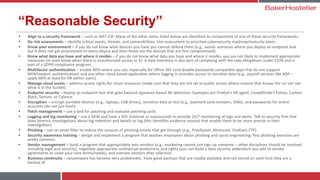
• Align to a security framework – such as NIST CSF. Many of the other items listed below are identified as components of one of these security frameworks.
• Do risk assessments – identify critical assets, threats, and vulnerabilities. Use assessment to prioritize cybersecurity roadmap/maturity plans. .
• Know your environment – if you do not know what devices you have you cannot defend them (e.g., avoids scenarios where you deploy an endpoint tool
but it does not get provisioned on every device and then those are the devices that are first compromised).
• Know what data you have and where it resides – if you do not know what data you have and where it resides, you are not likely to implement appropriate
measures (or even know when there is unauthorized access to it). A data inventory is also part of complying with the new obligations under CCPA and is
part of a GDPR compliance program.
• Multifactor authentication – enable MFA where you can, especially for Office 365 (and disable backwards compatible apps that do not support
MFA/modern authentication) and any other cloud based application where logging in provides access to sensitive data (e.g., payroll services like ADP –
apply MFA at least for HR admin users).
• Manage cloud assets – address access rights for cloud resources (make sure that they are not set to public access where anyone that knows the url can see
what is in the bucket).
• Endpoint security – deploy an endpoint tool that goes beyond signature-based AV detection. Examples are FireEye’s HX agent, CrowdStrike’s Falcon, Carbon
Black, Tanium, or Cylance.
• Encryption – encrypt portable devices (e.g., laptops, USB drives), sensitive data at rest (e.g., payment card numbers, SSNs), and passwords for online
accounts (do not just hash).
• Patch management – use a tool for patching and evaluate patching cycle.
• Logging and log monitoring – use a SIEM and have a SOC (internal or outsourced) to provide 24/7 monitoring of logs and alerts. Talk to security firm that
does forensic investigations about log retention and details to log (this identifies evidence sources that enable them to be more precise in their
investigation).
• Phishing – use an email filter to reduce the amount of phishing emails that get through (e.g., Proofpoint, Mimecast, FireEye’s ETP)
• Security awareness training – design and implement a program that teaches employees about phishing and social engineering. Test phishing exercises are
pretty common.
• Vendor management – build a program that appropriately vets vendors (e.g., marketing cannot just sign up someone – other disciplines should be involved
including legal and security), negotiate appropriate contractual protections and rights (you can build a data security addendum you add to vendor
agreements to cover your core terms/needs), and oversee vendors after selection.
• Business continuity – ransomware has become very problematic. Have good backups that are readily available and not stored on each host they are a
backup of.
Questions?
M. Scott Koller
Partner at Baker Hostetler
11601 Wilshire Boulevard | Suite 1400
Los Angeles, CA 90025-0509
T +1.310.979.8427
mskoller@bakerlaw.com

f6_cyber_security_and_your_agency.pdf

  • 1.
  • 2.
    • Chambers Globalranked & Legal 500 ranked Privacy and Data Protection practice • BTI Cybersecurity Powerhouse (2020) • Privacy and Data Protection “Practice Group of the Year” by Law360 in 2013, 2014, 2015, & 2018 • 70+ attorneys specializing in privacy and data security law nationwide • 3,500+ incidents handled (1,000+ in 2019 alone) • 200+ incident response training workshops and tabletops • 400+ regulatory investigations • 100+ privacy and data security class actions M. Scott Koller Partner BakerHostetler Data Privacy Group 310.979.8427 mskoller@bakerlaw.com
  • 3.
    BakerHostetler, 2019 DataSecurity Incident Response Report, (2019).
  • 4.
  • 5.
    A Simplified Viewof a Data Breach Handling the Long-Term Consequences Managing the Short-Term Crisis Evaluation of the Data Breach Discovery of a Data Breach Theft, loss, or Unauthorized Disclosure of PHI, PII, PCI Forensic Investigation and Legal Review Notification and Credit Monitoring Class-Action Lawsuits Regulatory Fines, Penalties, and Consumer Redress Public Relations Reputational Damage Income Loss
  • 6.
    Incident Response Timeline BakerHostetler,2019 Data Security Incident Response Report, (2019).
  • 9.
  • 11.
    Office of ForeignAssets Control • On October 1, 2020, the U.S. Department of Treasury’s Office of Foreign Assets Control (OFAC) issued an advisory regarding ransom payments and the risk of sanctions associated with such payments.
  • 12.
    Key Takeaways • TheU.S. Government disfavors payments of ransom, but there is no general ban. • Payments to sanctioned individuals and/or entities, however, can result in significant penalties and applications for licenses to make such payments will be handled with a presumption of denial, which may be based on U.S. policy interests alone. • Cooperating with law enforcement is critical. The U.S. Government benefits because it can gather more information about these threat actors to help with prosecution. Although our clients are generally working with law enforcement, we are hearing that many companies are not reporting these incidents to the FBI. OFAC’s guidance is pushing companies to work with the FBI more closely. The benefit to the company is the threat information sharing, which could also include information about the origin of the threat actor. In addition, OFAC has identified early and continuing cooperation with law enforcement as a “significant mitigating” factor in an enforcement context.
  • 14.
  • 15.
  • 16.
  • 17.
    “Reasonable Security” • Alignto a security framework – such as NIST CSF. Many of the other items listed below are identified as components of one of these security frameworks. • Do risk assessments – identify critical assets, threats, and vulnerabilities. Use assessment to prioritize cybersecurity roadmap/maturity plans. . • Know your environment – if you do not know what devices you have you cannot defend them (e.g., avoids scenarios where you deploy an endpoint tool but it does not get provisioned on every device and then those are the devices that are first compromised). • Know what data you have and where it resides – if you do not know what data you have and where it resides, you are not likely to implement appropriate measures (or even know when there is unauthorized access to it). A data inventory is also part of complying with the new obligations under CCPA and is part of a GDPR compliance program. • Multifactor authentication – enable MFA where you can, especially for Office 365 (and disable backwards compatible apps that do not support MFA/modern authentication) and any other cloud based application where logging in provides access to sensitive data (e.g., payroll services like ADP – apply MFA at least for HR admin users). • Manage cloud assets – address access rights for cloud resources (make sure that they are not set to public access where anyone that knows the url can see what is in the bucket). • Endpoint security – deploy an endpoint tool that goes beyond signature-based AV detection. Examples are FireEye’s HX agent, CrowdStrike’s Falcon, Carbon Black, Tanium, or Cylance. • Encryption – encrypt portable devices (e.g., laptops, USB drives), sensitive data at rest (e.g., payment card numbers, SSNs), and passwords for online accounts (do not just hash). • Patch management – use a tool for patching and evaluate patching cycle. • Logging and log monitoring – use a SIEM and have a SOC (internal or outsourced) to provide 24/7 monitoring of logs and alerts. Talk to security firm that does forensic investigations about log retention and details to log (this identifies evidence sources that enable them to be more precise in their investigation). • Phishing – use an email filter to reduce the amount of phishing emails that get through (e.g., Proofpoint, Mimecast, FireEye’s ETP) • Security awareness training – design and implement a program that teaches employees about phishing and social engineering. Test phishing exercises are pretty common. • Vendor management – build a program that appropriately vets vendors (e.g., marketing cannot just sign up someone – other disciplines should be involved including legal and security), negotiate appropriate contractual protections and rights (you can build a data security addendum you add to vendor agreements to cover your core terms/needs), and oversee vendors after selection. • Business continuity – ransomware has become very problematic. Have good backups that are readily available and not stored on each host they are a backup of.
  • 18.
    Questions? M. Scott Koller Partnerat Baker Hostetler 11601 Wilshire Boulevard | Suite 1400 Los Angeles, CA 90025-0509 T +1.310.979.8427 mskoller@bakerlaw.com