Semicolons!
● ”With educated people, I suppose,
punctuation is a matter of rule; with me it is
a matter of feeling. But I must say I have a
great respect for the semicolon; it’s a
useful little chap.” <--Abraham Lincoln
● Semicolons are a secondary divider. They
give you options.
● Semicolons are used between two items of
equal grammatical rank not already joined
with a coordinating conjunction. They will
be joined by a transitional expression.
Semicolons!!
● Two independent clauses, two phrases,
etc. Test your usage by placing a period
between them.
● The train ride is three days; by flight it takes
eight hours.
● Many baseball players make it to the majors
via hard work; however, he found other
means.
Independent Clauses!
● Use a semicolon between related
independent clauses that offer contrasting
or parellel information that do not have a
coordinating conjunction.
● Paul Revere's The Boston Massacre is
traditional American protest art; Edward
Hick's paintings are socially conscious art
with a religious strain.
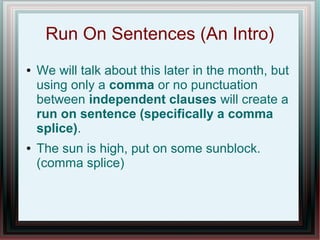
Run On Sentences (An Intro)
● We will talk about this later in the month, but
using only a comma or no punctuation
between independent clauses will create a
run on sentence (specifically a comma
splice).
● The sun is high, put on some sunblock.
(comma splice)
Independent Clauses With
Transitional Words
● Use a semicolon before a transitional
word or phrase to join two independent
clauses.
● The transition will normally be followed by
a comma.
● Thomas Jefferson brought two hundred
vanilla beans and a recipe for vanilla ice
cream back from France; thus, he gave
America its all-time favorite ice cream flavor.
● (that's true)
● Pause.
● Take a breath.
● Questions?
Items In A Series!
● As you'll recall from our discussion of
commas, if there are already commas in
the list of elements you will add
semicolons.
● Laramie, Wyoming; Wyoming, Deleware;
and Delaware, Ohio, were three of the
places they visited.
Don't Misuse Semicolons!
● Semicolons should be used for our good.
Here are some common misuses:
● Between a dependent clause and the rest
of the sentence (use a comma!)
● Introducing a list [use a colon! (stay tuned!)]
● Between two independent clauses joined
by coordinating conjunctions (use a
comma!)
● Do not use a semicolon to introduce a
quote.
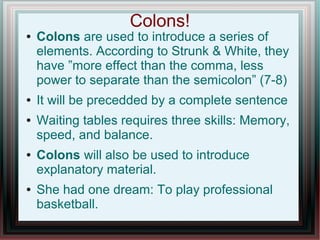
Colons!
● Colons are used to introduce a series of
elements. According to Strunk & White, they
have ”more effect than the comma, less
power to separate than the semicolon” (7-8)
● It will be precedded by a complete sentence
● Waiting tables requires three skills: Memory,
speed, and balance.
● Colons will also be used to introduce
explanatory material.
● She had one dream: To play professional
basketball.
Supplemental Material
● Grammar Girl on semicolons.

Semicolons online

  • 1.
    Semicolons! ● ”With educatedpeople, I suppose, punctuation is a matter of rule; with me it is a matter of feeling. But I must say I have a great respect for the semicolon; it’s a useful little chap.” <--Abraham Lincoln ● Semicolons are a secondary divider. They give you options. ● Semicolons are used between two items of equal grammatical rank not already joined with a coordinating conjunction. They will be joined by a transitional expression.
  • 2.
    Semicolons!! ● Two independentclauses, two phrases, etc. Test your usage by placing a period between them. ● The train ride is three days; by flight it takes eight hours. ● Many baseball players make it to the majors via hard work; however, he found other means.
  • 3.
    Independent Clauses! ● Usea semicolon between related independent clauses that offer contrasting or parellel information that do not have a coordinating conjunction. ● Paul Revere's The Boston Massacre is traditional American protest art; Edward Hick's paintings are socially conscious art with a religious strain.
  • 4.
    Run On Sentences(An Intro) ● We will talk about this later in the month, but using only a comma or no punctuation between independent clauses will create a run on sentence (specifically a comma splice). ● The sun is high, put on some sunblock. (comma splice)
  • 5.
    Independent Clauses With TransitionalWords ● Use a semicolon before a transitional word or phrase to join two independent clauses. ● The transition will normally be followed by a comma. ● Thomas Jefferson brought two hundred vanilla beans and a recipe for vanilla ice cream back from France; thus, he gave America its all-time favorite ice cream flavor. ● (that's true)
  • 6.
    ● Pause. ● Takea breath. ● Questions?
  • 7.
    Items In ASeries! ● As you'll recall from our discussion of commas, if there are already commas in the list of elements you will add semicolons. ● Laramie, Wyoming; Wyoming, Deleware; and Delaware, Ohio, were three of the places they visited.
  • 8.
    Don't Misuse Semicolons! ●Semicolons should be used for our good. Here are some common misuses: ● Between a dependent clause and the rest of the sentence (use a comma!) ● Introducing a list [use a colon! (stay tuned!)] ● Between two independent clauses joined by coordinating conjunctions (use a comma!) ● Do not use a semicolon to introduce a quote.
  • 9.
    Colons! ● Colons areused to introduce a series of elements. According to Strunk & White, they have ”more effect than the comma, less power to separate than the semicolon” (7-8) ● It will be precedded by a complete sentence ● Waiting tables requires three skills: Memory, speed, and balance. ● Colons will also be used to introduce explanatory material. ● She had one dream: To play professional basketball.
  • 10.