International Journal of Humanities and Social Science Invention
ISSN (Online): 2319 – 7722, ISSN (Print): 2319 – 7714
www.ijhssi.org Volume 3 Issue 2 ǁ February. 2014ǁ PP.32-34
www.ijhssi.org 32 | P a g e
Software and Mechanical Professionals Their Level of Anxiety
and Mental Healthiness
Dr.Vidya.Bhagat,
Dy Director Student Affairs,Associate Professor Department of Behavioural Science
USM-KLE International Medical Programme Belgaum Karnataka
ABSTRACT:The different type of professionals varies in their level of anxiety and mental health. Job related
stress in various professions increases the anxiety of an employee and found to haveimpact on theirmental
health. The main objective of the study was therefore to ascertain the differences in level of anxiety and mental
health of software and mechanical professionals. The participants for this study were 100 professionals (50
software and 50 mechanical) chosen from various ITcompanies, Lamina foundries in the Mangalore city of
Karnataka State, India.They were selected by random sampling technique. Sinha’s Comprehensive Anxiety Test
(SCAT) and PGI Health Questionnaire N-1were administered to asses’level of anxiety and mental healthiness
and compared the scores to find the differences between two professionals (software and mechanical). The
results revealsthat software professionals differed in the level of anxiety (t value of 2.26 and p=0.02); there is
no significance with physical aspect (t value 1.15 and p= 0.1265) and significance found in psychological
aspect of mental health with regard totheirdifferences (t value is 1.97 and p=0.0258). The implication of this
study was to develop insight among the employers ofsoftware professionals to understand the impact of
employees work related stress on their level of anxiety and mental health.
KEY WORDS: Level of Anxiety & Mental Healthiness
I. INTRODUCTION
In the present society there is great emphasis on software field for economic progress of a nation. A
sudden change from traditional handmade industrial development will create new and complex psychological
problems like depression, anxiety, meaninglessness and mental unhealthiness, among software professionals.
Knowledge of the level of anxiety, the quality of mental health of professionals is necessary for designing
intervention programmes to help professionals and to improve their quality of work and life. Anxiety in person
varies from normal to abnormal. Anxiousness is one of the factor of personality which influences the functional
efficacy and productivity of individuals. Anxiety is a normal reaction to stress. In fact, it can be a good thing.
Anxiety motivates you to accomplish your assignments, to study harder for a test and it can warn you when
you’re in a dangerous situation. It informs you to be extra vigilant about your environment — to fight or flee.1
In the professionals work stress is common more the stress anxiety level increases in the employees abnormal
anxiety disturbs the mental health affects the work productivity. Everyone will experience anxiety from time to
time. The demands and stress of college life may even make experiencing anxiety more frequent. So it can be
tough to tell the difference between normal anxiety and a condition like social anxiety disorder or obsessive-
compulsive disorder. If anxiety is affecting you or someone you know it’s important to learn the difference.1
Mental health is another important aspect in working professionals which includes physical and psychological
fitness of a person. Mental health refers to our cognitive, and/or emotional wellbeing - it is all about how we
think, feel and behave. Mental health, if somebody has it, can also mean an absence of a mental disorder.
According to WHO (World Health Organization), mental health is "a state of well-being in which the individual
realizes his or her own abilities, can cope with the normal stresses of life, can work productively and fruitfully,
and is able to make a contribution to his or her community". WHO stresses that mental health "is not just the
absence of mental disorder".2
According to Med lexicon’s medical dictionary, mental health is "emotional, behavioral, and social
maturity or normality; the absence of a mental or behavioral disorder; a state of psychological well-being in
which one has achieved a satisfactory integration of one's instinctual drives acceptable to both oneself and one's
social milieu; an appropriate balance of love, work, and leisure pursuits".2
Mental health on the other hand is a
major problem not only in the United States, but in the rest of the world as well. Mental health a state of
emotional and psychological well-being in which an individual is able to use his or her cognitive and emotional
capabilities, function in society, and meet the ordinary demands of everyday life.
Software and Mechanical Professionals Their…
www.ijhssi.org 33 | P a g e
In an organization or company if a person has to meet the goals of job, he should have a sound mental
balance. He/she should have well-balanced emotions to deal with the pressures of the work life. A person with
good mental health will perform efficiently at work and also in life as a whole.
II. ASSESSMENT TOOLS:
1.Sinha’s Comprehensive Anxiety Test (SCAT): this test has been constructed by A.K.P.Sinha (Raipur) and
L.N.K.Sinha (Patna). Sinha’s Comprehensive Anxiety Test (SCAT) measures the level of anxiety. It has 90
items measuring different aspects of anxiety. The answers were taken by ‘Yes’ or ‘No’ responses. The ‘yes’
response indicates the proneness for anxiety. The total score obtained in the scale may vary between 0 - 90. The
obtained raw scores are converted into percentiles separately for males and females interpretation is carried out.
The test retest reliability of the test is 0.85 and reliability coefficient is 0.92. and the validity is 0.62 significant
beyond .001 level of significance
2. PGI Health Questionnaire N.1: this questionnaire has been developed by Verma N.N. Wig and D.Prasad.
The test consists of 38 items having two dimensions namely, physical and psychological. The number of ticks
on section ‘A’ and ‘B’ indicate the respective scores, which can be then added up to give a total score also. The
test retest reliability is 0.88 split-half reliability is 0.86 and inter co-relation is 0.81.
Methodology
Aim: To find out thelevel of anxiety and mental health of software and mechanical professionals and further
using this data for developing various mental health programs in accordance to professional need.
Objective:
 To study the level of anxiety and mental health of software and mechanical professionals.
 To ascertain the differences in level of anxiety and mental health among the software and mechanical
professionals.
Hypothesis:
 The level of anxiety of the software professionals is significantly higher than the level of anxiety of
mechanical professionals.
 The level of mental health is significantly lower among software professionals than mechanical
professionals.
Sample:The sample for the present study includes 100 professionals 50 software and 50 mechanical
professionals of both sexes.The participants for this study were 100 professionals (50 software and 50
mechanical) chosen from various ITcompanies ofLamina foundries in the Mangalore city of Karnataka State,
India.The age of the sample group was between20 to 25 years.
Statistical Analysis:
After data collection, data were entered into SPSS 21.0 version, then analyzed by using unpaired t test
for comparison of software and mechanical professionals with anxiety scores. The statistical significance was
set at 5% level of significance (p<0.05.
III. RESULTS:
The data collected of 100 professionals 50 software and 50 mechanical professionals of both sexesage
group of 20 to 25 have been statistically analyzed to find the difference in their level ofComprehensive
Anxietyamong the professionals selected for this study.
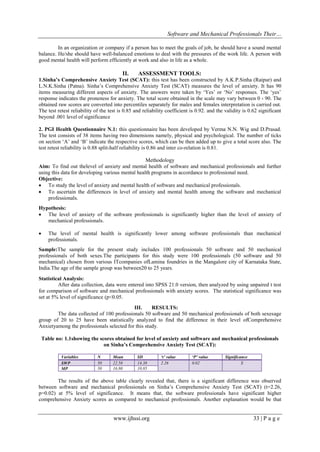
Table no: 1.1showing the scores obtained for level of anxiety and software and mechanical professionals
on Sinha’s Comprehensive Anxiety Test (SCAT):
Variables N Mean SD ‘t’ value ‘P’ value Significance
SWP 50 22.58 14.38 2.26 0.02 S
MP 50 16.80 10.85
The results of the above table clearly revealed that, there is a significant difference was observed
between software and mechanical professionals on Sinha’s Comprehensive Anxiety Test (SCAT) (t=2.26,
p=0.02) at 5% level of significance. It means that, the software professionals have significant higher
comprehensive Anxiety scores as compared to mechanical professionals. Another explanation would be that
Software and Mechanical Professionals Their…
www.ijhssi.org 34 | P a g e
software field is a very competitive one and fast changing. Software professional should be alert and adapt to
fast changing software language structure which creates a great amount of anxiety.
The data collected of 100 professionals 50 software and 50 mechanical professionals of both sexes age group of
20 to 25 have been statistically analyzed to find the mental healthinessamong the professionals selected for this
study with regard to their physical and psychological health and the difference among the professionals.
Table no 1.2 showing the scores obtained by software and mechanical professional on PGI Health
Questionnaire
The results of the above table clearly revealed that, there is no significant difference was observed
between software and mechanical professionals onphysicalhealth (t=1.15, p=0.1265) at 5% level of significance.
It means that, the software and mechanical professionals have similarphysicalhealth scores. However, there is a
significant difference was observed between software and mechanical professionals onPsychological health
(t=1.97, p=0.058) at 5% level of significance. It means that, the software professionals have significant
higherPsychological health scores as compared to mechanical professionals. As most of the software
professional work more mentallystressed which has been impacted their psychological health , with regard to
physical aspect they frequently suffered from head ache, lower back ache and spondylitis as very common this
may be due to their sitting posture at their work place even though there is no significant difference concerned
with the physical work.
IV. CONCLUSION:
[1] In the present study the level of anxiety and physical and ‘psychological dimension of mental health among
software professionals and mechanical professionals has been studied to find the variation among the
professionals.
[2] The anxiety level of software professionals is high than that of mechanical professionals.
[3] There was no significant difference found physical dimension and significant difference found in
psychological dimension between software and mechanical professionals related to ‘psychological
dimension of mental health.
Significance of the study
The present study was conducted with the basic objectives of analyzing and understanding the
difference between software and mechanical fields of engineering departments of different occupational fields.
In this study an attempt was made to compare Mental Health and anxiety between software and mechanical
professional. The objective of the study was to ascertain is there is any difference among various professionals
in their level of anxiety and mental health factor. There were frequent changes in getting in to newer project and
the time limitations and the dead line given for the work projects found to be stressful among the software
professionals than that of mechanical professional. This work related stressors are more prone to anxiety and
mental health entity of professionals.
WEB REFERENCES:
[1] http://abcnews.go.com/Health/AnxietyOverview/story?id=4659631
[2] http://www.medicalnewstoday.com/articles/154543.php
REFERENCES
[1] Alastair, Flapper, Erik, Pieter son, Somon, Winnifred (2002) Professional Psychological and Health Personnel Issues Vol. 89.
[2] Claver Enrique LloopisJuani, Gangates M. Reyes, and Gaplo, Jose L. (U. Alicante Span) (2002) The performance of Information
systems Vol. 89.
[3] Deo„ Pratibha and Sharma, Sagad (1971) "Relaqtionship of Self-Concept and Anxiety" Journal of Psychological Research 15(3), Pp.
63.65.
[4] King R.C. 1 Sethi V2A (1999), Europian Journal of Information system, Vol.6.
[5] James C Coleman (1988) "Abnormal Psychology and Modern Life", Published by D.B. Taraporevala Sons and Co Privte limited
scottForesman and Company.
[6] A.K. Sinha, L.N.K. Sinha Manual for Comprehensive Anxiety Test (SCAT) Agra, National Psychological Corporation.
[7] S.K. Verma, N.N. Wig, D. Parshad (1978) Manual for PGL Health Questionnaire No.1, Agra: National Psychological Corporation.
Mental Health Dimensions Sample
Groups
Mean SD ‘t’ value Significance
Physical SP 2.90 2.80 1.15
P=0.1265
NS
MP 2.32 2.15
Psychological SP 4.88 4.11 1.97*
P=0.0258
S
MP 3.54 2.46

F0321032034

  • 1.
    International Journal ofHumanities and Social Science Invention ISSN (Online): 2319 – 7722, ISSN (Print): 2319 – 7714 www.ijhssi.org Volume 3 Issue 2 ǁ February. 2014ǁ PP.32-34 www.ijhssi.org 32 | P a g e Software and Mechanical Professionals Their Level of Anxiety and Mental Healthiness Dr.Vidya.Bhagat, Dy Director Student Affairs,Associate Professor Department of Behavioural Science USM-KLE International Medical Programme Belgaum Karnataka ABSTRACT:The different type of professionals varies in their level of anxiety and mental health. Job related stress in various professions increases the anxiety of an employee and found to haveimpact on theirmental health. The main objective of the study was therefore to ascertain the differences in level of anxiety and mental health of software and mechanical professionals. The participants for this study were 100 professionals (50 software and 50 mechanical) chosen from various ITcompanies, Lamina foundries in the Mangalore city of Karnataka State, India.They were selected by random sampling technique. Sinha’s Comprehensive Anxiety Test (SCAT) and PGI Health Questionnaire N-1were administered to asses’level of anxiety and mental healthiness and compared the scores to find the differences between two professionals (software and mechanical). The results revealsthat software professionals differed in the level of anxiety (t value of 2.26 and p=0.02); there is no significance with physical aspect (t value 1.15 and p= 0.1265) and significance found in psychological aspect of mental health with regard totheirdifferences (t value is 1.97 and p=0.0258). The implication of this study was to develop insight among the employers ofsoftware professionals to understand the impact of employees work related stress on their level of anxiety and mental health. KEY WORDS: Level of Anxiety & Mental Healthiness I. INTRODUCTION In the present society there is great emphasis on software field for economic progress of a nation. A sudden change from traditional handmade industrial development will create new and complex psychological problems like depression, anxiety, meaninglessness and mental unhealthiness, among software professionals. Knowledge of the level of anxiety, the quality of mental health of professionals is necessary for designing intervention programmes to help professionals and to improve their quality of work and life. Anxiety in person varies from normal to abnormal. Anxiousness is one of the factor of personality which influences the functional efficacy and productivity of individuals. Anxiety is a normal reaction to stress. In fact, it can be a good thing. Anxiety motivates you to accomplish your assignments, to study harder for a test and it can warn you when you’re in a dangerous situation. It informs you to be extra vigilant about your environment — to fight or flee.1 In the professionals work stress is common more the stress anxiety level increases in the employees abnormal anxiety disturbs the mental health affects the work productivity. Everyone will experience anxiety from time to time. The demands and stress of college life may even make experiencing anxiety more frequent. So it can be tough to tell the difference between normal anxiety and a condition like social anxiety disorder or obsessive- compulsive disorder. If anxiety is affecting you or someone you know it’s important to learn the difference.1 Mental health is another important aspect in working professionals which includes physical and psychological fitness of a person. Mental health refers to our cognitive, and/or emotional wellbeing - it is all about how we think, feel and behave. Mental health, if somebody has it, can also mean an absence of a mental disorder. According to WHO (World Health Organization), mental health is "a state of well-being in which the individual realizes his or her own abilities, can cope with the normal stresses of life, can work productively and fruitfully, and is able to make a contribution to his or her community". WHO stresses that mental health "is not just the absence of mental disorder".2 According to Med lexicon’s medical dictionary, mental health is "emotional, behavioral, and social maturity or normality; the absence of a mental or behavioral disorder; a state of psychological well-being in which one has achieved a satisfactory integration of one's instinctual drives acceptable to both oneself and one's social milieu; an appropriate balance of love, work, and leisure pursuits".2 Mental health on the other hand is a major problem not only in the United States, but in the rest of the world as well. Mental health a state of emotional and psychological well-being in which an individual is able to use his or her cognitive and emotional capabilities, function in society, and meet the ordinary demands of everyday life.
  • 2.
    Software and MechanicalProfessionals Their… www.ijhssi.org 33 | P a g e In an organization or company if a person has to meet the goals of job, he should have a sound mental balance. He/she should have well-balanced emotions to deal with the pressures of the work life. A person with good mental health will perform efficiently at work and also in life as a whole. II. ASSESSMENT TOOLS: 1.Sinha’s Comprehensive Anxiety Test (SCAT): this test has been constructed by A.K.P.Sinha (Raipur) and L.N.K.Sinha (Patna). Sinha’s Comprehensive Anxiety Test (SCAT) measures the level of anxiety. It has 90 items measuring different aspects of anxiety. The answers were taken by ‘Yes’ or ‘No’ responses. The ‘yes’ response indicates the proneness for anxiety. The total score obtained in the scale may vary between 0 - 90. The obtained raw scores are converted into percentiles separately for males and females interpretation is carried out. The test retest reliability of the test is 0.85 and reliability coefficient is 0.92. and the validity is 0.62 significant beyond .001 level of significance 2. PGI Health Questionnaire N.1: this questionnaire has been developed by Verma N.N. Wig and D.Prasad. The test consists of 38 items having two dimensions namely, physical and psychological. The number of ticks on section ‘A’ and ‘B’ indicate the respective scores, which can be then added up to give a total score also. The test retest reliability is 0.88 split-half reliability is 0.86 and inter co-relation is 0.81. Methodology Aim: To find out thelevel of anxiety and mental health of software and mechanical professionals and further using this data for developing various mental health programs in accordance to professional need. Objective:  To study the level of anxiety and mental health of software and mechanical professionals.  To ascertain the differences in level of anxiety and mental health among the software and mechanical professionals. Hypothesis:  The level of anxiety of the software professionals is significantly higher than the level of anxiety of mechanical professionals.  The level of mental health is significantly lower among software professionals than mechanical professionals. Sample:The sample for the present study includes 100 professionals 50 software and 50 mechanical professionals of both sexes.The participants for this study were 100 professionals (50 software and 50 mechanical) chosen from various ITcompanies ofLamina foundries in the Mangalore city of Karnataka State, India.The age of the sample group was between20 to 25 years. Statistical Analysis: After data collection, data were entered into SPSS 21.0 version, then analyzed by using unpaired t test for comparison of software and mechanical professionals with anxiety scores. The statistical significance was set at 5% level of significance (p<0.05. III. RESULTS: The data collected of 100 professionals 50 software and 50 mechanical professionals of both sexesage group of 20 to 25 have been statistically analyzed to find the difference in their level ofComprehensive Anxietyamong the professionals selected for this study. Table no: 1.1showing the scores obtained for level of anxiety and software and mechanical professionals on Sinha’s Comprehensive Anxiety Test (SCAT): Variables N Mean SD ‘t’ value ‘P’ value Significance SWP 50 22.58 14.38 2.26 0.02 S MP 50 16.80 10.85 The results of the above table clearly revealed that, there is a significant difference was observed between software and mechanical professionals on Sinha’s Comprehensive Anxiety Test (SCAT) (t=2.26, p=0.02) at 5% level of significance. It means that, the software professionals have significant higher comprehensive Anxiety scores as compared to mechanical professionals. Another explanation would be that
  • 3.
    Software and MechanicalProfessionals Their… www.ijhssi.org 34 | P a g e software field is a very competitive one and fast changing. Software professional should be alert and adapt to fast changing software language structure which creates a great amount of anxiety. The data collected of 100 professionals 50 software and 50 mechanical professionals of both sexes age group of 20 to 25 have been statistically analyzed to find the mental healthinessamong the professionals selected for this study with regard to their physical and psychological health and the difference among the professionals. Table no 1.2 showing the scores obtained by software and mechanical professional on PGI Health Questionnaire The results of the above table clearly revealed that, there is no significant difference was observed between software and mechanical professionals onphysicalhealth (t=1.15, p=0.1265) at 5% level of significance. It means that, the software and mechanical professionals have similarphysicalhealth scores. However, there is a significant difference was observed between software and mechanical professionals onPsychological health (t=1.97, p=0.058) at 5% level of significance. It means that, the software professionals have significant higherPsychological health scores as compared to mechanical professionals. As most of the software professional work more mentallystressed which has been impacted their psychological health , with regard to physical aspect they frequently suffered from head ache, lower back ache and spondylitis as very common this may be due to their sitting posture at their work place even though there is no significant difference concerned with the physical work. IV. CONCLUSION: [1] In the present study the level of anxiety and physical and ‘psychological dimension of mental health among software professionals and mechanical professionals has been studied to find the variation among the professionals. [2] The anxiety level of software professionals is high than that of mechanical professionals. [3] There was no significant difference found physical dimension and significant difference found in psychological dimension between software and mechanical professionals related to ‘psychological dimension of mental health. Significance of the study The present study was conducted with the basic objectives of analyzing and understanding the difference between software and mechanical fields of engineering departments of different occupational fields. In this study an attempt was made to compare Mental Health and anxiety between software and mechanical professional. The objective of the study was to ascertain is there is any difference among various professionals in their level of anxiety and mental health factor. There were frequent changes in getting in to newer project and the time limitations and the dead line given for the work projects found to be stressful among the software professionals than that of mechanical professional. This work related stressors are more prone to anxiety and mental health entity of professionals. WEB REFERENCES: [1] http://abcnews.go.com/Health/AnxietyOverview/story?id=4659631 [2] http://www.medicalnewstoday.com/articles/154543.php REFERENCES [1] Alastair, Flapper, Erik, Pieter son, Somon, Winnifred (2002) Professional Psychological and Health Personnel Issues Vol. 89. [2] Claver Enrique LloopisJuani, Gangates M. Reyes, and Gaplo, Jose L. (U. Alicante Span) (2002) The performance of Information systems Vol. 89. [3] Deo„ Pratibha and Sharma, Sagad (1971) "Relaqtionship of Self-Concept and Anxiety" Journal of Psychological Research 15(3), Pp. 63.65. [4] King R.C. 1 Sethi V2A (1999), Europian Journal of Information system, Vol.6. [5] James C Coleman (1988) "Abnormal Psychology and Modern Life", Published by D.B. Taraporevala Sons and Co Privte limited scottForesman and Company. [6] A.K. Sinha, L.N.K. Sinha Manual for Comprehensive Anxiety Test (SCAT) Agra, National Psychological Corporation. [7] S.K. Verma, N.N. Wig, D. Parshad (1978) Manual for PGL Health Questionnaire No.1, Agra: National Psychological Corporation. Mental Health Dimensions Sample Groups Mean SD ‘t’ value Significance Physical SP 2.90 2.80 1.15 P=0.1265 NS MP 2.32 2.15 Psychological SP 4.88 4.11 1.97* P=0.0258 S MP 3.54 2.46