eye movement analysis for an augmenting  video game development investigation plan presentation january  20, 2009
PRESENTATION SUMMARY Characterization of the investigation problem Project objectives and finality State of the art Project methodology Chronogram Expected results samuel de jesus almeida / sja@ua.pt
INVESTIGATION PROBLEM [1] Video game industry generates millions of dollars in sales: $45 billion by 2010 ( Hartig ) Video games must be appealing to the consumer: Achievable through gameplay, game mechanics and game interface quality. Sometimes video games are  poorly  developed. Why?  Reduced testing or none at all. Results in fragile game elements: gameplay, game mechanics and game interface. samuel de jesus almeida / sja@ua.pt
INVESTIGATION PROBLEM [2] To overcome this problem, research is being conducted and products are being developed to assist in video game development  &  evaluation [ see State of the Art ]; Much of the existing work uses traditional usability evaluation techniques: Not incorrect, but limited; Games are a product of their own nature: Proper evaluation techniques and development guidelines are required. samuel de jesus almeida / sja@ua.pt
INVESTIGATION PROBLEM [3] It is necessary to look into new technologies as solutions for these problems: Eye tracking systems + other methods  The big question: In what way can the analysis of the ocular globe movement contribute to the development of guidelines that can assist in the evaluation of enjoyment in video games? samuel de jesus almeida / sja@ua.pt
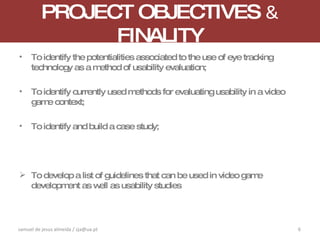
PROJECT OBJECTIVES  &   FINALITY To identify the potentialities associated to the use of eye tracking technology as a method of  usability evaluation; To identify currently used methods for evaluating usability in a video game context; To identify and build a case study; To develop a list of guidelines that can be used in video game development as well as usability studies samuel de jesus almeida / sja@ua.pt
STATE OF THE ART [1] Human Visual System: Eye components Eye muscles Eye movements Eye Tracking Systems: Two common techniques Point of regard    video-based combined pupil/corneal reflection Eye tracking limitations Technical, data extraction, data interpretation Eye tracking potentialities Visual search, learning, visibility of features, ... samuel de jesus almeida / sja@ua.pt
STATE OF THE ART [2] Usability Definitions (ISO n.9241-11; Jakob Nielsen); Evaluation methods; Video game  usability ? Game experience Video Games VG taxonomies (M. Wolf, C. Crawford, Rollings & Adams); First-Person Shooter & RPG genre samuel de jesus almeida / sja@ua.pt
STATE OF THE ART [3] Video Game Evaluation (Research and Projects) Without Eye Tracking Melissa Federoff ‘s  Heuristics and Usability Guidelines for the Creation and Evaluation of Fun in  Video Games  (2002) Desurvire, Caplan & Toth’s  Using Heuristics to Evaluate the Playability of Games   (2004) Kim  et al.’s  Tracking Real-Time User Experience - TRUE   (2006) With Eye Tracking El-Nasr & Yan’s  Visual Attention in 3D Video Games  (2006) Johansen, Norgaard & Rau’s  Can Eye Tracking Boost usability evaluation of computer games  (2008) samuel de jesus almeida / sja@ua.pt
METHODOLOGY Exploratory methodology: bibliographical research Methodological procedure: elaboration of case study Data collection techniques: inquiry & eye tracking Inquiry: questionnaire instrumentation Retrospective think-aloud process Observation: video recordings, notes ( to be decided ) Participants: minimum of 15 Male or female Divided into 3 groups: novice,  regular , hardcore samuel de jesus almeida / sja@ua.pt
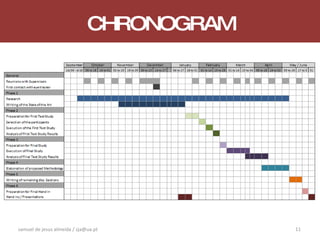
CHRONOGRAM samuel de jesus almeida / sja@ua.pt
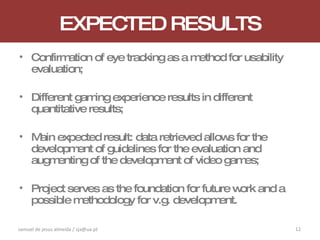
EXPECTED RESULTS Confirmation of eye tracking as a method for usability evaluation; Different gaming experience results in different quantitative results; Main expected result: data retrieved allows for the development of guidelines for the evaluation and augmenting of the development of video games; Project serves as the foundation for future work and a possible methodology for v.g. development. samuel de jesus almeida / sja@ua.pt
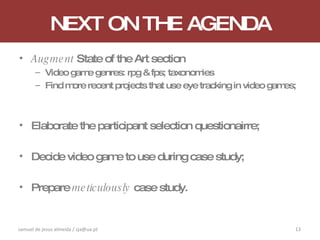
NEXT ON THE AGENDA Augment  State of the Art section Video game genres: rpg & fps; taxonomies Find more recent projects that use eye tracking in video games; Elaborate the participant selection questionairre; Decide video game to use during case study; Prepare  meticulously  case study. samuel de jesus almeida / sja@ua.pt
THE END thank you! samuel de jesus almeida / sja@ua.pt
eye movement analysis for an augmenting  video game development january 20, 2009 Samuel de Jesus Almeida / sja@ua.pt Mestrado em Comunicação Multimédia DeCA / Universidade de Aveiro

Eye Movement Analysis for an Augmenting Video Game Development

  • 1.
    eye movement analysisfor an augmenting video game development investigation plan presentation january 20, 2009
  • 2.
    PRESENTATION SUMMARY Characterizationof the investigation problem Project objectives and finality State of the art Project methodology Chronogram Expected results samuel de jesus almeida / sja@ua.pt
  • 3.
    INVESTIGATION PROBLEM [1]Video game industry generates millions of dollars in sales: $45 billion by 2010 ( Hartig ) Video games must be appealing to the consumer: Achievable through gameplay, game mechanics and game interface quality. Sometimes video games are poorly developed. Why? Reduced testing or none at all. Results in fragile game elements: gameplay, game mechanics and game interface. samuel de jesus almeida / sja@ua.pt
  • 4.
    INVESTIGATION PROBLEM [2]To overcome this problem, research is being conducted and products are being developed to assist in video game development & evaluation [ see State of the Art ]; Much of the existing work uses traditional usability evaluation techniques: Not incorrect, but limited; Games are a product of their own nature: Proper evaluation techniques and development guidelines are required. samuel de jesus almeida / sja@ua.pt
  • 5.
    INVESTIGATION PROBLEM [3]It is necessary to look into new technologies as solutions for these problems: Eye tracking systems + other methods The big question: In what way can the analysis of the ocular globe movement contribute to the development of guidelines that can assist in the evaluation of enjoyment in video games? samuel de jesus almeida / sja@ua.pt
  • 6.
    PROJECT OBJECTIVES & FINALITY To identify the potentialities associated to the use of eye tracking technology as a method of usability evaluation; To identify currently used methods for evaluating usability in a video game context; To identify and build a case study; To develop a list of guidelines that can be used in video game development as well as usability studies samuel de jesus almeida / sja@ua.pt
  • 7.
    STATE OF THEART [1] Human Visual System: Eye components Eye muscles Eye movements Eye Tracking Systems: Two common techniques Point of regard  video-based combined pupil/corneal reflection Eye tracking limitations Technical, data extraction, data interpretation Eye tracking potentialities Visual search, learning, visibility of features, ... samuel de jesus almeida / sja@ua.pt
  • 8.
    STATE OF THEART [2] Usability Definitions (ISO n.9241-11; Jakob Nielsen); Evaluation methods; Video game usability ? Game experience Video Games VG taxonomies (M. Wolf, C. Crawford, Rollings & Adams); First-Person Shooter & RPG genre samuel de jesus almeida / sja@ua.pt
  • 9.
    STATE OF THEART [3] Video Game Evaluation (Research and Projects) Without Eye Tracking Melissa Federoff ‘s Heuristics and Usability Guidelines for the Creation and Evaluation of Fun in Video Games (2002) Desurvire, Caplan & Toth’s Using Heuristics to Evaluate the Playability of Games (2004) Kim et al.’s Tracking Real-Time User Experience - TRUE (2006) With Eye Tracking El-Nasr & Yan’s Visual Attention in 3D Video Games (2006) Johansen, Norgaard & Rau’s Can Eye Tracking Boost usability evaluation of computer games (2008) samuel de jesus almeida / sja@ua.pt
  • 10.
    METHODOLOGY Exploratory methodology:bibliographical research Methodological procedure: elaboration of case study Data collection techniques: inquiry & eye tracking Inquiry: questionnaire instrumentation Retrospective think-aloud process Observation: video recordings, notes ( to be decided ) Participants: minimum of 15 Male or female Divided into 3 groups: novice, regular , hardcore samuel de jesus almeida / sja@ua.pt
  • 11.
    CHRONOGRAM samuel dejesus almeida / sja@ua.pt
  • 12.
    EXPECTED RESULTS Confirmationof eye tracking as a method for usability evaluation; Different gaming experience results in different quantitative results; Main expected result: data retrieved allows for the development of guidelines for the evaluation and augmenting of the development of video games; Project serves as the foundation for future work and a possible methodology for v.g. development. samuel de jesus almeida / sja@ua.pt
  • 13.
    NEXT ON THEAGENDA Augment State of the Art section Video game genres: rpg & fps; taxonomies Find more recent projects that use eye tracking in video games; Elaborate the participant selection questionairre; Decide video game to use during case study; Prepare meticulously case study. samuel de jesus almeida / sja@ua.pt
  • 14.
    THE END thankyou! samuel de jesus almeida / sja@ua.pt
  • 15.
    eye movement analysisfor an augmenting video game development january 20, 2009 Samuel de Jesus Almeida / sja@ua.pt Mestrado em Comunicação Multimédia DeCA / Universidade de Aveiro