


VR Escape Room
By: Nicole , Antigone Bellanich Jonathan Coopersmith, Su Hnin
Pwint, Pedram
When the real world is messed up,
but the virtual one is worse, how will
you escape?
Industry Analysis & Trends
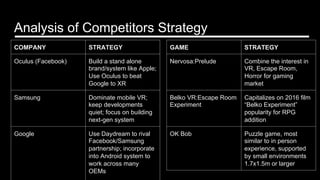
Analysis of Competitors Strategy
COMPANY STRATEGY
Oculus (Facebook) Build a stand alone
brand/system like Apple;
Use Oculus to beat
Google to XR
Samsung Dominate mobile VR;
keep developments
quiet; focus on building
next-gen system
Google Use Daydream to rival
Facebook/Samsung
partnership; incorporate
into Android system to
work across many
OEMs
GAME STRATEGY
Nervosa:Prelude Combine the interest in
VR, Escape Room,
Horror for gaming
market
Belko VR:Escape Room
Experiment
Capitalizes on 2016 film
“Belko Experiment”
popularity for RPG
addition
OK Bob Puzzle game, most
similar to in person
experience, supported
by small environments
1.7x1.5m or larger
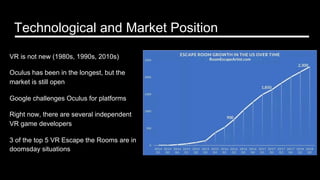
Technological and Market Position
VR is not new (1980s, 1990s, 2010s)
Oculus has been in the longest, but the
market is still open
Google challenges Oculus for platforms
Right now, there are several independent
VR game developers
3 of the top 5 VR Escape the Rooms are in
doomsday situations
Capabilities and Competitive Advantage
Design Process
Multiplayer game→ most multiplayer VR games are in person locations
Strategic Position
Technologies
-  Mainstream VR Platforms
-  Mobile (Samsung, Google)
-  Local (Oculus Rift, HTC Vive, Playstation VR)
-  Remote (Oculus Go)
-  Cross Platform Compatibility
-  Play across different devices
Strategic Position
●  Inclusivity
○  Provide gameplay for non-mature audiences
■  No blood, no jump scares
●  Cross Platform Compatibility
○  Play with friends on different devices
●  Free to play
○  In-game microtransactions
■  Character customization
■  Unlock new rooms
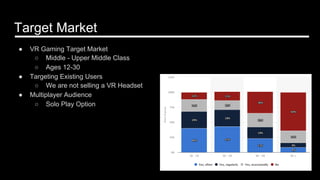
Target Market
●  VR Gaming Target Market
○  Middle - Upper Middle Class
○  Ages 12-30
●  Targeting Existing Users
○  We are not selling a VR Headset
●  Multiplayer Audience
○  Solo Play Option
Marketing Plan & Strategy
●  Digital Marketing Campaigns
○  Target VR/Online Gaming Users
○  Use influencers (tech, gaming, news)
●  Partner with Escape the Room Locations
○  “Continue the experience online”
●  Device Based Advertising
○  Advertise within app stores
●  Built-in Content Sharing
○  Upload experiences to YouTube
○  Livestream
Operation
●  Quality Management
○  Easy to access, user feedback
●  Benchmarking
○  Weekly market and competitor analysis
○  Weekly user analysis
●  Learning From Mistakes
○  Not only our own, but our competitors
○  Act on reviews from competitors
■  Do what they are failing to do
Innovation Projects
Quantitative Method
●  NPV = Net Present Value - present value of the net cash flows
○  Each cash inflow/outflow is discounted back to its PV and then they are summed,
●  Discounted Cash Flow (DCF) - Using it to provide concrete financial estimates
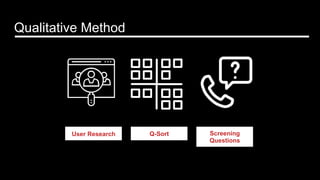
Qualitative Method
User Research Q-Sort Screening
Questions
Conjoint Analysis
-  A popular marketing research technique that marketers use to
determine what features a new product should have and how it
should be priced.
-  Became popular because it was a far less expensive and more
flexible way to address these issues than concept (market) testing.
Combining Quantitative and
Qualitative Information
Data Envelopment
Analysis
-  Using linear programming to combine measures of projects based on
different units ( Dollars Vs Rank)
-  Projects can be ranked by assessing their distance from efficiency
frontier
Management & Organization
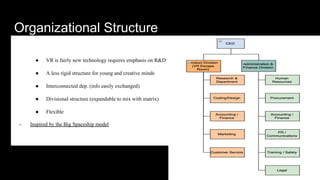
Organizational Structure
●  VR is fairly new technology requires emphasis on R&D
●  A less rigid structure for young and creative minds
●  Interconnected dep. (info easily exchanged)
●  Divisional structure (expandable to mix with matrix)
●  Flexible
-  Inspired by the Big Spaceship model
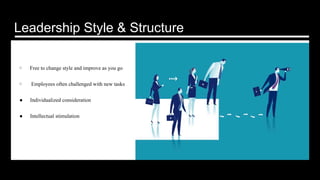
Leadership Style & Structure
●  Free to change style and improve as you go
●  Employees often challenged with new tasks
●  Individualized consideration
●  Intellectual stimulation
Staff Composition
What our staff is composed off?
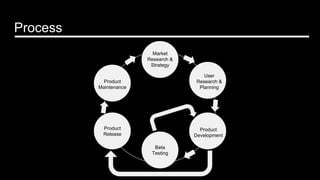
New Development Process
Process
Beta
Testing
Product
Release
Product
Maintenance
Product
Development
Market
Research &
Strategy
User
Research &
Planning
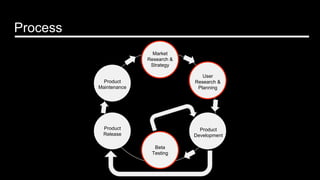
Process
Beta
Testing
Product
Release
Product
Maintenance
Product
Development
Market
Research &
Strategy
User
Research &
Planning
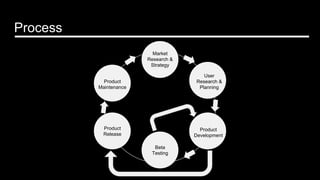
Process
Beta
Testing
Product
Release
Product
Maintenance
Product
Development
Market
Research &
Strategy
User
Research &
Planning
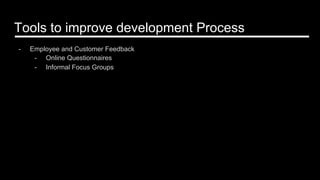
Tools to improve development Process
-  Employee and Customer Feedback
-  Online Questionnaires
-  Informal Focus Groups
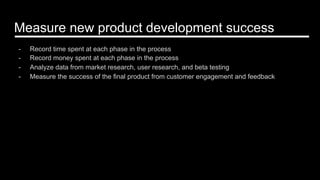
Measure new product development success
-  Record time spent at each phase in the process
-  Record money spent at each phase in the process
-  Analyze data from market research, user research, and beta testing
-  Measure the success of the final product from customer engagement and feedback
New Product Development Teams
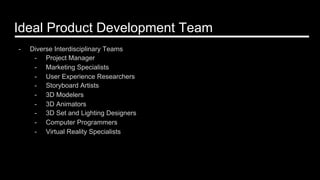
Ideal Product Development Team
-  Diverse Interdisciplinary Teams
-  Project Manager
-  Marketing Specialists
-  User Experience Researchers
-  Storyboard Artists
-  3D Modelers
-  3D Animators
-  3D Set and Lighting Designers
-  Computer Programmers
-  Virtual Reality Specialists
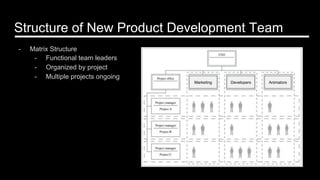
Structure of New Product Development Team
-  Matrix Structure
-  Functional team leaders
-  Organized by project
-  Multiple projects ongoing
AnimatorsDevelopersMarketing
Development & Milestones
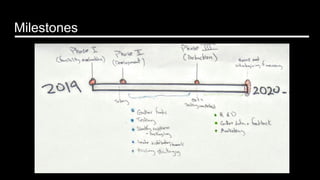
Milestones
Questions
Team Project
Your old friend came up with a great video game idea. Your friend has a lot of experience with
writing game software, but would like your help in designing a process for taking that idea to
market. Assume that you have funding for hiring enough software developers, and any
equipment that you might reasonably need. You should specify the sequence of project phases,
gates, and milestones, as well as any specific methodologies that you think you should use,
based on your readings. You should also discuss firm strategy, structure, team composition,
leadership etc. Your process design should define the sequence of major product development
activities, and this should be sketched on a sheet of paper.
Length: not page limit. Font: Time new roman, 12. Double spaced. Please use graphics. Include
additional information in the Appendix if need. Please include the following sections to you
description.
1. Executive summary of plan:
The growth of VR has been not as quickly as predicted, mainly because of the
high prices of the hard wear in the beginning, and more importantly people still had not
seen a tangible benefit for having/owning one. Despite that, VR and its like technologies
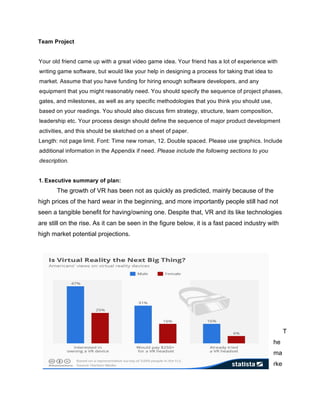
are still on the rise. As it can be seen in the figure below, it is a fast paced industry with
high market potential projections.
T
he
ma
rke
t is growing, while more and more people are gaining access to the headsets and
having to experience the tech thanks to the decreasing prices. Moreover, with the very
low current unemployment rate, people are having more money to spend, translating to
a great time for innovative new tech to be recognized and tried. This game and the likes
of this game can attract an even broader audience to join the VR community. Gaming is
all about immersing in a different world and our game and the VR tech go hand in hand
to provide the best experience for the user.
In regards to further evaluating/forecasting product success, beta testing and
surveys should be considered. As we read in the week 6 case, Yahoo incorporated
internal and external testers from early adopters, which had the advantage of testing the
waters of possibly having the next big innovation early. On the other hand, the
disadvantage was that no long term income was guaranteed. Netscape used beta
testing with sophisticated users that could pave the path for common users, providing
more accurate results, but costing higher. We also saw how microsoft gained insights
from competitors, learned from their mistakes and started when there were better and
more complete coding languages available, leaving the competition in the dust. So
since VR is still evolving companies should keep an eye on new tech that can be
incorporated into VR hardware and software.
2. Industry Analysis & Trends:
a. Analysis of competitors strategy
b. Technological and market position
c. Capabilities and competitive advantage
Instructions: With this analysis you need to demonstrate that you understand the competitive
landscape: who are the competitors, where they are located, what strategies they employee
and what are their competitive advantages. This will help me understand how your strategic
analysis informed your strategic decision
3. Strategic Position
a. What technology/ies platform/s you are going to use
b. What is the strategic position you are going to take relative to your competition
c. Who is the target market for your product?
d. Marketing plan & sales strategy
e. Operation
Instructions: The key here is to convey how your strategic positioning and marketing plan can
position you for success.
4. Innovation projects
a. Which quantitative and qualitative method are you going to use to choose a
project?
b. What are your selection criteria to hire individual to the team.
Instructions: The key here is to explain the methods that will inform your project choice. I
would like to see how you align this choice with the type of individual you hire.
***Management structure to innovate and how we will do so
5. Management & Organization
a. What is the organizational structure you are going to adopt to implement your
strategy?
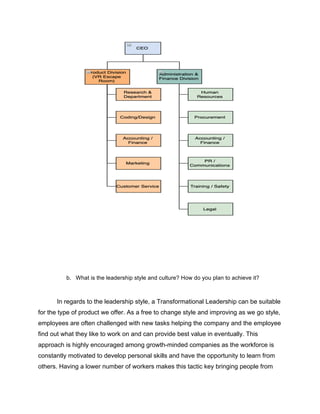
VR is fairly new technology and requires further R&D. As a result, a less rigid
structure for young and creative minds to be able maximize VR experience in the game
interface is necessary. Having interconnected departments where information is easily
exchanged among people, creativity is stimulated, and flexibility is present are key.
Nonetheless, the internal and external environments must also assist employees with
necessary resources and aesthetics.
A mixed structure is eventually where the company should go, but for the start a
divisional structure is considered to be the best option as it provides more
interconnection among divisions, while not being to complex. We’ve read in Draft
Chapter 4 that the more complexity and change exist, the more uncertainty exists. In
order to combat any complexity a greater structural flexibility is needed. Moreover,
knowing this is a new company, resources are limited making the company dependent
on outside networks.
b. What is the leadership style and culture? How do you plan to achieve it?
In regards to the leadership style, a Transformational Leadership can be suitable
for the type of product we offer. As a free to change style and improving as we go style,
employees are often challenged with new tasks helping the company and the employee
find out what they like to work on and can provide best value in eventually. This
approach is highly encouraged among growth-minded companies as the workforce is
constantly motivated to develop personal skills and have the opportunity to learn from
others. Having a lower number of workers makes this tactic key bringing people from
different backgrounds and skills together. The risk of this approach is not having
authority and hard data on everyone’s learning curves and specialization.
At the end of the day, there is no strategy with 100% success rate. Lastly, we are
relying on quality employee, and the giant companies in tech to further develop the
market and increase awareness with us. In the case of them giving up on this mission
we fail as well.
6. Managing new development process
1. Process
i. How are you going to maximize fit with customer requirements
ii. Minimize development cycle time
iii. Control for development cost
1. Is the process going to be sequential or parallel?
2. How are you going involve customers and supplier? Please justify your choice
3. What tools you are going to use to improve development process
4. What tools are you going to use to measure new product development success
Instructions: please provide a short description on your process related issues.
7. Managing new product development teams
1. What is the ideal product development team composition in terms of skills and
experience
2. What is the structure of the new product development team: e.g., functional,
autonomous teach etc.
3. What is the team leadership structure?
8. Development and Milestones
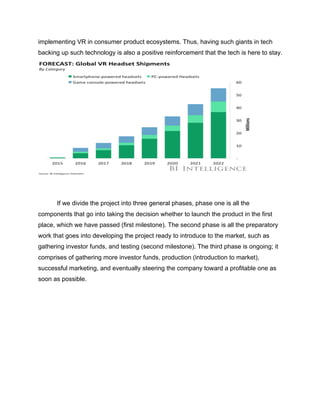
VR headset shipments are constantly on the rise (see figure below). It is
undeniable that sooner than later, more people are going to have abundant access to
VR. We already see companies like Apple, Facebook, Amazon and Google
implementing VR in consumer product ecosystems. Thus, having such giants in tech
backing up such technology is also a positive reinforcement that the tech is here to stay.
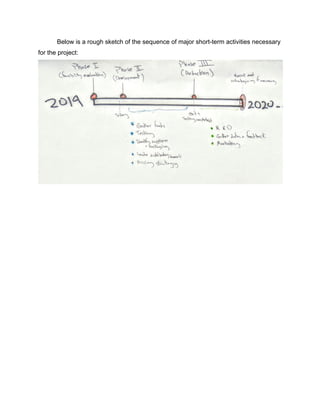
If we divide the project into three general phases, phase one is all the
components that go into taking the decision whether to launch the product in the first
place, which we have passed (first milestone). The second phase is all the preparatory
work that goes into developing the project ready to introduce to the market, such as
gathering investor funds, and testing (second milestone). The third phase is ongoing; it
comprises of gathering more investor funds, production (introduction to market),
successful marketing, and eventually steering the company toward a profitable one as
soon as possible.
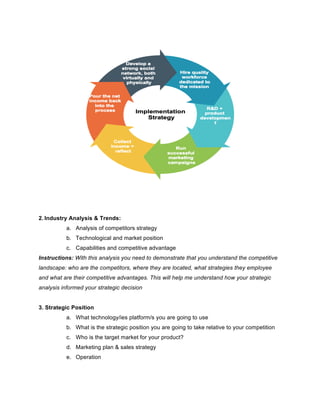
Below is a rough sketch of the sequence of major short-term activities necessary
for the project:

Organizational Strategy Final Project

  • 1.
    VR Escape Room By:Nicole , Antigone Bellanich Jonathan Coopersmith, Su Hnin Pwint, Pedram
  • 2.
    When the realworld is messed up, but the virtual one is worse, how will you escape?
  • 3.
  • 4.
    Analysis of CompetitorsStrategy COMPANY STRATEGY Oculus (Facebook) Build a stand alone brand/system like Apple; Use Oculus to beat Google to XR Samsung Dominate mobile VR; keep developments quiet; focus on building next-gen system Google Use Daydream to rival Facebook/Samsung partnership; incorporate into Android system to work across many OEMs GAME STRATEGY Nervosa:Prelude Combine the interest in VR, Escape Room, Horror for gaming market Belko VR:Escape Room Experiment Capitalizes on 2016 film “Belko Experiment” popularity for RPG addition OK Bob Puzzle game, most similar to in person experience, supported by small environments 1.7x1.5m or larger
  • 5.
    Technological and MarketPosition VR is not new (1980s, 1990s, 2010s) Oculus has been in the longest, but the market is still open Google challenges Oculus for platforms Right now, there are several independent VR game developers 3 of the top 5 VR Escape the Rooms are in doomsday situations
  • 6.
    Capabilities and CompetitiveAdvantage Design Process Multiplayer game→ most multiplayer VR games are in person locations
  • 7.
  • 8.
    Technologies -  Mainstream VRPlatforms -  Mobile (Samsung, Google) -  Local (Oculus Rift, HTC Vive, Playstation VR) -  Remote (Oculus Go) -  Cross Platform Compatibility -  Play across different devices
  • 9.
    Strategic Position ●  Inclusivity ○ Provide gameplay for non-mature audiences ■  No blood, no jump scares ●  Cross Platform Compatibility ○  Play with friends on different devices ●  Free to play ○  In-game microtransactions ■  Character customization ■  Unlock new rooms
  • 10.
    Target Market ●  VRGaming Target Market ○  Middle - Upper Middle Class ○  Ages 12-30 ●  Targeting Existing Users ○  We are not selling a VR Headset ●  Multiplayer Audience ○  Solo Play Option
  • 11.
    Marketing Plan &Strategy ●  Digital Marketing Campaigns ○  Target VR/Online Gaming Users ○  Use influencers (tech, gaming, news) ●  Partner with Escape the Room Locations ○  “Continue the experience online” ●  Device Based Advertising ○  Advertise within app stores ●  Built-in Content Sharing ○  Upload experiences to YouTube ○  Livestream
  • 12.
    Operation ●  Quality Management ○ Easy to access, user feedback ●  Benchmarking ○  Weekly market and competitor analysis ○  Weekly user analysis ●  Learning From Mistakes ○  Not only our own, but our competitors ○  Act on reviews from competitors ■  Do what they are failing to do
  • 13.
  • 14.
    Quantitative Method ●  NPV= Net Present Value - present value of the net cash flows ○  Each cash inflow/outflow is discounted back to its PV and then they are summed, ●  Discounted Cash Flow (DCF) - Using it to provide concrete financial estimates
  • 15.
    Qualitative Method User ResearchQ-Sort Screening Questions
  • 16.
    Conjoint Analysis -  Apopular marketing research technique that marketers use to determine what features a new product should have and how it should be priced. -  Became popular because it was a far less expensive and more flexible way to address these issues than concept (market) testing.
  • 17.
    Combining Quantitative and QualitativeInformation Data Envelopment Analysis -  Using linear programming to combine measures of projects based on different units ( Dollars Vs Rank) -  Projects can be ranked by assessing their distance from efficiency frontier
  • 18.
  • 19.
    Organizational Structure ●  VRis fairly new technology requires emphasis on R&D ●  A less rigid structure for young and creative minds ●  Interconnected dep. (info easily exchanged) ●  Divisional structure (expandable to mix with matrix) ●  Flexible -  Inspired by the Big Spaceship model
  • 20.
    Leadership Style &Structure ●  Free to change style and improve as you go ●  Employees often challenged with new tasks ●  Individualized consideration ●  Intellectual stimulation
  • 21.
    Staff Composition What ourstaff is composed off?
  • 22.
  • 23.
  • 24.
  • 25.
  • 26.
    Tools to improvedevelopment Process -  Employee and Customer Feedback -  Online Questionnaires -  Informal Focus Groups
  • 27.
    Measure new productdevelopment success -  Record time spent at each phase in the process -  Record money spent at each phase in the process -  Analyze data from market research, user research, and beta testing -  Measure the success of the final product from customer engagement and feedback
  • 28.
  • 29.
    Ideal Product DevelopmentTeam -  Diverse Interdisciplinary Teams -  Project Manager -  Marketing Specialists -  User Experience Researchers -  Storyboard Artists -  3D Modelers -  3D Animators -  3D Set and Lighting Designers -  Computer Programmers -  Virtual Reality Specialists
  • 30.
    Structure of NewProduct Development Team -  Matrix Structure -  Functional team leaders -  Organized by project -  Multiple projects ongoing AnimatorsDevelopersMarketing
  • 31.
  • 32.
  • 33.
  • 34.
    Team Project Your oldfriend came up with a great video game idea. Your friend has a lot of experience with writing game software, but would like your help in designing a process for taking that idea to market. Assume that you have funding for hiring enough software developers, and any equipment that you might reasonably need. You should specify the sequence of project phases, gates, and milestones, as well as any specific methodologies that you think you should use, based on your readings. You should also discuss firm strategy, structure, team composition, leadership etc. Your process design should define the sequence of major product development activities, and this should be sketched on a sheet of paper. Length: not page limit. Font: Time new roman, 12. Double spaced. Please use graphics. Include additional information in the Appendix if need. Please include the following sections to you description. 1. Executive summary of plan: The growth of VR has been not as quickly as predicted, mainly because of the high prices of the hard wear in the beginning, and more importantly people still had not seen a tangible benefit for having/owning one. Despite that, VR and its like technologies are still on the rise. As it can be seen in the figure below, it is a fast paced industry with high market potential projections. T he ma rke
  • 35.
    t is growing,while more and more people are gaining access to the headsets and having to experience the tech thanks to the decreasing prices. Moreover, with the very low current unemployment rate, people are having more money to spend, translating to a great time for innovative new tech to be recognized and tried. This game and the likes of this game can attract an even broader audience to join the VR community. Gaming is all about immersing in a different world and our game and the VR tech go hand in hand to provide the best experience for the user. In regards to further evaluating/forecasting product success, beta testing and surveys should be considered. As we read in the week 6 case, Yahoo incorporated internal and external testers from early adopters, which had the advantage of testing the waters of possibly having the next big innovation early. On the other hand, the disadvantage was that no long term income was guaranteed. Netscape used beta testing with sophisticated users that could pave the path for common users, providing more accurate results, but costing higher. We also saw how microsoft gained insights from competitors, learned from their mistakes and started when there were better and more complete coding languages available, leaving the competition in the dust. So since VR is still evolving companies should keep an eye on new tech that can be incorporated into VR hardware and software.
  • 36.
    2. Industry Analysis& Trends: a. Analysis of competitors strategy b. Technological and market position c. Capabilities and competitive advantage Instructions: With this analysis you need to demonstrate that you understand the competitive landscape: who are the competitors, where they are located, what strategies they employee and what are their competitive advantages. This will help me understand how your strategic analysis informed your strategic decision 3. Strategic Position a. What technology/ies platform/s you are going to use b. What is the strategic position you are going to take relative to your competition c. Who is the target market for your product? d. Marketing plan & sales strategy e. Operation
  • 37.
    Instructions: The keyhere is to convey how your strategic positioning and marketing plan can position you for success. 4. Innovation projects a. Which quantitative and qualitative method are you going to use to choose a project? b. What are your selection criteria to hire individual to the team. Instructions: The key here is to explain the methods that will inform your project choice. I would like to see how you align this choice with the type of individual you hire. ***Management structure to innovate and how we will do so 5. Management & Organization a. What is the organizational structure you are going to adopt to implement your strategy? VR is fairly new technology and requires further R&D. As a result, a less rigid structure for young and creative minds to be able maximize VR experience in the game interface is necessary. Having interconnected departments where information is easily exchanged among people, creativity is stimulated, and flexibility is present are key. Nonetheless, the internal and external environments must also assist employees with necessary resources and aesthetics. A mixed structure is eventually where the company should go, but for the start a divisional structure is considered to be the best option as it provides more interconnection among divisions, while not being to complex. We’ve read in Draft Chapter 4 that the more complexity and change exist, the more uncertainty exists. In order to combat any complexity a greater structural flexibility is needed. Moreover, knowing this is a new company, resources are limited making the company dependent on outside networks.
  • 38.
    b. What isthe leadership style and culture? How do you plan to achieve it? In regards to the leadership style, a Transformational Leadership can be suitable for the type of product we offer. As a free to change style and improving as we go style, employees are often challenged with new tasks helping the company and the employee find out what they like to work on and can provide best value in eventually. This approach is highly encouraged among growth-minded companies as the workforce is constantly motivated to develop personal skills and have the opportunity to learn from others. Having a lower number of workers makes this tactic key bringing people from
  • 39.
    different backgrounds andskills together. The risk of this approach is not having authority and hard data on everyone’s learning curves and specialization. At the end of the day, there is no strategy with 100% success rate. Lastly, we are relying on quality employee, and the giant companies in tech to further develop the market and increase awareness with us. In the case of them giving up on this mission we fail as well. 6. Managing new development process 1. Process i. How are you going to maximize fit with customer requirements ii. Minimize development cycle time iii. Control for development cost 1. Is the process going to be sequential or parallel? 2. How are you going involve customers and supplier? Please justify your choice 3. What tools you are going to use to improve development process 4. What tools are you going to use to measure new product development success Instructions: please provide a short description on your process related issues. 7. Managing new product development teams 1. What is the ideal product development team composition in terms of skills and experience 2. What is the structure of the new product development team: e.g., functional, autonomous teach etc. 3. What is the team leadership structure? 8. Development and Milestones VR headset shipments are constantly on the rise (see figure below). It is undeniable that sooner than later, more people are going to have abundant access to VR. We already see companies like Apple, Facebook, Amazon and Google
  • 40.
    implementing VR inconsumer product ecosystems. Thus, having such giants in tech backing up such technology is also a positive reinforcement that the tech is here to stay. If we divide the project into three general phases, phase one is all the components that go into taking the decision whether to launch the product in the first place, which we have passed (first milestone). The second phase is all the preparatory work that goes into developing the project ready to introduce to the market, such as gathering investor funds, and testing (second milestone). The third phase is ongoing; it comprises of gathering more investor funds, production (introduction to market), successful marketing, and eventually steering the company toward a profitable one as soon as possible.
  • 41.
    Below is arough sketch of the sequence of major short-term activities necessary for the project: