Downloaded 13 times


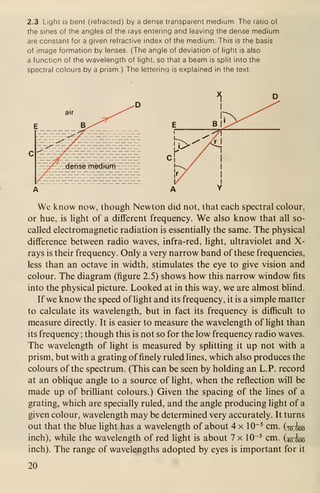
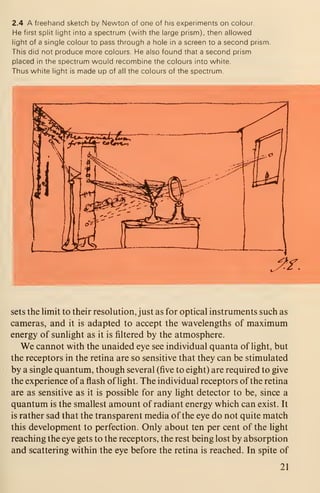
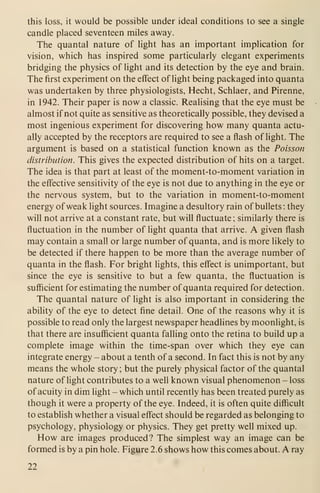
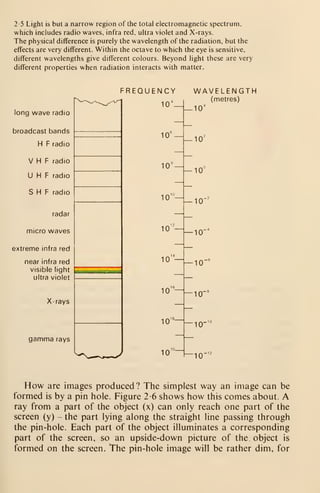
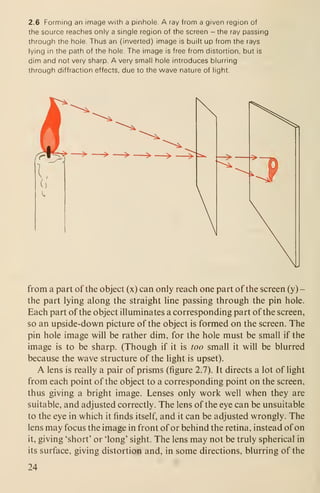
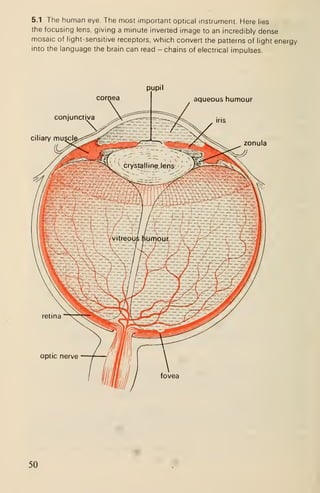
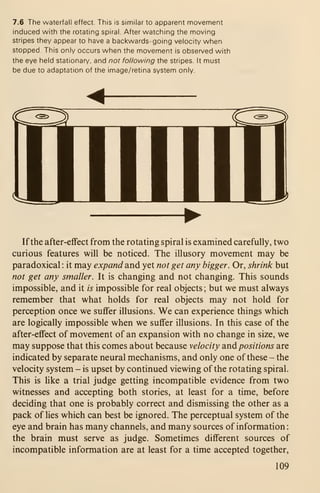
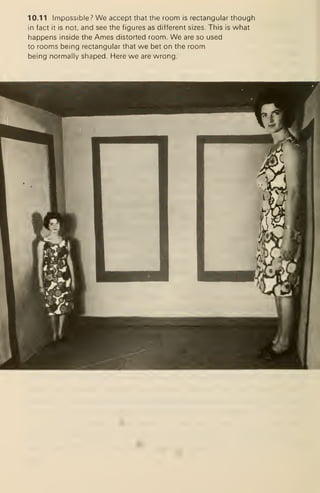
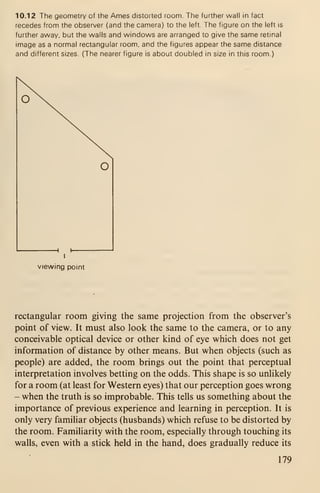
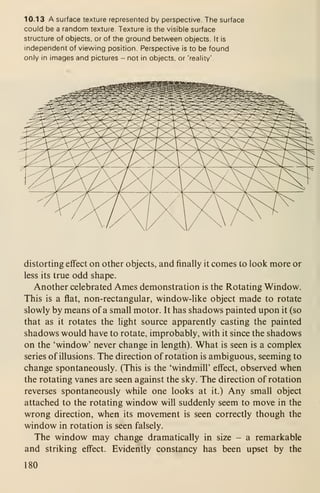
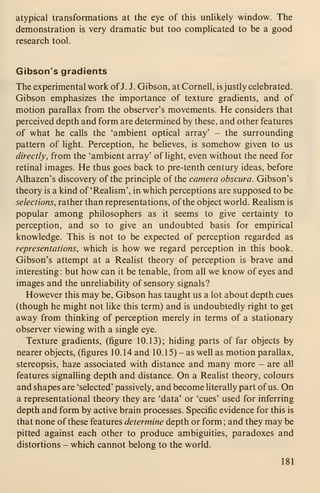
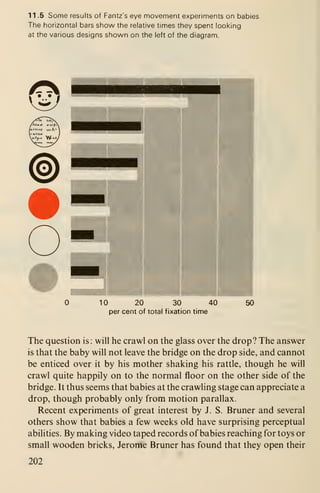
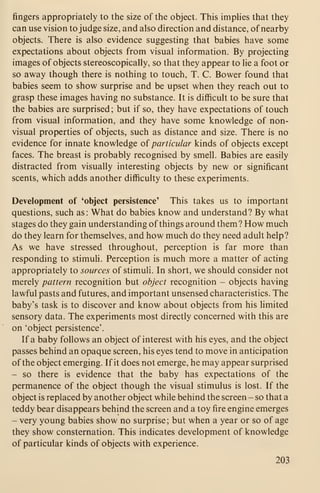
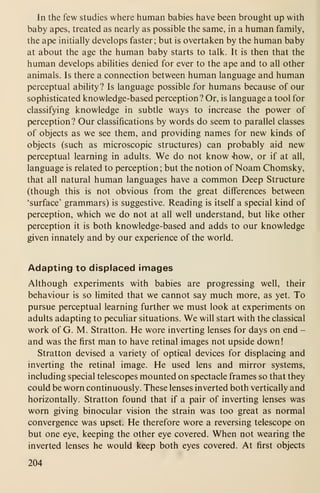
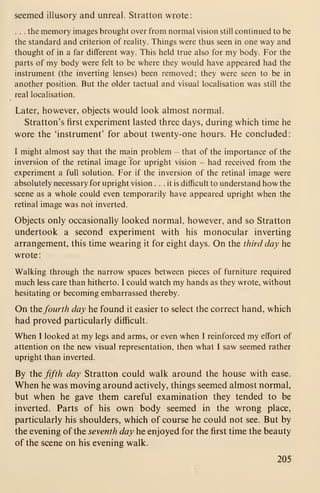
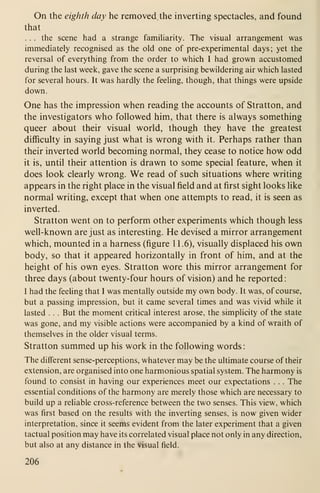
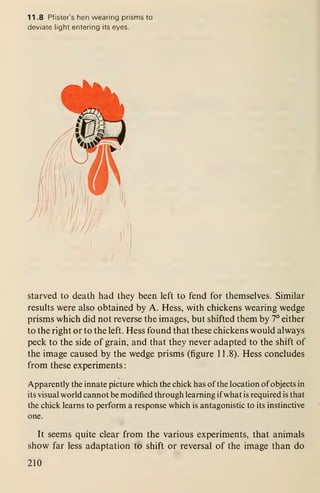
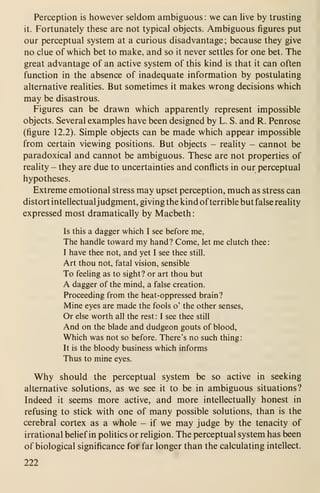
![2.7 A lens can be thought of as a pair of converging
prisms, forming an image from a bundle of rays.
The image is far brighter than from a pinhole, but it is
generally distorted in some degree, and the depth of
focus is limited. [This figure should not be taken too
literally - image-forming lenses have curved surfaces.]
image. The cornea may be irregular, or pitted (perhaps due to
abrasion from metal filings in industry, or grit from riding a motor
cycle without protective goggles). Most optical defects can be
corrected by adding artificial lenses - spectacles. Spectacles correct
for errors in accommodation by changing the power of the lens of the
eye; they correct for astigmatism by adding a non-spherical
component. Ordinary spectacles cannot correct for damage to the
surface of the cornea but corneal lenses, fitted to the eye itself, serve to
give a fresh surface to the cornea.
Spectacles lengthen our effective lives. With their aid we can see to
read and to perform skilled tasks into old age: before their invention
scholars and craftsmen were made helpless by lack of sight, though
they still had the power of their minds.
25](https://image.slidesharecdn.com/eye-brain-gregory-140608051504-phpapp01/85/Eye-brain-gregory-27-320.jpg)
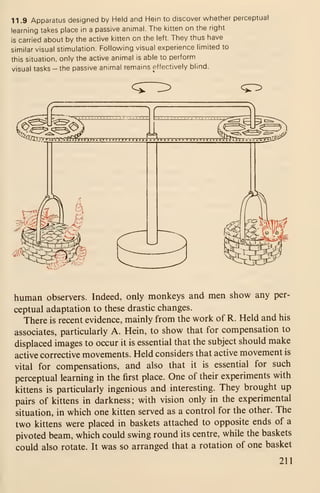
![the fact that although the image grows as the distance of the object
decreases, // still looks almost the same size. Consider an audience at a
theatre - the faces all look much the same size, and yet the retinal
images of the distant faces are far smaller than the nearer. Look at
your two hands, one placed at arm's length the other at half the
distance - they will look almost exactly the same size, and yet the
image of the further hand will be only half the (linear) size of the
nearer. If the nearer hand is brought to overlap the further, then they
will look quite different in size. This little experiment is well worth
carrying out. The overlap defeats Constancy Scaling, and shows us
what perception would be like without it.
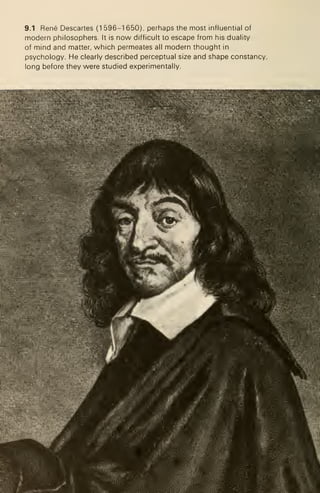
What is known as Size Constancy was described by Descartes, who
wrote in his Dioptrics, of 1637:
I need not, in conclusion, say anything special about the way we see the size
and shape of objects ; it is completely determined by the way we see the
distance and position of their parts. Thus, their size is judged according to
our knowledge or opinion as to their distance, in conjunction with the size of
the images that they impress on the back of the eye. It is not the absolute size
of the images that counts. Clearly they are a hundred times bigger [in area]
when the objects are very close to us than when they are ten times farther
away ; but they do not make us see the objects a hundred times bigger ; on the
contrary, they seem almost the same size, at any rate so long as we are not
deceived by (too great) a distance.
We have here as clear a statement of size constancy as any made
later by psychologists; except that Descartes over-states the
importance of knowing the sizes or shapes of the objects. Descartes
goes on to describe what is now called Shape Constancy
:
Again, our judgments of shape clearly come from our knowledge, or opinion,
as to the position of the various parts of the objects and not in accordance
with the pictures in the eye ; for these pictures normally contain ovals and
diamonds when they cause us to see circles and squares.
The ability of the perceptual system to compensate for changing
distance has been very fully investigated, notably by the English
psychologist Robert Thouless in the 1930's. Thouless measured the
amount of constancy under various conditions, and for different
types of people. He used very simple apparatus - nothing more
elaborate than rulers and pieces of cardboard. For measuring size
153](https://image.slidesharecdn.com/eye-brain-gregory-140608051504-phpapp01/85/Eye-brain-gregory-155-320.jpg)
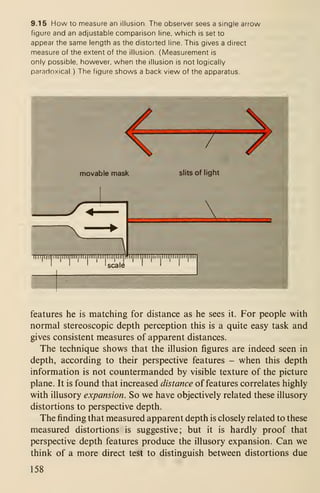
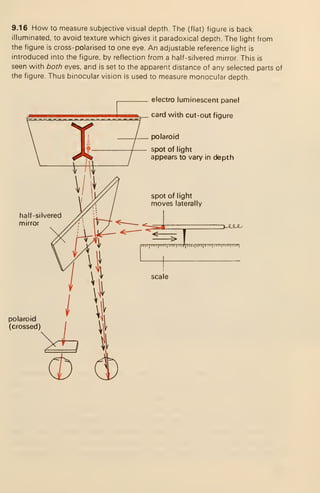
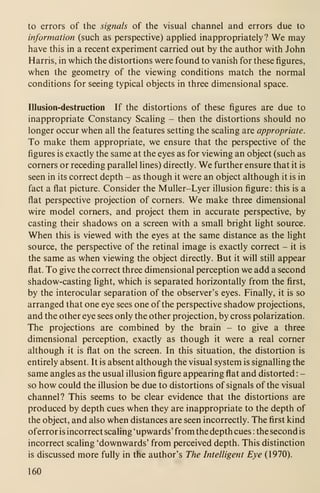
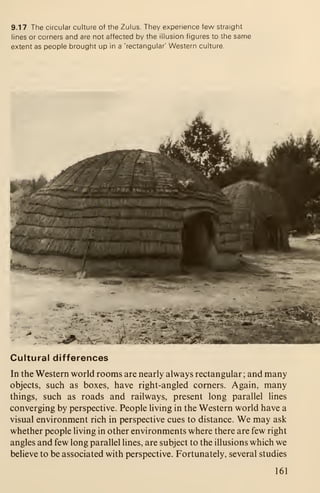
![drawings of crystals: L. A. Necker, 'Observations on some remarkable
phenomena seen in Switzerland ; and an optical phenomenon which occurs
on viewing of a crystal or geometrical solid', Phil. Mag. (3 ser.) 1, 329-37
(1832). This is the origin of the Necker Cube.
2 Light
Sir William Bragg, Universe ofLight, Bell-Clarke, Irwin (1962); F. A. Jenkins
& H. E. White, Fundamentals of Optics, McGraw-Hill, 3rd ed. (1957). For a
fascinating historical account: Vasco Ronchi, The Nature of Light,
Heinemann (1970) (trans, of Storia della Luce [1939]). Sir Isaac Newton,
Opticks, 4th ed. (1730), Dover PubHcations Reprint (1952).
3 In the beginning
There is no book describing primitive eyes in detail, but more developed eyes
are described magnificently in G. L. Walls, The vertebrate eye and its
adaptive radiation', Cranbrook Institute of Science Bulletin 19 (1942).
The eyes of insects are described by V. B. Wigglesworth in The Principles of
Insect Physiology, Methuen/Wiley, 5th ed. (1953). Investigation of the eye of
Copilia is described by R. L. Gregory, H. E. Ross and N. Moray, in 'The
Curious eye of Copilia', Nature (Lond.) 201, 1 166 (1964). For fairly recent
research papers: C. G. Bernhard (ed.). The Functional Organization of the
Compound Eye, Wenner-Gren Symp. Ser. 7, Pergamon (1965).
4 The brain
The structure of the brain and nervous system is given in: M. L. Barr, The
Human Nervous System: An Anatomical Viewpoint, Harper, 2nd ed. (1974);
A general discussion of structure and function is given by C. U. M. Smith,
The Brain, Towards an Understanding, Faber and Faber (1970). Interesting
accounts are, D. E. Wooldridge, The Machinery of the Brain, McGraw-Hill
(1963), and S. Rose, The Conscious Brain, Weidenfeld and Nicolson (1973).
Still worth reading today is the classic: Sir Charles Sherrington, The
Integrative Action ofthe Nervous System (1906), Yale paperback (1947). The
history of ideas on the brain and sensation is given by K. D. Keele in Ana-
tomies of Pain, Blackwell/Machwith (1957). The action potential in nerves
is described in B. Katz, Nerve, Muscle and Synapse, McGraw-Hill (1966).
The important work on discovering the neural mechanism responding to
angles of lines and movements, for the cat and monkey brain, is due to D. H.
Hubel and T. N. Wiesel, 'Receptive fields, binocular interaction and
functional architecture in the cat's visual cortex', J. Physiol. 160, 106 (1962),
and many later papers in the same and other journals. For pioneer work on
the retina of the frog, see J. Y. Lettvin, H. R. Maturana, W. S. McCulloch,
242](https://image.slidesharecdn.com/eye-brain-gregory-140608051504-phpapp01/85/Eye-brain-gregory-244-320.jpg)
![10 Art and reality
The Ames' demonstrations are described in W. H. Ittleson, The Ames
Demonstrations in Perception, O.U. P. /Princeton (1952). For Gibson's ideas
on 'pick up of information from the ambient array': J. J. Gibson, The
Perception ofthe Visual World, Allen & Unwin/Houghton Mifflin (1950) and
J. J. Gibson, The Senses Considered as Perceptual Systems, Boston (1966).
The best discussion relating the problems of the artist to what we know of
visual perception is E. H. Gombrich, Art and Illusion, Phaidon/Pantheon
(1960).
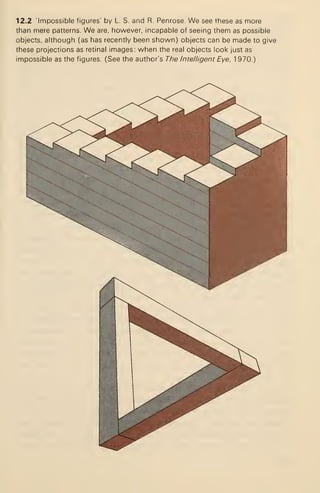
The 'impossible' figures are due to L. S. Penrose and R. Penrose,
'Impossible objects: a special type of illusion', Brit. J. Psychol. 49, 31 (1958).
These are in fact drawings. Elaborate examples are by the Dutch artist, the
late Maurits Escher ; see J. L. Locher (ed.), The World ofM. C. Escher, Harry
N. Abrams, N.Y. (1971). See also: Marianne L. Teuber, 'Sources of
Ambiguity in the Prints of Maurits C. Escher', Sci. Amer. 231, 1 (1974). Truly
three dimensional objects which look impossible from critical points of view
are discussed by the author in The Intelligent Eye (1970).
For the history of perspective see: J. White, The Birth and Rebirth of
Pictorial Space, Faber and Faber (1967).
11 Do /ve have to learn how to see?
For experiments on animals reared in darkness, see E. H. Hess, 'Space
perception in the chick', Sci. Amer. 195, 71 (1956); A. H. Reisen, 'The
development of perception in man and chimpanzee'. Science 106 (1947);
A. H. Reisen, 'Arrested vision', Sci. Amer. 183, 16 (1950).
For a discussion of cases of human recovery from blindness, up to 1932:
M. von Senden, Space and Sight (tr. P. Heath), Methuen/Free Press (1960).
These cases came into prominence with D. O. Hebb's The Organisation of
Behaviour, Chapman & Hall/Wiley (1949). A recent case is described by R. L.
Gregory and J. G. Wallace, '' Recovery from early blindness: a case study',
Exp. Psychol. Soc. Monogr. No. 2, Cambridge (1963) (reprinted in R. L.
Gregory, Concepts and Mechanisms of Perception, Duckworth [1974]. This
contains the full account ofthe case of S.B. described in this chapter. Recovery
of sight with an artificial lens - in a hollow tooth - in the eye is discussed by
Alberto Valvo, Sight Restoration Rehabilitation, Amer. Foundation for the
Blind, 15 West 16th Street, New York, N.Y. 10011 (1971).
For the work of recording eye movements of young babies, see R. L. Fantz,
'The Origin of Form Perception', Sci Amer. 204, 66 (1961) (offprint No. 459).
For G. M. Stratton's work, see 'Some preliminary experiments on vision',
248](https://image.slidesharecdn.com/eye-brain-gregory-140608051504-phpapp01/85/Eye-brain-gregory-250-320.jpg)


This document provides an introduction to the psychology of seeing and perception. It discusses how the eye and brain work together to transform retinal images into perceptions of three-dimensional objects in the world. While the eye functions somewhat like a camera, the brain's role in perception goes far beyond merely processing images. The brain actively organizes sensory data to perceive objects, even when stimuli are ambiguous. It draws on past experiences and knowledge to interpret patterns of light. Understanding these perceptual processes can explain visual illusions and how the same retinal image can result in different perceptions of objects and their positions in space.


![Getting Started with Apache Spark: Big Data Made Simple [Free Meetup]](https://cdn.slidesharecdn.com/ss_thumbnails/apachesparkgettingstarted-260203175547-8361bcc3-thumbnail.jpg?width=640&height=640&fit=bounds)


