SEMINAR PRESENTATION (0+1)
TOPIC: ROBOTICS IN FOOD PROCESING
KERALA UNIVERSITY OF FISHERIES AND OCEAN STUDIES
BTECH FOOD TECHNOLOGY
PRESENTED BY
CHRIS REX FRANCIS
OET-2019-02-16
Robotics in food
processing
BY CHRIS REX FRANCIS
OET-2019-02-16
CONTENTS
▪ Introduction
▪ Reason for automating process
▪ History
▪ Component of robot
▪ Types of robots used in food industry
▪ Application of robotics in food processing
▪ Meat industry Fruit and vegetable industry
▪ Dairy industry
▪ Packaging
▪ Conclusion
3
4
INTRODUCTION
▪ The use of robotics in the food industry has increased over recent
years, particularly in the field of processing and packaging systems
However, the industry has not taken to the technology with the same
enthusiasm as the automotive and other industries
▪ Now that the technology is becoming more affordable and the
systems more intelligent, it may be feasible to automate many of the
complex and repetitive tasks that are carried out in the food industry
▪ The opportunity still exists to deliver significant benefits in terms of
increased food shelf life, cost reductions and flexibility (Wallin, P. J.
1997)
5
Reasons for Automating Processes
▪ Need to reduce direct labour
▪ Can't get people to do the job
▪ Need to increase quality
▪ Difficult to do the job manually
▪ Need to increase production
▪ Difficult to meet specifications consistently
▪ Need to provide flexibility in processes
▪ Hazardous to personnel
▪ Eliminates a contamination source
6
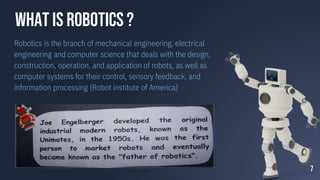
WHAT IS ROBOTICS ?
Robotics is the branch of mechanical engineering, electrical
engineering and computer science that deals with the design,
construction, operation, and application of robots, as well as
computer systems for their control, sensory feedback, and
information processing (Robot institute of America)
7
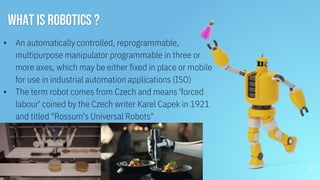
▪ An automatically controlled, reprogrammable,
multipurpose manipulator programmable in three or
more axes, which may be either fixed in place or mobile
for use in industrial automation applications (ISO)
▪ The term robot comes from Czech and means 'forced
labour' coined by the Czech writer Karel Capek in 1921
and titled "Rossum's Universal Robots"
WHAT IS ROBOTICS ?
8
Robotics Flexible Automation
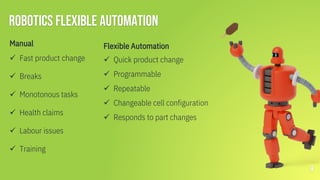
Manual
 Fast product change
 Breaks
 Monotonous tasks
 Health claims
 Labour issues
 Training
Flexible Automation
 Quick product change
 Programmable
 Repeatable
 Changeable cell configuration
 Responds to part changes
9
10
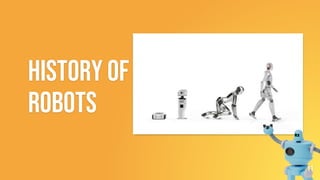
History of
Robots
11
History
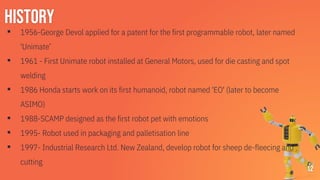
▪ 1956-George Devol applied for a patent for the first programmable robot, later named
'Unimate’
▪ 1961 - First Unimate robot installed at General Motors, used for die casting and spot
welding
▪ 1986 Honda starts work on its first humanoid, robot named 'EO' (later to become
ASIMO)
▪ 1988-SCAMP designed as the first robot pet with emotions
▪ 1995- Robot used in packaging and palletisation line
▪ 1997- Industrial Research Ltd. New Zealand, develop robot for sheep de-fleecing and
cutting
12
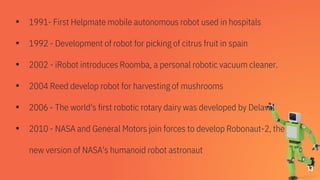
▪ 1991- First Helpmate mobile autonomous robot used in hospitals
▪ 1992 - Development of robot for picking of citrus fruit in spain
▪ 2002 - iRobot introduces Roomba, a personal robotic vacuum cleaner.
▪ 2004 Reed develop robot for harvesting of mushrooms
▪ 2006 - The world's first robotic rotary dairy was developed by Delaval
▪ 2010 - NASA and General Motors join forces to develop Robonaut-2, the
new version of NASA's humanoid robot astronaut
13
Components of Robot
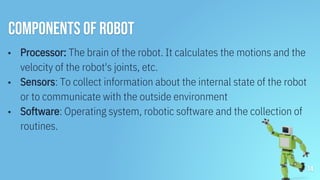
▪ Processor: The brain of the robot. It calculates the motions and the
velocity of the robot's joints, etc.
▪ Sensors: To collect information about the internal state of the robot
or to communicate with the outside environment
▪ Software: Operating system, robotic software and the collection of
routines.
14
15
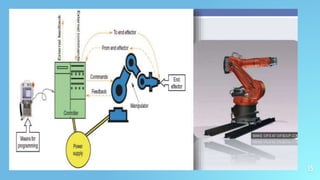
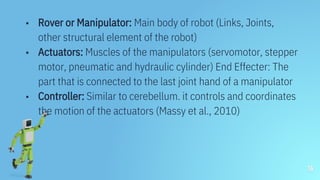
▪ Rover or Manipulator: Main body of robot (Links, Joints,
other structural element of the robot)
▪ Actuators: Muscles of the manipulators (servomotor, stepper
motor, pneumatic and hydraulic cylinder) End Effecter: The
part that is connected to the last joint hand of a manipulator
▪ Controller: Similar to cerebellum. it controls and coordinates
the motion of the actuators (Massy et al., 2010)
16
The Food Industry
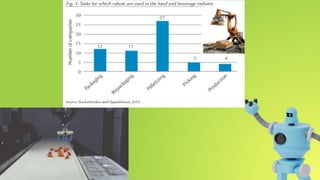
▪ Traditional Applications -Mostly Packaging Areas
• Palletizing
• Secondary Packaging: Case packing/carton loading Primary Packaging:
Dependent upon the products
▪ Current and New Applications
• Handling raw or unpackaged food products: Primary Packaging
• Ready-meal construction
• Cake and pic handling Meat processing Cake decoration
• Pizza assembly Grading of fruit and vegetables
• Cooking
▪ Warehouse
17
Requirements of food robot system
▪ Any Robotic Automation System Specifications: Reach /Speed
▪ Protection from Water and Humidity
 Sealed Design with Smooth Finish for Drainage
 Protected from water with sealed covers
 Motors and 'electronics'
 Corrosion resistant coating * Purged to prevent water entry and damage
 Cabling protected from water
 Locate Controls away from water damage
▪ Covers
‾ Condensation inside creates corrosion Leaks when damaged or installed incorrectly
18
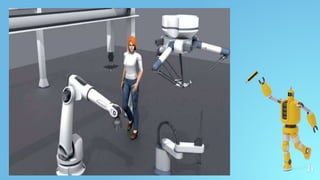
Types of Robots used in food industry
The main types of robots used in the food industry are
▪ Portal robots:
 Portal robots are mounted robotic systems that span a cubic handling area
by means of three linear axes
 The actual robotic kinematics (the moving axes) are located above the
mounting
▪ Articulated robots:
 Articulated robots are industrial robots with multiple interacting jointed
arms that can be fitted with grippers or tools
 Articulated robots offer a high degree of flexibility
19
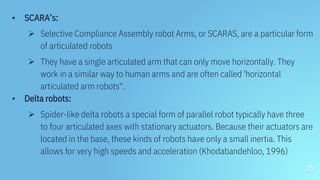
▪ SCARA’s:
 Selective Compliance Assembly robot Arms, or SCARAS, are a particular form
of articulated robots
 They have a single articulated arm that can only move horizontally. They
work in a similar way to human arms and are often called 'horizontal
articulated arm robots".
▪ Delta robots:
 Spider-like delta robots a special form of parallel robot typically have three
to four articulated axes with stationary actuators. Because their actuators are
located in the base, these kinds of robots have only a small inertia. This
allows for very high speeds and acceleration (Khodabandehloo, 1996)
20
21
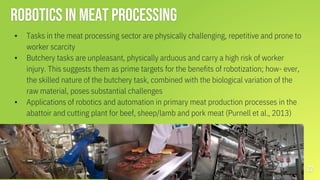
Robotics in Meat Processing
▪ Tasks in the meat processing sector are physically challenging, repetitive and prone to
worker scarcity
▪ Butchery tasks are unpleasant, physically arduous and carry a high risk of worker
injury. This suggests them as prime targets for the benefits of robotization; how- ever,
the skilled nature of the butchery task, combined with the biological variation of the
raw material, poses substantial challenges
▪ Applications of robotics and automation in primary meat production processes in the
abattoir and cutting plant for beef, sheep/lamb and pork meat (Purnell et al., 2013)
22
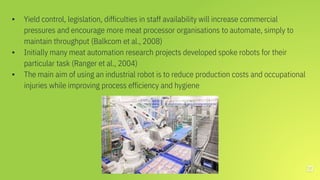
▪ Yield control, legislation, difficulties in staff availability will increase commercial
pressures and encourage more meat processor organisations to automate, simply to
maintain throughput (Balkcom et al., 2008)
▪ Initially many meat automation research projects developed spoke robots for their
particular task (Ranger et al., 2004)
▪ The main aim of using an industrial robot is to reduce production costs and occupational
injuries while improving process efficiency and hygiene
23
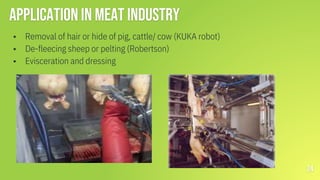
Application in Meat Industry
▪ Removal of hair or hide of pig, cattle/ cow (KUKA robot)
▪ De-fleecing sheep or pelting (Robertson)
▪ Evisceration and dressing
24
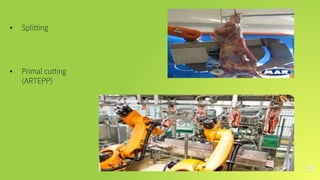
▪ Splitting
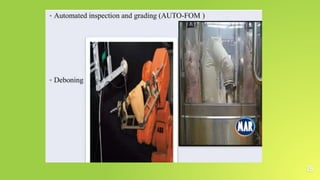
▪ Primal cutting
(ARTEPP)
25
26
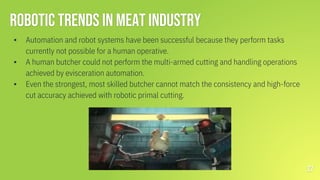
Robotic trends in Meat Industry
▪ Automation and robot systems have been successful because they perform tasks
currently not possible for a human operative.
▪ A human butcher could not perform the multi-armed cutting and handling operations
achieved by evisceration automation.
▪ Even the strongest, most skilled butcher cannot match the consistency and high-force
cut accuracy achieved with robotic primal cutting.
27
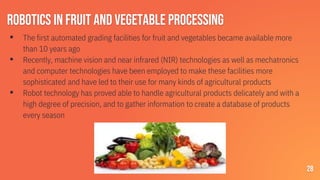
Robotics in fruit and vegetable processing
▪ The first automated grading facilities for fruit and vegetables became available more
than 10 years ago
▪ Recently, machine vision and near infrared (NIR) technologies as well as mechatronics
and computer technologies have been employed to make these facilities more
sophisticated and have led to their use for many kinds of agricultural products
▪ Robot technology has proved able to handle agricultural products delicately and with a
high degree of precision, and to gather information to create a database of products
every season
28
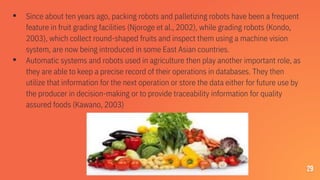
▪ Since about ten years ago, packing robots and palletizing robots have been a frequent
feature in fruit grading facilities (Njoroge et al., 2002), while grading robots (Kondo,
2003), which collect round-shaped fruits and inspect them using a machine vision
system, are now being introduced in some East Asian countries.
▪ Automatic systems and robots used in agriculture then play another important role, as
they are able to keep a precise record of their operations in databases. They then
utilize that information for the next operation or store the data either for future use by
the producer in decision-making or to provide traceability information for quality
assured foods (Kawano, 2003)
29
Applicationin fruit and vegetable processing
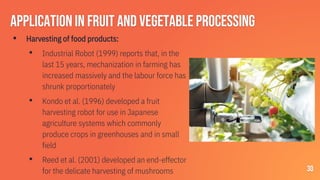
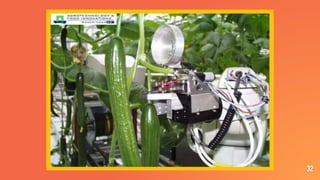
▪ Harvesting of food products:
• Industrial Robot (1999) reports that, in the
last 15 years, mechanization in farming has
increased massively and the labour force has
shrunk proportionately
• Kondo et al. (1996) developed a fruit
harvesting robot for use in Japanese
agriculture systems which commonly
produce crops in greenhouses and in small
field
• Reed et al. (2001) developed an end-effector
for the delicate harvesting of mushrooms 30
31
32
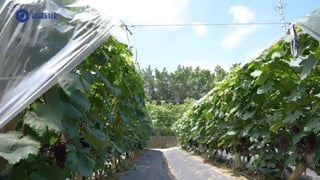
Grading of fruit and vegetables
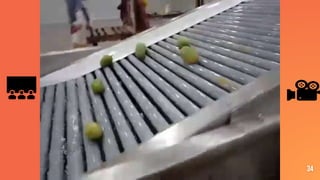
▪ A grading system using robots has been developed for use with deciduous
fruits such as peaches, pears, and apples. system automatically picks fruit from
containers and inspects all sides of the fruit (Kondo, 2003)
▪ Grading robot's maximum speed is 1 m/s and its stroke is about 1.2 m.
▪ It takes the robot 2.7 s to transfer 12 fruits to trays, 0.4 s to move down to the
conveyor line, and I s to return once fruits have been released. 0.15 s are spent
waiting for the next batch of fruit The total time to complete the operation is
4.25 s.
▪ This means that one set of robots can process approximately 10,000 fruits per
hour
33
34
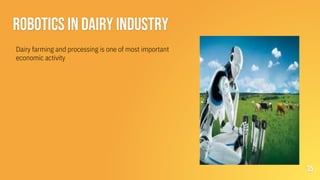
Robotics in Dairy Industry
35
Dairy farming and processing is one of most important
economic activity
36
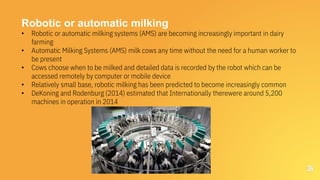
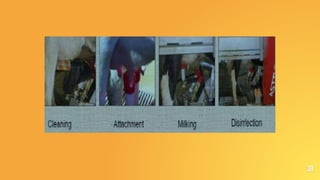
Robotic or automatic milking
• Robotic or automatic milking systems (AMS) are becoming increasingly important in dairy
farming
• Automatic Milking Systems (AMS) milk cows any time without the need for a human worker to
be present
• Cows choose when to be milked and detailed data is recorded by the robot which can be
accessed remotely by computer or mobile device
• Relatively small base, robotic milking has been predicted to become increasingly common
• DeKoning and Rodenburg (2014) estimated that Internationally therewere around 5,200
machines in operation in 2014
37
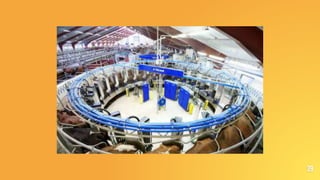
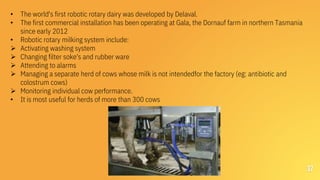
• The world's first robotic rotary dairy was developed by Delaval.
• The first commercial installation has been operating at Gala, the Dornauf farm in northern Tasmania
since early 2012
• Robotic rotary milking system include:
 Activating washing system
 Changing filter soke's and rubber ware
 Attending to alarms
 Managing a separate herd of cows whose milk is not intendedfor the factory (eg: antibiotic and
colostrum cows)
 Monitoring individual cow performance.
• It is most useful for herds of more than 300 cows
38
39
40
Advantages
 The adoption of AMS has been shown to change the nature of stock manship in dairy
farming
 Creates freedom and flexibility for the farmer
 Robotic milking improves the working conditions and lifestyle of the dairy farmer
 It has economic advantages and benefits for cow health and welfare
41
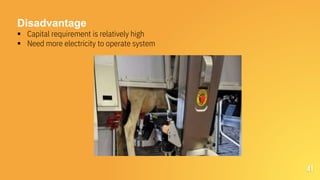
Disadvantage
 Capital requirement is relatively high
 Need more electricity to operate system
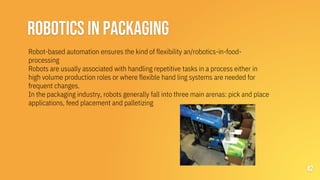
ROBOTICS IN PACKAGING
42
Robot-based automation ensures the kind of flexibility an/robotics-in-food-
processing
Robots are usually associated with handling repetitive tasks in a process either in
high volume production roles or where flexible hand ling systems are needed for
frequent changes.
In the packaging industry, robots generally fall into three main arenas: pick and place
applications, feed placement and palletizing
BenefitsandDrawbacksof RoboticTechintheFood
Industry
43
Benefits
 Reduced Operational Costs
The application of robots in the food industry can help you
lower your total operational costs by reducing:
 Floor space
 Production time
 Labour costs
 Resource waste
44
 Healthy and Safety Issues
 Meet Supply and Demand
 Increase Employee Satisfaction
 Accuracy
 Streamline Your Ordering
 Track Inventory and Ingredients
Drawbacks
 High Production Costs
 Training Human Employees to Work With Robots
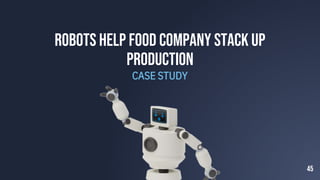
Robots help food company stack up
production
CASE STUDY
45
46
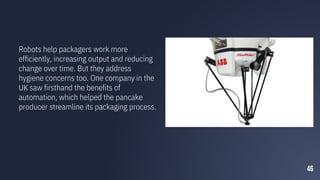
Robots help packagers work more
efficiently, increasing output and reducing
change over time. But they address
hygiene concerns too. One company in the
UK saw firsthand the benefits of
automation, which helped the pancake
producer streamline its packaging process.
47
The success
• The system not only proved instantly successful, but has demonstrated its value since the
installation in 2011. William Eid, Honey top’s director says,
• “We work in a competitive industry with very tight turnaround times and receive daily orders
that are expected to be sent out to the depots within 12 hours of production. We have not
experienced one issue since the installation last year. The robots have already enabled us to
absorb a number of overheads, thanks to a reduction in labour costs and improved
productivity.”
• The versatility of the production line has dramatically reduced the changeover time between
each different product. Andrew Jones, RG Luma’s sales director, says, “After three weeks of
production, a brand-new product was introduced in less than an hour without the need for any
new investment from Honey top.”
CONCLUSION
48
▪ The challenges faced by different sectors of the food processing industry largely depend on the raw
materials in each sector and whether the product must be delivered continuously or in batches.
▪ Giving robots the ability to evaluate each raw material before processing could be essential in key
processes, while training staff to work alongside robots could be a bigger issue in processes,
secondary. Overall, the food industry must consider not only where robots can be a profitable
investment, but also how to shift its employees away from the roles robots take on.
▪ Robotics has the potential to become next frontier in the food industries. Manual handling of foods
is not going to end soon, but still the acceptance of automation and robotics in the industry is
increasing.
▪ Robotics are populating the food industry in increasing numbers as processors intensify their
continuing, relentless search for faster, more economic methods of production that will enable
them to satisfy the insatiable demands of modern retailers and the rapidly changing lifestyles of
consumers. Robots increase the safety process and decrease the chances of downtimes or
production shortfall, thanks to their reliability and availability.
49
REFERENCE
50
• The Pharma Innovation Journal 2022; SP-11(7): 948-953, Kokanee Sankey B, Kalamnurikar
Shalaka S and Khose Suyog B,2022
• Ahmad Nayik G. Robotics and Food Technology: A Mini Review. Journal of Nutrition & Food
Sciences, 2015, 05(04). https://doi.org/10.4172/2155-9600.1000384
• Anonymous. Top 6 ways robotics is changing the food industry in 2020 website, 2020a.
https://roboticsbiz.com/top-6-ways-robotics-is-changingthe-food-industry/ accessed on 3rd
December, 2020
• Anonymous. The Main Components of an Industrial Robot website, 2020b.
https://www.robots.com/faq/whatare-the-main-parts-of-an-industrial-robot accessed on 30th
December, 2020
• ABB. (2007). ABB Robotics launches simple programming tool. Assembly Automation, 27(1).
• ABB. (2016a). News: picking. São Paulo: ABB. Retrieved from http://
new.abb.com/products/robotics/applications-by-industry/foodand-beverages/applications/picking
•FOOD ENGINEERING – Vol. IV - Automation of Food Processing - Gunasegaram, S.
Any Questions ?
51
THANK YOU
52

ROBOTICS IN FOOD PROCESSING.pptx

  • 1.
    SEMINAR PRESENTATION (0+1) TOPIC:ROBOTICS IN FOOD PROCESING KERALA UNIVERSITY OF FISHERIES AND OCEAN STUDIES BTECH FOOD TECHNOLOGY PRESENTED BY CHRIS REX FRANCIS OET-2019-02-16
  • 2.
    Robotics in food processing BYCHRIS REX FRANCIS OET-2019-02-16
  • 3.
    CONTENTS ▪ Introduction ▪ Reasonfor automating process ▪ History ▪ Component of robot ▪ Types of robots used in food industry ▪ Application of robotics in food processing ▪ Meat industry Fruit and vegetable industry ▪ Dairy industry ▪ Packaging ▪ Conclusion 3
  • 4.
  • 5.
    ▪ The useof robotics in the food industry has increased over recent years, particularly in the field of processing and packaging systems However, the industry has not taken to the technology with the same enthusiasm as the automotive and other industries ▪ Now that the technology is becoming more affordable and the systems more intelligent, it may be feasible to automate many of the complex and repetitive tasks that are carried out in the food industry ▪ The opportunity still exists to deliver significant benefits in terms of increased food shelf life, cost reductions and flexibility (Wallin, P. J. 1997) 5
  • 6.
    Reasons for AutomatingProcesses ▪ Need to reduce direct labour ▪ Can't get people to do the job ▪ Need to increase quality ▪ Difficult to do the job manually ▪ Need to increase production ▪ Difficult to meet specifications consistently ▪ Need to provide flexibility in processes ▪ Hazardous to personnel ▪ Eliminates a contamination source 6
  • 7.
    WHAT IS ROBOTICS? Robotics is the branch of mechanical engineering, electrical engineering and computer science that deals with the design, construction, operation, and application of robots, as well as computer systems for their control, sensory feedback, and information processing (Robot institute of America) 7
  • 8.
    ▪ An automaticallycontrolled, reprogrammable, multipurpose manipulator programmable in three or more axes, which may be either fixed in place or mobile for use in industrial automation applications (ISO) ▪ The term robot comes from Czech and means 'forced labour' coined by the Czech writer Karel Capek in 1921 and titled "Rossum's Universal Robots" WHAT IS ROBOTICS ? 8
  • 9.
    Robotics Flexible Automation Manual Fast product change  Breaks  Monotonous tasks  Health claims  Labour issues  Training Flexible Automation  Quick product change  Programmable  Repeatable  Changeable cell configuration  Responds to part changes 9
  • 10.
  • 11.
  • 12.
    History ▪ 1956-George Devolapplied for a patent for the first programmable robot, later named 'Unimate’ ▪ 1961 - First Unimate robot installed at General Motors, used for die casting and spot welding ▪ 1986 Honda starts work on its first humanoid, robot named 'EO' (later to become ASIMO) ▪ 1988-SCAMP designed as the first robot pet with emotions ▪ 1995- Robot used in packaging and palletisation line ▪ 1997- Industrial Research Ltd. New Zealand, develop robot for sheep de-fleecing and cutting 12
  • 13.
    ▪ 1991- FirstHelpmate mobile autonomous robot used in hospitals ▪ 1992 - Development of robot for picking of citrus fruit in spain ▪ 2002 - iRobot introduces Roomba, a personal robotic vacuum cleaner. ▪ 2004 Reed develop robot for harvesting of mushrooms ▪ 2006 - The world's first robotic rotary dairy was developed by Delaval ▪ 2010 - NASA and General Motors join forces to develop Robonaut-2, the new version of NASA's humanoid robot astronaut 13
  • 14.
    Components of Robot ▪Processor: The brain of the robot. It calculates the motions and the velocity of the robot's joints, etc. ▪ Sensors: To collect information about the internal state of the robot or to communicate with the outside environment ▪ Software: Operating system, robotic software and the collection of routines. 14
  • 15.
  • 16.
    ▪ Rover orManipulator: Main body of robot (Links, Joints, other structural element of the robot) ▪ Actuators: Muscles of the manipulators (servomotor, stepper motor, pneumatic and hydraulic cylinder) End Effecter: The part that is connected to the last joint hand of a manipulator ▪ Controller: Similar to cerebellum. it controls and coordinates the motion of the actuators (Massy et al., 2010) 16
  • 17.
    The Food Industry ▪Traditional Applications -Mostly Packaging Areas • Palletizing • Secondary Packaging: Case packing/carton loading Primary Packaging: Dependent upon the products ▪ Current and New Applications • Handling raw or unpackaged food products: Primary Packaging • Ready-meal construction • Cake and pic handling Meat processing Cake decoration • Pizza assembly Grading of fruit and vegetables • Cooking ▪ Warehouse 17
  • 18.
    Requirements of foodrobot system ▪ Any Robotic Automation System Specifications: Reach /Speed ▪ Protection from Water and Humidity  Sealed Design with Smooth Finish for Drainage  Protected from water with sealed covers  Motors and 'electronics'  Corrosion resistant coating * Purged to prevent water entry and damage  Cabling protected from water  Locate Controls away from water damage ▪ Covers ‾ Condensation inside creates corrosion Leaks when damaged or installed incorrectly 18
  • 19.
    Types of Robotsused in food industry The main types of robots used in the food industry are ▪ Portal robots:  Portal robots are mounted robotic systems that span a cubic handling area by means of three linear axes  The actual robotic kinematics (the moving axes) are located above the mounting ▪ Articulated robots:  Articulated robots are industrial robots with multiple interacting jointed arms that can be fitted with grippers or tools  Articulated robots offer a high degree of flexibility 19
  • 20.
    ▪ SCARA’s:  SelectiveCompliance Assembly robot Arms, or SCARAS, are a particular form of articulated robots  They have a single articulated arm that can only move horizontally. They work in a similar way to human arms and are often called 'horizontal articulated arm robots". ▪ Delta robots:  Spider-like delta robots a special form of parallel robot typically have three to four articulated axes with stationary actuators. Because their actuators are located in the base, these kinds of robots have only a small inertia. This allows for very high speeds and acceleration (Khodabandehloo, 1996) 20
  • 21.
  • 22.
    Robotics in MeatProcessing ▪ Tasks in the meat processing sector are physically challenging, repetitive and prone to worker scarcity ▪ Butchery tasks are unpleasant, physically arduous and carry a high risk of worker injury. This suggests them as prime targets for the benefits of robotization; how- ever, the skilled nature of the butchery task, combined with the biological variation of the raw material, poses substantial challenges ▪ Applications of robotics and automation in primary meat production processes in the abattoir and cutting plant for beef, sheep/lamb and pork meat (Purnell et al., 2013) 22
  • 23.
    ▪ Yield control,legislation, difficulties in staff availability will increase commercial pressures and encourage more meat processor organisations to automate, simply to maintain throughput (Balkcom et al., 2008) ▪ Initially many meat automation research projects developed spoke robots for their particular task (Ranger et al., 2004) ▪ The main aim of using an industrial robot is to reduce production costs and occupational injuries while improving process efficiency and hygiene 23
  • 24.
    Application in MeatIndustry ▪ Removal of hair or hide of pig, cattle/ cow (KUKA robot) ▪ De-fleecing sheep or pelting (Robertson) ▪ Evisceration and dressing 24
  • 25.
    ▪ Splitting ▪ Primalcutting (ARTEPP) 25
  • 26.
  • 27.
    Robotic trends inMeat Industry ▪ Automation and robot systems have been successful because they perform tasks currently not possible for a human operative. ▪ A human butcher could not perform the multi-armed cutting and handling operations achieved by evisceration automation. ▪ Even the strongest, most skilled butcher cannot match the consistency and high-force cut accuracy achieved with robotic primal cutting. 27
  • 28.
    Robotics in fruitand vegetable processing ▪ The first automated grading facilities for fruit and vegetables became available more than 10 years ago ▪ Recently, machine vision and near infrared (NIR) technologies as well as mechatronics and computer technologies have been employed to make these facilities more sophisticated and have led to their use for many kinds of agricultural products ▪ Robot technology has proved able to handle agricultural products delicately and with a high degree of precision, and to gather information to create a database of products every season 28
  • 29.
    ▪ Since aboutten years ago, packing robots and palletizing robots have been a frequent feature in fruit grading facilities (Njoroge et al., 2002), while grading robots (Kondo, 2003), which collect round-shaped fruits and inspect them using a machine vision system, are now being introduced in some East Asian countries. ▪ Automatic systems and robots used in agriculture then play another important role, as they are able to keep a precise record of their operations in databases. They then utilize that information for the next operation or store the data either for future use by the producer in decision-making or to provide traceability information for quality assured foods (Kawano, 2003) 29
  • 30.
    Applicationin fruit andvegetable processing ▪ Harvesting of food products: • Industrial Robot (1999) reports that, in the last 15 years, mechanization in farming has increased massively and the labour force has shrunk proportionately • Kondo et al. (1996) developed a fruit harvesting robot for use in Japanese agriculture systems which commonly produce crops in greenhouses and in small field • Reed et al. (2001) developed an end-effector for the delicate harvesting of mushrooms 30
  • 31.
  • 32.
  • 33.
    Grading of fruitand vegetables ▪ A grading system using robots has been developed for use with deciduous fruits such as peaches, pears, and apples. system automatically picks fruit from containers and inspects all sides of the fruit (Kondo, 2003) ▪ Grading robot's maximum speed is 1 m/s and its stroke is about 1.2 m. ▪ It takes the robot 2.7 s to transfer 12 fruits to trays, 0.4 s to move down to the conveyor line, and I s to return once fruits have been released. 0.15 s are spent waiting for the next batch of fruit The total time to complete the operation is 4.25 s. ▪ This means that one set of robots can process approximately 10,000 fruits per hour 33
  • 34.
  • 35.
    Robotics in DairyIndustry 35 Dairy farming and processing is one of most important economic activity
  • 36.
    36 Robotic or automaticmilking • Robotic or automatic milking systems (AMS) are becoming increasingly important in dairy farming • Automatic Milking Systems (AMS) milk cows any time without the need for a human worker to be present • Cows choose when to be milked and detailed data is recorded by the robot which can be accessed remotely by computer or mobile device • Relatively small base, robotic milking has been predicted to become increasingly common • DeKoning and Rodenburg (2014) estimated that Internationally therewere around 5,200 machines in operation in 2014
  • 37.
    37 • The world'sfirst robotic rotary dairy was developed by Delaval. • The first commercial installation has been operating at Gala, the Dornauf farm in northern Tasmania since early 2012 • Robotic rotary milking system include:  Activating washing system  Changing filter soke's and rubber ware  Attending to alarms  Managing a separate herd of cows whose milk is not intendedfor the factory (eg: antibiotic and colostrum cows)  Monitoring individual cow performance. • It is most useful for herds of more than 300 cows
  • 38.
  • 39.
  • 40.
    40 Advantages  The adoptionof AMS has been shown to change the nature of stock manship in dairy farming  Creates freedom and flexibility for the farmer  Robotic milking improves the working conditions and lifestyle of the dairy farmer  It has economic advantages and benefits for cow health and welfare
  • 41.
    41 Disadvantage  Capital requirementis relatively high  Need more electricity to operate system
  • 42.
    ROBOTICS IN PACKAGING 42 Robot-basedautomation ensures the kind of flexibility an/robotics-in-food- processing Robots are usually associated with handling repetitive tasks in a process either in high volume production roles or where flexible hand ling systems are needed for frequent changes. In the packaging industry, robots generally fall into three main arenas: pick and place applications, feed placement and palletizing
  • 43.
    BenefitsandDrawbacksof RoboticTechintheFood Industry 43 Benefits  ReducedOperational Costs The application of robots in the food industry can help you lower your total operational costs by reducing:  Floor space  Production time  Labour costs  Resource waste
  • 44.
    44  Healthy andSafety Issues  Meet Supply and Demand  Increase Employee Satisfaction  Accuracy  Streamline Your Ordering  Track Inventory and Ingredients Drawbacks  High Production Costs  Training Human Employees to Work With Robots
  • 45.
    Robots help foodcompany stack up production CASE STUDY 45
  • 46.
    46 Robots help packagerswork more efficiently, increasing output and reducing change over time. But they address hygiene concerns too. One company in the UK saw firsthand the benefits of automation, which helped the pancake producer streamline its packaging process.
  • 47.
    47 The success • Thesystem not only proved instantly successful, but has demonstrated its value since the installation in 2011. William Eid, Honey top’s director says, • “We work in a competitive industry with very tight turnaround times and receive daily orders that are expected to be sent out to the depots within 12 hours of production. We have not experienced one issue since the installation last year. The robots have already enabled us to absorb a number of overheads, thanks to a reduction in labour costs and improved productivity.” • The versatility of the production line has dramatically reduced the changeover time between each different product. Andrew Jones, RG Luma’s sales director, says, “After three weeks of production, a brand-new product was introduced in less than an hour without the need for any new investment from Honey top.”
  • 48.
  • 49.
    ▪ The challengesfaced by different sectors of the food processing industry largely depend on the raw materials in each sector and whether the product must be delivered continuously or in batches. ▪ Giving robots the ability to evaluate each raw material before processing could be essential in key processes, while training staff to work alongside robots could be a bigger issue in processes, secondary. Overall, the food industry must consider not only where robots can be a profitable investment, but also how to shift its employees away from the roles robots take on. ▪ Robotics has the potential to become next frontier in the food industries. Manual handling of foods is not going to end soon, but still the acceptance of automation and robotics in the industry is increasing. ▪ Robotics are populating the food industry in increasing numbers as processors intensify their continuing, relentless search for faster, more economic methods of production that will enable them to satisfy the insatiable demands of modern retailers and the rapidly changing lifestyles of consumers. Robots increase the safety process and decrease the chances of downtimes or production shortfall, thanks to their reliability and availability. 49
  • 50.
    REFERENCE 50 • The PharmaInnovation Journal 2022; SP-11(7): 948-953, Kokanee Sankey B, Kalamnurikar Shalaka S and Khose Suyog B,2022 • Ahmad Nayik G. Robotics and Food Technology: A Mini Review. Journal of Nutrition & Food Sciences, 2015, 05(04). https://doi.org/10.4172/2155-9600.1000384 • Anonymous. Top 6 ways robotics is changing the food industry in 2020 website, 2020a. https://roboticsbiz.com/top-6-ways-robotics-is-changingthe-food-industry/ accessed on 3rd December, 2020 • Anonymous. The Main Components of an Industrial Robot website, 2020b. https://www.robots.com/faq/whatare-the-main-parts-of-an-industrial-robot accessed on 30th December, 2020 • ABB. (2007). ABB Robotics launches simple programming tool. Assembly Automation, 27(1). • ABB. (2016a). News: picking. São Paulo: ABB. Retrieved from http:// new.abb.com/products/robotics/applications-by-industry/foodand-beverages/applications/picking •FOOD ENGINEERING – Vol. IV - Automation of Food Processing - Gunasegaram, S.
  • 51.
  • 52.