Extensible Database APIs and
their role in Software
Architecture
Max Neunhöffer
Education Tech + Cold Beer (SF) 4 March 2015
www.arangodb.com
Typical structure of an application
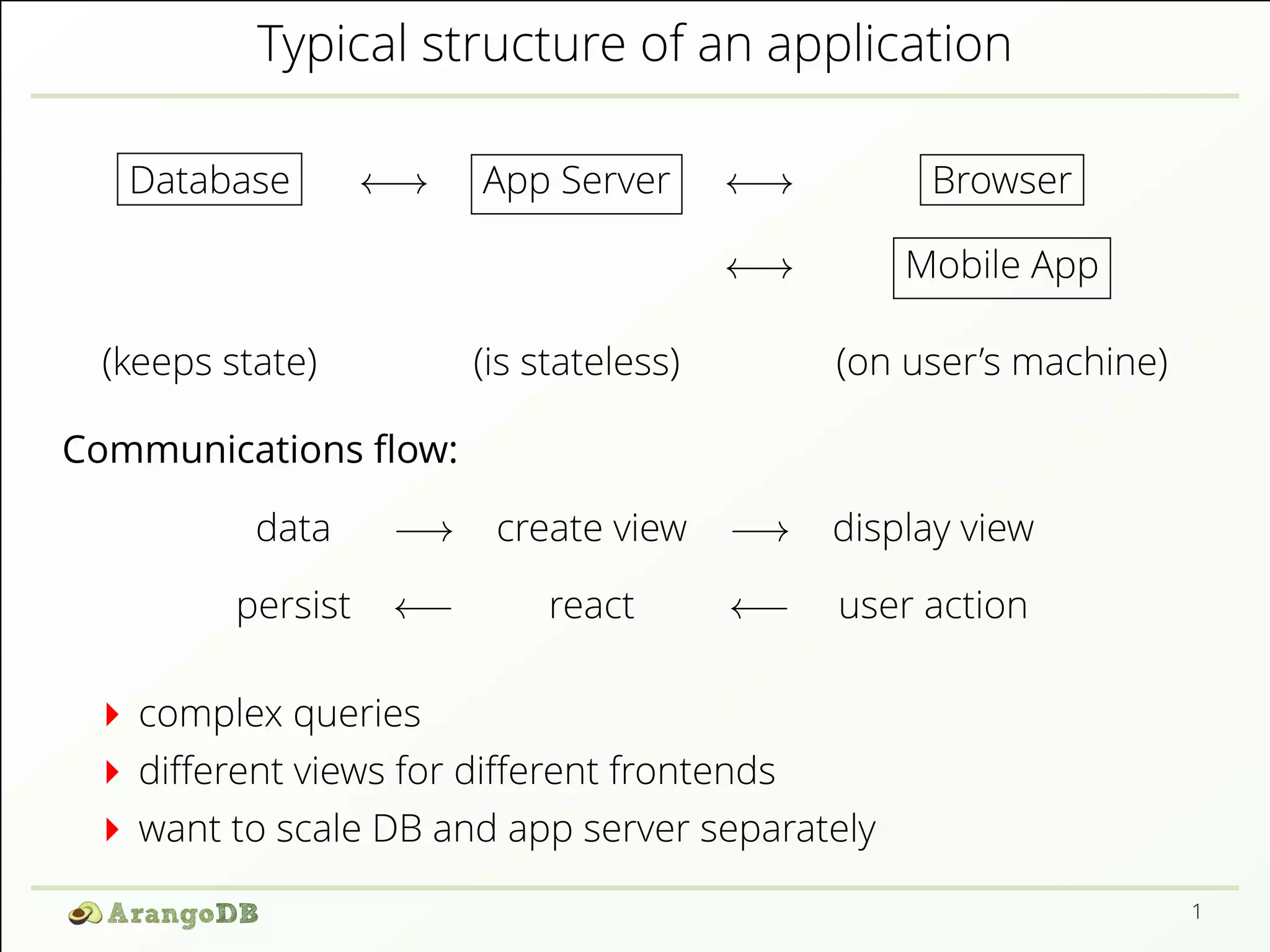
Database ←→ App Server ←→ Browser
←→ Mobile App
(keeps state) (is stateless) (on user’s machine)
Communications flow:
data −→ create view −→ display view
persist ←− react ←− user action
complex queries
different views for different frontends
want to scale DB and app server separately
1
Agile development
Facts of life as a software developer/architect
Software grows, we release frequently and quickly, give
rapid feedback, one learns as one goes.
In the beginning . . .
the data schema is unclear
the scope of the app is unclear
the list of front end devices is unclear
protocols are not yet sorted out
performance bottlenecks are unknown
security requirements and problems are unclear
All these are good things!
2
Microservices
These days, everybody talks about microservices:
http://martinfowler.com/articles/microservices.html
Features of a microservice architecture
It is a “particular way of designing software app-
lications as suites of independently deployable
services.”
We cut the application into services,
built around business capabilities. They are
independently deployable (fully automatically!)
have well-defined interfaces (often via REST/HTTP),
and typically run in their own process.
3
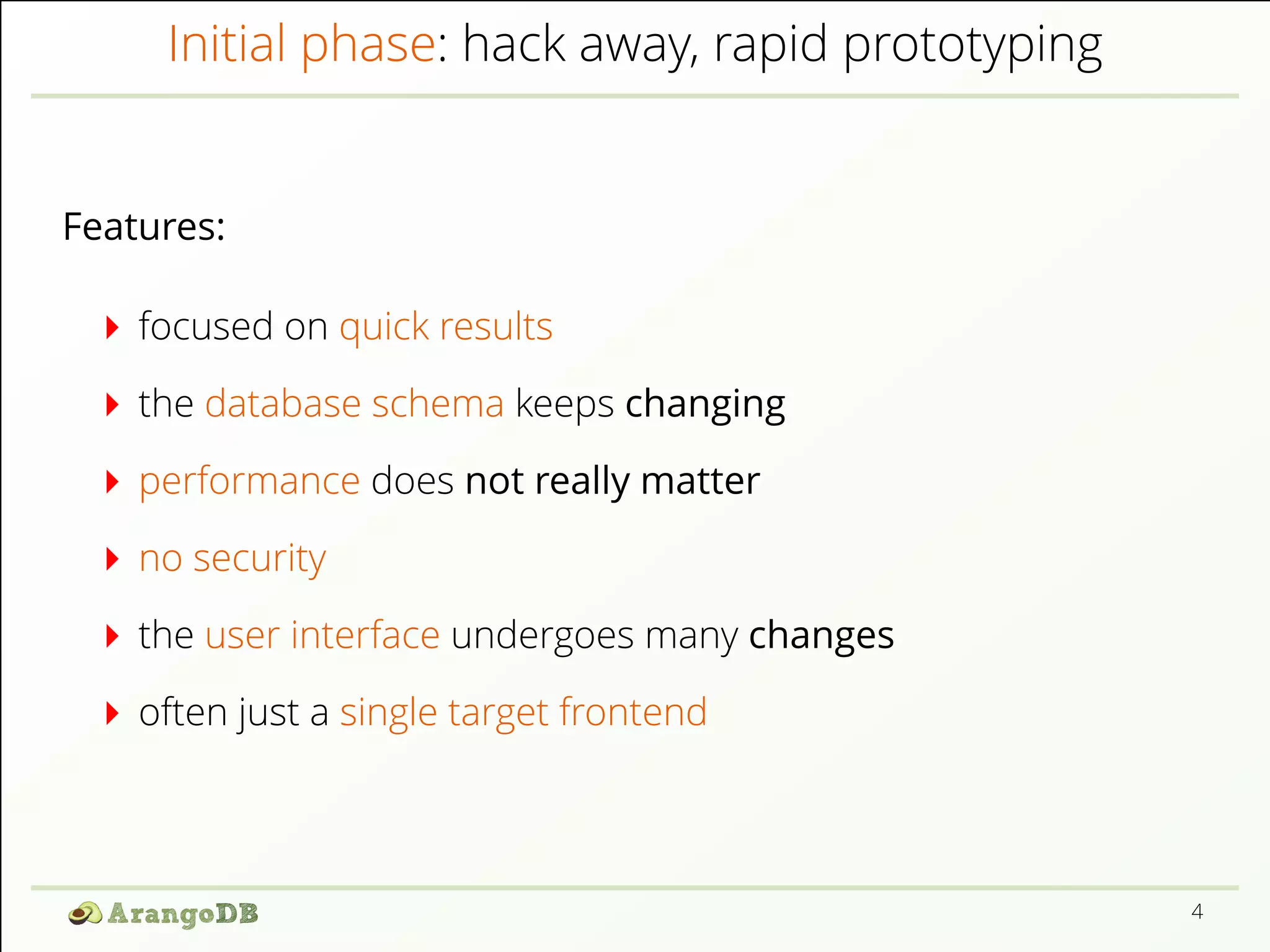
Initial phase: hack away, rapid prototyping
Features:
focused on quick results
the database schema keeps changing
performance does not really matter
no security
the user interface undergoes many changes
often just a single target frontend
4
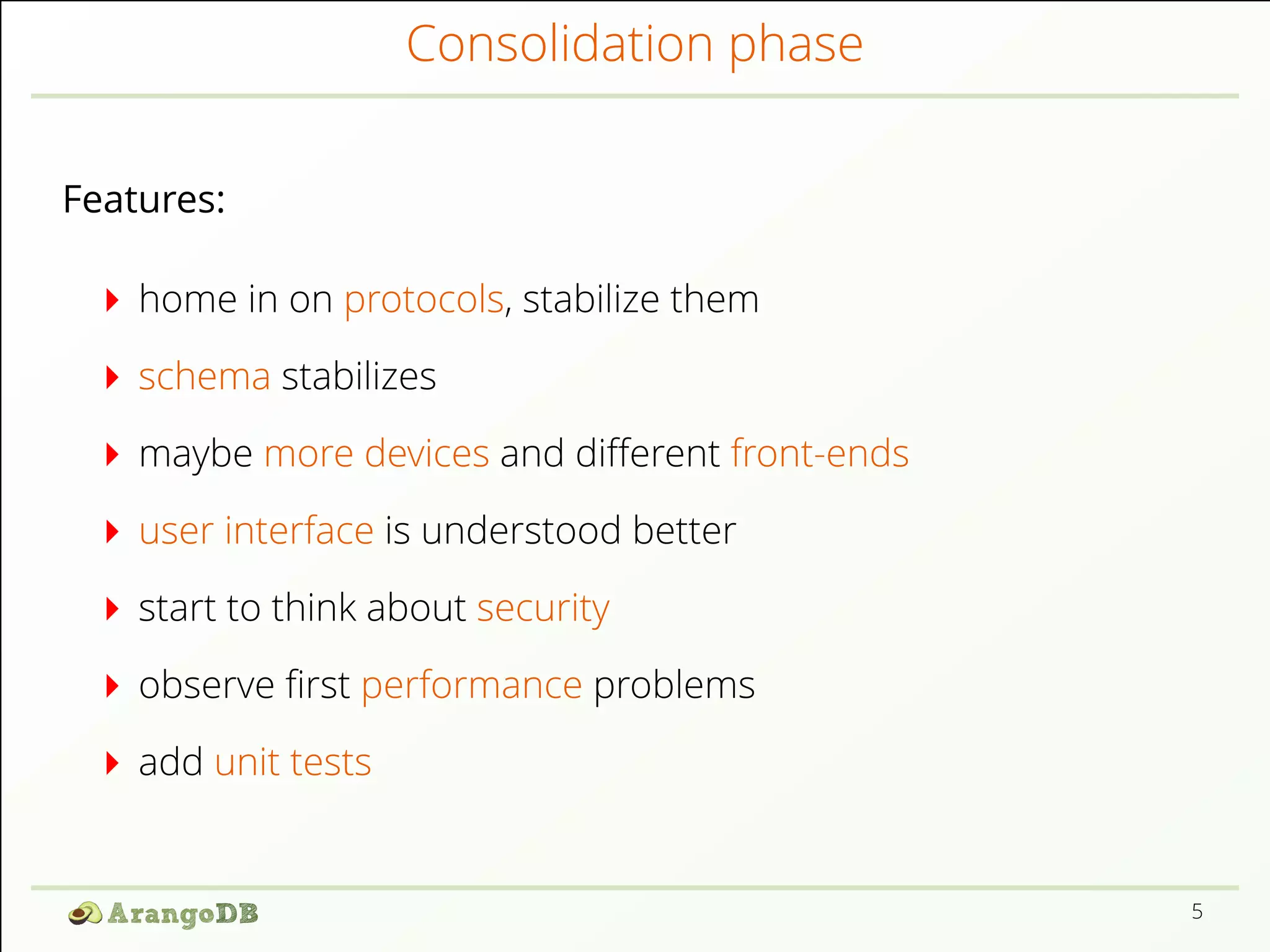
Consolidation phase
Features:
home in on protocols, stabilize them
schema stabilizes
maybe more devices and different front-ends
user interface is understood better
start to think about security
observe first performance problems
add unit tests
5
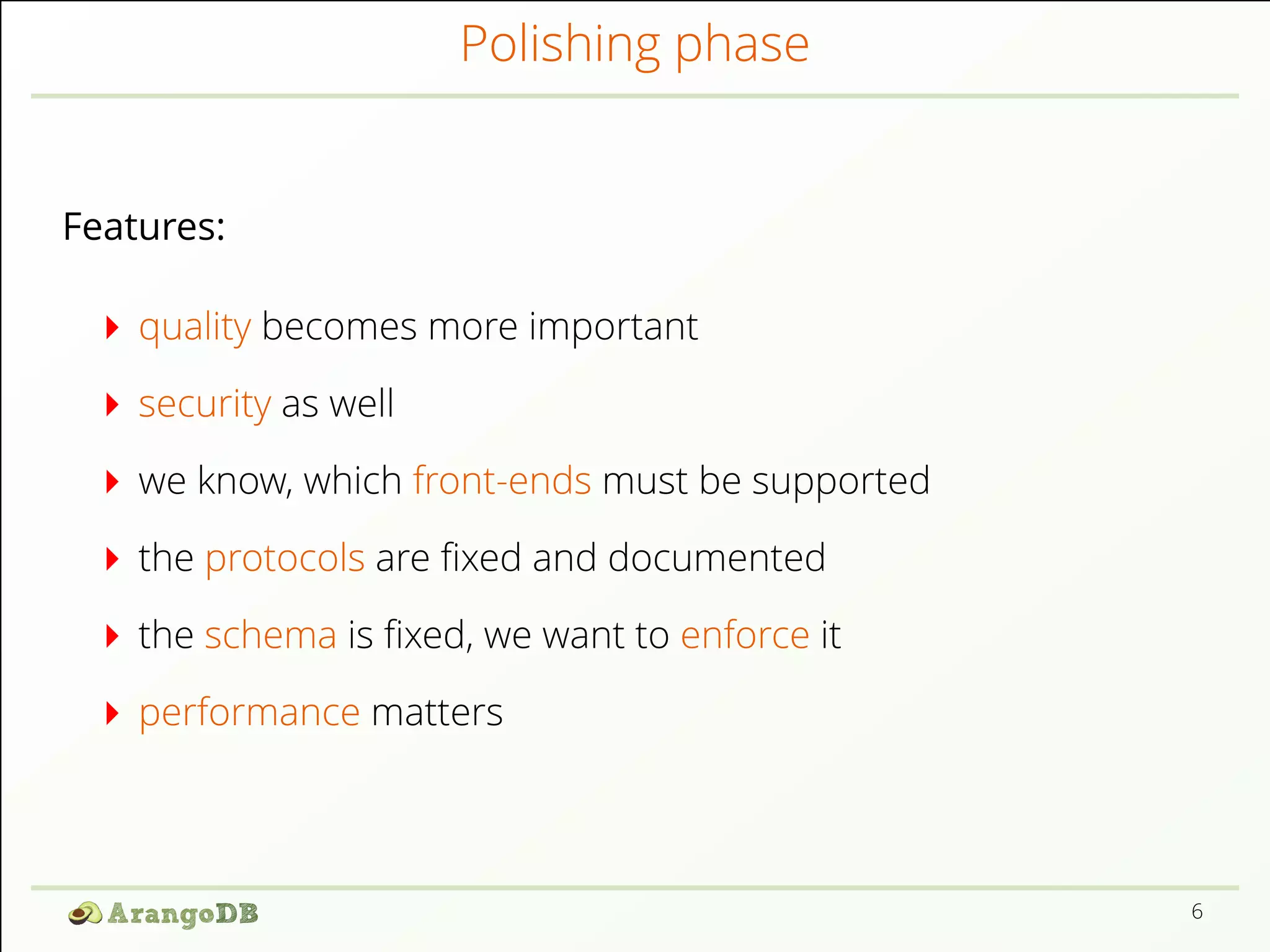
Polishing phase
Features:
quality becomes more important
security as well
we know, which front-ends must be supported
the protocols are fixed and documented
the schema is fixed, we want to enforce it
performance matters
6
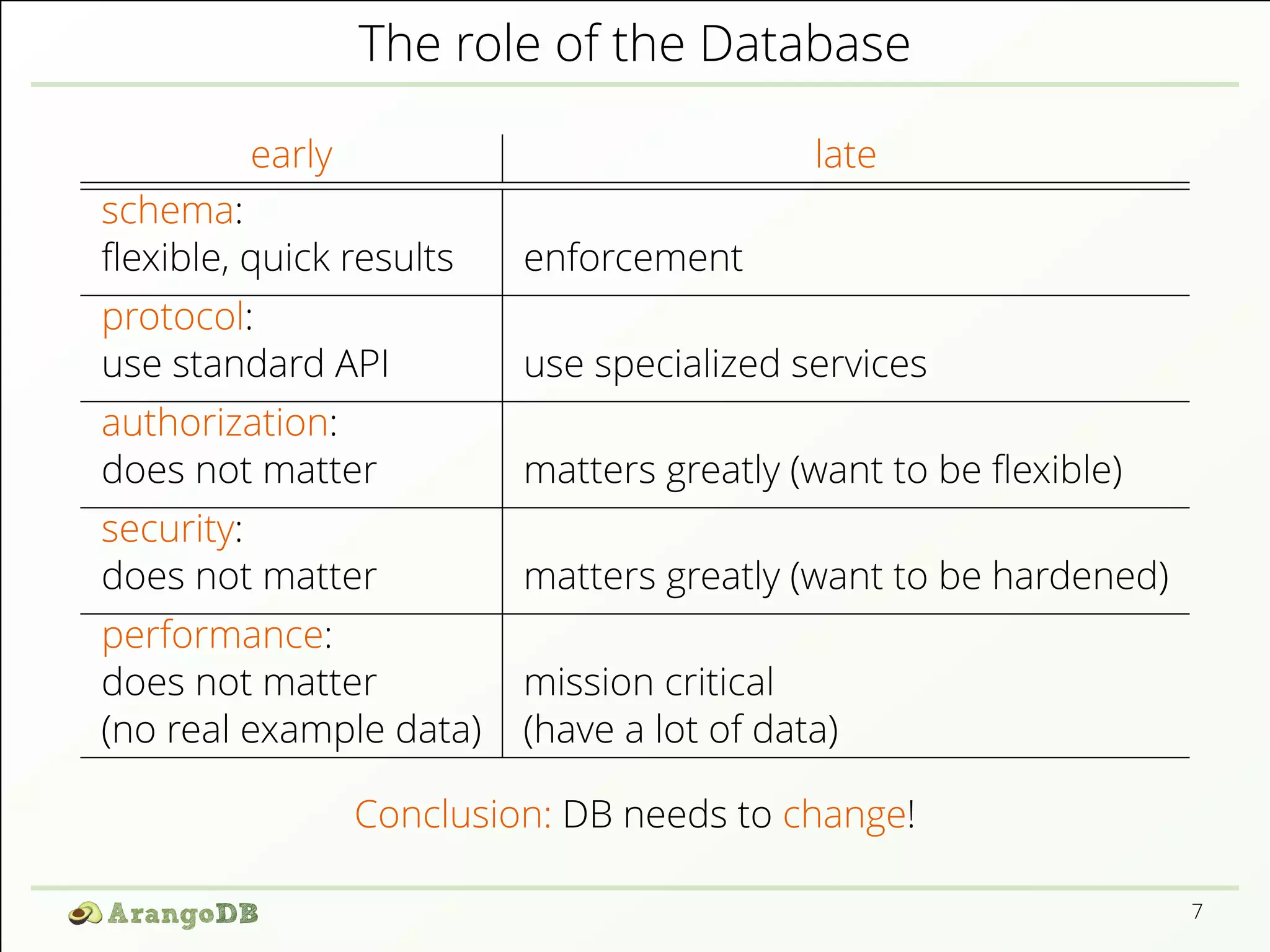
The role of the Database
early late
schema:
flexible, quick results enforcement
protocol:
use standard API use specialized services
authorization:
does not matter matters greatly (want to be flexible)
security:
does not matter matters greatly (want to be hardened)
performance:
does not matter mission critical
(no real example data) (have a lot of data)
Conclusion: DB needs to change!
7
WANTED: (better alive than dead)
a smart database
that can be adapted over time
whose API is extensible
can run performance critical complex queries in the DB,
expose them as data-centric microservices via REST
has configurable consistency
has configurable security features
8
is a multi-model database (document store & graph database),
is open source and free (Apache 2 license),
offers convenient queries (via HTTP/REST and AQL),
including joins between different collections,
configurable consistency guarantees using transactions
is memory efficient by shape detection,
uses JavaScript throughout (Google’s V8 built into server),
API extensible by JS code in the Foxx Microservice Framework,
offers many drivers for a wide range of languages,
is easy to use with web front end and good documentation,
and enjoys good community as well as professional support.
9
Extensible through JavaScript and Foxx
The HTTP API of ArangoDB
can be extended by user-defined JavaScript code,
that is executed in the DB server for high performance.
This is formalised by the Foxx microservice framework,
which allows to implement complex, user-defined APIs with
direct access to the DB engine.
Very flexible and secure authentication schemes can be
implemented conveniently by the user in JavaScript.
Because JavaScript runs everywhere (in the DB server as well
as in the browser), one can use the same libraries in the
back-end and in the front-end.
=⇒ can implement your own data-centric microservices
10
Links
https://www.arangodb.com
http://guesser.9hoeffer.de:8000
https://github.com/ArangoDB/guesser
11

Extensible Database APIs and their role in Software Architecture

  • 1.
    Extensible Database APIsand their role in Software Architecture Max Neunhöffer Education Tech + Cold Beer (SF) 4 March 2015 www.arangodb.com
  • 2.
    Typical structure ofan application Database ←→ App Server ←→ Browser ←→ Mobile App (keeps state) (is stateless) (on user’s machine) Communications flow: data −→ create view −→ display view persist ←− react ←− user action complex queries different views for different frontends want to scale DB and app server separately 1
  • 3.
    Agile development Facts oflife as a software developer/architect Software grows, we release frequently and quickly, give rapid feedback, one learns as one goes. In the beginning . . . the data schema is unclear the scope of the app is unclear the list of front end devices is unclear protocols are not yet sorted out performance bottlenecks are unknown security requirements and problems are unclear All these are good things! 2
  • 4.
    Microservices These days, everybodytalks about microservices: http://martinfowler.com/articles/microservices.html Features of a microservice architecture It is a “particular way of designing software app- lications as suites of independently deployable services.” We cut the application into services, built around business capabilities. They are independently deployable (fully automatically!) have well-defined interfaces (often via REST/HTTP), and typically run in their own process. 3
  • 5.
    Initial phase: hackaway, rapid prototyping Features: focused on quick results the database schema keeps changing performance does not really matter no security the user interface undergoes many changes often just a single target frontend 4
  • 6.
    Consolidation phase Features: home inon protocols, stabilize them schema stabilizes maybe more devices and different front-ends user interface is understood better start to think about security observe first performance problems add unit tests 5
  • 7.
    Polishing phase Features: quality becomesmore important security as well we know, which front-ends must be supported the protocols are fixed and documented the schema is fixed, we want to enforce it performance matters 6
  • 8.
    The role ofthe Database early late schema: flexible, quick results enforcement protocol: use standard API use specialized services authorization: does not matter matters greatly (want to be flexible) security: does not matter matters greatly (want to be hardened) performance: does not matter mission critical (no real example data) (have a lot of data) Conclusion: DB needs to change! 7
  • 9.
    WANTED: (better alivethan dead) a smart database that can be adapted over time whose API is extensible can run performance critical complex queries in the DB, expose them as data-centric microservices via REST has configurable consistency has configurable security features 8
  • 10.
    is a multi-modeldatabase (document store & graph database), is open source and free (Apache 2 license), offers convenient queries (via HTTP/REST and AQL), including joins between different collections, configurable consistency guarantees using transactions is memory efficient by shape detection, uses JavaScript throughout (Google’s V8 built into server), API extensible by JS code in the Foxx Microservice Framework, offers many drivers for a wide range of languages, is easy to use with web front end and good documentation, and enjoys good community as well as professional support. 9
  • 11.
    Extensible through JavaScriptand Foxx The HTTP API of ArangoDB can be extended by user-defined JavaScript code, that is executed in the DB server for high performance. This is formalised by the Foxx microservice framework, which allows to implement complex, user-defined APIs with direct access to the DB engine. Very flexible and secure authentication schemes can be implemented conveniently by the user in JavaScript. Because JavaScript runs everywhere (in the DB server as well as in the browser), one can use the same libraries in the back-end and in the front-end. =⇒ can implement your own data-centric microservices 10
  • 12.