EXTENDED
TRANSIENT MODEL
LEAK DETECTION
TECHNOLOGY FOR
PIPELINES
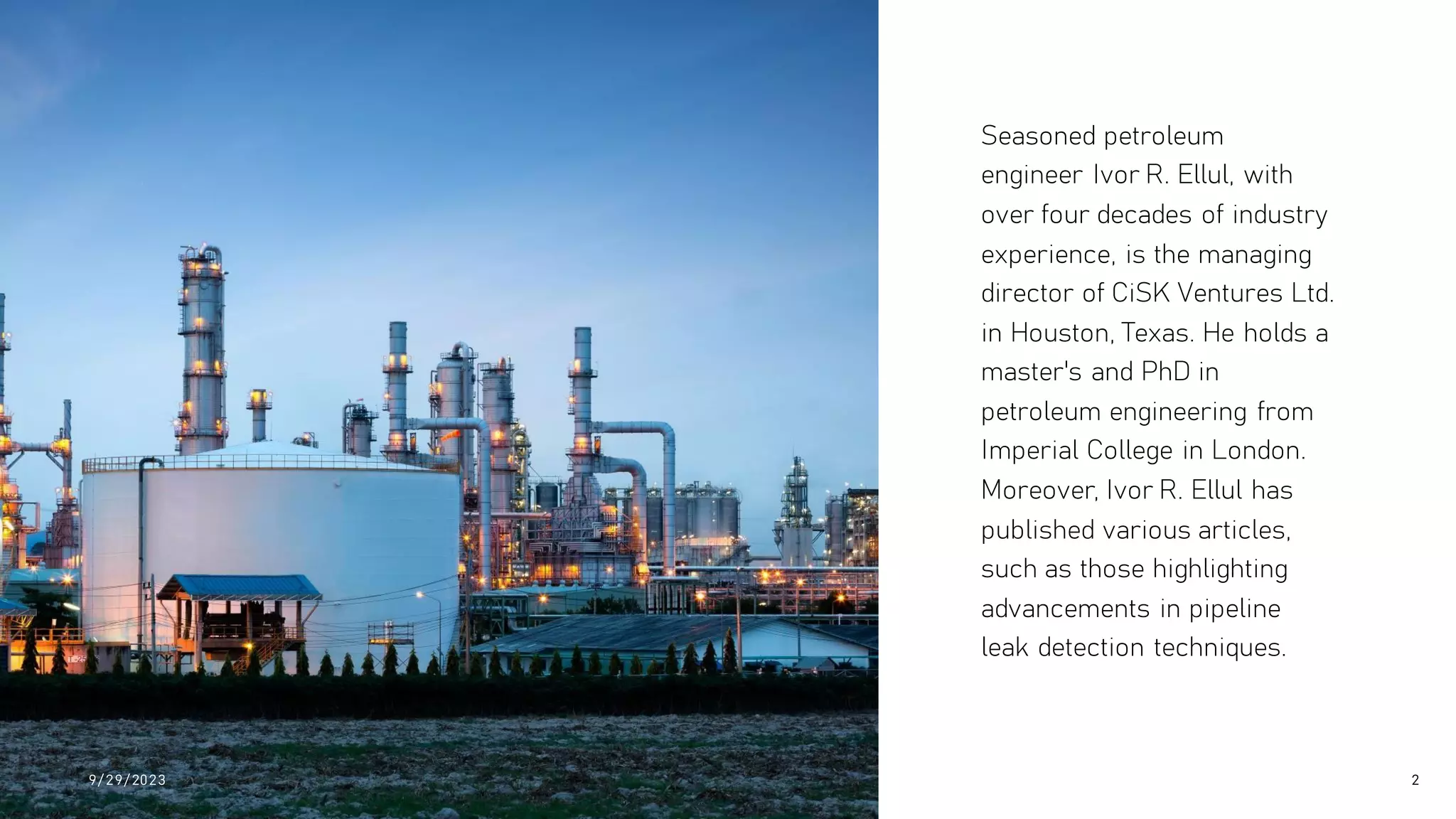
Seasoned petroleum
engineer Ivor R. Ellul, with
over four decades of industry
experience, is the managing
director of CiSK Ventures Ltd.
in Houston, Texas. He holds a
master's and PhD in
petroleum engineering from
Imperial College in London.
Moreover, Ivor R. Ellul has
published various articles,
such as those highlighting
advancements in pipeline
leak detection techniques.
9/ 29/ 2023 2
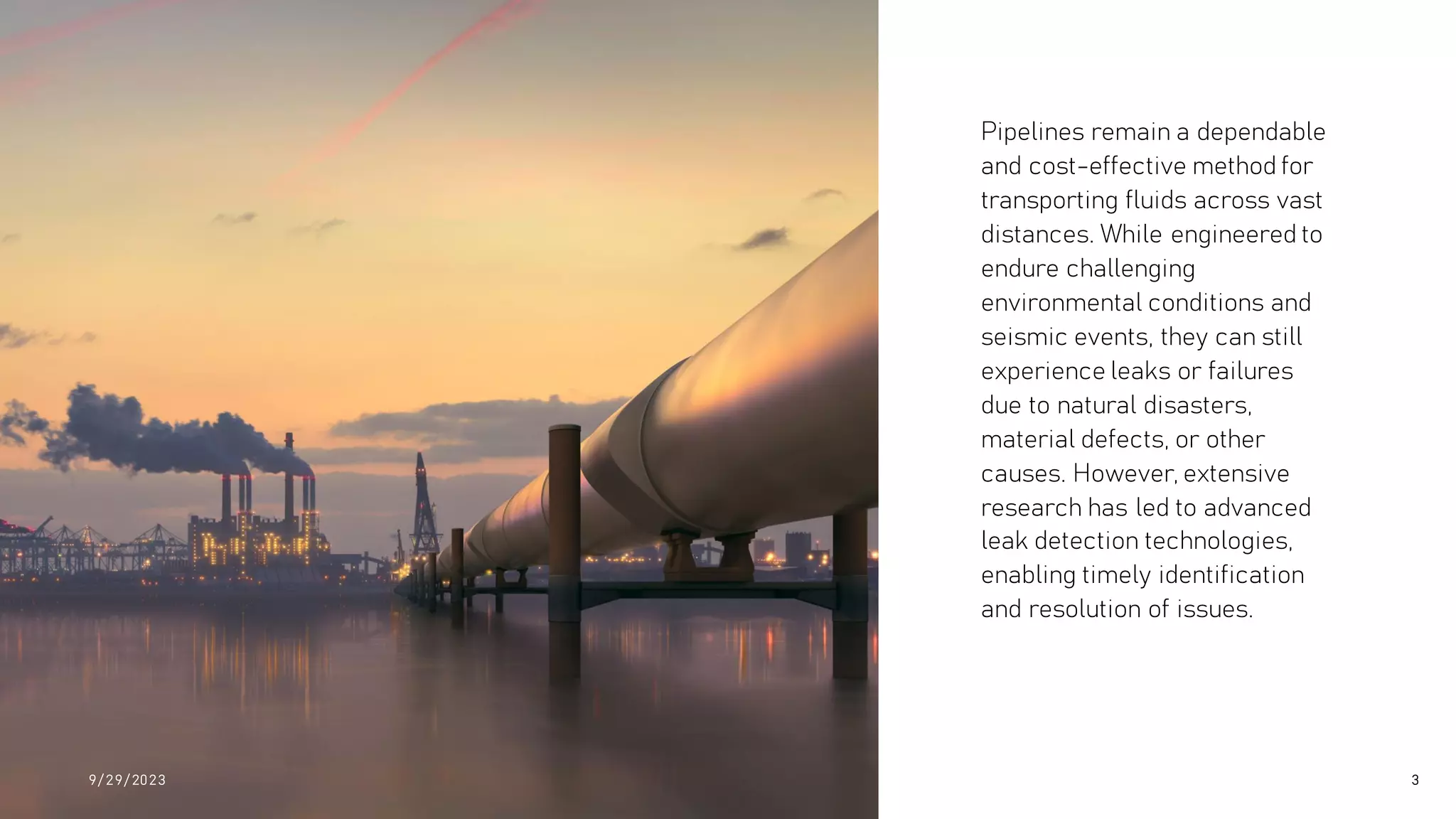
Pipelines remain a dependable
and cost-effective method for
transporting fluids across vast
distances. While engineered to
endure challenging
environmental conditions and
seismic events, they can still
experience leaks or failures
due to natural disasters,
material defects, or other
causes. However, extensive
research has led to advanced
leak detection technologies,
enabling timely identification
and resolution of issues.
9/ 29/ 2023 3
Most leak detection systems are
based on the continuous monitoring
of the flow characteristics of a
pipeline. In particular, sensors are
deployed along the pipeline to
measure pressure, flow, temperature,
and, depending on the fluid being
transported, density or composition.
Mathematical models of the pipeline
are run in real-time using a sub-set
of the measurements as boundary
conditions for the flow equations that
are being solved.
9/ 29/ 2023 4
The system constantly monitors the
actual values coming from the
measurement devices, such as flow
meters and transducers, and
compares them to the values being
predicted by the mathematical
model. . Notable discrepancies
between the two values, (measured
and calculated), may indicate a
potential issue that engineers
should investigate further to
determine whether a leak may be
present.
9/ 29/ 2023 5
Such model-based leak
detection systems
outperform more traditional
systems in terms of
reliability. The technology
allows for speedy leak
detection while maintaining
high accuracy to prevent
false alarms. Additionally,
these systems can adapt to
evolving operating conditions
and pipeline product
variations.
9/ 29/ 2023 6
Once a leak is alerted, further
modeling is performed to determine
the possible location of that leak.
This is quite important given that
pipelines may be thousands of
miles in length and a target leak
location will be required to assist in
remediatingthe situation.
9/ 29/ 2023 7

Extended Transient Model Leak Detection Technology for Pipelines

  • 1.
  • 2.
    Seasoned petroleum engineer IvorR. Ellul, with over four decades of industry experience, is the managing director of CiSK Ventures Ltd. in Houston, Texas. He holds a master's and PhD in petroleum engineering from Imperial College in London. Moreover, Ivor R. Ellul has published various articles, such as those highlighting advancements in pipeline leak detection techniques. 9/ 29/ 2023 2
  • 3.
    Pipelines remain adependable and cost-effective method for transporting fluids across vast distances. While engineered to endure challenging environmental conditions and seismic events, they can still experience leaks or failures due to natural disasters, material defects, or other causes. However, extensive research has led to advanced leak detection technologies, enabling timely identification and resolution of issues. 9/ 29/ 2023 3
  • 4.
    Most leak detectionsystems are based on the continuous monitoring of the flow characteristics of a pipeline. In particular, sensors are deployed along the pipeline to measure pressure, flow, temperature, and, depending on the fluid being transported, density or composition. Mathematical models of the pipeline are run in real-time using a sub-set of the measurements as boundary conditions for the flow equations that are being solved. 9/ 29/ 2023 4
  • 5.
    The system constantlymonitors the actual values coming from the measurement devices, such as flow meters and transducers, and compares them to the values being predicted by the mathematical model. . Notable discrepancies between the two values, (measured and calculated), may indicate a potential issue that engineers should investigate further to determine whether a leak may be present. 9/ 29/ 2023 5
  • 6.
    Such model-based leak detectionsystems outperform more traditional systems in terms of reliability. The technology allows for speedy leak detection while maintaining high accuracy to prevent false alarms. Additionally, these systems can adapt to evolving operating conditions and pipeline product variations. 9/ 29/ 2023 6
  • 7.
    Once a leakis alerted, further modeling is performed to determine the possible location of that leak. This is quite important given that pipelines may be thousands of miles in length and a target leak location will be required to assist in remediatingthe situation. 9/ 29/ 2023 7