eXtended
Reality
Prepared by: Elanthirayan M, XR Specialist
HISTORY
XR(eXtended Reality), refers to the combination of virtual, augmented, mixed and assisted reality
technologies. The origins of XR date back to the 1960s, when computer scientist Ivan Sutherland developed the
first head-mounted display (HMD), called The Sword of Damocles, which used a computer-generated display to
create a rudimentary form of VR. In the 1990s, companies like Sega and Nintendo introduced gaming consoles
with VR capabilities, but the technology was still too expensive and bulky for widespread use.
In the early 2000s, AR technologies began to emerge with the development of marker-based AR, which used a
camera and a visual marker to overlay virtual objects onto the real world. The launch of smartphones in the late
2000s led to a surge in AR development, with companies like Apple and Google releasing AR software
development kits (SDKs) for their platforms.
More recently, advances in VR and AR hardware, such as the Quest 3 and Apple vision pro, have made XR more
immersive and accessible, leading to a growing number of applications in fields such as gaming, education,
and healthcare.
TYPES OF XR
• Virtual Reality
• Augmented Reality
• Mixed Reality
• Assisted Reality
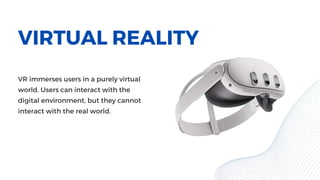
VIRTUAL REALITY
VR immerses users in a purely virtual
world. Users can interact with the
digital environment, but they cannot
interact with the real world.
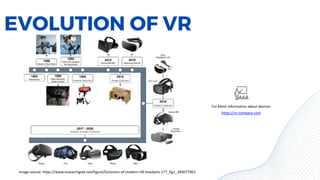
EVOLUTION OF VR
https://vr-compare.com
For More information about devices
Image source: https://www.researchgate.net/figure/Evolution-of-modern-VR-headsets-177_fig1_349077963
TYPES OF VR
• Tethered
• Standalone (Untethered)
• Game console
• Mobile
MOBILE BASED VR
Cardboard
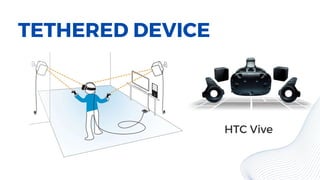
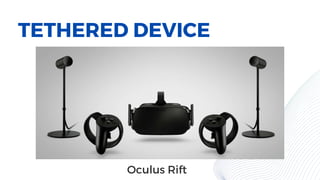
TETHERED DEVICE
HTC Vive
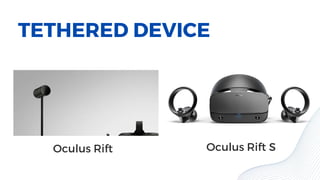
TETHERED DEVICE
Oculus Rift
TETHERED DEVICE
Oculus Rift Oculus Rift S
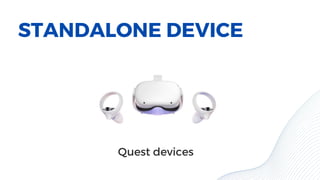
STANDALONE DEVICE
Quest devices
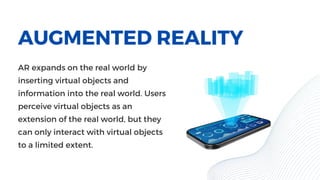
AUGMENTED REALITY
AR expands on the real world by
inserting virtual objects and
information into the real world. Users
perceive virtual objects as an
extension of the real world, but they
can only interact with virtual objects
to a limited extent.
AR DEVICES
Mobiles & Tablets Magic Leap
MIXED REALITY
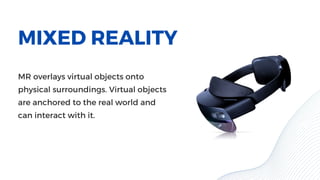
MR overlays virtual objects onto
physical surroundings. Virtual objects
are anchored to the real world and
can interact with it.
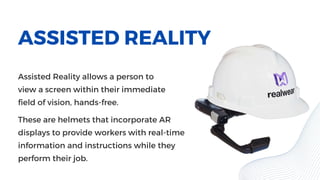
ASSISTED REALITY
Assisted Reality allows a person to
view a screen within their immediate
field of vision, hands-free.
These are helmets that incorporate AR
displays to provide workers with real-time
information and instructions while they
perform their job.
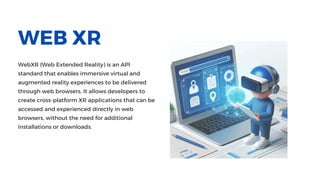
WEB XR
WebXR (Web Extended Reality) is an API
standard that enables immersive virtual and
augmented reality experiences to be delivered
through web browsers. It allows developers to
create cross-platform XR applications that can be
accessed and experienced directly in web
browsers, without the need for additional
installations or downloads.
WEBGL VS WEBGPU
WebGL is a JavaScript API for rendering
2D and 3D graphics in web browsers,
providing a high-level interface based on
OpenGL ES.
WebGPU is a modern, low-level graphics
API for the web, offering explicit control
over GPU resources and improved
performance compared to WebGL.
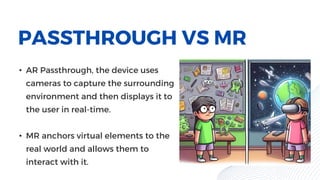
PASSTHROUGH VS MR
• AR Passthrough, the device uses
cameras to capture the surrounding
environment and then displays it to
the user in real-time.
• MR anchors virtual elements to the
real world and allows them to
interact with it.
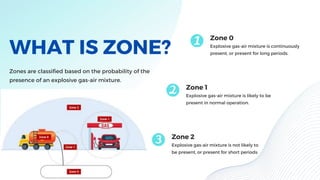
Zone 2
Explosive gas-air mixture is not likely to
be present, or present for short periods.
Explosive gas-air mixture is likely to be
present in normal operation.
WHAT IS ZONE?
Zones are classified based on the probability of the
presence of an explosive gas-air mixture.
Zone 0
Explosive gas-air mixture is continuously
present, or present for long periods.
Zone 1
ZONE CERTIFIED
"Zone Certification" in the energy industry
typically refers to the certification of equipment
for use in hazardous locations, particularly in
areas where there is a risk of explosive
atmospheres. This concept is commonly

associated with the ATEX (Atmosphères
Explosibles) directive in Europe, which regulates
equipment intended for use in potentially
explosive atmospheres.
ATEX
In Europe, the ATEX directive (Atmosphères
Explosibles) sets the standards for equipment
used in potentially explosive atmospheres.
IECEx
The International Electrotechnical Commission (IEC)
provides standards and certifications for electrical
equipment and systems used in explosive atmospheres.
LET'S
CONNECT !
https://linktr.ee/elanthirayan

eXtended Reality(XR) Basic introductions

  • 1.
  • 2.
    HISTORY XR(eXtended Reality), refersto the combination of virtual, augmented, mixed and assisted reality technologies. The origins of XR date back to the 1960s, when computer scientist Ivan Sutherland developed the first head-mounted display (HMD), called The Sword of Damocles, which used a computer-generated display to create a rudimentary form of VR. In the 1990s, companies like Sega and Nintendo introduced gaming consoles with VR capabilities, but the technology was still too expensive and bulky for widespread use. In the early 2000s, AR technologies began to emerge with the development of marker-based AR, which used a camera and a visual marker to overlay virtual objects onto the real world. The launch of smartphones in the late 2000s led to a surge in AR development, with companies like Apple and Google releasing AR software development kits (SDKs) for their platforms. More recently, advances in VR and AR hardware, such as the Quest 3 and Apple vision pro, have made XR more immersive and accessible, leading to a growing number of applications in fields such as gaming, education, and healthcare.
  • 3.
    TYPES OF XR •Virtual Reality • Augmented Reality • Mixed Reality • Assisted Reality
  • 4.
    VIRTUAL REALITY VR immersesusers in a purely virtual world. Users can interact with the digital environment, but they cannot interact with the real world.
  • 5.
    EVOLUTION OF VR https://vr-compare.com ForMore information about devices Image source: https://www.researchgate.net/figure/Evolution-of-modern-VR-headsets-177_fig1_349077963
  • 6.
    TYPES OF VR •Tethered • Standalone (Untethered) • Game console • Mobile
  • 7.
  • 8.
  • 9.
  • 10.
  • 11.
  • 12.
    AUGMENTED REALITY AR expandson the real world by inserting virtual objects and information into the real world. Users perceive virtual objects as an extension of the real world, but they can only interact with virtual objects to a limited extent.
  • 13.
    AR DEVICES Mobiles &Tablets Magic Leap
  • 14.
    MIXED REALITY MR overlaysvirtual objects onto physical surroundings. Virtual objects are anchored to the real world and can interact with it.
  • 15.
    ASSISTED REALITY Assisted Realityallows a person to view a screen within their immediate field of vision, hands-free. These are helmets that incorporate AR displays to provide workers with real-time information and instructions while they perform their job.
  • 16.
    WEB XR WebXR (WebExtended Reality) is an API standard that enables immersive virtual and augmented reality experiences to be delivered through web browsers. It allows developers to create cross-platform XR applications that can be accessed and experienced directly in web browsers, without the need for additional installations or downloads.
  • 17.
    WEBGL VS WEBGPU WebGLis a JavaScript API for rendering 2D and 3D graphics in web browsers, providing a high-level interface based on OpenGL ES. WebGPU is a modern, low-level graphics API for the web, offering explicit control over GPU resources and improved performance compared to WebGL.
  • 18.
    PASSTHROUGH VS MR •AR Passthrough, the device uses cameras to capture the surrounding environment and then displays it to the user in real-time. • MR anchors virtual elements to the real world and allows them to interact with it.
  • 19.
    Zone 2 Explosive gas-airmixture is not likely to be present, or present for short periods. Explosive gas-air mixture is likely to be present in normal operation. WHAT IS ZONE? Zones are classified based on the probability of the presence of an explosive gas-air mixture. Zone 0 Explosive gas-air mixture is continuously present, or present for long periods. Zone 1
  • 20.
    ZONE CERTIFIED "Zone Certification"in the energy industry typically refers to the certification of equipment for use in hazardous locations, particularly in areas where there is a risk of explosive atmospheres. This concept is commonly associated with the ATEX (Atmosphères Explosibles) directive in Europe, which regulates equipment intended for use in potentially explosive atmospheres. ATEX In Europe, the ATEX directive (Atmosphères Explosibles) sets the standards for equipment used in potentially explosive atmospheres. IECEx The International Electrotechnical Commission (IEC) provides standards and certifications for electrical equipment and systems used in explosive atmospheres.

  • 21.