At the endof the lesson, you
are expected to:
•Describes distinctive musical
elements of given pieces in 20th
century styles (MU10TC-Ia-h-2);
•explains the performance practice
(setting, composition, role of
composers/performers, and
audience) of 20th century music;
(MU10TCIb-g-4)
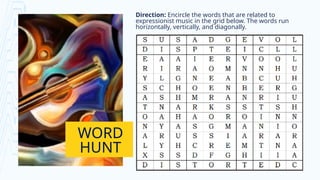
WORD
HUNT Client Satisfaction
Direction:Encircle the words that are related to
expressionist music in the grid below. The words run
horizontally, vertically, and diagonally.
5.
What is/are the
word(s)have you
found? Are you
familiar with these
words/terns?
How is it connected
to EXPRESSIONISM?
What is
Expressionism in
Music?
Who are the major
exponents of
Expressionism in
music?
EXPRESSIONIS
M
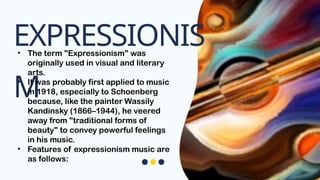
• The term"Expressionism" was
originally used in visual and literary
arts.
• It was probably first applied to music
in 1918, especially to Schoenberg
because, like the painter Wassily
Kandinsky (1866–1944), he veered
away from "traditional forms of
beauty" to convey powerful feelings
in his music.
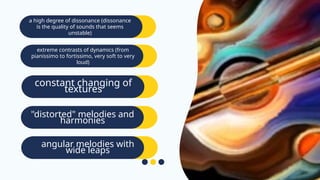
• Features of expressionism music are
as follows:
8.
a high degreeof dissonance (dissonance
is the quality of sounds that seems
unstable)
extreme contrasts of dynamics (from
pianissimo to fortissimo, very soft to very
loud)
constant changing of
textures
"distorted" melodies and
harmonies
angular melodies with
wide leaps
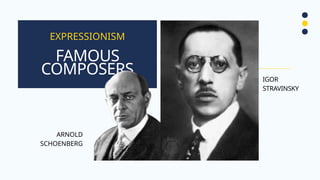
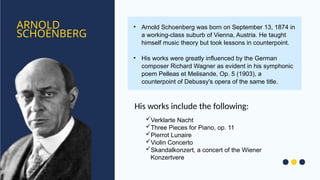
ARNOLD
SCHOENBERG
• Arnold Schoenbergwas born on September 13, 1874 in
a working-class suburb of Vienna, Austria. He taught
himself music theory but took lessons in counterpoint.
• His works were greatly influenced by the German
composer Richard Wagner as evident in his symphonic
poem Pelleas et Melisande, Op. 5 (1903), a
counterpoint of Debussy's opera of the same title.
Verklarte Nacht
Three Pieces for Piano, op. 11
Pierrot Lunaire
Violin Concerto
Skandalkonzert, a concert of the Wiener
Konzertvere
His works include the following:
11.
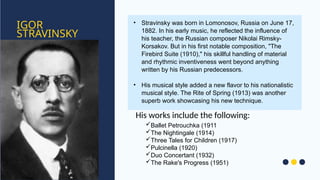
IGOR
STRAVINSKY
• Stravinsky wasborn in Lomonosov, Russia on June 17,
1882. In his early music, he reflected the influence of
his teacher, the Russian composer Nikolai Rimsky-
Korsakov. But in his first notable composition, "The
Firebird Suite (1910)," his skillful handling of material
and rhythmic inventiveness went beyond anything
written by his Russian predecessors.
• His musical style added a new flavor to his nationalistic
musical style. The Rite of Spring (1913) was another
superb work showcasing his new technique.
Ballet Petrouchka (1911
The Nightingale (1914)
Three Tales for Children (1917)
Pulcinella (1920)
Duo Concertant (1932)
The Rake's Progress (1951)
His works include the following:
1. What genreof a
movie can this music be
used?
2. What particular
moment in your life does
this music remind you of?
15.
ASSESSMENT:
Direction: Tell whetherthe following music is for
Schoenberg or Stravinsky.
1.Verklarte Nacht
2.Three Pieces for Piano, op. 11
3.Ballet Petrouchka
4.The Nightingale
5.Pierrot Lunaire
6. Pulcinella
7. Duo Concertant
8. Violin Concerto
9. Skandalkonzert
10.Three Tales for Children