EXPOSURE PATHWAYS,
PHYSIOLOGICAL INTERACTIONS,
AND TOXICITY MECHANISMS
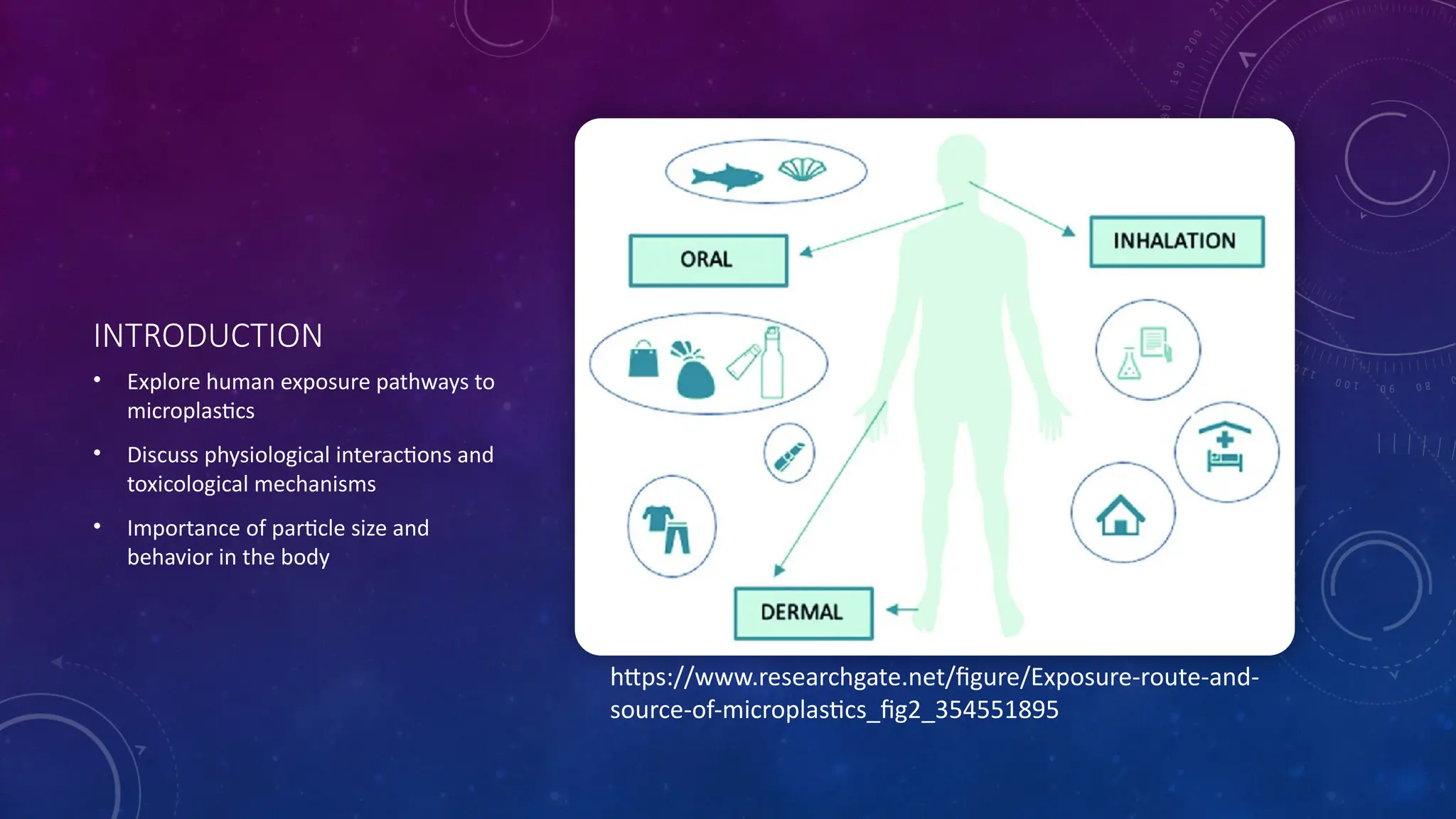
INTRODUCTION
• Explore human exposure pathways to
microplastics
• Discuss physiological interactions and
toxicological mechanisms
• Importance of particle size and
behavior in the body
https://www.researchgate.net/figure/Exposure-route-and-
source-of-microplastics_fig2_354551895
EXPOSURE
PATHWAYS AND
PARTICLE SIZE
• Exposure via air, water, diet
• Adults ingest ~220 particles/kg
body weight/day
• Inhale ~195 particles/kg body
weight/day
• Particle size influences deposition
and uptake
• Smaller particles penetrate
deeper
https://en.wikipedia.org/wiki/
Microplastics_and_human_health#/media/File
%3AWe_are_exposed_to_toxic_chemicals_and_microplastic
s_at_all_stages_in_the_plastics_life_cycle._The_pollutants_c
RESPIRATORY TRACT
DEPOSITION
• 10-30 microns deposit in upper airways (nose,
mouth)
• 2-10 microns reach large conducting airways
• <2.5 microns penetrate alveoli air sacs
• Clearance mechanisms vary by region
https://ars.els-cdn.com/content/image/1-s2.0-
S2405844024003864-gr1_lrg.jpg
CLEARANCE IN AIRWAYS
• Mucociliary clearance removes particles in large
airways (hours to days)
• Macrophages clear alveolar particles (months or
longer)
• Clearance efficiency affects exposure duration
https://bronchiectasis.com.au/wp-content/uploads/2015/09/
Airway.png
GASTROINTESTINAL
UPTAKE
• Microplastics encounter mucus barrier and
Peyer’s patches
• Particles <1 micron permeate mucus and enter
cells
• Uptake via transcellular and paracellular pathways
• Absorption rate very low (~0.002%)
https://ars.els-cdn.com/content/image/1-s2.0-
S0304389425007095-ga1_lrg.jpg
DIRECT TOXIC
EFFECTS
• Physical damage from particle
shape and size
• Chemical toxicity from additives
and adsorbed pollutants
• Cellular damage and impaired
function
https://pub.mdpi-res.com/cimb/cimb-46-00168/article_deploy/
html/images/cimb-46-00168-g001.png
INDIRECT TOXIC
EFFECTS
• Immune response triggers
inflammation
• Localized inflammation can
become systemic
• Oxidative stress and metabolic
disruption follow
https://pub.mdpi-res.com/microplastics/microplastics-04-00023/
article_deploy/html/images/microplastics-04-00023-g001.png
OXIDATIVE STRESS MECHANISMS
• Microplastics generate reactive oxygen species (ROS)
• ROS damage DNA, proteins, lipids
• Oxidative stress key in cellular injury
https://www.researchgate.net/profile/Yifan-
Zhu-12/publication/347535583/figure/fig3/
AS:971394514956290@1608609908895/
Mechanisms-of-microplastic-induced-
oxidative-stress.png
INFLAMMATORY
RESPONSES
• Immune cells recruited to remove
particles
• Chronic inflammation leads to
tissue damage
• Fibrosis and scarring may develop
https://share.google/eea5YOrhqmUMx3HGU
METABOLIC DISRUPTION
• Mitochondrial dysfunction impairs energy metabolism
• Reduced cell viability and altered signaling
• Contributes to cell death and organ dysfunction
https://share.google/LRjL4moZOYQ0YRLoQ
OCCUPATIONAL
HEALTH RISKS
• High microfiber exposure linked to
lung fibrosis
• Nylon flock workers at increased
risk
• Provides insight into
environmental exposure risks
https://ars.els-cdn.com/content/image/1-s2.0-
S2211383524004040-ga1_lrg.jpg
DOSE-RESPONSE
FUNDAMENTALS
• Toxicity depends on exposure dose
• “The dose makes the poison”
principle applies
• Reliable dose-response data
needed for risk assessment
https://share.google/x3Bnj8dYlkEGf9wQU
DATA GAPS IN EXPOSURE
AND TOXICITY
• Limited reliable exposure data
• Need for relevant hazard identification
• Standardized testing protocols lacking
https://share.google/1WvIPJ1KC05uWAEJ7
SUMMARY OF TOXICITY
MECHANISMS
• Microplastics cause oxidative stress,
inflammation, metabolic disruption
• Particle size and chemistry influence toxicity
• Occupational studies highlight potential long-term
effects
https://share.google/A3leMPYyQdFiz7bEv
TRANSITION TO NEXT TOPIC
• Next focus: Risk assessment challenges, chemical exposure, and regulatory actions
• Understanding exposure and toxicity data critical for policy

exposure pathways, physiological interactions, and toxicity Mechanisms

  • 1.
  • 2.
    INTRODUCTION • Explore humanexposure pathways to microplastics • Discuss physiological interactions and toxicological mechanisms • Importance of particle size and behavior in the body https://www.researchgate.net/figure/Exposure-route-and- source-of-microplastics_fig2_354551895
  • 3.
    EXPOSURE PATHWAYS AND PARTICLE SIZE •Exposure via air, water, diet • Adults ingest ~220 particles/kg body weight/day • Inhale ~195 particles/kg body weight/day • Particle size influences deposition and uptake • Smaller particles penetrate deeper https://en.wikipedia.org/wiki/ Microplastics_and_human_health#/media/File %3AWe_are_exposed_to_toxic_chemicals_and_microplastic s_at_all_stages_in_the_plastics_life_cycle._The_pollutants_c
  • 4.
    RESPIRATORY TRACT DEPOSITION • 10-30microns deposit in upper airways (nose, mouth) • 2-10 microns reach large conducting airways • <2.5 microns penetrate alveoli air sacs • Clearance mechanisms vary by region https://ars.els-cdn.com/content/image/1-s2.0- S2405844024003864-gr1_lrg.jpg
  • 5.
    CLEARANCE IN AIRWAYS •Mucociliary clearance removes particles in large airways (hours to days) • Macrophages clear alveolar particles (months or longer) • Clearance efficiency affects exposure duration https://bronchiectasis.com.au/wp-content/uploads/2015/09/ Airway.png
  • 6.
    GASTROINTESTINAL UPTAKE • Microplastics encountermucus barrier and Peyer’s patches • Particles <1 micron permeate mucus and enter cells • Uptake via transcellular and paracellular pathways • Absorption rate very low (~0.002%) https://ars.els-cdn.com/content/image/1-s2.0- S0304389425007095-ga1_lrg.jpg
  • 7.
    DIRECT TOXIC EFFECTS • Physicaldamage from particle shape and size • Chemical toxicity from additives and adsorbed pollutants • Cellular damage and impaired function https://pub.mdpi-res.com/cimb/cimb-46-00168/article_deploy/ html/images/cimb-46-00168-g001.png
  • 8.
    INDIRECT TOXIC EFFECTS • Immuneresponse triggers inflammation • Localized inflammation can become systemic • Oxidative stress and metabolic disruption follow https://pub.mdpi-res.com/microplastics/microplastics-04-00023/ article_deploy/html/images/microplastics-04-00023-g001.png
  • 9.
    OXIDATIVE STRESS MECHANISMS •Microplastics generate reactive oxygen species (ROS) • ROS damage DNA, proteins, lipids • Oxidative stress key in cellular injury https://www.researchgate.net/profile/Yifan- Zhu-12/publication/347535583/figure/fig3/ AS:971394514956290@1608609908895/ Mechanisms-of-microplastic-induced- oxidative-stress.png
  • 10.
    INFLAMMATORY RESPONSES • Immune cellsrecruited to remove particles • Chronic inflammation leads to tissue damage • Fibrosis and scarring may develop https://share.google/eea5YOrhqmUMx3HGU
  • 11.
    METABOLIC DISRUPTION • Mitochondrialdysfunction impairs energy metabolism • Reduced cell viability and altered signaling • Contributes to cell death and organ dysfunction https://share.google/LRjL4moZOYQ0YRLoQ
  • 12.
    OCCUPATIONAL HEALTH RISKS • Highmicrofiber exposure linked to lung fibrosis • Nylon flock workers at increased risk • Provides insight into environmental exposure risks https://ars.els-cdn.com/content/image/1-s2.0- S2211383524004040-ga1_lrg.jpg
  • 13.
    DOSE-RESPONSE FUNDAMENTALS • Toxicity dependson exposure dose • “The dose makes the poison” principle applies • Reliable dose-response data needed for risk assessment https://share.google/x3Bnj8dYlkEGf9wQU
  • 14.
    DATA GAPS INEXPOSURE AND TOXICITY • Limited reliable exposure data • Need for relevant hazard identification • Standardized testing protocols lacking https://share.google/1WvIPJ1KC05uWAEJ7
  • 15.
    SUMMARY OF TOXICITY MECHANISMS •Microplastics cause oxidative stress, inflammation, metabolic disruption • Particle size and chemistry influence toxicity • Occupational studies highlight potential long-term effects https://share.google/A3leMPYyQdFiz7bEv
  • 16.
    TRANSITION TO NEXTTOPIC • Next focus: Risk assessment challenges, chemical exposure, and regulatory actions • Understanding exposure and toxicity data critical for policy