A Presentation by
Maj Gen Nilendra Kumar
Director
Lex Consilium Foundation
Lecture to PG Diploma course in Human
Rights International Humanitarian Law and
Refugee Law at Indian Society of
International Law
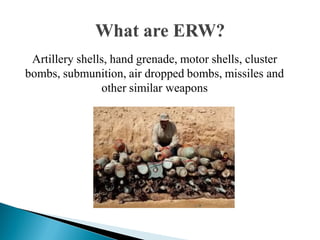
Artillery shells, hand grenade, motor shells, cluster
bombs, submunition, air dropped bombs, missiles and
other similar weapons
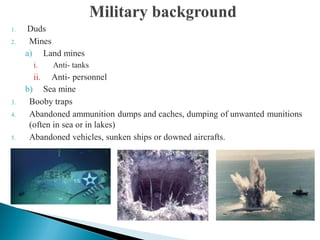
1. Duds
2. Mines
a) Land mines
i. Anti- tanks
ii. Anti- personnel
b) Sea mine
3. Booby traps
4. Abandoned ammunition dumps and caches, dumping of unwanted munitions
(often in sea or in lakes)
5. Abandoned vehicles, sunken ships or downed aircrafts.
More than 82 countries affected worldwide.
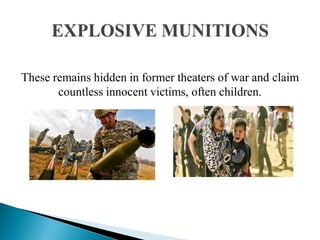
These remains hidden in former theaters of war and claim
countless innocent victims, often children.
 Distinction
 Proportionality
 Precaution
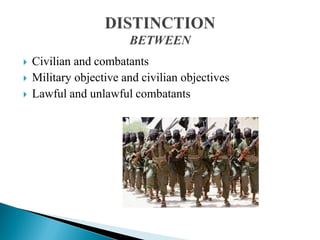
 Civilian and combatants
 Military objective and civilian objectives
 Lawful and unlawful combatants
With regard to legal use of force in an armed conflict,
proportionality and distinction are important factors in
assessing military necessity.
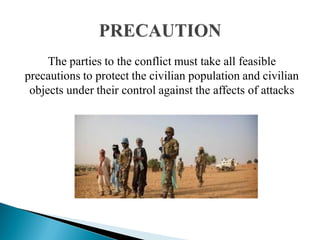
The parties to the conflict must take all feasible
precautions to protect the civilian population and civilian
objects under their control against the affects of attacks
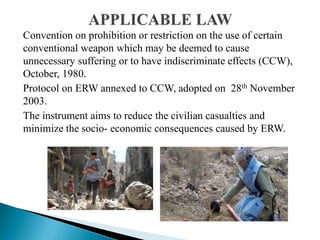
Convention on prohibition or restriction on the use of certain
conventional weapon which may be deemed to cause
unnecessary suffering or to have indiscriminate effects (CCW),
October, 1980.
Protocol on ERW annexed to CCW, adopted on 28th November
2003.
The instrument aims to reduce the civilian casualties and
minimize the socio- economic consequences caused by ERW.
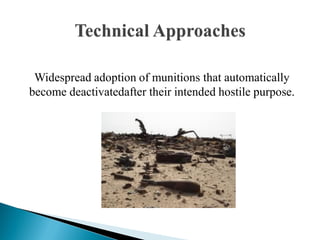
Widespread adoption of munitions that automatically
become deactivatedafter their intended hostile purpose.
Universal adherence to the Inhuman Weapons
Conventions of 1981.
 Identification or establishment of a relevant
information and training center
 Protocol V to the 1980 Convention on Certain
Conventional Weapons, 1980.
 Explosive ordinance
 Unexploded ordinance
 Abandoned explosive ordinance
 Explosive remnants of war
 Existing explosive remnants of war
 Clearance, removal or destruction of explosive remnants of
war.
 Recording, retaining and transmission of information.
 Other precautions for the protection of the civilian,
population, individual civilians and civilian objects from
the risks and effects of ERW.
 Assistance with respect to existing ERW.
 Cooperation and assistance
 Generic preventive measures
 Consultation of high contracting parties
 Compliances
 Recording, storage and release of information for UXO
and AXO
 Warning, risk education, marking, fencing and
monitoring together with best practice element.
Securing implementation and compliance among non-
state actors after the end of non international armed
conflicts
 Explosive remnants of war, mitigating the environmental
effects by Arthur H.Westing, Tyler and Francis, 1985
 The Handbook of International Humanitarian Law by OUP.
THANK YOU

Explosive Remnants of War

  • 2.
    A Presentation by MajGen Nilendra Kumar Director Lex Consilium Foundation
  • 3.
    Lecture to PGDiploma course in Human Rights International Humanitarian Law and Refugee Law at Indian Society of International Law
  • 4.
    Artillery shells, handgrenade, motor shells, cluster bombs, submunition, air dropped bombs, missiles and other similar weapons
  • 5.
    1. Duds 2. Mines a)Land mines i. Anti- tanks ii. Anti- personnel b) Sea mine 3. Booby traps 4. Abandoned ammunition dumps and caches, dumping of unwanted munitions (often in sea or in lakes) 5. Abandoned vehicles, sunken ships or downed aircrafts.
  • 6.
    More than 82countries affected worldwide.
  • 8.
    These remains hiddenin former theaters of war and claim countless innocent victims, often children.
  • 9.
  • 10.
     Civilian andcombatants  Military objective and civilian objectives  Lawful and unlawful combatants
  • 11.
    With regard tolegal use of force in an armed conflict, proportionality and distinction are important factors in assessing military necessity.
  • 12.
    The parties tothe conflict must take all feasible precautions to protect the civilian population and civilian objects under their control against the affects of attacks
  • 13.
    Convention on prohibitionor restriction on the use of certain conventional weapon which may be deemed to cause unnecessary suffering or to have indiscriminate effects (CCW), October, 1980. Protocol on ERW annexed to CCW, adopted on 28th November 2003. The instrument aims to reduce the civilian casualties and minimize the socio- economic consequences caused by ERW.
  • 14.
    Widespread adoption ofmunitions that automatically become deactivatedafter their intended hostile purpose.
  • 15.
    Universal adherence tothe Inhuman Weapons Conventions of 1981.
  • 16.
     Identification orestablishment of a relevant information and training center  Protocol V to the 1980 Convention on Certain Conventional Weapons, 1980.
  • 17.
     Explosive ordinance Unexploded ordinance  Abandoned explosive ordinance  Explosive remnants of war  Existing explosive remnants of war
  • 18.
     Clearance, removalor destruction of explosive remnants of war.  Recording, retaining and transmission of information.  Other precautions for the protection of the civilian, population, individual civilians and civilian objects from the risks and effects of ERW.  Assistance with respect to existing ERW.  Cooperation and assistance  Generic preventive measures  Consultation of high contracting parties  Compliances
  • 19.
     Recording, storageand release of information for UXO and AXO  Warning, risk education, marking, fencing and monitoring together with best practice element.
  • 20.
    Securing implementation andcompliance among non- state actors after the end of non international armed conflicts
  • 21.
     Explosive remnantsof war, mitigating the environmental effects by Arthur H.Westing, Tyler and Francis, 1985  The Handbook of International Humanitarian Law by OUP.
  • 22.