Exploring Planck Scale Dynamics in
High Energy Physics
DEPARTMENT OF PHYSICS
GOVT POST GRADUATE COLLEGE SWABI
SYED SIRAJ UR RAHMAN
Session (2019 – 2023)
SYED SIRAJ UR RAHMAN
Session (2019 – 2023)
Outlines
• Introduction
• Planck Scale
• Why study Planck scale?
• Theoretical Frameworks
• Experimental Methods
• Conclusion
2
Introduction
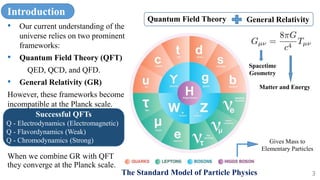
• Our current understanding of the
universe relies on two prominent
frameworks:
• Quantum Field Theory (QFT)
QED, QCD, and QFD.
• General Relativity (GR)
However, these frameworks become
incompatible at the Planck scale.
When we combine GR with QFT
they converge at the Planck scale.
3
Quantum Field Theory General Relativity
Spacetime
Geometry
Matter and Energy
Successful QFTs
Q - Electrodynamics (Electromagnetic)
Q - Flavordynamics (Weak)
Q - Chromodynamics (Strong)
The Standard Model of Particle Physics
Gives Mass to
Elementary Particles
Planck Scale
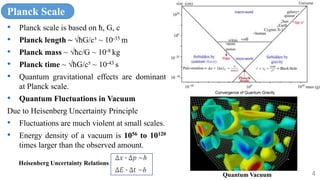
• Planck scale is based on ħ, G, c
• Planck length ~ √ħG/c³ ~ 10-35 m
• Planck mass ~ √ħc/G ~ 10-8 kg
• Planck time ~ √ħG/c⁵ ~ 10-43 s
• Quantum gravitational effects are dominant
at Planck scale.
• Quantum Fluctuations in Vacuum
Due to Heisenberg Uncertainty Principle
• Fluctuations are much violent at small scales.
• Energy density of a vacuum is 1056 to 10120
times larger than the observed amount.
4
Heisenberg Uncertainty Relations
Quantum Vacuum
Why study Planck scale?
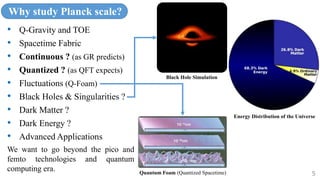
• Q-Gravity and TOE
• Spacetime Fabric
• Continuous ? (as GR predicts)
• Quantized ? (as QFT expects)
• Fluctuations (Q-Foam)
• Black Holes & Singularities ?
• Dark Matter ?
• Dark Energy ?
• Advanced Applications
We want to go beyond the pico and
femto technologies and quantum
computing era.
5
Quantum Foam (Quantized Spacetime)
Energy Distribution of the Universe
Black Hole Simulation
Theoretical Frameworks
These theoretical frameworks aim to reconcile General Relativity
(GR) with Quantum Field Theory (QFT), offering potential avenues
for understanding the fundamental nature of the universe. Ongoing
research continues to explore these models:
• Superstring/M Theory
• Loop Quantum Gravity (LQG)
• Emergence/E8 Theory
• Causal Dynamical Triangulations (CDT)
• The Holographic Principle
6
Superstring/M Theory
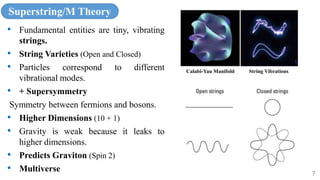
• Fundamental entities are tiny, vibrating
strings.
• String Varieties (Open and Closed)
• Particles correspond to different
vibrational modes.
• + Supersymmetry
Symmetry between fermions and bosons.
• Higher Dimensions (10 + 1)
• Gravity is weak because it leaks to
higher dimensions.
• Predicts Graviton (Spin 2)
• Multiverse
Calabi-Yau Manifold String Vibrations
7
Loop Quantum Gravity
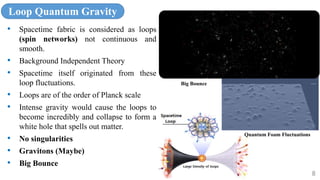
• Spacetime fabric is considered as loops
(spin networks) not continuous and
smooth.
• Background Independent Theory
• Spacetime itself originated from these
loop fluctuations.
• Loops are of the order of Planck scale
• Intense gravity would cause the loops to
become incredibly and collapse to form a
white hole that spells out matter.
• No singularities
• Gravitons (Maybe)
• Big Bounce
8
Quantum Foam Fluctuations
Big Bounce
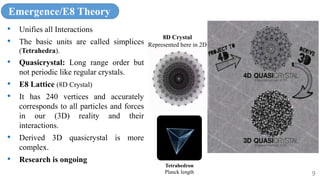
Emergence/E8 Theory
• Unifies all Interactions
• The basic units are called simplices
(Tetrahedra).
• Quasicrystal: Long range order but
not periodic like regular crystals.
• E8 Lattice (8D Crystal)
• It has 240 vertices and accurately
corresponds to all particles and forces
in our (3D) reality and their
interactions.
• Derived 3D quasicrystal is more
complex.
• Research is ongoing
9
8D Crystal
Represented here in 2D
Tetrahedron
Planck length
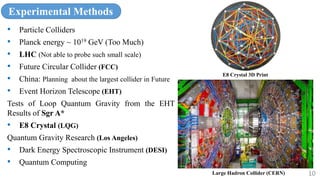
Experimental Methods
• Particle Colliders
• Planck energy ~ 1019 GeV (Too Much)
• LHC (Not able to probe such small scale)
• Future Circular Collider (FCC)
• China: Planning about the largest collider in Future
• Event Horizon Telescope (EHT)
Tests of Loop Quantum Gravity from the EHT
Results of Sgr A*
• E8 Crystal (LQG)
Quantum Gravity Research (Los Angeles)
• Dark Energy Spectroscopic Instrument (DESI)
• Quantum Computing
10
Large Hadron Collider (CERN)
E8 Crystal 3D Print
Conclusion
• Current Understanding: Based on general relativity and Quantum Theory.
• Challenges at the Planck Scale: Demands a quantum theory of gravity.
• Diverse Theoretical Frameworks: Superstring/M theory, loop quantum gravity,
Emergence/E8 theory, and causal dynamical triangulations (CDT).
• Unique Challenges: Extremely high energies and small distances, dimensionality,
spacetime structure, simulations, etc.
• Applications: Energy technologies, quantum computing, material science, medical
technologies, space exploration.
• Research Ongoing
Ulti ma te G o a l: The o r y o f Eve r yt hi ng (TOE)
11
THANKS!
12

Exploring Planck Scale Dynamics in High Energy Physics

  • 1.
    Exploring Planck ScaleDynamics in High Energy Physics DEPARTMENT OF PHYSICS GOVT POST GRADUATE COLLEGE SWABI SYED SIRAJ UR RAHMAN Session (2019 – 2023) SYED SIRAJ UR RAHMAN Session (2019 – 2023)
  • 2.
    Outlines • Introduction • PlanckScale • Why study Planck scale? • Theoretical Frameworks • Experimental Methods • Conclusion 2
  • 3.
    Introduction • Our currentunderstanding of the universe relies on two prominent frameworks: • Quantum Field Theory (QFT) QED, QCD, and QFD. • General Relativity (GR) However, these frameworks become incompatible at the Planck scale. When we combine GR with QFT they converge at the Planck scale. 3 Quantum Field Theory General Relativity Spacetime Geometry Matter and Energy Successful QFTs Q - Electrodynamics (Electromagnetic) Q - Flavordynamics (Weak) Q - Chromodynamics (Strong) The Standard Model of Particle Physics Gives Mass to Elementary Particles
  • 4.
    Planck Scale • Planckscale is based on ħ, G, c • Planck length ~ √ħG/c³ ~ 10-35 m • Planck mass ~ √ħc/G ~ 10-8 kg • Planck time ~ √ħG/c⁵ ~ 10-43 s • Quantum gravitational effects are dominant at Planck scale. • Quantum Fluctuations in Vacuum Due to Heisenberg Uncertainty Principle • Fluctuations are much violent at small scales. • Energy density of a vacuum is 1056 to 10120 times larger than the observed amount. 4 Heisenberg Uncertainty Relations Quantum Vacuum
  • 5.
    Why study Planckscale? • Q-Gravity and TOE • Spacetime Fabric • Continuous ? (as GR predicts) • Quantized ? (as QFT expects) • Fluctuations (Q-Foam) • Black Holes & Singularities ? • Dark Matter ? • Dark Energy ? • Advanced Applications We want to go beyond the pico and femto technologies and quantum computing era. 5 Quantum Foam (Quantized Spacetime) Energy Distribution of the Universe Black Hole Simulation
  • 6.
    Theoretical Frameworks These theoreticalframeworks aim to reconcile General Relativity (GR) with Quantum Field Theory (QFT), offering potential avenues for understanding the fundamental nature of the universe. Ongoing research continues to explore these models: • Superstring/M Theory • Loop Quantum Gravity (LQG) • Emergence/E8 Theory • Causal Dynamical Triangulations (CDT) • The Holographic Principle 6
  • 7.
    Superstring/M Theory • Fundamentalentities are tiny, vibrating strings. • String Varieties (Open and Closed) • Particles correspond to different vibrational modes. • + Supersymmetry Symmetry between fermions and bosons. • Higher Dimensions (10 + 1) • Gravity is weak because it leaks to higher dimensions. • Predicts Graviton (Spin 2) • Multiverse Calabi-Yau Manifold String Vibrations 7
  • 8.
    Loop Quantum Gravity •Spacetime fabric is considered as loops (spin networks) not continuous and smooth. • Background Independent Theory • Spacetime itself originated from these loop fluctuations. • Loops are of the order of Planck scale • Intense gravity would cause the loops to become incredibly and collapse to form a white hole that spells out matter. • No singularities • Gravitons (Maybe) • Big Bounce 8 Quantum Foam Fluctuations Big Bounce
  • 9.
    Emergence/E8 Theory • Unifiesall Interactions • The basic units are called simplices (Tetrahedra). • Quasicrystal: Long range order but not periodic like regular crystals. • E8 Lattice (8D Crystal) • It has 240 vertices and accurately corresponds to all particles and forces in our (3D) reality and their interactions. • Derived 3D quasicrystal is more complex. • Research is ongoing 9 8D Crystal Represented here in 2D Tetrahedron Planck length
  • 10.
    Experimental Methods • ParticleColliders • Planck energy ~ 1019 GeV (Too Much) • LHC (Not able to probe such small scale) • Future Circular Collider (FCC) • China: Planning about the largest collider in Future • Event Horizon Telescope (EHT) Tests of Loop Quantum Gravity from the EHT Results of Sgr A* • E8 Crystal (LQG) Quantum Gravity Research (Los Angeles) • Dark Energy Spectroscopic Instrument (DESI) • Quantum Computing 10 Large Hadron Collider (CERN) E8 Crystal 3D Print
  • 11.
    Conclusion • Current Understanding:Based on general relativity and Quantum Theory. • Challenges at the Planck Scale: Demands a quantum theory of gravity. • Diverse Theoretical Frameworks: Superstring/M theory, loop quantum gravity, Emergence/E8 theory, and causal dynamical triangulations (CDT). • Unique Challenges: Extremely high energies and small distances, dimensionality, spacetime structure, simulations, etc. • Applications: Energy technologies, quantum computing, material science, medical technologies, space exploration. • Research Ongoing Ulti ma te G o a l: The o r y o f Eve r yt hi ng (TOE) 11
  • 12.