The Many Flavors of Exploratory
                        Testing


                              Gitte Ottosen
                            Managing Consultant
                    gitte.ottosen@sogeti.dk
Sogeti Profile

 • Sogeti is a leading provider of structured testing solutions
 • Part of the Sogeti Group, which brings together more than
   20,000 professionals in 15 countries and is present in over
   100 locations in Europe, USA and India
 • Creators of the globally recognized methodologies TMap
   NEXT ® and TPI NEXT®
 • Well established cooperation with HP, IBM and Microsoft


© Sogeti
Agenda
•      Background
•      Introducing different ”flavors” of exploratory test
•      Challenges – and what to do about it
•      What we ended up with – our ”flavors”


© Sogeti
Where Were We?
• CMMI5 level software company

• Following several standards (AQAP, ISO9001 etc.)

• Developing mission critical software:
   – Defense command and control system
   – Defense communication system
   – Electronic patient journal
   – National security and intelligence
   – System integration, public sector


© Sogeti
Why Moving Towards Exploratory Test?
• EUROSTAR 2004
           – Introduction to exploratory test - James Bach
           – Introduction to attacks – James Whittaker

• Soon after the story about ”bug hunt” – Klaus
  Olsen

• Status on testing ”back home”
           –   The beginning of a structured approach to testing
           –   Classical scripted test
           –   Primarily focus on acceptance testing
           –   To many defects ended in production

© Sogeti
Definition of Exploratory Test
  ”An interactive process of simultaneous learning,
           test design, and test execution.”

Exploratory testing is not against the idea of scripting. In some contexts, you
will achieve your testing mission better through a more scripted approach; in
other contexts, your mission will benefit more from the ability to create and
improve tests as you execute them. I find that most situations benefit from a
mix of scripted and exploratory approaches.

                                                                    James Bach
                                                    Exploratory Testing Explained


© Sogeti
7
© Sogeti
Exploratory Flavors
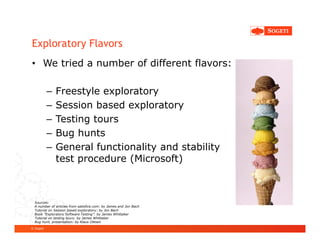
• We tried a number of different flavors:

           –   Freestyle exploratory
           –   Session based exploratory
           –   Testing tours
           –   Bug hunts
           –   General functionality and stability
               test procedure (Microsoft)


  Sources:
  A number of articles from satisfice.com: by James and Jon Bach
  Tutorial on Session based exploratory: by Jon Bach
  Book ”Exploratory Software Testing”: by James Whittaker
  Tutorial on testing tours: by James Whittaker
  Bug hunt, presentation: by Klaus Olesen
© Sogeti
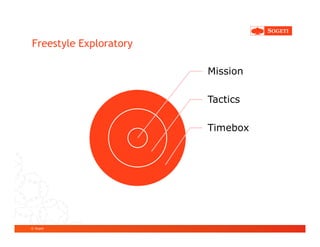
Freestyle Exploratory

                        Mission

                        Tactics

                        Timebox


© Sogeti
Freestyle Exploratory – Comments
• What have been tested?, Missing tangible
  evidence
   – Only output is bug reports
   – No notes
   – No coverage
• A great tool when you haven’t got anything else
• Be careful with too large time boxes
• Be careful with too complex/big charters
• Hard to convince management
• Often misunderstood
• Cannot stand on its own in a structured process

© Sogeti
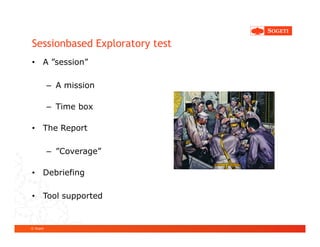
Sessionbased Exploratory test
• A ”session”

           – A mission

           – Time box

• The Report

           – ”Coverage”

• Debriefing

• Tool supported


© Sogeti
Session Based Exploratory – Report and
Debriefing
                                         Debriefing
  •Session charter (includes a mission
  statement, and areas to be tested)     • Past
                                         • Results
  •Tester name(s)
                                         • Obstacles
  •Date and time started                 • Outlook
  •Task breakdown (the TBS metrics)      • Feelings

  •Data files

  •Test notes

  •Issues

  •Bugs


© Sogeti
Session Based Exploratory – Comments
• Be careful with too large time boxes
• Be careful with too complex/big charters
• Challenge to get testers to make good notes in a
  defined structure
• No success in implementing note/coverage tool
• Who to make the debriefing? Someone who
  knows about the SUT in detail or the test
  manager?
• Makes it easier to keep track on what is tested


© Sogeti
Testing Tours
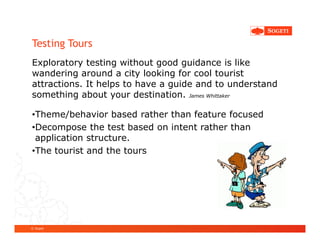
Exploratory testing without good guidance is like
wandering around a city looking for cool tourist
attractions. It helps to have a guide and to understand
something about your destination. James Whittaker

•Theme/behavior based rather than feature focused
•Decompose the test based on intent rather than
 application structure.
•The tourist and the tours


© Sogeti
Testing Tours - Example
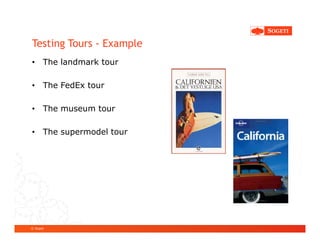
• The landmark tour

• The FedEx tour

• The museum tour

• The supermodel tour


© Sogeti
Testing Tours – Comments
• Hard to introduce to testers
• Hard to keep track on coverage
• Hard to communicate to management
• When to apply?
• A good way to get another perspective than
  workflows or features
• A good input for bug hunts


© Sogeti
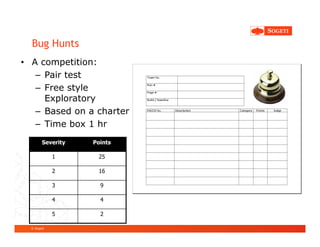
Bug Hunts
• A competition:
   – Pair test
   – Free style
     Exploratory
   – Based on a charter
   – Time box 1 hr
        Severity   Points

             1      25

             2      16

             3       9

             4       4

             5       2

  © Sogeti
Prices and Experiences
• To the team that finds the biggest (most serious) bug
  (determined by the “judges”)
• To the team that finds the most bugs (sum of points)

• We spent 112 hours on the first event
           –   6 teams of 2 people with 4 runs of 1 hour (48 hours)
           –   Rest of the time spent on; Preparations and defect reporting
           –   Facilitators
           –   Judges (architects) – they were very busy
• Found 76 defects
           – Worth a total of 573 points
• Equivalent to 0.68 defects/hour
           – Better than our normal average finding rate
• Best bug was a security loop-hole


© Sogeti
Bughunt – Comments
• A Bug-Hunt Is:
   – NOT a replacement for structured/scripted
     tests
             • Cannot cope with hard-to-test features and long
               scenarios
             • Coverage
             • Number of testers needed


           – But great as a supplement
             • Finds new errors
             • Get different profiles to pair test
             • ... and a fun team building exercise ☺


© Sogeti
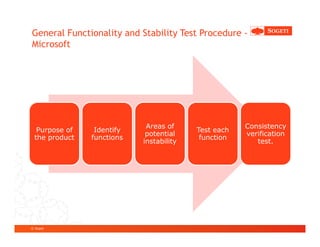
General Functionality and Stability Test Procedure -
Microsoft


                             Areas of                 Consistency
   Purpose of    Identify                 Test each
                             potential                verification
  the product   functions                  function
                            instability                  test.


© Sogeti
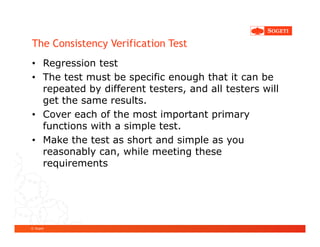
The Consistency Verification Test
• Regression test
• The test must be specific enough that it can be
  repeated by different testers, and all testers will
  get the same results.
• Cover each of the most important primary
  functions with a simple test.
• Make the test as short and simple as you
  reasonably can, while meeting these
  requirements


© Sogeti
General functionality and stability test
procedure - Comments
• The best of Exploratory Test but also gives you:
           –   More structured documented result
           –   Regression test
           –   Visible coverage
           –   Enough ”proof” to satisfy certifications (e.g. AQAP)
• Take care not to make to big charters (time box)
• The test notes are still crucial
• Missing debriefing


© Sogeti
General Challenges
And What we Ended up With
Challenges
•      Management understanding
•      Tester understanding
•      The notes
•      Sourcing
•      The regression test
•      How to get visible coverage
•      Mapping to requirements


© Sogeti
How we Solved it?
• For classic/traditional testers:
           – An introduction/workshop
           – Pair testing (sourcing tester + “local” tester)
• For management:
           – An introduction
           – Prove in battle
• For a ”structured house”: a way to keep track
  enforcing:
           –   Notes
           –   Debriefing
           –   Requirement traceability
           –   ”Documentation” of regression test


© Sogeti
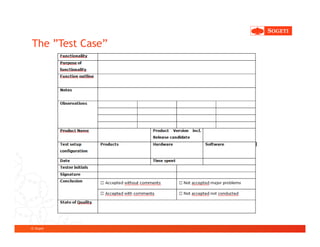
The ”Test Case”


© Sogeti
Our Implementation
• Microsoft approach with session based debriefing

• Charters based on test design for story test

• Freestyle charters to fill in the gaps

• Bug hunts when appropriate

• Heuristics - checklists


© Sogeti
Is it Exploratory Testing?
I think so - just in our context


if we cannot call it that then lets call it:


Examinating                                        Inquiry
                     Expedition

                                   Investigation
Inquisition
                                                    Reconnaissance
           Questioning
                               Scrutiny


© Sogeti
Please evaluate my
            presentation by using
           the evaluation booklets
            which you can find in
            your conference bag.

                Thank you!

© Sogeti

Exploratory test

  • 1.
    The Many Flavorsof Exploratory Testing Gitte Ottosen Managing Consultant gitte.ottosen@sogeti.dk
  • 2.
    Sogeti Profile •Sogeti is a leading provider of structured testing solutions • Part of the Sogeti Group, which brings together more than 20,000 professionals in 15 countries and is present in over 100 locations in Europe, USA and India • Creators of the globally recognized methodologies TMap NEXT ® and TPI NEXT® • Well established cooperation with HP, IBM and Microsoft © Sogeti
  • 3.
    Agenda • Background • Introducing different ”flavors” of exploratory test • Challenges – and what to do about it • What we ended up with – our ”flavors” © Sogeti
  • 4.
    Where Were We? •CMMI5 level software company • Following several standards (AQAP, ISO9001 etc.) • Developing mission critical software: – Defense command and control system – Defense communication system – Electronic patient journal – National security and intelligence – System integration, public sector © Sogeti
  • 5.
    Why Moving TowardsExploratory Test? • EUROSTAR 2004 – Introduction to exploratory test - James Bach – Introduction to attacks – James Whittaker • Soon after the story about ”bug hunt” – Klaus Olsen • Status on testing ”back home” – The beginning of a structured approach to testing – Classical scripted test – Primarily focus on acceptance testing – To many defects ended in production © Sogeti
  • 6.
    Definition of ExploratoryTest ”An interactive process of simultaneous learning, test design, and test execution.” Exploratory testing is not against the idea of scripting. In some contexts, you will achieve your testing mission better through a more scripted approach; in other contexts, your mission will benefit more from the ability to create and improve tests as you execute them. I find that most situations benefit from a mix of scripted and exploratory approaches. James Bach Exploratory Testing Explained © Sogeti
  • 7.
  • 8.
    Exploratory Flavors • Wetried a number of different flavors: – Freestyle exploratory – Session based exploratory – Testing tours – Bug hunts – General functionality and stability test procedure (Microsoft) Sources: A number of articles from satisfice.com: by James and Jon Bach Tutorial on Session based exploratory: by Jon Bach Book ”Exploratory Software Testing”: by James Whittaker Tutorial on testing tours: by James Whittaker Bug hunt, presentation: by Klaus Olesen © Sogeti
  • 9.
    Freestyle Exploratory Mission Tactics Timebox © Sogeti
  • 10.
    Freestyle Exploratory –Comments • What have been tested?, Missing tangible evidence – Only output is bug reports – No notes – No coverage • A great tool when you haven’t got anything else • Be careful with too large time boxes • Be careful with too complex/big charters • Hard to convince management • Often misunderstood • Cannot stand on its own in a structured process © Sogeti
  • 11.
    Sessionbased Exploratory test •A ”session” – A mission – Time box • The Report – ”Coverage” • Debriefing • Tool supported © Sogeti
  • 12.
    Session Based Exploratory– Report and Debriefing Debriefing •Session charter (includes a mission statement, and areas to be tested) • Past • Results •Tester name(s) • Obstacles •Date and time started • Outlook •Task breakdown (the TBS metrics) • Feelings •Data files •Test notes •Issues •Bugs © Sogeti
  • 13.
    Session Based Exploratory– Comments • Be careful with too large time boxes • Be careful with too complex/big charters • Challenge to get testers to make good notes in a defined structure • No success in implementing note/coverage tool • Who to make the debriefing? Someone who knows about the SUT in detail or the test manager? • Makes it easier to keep track on what is tested © Sogeti
  • 14.
    Testing Tours Exploratory testingwithout good guidance is like wandering around a city looking for cool tourist attractions. It helps to have a guide and to understand something about your destination. James Whittaker •Theme/behavior based rather than feature focused •Decompose the test based on intent rather than application structure. •The tourist and the tours © Sogeti
  • 15.
    Testing Tours -Example • The landmark tour • The FedEx tour • The museum tour • The supermodel tour © Sogeti
  • 16.
    Testing Tours –Comments • Hard to introduce to testers • Hard to keep track on coverage • Hard to communicate to management • When to apply? • A good way to get another perspective than workflows or features • A good input for bug hunts © Sogeti
  • 17.
    Bug Hunts • Acompetition: – Pair test – Free style Exploratory – Based on a charter – Time box 1 hr Severity Points 1 25 2 16 3 9 4 4 5 2 © Sogeti
  • 18.
    Prices and Experiences •To the team that finds the biggest (most serious) bug (determined by the “judges”) • To the team that finds the most bugs (sum of points) • We spent 112 hours on the first event – 6 teams of 2 people with 4 runs of 1 hour (48 hours) – Rest of the time spent on; Preparations and defect reporting – Facilitators – Judges (architects) – they were very busy • Found 76 defects – Worth a total of 573 points • Equivalent to 0.68 defects/hour – Better than our normal average finding rate • Best bug was a security loop-hole © Sogeti
  • 19.
    Bughunt – Comments •A Bug-Hunt Is: – NOT a replacement for structured/scripted tests • Cannot cope with hard-to-test features and long scenarios • Coverage • Number of testers needed – But great as a supplement • Finds new errors • Get different profiles to pair test • ... and a fun team building exercise ☺ © Sogeti
  • 20.
    General Functionality andStability Test Procedure - Microsoft Areas of Consistency Purpose of Identify Test each potential verification the product functions function instability test. © Sogeti
  • 21.
    The Consistency VerificationTest • Regression test • The test must be specific enough that it can be repeated by different testers, and all testers will get the same results. • Cover each of the most important primary functions with a simple test. • Make the test as short and simple as you reasonably can, while meeting these requirements © Sogeti
  • 22.
    General functionality andstability test procedure - Comments • The best of Exploratory Test but also gives you: – More structured documented result – Regression test – Visible coverage – Enough ”proof” to satisfy certifications (e.g. AQAP) • Take care not to make to big charters (time box) • The test notes are still crucial • Missing debriefing © Sogeti
  • 23.
  • 24.
    Challenges • Management understanding • Tester understanding • The notes • Sourcing • The regression test • How to get visible coverage • Mapping to requirements © Sogeti
  • 25.
    How we Solvedit? • For classic/traditional testers: – An introduction/workshop – Pair testing (sourcing tester + “local” tester) • For management: – An introduction – Prove in battle • For a ”structured house”: a way to keep track enforcing: – Notes – Debriefing – Requirement traceability – ”Documentation” of regression test © Sogeti
  • 26.
  • 27.
    Our Implementation • Microsoftapproach with session based debriefing • Charters based on test design for story test • Freestyle charters to fill in the gaps • Bug hunts when appropriate • Heuristics - checklists © Sogeti
  • 28.
    Is it ExploratoryTesting? I think so - just in our context if we cannot call it that then lets call it: Examinating Inquiry Expedition Investigation Inquisition Reconnaissance Questioning Scrutiny © Sogeti
  • 29.
    Please evaluate my presentation by using the evaluation booklets which you can find in your conference bag. Thank you! © Sogeti