

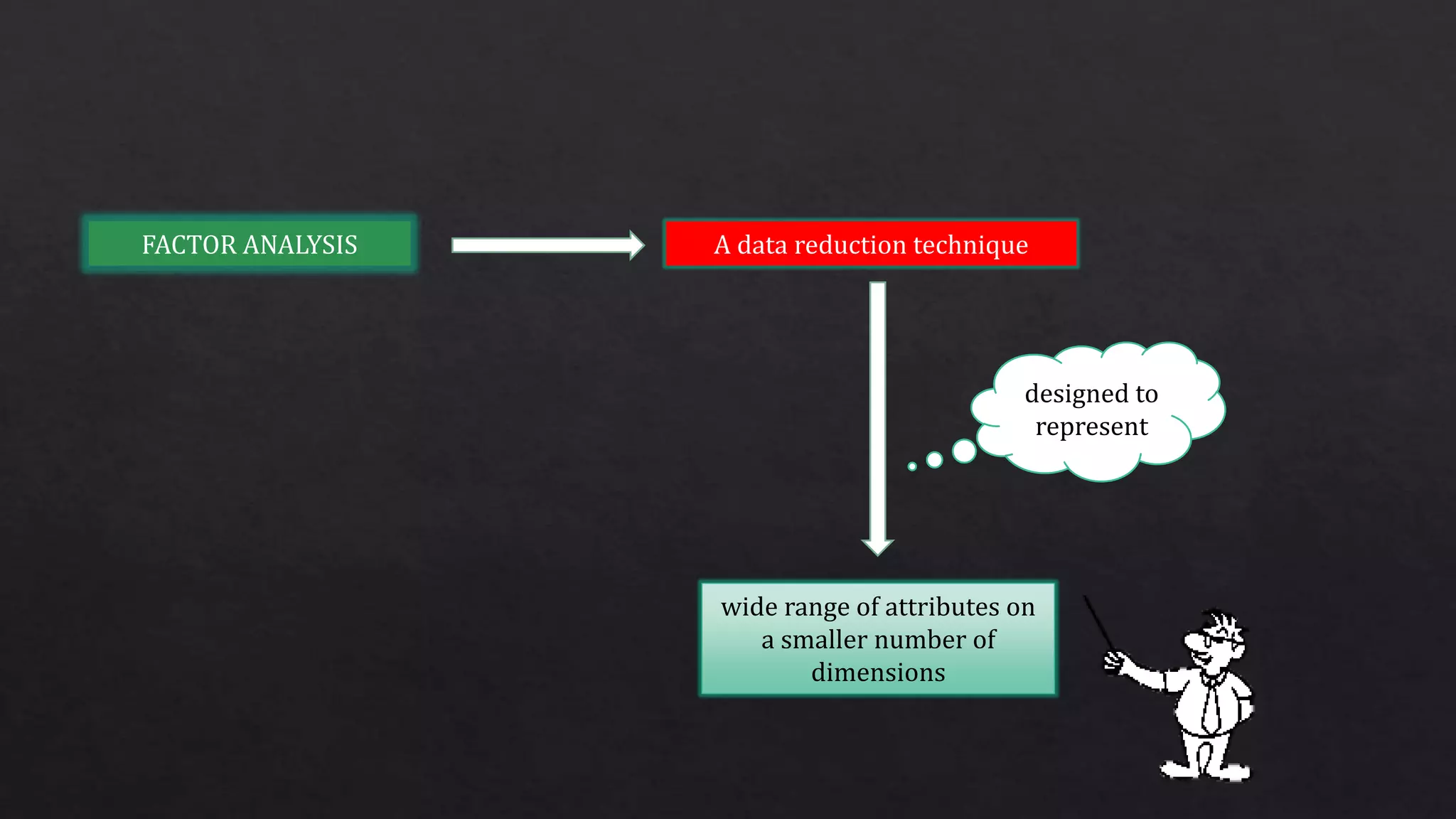




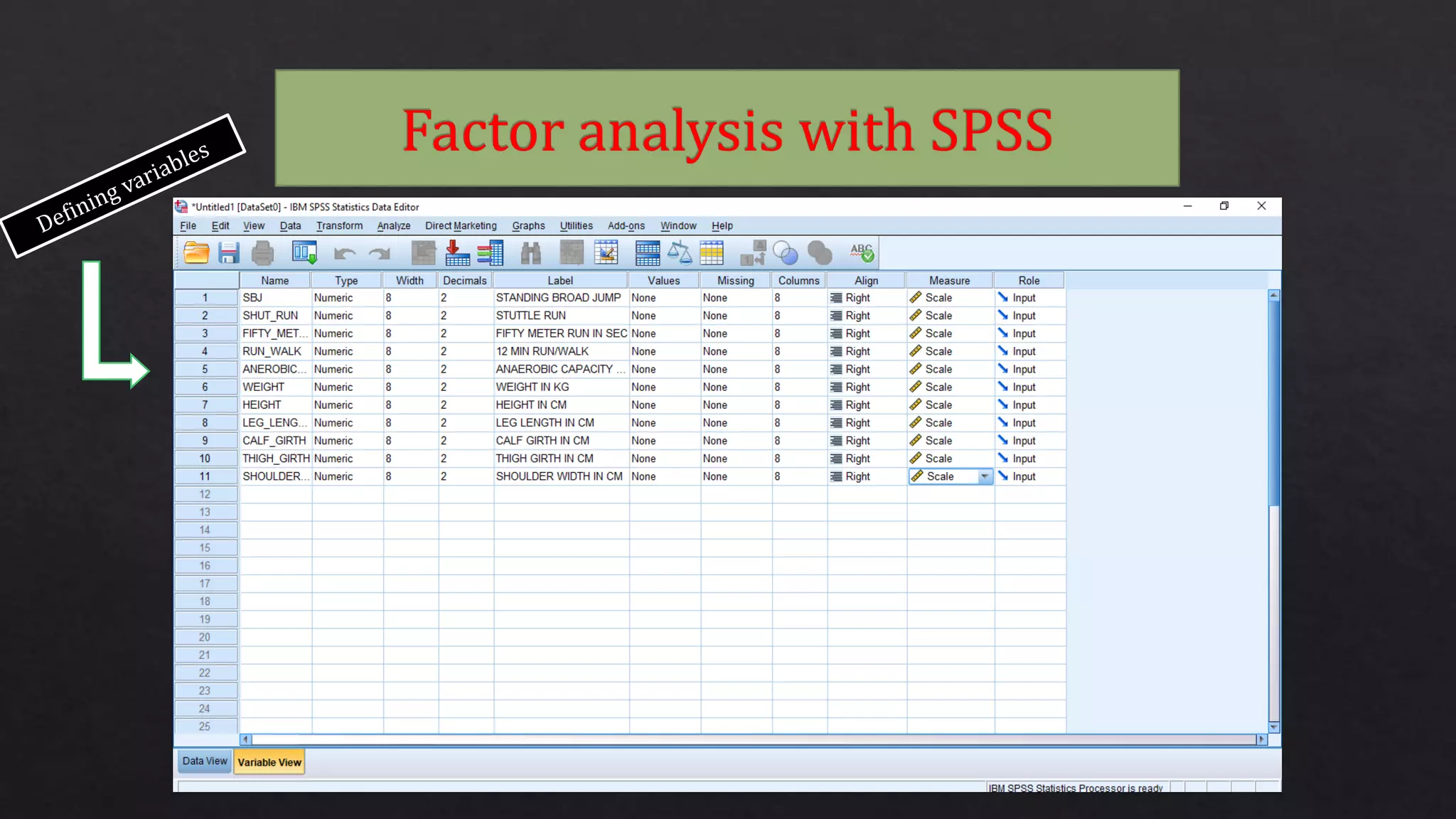
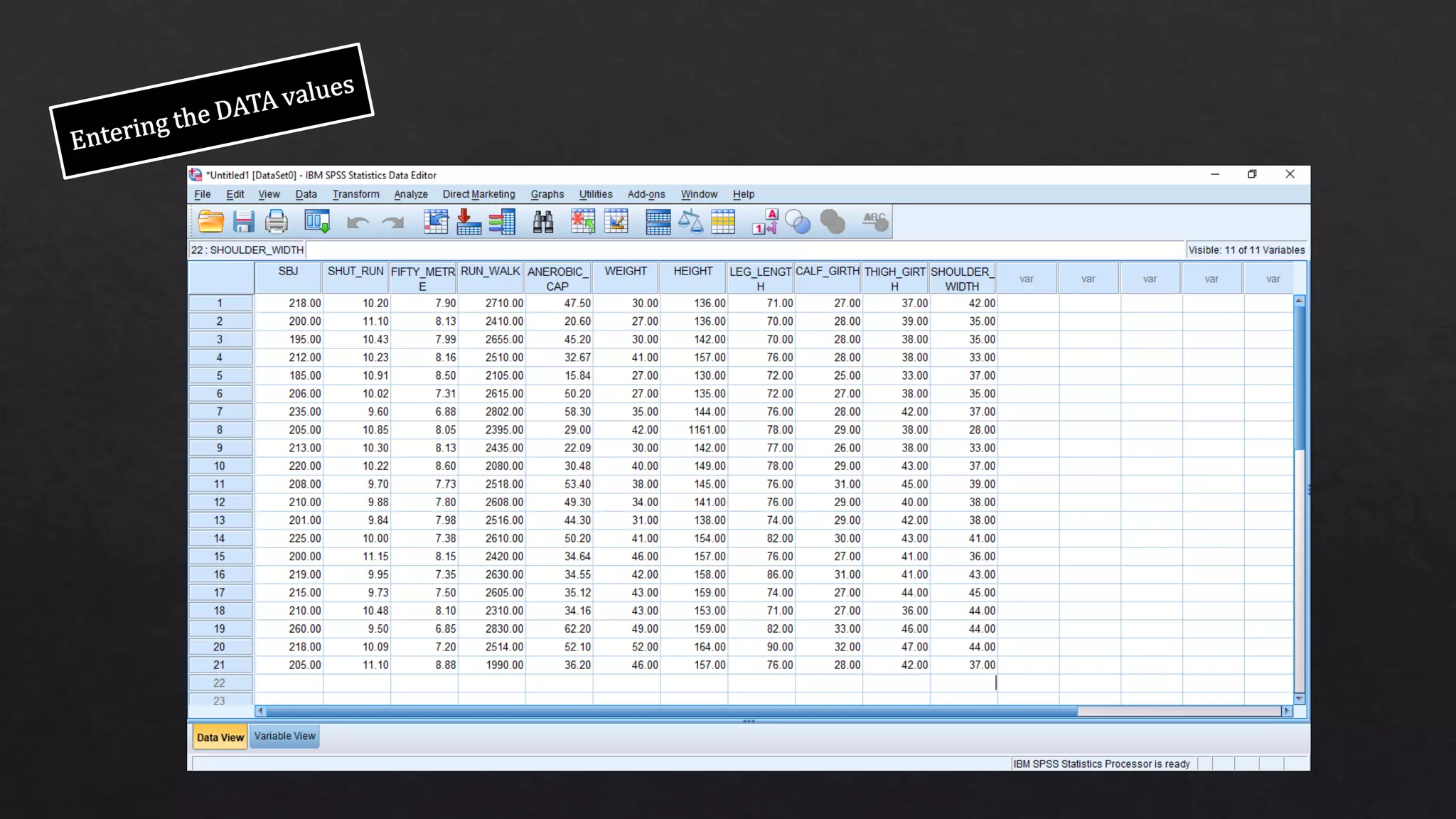
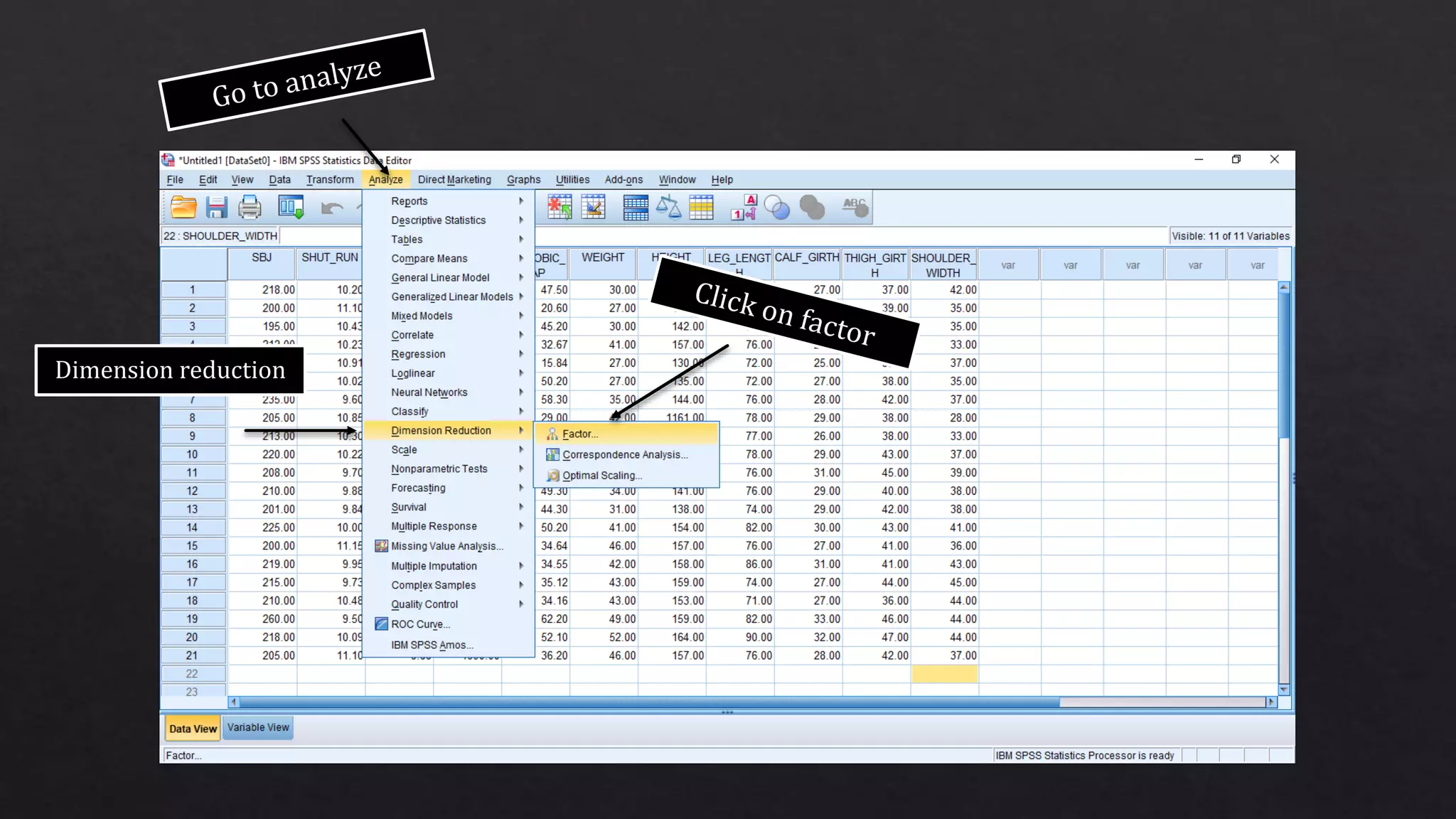
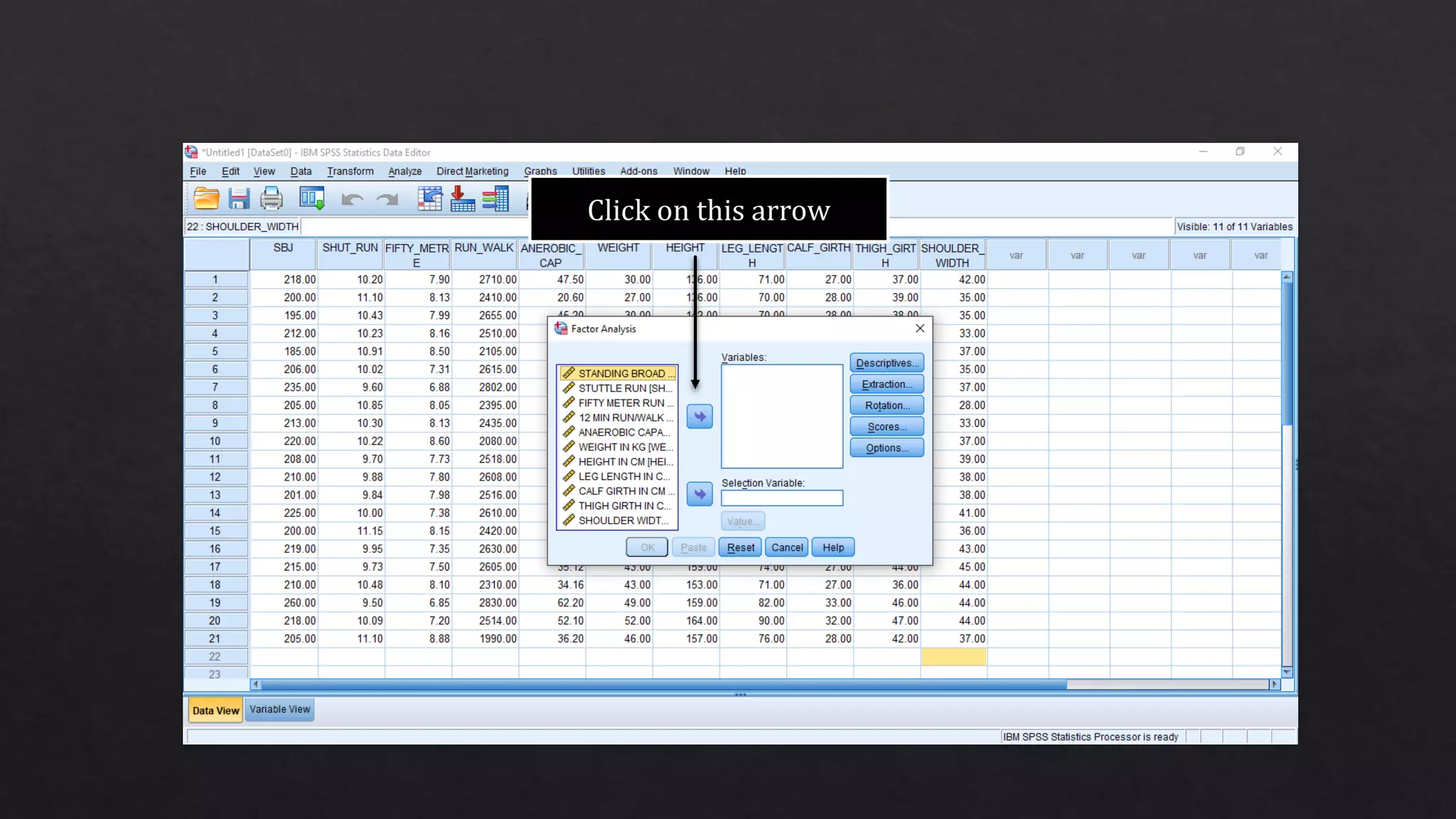
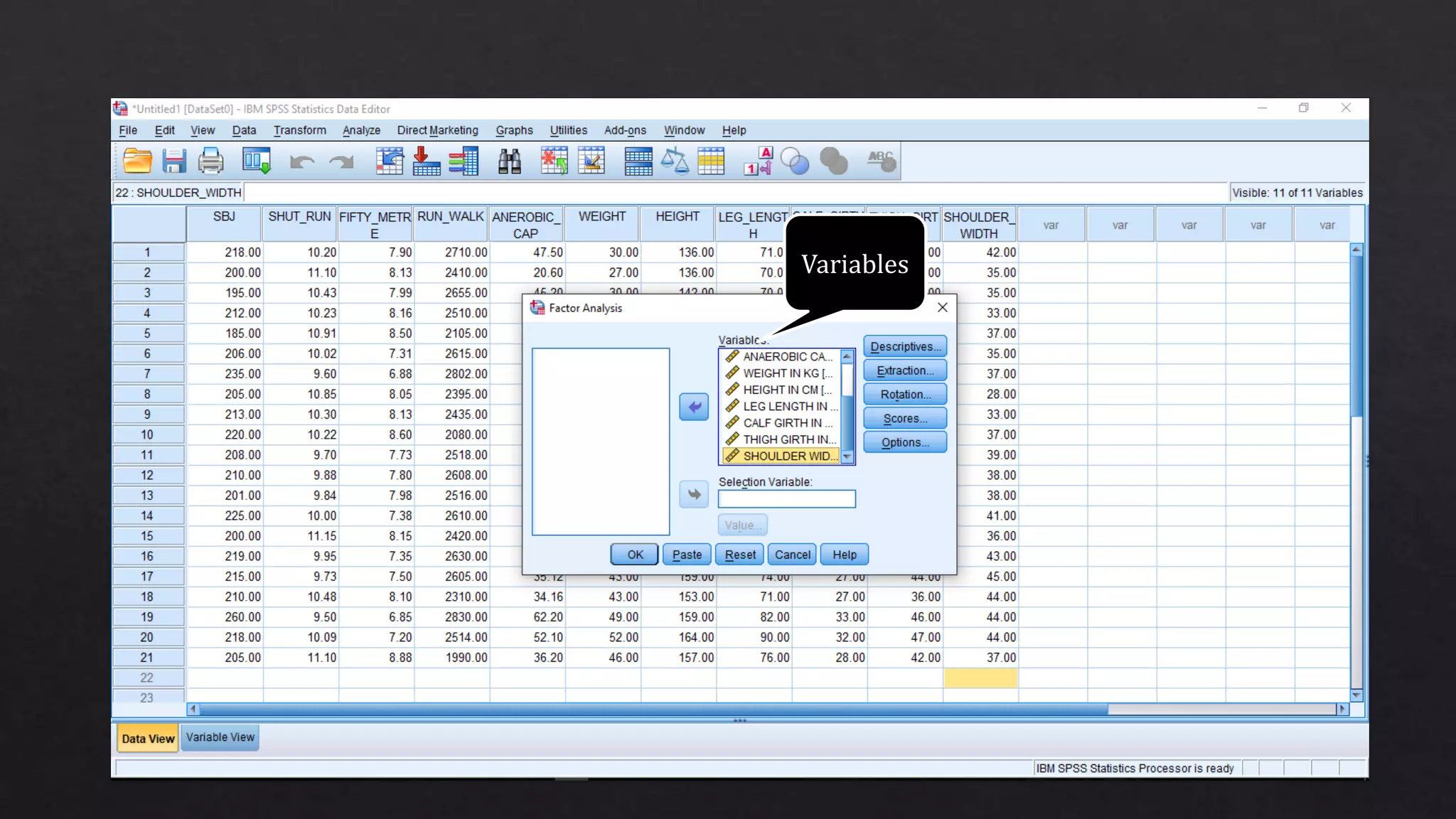
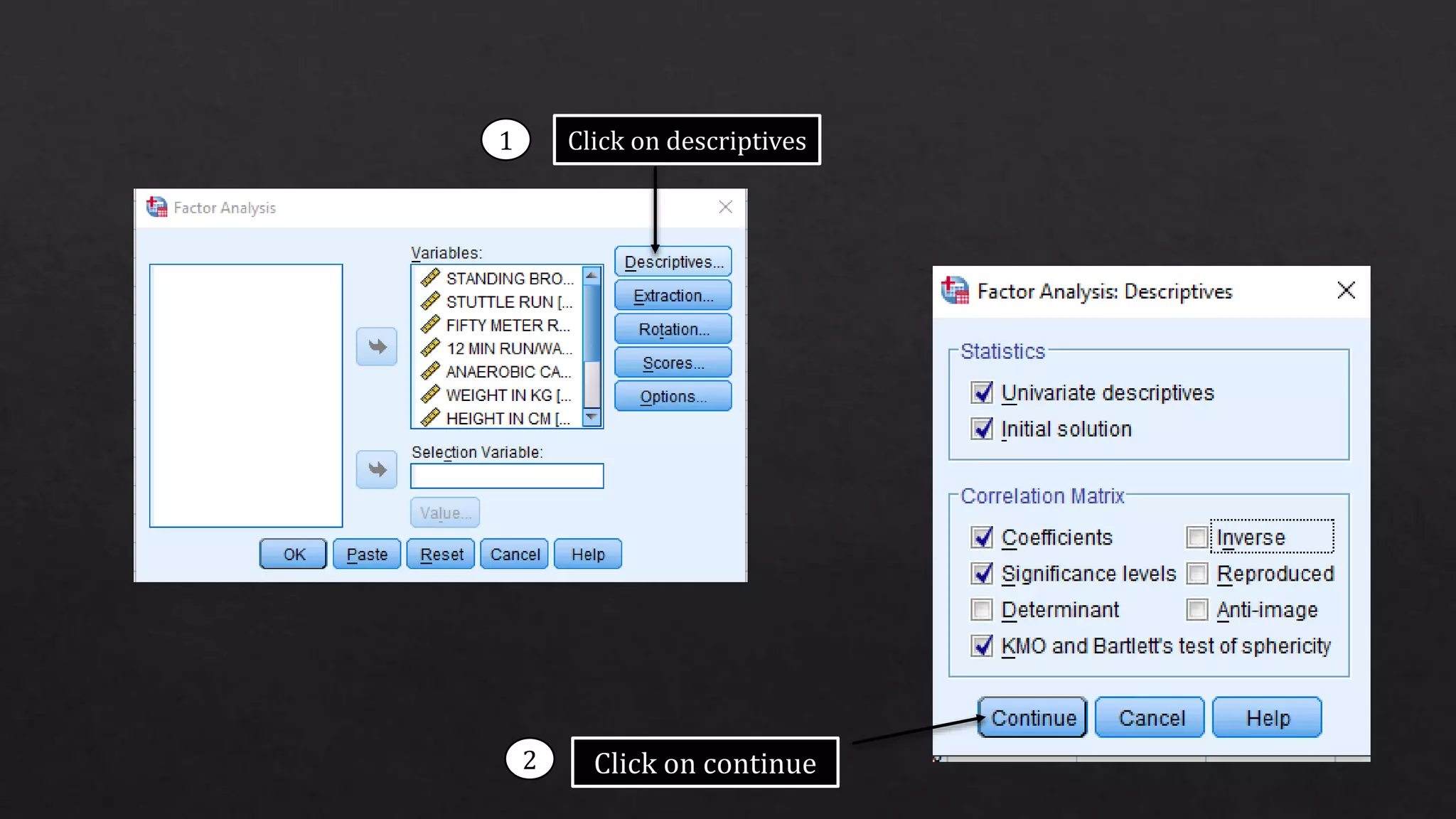
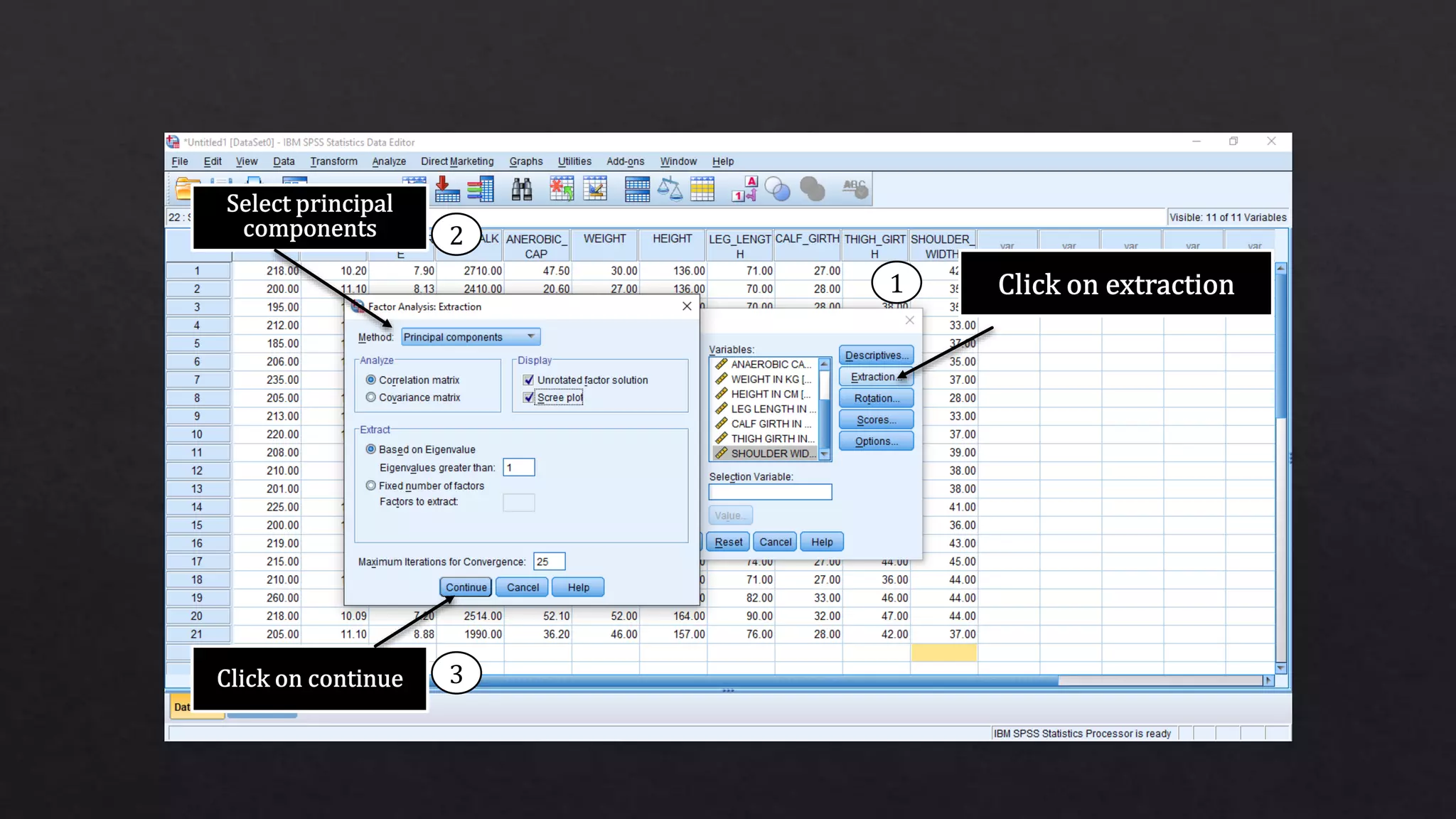
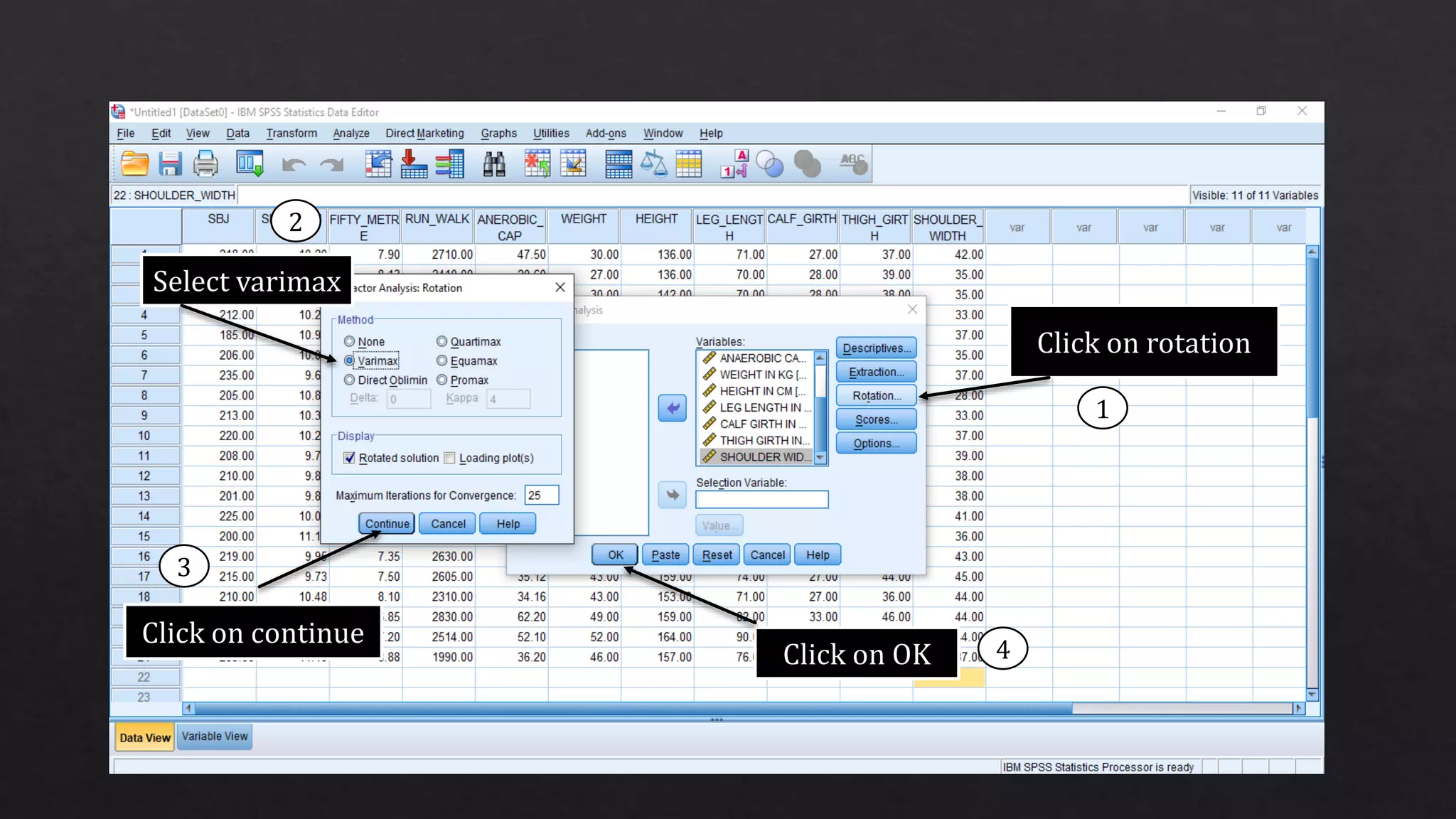
FACTOR ANALYSIS A data reduction technique
wide range of attributes on
a smaller number of
dimensions
designed to
represent
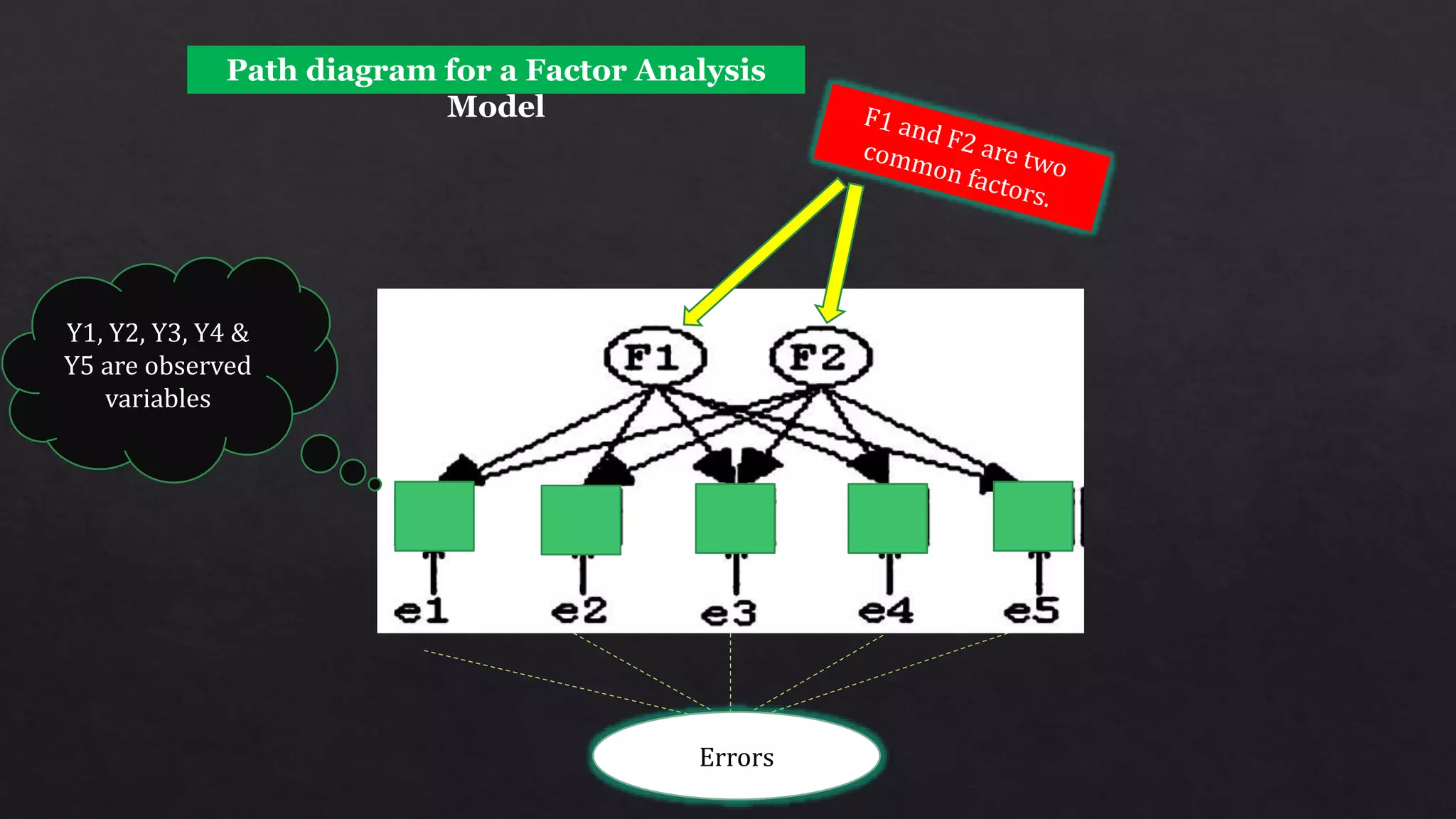
Path diagram for a Factor Analysis
Model
Y1, Y2, Y3, Y4 &
Y5 are observed
variables
Errors
?
No outliers in the data
set.
Normality of the data
set.
Multi collinearity and
singularity among the
variables does not exist.
Homoscedasticity does not
exist between the variables
because factor analysis is a
linear function of measured
variables.
Variables should be linear in
nature.
Data should be metric in
nature i.e. on interval and
ratio scale.
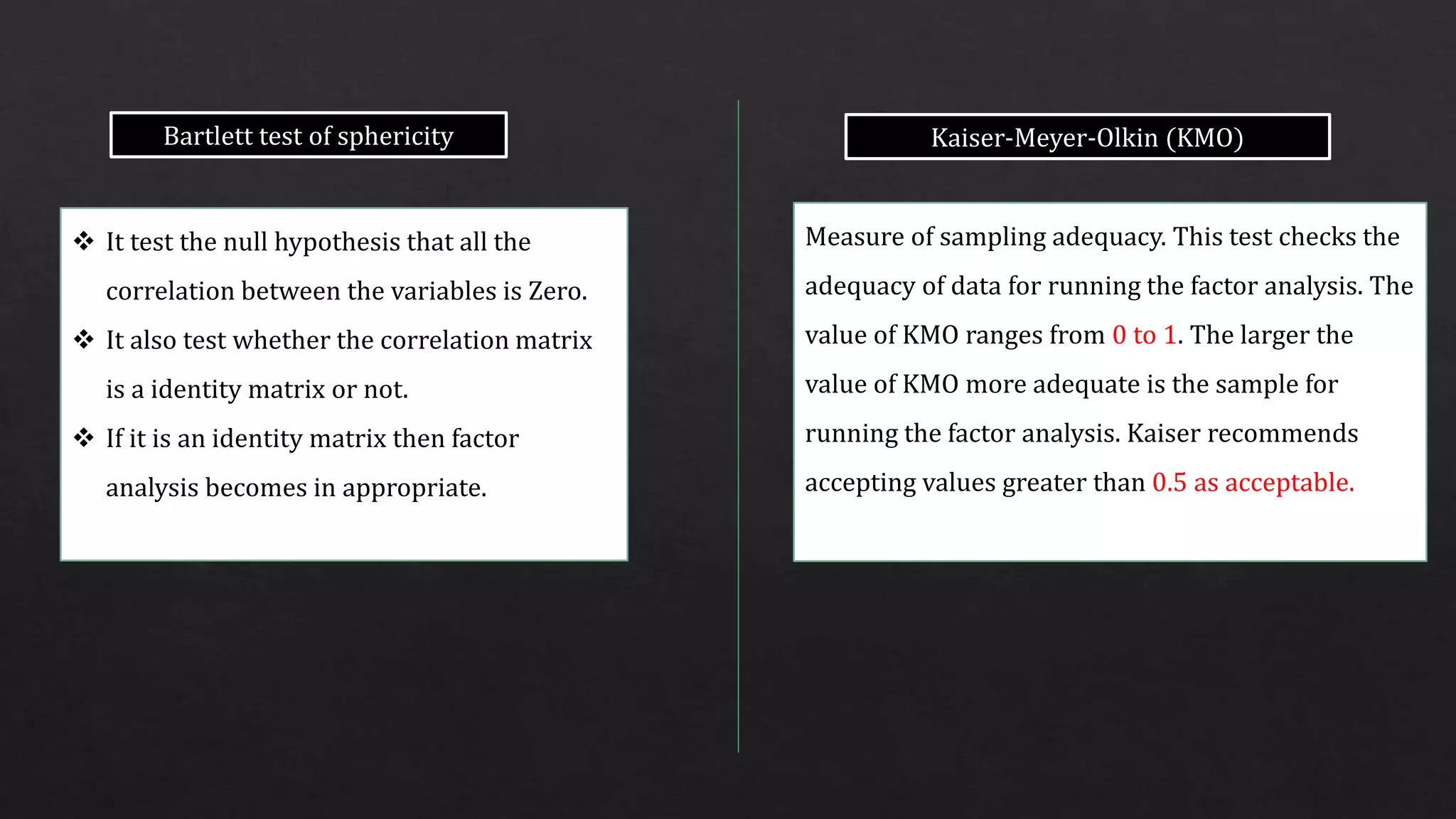
Measure of sampling adequacy. This test checks the
adequacy of data for running the factor analysis. The
value of KMO ranges from 0 to 1. The larger the
value of KMO more adequate is the sample for
running the factor analysis. Kaiser recommends
accepting values greater than 0.5 as acceptable.
Kaiser-Meyer-Olkin (KMO)
 It test the null hypothesis that all the
correlation between the variables is Zero.
 It also test whether the correlation matrix
is a identity matrix or not.
 If it is an identity matrix then factor
analysis becomes in appropriate.
Bartlett test of sphericity
Analyses the pattern of correlations between
variables in the correlation matrixWhich variables tend to correlate highly together?If variables are highly correlated, likely that they
represent the same underlying dimension
Factor analysis pinpoints the clusters of high correlations
between variables and for each cluster, it will assign a factor
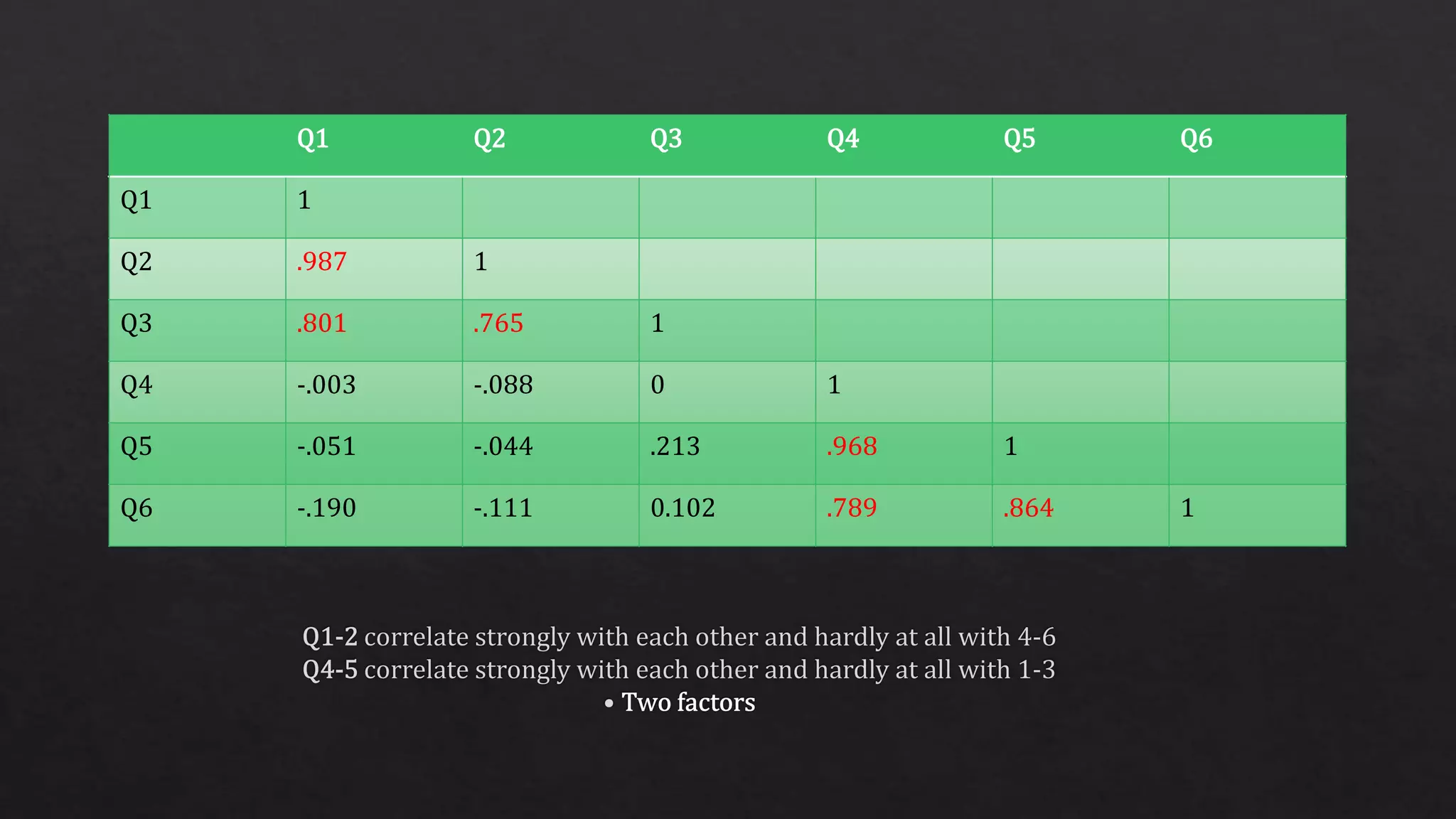
Q1 Q2 Q3 Q4 Q5 Q6
Q1 1
Q2 .987 1
Q3 .801 .765 1
Q4 -.003 -.088 0 1
Q5 -.051 -.044 .213 .968 1
Q6 -.190 -.111 0.102 .789 .864 1
Method of Factor Analysis
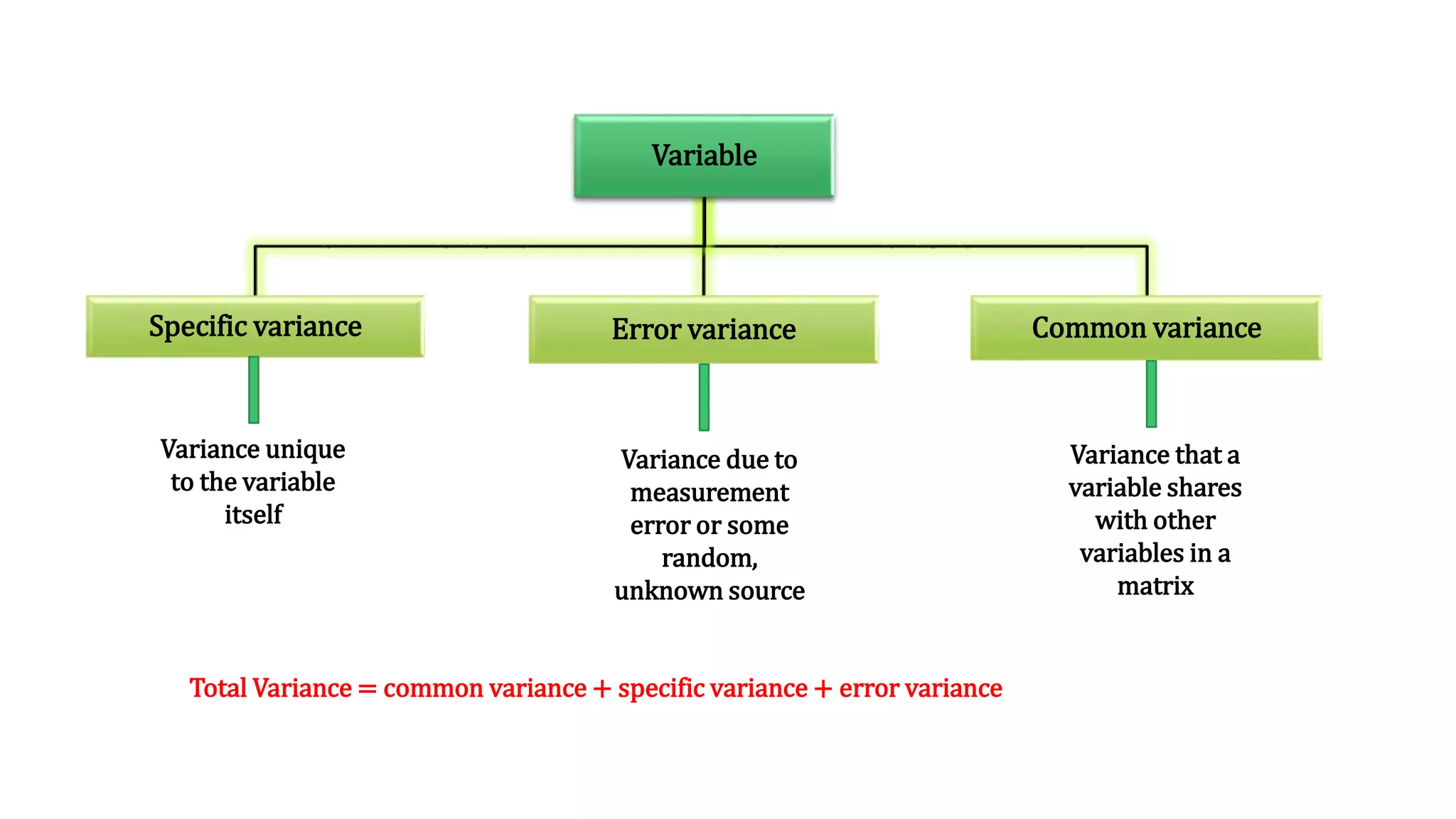
Variable
Specific variance Error variance Common variance
Variance unique
to the variable
itself
Variance due to
measurement
error or some
random,
unknown source
Variance that a
variable shares
with other
variables in a
matrix
Total Variance = common variance + specific variance + error variance
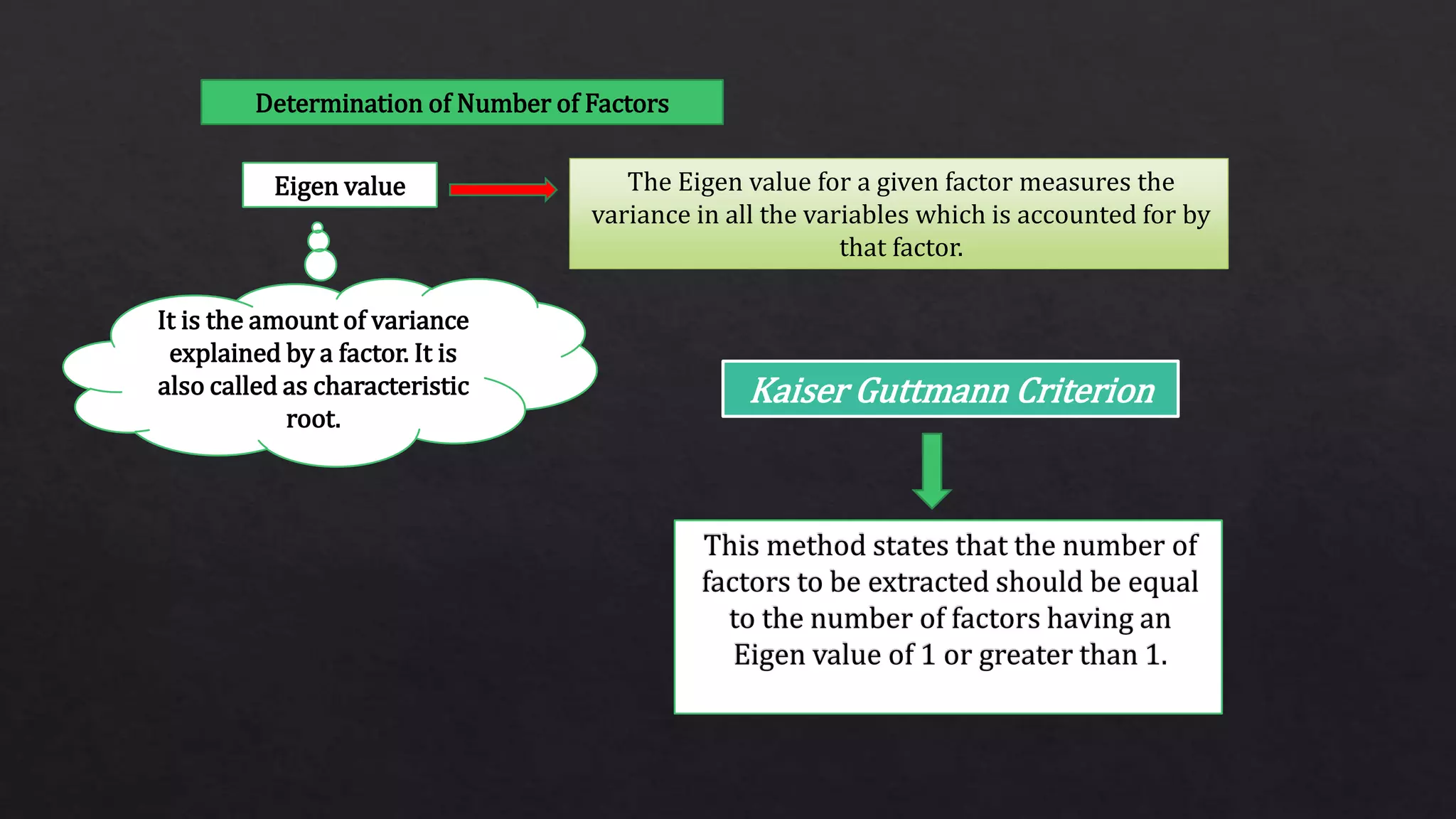
Determination of Number of Factors
Eigen value The Eigen value for a given factor measures the
variance in all the variables which is accounted for by
that factor.
It is the amount of variance
explained by a factor. It is
also called as characteristic
root.
Kaiser Guttmann Criterion
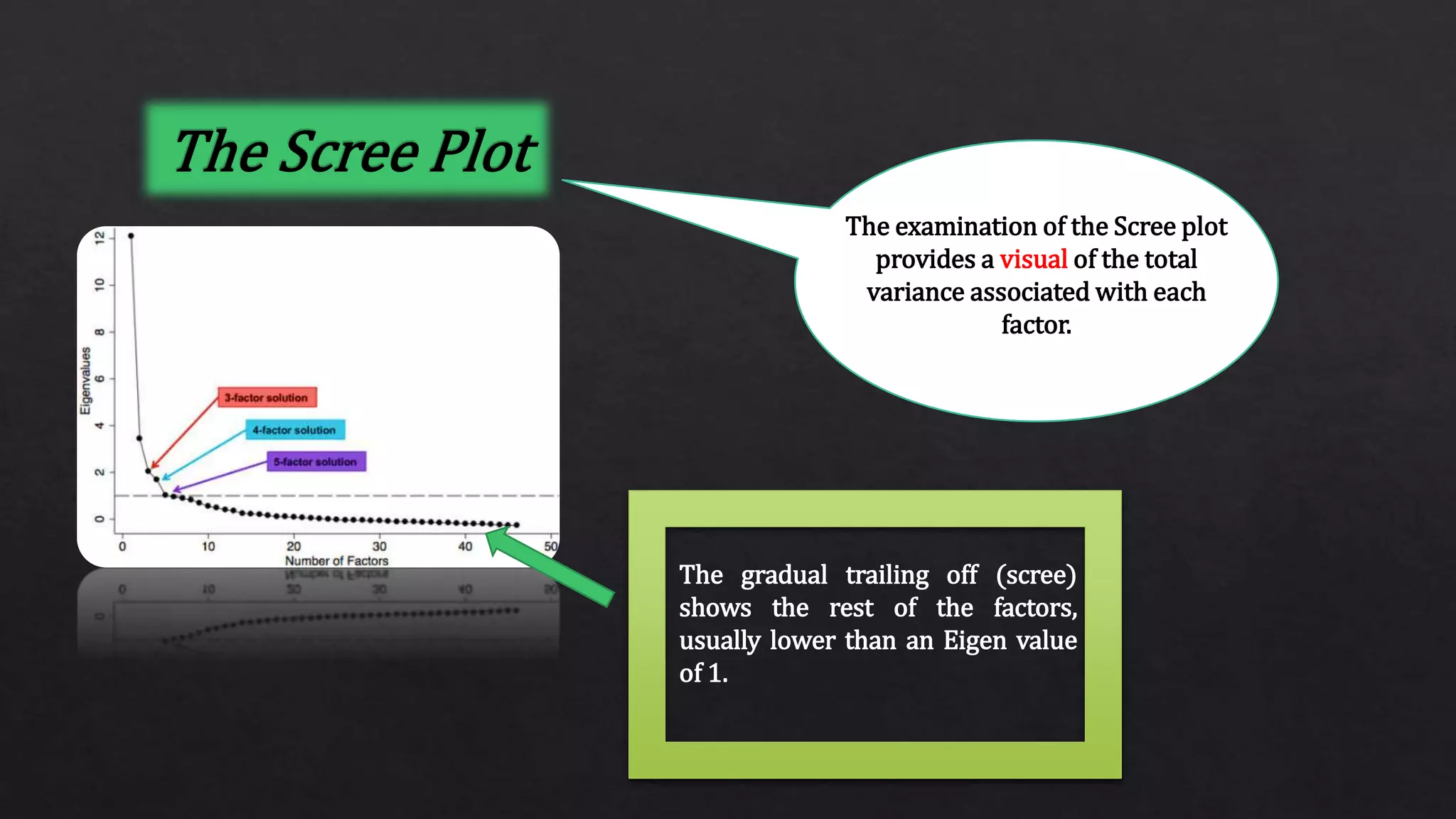
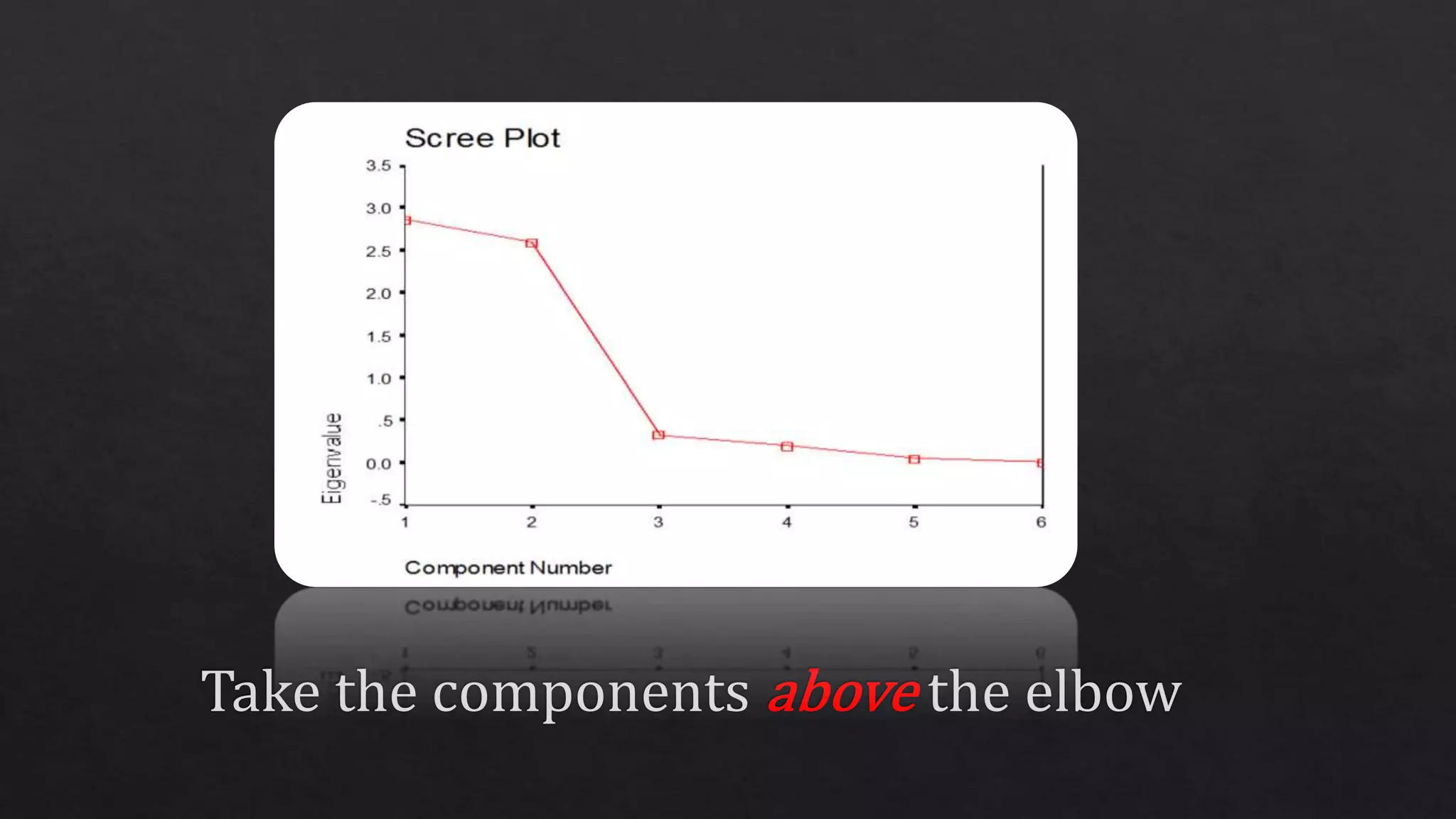
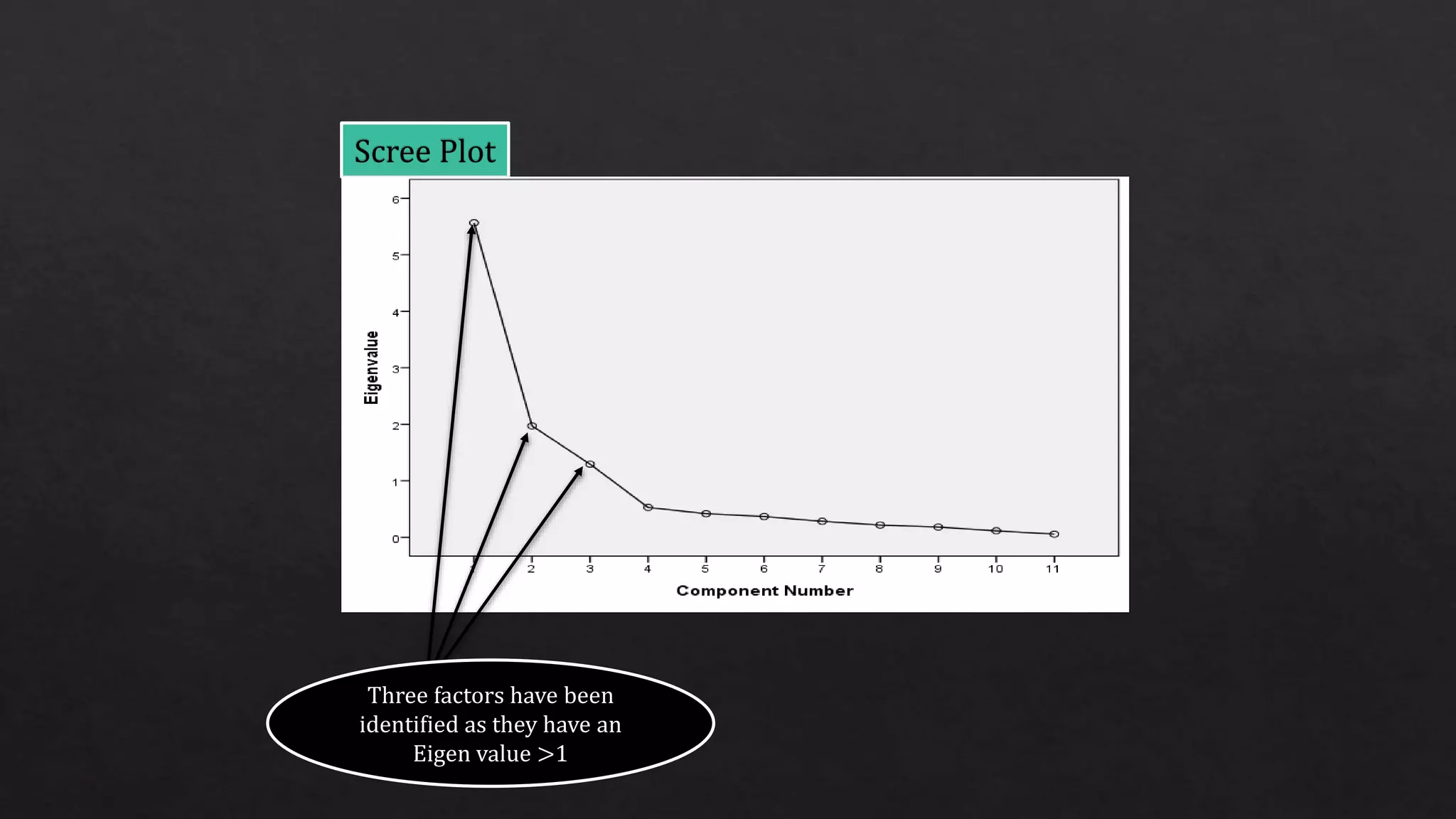
The examination of the Scree plot
provides a visual of the total
variance associated with each
factor.
The gradual trailing off (scree)
shows the rest of the factors,
usually lower than an Eigen value
of 1.
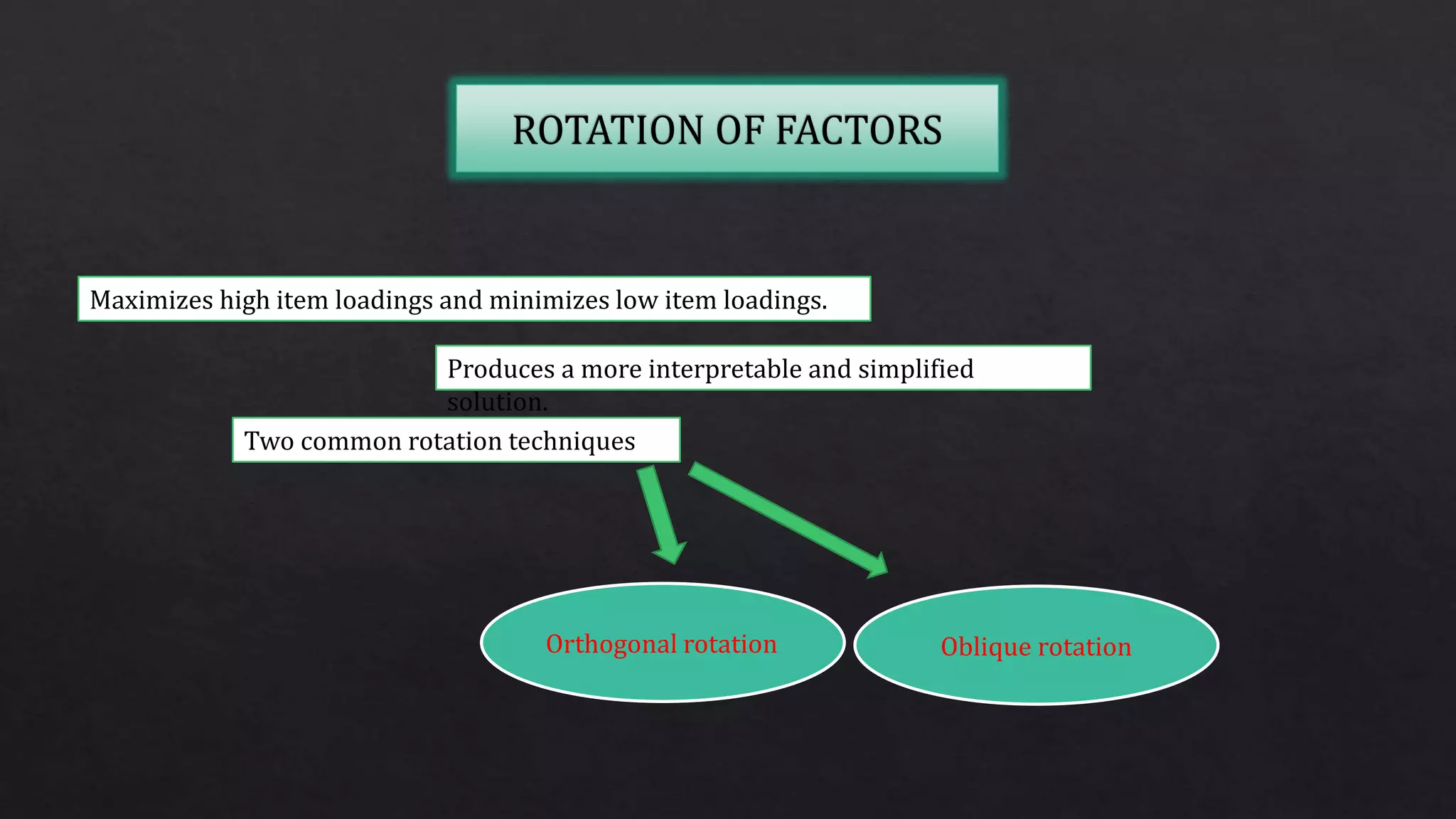
Maximizes high item loadings and minimizes low item loadings.
Produces a more interpretable and simplified
solution.
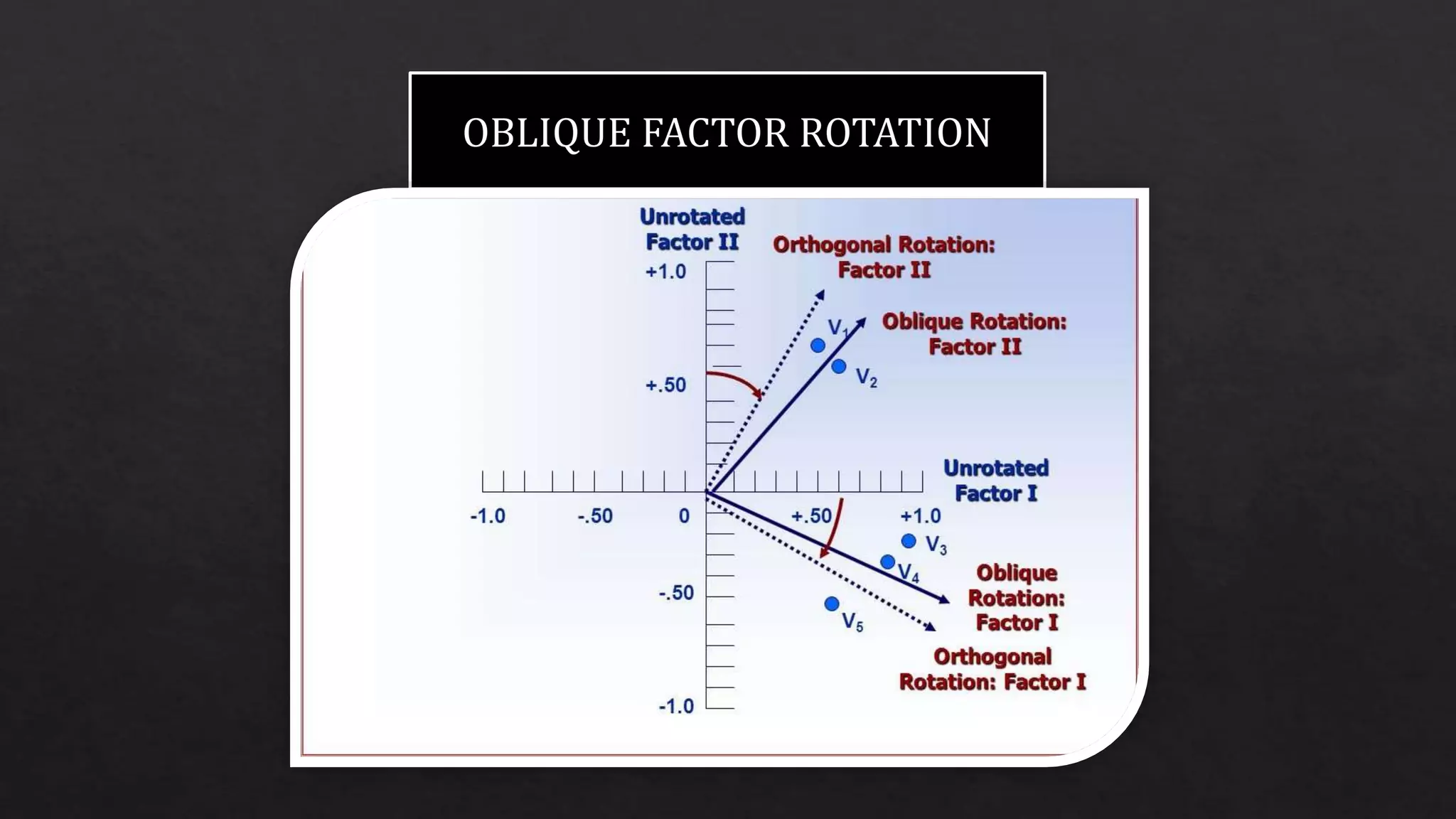
Two common rotation techniques
Orthogonal rotation Oblique rotation
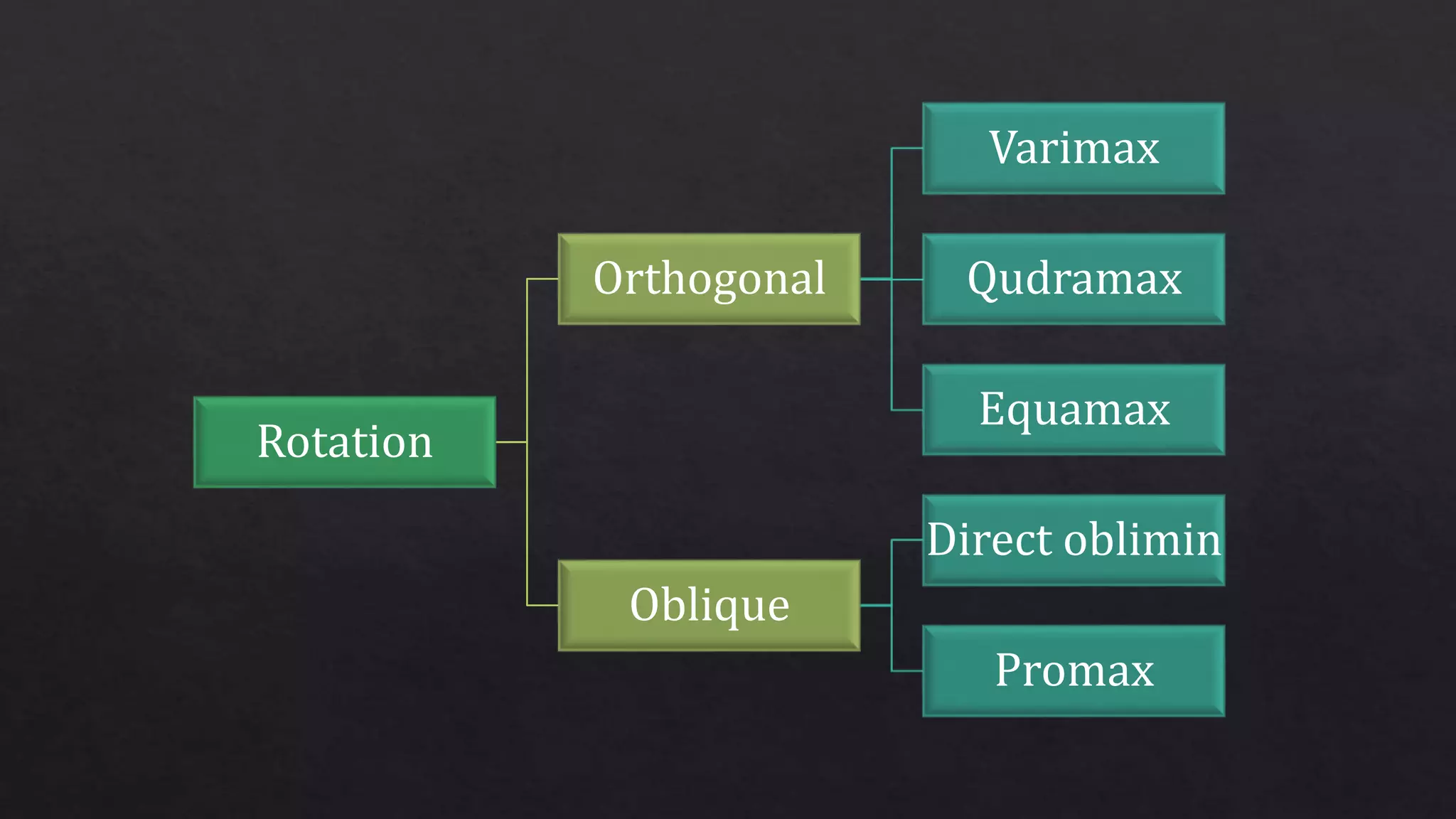
Rotation
Orthogonal
Varimax
Qudramax
Equamax
Oblique
Direct oblimin
Promax
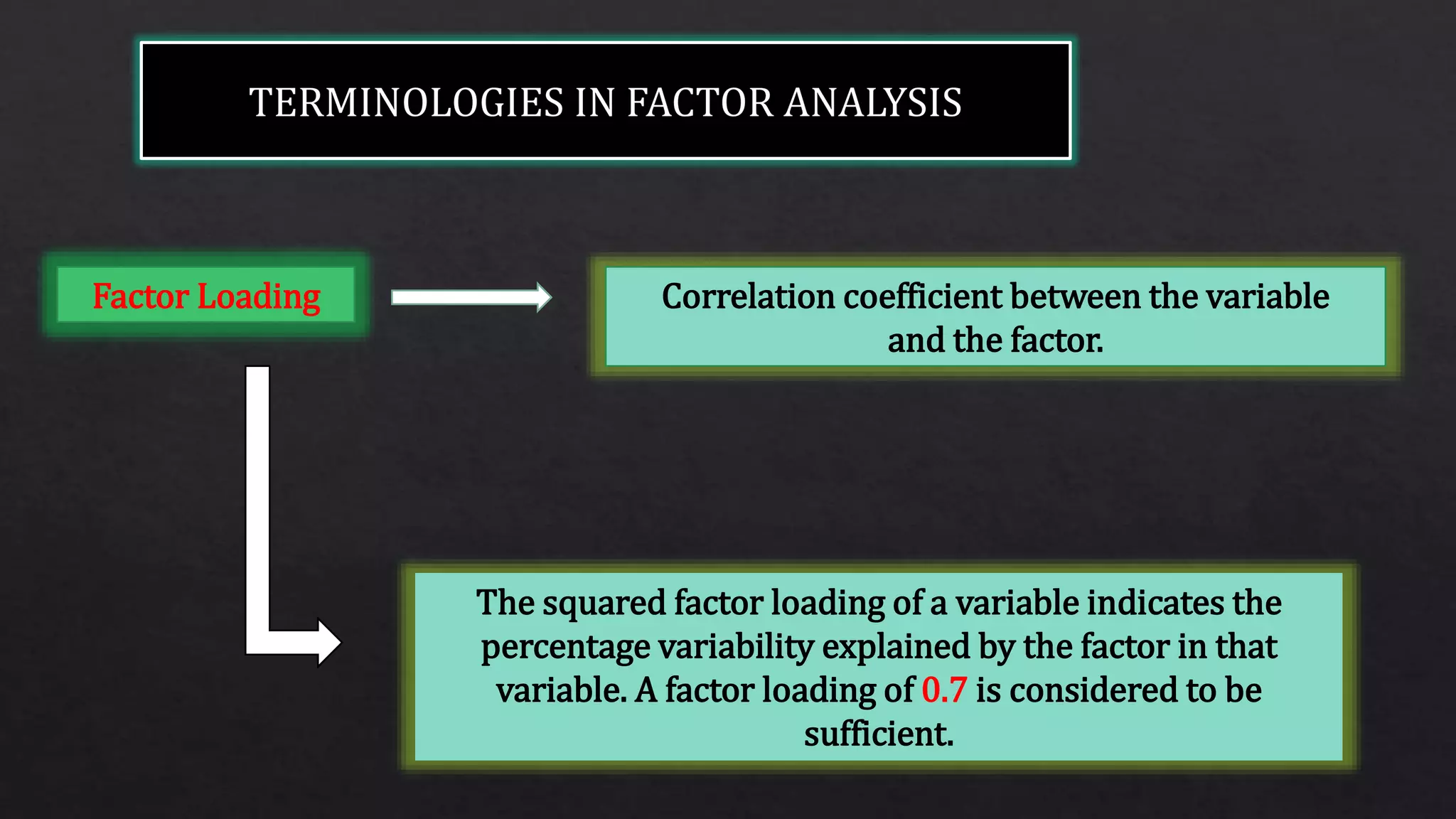
Factor Loading Correlation coefficient between the variable
and the factor.
The squared factor loading of a variable indicates the
percentage variability explained by the factor in that
variable. A factor loading of 0.7 is considered to be
sufficient.
COMMUNALITY
The communality is the amount of variance each variable in the
analysis shares with other variables.
Squared multiple correlation for the variable as dependent using the
factors as predictors and is denoted by h².
The value of communality may be considered as the indicator of
reliability of a variable.
Variables
1
2
1
2
3
1
2
3
4
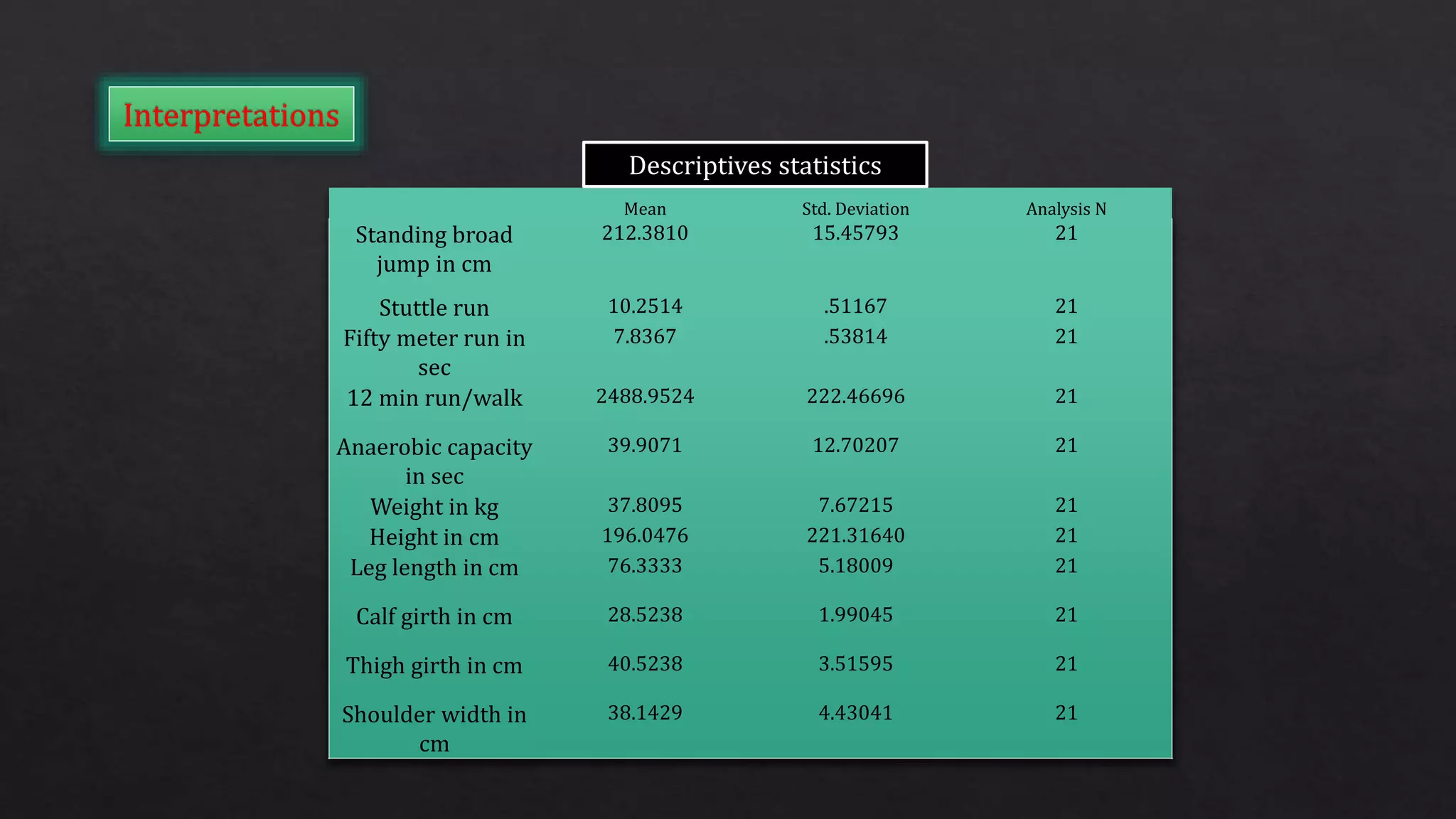
Mean Std. Deviation Analysis N
Standing broad
jump in cm
212.3810 15.45793 21
Stuttle run 10.2514 .51167 21
Fifty meter run in
sec
7.8367 .53814 21
12 min run/walk 2488.9524 222.46696 21
Anaerobic capacity
in sec
39.9071 12.70207 21
Weight in kg 37.8095 7.67215 21
Height in cm 196.0476 221.31640 21
Leg length in cm 76.3333 5.18009 21
Calf girth in cm 28.5238 1.99045 21
Thigh girth in cm 40.5238 3.51595 21
Shoulder width in
cm
38.1429 4.43041 21
Descriptives statistics
SBJ Stuttle run
Fifty
meter run
in sec
12 min
run/walk
Anaerobic
capacity in
sec
Weight in
kg
Height in
cm
Leg length
in cm
Calf girth
in cm
Thigh
girth in cm
Shoulder
width in
cm
correlatio
n
SBJ 1.000
Stuttle run -.651 1.000
Fifty meter
run in sec
-.672 .742 1.000
12 min
run/walk
.539 -.691 -.858 1.000
Anae.cap in
sec
.608 -.709 -.723 .686 1.000
Weight in kg .469 -.087 -.194 -.045 .255 1.000
Height in cm -.089 .262 .081 -.095 -.188 .167 1.000
Leg length in
cm
.513 -.321 -.442 .151 .292 .687 .104 1.000
Calf girth in
cm
.606 -.495 -.534 .366 .602 .577 .078 .739 1.000
Thigh girth
in cm
.584 -.515 -.479 .269 .589 .632 -.137 .646 .773 1.000
Shoulder
width in cm
.455 -.483 -.446 .279 .410 .405 -.506 .322 .377 .451 1.000
Significant at 0.05
Significant at 0.01
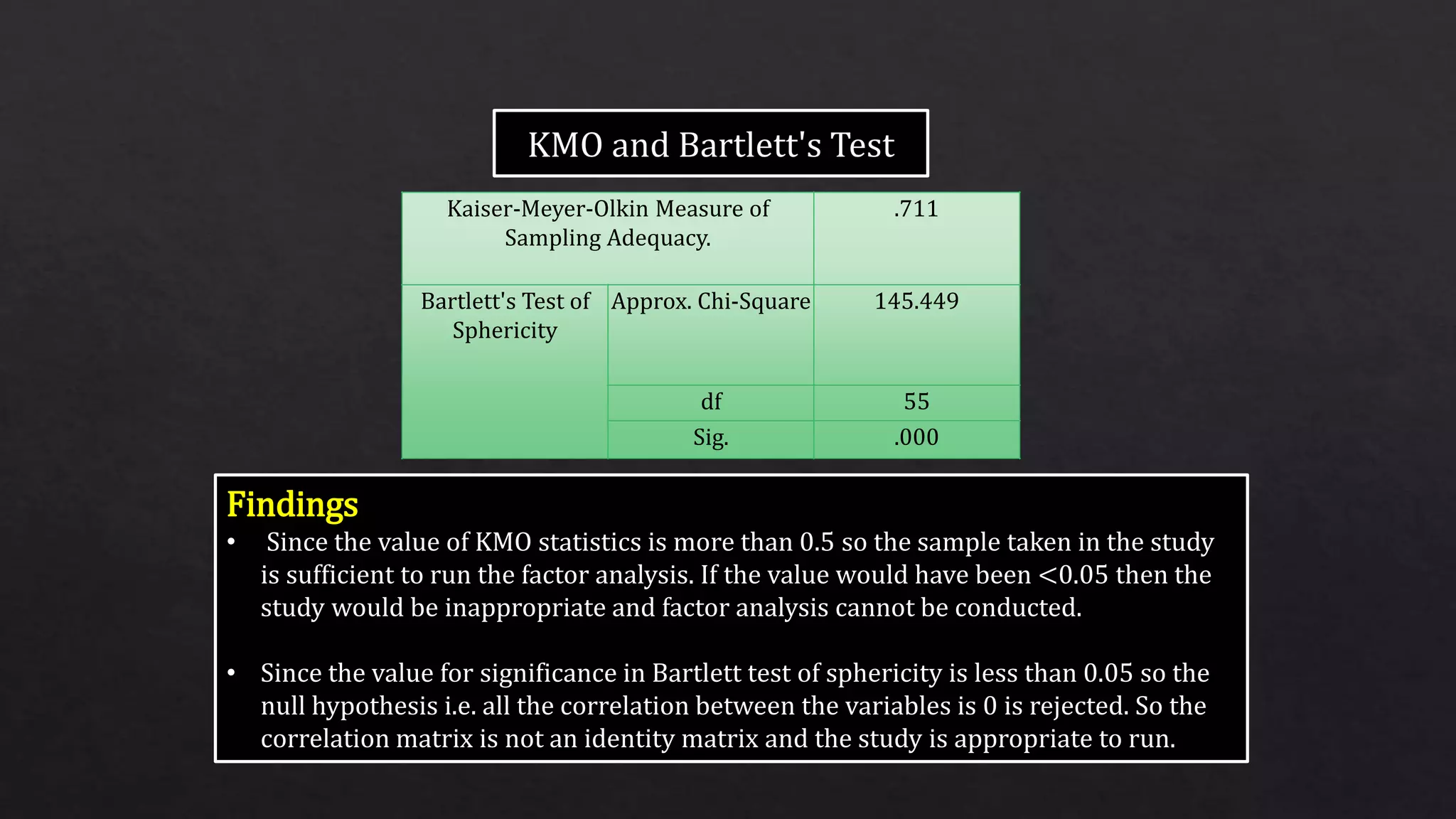
Kaiser-Meyer-Olkin Measure of
Sampling Adequacy.
.711
Bartlett's Test of
Sphericity
Approx. Chi-Square 145.449
df 55
Sig. .000
Findings
• Since the value of KMO statistics is more than 0.5 so the sample taken in the study
is sufficient to run the factor analysis. If the value would have been <0.05 then the
study would be inappropriate and factor analysis cannot be conducted.
• Since the value for significance in Bartlett test of sphericity is less than 0.05 so the
null hypothesis i.e. all the correlation between the variables is 0 is rejected. So the
correlation matrix is not an identity matrix and the study is appropriate to run.
Component
Initial Eigenvalues
Extraction Sums of Squared
Loadings Rotation Sums of Squared Loadings
Total
% of
Variance
Cumulative
% Total
% of
Variance
Cumulative
% Total
% of
Variance
Cumulative
%
1 5.567 50.607 50.607 5.567 50.607 50.607 3.820 34.725 34.725
2 1.972 17.926 68.532 1.972 17.926 68.532 3.415 31.047 65.772
3 1.293 11.758 80.290 1.293 11.758 80.290 1.597 14.519 80.290
4 .529 4.813 85.103
5 .417 3.794 88.898
6 .368 3.347 92.245
7 .283 2.577 94.822
8 .216 1.966 96.788
9 .181 1.644 98.433
10 .116 1.052 99.484
11 .057 .516 100.000
Extraction Method: Principal Component Analysis.
Eigen value above
1
Total variance
explained
Three factors have been
identified as they have an
Eigen value >1
component
1 2 3
Standing broad jump in
cm
.828 .003 .062
Stuttle run -.792 .408 -.032
Fifty meter run in sec -.835 .328 -.253
12 min run/walk .667 -.562 .356
Anaerobic capacity in sec .812 -.279 .104
Weight in kg .538 .725 -.139
Height in cm -.167 .458 .803
Leg length in cm .669 .570 .027
Calf girth in cm .814 .358 .109
Thigh girth in cm .800 .329 -.153
Shoulder width in cm .621 -.087 -.622
extraction method: principal component analysis.
A. 3 components extracted.
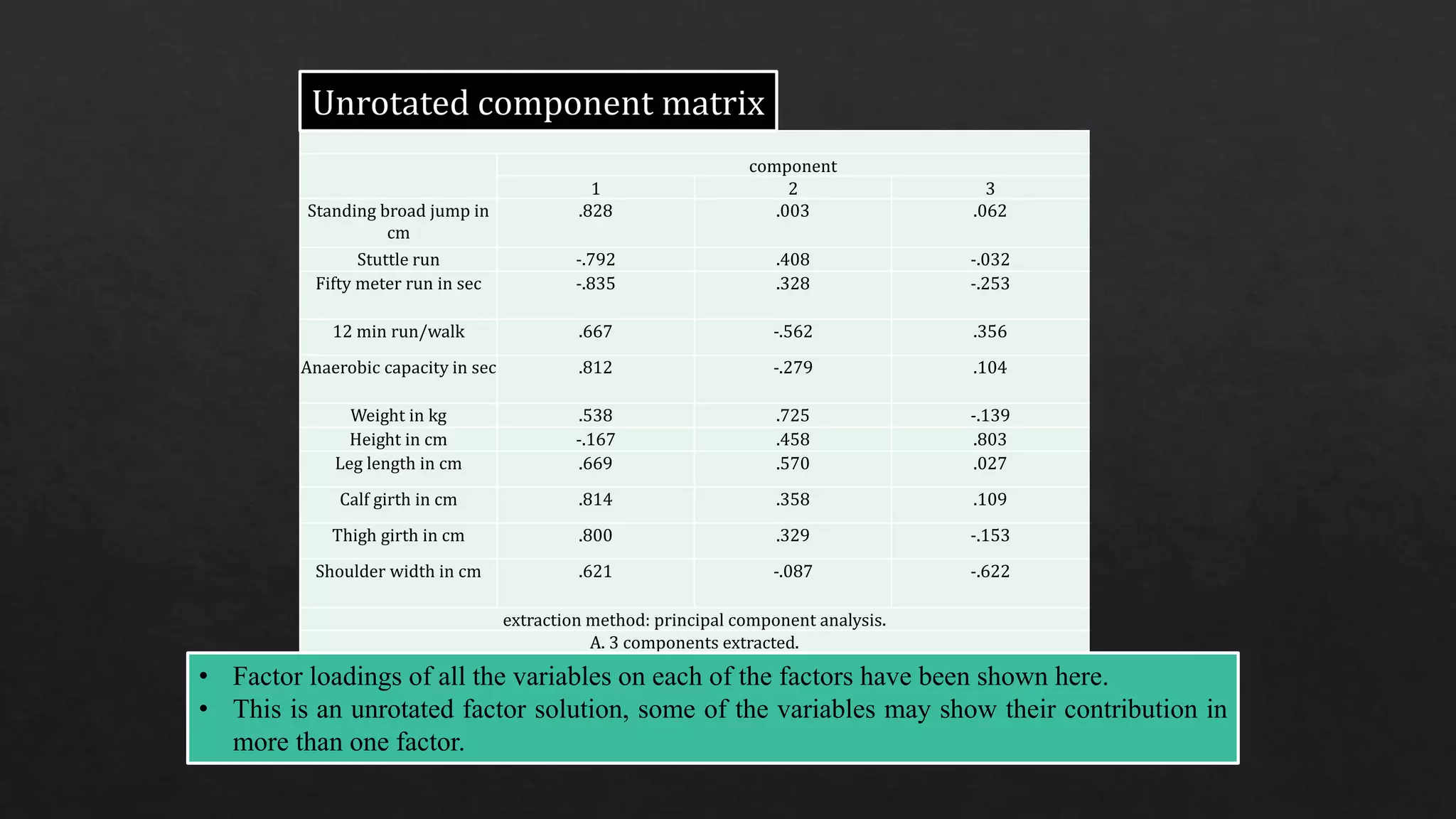
• Factor loadings of all the variables on each of the factors have been shown here.
• This is an unrotated factor solution, some of the variables may show their contribution in
more than one factor.
component
1 2 3
Standing broad jump in cm .631 .523 -.137
Stuttle run -.824 -.187 .284
Fifty meter run in sec -.894 -.255 .066
12 min run/walk .941 -.042 -.005
Anaerobic capacity in sec .793 .292 -.182
Weight in kg -.064 .910 -.029
Height in cm -.077 .167 .921
Leg length in cm .183 .859 .044
Calf girth in cm .439 .780 .020
Thigh girth in cm .346 .775 -.227
Shoulder width in cm .270 -.746 .388
Extraction method: principal component analysis.
Rotation method: varimax with kaiser normalization.
A. Rotation converged in 4 iterations.
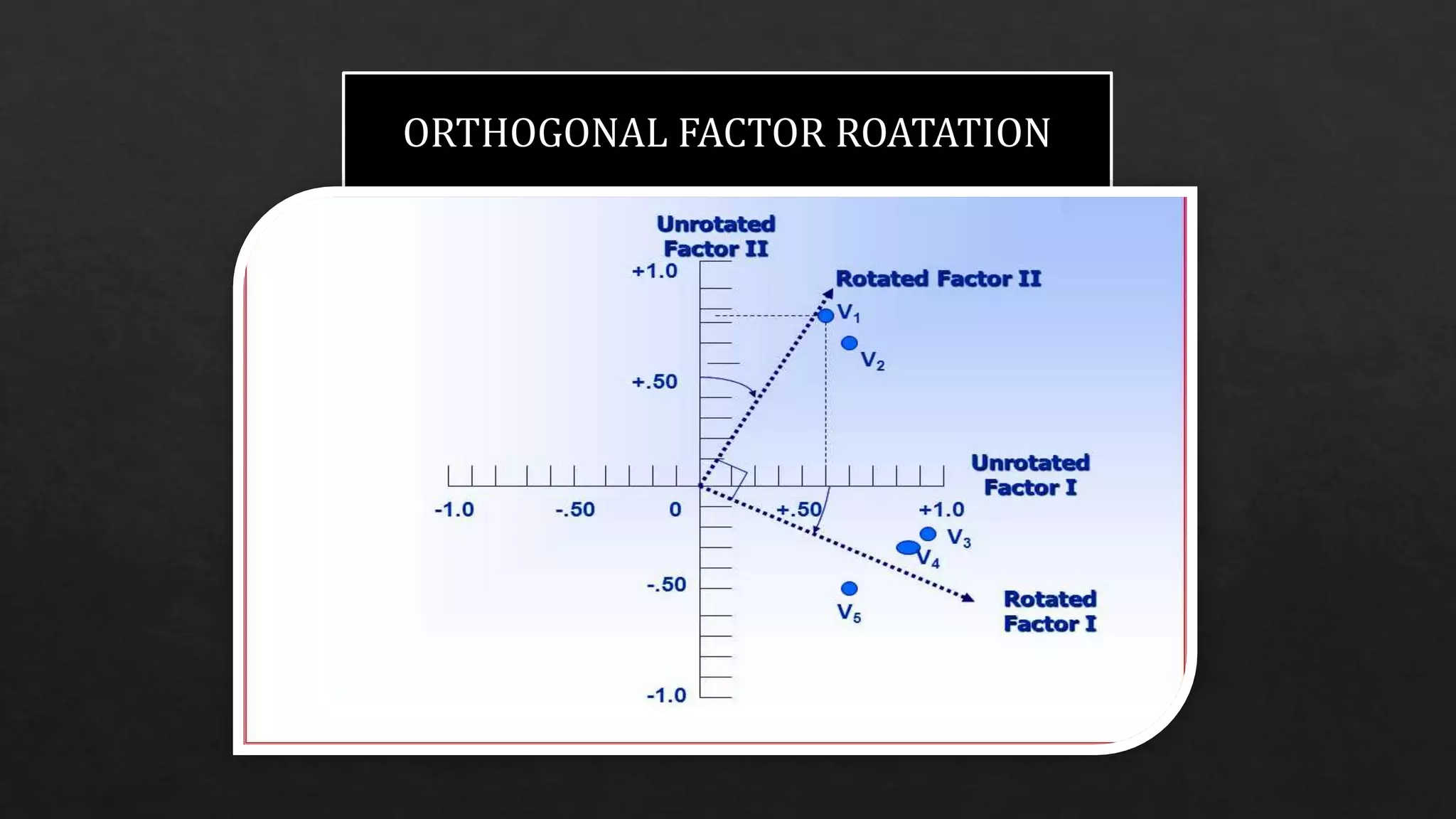
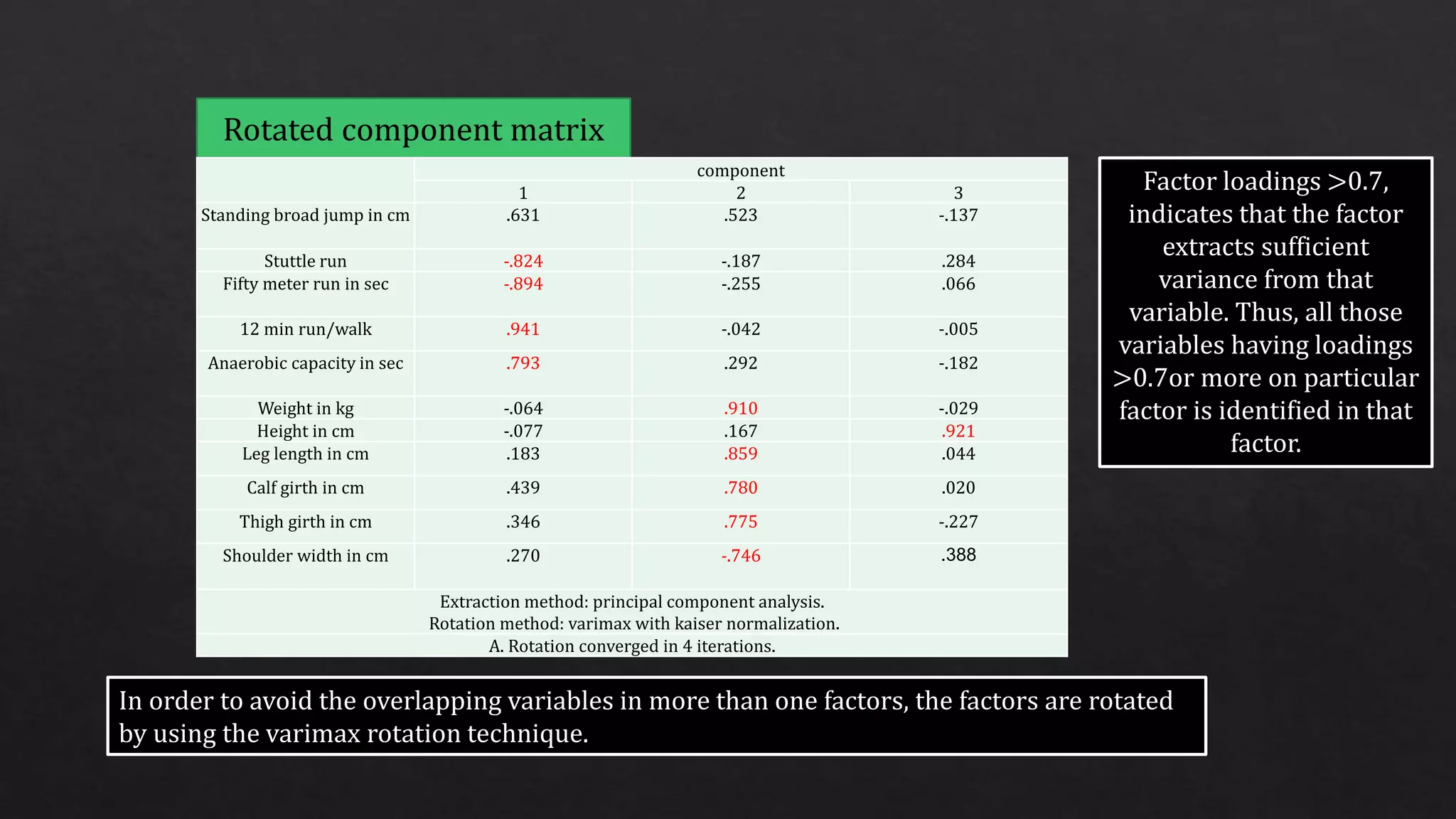
In order to avoid the overlapping variables in more than one factors, the factors are rotated
by using the varimax rotation technique.
Factor loadings >0.7,
indicates that the factor
extracts sufficient
variance from that
variable. Thus, all those
variables having loadings
>0.7or more on particular
factor is identified in that
factor.
Anthropometric Loadings
Weight in kg
.910
Leg length in cm
.859
Calf girth in cm
.780
Thigh girth in cm
.775
Shoulder width in cm
-.746
Physical Loadings
Stuttle run -.824
Fifty meter run in sec -.894
12 min run/walk .941
Anaerobic capacity in sec .793
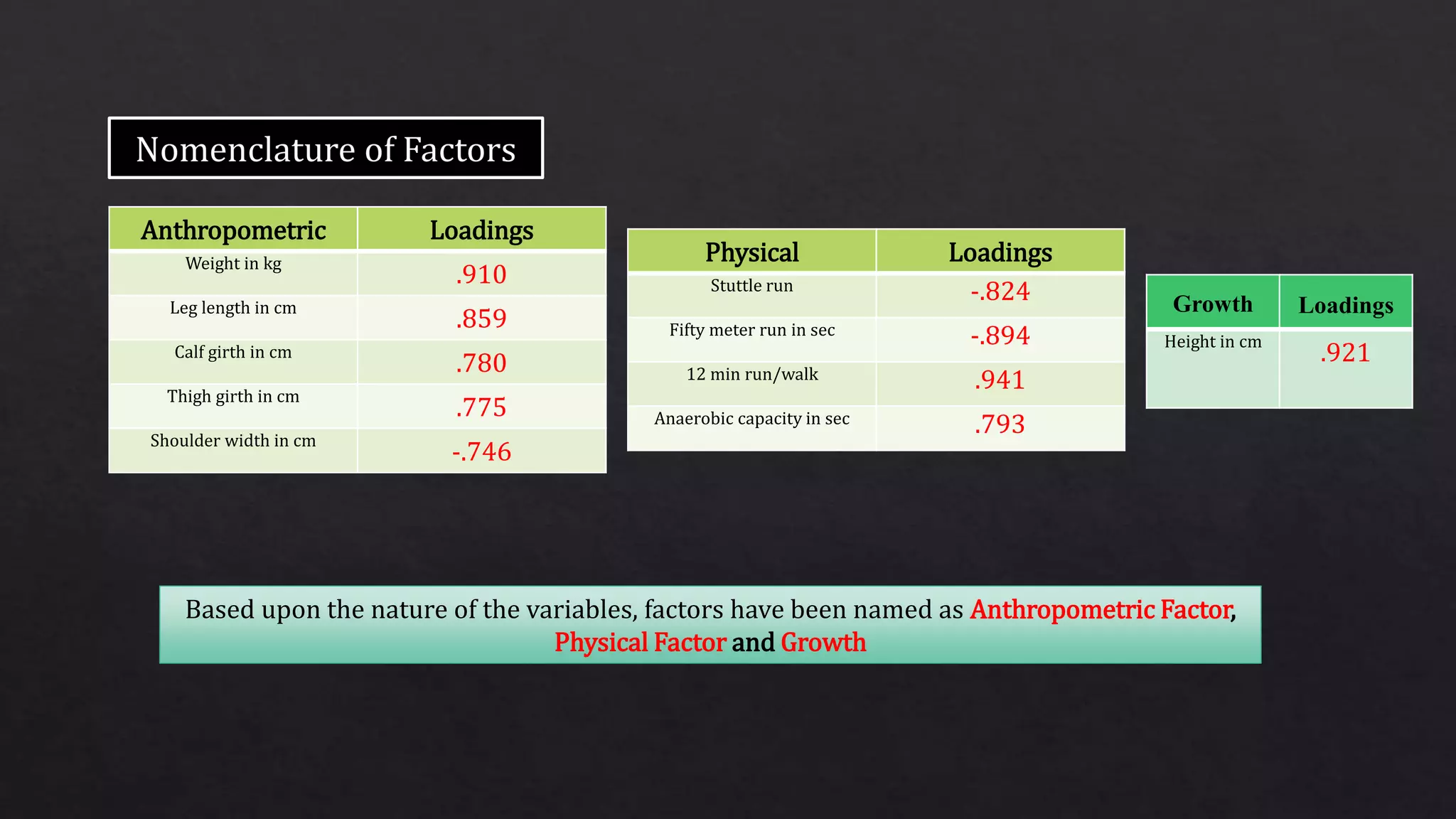
Based upon the nature of the variables, factors have been named as Anthropometric Factor,
Physical Factor and Growth
Growth Loadings
Height in cm
.921
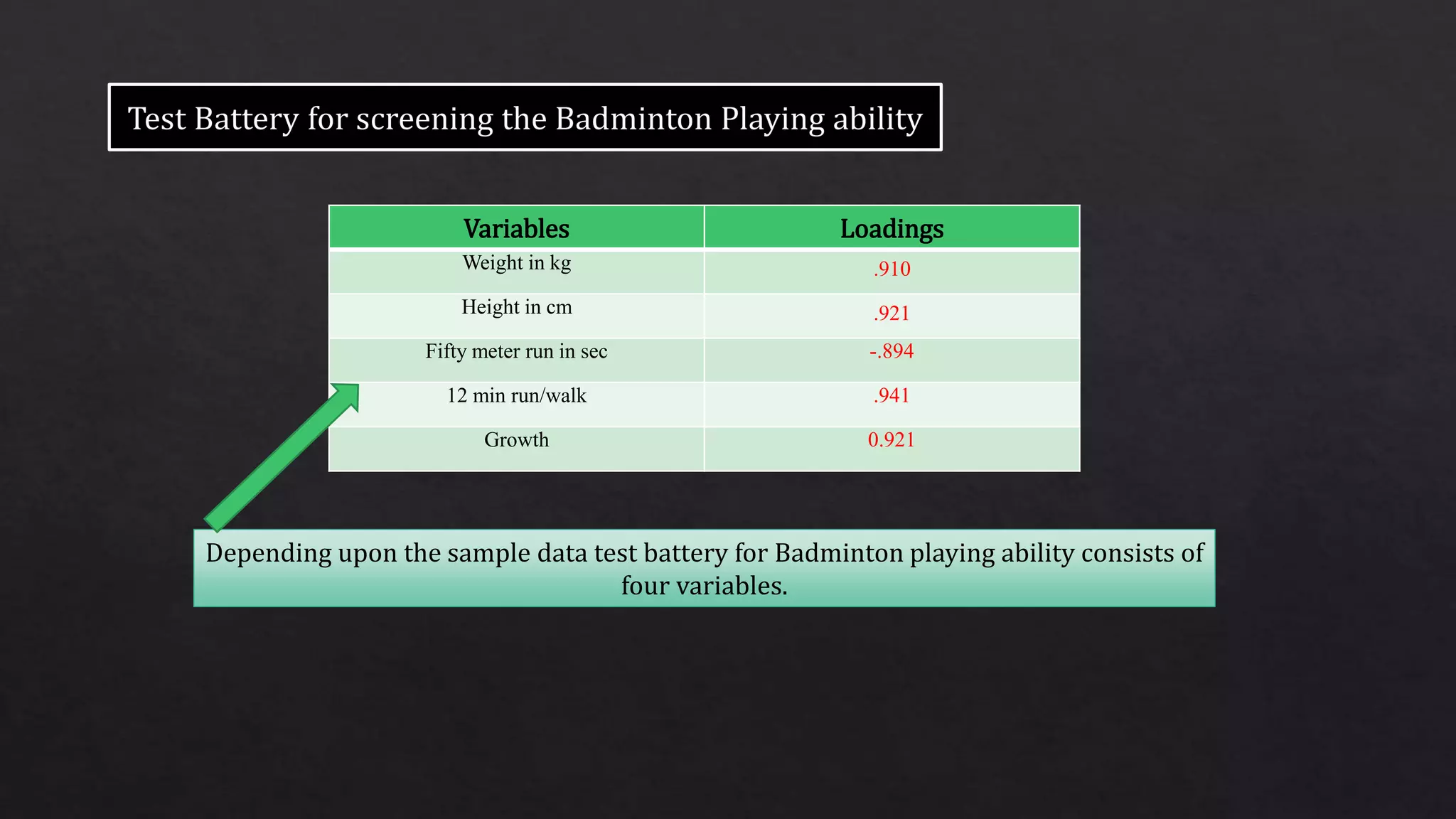
Variables Loadings
Weight in kg .910
Height in cm .921
Fifty meter run in sec -.894
12 min run/walk .941
Growth 0.921
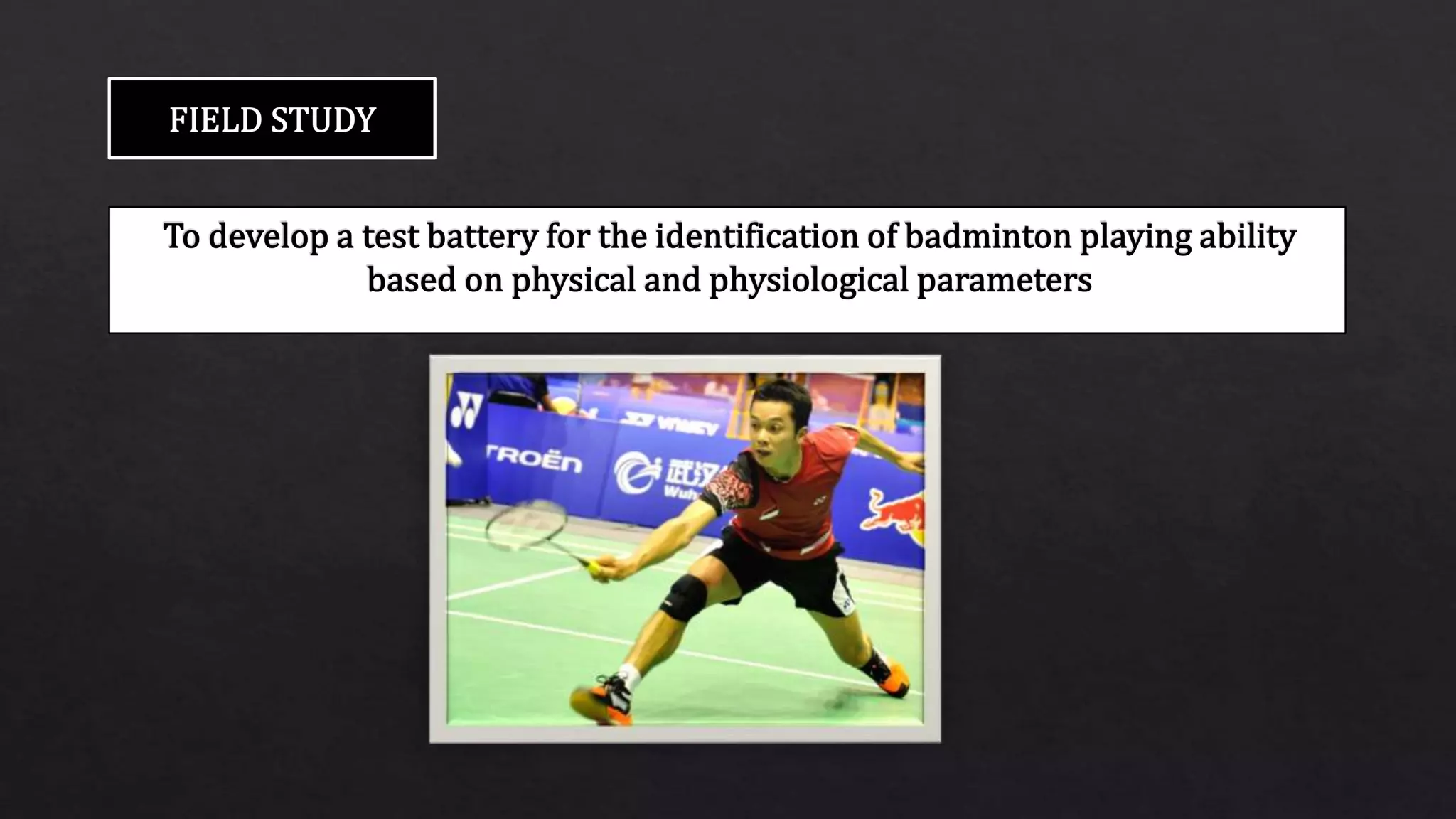
Depending upon the sample data test battery for Badminton playing ability consists of
four variables.

Exploratory factor analysis

  • 3.
    FACTOR ANALYSIS Adata reduction technique wide range of attributes on a smaller number of dimensions designed to represent
  • 7.
    Path diagram fora Factor Analysis Model Y1, Y2, Y3, Y4 & Y5 are observed variables Errors
  • 8.
  • 10.
    No outliers inthe data set. Normality of the data set. Multi collinearity and singularity among the variables does not exist. Homoscedasticity does not exist between the variables because factor analysis is a linear function of measured variables. Variables should be linear in nature. Data should be metric in nature i.e. on interval and ratio scale.
  • 11.
    Measure of samplingadequacy. This test checks the adequacy of data for running the factor analysis. The value of KMO ranges from 0 to 1. The larger the value of KMO more adequate is the sample for running the factor analysis. Kaiser recommends accepting values greater than 0.5 as acceptable. Kaiser-Meyer-Olkin (KMO)  It test the null hypothesis that all the correlation between the variables is Zero.  It also test whether the correlation matrix is a identity matrix or not.  If it is an identity matrix then factor analysis becomes in appropriate. Bartlett test of sphericity
  • 12.
    Analyses the patternof correlations between variables in the correlation matrixWhich variables tend to correlate highly together?If variables are highly correlated, likely that they represent the same underlying dimension Factor analysis pinpoints the clusters of high correlations between variables and for each cluster, it will assign a factor
  • 13.
    Q1 Q2 Q3Q4 Q5 Q6 Q1 1 Q2 .987 1 Q3 .801 .765 1 Q4 -.003 -.088 0 1 Q5 -.051 -.044 .213 .968 1 Q6 -.190 -.111 0.102 .789 .864 1
  • 14.
  • 16.
    Variable Specific variance Errorvariance Common variance Variance unique to the variable itself Variance due to measurement error or some random, unknown source Variance that a variable shares with other variables in a matrix Total Variance = common variance + specific variance + error variance
  • 17.
    Determination of Numberof Factors Eigen value The Eigen value for a given factor measures the variance in all the variables which is accounted for by that factor. It is the amount of variance explained by a factor. It is also called as characteristic root. Kaiser Guttmann Criterion
  • 18.
    The examination ofthe Scree plot provides a visual of the total variance associated with each factor. The gradual trailing off (scree) shows the rest of the factors, usually lower than an Eigen value of 1.
  • 20.
    Maximizes high itemloadings and minimizes low item loadings. Produces a more interpretable and simplified solution. Two common rotation techniques Orthogonal rotation Oblique rotation
  • 21.
  • 24.
    Factor Loading Correlationcoefficient between the variable and the factor. The squared factor loading of a variable indicates the percentage variability explained by the factor in that variable. A factor loading of 0.7 is considered to be sufficient.
  • 25.
    COMMUNALITY The communality isthe amount of variance each variable in the analysis shares with other variables. Squared multiple correlation for the variable as dependent using the factors as predictors and is denoted by h². The value of communality may be considered as the indicator of reliability of a variable.
  • 31.
  • 32.
  • 33.
  • 34.
  • 35.
    Mean Std. DeviationAnalysis N Standing broad jump in cm 212.3810 15.45793 21 Stuttle run 10.2514 .51167 21 Fifty meter run in sec 7.8367 .53814 21 12 min run/walk 2488.9524 222.46696 21 Anaerobic capacity in sec 39.9071 12.70207 21 Weight in kg 37.8095 7.67215 21 Height in cm 196.0476 221.31640 21 Leg length in cm 76.3333 5.18009 21 Calf girth in cm 28.5238 1.99045 21 Thigh girth in cm 40.5238 3.51595 21 Shoulder width in cm 38.1429 4.43041 21 Descriptives statistics
  • 36.
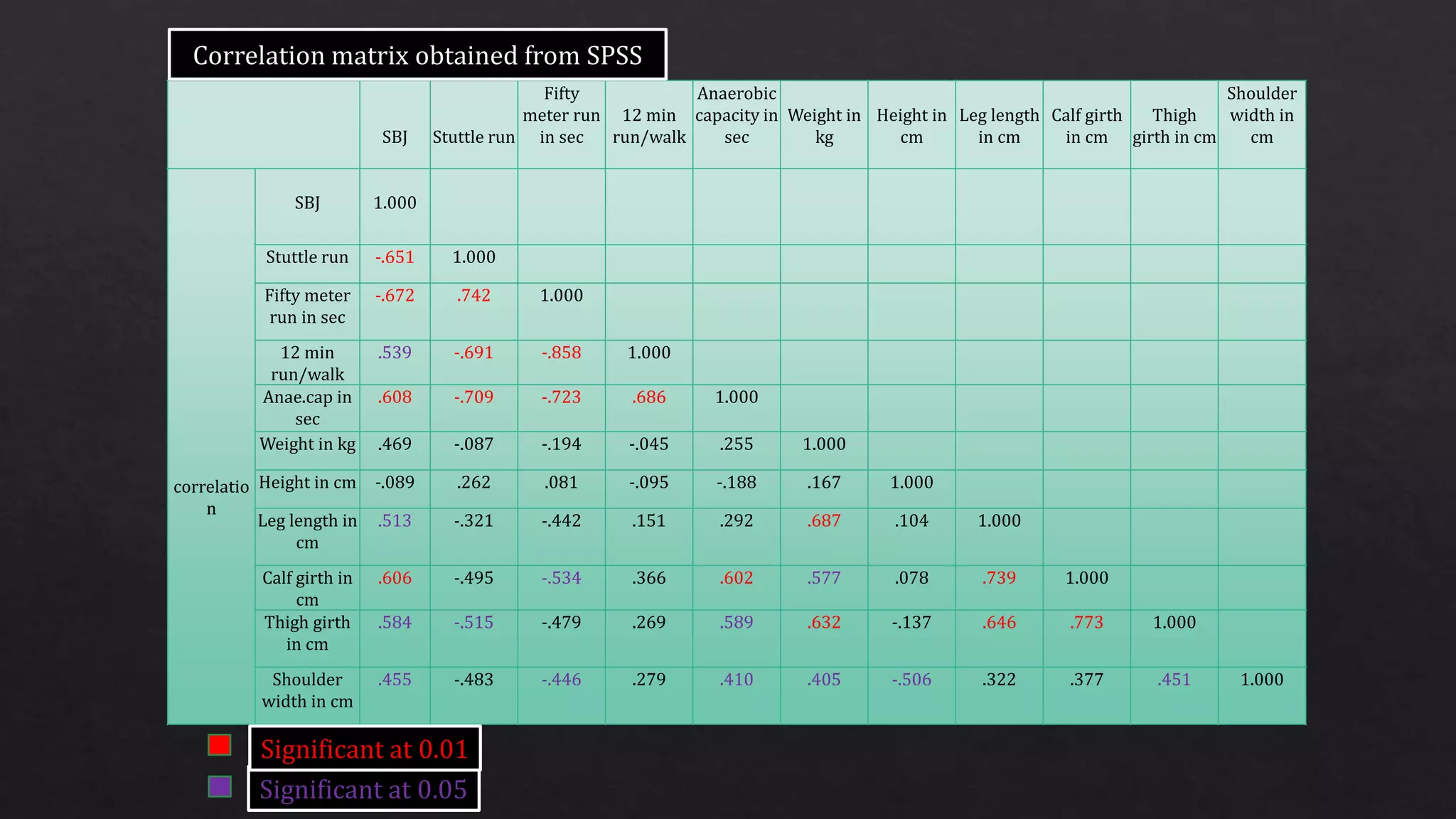
    SBJ Stuttle run Fifty meterrun in sec 12 min run/walk Anaerobic capacity in sec Weight in kg Height in cm Leg length in cm Calf girth in cm Thigh girth in cm Shoulder width in cm correlatio n SBJ 1.000 Stuttle run -.651 1.000 Fifty meter run in sec -.672 .742 1.000 12 min run/walk .539 -.691 -.858 1.000 Anae.cap in sec .608 -.709 -.723 .686 1.000 Weight in kg .469 -.087 -.194 -.045 .255 1.000 Height in cm -.089 .262 .081 -.095 -.188 .167 1.000 Leg length in cm .513 -.321 -.442 .151 .292 .687 .104 1.000 Calf girth in cm .606 -.495 -.534 .366 .602 .577 .078 .739 1.000 Thigh girth in cm .584 -.515 -.479 .269 .589 .632 -.137 .646 .773 1.000 Shoulder width in cm .455 -.483 -.446 .279 .410 .405 -.506 .322 .377 .451 1.000 Significant at 0.05 Significant at 0.01
  • 37.
    Kaiser-Meyer-Olkin Measure of SamplingAdequacy. .711 Bartlett's Test of Sphericity Approx. Chi-Square 145.449 df 55 Sig. .000 Findings • Since the value of KMO statistics is more than 0.5 so the sample taken in the study is sufficient to run the factor analysis. If the value would have been <0.05 then the study would be inappropriate and factor analysis cannot be conducted. • Since the value for significance in Bartlett test of sphericity is less than 0.05 so the null hypothesis i.e. all the correlation between the variables is 0 is rejected. So the correlation matrix is not an identity matrix and the study is appropriate to run.
  • 38.
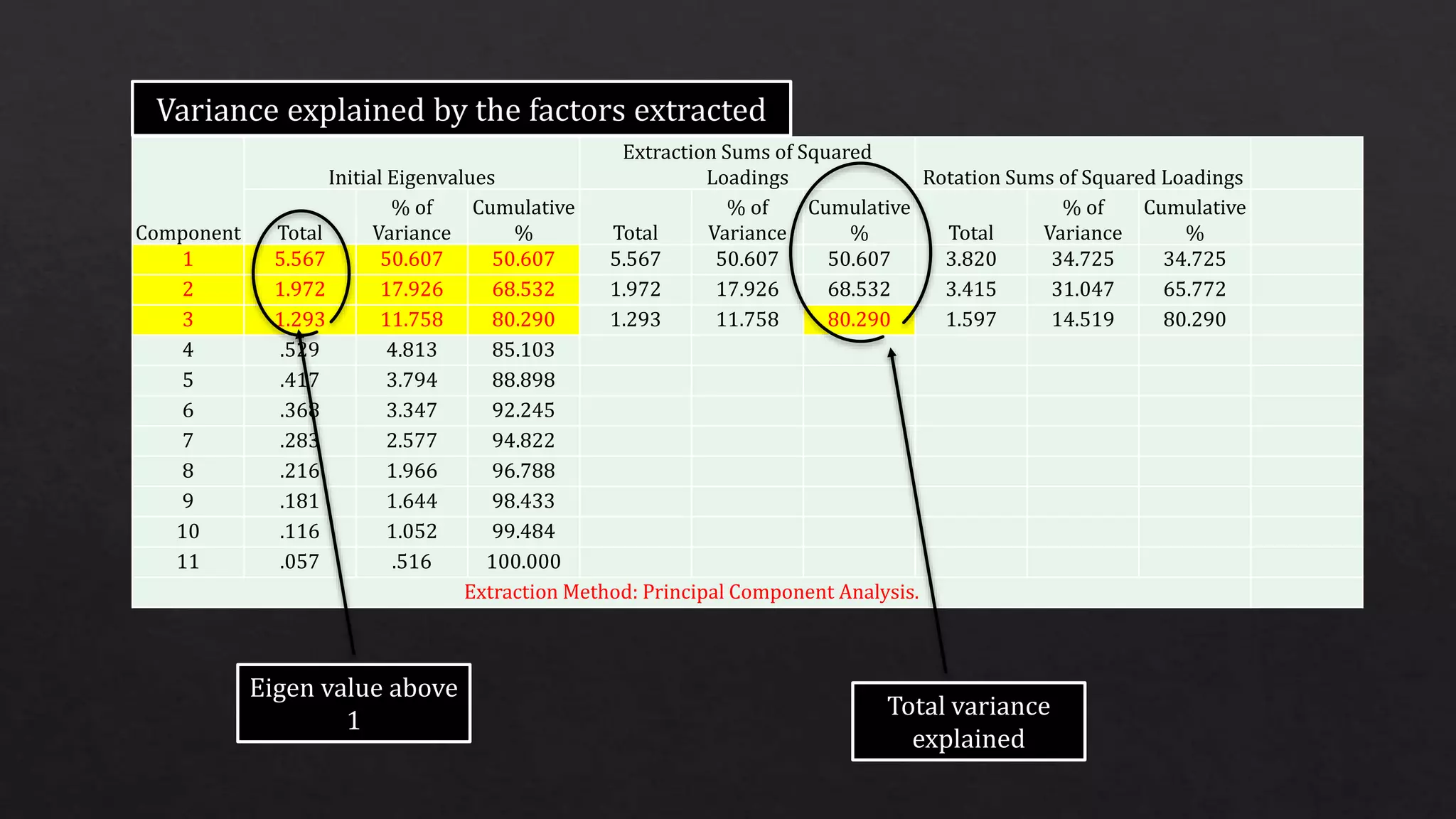
    Component Initial Eigenvalues Extraction Sumsof Squared Loadings Rotation Sums of Squared Loadings Total % of Variance Cumulative % Total % of Variance Cumulative % Total % of Variance Cumulative % 1 5.567 50.607 50.607 5.567 50.607 50.607 3.820 34.725 34.725 2 1.972 17.926 68.532 1.972 17.926 68.532 3.415 31.047 65.772 3 1.293 11.758 80.290 1.293 11.758 80.290 1.597 14.519 80.290 4 .529 4.813 85.103 5 .417 3.794 88.898 6 .368 3.347 92.245 7 .283 2.577 94.822 8 .216 1.966 96.788 9 .181 1.644 98.433 10 .116 1.052 99.484 11 .057 .516 100.000 Extraction Method: Principal Component Analysis. Eigen value above 1 Total variance explained
  • 39.
    Three factors havebeen identified as they have an Eigen value >1
  • 40.
    component 1 2 3 Standingbroad jump in cm .828 .003 .062 Stuttle run -.792 .408 -.032 Fifty meter run in sec -.835 .328 -.253 12 min run/walk .667 -.562 .356 Anaerobic capacity in sec .812 -.279 .104 Weight in kg .538 .725 -.139 Height in cm -.167 .458 .803 Leg length in cm .669 .570 .027 Calf girth in cm .814 .358 .109 Thigh girth in cm .800 .329 -.153 Shoulder width in cm .621 -.087 -.622 extraction method: principal component analysis. A. 3 components extracted. • Factor loadings of all the variables on each of the factors have been shown here. • This is an unrotated factor solution, some of the variables may show their contribution in more than one factor.
  • 41.
    component 1 2 3 Standingbroad jump in cm .631 .523 -.137 Stuttle run -.824 -.187 .284 Fifty meter run in sec -.894 -.255 .066 12 min run/walk .941 -.042 -.005 Anaerobic capacity in sec .793 .292 -.182 Weight in kg -.064 .910 -.029 Height in cm -.077 .167 .921 Leg length in cm .183 .859 .044 Calf girth in cm .439 .780 .020 Thigh girth in cm .346 .775 -.227 Shoulder width in cm .270 -.746 .388 Extraction method: principal component analysis. Rotation method: varimax with kaiser normalization. A. Rotation converged in 4 iterations. In order to avoid the overlapping variables in more than one factors, the factors are rotated by using the varimax rotation technique. Factor loadings >0.7, indicates that the factor extracts sufficient variance from that variable. Thus, all those variables having loadings >0.7or more on particular factor is identified in that factor.
  • 42.
    Anthropometric Loadings Weight inkg .910 Leg length in cm .859 Calf girth in cm .780 Thigh girth in cm .775 Shoulder width in cm -.746 Physical Loadings Stuttle run -.824 Fifty meter run in sec -.894 12 min run/walk .941 Anaerobic capacity in sec .793 Based upon the nature of the variables, factors have been named as Anthropometric Factor, Physical Factor and Growth Growth Loadings Height in cm .921
  • 43.
    Variables Loadings Weight inkg .910 Height in cm .921 Fifty meter run in sec -.894 12 min run/walk .941 Growth 0.921 Depending upon the sample data test battery for Badminton playing ability consists of four variables.