Exploratory Facebook Social
Network Analysis
with Gephi

Thomas Plotkowiak
twitterresearcher.wordpress.com
Process

1. Import Data with Netviz
2. Gephi

   1.   Open                    7.    Labels
   2.   Layout                  8.    Community detection
   3.   Ranking (Degree)        9.    Filter
   4.   Statistics              10.   Label Adjust
   5.   Ranking (Betweenness)   11.   Preview
   6.   Layout (Size Adjust)    12.   Export
Netvizz

1. Sign in to your Facebook account
2. Search for netvizz application
3. Choose parameters you would like to include in the data (e.g.
   gender, wall posts count, interface language)
4. Analyze either
   – Your personal friend network  today
   – [OR] one of your groups listed at the bottom
5. Wait for the application to create the .gdf file and download it
   (right click, save as)
Gephi

•   Gephi is an open-source network analysis and visualization
    software package.
•   Envisioned as providing "easy and broad access to network
    data", it's advertised as being "Like Photoshop for graphs."
•   Gephi has been used in a number of research projects in the
    university, journalism and elsewhere.
•   The Gephi Team: Mathieu Bastian, Sebastien Heymann, Julian
    Bilcke, Mathieu Jacomy, Franck Ghitalla
Gephi: 1. Open

•   From File menu select
    Open and then select
    the .gdf file you saved
    from Netvizz
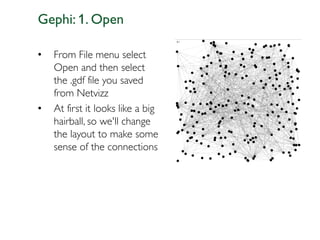
•   At first it looks like a big
    hairball, so we'll change
    the layout to make some
    sense of the connections
Gephi: 2. Layout

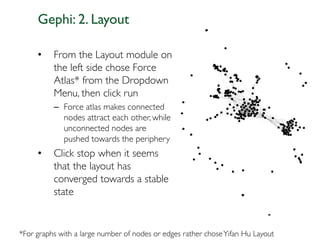
     •    From the Layout module on
          the left side chose Force
          Atlas* from the Dropdown
          Menu, then click run
          – Force atlas makes connected
            nodes attract each other, while
            unconnected nodes are
            pushed towards the periphery
     •    Click stop when it seems
          that the layout has
          converged towards a stable
          state


*For graphs with a large number of nodes or edges rather chose Yifan Hu Layout
Gephi: 3. Ranking (Degree)

1. Chose the Ranking-Nodes
   Tab in the top left module
   and chose Degree from the
   dropdown menu
   – Degree = number of
     connections
2. Hover your mouse over the
   gradient bar, then double click
   on each triangle to choose a
   color for each side of the
   range
   – Try to use bright colors for the
     highest degree and dark for
     lowest
3. Click apply
Gephi: 4. Statistics

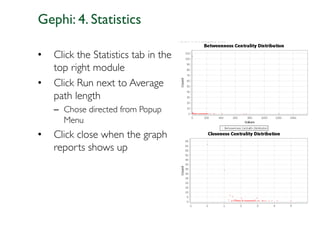
•   Click the Statistics tab in the
    top right module
•   Click Run next to Average
    path length
    – Chose directed from Popup
      Menu
•   Click close when the graph
    reports shows up
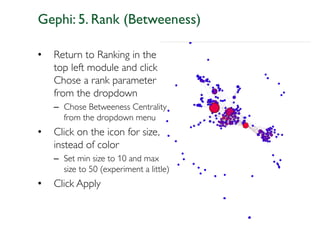
Gephi: 5. Rank (Betweeness)

•   Return to Ranking in the
    top left module and click
    Chose a rank parameter
    from the dropdown
    – Chose Betweeness Centrality
      from the dropdown menu
•   Click on the icon for size,
    instead of color
    – Set min size to 10 and max
      size to 50 (experiment a little)
•   Click Apply
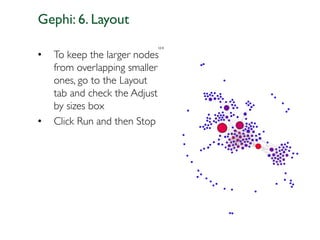
Gephi: 6. Layout

•   To keep the larger nodes
    from overlapping smaller
    ones, go to the Layout
    tab and check the Adjust
    by sizes box
•   Click Run and then Stop
Gephi: 7. Labels

•   Click the bold black T in
    the toolabar at the bottom
    of the window to turn
    labels on
•   Click the black letter A in
    the same toolbar to select
    the Size Mode for the
    labels, and choose the node
    size option
•   Use the slider on the right
    to adjust the size
•   You can also change the
    font style by clicking next
    to the slider
Gephi: 8. Community Detection

•   Go back to the statistics tab
    on the right and click Run
    next to Modularity
    – Check randomize and click OK
•   Go to the partition tab in the
    top left module and click the
    refresh arrow
•   Choose modularity class
    from the dropdown menu
    – Right click to randomize colors
•   Click Apply
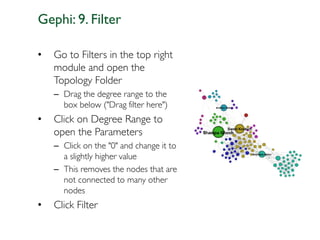
Gephi: 9. Filter

•   Go to Filters in the top right
    module and open the
    Topology Folder
    – Drag the degree range to the
      box below ("Drag filter here")
•   Click on Degree Range to
    open the Parameters
    – Click on the "0" and change it to
      a slightly higher value
    – This removes the nodes that are
      not connected to many other
      nodes
•   Click Filter
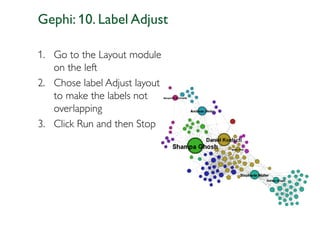
Gephi: 10. Label Adjust

1. Go to the Layout module
   on the left
2. Chose label Adjust layout
   to make the labels not
   overlapping
3. Click Run and then Stop
Gephi: 11. Preview

1. At the very top click on the
   Preview tab
2. Under Node, check the box
   "Show Labels"
3. Click Refresh at the bottom,
   and choose your label font
4. Play around with the
   options until you like your
   graph (Don't forget to click
   refresh every time)
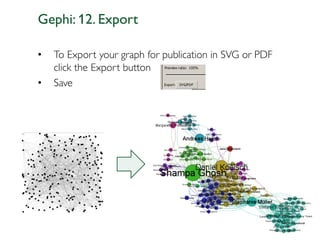
Gephi: 12. Export

•   To Export your graph for publication in SVG or PDF
    click the Export button
•   Save
Gephi: 13. Make sense out of it
                              Friends from swimming club


                                  Roommate & swimming club
Friends from
staying in Japan
                                                       Friends from studies at the
                                                       University of Mannheim

                                                           Friends from studies at the
                                                           University of Waterloo


                                     Joined me on
        Friends from school          the exchange to
                                     Canada
Hungry? Need More Data?

•   Use NodeXL
•   Write own crawlers
    (ask me)
•   Use existing archives
    – http://snap.stanford.edu/
    – http://vlado.fmf.uni-
      lj.si/pub/networks/pajek
    – http://vlado.fmf.uni-
      lj.si/pub/networks/data/
      ucinet/ucidata.htm
•   Collect by Surveys

Exploratory facebook social network analysis with gephi

  • 1.
    Exploratory Facebook Social NetworkAnalysis with Gephi Thomas Plotkowiak twitterresearcher.wordpress.com
  • 2.
    Process 1. Import Datawith Netviz 2. Gephi 1. Open 7. Labels 2. Layout 8. Community detection 3. Ranking (Degree) 9. Filter 4. Statistics 10. Label Adjust 5. Ranking (Betweenness) 11. Preview 6. Layout (Size Adjust) 12. Export
  • 3.
    Netvizz 1. Sign into your Facebook account 2. Search for netvizz application 3. Choose parameters you would like to include in the data (e.g. gender, wall posts count, interface language) 4. Analyze either – Your personal friend network  today – [OR] one of your groups listed at the bottom 5. Wait for the application to create the .gdf file and download it (right click, save as)
  • 4.
    Gephi • Gephi is an open-source network analysis and visualization software package. • Envisioned as providing "easy and broad access to network data", it's advertised as being "Like Photoshop for graphs." • Gephi has been used in a number of research projects in the university, journalism and elsewhere. • The Gephi Team: Mathieu Bastian, Sebastien Heymann, Julian Bilcke, Mathieu Jacomy, Franck Ghitalla
  • 5.
    Gephi: 1. Open • From File menu select Open and then select the .gdf file you saved from Netvizz • At first it looks like a big hairball, so we'll change the layout to make some sense of the connections
  • 6.
    Gephi: 2. Layout • From the Layout module on the left side chose Force Atlas* from the Dropdown Menu, then click run – Force atlas makes connected nodes attract each other, while unconnected nodes are pushed towards the periphery • Click stop when it seems that the layout has converged towards a stable state *For graphs with a large number of nodes or edges rather chose Yifan Hu Layout
  • 7.
    Gephi: 3. Ranking(Degree) 1. Chose the Ranking-Nodes Tab in the top left module and chose Degree from the dropdown menu – Degree = number of connections 2. Hover your mouse over the gradient bar, then double click on each triangle to choose a color for each side of the range – Try to use bright colors for the highest degree and dark for lowest 3. Click apply
  • 8.
    Gephi: 4. Statistics • Click the Statistics tab in the top right module • Click Run next to Average path length – Chose directed from Popup Menu • Click close when the graph reports shows up
  • 9.
    Gephi: 5. Rank(Betweeness) • Return to Ranking in the top left module and click Chose a rank parameter from the dropdown – Chose Betweeness Centrality from the dropdown menu • Click on the icon for size, instead of color – Set min size to 10 and max size to 50 (experiment a little) • Click Apply
  • 10.
    Gephi: 6. Layout • To keep the larger nodes from overlapping smaller ones, go to the Layout tab and check the Adjust by sizes box • Click Run and then Stop
  • 11.
    Gephi: 7. Labels • Click the bold black T in the toolabar at the bottom of the window to turn labels on • Click the black letter A in the same toolbar to select the Size Mode for the labels, and choose the node size option • Use the slider on the right to adjust the size • You can also change the font style by clicking next to the slider
  • 12.
    Gephi: 8. CommunityDetection • Go back to the statistics tab on the right and click Run next to Modularity – Check randomize and click OK • Go to the partition tab in the top left module and click the refresh arrow • Choose modularity class from the dropdown menu – Right click to randomize colors • Click Apply
  • 13.
    Gephi: 9. Filter • Go to Filters in the top right module and open the Topology Folder – Drag the degree range to the box below ("Drag filter here") • Click on Degree Range to open the Parameters – Click on the "0" and change it to a slightly higher value – This removes the nodes that are not connected to many other nodes • Click Filter
  • 14.
    Gephi: 10. LabelAdjust 1. Go to the Layout module on the left 2. Chose label Adjust layout to make the labels not overlapping 3. Click Run and then Stop
  • 15.
    Gephi: 11. Preview 1.At the very top click on the Preview tab 2. Under Node, check the box "Show Labels" 3. Click Refresh at the bottom, and choose your label font 4. Play around with the options until you like your graph (Don't forget to click refresh every time)
  • 16.
    Gephi: 12. Export • To Export your graph for publication in SVG or PDF click the Export button • Save
  • 17.
    Gephi: 13. Makesense out of it Friends from swimming club Roommate & swimming club Friends from staying in Japan Friends from studies at the University of Mannheim Friends from studies at the University of Waterloo Joined me on Friends from school the exchange to Canada
  • 18.
    Hungry? Need MoreData? • Use NodeXL • Write own crawlers (ask me) • Use existing archives – http://snap.stanford.edu/ – http://vlado.fmf.uni- lj.si/pub/networks/pajek – http://vlado.fmf.uni- lj.si/pub/networks/data/ ucinet/ucidata.htm • Collect by Surveys