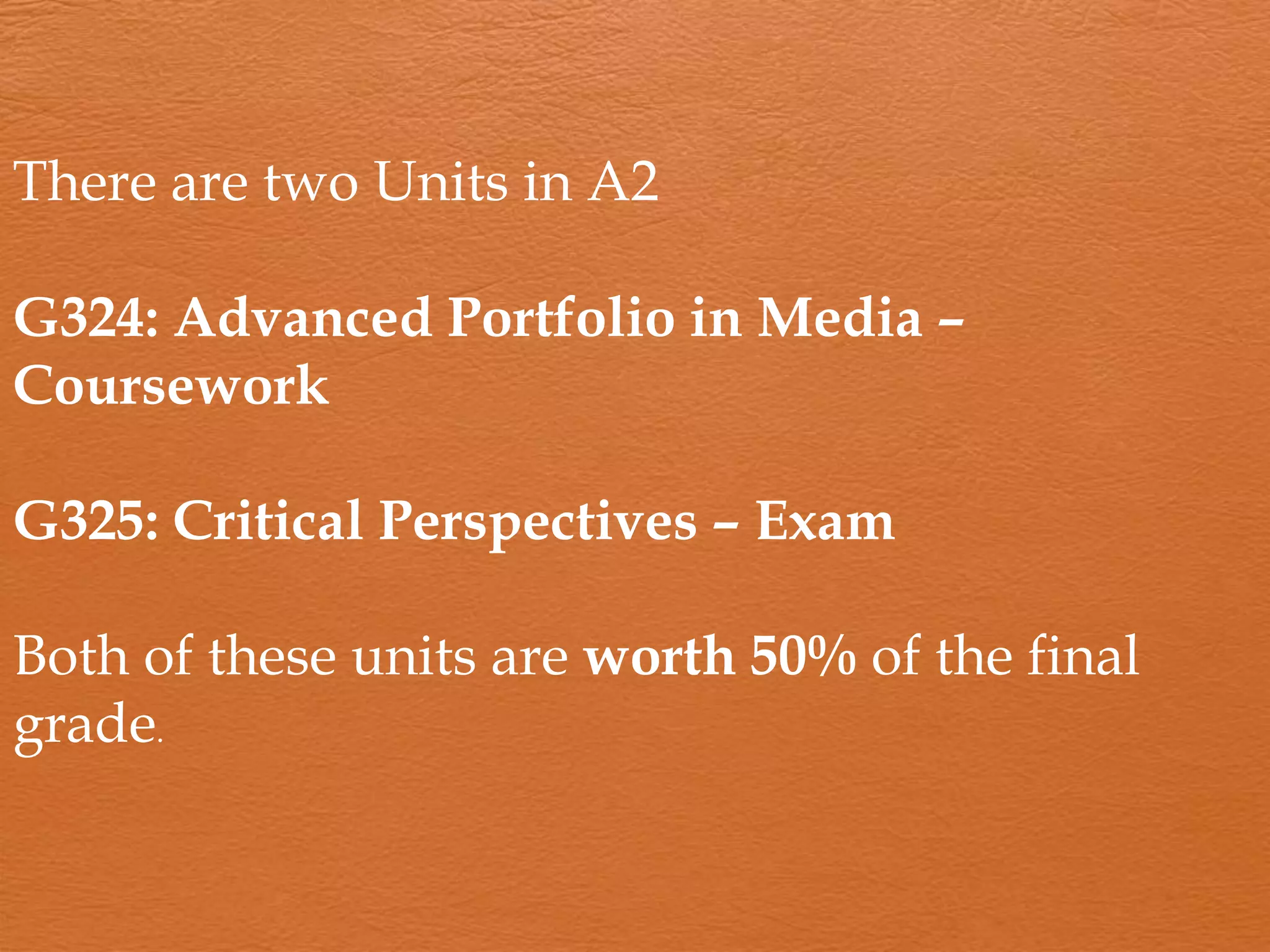
There are two Units in A2
G324: Advanced Portfolio in Media –
Coursework
G325: Critical Perspectives – Exam
Both of these units are worth 50% of the final
grade.
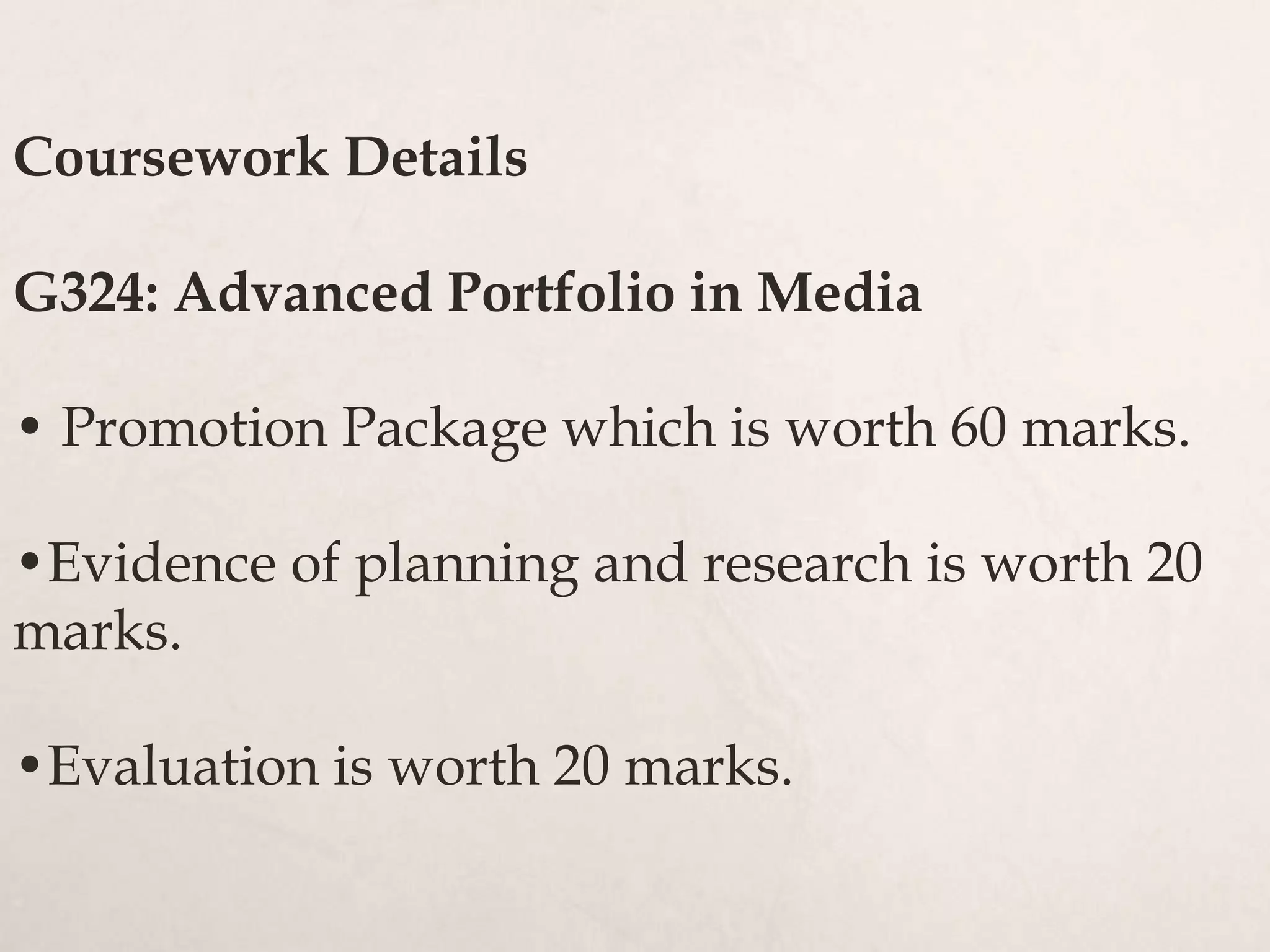
Coursework Details
G324: Advanced Portfolio in Media
• Promotion Package which is worth 60 marks.
•Evidence of planning and research is worth 20
marks.
•Evaluation is worth 20 marks.
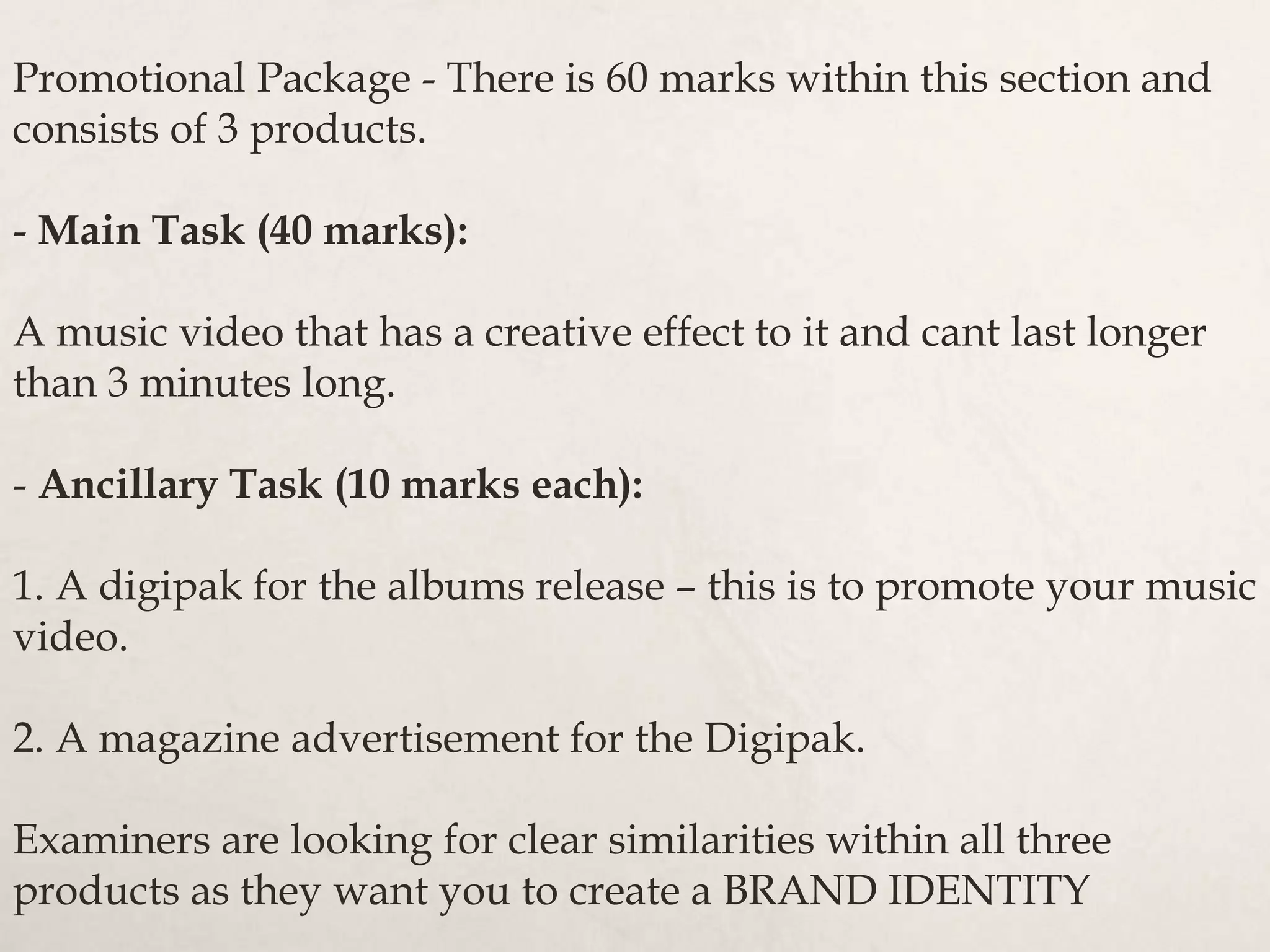
Promotional Package - There is 60 marks within this section and
consists of 3 products.
- Main Task (40 marks):
A music video that has a creative effect to it and cant last longer
than 3 minutes long.
- Ancillary Task (10 marks each):
1. A digipak for the albums release – this is to promote your music
video.
2. A magazine advertisement for the Digipak.
Examiners are looking for clear similarities within all three
products as they want you to create a BRAND IDENTITY
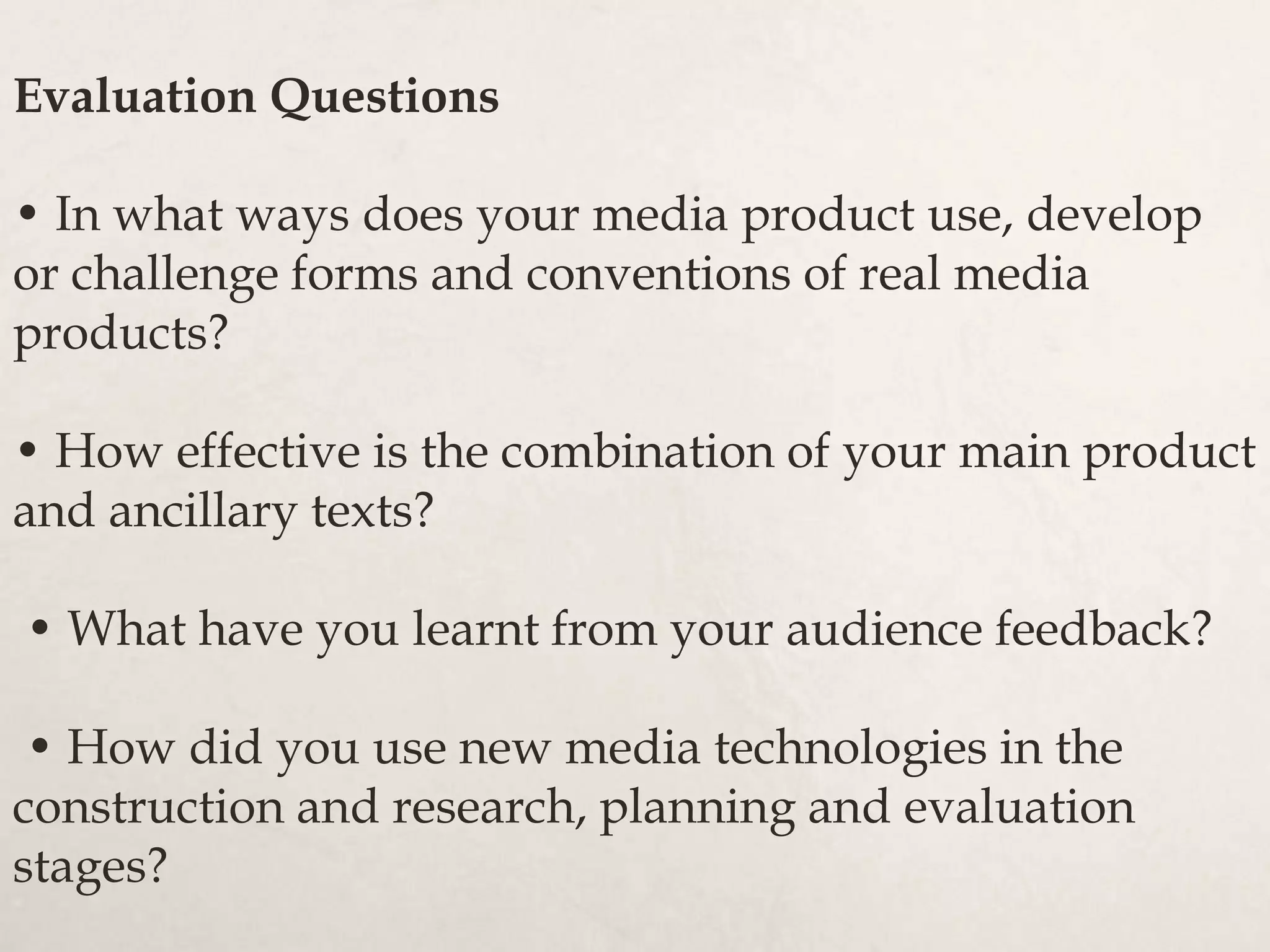
Evaluation Questions
• In what ways does your media product use, develop
or challenge forms and conventions of real media
products?
• How effective is the combination of your main product
and ancillary texts?
• What have you learnt from your audience feedback?
• How did you use new media technologies in the
construction and research, planning and evaluation
stages?
Section 2 - G325: Critical Perspectives
This exam is 2 HOURS long.
There are two sections to this paper;
1. Section A: Theoretical Evaluation of
Production (50 marks)
2. 2. Section B: Contemporary Media Issues (50
marks)
Exam Section A
Section A has two compulsory questions:
• Q1(a) asks you to describe and evaluate your skills development
over the course of all your production work, from AS to A2.
• Questions will be based on one or two of the categories: digital
technology, research/planning, creativity, post-production or
using conventions from real media products.
• Q1(b) asks you to select one of your productions and evaluate it
in relation to one of the following media concepts: genre,
narrative, representation, audience or media language.
Section B: Contemporary Media Regulation
• What is the nature of contemporary media regulation
compared with previous practices?
• What are the arguments for and against specific forms
of contemporary media regulation?
• How effective are regulatory practices?
• What are the wider social issues relating to media
regulation?
Research and Planning Grading
For a Level 4 band (16-20 marks):
• Planning and research evidence will be complete and detailed.
• There is excellent research into similar products and a potential target
audience.
• There is excellent work on shot-lists, layouts, drafting, scripting or
storyboarding.
• There is excellent organization of actors, locations, costumes or props.
• Time management is excellent.
• There is excellent skill in the use of digital technology or ICT in the
presentation.
• There are excellent communication skills.
• There is an excellent level of care in the presentation of the research
and planning.
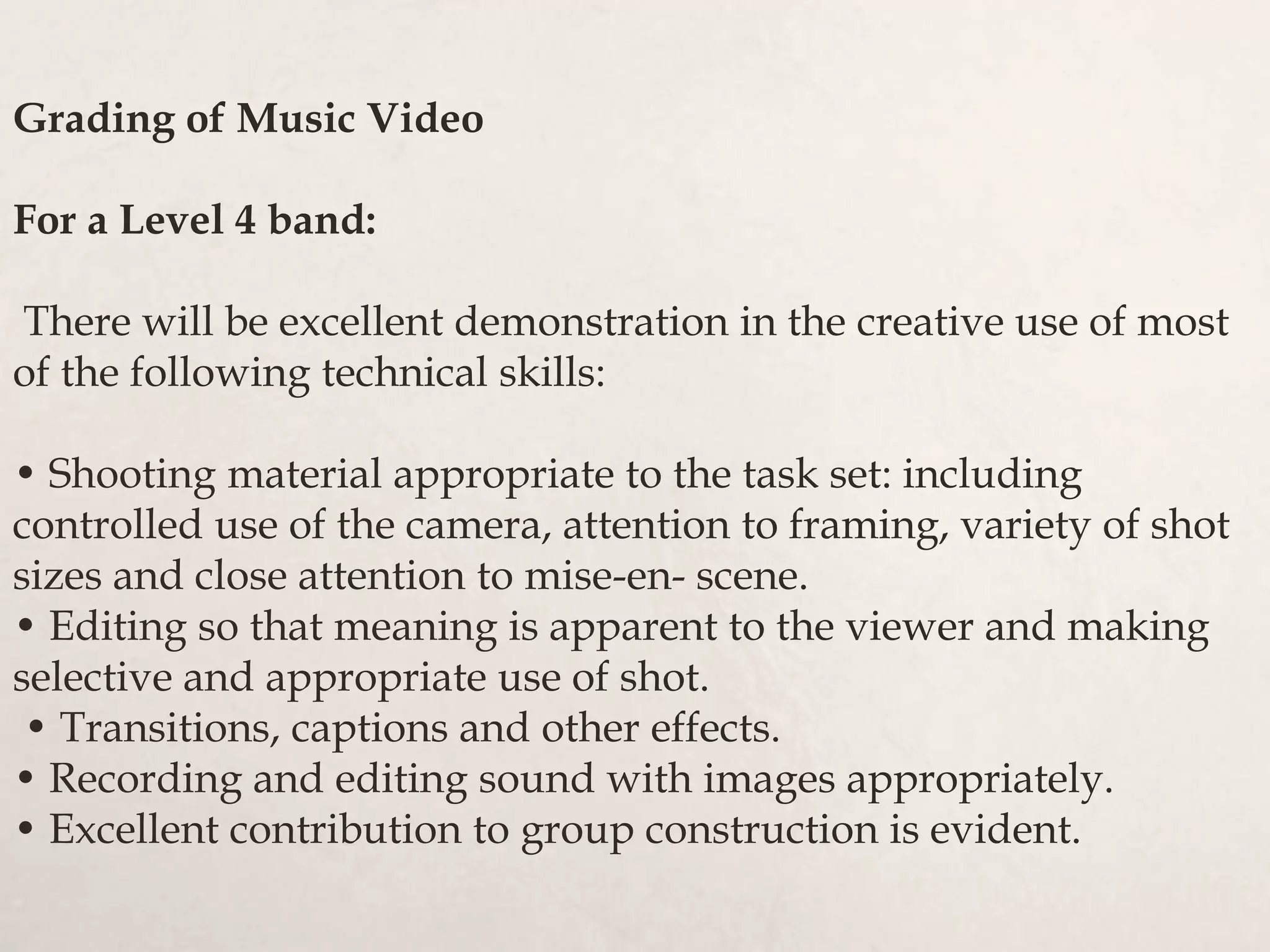
Grading of Music Video
For a Level 4 band:
There will be excellent demonstration in the creative use of most
of the following technical skills:
• Shooting material appropriate to the task set: including
controlled use of the camera, attention to framing, variety of shot
sizes and close attention to mise-en- scene.
• Editing so that meaning is apparent to the viewer and making
selective and appropriate use of shot.
• Transitions, captions and other effects.
• Recording and editing sound with images appropriately.
• Excellent contribution to group construction is evident.
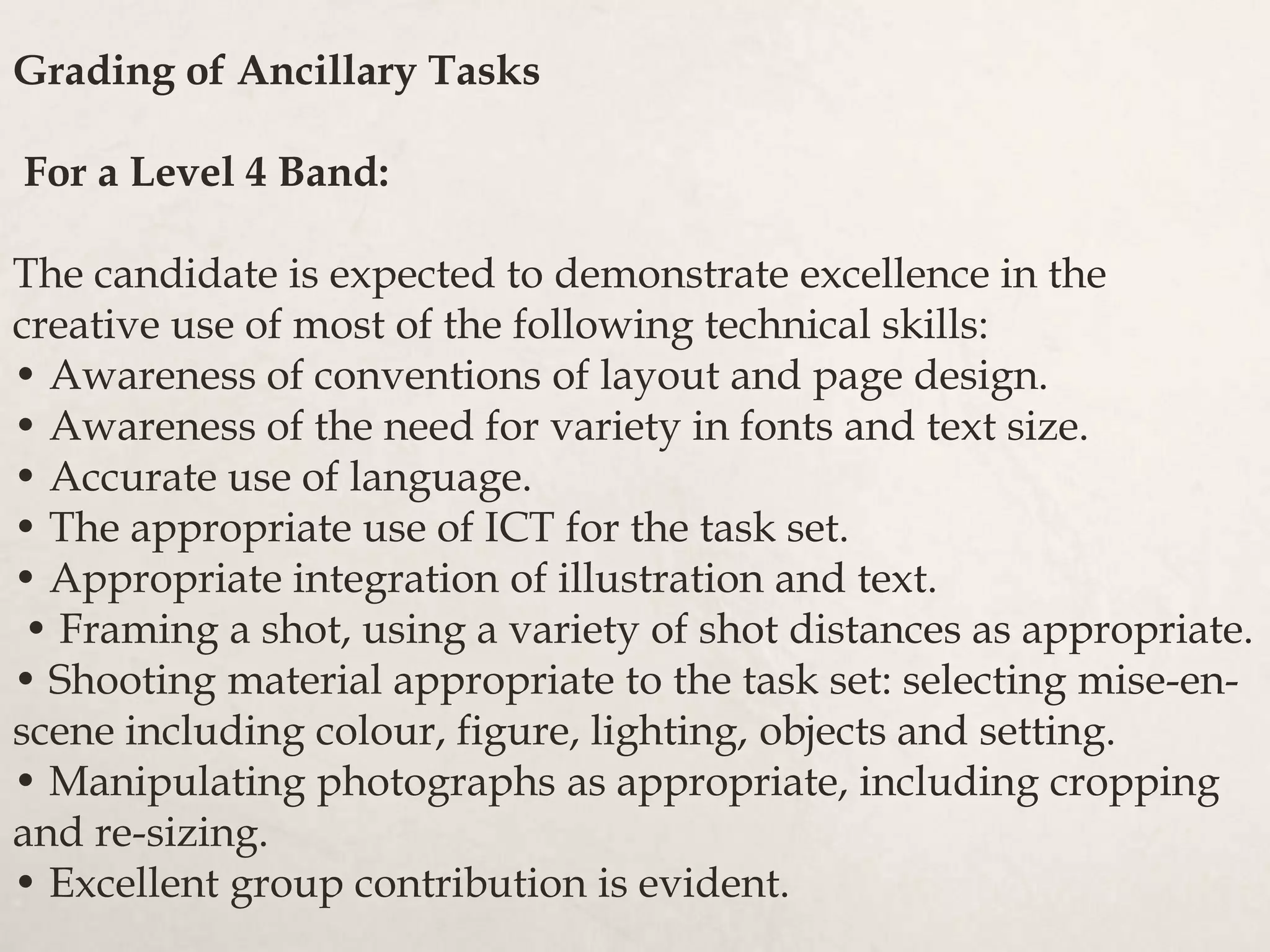
Grading of Ancillary Tasks
For a Level 4 Band:
The candidate is expected to demonstrate excellence in the
creative use of most of the following technical skills:
• Awareness of conventions of layout and page design.
• Awareness of the need for variety in fonts and text size.
• Accurate use of language.
• The appropriate use of ICT for the task set.
• Appropriate integration of illustration and text.
• Framing a shot, using a variety of shot distances as appropriate.
• Shooting material appropriate to the task set: selecting mise-en-
scene including colour, figure, lighting, objects and setting.
• Manipulating photographs as appropriate, including cropping
and re-sizing.
• Excellent group contribution is evident.

Explanation Of A2 Course

  • 1.
    There are twoUnits in A2 G324: Advanced Portfolio in Media – Coursework G325: Critical Perspectives – Exam Both of these units are worth 50% of the final grade.
  • 2.
    Coursework Details G324: AdvancedPortfolio in Media • Promotion Package which is worth 60 marks. •Evidence of planning and research is worth 20 marks. •Evaluation is worth 20 marks.
  • 3.
    Promotional Package -There is 60 marks within this section and consists of 3 products. - Main Task (40 marks): A music video that has a creative effect to it and cant last longer than 3 minutes long. - Ancillary Task (10 marks each): 1. A digipak for the albums release – this is to promote your music video. 2. A magazine advertisement for the Digipak. Examiners are looking for clear similarities within all three products as they want you to create a BRAND IDENTITY
  • 4.
    Evaluation Questions • Inwhat ways does your media product use, develop or challenge forms and conventions of real media products? • How effective is the combination of your main product and ancillary texts? • What have you learnt from your audience feedback? • How did you use new media technologies in the construction and research, planning and evaluation stages?
  • 5.
    Section 2 -G325: Critical Perspectives This exam is 2 HOURS long. There are two sections to this paper; 1. Section A: Theoretical Evaluation of Production (50 marks) 2. 2. Section B: Contemporary Media Issues (50 marks)
  • 6.
    Exam Section A SectionA has two compulsory questions: • Q1(a) asks you to describe and evaluate your skills development over the course of all your production work, from AS to A2. • Questions will be based on one or two of the categories: digital technology, research/planning, creativity, post-production or using conventions from real media products. • Q1(b) asks you to select one of your productions and evaluate it in relation to one of the following media concepts: genre, narrative, representation, audience or media language.
  • 7.
    Section B: ContemporaryMedia Regulation • What is the nature of contemporary media regulation compared with previous practices? • What are the arguments for and against specific forms of contemporary media regulation? • How effective are regulatory practices? • What are the wider social issues relating to media regulation?
  • 8.
    Research and PlanningGrading For a Level 4 band (16-20 marks): • Planning and research evidence will be complete and detailed. • There is excellent research into similar products and a potential target audience. • There is excellent work on shot-lists, layouts, drafting, scripting or storyboarding. • There is excellent organization of actors, locations, costumes or props. • Time management is excellent. • There is excellent skill in the use of digital technology or ICT in the presentation. • There are excellent communication skills. • There is an excellent level of care in the presentation of the research and planning.
  • 9.
    Grading of MusicVideo For a Level 4 band: There will be excellent demonstration in the creative use of most of the following technical skills: • Shooting material appropriate to the task set: including controlled use of the camera, attention to framing, variety of shot sizes and close attention to mise-en- scene. • Editing so that meaning is apparent to the viewer and making selective and appropriate use of shot. • Transitions, captions and other effects. • Recording and editing sound with images appropriately. • Excellent contribution to group construction is evident.
  • 10.
    Grading of AncillaryTasks For a Level 4 Band: The candidate is expected to demonstrate excellence in the creative use of most of the following technical skills: • Awareness of conventions of layout and page design. • Awareness of the need for variety in fonts and text size. • Accurate use of language. • The appropriate use of ICT for the task set. • Appropriate integration of illustration and text. • Framing a shot, using a variety of shot distances as appropriate. • Shooting material appropriate to the task set: selecting mise-en- scene including colour, figure, lighting, objects and setting. • Manipulating photographs as appropriate, including cropping and re-sizing. • Excellent group contribution is evident.