INTRODUCTION TO
      SECTION A
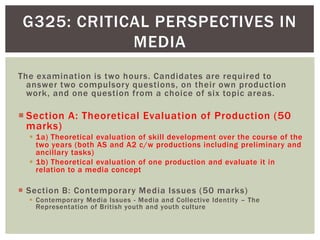
G325: CRITICAL PERSPECTIVES IN
            MEDIA
The examination is two hours. Candidates are required to
  answer two compulsory questions, on their own production
  work, and one question from a choice of six topic areas.

 Section A: Theoretical Evaluation of Production (50
  marks)
   1a) Theoretical evaluation of skill development over the course of the
    two years (both AS and A2 c/w productions including preliminary and
    ancillary tasks)
   1b) Theoretical evaluation of one production and evaluate it in
    relation to a media concept

 Section B: Contemporary Media Issues (50 marks)
   Contemporary Media Issues - Media and Collective Identity – The
    Representation of British youth and youth culture
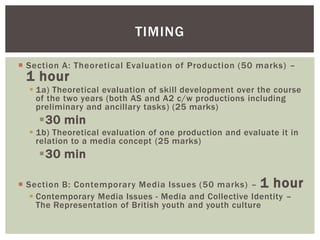
TIMING

 Section A: Theoretical Evaluation of Production (50 marks) –
 1 hour
   1a) Theoretical evaluation of skill development over the course
    of the two years (both AS and A2 c/w productions including
    preliminary and ancillary tasks) (25 marks)
    30 min
   1b) Theoretical evaluation of one production and evaluate it in
    relation to a media concept (25 marks)
    30 min

 Section B: Contemporary Media Issues (50 marks) – 1 hour
    Contemporary Media Issues - Media and Collective Identity –
     The Representation of British youth and youth culture
G325: SECTION A, QUESTION 1A

 Candidates answer two compulsory questions.

 The first requires them to describe and evaluate
  their skills development over the course of their
  production work, from Foundation Portfolio to
  Advanced Portfolio.

 The second asks them to identify one production
  and evaluate it in relation to one theoretical
  concept.
QUESTION 1A

 Question 1(a) requires candidates to describe and evaluate
  their skills development over the course of their production
  work, from Foundation Portfolio AND Advanced Portfolio.

 The focus of this evaluation must be on skills
  development, and the question will require them to adapt this
  to one or two specific production practices.

 The list of practices to which questions will relate is as
  follows:
     Digital Technology
     Creativity
     Research and planning
     Post-production
     Using conventions from real media texts
QUESTION 1B

 Question 1(b) requires candidates to select one production
  and evaluate it in relation to a media concept.

 The list of concepts to which questions will relate is as
  follows:
    Genre
    Narrative
    Representation
    Audience
    Media language

 Where candidates have produced relevant work outside the
  context of their A Level media course, they are free to
  additionally refer to this experience.
QUESTION 1B CONT…

 In the examination, questions will be set using one of
  these concepts only.

 In some circumstances, candidates will be expected
  to select the production that appears to relate most
  effectively to the specific concept that arises in the
  exam question.

 However, the requirement for candidates to evaluate
  one of their productions in relation to a concept does
  not assume that the concept will necessarily always
  fit easily and in an orthodox way. Thus in some cases
  candidates will be describing their productions in
  terms of them not relating straightforwardly to the
  concept
YOUR COURSEWORK

 You will need to know your own coursework projects in detail,
  and be able to recall and analyse your own work in relation to
  each of these concepts.

 Question 1a – Both AS and A2 coursework
     Digital Technology
     Creativity
     Research and planning
     Post-production
     Using conventions from real media texts

 Question 1b – Either AS or A2 coursework
    Genre
    Narrative
    Representation
    Audience
    Media language
SECTION A, QUESTION 1A
– SKILLS EVALUATION OF
           PRODUCTION
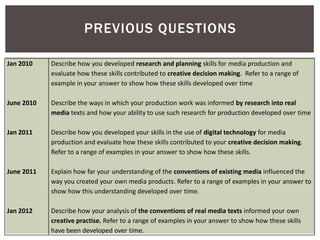
PREVIOUS QUESTIONS

Jan 2010    Describe how you developed research and planning skills for media production and
            evaluate how these skills contributed to creative decision making. Refer to a range of
            example in your answer to show how these skills developed over time

June 2010   Describe the ways in which your production work was informed by research into real
            media texts and how your ability to use such research for production developed over time

Jan 2011    Describe how you developed your skills in the use of digital technology for media
            production and evaluate how these skills contributed to your creative decision making.
            Refer to a range of examples in your answer to show how these skills.

June 2011   Explain how far your understanding of the conventions of existing media influenced the
            way you created your own media products. Refer to a range of examples in your answer to
            show how this understanding developed over time.

Jan 2012    Describe how your analysis of the conventions of real media texts informed your own
            creative practise. Refer to a range of examples in your answer to show how these skills
            have been developed over time.
WHAT IS IT ABOUT?

   What did you do?
   How did you do it?
   How did your skills develop?
   All supported with specific examples
   In relation to the area(s) in question
CRITICAL REFLECTION

 Reflective practice is a skill that is much sought after and is
  highly regarded by universities and employers. This goes
  beyond evaluations of the outcomes; we are not simply
  thinking about strengths and weaknesses.
 This is probably the most dif ficult part of the A2 course.
SECTION A: SKILLS EVALUATION OF
                PRODUCTION

 There is some cross over between the 5 areas e.g. for
  Research and Planning you had to research other film
  openings/music magazines, which clearly links to “Using
  conventions from real media texts” , the final bullet point.
 Your task will be to produce a detailed evaluation of your
  coursework using all 5 areas. The documents you produce will
  be vital revision aids for the exam this summer.
DIGITAL TECHNOLOGY-
     HARDWARE, SOFT WARE AND ONLINE

 For this topic, you need to consider the impact of the new
  technologies you have used on your consumption and
  production of media texts.
 Consider how you have presented your work; have you used
  blogs?
 How has the internet supported your skills development?
 Consider the pro’s and con’s of the digital technology you
  have used
ICT/DIGITAL TECHNOLOGY

   How did AS compare to A2?
   Blogs/websites
   Slideshare
   Flickr
   Facebook questionnaires
   Film and upload to YouTube (audience questionnaires and
    feedback)
   Vlogs
   Post it note film/stop frame animations
   Digital photography
   Software and hardware
DIGITAL TECHNOLOGY

 You need to consider the skills you have learnt during AS with the
  following sof tware:
 Adobe Photoshop. The image manipulation program allowed you to
  manipulate graphics necessar y for the magazine. E.g. crop tools such
  as Marquee (magic wand), Lassos, and colour conver ters such as Red
  Eye Corrector, Colour Variations, Colour Dropper, Dodge and Burn, text
  tools, picture boxes, shape tools, photograph manipulation, layer s etc.
 Adobe Indesign CS5. The print construction sof tware allowed you to
  create a realistic product through layout/font/logo/colour manipulation
  etc.
 Adobe Premiere Pro CS5 . The editing sof tware allowed you to add
  specific transitions/sound ef fects/manipulate time (temporal
  relations)…etc.
 Weblogs. e.g. blogger which allowed you to regularly post about your
  research & planning, progress and to display your final piece. It also
  enabled you to leave comments (audience feedback) on each other’s
  blogs….
DIGITAL TECHNOLOGY

 You need to consider the skills you have learnt from AS to A2
  with the following hardware:
 Digital stills cameras
 Lighting
 Mini DV cameras
 Tripods
 PC
 Mini DV tape
DIGITAL TECHNOLOGY

 What are the pros and cons of the software and hardware you
  used at AS and A2 in terms of skills development?
 How did you use your skills to aid the construction of your
  task?
 Be really really specific with your examples
CREATIVIT Y

 It is important not to assume one answer to any question!
 Rather than ask yourself the question, "How have I become
  more creative during my A level course?", ask yourself, "Have
  I become more creative?".
 If you answer the second question, then you will evaluate your
  progress much more thoroughly.
 Consider the pro’s and con’s of the technology you have used
  and how this has impacted on your creativity
CREATIVIT Y

 Creativity involves thinking or behaving imaginatively. It might
  involve challenging conventions or replicating / furthering
  knowledge of them – what did you do in your c/w?
 You need to think about the decisions that were made for you
  (the restrictions put on you by the exam board) e.g. you must
  make a music magazine or film opening. Then consider the
  creative choices you made e.g. which type of music magazine
  or genre of film? Etc.
CREATIVIT Y

 How creative do you think you were in the decisions you made
  when creating your c/w?
 Did the technology enhance your creativity or not?
 What ideas did you communicate and what stylistic
  techniques did you use? How did it relate to your
  interests/vision of identity?
 Was your product influenced by your social environmental?
 Was this original or did you add something extra to an original
  media text?
 Would you take any creative skills into future projects or have
  you been influenced to engage these skills in any other
  projects?
RESEARCH AND PLANNING

   Consider the following:
   How you reviewed real text examples and discuss conventions
   Analysis of old student work and discuss marking criteria
   How you planned the micro elements
   Research into audience expectations
   How you reviewed your own progress and update your plans.
RESEARCH AND PLANNING

 Think about the types of research you carried out:
 Primary –
  films, magazines, internet, questionnaires, audience feedback
 Secondary – internet, textbooks, blogs for theories
 Advantages/Disadvantages of your sources:
 Cost of magazines etc
 Accessibility – easy to find?
 Time consuming?
 Reliability of sources?
 Accuracy of sources?
 Usefulness of sources?
RESEARCH AND PLANNING

 How did you organise your research and planning? E.g.
  labels, blog etc
 What did you research?
 How did drafting help you?
 How did audience feedback improve your planning?
 How organised were you?
 What did you learn about working as part of a group or
  independently?
 How did you present your research and planning? E.g.
  wordle, moodboard, flickr, scribd, slideshare etc
POST-PRODUCTION

   Consider the following:
   How you made decisions about editing and layout
   Influence of audience expectations
   Photo manipulation
POST-PRODUCTION

 Post Production at AS might have consisted of editing the
  material and putting all the titles and music together on
  Adobe Premiere Pro or editing images and putting text
  together on Photoshop/Indesign. This is very similar to the
  software listed as part of Digital technology
 You need to identify all of the steps you took once you had
  either filmed or photographed – to do this accurately it will be
  helpful to look at your work and make a list of everything you
  did in order to get to the finished stage.
 Post-production is everything that happens after
  filming/photographing
USING CONVENTIONS OF REAL MEDIA TEXTS

 Each of your 3 practical projects had a specific set of
  conventions.
 For this topic, you need to consider how your understanding
  has developed over the course.
 Begin by make a note of the conventions of each of the
  genres you created.
 Then pick 2 or 3 of these conventions and say how you used
  them within your own work
 Don't forget to ask yourself how useful it is to understand and
  apply real conventions AND why your ability to apply this
  understanding has improved over the course.
USING CONVENTIONS FROM REAL MEDIA
                 TEXTS

 What conventions of music magazines/film openings did you
  apply to your c/w?
 Identify real media texts and explain how your text is similar
  and dif ferent.
 “Creativity is always constrained by generic conventions”. To
  what extent did you adhere to or subvert generic conventions
  in the creation of your media products.
QUESTION 1A TASK

 You will now analyse both your AS and A2 coursework
  pieces, applying each of them to the key concepts we have just
  discussed

 These notes should be detailed and use specific examples from
  your coursework. The more detailed these notes are, the more
  useful they will be as revision aids

 There are several ways you can layout these notes, for example
  the grid shown on the next slide, or a mind map. Make sure your
  layout works for you and your own style of learning.

 Which ever way you lay them out, make sure they are detailed
  and specific. These will form the basis of your revision for this
  section of the exam
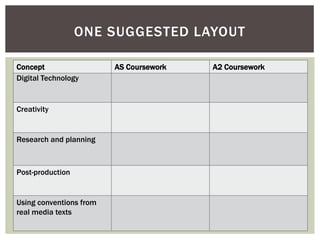
ONE SUGGESTED LAYOUT

Concept                  AS Coursework   A2 Coursework
Digital Technology


Creativity


Research and planning


Post-production


Using conventions from
real media texts
EASTER HOMEWORK

 Complete your analysis of your AS and A2 Coursework in
  relation to the key concepts
     Digital Technology
     Creativity
     Research and planning
     Post-production
     Using conventions from real media texts

 You will be using these notes and revision aids as soon as you
  come back over Easter

Introduction to section a

  • 1.
  • 2.
    G325: CRITICAL PERSPECTIVESIN MEDIA The examination is two hours. Candidates are required to answer two compulsory questions, on their own production work, and one question from a choice of six topic areas.  Section A: Theoretical Evaluation of Production (50 marks)  1a) Theoretical evaluation of skill development over the course of the two years (both AS and A2 c/w productions including preliminary and ancillary tasks)  1b) Theoretical evaluation of one production and evaluate it in relation to a media concept  Section B: Contemporary Media Issues (50 marks)  Contemporary Media Issues - Media and Collective Identity – The Representation of British youth and youth culture
  • 3.
    TIMING  Section A:Theoretical Evaluation of Production (50 marks) – 1 hour  1a) Theoretical evaluation of skill development over the course of the two years (both AS and A2 c/w productions including preliminary and ancillary tasks) (25 marks) 30 min  1b) Theoretical evaluation of one production and evaluate it in relation to a media concept (25 marks) 30 min  Section B: Contemporary Media Issues (50 marks) – 1 hour  Contemporary Media Issues - Media and Collective Identity – The Representation of British youth and youth culture
  • 4.
    G325: SECTION A,QUESTION 1A  Candidates answer two compulsory questions.  The first requires them to describe and evaluate their skills development over the course of their production work, from Foundation Portfolio to Advanced Portfolio.  The second asks them to identify one production and evaluate it in relation to one theoretical concept.
  • 5.
    QUESTION 1A  Question1(a) requires candidates to describe and evaluate their skills development over the course of their production work, from Foundation Portfolio AND Advanced Portfolio.  The focus of this evaluation must be on skills development, and the question will require them to adapt this to one or two specific production practices.  The list of practices to which questions will relate is as follows:  Digital Technology  Creativity  Research and planning  Post-production  Using conventions from real media texts
  • 6.
    QUESTION 1B  Question1(b) requires candidates to select one production and evaluate it in relation to a media concept.  The list of concepts to which questions will relate is as follows:  Genre  Narrative  Representation  Audience  Media language  Where candidates have produced relevant work outside the context of their A Level media course, they are free to additionally refer to this experience.
  • 7.
    QUESTION 1B CONT… In the examination, questions will be set using one of these concepts only.  In some circumstances, candidates will be expected to select the production that appears to relate most effectively to the specific concept that arises in the exam question.  However, the requirement for candidates to evaluate one of their productions in relation to a concept does not assume that the concept will necessarily always fit easily and in an orthodox way. Thus in some cases candidates will be describing their productions in terms of them not relating straightforwardly to the concept
  • 8.
    YOUR COURSEWORK  Youwill need to know your own coursework projects in detail, and be able to recall and analyse your own work in relation to each of these concepts.  Question 1a – Both AS and A2 coursework  Digital Technology  Creativity  Research and planning  Post-production  Using conventions from real media texts  Question 1b – Either AS or A2 coursework  Genre  Narrative  Representation  Audience  Media language
  • 9.
    SECTION A, QUESTION1A – SKILLS EVALUATION OF PRODUCTION
  • 10.
    PREVIOUS QUESTIONS Jan 2010 Describe how you developed research and planning skills for media production and evaluate how these skills contributed to creative decision making. Refer to a range of example in your answer to show how these skills developed over time June 2010 Describe the ways in which your production work was informed by research into real media texts and how your ability to use such research for production developed over time Jan 2011 Describe how you developed your skills in the use of digital technology for media production and evaluate how these skills contributed to your creative decision making. Refer to a range of examples in your answer to show how these skills. June 2011 Explain how far your understanding of the conventions of existing media influenced the way you created your own media products. Refer to a range of examples in your answer to show how this understanding developed over time. Jan 2012 Describe how your analysis of the conventions of real media texts informed your own creative practise. Refer to a range of examples in your answer to show how these skills have been developed over time.
  • 11.
    WHAT IS ITABOUT?  What did you do?  How did you do it?  How did your skills develop?  All supported with specific examples  In relation to the area(s) in question
  • 12.
    CRITICAL REFLECTION  Reflectivepractice is a skill that is much sought after and is highly regarded by universities and employers. This goes beyond evaluations of the outcomes; we are not simply thinking about strengths and weaknesses.  This is probably the most dif ficult part of the A2 course.
  • 13.
    SECTION A: SKILLSEVALUATION OF PRODUCTION  There is some cross over between the 5 areas e.g. for Research and Planning you had to research other film openings/music magazines, which clearly links to “Using conventions from real media texts” , the final bullet point.  Your task will be to produce a detailed evaluation of your coursework using all 5 areas. The documents you produce will be vital revision aids for the exam this summer.
  • 14.
    DIGITAL TECHNOLOGY- HARDWARE, SOFT WARE AND ONLINE  For this topic, you need to consider the impact of the new technologies you have used on your consumption and production of media texts.  Consider how you have presented your work; have you used blogs?  How has the internet supported your skills development?  Consider the pro’s and con’s of the digital technology you have used
  • 15.
    ICT/DIGITAL TECHNOLOGY  How did AS compare to A2?  Blogs/websites  Slideshare  Flickr  Facebook questionnaires  Film and upload to YouTube (audience questionnaires and feedback)  Vlogs  Post it note film/stop frame animations  Digital photography  Software and hardware
  • 16.
    DIGITAL TECHNOLOGY  Youneed to consider the skills you have learnt during AS with the following sof tware:  Adobe Photoshop. The image manipulation program allowed you to manipulate graphics necessar y for the magazine. E.g. crop tools such as Marquee (magic wand), Lassos, and colour conver ters such as Red Eye Corrector, Colour Variations, Colour Dropper, Dodge and Burn, text tools, picture boxes, shape tools, photograph manipulation, layer s etc.  Adobe Indesign CS5. The print construction sof tware allowed you to create a realistic product through layout/font/logo/colour manipulation etc.  Adobe Premiere Pro CS5 . The editing sof tware allowed you to add specific transitions/sound ef fects/manipulate time (temporal relations)…etc.  Weblogs. e.g. blogger which allowed you to regularly post about your research & planning, progress and to display your final piece. It also enabled you to leave comments (audience feedback) on each other’s blogs….
  • 17.
    DIGITAL TECHNOLOGY  Youneed to consider the skills you have learnt from AS to A2 with the following hardware:  Digital stills cameras  Lighting  Mini DV cameras  Tripods  PC  Mini DV tape
  • 18.
    DIGITAL TECHNOLOGY  Whatare the pros and cons of the software and hardware you used at AS and A2 in terms of skills development?  How did you use your skills to aid the construction of your task?  Be really really specific with your examples
  • 19.
    CREATIVIT Y  Itis important not to assume one answer to any question!  Rather than ask yourself the question, "How have I become more creative during my A level course?", ask yourself, "Have I become more creative?".  If you answer the second question, then you will evaluate your progress much more thoroughly.  Consider the pro’s and con’s of the technology you have used and how this has impacted on your creativity
  • 20.
    CREATIVIT Y  Creativityinvolves thinking or behaving imaginatively. It might involve challenging conventions or replicating / furthering knowledge of them – what did you do in your c/w?  You need to think about the decisions that were made for you (the restrictions put on you by the exam board) e.g. you must make a music magazine or film opening. Then consider the creative choices you made e.g. which type of music magazine or genre of film? Etc.
  • 21.
    CREATIVIT Y  Howcreative do you think you were in the decisions you made when creating your c/w?  Did the technology enhance your creativity or not?  What ideas did you communicate and what stylistic techniques did you use? How did it relate to your interests/vision of identity?  Was your product influenced by your social environmental?  Was this original or did you add something extra to an original media text?  Would you take any creative skills into future projects or have you been influenced to engage these skills in any other projects?
  • 22.
    RESEARCH AND PLANNING  Consider the following:  How you reviewed real text examples and discuss conventions  Analysis of old student work and discuss marking criteria  How you planned the micro elements  Research into audience expectations  How you reviewed your own progress and update your plans.
  • 23.
    RESEARCH AND PLANNING Think about the types of research you carried out:  Primary – films, magazines, internet, questionnaires, audience feedback  Secondary – internet, textbooks, blogs for theories  Advantages/Disadvantages of your sources:  Cost of magazines etc  Accessibility – easy to find?  Time consuming?  Reliability of sources?  Accuracy of sources?  Usefulness of sources?
  • 24.
    RESEARCH AND PLANNING How did you organise your research and planning? E.g. labels, blog etc  What did you research?  How did drafting help you?  How did audience feedback improve your planning?  How organised were you?  What did you learn about working as part of a group or independently?  How did you present your research and planning? E.g. wordle, moodboard, flickr, scribd, slideshare etc
  • 25.
    POST-PRODUCTION  Consider the following:  How you made decisions about editing and layout  Influence of audience expectations  Photo manipulation
  • 26.
    POST-PRODUCTION  Post Productionat AS might have consisted of editing the material and putting all the titles and music together on Adobe Premiere Pro or editing images and putting text together on Photoshop/Indesign. This is very similar to the software listed as part of Digital technology  You need to identify all of the steps you took once you had either filmed or photographed – to do this accurately it will be helpful to look at your work and make a list of everything you did in order to get to the finished stage.  Post-production is everything that happens after filming/photographing
  • 27.
    USING CONVENTIONS OFREAL MEDIA TEXTS  Each of your 3 practical projects had a specific set of conventions.  For this topic, you need to consider how your understanding has developed over the course.  Begin by make a note of the conventions of each of the genres you created.  Then pick 2 or 3 of these conventions and say how you used them within your own work  Don't forget to ask yourself how useful it is to understand and apply real conventions AND why your ability to apply this understanding has improved over the course.
  • 28.
    USING CONVENTIONS FROMREAL MEDIA TEXTS  What conventions of music magazines/film openings did you apply to your c/w?  Identify real media texts and explain how your text is similar and dif ferent.  “Creativity is always constrained by generic conventions”. To what extent did you adhere to or subvert generic conventions in the creation of your media products.
  • 29.
    QUESTION 1A TASK You will now analyse both your AS and A2 coursework pieces, applying each of them to the key concepts we have just discussed  These notes should be detailed and use specific examples from your coursework. The more detailed these notes are, the more useful they will be as revision aids  There are several ways you can layout these notes, for example the grid shown on the next slide, or a mind map. Make sure your layout works for you and your own style of learning.  Which ever way you lay them out, make sure they are detailed and specific. These will form the basis of your revision for this section of the exam
  • 30.
    ONE SUGGESTED LAYOUT Concept AS Coursework A2 Coursework Digital Technology Creativity Research and planning Post-production Using conventions from real media texts
  • 31.
    EASTER HOMEWORK  Completeyour analysis of your AS and A2 Coursework in relation to the key concepts  Digital Technology  Creativity  Research and planning  Post-production  Using conventions from real media texts  You will be using these notes and revision aids as soon as you come back over Easter