Fatima Banu
The development of eLearning content is a meticulous process that demands attention to detail
and a commitment to quality. This guide focuses on the journey from the initial stages of
eLearning content development to the critical phase of Quality Control (QC), ensuring that the
final product is not only educational and engaging but also technically sound and user-friendly.
Article Insight:
Understanding eLearning and Its Impact
eLearning, a product of technological advancement and educational innovation, has transformed
traditional learning paradigms. It offers flexibility, accessibility, and a personalized learning
experience. Let's explores the evolution, current landscape, and potential future trends in
eLearning.
1. Understanding eLearning
2. Understanding QA and QC
3. Phase 1: eLearning Content Development
4. Phase 2: Implementing the eLearning Course
5. Phase 3: Quality Control in eLearning
6. Continuous Improvement and Updating
7. Documentation and Legal Compliance
8. Bonus: Focusing on Quality Control in eLearning Development
4/26/24, 6:20 PM Expert Guide to eLearning Development: Enhancing Quality & Engagement
https://www.kytewayelearning.com/article/elearning-content-development-to-quality-control-guide 1/7
The Cornerstones of eLearning Quality:
Understanding QA and QC
Definitions and Differences
Quality Assurance (QA) is a proactive process focusing on preventing defects in eLearning
content through a comprehensive system of practices and standards.
Quality Control (QC) is a reactive process, entailing the identification and correction of
defects in the final eLearning product.
The Role of QA and QC in eLearning
QA and QC in eLearning ensure the delivery of content that is pedagogically sound, technically
robust, and user-friendly. These processes are crucial in maintaining the credibility and
effectiveness of eLearning courses.
Phase 1: eLearning Content Development
4/26/24, 6:20 PM Expert Guide to eLearning Development: Enhancing Quality & Engagement
https://www.kytewayelearning.com/article/elearning-content-development-to-quality-control-guide 2/7
Conceptualizing the eLearning Project
Effective eLearning begins with a deep understanding of the target audience. This involves
demographic analysis, understanding their learning styles, and identifying their knowledge gaps.
Learning objectives should be SMART: Specific, Measurable, Achievable, Relevant, and Time-
bound. The choice of eLearning models (synchronous vs. asynchronous, self-paced learning,
blended learning) and methodologies (like the ADDIE model or Agile Learning Design) should be
based on these insights.
Designing the Course Structure
The instructional design phase is crucial. It involves applying learning theories (like Constructivism
or Behaviorism) and models (such as Bloom’s Taxonomy) to craft an engaging and effective
learning journey. Storyboarding is not just about content layout; it's about creating a narrative
that resonates with learners. It includes decisions about the types of multimedia (like interactive
simulations, infographics, or podcasts) that will be used to enhance engagement.
Developing the Content
Content development involves more than just writing text. It’s about creating a cohesive and
engaging learning experience. This includes scriptwriting for video content, designing interactive
elements, and creating assessments that align with the learning objectives. The choice of
authoring tools (like Adobe Captivate or Articulate 360) can significantly impact the type of
content you can create and how it's delivered.
4/26/24, 6:20 PM Expert Guide to eLearning Development: Enhancing Quality & Engagement
https://www.kytewayelearning.com/article/elearning-content-development-to-quality-control-guide 3/7
Incorporating Diverse Learning Modalities
Modern eLearning caters to diverse learning preferences. Let's delve into designing content that
appeals to visual, auditory, and kinesthetic learners, integrating elements like interactive quizzes
for kinesthetic learners, podcasts for auditory learners, and infographics for visual learners.
Additionally, the rise of mobile learning and microlearning – learning in small, bite-sized units –
has become crucial in today’s fast-paced world.
Phase 2: Implementing the eLearning Course
Selecting and Utilizing a Learning Management System (LMS)
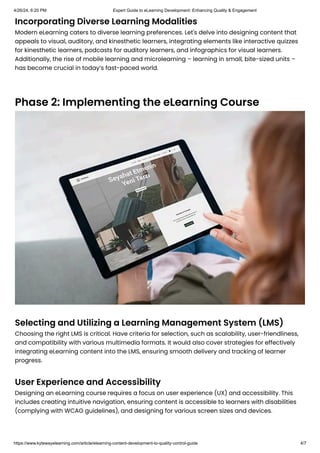
Choosing the right LMS is critical. Have criteria for selection, such as scalability, user-friendliness,
and compatibility with various multimedia formats. It would also cover strategies for effectively
integrating eLearning content into the LMS, ensuring smooth delivery and tracking of learner
progress.
User Experience and Accessibility
Designing an eLearning course requires a focus on user experience (UX) and accessibility. This
includes creating intuitive navigation, ensuring content is accessible to learners with disabilities
(complying with WCAG guidelines), and designing for various screen sizes and devices.
4/26/24, 6:20 PM Expert Guide to eLearning Development: Enhancing Quality & Engagement
https://www.kytewayelearning.com/article/elearning-content-development-to-quality-control-guide 4/7
Phase 3: Quality Control in eLearning
Establishing Quality Control Parameters
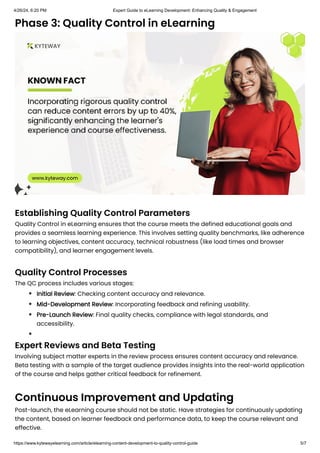
Quality Control in eLearning ensures that the course meets the defined educational goals and
provides a seamless learning experience. This involves setting quality benchmarks, like adherence
to learning objectives, content accuracy, technical robustness (like load times and browser
compatibility), and learner engagement levels.
Quality Control Processes
The QC process includes various stages:
Initial Review: Checking content accuracy and relevance.
Mid-Development Review: Incorporating feedback and refining usability.
Pre-Launch Review: Final quality checks, compliance with legal standards, and
accessibility.
Expert Reviews and Beta Testing
Involving subject matter experts in the review process ensures content accuracy and relevance.
Beta testing with a sample of the target audience provides insights into the real-world application
of the course and helps gather critical feedback for refinement.
Continuous Improvement and Updating
Post-launch, the eLearning course should not be static. Have strategies for continuously updating
the content, based on learner feedback and performance data, to keep the course relevant and
effective.
4/26/24, 6:20 PM Expert Guide to eLearning Development: Enhancing Quality & Engagement
https://www.kytewayelearning.com/article/elearning-content-development-to-quality-control-guide 5/7
Documentation and Legal Compliance
Maintaining detailed records of the development process is essential for quality assurance and
addressing any legal compliance issues. This includes documenting the instructional design
process, development iterations, QC checks, and compliance with standards such as copyright
laws.
Bonus: Focusing on Quality Control in eLearning
Development
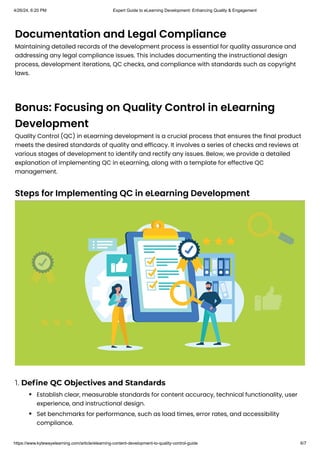
Quality Control (QC) in eLearning development is a crucial process that ensures the final product
meets the desired standards of quality and efficacy. It involves a series of checks and reviews at
various stages of development to identify and rectify any issues. Below, we provide a detailed
explanation of implementing QC in eLearning, along with a template for effective QC
management.
Steps for Implementing QC in eLearning Development
1. Define QC Objectives and Standards
Establish clear, measurable standards for content accuracy, technical functionality, user
experience, and instructional design.
Set benchmarks for performance, such as load times, error rates, and accessibility
compliance.
4/26/24, 6:20 PM Expert Guide to eLearning Development: Enhancing Quality & Engagement
https://www.kytewayelearning.com/article/elearning-content-development-to-quality-control-guide 6/7
2. Develop a QC Plan
Create a structured QC plan that outlines the stages of content development where
checks will be conducted.
Identify the key deliverables at each stage and the specific QC activities to be performed.
3. Assign QC Responsibilities
Allocate QC tasks to team members with the appropriate expertise, such as instructional
designers, technical experts, and content reviewers.
Ensure a balance between internal reviews and external expert assessments.
4. Conduct Regular Reviews and Audits
Schedule regular reviews at predetermined stages – after initial development, mid-
development, and before finalization.
Use checklists and tools to systematically review content for errors, inconsistencies, and
alignment with objectives.
5. Test for Technical Functionality
Perform technical testing to ensure compatibility with various devices and browsers.
Check for issues like broken links, loading errors, and multimedia functionality.
6. Evaluate User Experience and Engagement
Assess the course’s design, navigability, and overall user experience.
Use pilot groups or beta testers to gather feedback on engagement and comprehension.
7. Incorporate Feedback and Refine
Analyze feedback from reviews and tests to identify areas for improvement.
Implement changes iteratively, focusing on enhancing quality and learner satisfaction.
8. Document QC Processes and Outcomes
Keep detailed records of all QC activities, findings, and actions taken.
Use this documentation for future reference and continuous improvement.
Conclusion
Quality Control in eLearning development is a systematic process that ensures the final product is
of high quality and meets the learners’ needs. By following a structured QC plan and using the
provided template, eLearning developers can effectively manage the quality of their content,
leading to more successful and impactful learning experiences.
4/26/24, 6:20 PM Expert Guide to eLearning Development: Enhancing Quality & Engagement
https://www.kytewayelearning.com/article/elearning-content-development-to-quality-control-guide 7/7

Expert Guide to eLearning Development_ Enhancing Quality & Engagement

  • 1.
    Fatima Banu The developmentof eLearning content is a meticulous process that demands attention to detail and a commitment to quality. This guide focuses on the journey from the initial stages of eLearning content development to the critical phase of Quality Control (QC), ensuring that the final product is not only educational and engaging but also technically sound and user-friendly. Article Insight: Understanding eLearning and Its Impact eLearning, a product of technological advancement and educational innovation, has transformed traditional learning paradigms. It offers flexibility, accessibility, and a personalized learning experience. Let's explores the evolution, current landscape, and potential future trends in eLearning. 1. Understanding eLearning 2. Understanding QA and QC 3. Phase 1: eLearning Content Development 4. Phase 2: Implementing the eLearning Course 5. Phase 3: Quality Control in eLearning 6. Continuous Improvement and Updating 7. Documentation and Legal Compliance 8. Bonus: Focusing on Quality Control in eLearning Development 4/26/24, 6:20 PM Expert Guide to eLearning Development: Enhancing Quality & Engagement https://www.kytewayelearning.com/article/elearning-content-development-to-quality-control-guide 1/7
  • 2.
    The Cornerstones ofeLearning Quality: Understanding QA and QC Definitions and Differences Quality Assurance (QA) is a proactive process focusing on preventing defects in eLearning content through a comprehensive system of practices and standards. Quality Control (QC) is a reactive process, entailing the identification and correction of defects in the final eLearning product. The Role of QA and QC in eLearning QA and QC in eLearning ensure the delivery of content that is pedagogically sound, technically robust, and user-friendly. These processes are crucial in maintaining the credibility and effectiveness of eLearning courses. Phase 1: eLearning Content Development 4/26/24, 6:20 PM Expert Guide to eLearning Development: Enhancing Quality & Engagement https://www.kytewayelearning.com/article/elearning-content-development-to-quality-control-guide 2/7
  • 3.
    Conceptualizing the eLearningProject Effective eLearning begins with a deep understanding of the target audience. This involves demographic analysis, understanding their learning styles, and identifying their knowledge gaps. Learning objectives should be SMART: Specific, Measurable, Achievable, Relevant, and Time- bound. The choice of eLearning models (synchronous vs. asynchronous, self-paced learning, blended learning) and methodologies (like the ADDIE model or Agile Learning Design) should be based on these insights. Designing the Course Structure The instructional design phase is crucial. It involves applying learning theories (like Constructivism or Behaviorism) and models (such as Bloom’s Taxonomy) to craft an engaging and effective learning journey. Storyboarding is not just about content layout; it's about creating a narrative that resonates with learners. It includes decisions about the types of multimedia (like interactive simulations, infographics, or podcasts) that will be used to enhance engagement. Developing the Content Content development involves more than just writing text. It’s about creating a cohesive and engaging learning experience. This includes scriptwriting for video content, designing interactive elements, and creating assessments that align with the learning objectives. The choice of authoring tools (like Adobe Captivate or Articulate 360) can significantly impact the type of content you can create and how it's delivered. 4/26/24, 6:20 PM Expert Guide to eLearning Development: Enhancing Quality & Engagement https://www.kytewayelearning.com/article/elearning-content-development-to-quality-control-guide 3/7
  • 4.
    Incorporating Diverse LearningModalities Modern eLearning caters to diverse learning preferences. Let's delve into designing content that appeals to visual, auditory, and kinesthetic learners, integrating elements like interactive quizzes for kinesthetic learners, podcasts for auditory learners, and infographics for visual learners. Additionally, the rise of mobile learning and microlearning – learning in small, bite-sized units – has become crucial in today’s fast-paced world. Phase 2: Implementing the eLearning Course Selecting and Utilizing a Learning Management System (LMS) Choosing the right LMS is critical. Have criteria for selection, such as scalability, user-friendliness, and compatibility with various multimedia formats. It would also cover strategies for effectively integrating eLearning content into the LMS, ensuring smooth delivery and tracking of learner progress. User Experience and Accessibility Designing an eLearning course requires a focus on user experience (UX) and accessibility. This includes creating intuitive navigation, ensuring content is accessible to learners with disabilities (complying with WCAG guidelines), and designing for various screen sizes and devices. 4/26/24, 6:20 PM Expert Guide to eLearning Development: Enhancing Quality & Engagement https://www.kytewayelearning.com/article/elearning-content-development-to-quality-control-guide 4/7
  • 5.
    Phase 3: QualityControl in eLearning Establishing Quality Control Parameters Quality Control in eLearning ensures that the course meets the defined educational goals and provides a seamless learning experience. This involves setting quality benchmarks, like adherence to learning objectives, content accuracy, technical robustness (like load times and browser compatibility), and learner engagement levels. Quality Control Processes The QC process includes various stages: Initial Review: Checking content accuracy and relevance. Mid-Development Review: Incorporating feedback and refining usability. Pre-Launch Review: Final quality checks, compliance with legal standards, and accessibility. Expert Reviews and Beta Testing Involving subject matter experts in the review process ensures content accuracy and relevance. Beta testing with a sample of the target audience provides insights into the real-world application of the course and helps gather critical feedback for refinement. Continuous Improvement and Updating Post-launch, the eLearning course should not be static. Have strategies for continuously updating the content, based on learner feedback and performance data, to keep the course relevant and effective. 4/26/24, 6:20 PM Expert Guide to eLearning Development: Enhancing Quality & Engagement https://www.kytewayelearning.com/article/elearning-content-development-to-quality-control-guide 5/7
  • 6.
    Documentation and LegalCompliance Maintaining detailed records of the development process is essential for quality assurance and addressing any legal compliance issues. This includes documenting the instructional design process, development iterations, QC checks, and compliance with standards such as copyright laws. Bonus: Focusing on Quality Control in eLearning Development Quality Control (QC) in eLearning development is a crucial process that ensures the final product meets the desired standards of quality and efficacy. It involves a series of checks and reviews at various stages of development to identify and rectify any issues. Below, we provide a detailed explanation of implementing QC in eLearning, along with a template for effective QC management. Steps for Implementing QC in eLearning Development 1. Define QC Objectives and Standards Establish clear, measurable standards for content accuracy, technical functionality, user experience, and instructional design. Set benchmarks for performance, such as load times, error rates, and accessibility compliance. 4/26/24, 6:20 PM Expert Guide to eLearning Development: Enhancing Quality & Engagement https://www.kytewayelearning.com/article/elearning-content-development-to-quality-control-guide 6/7
  • 7.
    2. Develop aQC Plan Create a structured QC plan that outlines the stages of content development where checks will be conducted. Identify the key deliverables at each stage and the specific QC activities to be performed. 3. Assign QC Responsibilities Allocate QC tasks to team members with the appropriate expertise, such as instructional designers, technical experts, and content reviewers. Ensure a balance between internal reviews and external expert assessments. 4. Conduct Regular Reviews and Audits Schedule regular reviews at predetermined stages – after initial development, mid- development, and before finalization. Use checklists and tools to systematically review content for errors, inconsistencies, and alignment with objectives. 5. Test for Technical Functionality Perform technical testing to ensure compatibility with various devices and browsers. Check for issues like broken links, loading errors, and multimedia functionality. 6. Evaluate User Experience and Engagement Assess the course’s design, navigability, and overall user experience. Use pilot groups or beta testers to gather feedback on engagement and comprehension. 7. Incorporate Feedback and Refine Analyze feedback from reviews and tests to identify areas for improvement. Implement changes iteratively, focusing on enhancing quality and learner satisfaction. 8. Document QC Processes and Outcomes Keep detailed records of all QC activities, findings, and actions taken. Use this documentation for future reference and continuous improvement. Conclusion Quality Control in eLearning development is a systematic process that ensures the final product is of high quality and meets the learners’ needs. By following a structured QC plan and using the provided template, eLearning developers can effectively manage the quality of their content, leading to more successful and impactful learning experiences. 4/26/24, 6:20 PM Expert Guide to eLearning Development: Enhancing Quality & Engagement https://www.kytewayelearning.com/article/elearning-content-development-to-quality-control-guide 7/7