Do we experiment? ¿Experimentamos?
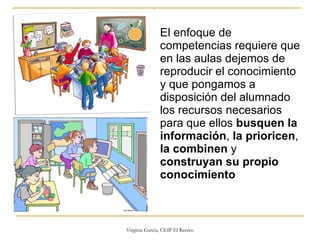
El enfoque de competencias requiere que en las aulas dejemos de reproducir el conocimiento y que pongamos a disposición del alumnado los recursos necesarios para que ellos  busquen la información ,  la prioricen ,  la combinen  y  construyan su propio conocimiento
Nuevo planteamiento para mis alumnos/as “ Vamos a elaborar nuestro conocimiento”. Objetivos:  Identificar los experimentos.  Buscar el argumento científico. Relacionar las argumentaciones. Elaborar una explicación lógica que yo pueda entender y que se lo pueda explicar a los demás.
Metodología Trabajo en pequeños grupos. Se le asigna a cada uno un experimento y una relación de fuentes donde acudir. Ofrecerles una guía clara de los pasos del trabajo. Visita a la nueva biblioteca pública para la búsqueda y recogida de datos. Rúbrica: valoración del trabajo.
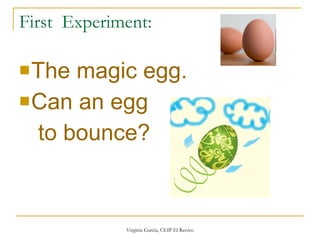
First  Experiment: The magic egg. Can an egg to bounce?
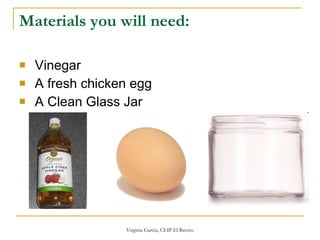
Materials you will need: Vinegar A fresh chicken egg   A Clean Glass Jar
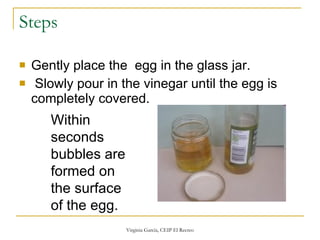
Steps Gently place the  egg in the glass jar.   Slowly pour in the vinegar until the egg is completely covered. Within seconds bubbles are formed on the surface of the egg.
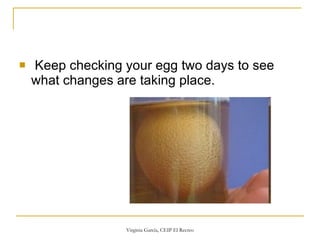
  Keep checking your egg two days to see what changes are taking place.
After approximately 24 - 48 hours we took the egg from the container and rinse it with water. We see that the egg loses its shell, grows and takes on a rubbery. If you press with your fingers is deformed without breaking eggs, and if dropped from a height bounce without breaking
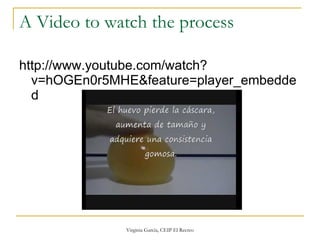
A Video to watch the process http://www.youtube.com/watch?v=hOGEn0r5MHE&feature=player_embedded
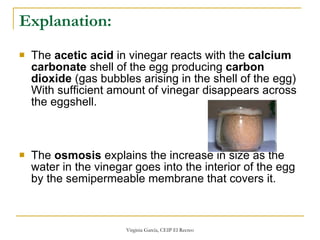
Explanation: The  acetic acid  in vinegar reacts with the  calcium carbonate  shell of the egg producing  carbon dioxide  (gas bubbles arising in the shell of the egg) With sufficient amount of vinegar disappears across the eggshell. The  osmosis  explains the increase in size as the water in the vinegar goes into the interior of the egg by the semipermeable membrane that covers it.
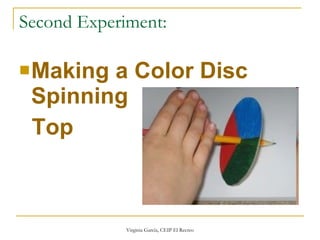
Second Experiment: Making a Color Disc Spinning Top
Materials you will need: •  Pencil • A Glass • White Card • Cardboard • Scissors • Glue • Ruler (for straight lines) • A pair of Compasses  • Crayons or Felt Tip Pens Watch as primary colors mix!
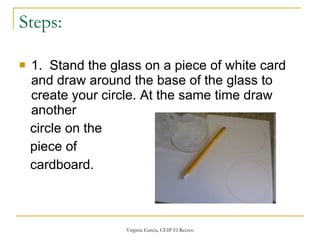
Steps:  1.  Stand the glass on a piece of white card and draw around the base of the glass to create your circle. At the same time draw another circle on the piece of  cardboard.
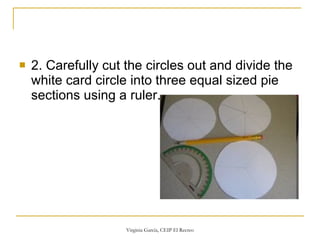
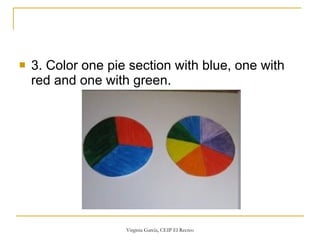
2. Carefully cut the circles out and divide the white card circle into three equal sized pie sections using a ruler.
3. Color one pie section with blue, one with red and one with green.
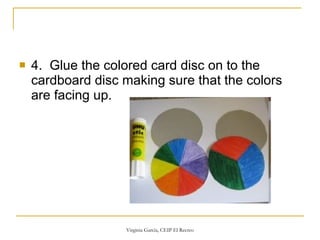
4.  Glue the colored card disc on to the cardboard disc making sure that the colors are facing up.
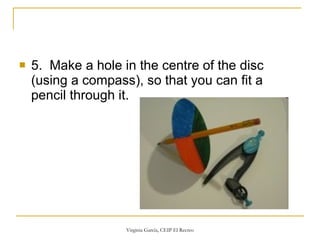
5.  Make a hole in the centre of the disc (using a compass), so that you can fit a pencil through it. 
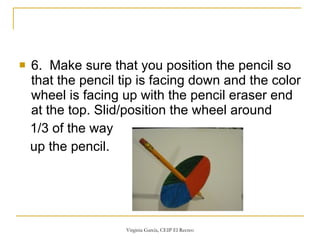
6.  Make sure that you position the pencil so that the pencil tip is facing down and the color wheel is facing up with the pencil eraser end at the top. Slid/position the wheel around  1/3 of the way  up the pencil. 
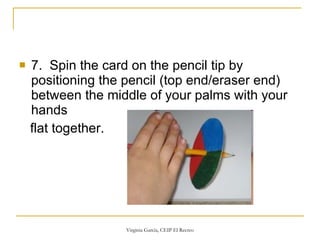
7.  Spin the card on the pencil tip by positioning the pencil (top end/eraser end) between the middle of your palms with your hands flat together.
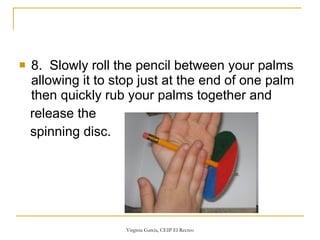
8.  Slowly roll the pencil between your palms allowing it to stop just at the end of one palm then quickly rub your palms together and  release the  spinning disc.
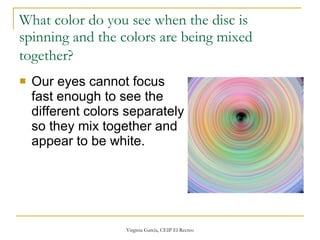
What color do you see when the disc is spinning and the colors are being mixed together?   Our eyes cannot focus fast enough to see the different colors separately so they mix together and appear to be white.
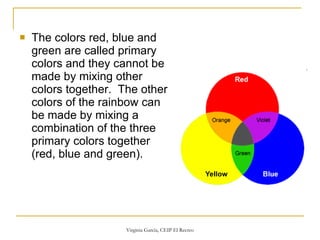
The colors red, blue and green are called primary colors and they cannot be made by mixing other colors together.  The other colors of the rainbow can be made by mixing a combination of the three primary colors together (red, blue and green).
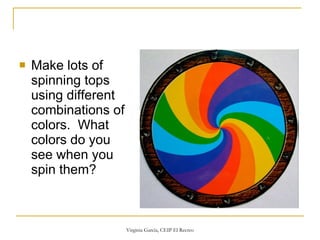
Make lots of spinning tops using different combinations of colors.  What colors do you see when you spin them?
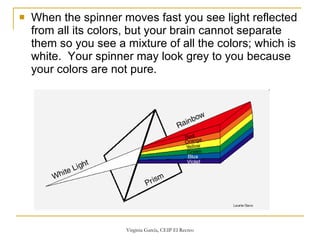
When the spinner moves fast you see light reflected from all its colors, but your brain cannot separate them so you see a mixture of all the colors; which is white.  Your spinner may look grey to you because your colors are not pure.
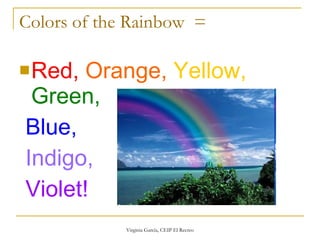
Colors of the Rainbow  =   Red,   Orange,   Yellow,   Green,   Blue, Indigo,   Violet!
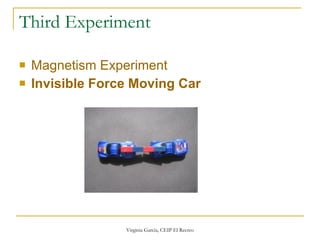
Third Experiment Magnetism Experiment Invisible Force Moving Car
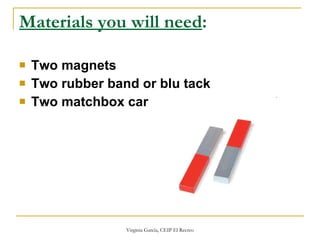
Materials you will need :   Two magnets Two rubber band or blu tack  Two matchbox car
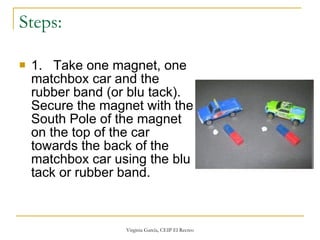
Steps:  1.   Take one magnet, one matchbox car and the rubber band (or blu tack).  Secure the magnet with the South Pole of the magnet on the top of the car towards the back of the matchbox car using the blu tack or rubber band.
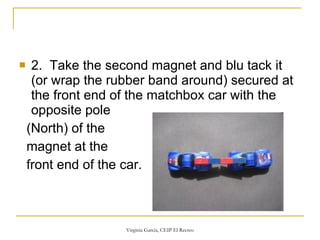
2.  Take the second magnet and blu tack it (or wrap the rubber band around) secured at the front end of the matchbox car with the opposite pole  (North) of the magnet at the  front end of the car.
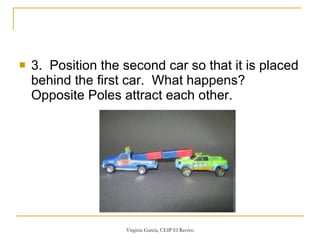
3.  Position the second car so that it is placed behind the first car.  What happens?  Opposite Poles attract each other.
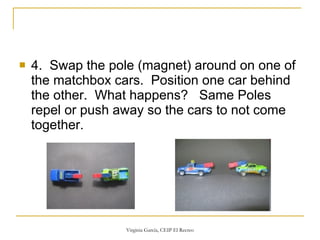
4.  Swap the pole (magnet) around on one of the matchbox cars.  Position one car behind the other.  What happens?   Same Poles repel or push away so the cars to not come together.
Fourth Experiment: Temperature Experiment   Heat Conduction Try this easy experiment using all the items needed found in your kitchen.    Solid materials make the best heat conductors.
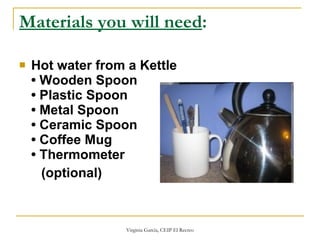
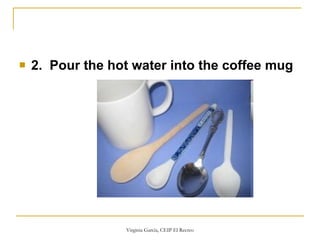
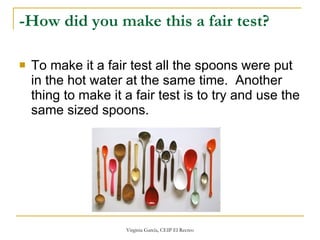
Materials you will need :   Hot water from a Kettle  • Wooden Spoon • Plastic Spoon • Metal Spoon • Ceramic Spoon   • Coffee Mug • Thermometer  (optional)
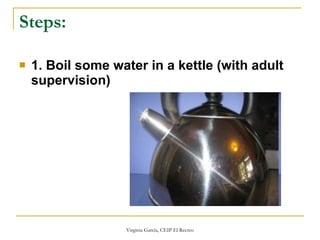
Steps:   1. Boil some water in a kettle (with adult supervision)
2.  Pour the hot water into the coffee mug
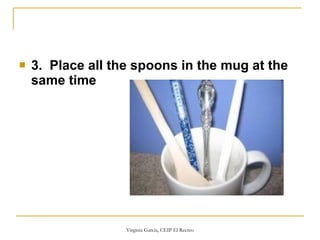
3.  Place all the spoons in the mug at the same time
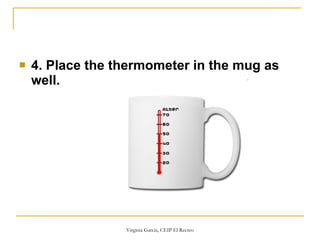
4. Place the thermometer in the mug as well.
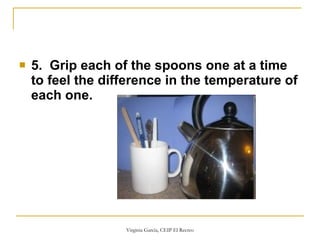
5.  Grip each of the spoons one at a time to feel the difference in the temperature of each one.
6.  Record you finding. 
-How did you make this a fair test?    To make it a fair test all the spoons were put in the hot water at the same time.  Another thing to make it a fair test is to try and use the same sized spoons.
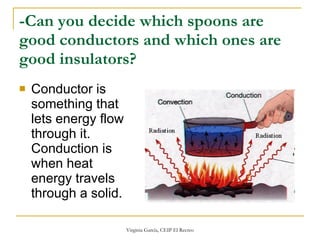
-Can you decide which spoons are good conductors and which ones are good insulators?   Conductor is something that lets energy flow through it.  Conduction is when heat energy travels through a solid. 
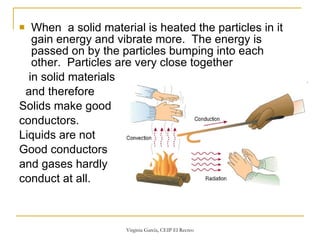
When  a solid material is heated the particles in it gain energy and vibrate more.  The energy is passed on by the particles bumping into each other.  Particles are very close together  in solid materials  and therefore  Solids make good  conductors. Liquids are not  Good conductors  and gases hardly conduct at all. 
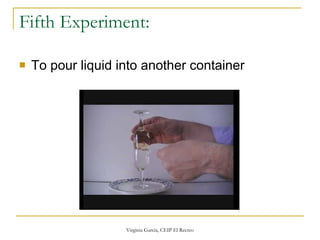
Fifth Experiment: To pour liquid into another container
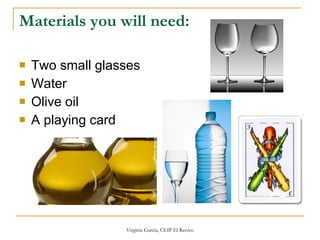
Materials you will need: Two small glasses Water Olive oil  A playing card
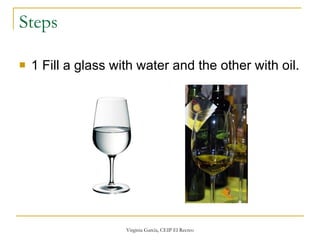
Steps 1 Fill a glass with water and the other with oil.
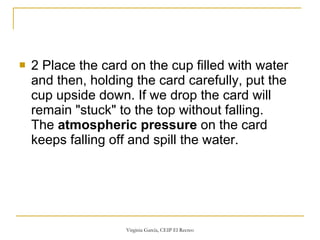
2 Place the card on the cup filled with water and then, holding the card carefully, put the cup upside down. If we drop the card will remain "stuck" to the top without falling. The  atmospheric pressure  on the card keeps falling off and spill the water.
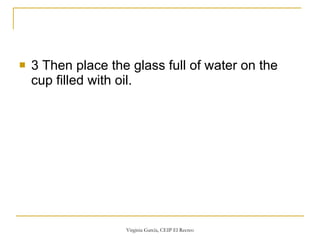
3 Then place the glass full of water on the cup filled with oil.
4 If we remove the card carefully you can transfer the oil from the lower bowl to the upper cup without spilling. The oil is less dense, water is placed on the fully occupied and the upper cup water occupies the lower bowl.
5 If we put the card carefully between the two cups we can remove the top with oil cup without spilling.
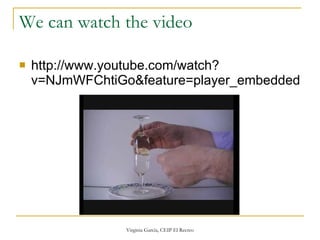
We can watch the video  http://www.youtube.com/watch?v=NJmWFChtiGo&feature=player_embedded
http://www.kids-science-experiments.com/ http :// fq - experimentos.blogspot.com / http://www.sciencekids.co.nz/experiments.html http://ciencianet.com/experimentos.html http://ficus.pntic.mec.es/vmad0017/wrecreativa/recreativacaseras.html

Experimentamos

  • 1.
    Do we experiment?¿Experimentamos?
  • 2.
    El enfoque decompetencias requiere que en las aulas dejemos de reproducir el conocimiento y que pongamos a disposición del alumnado los recursos necesarios para que ellos busquen la información , la prioricen , la combinen y construyan su propio conocimiento
  • 3.
    Nuevo planteamiento paramis alumnos/as “ Vamos a elaborar nuestro conocimiento”. Objetivos: Identificar los experimentos. Buscar el argumento científico. Relacionar las argumentaciones. Elaborar una explicación lógica que yo pueda entender y que se lo pueda explicar a los demás.
  • 4.
    Metodología Trabajo enpequeños grupos. Se le asigna a cada uno un experimento y una relación de fuentes donde acudir. Ofrecerles una guía clara de los pasos del trabajo. Visita a la nueva biblioteca pública para la búsqueda y recogida de datos. Rúbrica: valoración del trabajo.
  • 5.
    First Experiment:The magic egg. Can an egg to bounce?
  • 6.
    Materials you willneed: Vinegar A fresh chicken egg A Clean Glass Jar
  • 7.
    Steps Gently placethe egg in the glass jar.   Slowly pour in the vinegar until the egg is completely covered. Within seconds bubbles are formed on the surface of the egg.
  • 8.
      Keep checkingyour egg two days to see what changes are taking place.
  • 9.
    After approximately 24- 48 hours we took the egg from the container and rinse it with water. We see that the egg loses its shell, grows and takes on a rubbery. If you press with your fingers is deformed without breaking eggs, and if dropped from a height bounce without breaking
  • 10.
    A Video towatch the process http://www.youtube.com/watch?v=hOGEn0r5MHE&feature=player_embedded
  • 11.
    Explanation: The acetic acid in vinegar reacts with the calcium carbonate shell of the egg producing carbon dioxide (gas bubbles arising in the shell of the egg) With sufficient amount of vinegar disappears across the eggshell. The osmosis explains the increase in size as the water in the vinegar goes into the interior of the egg by the semipermeable membrane that covers it.
  • 12.
    Second Experiment: Makinga Color Disc Spinning Top
  • 13.
    Materials you willneed: • Pencil • A Glass • White Card • Cardboard • Scissors • Glue • Ruler (for straight lines) • A pair of Compasses • Crayons or Felt Tip Pens Watch as primary colors mix!
  • 14.
    Steps: 1. Stand the glass on a piece of white card and draw around the base of the glass to create your circle. At the same time draw another circle on the piece of cardboard.
  • 15.
    2. Carefully cutthe circles out and divide the white card circle into three equal sized pie sections using a ruler.
  • 16.
    3. Color onepie section with blue, one with red and one with green.
  • 17.
    4.  Glue thecolored card disc on to the cardboard disc making sure that the colors are facing up.
  • 18.
    5.  Make ahole in the centre of the disc (using a compass), so that you can fit a pencil through it. 
  • 19.
    6.  Make surethat you position the pencil so that the pencil tip is facing down and the color wheel is facing up with the pencil eraser end at the top. Slid/position the wheel around 1/3 of the way up the pencil. 
  • 20.
    7.  Spin thecard on the pencil tip by positioning the pencil (top end/eraser end) between the middle of your palms with your hands flat together.
  • 21.
    8.  Slowly rollthe pencil between your palms allowing it to stop just at the end of one palm then quickly rub your palms together and release the spinning disc.
  • 22.
    What color doyou see when the disc is spinning and the colors are being mixed together? Our eyes cannot focus fast enough to see the different colors separately so they mix together and appear to be white.
  • 23.
    The colors red,blue and green are called primary colors and they cannot be made by mixing other colors together.  The other colors of the rainbow can be made by mixing a combination of the three primary colors together (red, blue and green).
  • 24.
    Make lots ofspinning tops using different combinations of colors.  What colors do you see when you spin them?
  • 25.
    When the spinnermoves fast you see light reflected from all its colors, but your brain cannot separate them so you see a mixture of all the colors; which is white.  Your spinner may look grey to you because your colors are not pure.
  • 26.
    Colors of theRainbow  = Red, Orange, Yellow, Green, Blue, Indigo, Violet!
  • 27.
    Third Experiment MagnetismExperiment Invisible Force Moving Car
  • 28.
    Materials you willneed : Two magnets Two rubber band or blu tack Two matchbox car
  • 29.
    Steps: 1.  Take one magnet, one matchbox car and the rubber band (or blu tack).  Secure the magnet with the South Pole of the magnet on the top of the car towards the back of the matchbox car using the blu tack or rubber band.
  • 30.
    2.  Take thesecond magnet and blu tack it (or wrap the rubber band around) secured at the front end of the matchbox car with the opposite pole (North) of the magnet at the front end of the car.
  • 31.
    3.  Position thesecond car so that it is placed behind the first car.  What happens?  Opposite Poles attract each other.
  • 32.
    4.  Swap thepole (magnet) around on one of the matchbox cars.  Position one car behind the other.  What happens?   Same Poles repel or push away so the cars to not come together.
  • 33.
    Fourth Experiment: TemperatureExperiment Heat Conduction Try this easy experiment using all the items needed found in your kitchen.   Solid materials make the best heat conductors.
  • 34.
    Materials you willneed : Hot water from a Kettle • Wooden Spoon • Plastic Spoon • Metal Spoon • Ceramic Spoon • Coffee Mug • Thermometer (optional)
  • 35.
    Steps: 1. Boil some water in a kettle (with adult supervision)
  • 36.
    2.  Pour thehot water into the coffee mug
  • 37.
    3.  Place allthe spoons in the mug at the same time
  • 38.
    4. Place thethermometer in the mug as well.
  • 39.
    5.  Grip eachof the spoons one at a time to feel the difference in the temperature of each one.
  • 40.
    6.  Record youfinding. 
  • 41.
    -How did youmake this a fair test?   To make it a fair test all the spoons were put in the hot water at the same time.  Another thing to make it a fair test is to try and use the same sized spoons.
  • 42.
    -Can you decidewhich spoons are good conductors and which ones are good insulators? Conductor is something that lets energy flow through it.  Conduction is when heat energy travels through a solid. 
  • 43.
    When  a solidmaterial is heated the particles in it gain energy and vibrate more.  The energy is passed on by the particles bumping into each other.  Particles are very close together in solid materials and therefore Solids make good conductors. Liquids are not Good conductors and gases hardly conduct at all. 
  • 44.
    Fifth Experiment: Topour liquid into another container
  • 45.
    Materials you willneed: Two small glasses Water Olive oil A playing card
  • 46.
    Steps 1 Filla glass with water and the other with oil.
  • 47.
    2 Place thecard on the cup filled with water and then, holding the card carefully, put the cup upside down. If we drop the card will remain "stuck" to the top without falling. The atmospheric pressure on the card keeps falling off and spill the water.
  • 48.
    3 Then placethe glass full of water on the cup filled with oil.
  • 49.
    4 If weremove the card carefully you can transfer the oil from the lower bowl to the upper cup without spilling. The oil is less dense, water is placed on the fully occupied and the upper cup water occupies the lower bowl.
  • 50.
    5 If weput the card carefully between the two cups we can remove the top with oil cup without spilling.
  • 51.
    We can watchthe video http://www.youtube.com/watch?v=NJmWFChtiGo&feature=player_embedded
  • 52.
    http://www.kids-science-experiments.com/ http ://fq - experimentos.blogspot.com / http://www.sciencekids.co.nz/experiments.html http://ciencianet.com/experimentos.html http://ficus.pntic.mec.es/vmad0017/wrecreativa/recreativacaseras.html