International Congress on Physics Education ICPE 2011 Mexico http://www.icpe2011.net/ An Experience in Learning in an Open and Online Course on Computational Physics at Undergraduate Level Carlos Lizárraga-Celaya  Sara Lorelí Díaz-Martínez Departamento de Física  Universidad de Sonora México City, México Aug. 18 th  2011
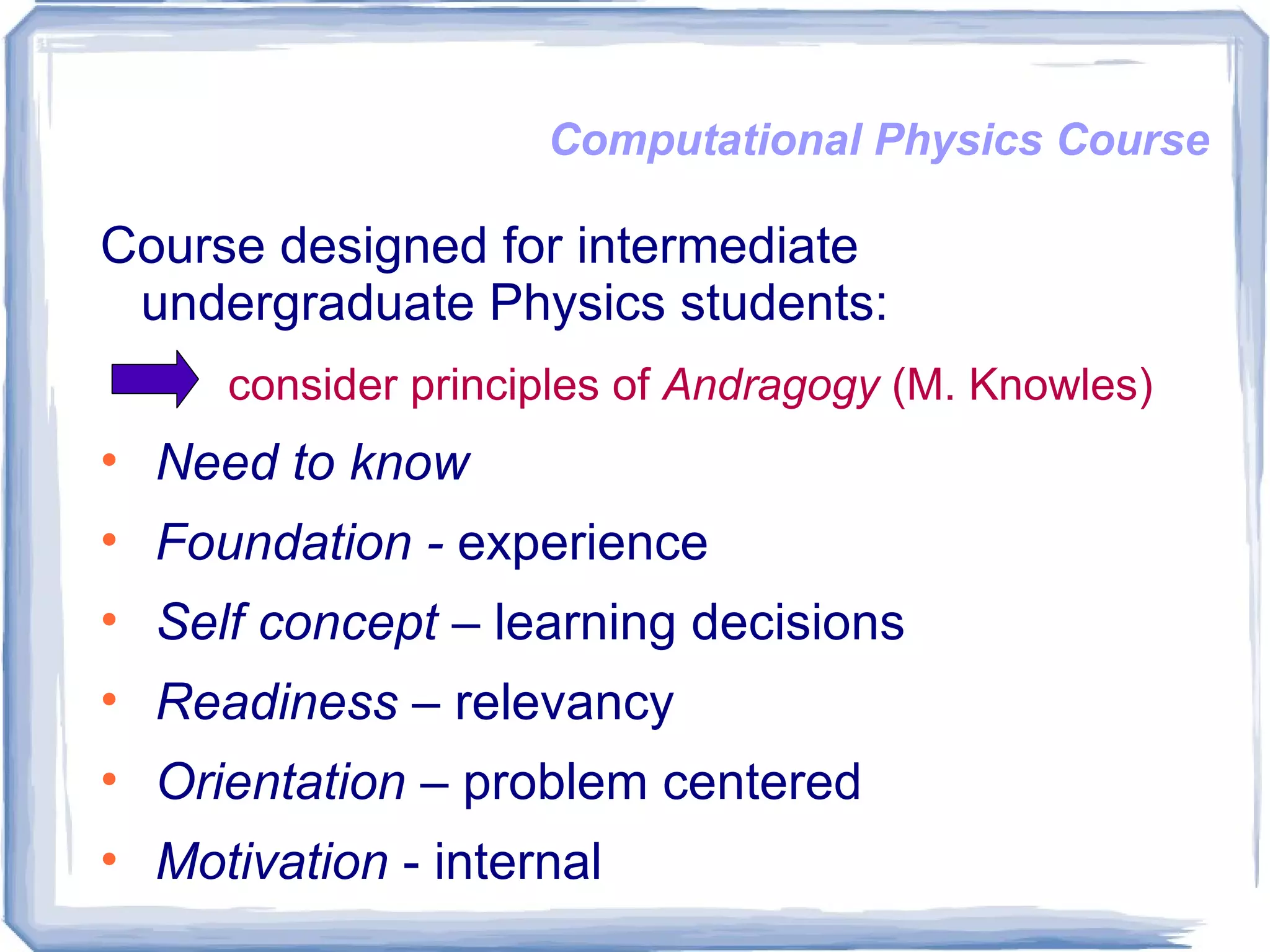
Computational Physics Course Course designed for intermediate undergraduate Physics students:  consider principles of  Andragogy  (M. Knowles) Need to know Foundation -  e xperience  Self concept  – learning decisions  Readiness  – relevancy Orientation  – problem centered Motivation  - internal
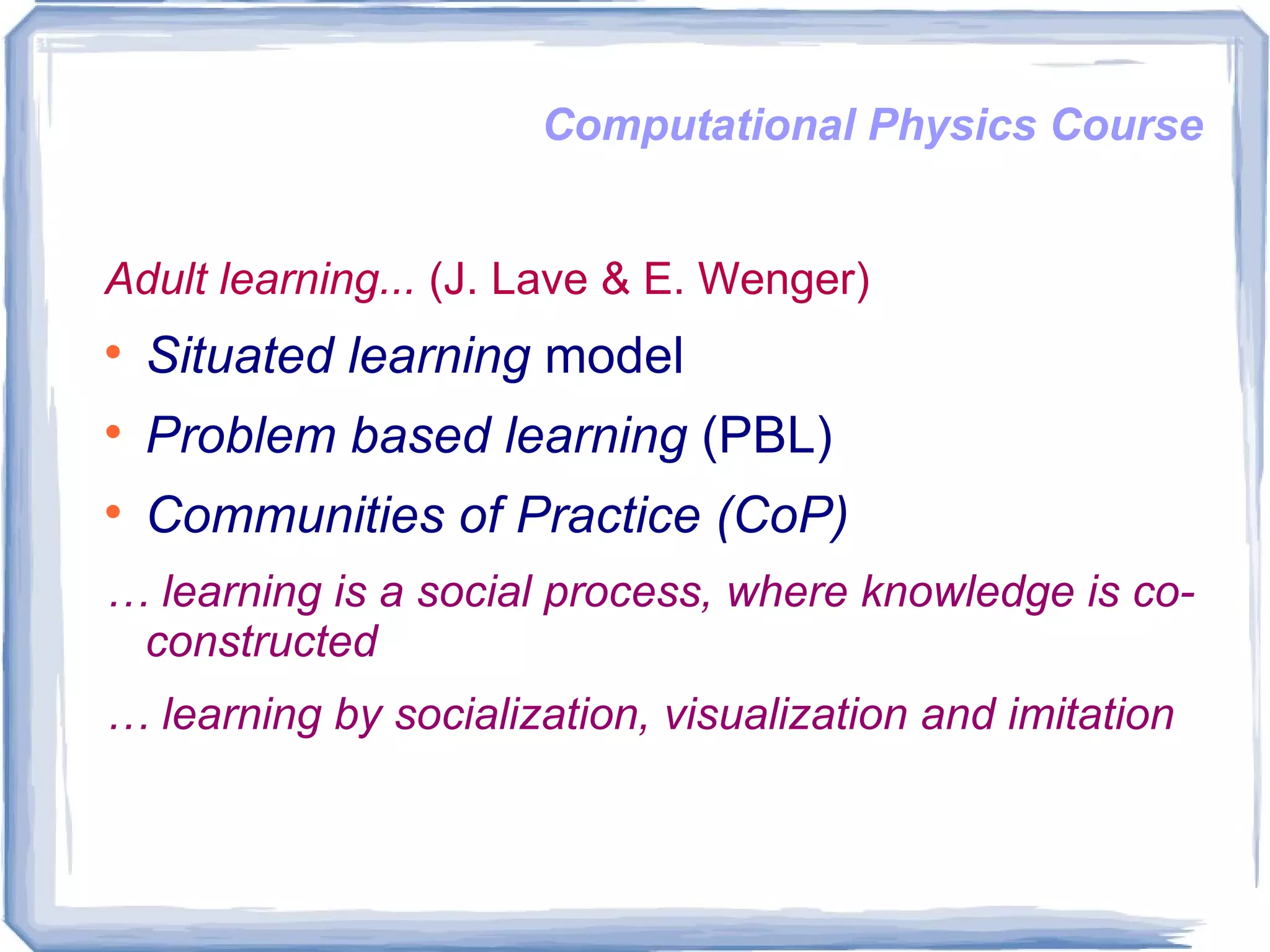
Computational Physics Course Adult learning...   (J. Lave & E. Wenger)  Situated learning  model Problem based learning  (PBL) Communities of Practice (CoP) …  learning is a social process, where knowledge is co-constructed …  learning by socialization, visualization and imitation
Computational Physics Course Methodology (Computational Science + Physics + Math + ICT)  The  Computational Physics Course  is designed around skill development in Scientific Computing
Computational Physics Course Specific skills Install and configure software applications Work in diverse computer programming environments.  Functions and data visualization  Scientific and technical document preparation  Use of scientific programming languages and specialized software libraries.
Computational Physics Course Specific skills (more)  ... Algorithm selection for numerically solving  ODE . Use of  CAS   for finding symbolic & numerical solutions and data visualization.
Computational Physics Course Transverse skills Scientific and technical document composition. Readings in a second language. Use of Information and Communication Technologies (ICT).  Time management.
Computational Physics Course Transverse skills   (more)  … Complex thinking. Self learning. Problem solving in holistic form. Collaborative work.
Computational Physics Course Didactic strategies Learner centered  focusing on skill development. Problem based learning  in a workshop format. Open learning format  (no classroom). F2F group sessions at the beginning of a new problem, with individual follow up F2F and/or thru Social Network group ( Facebook ).  Additional F2F group meetings when needed ( e.g.  no advances, to discuss new solving strategies).
Computational Physics Course Educational technologies involved. Linux based computer lab with FOSS software computational tools (Fortran, Python, Gnuplot, Maxima, Emacs, LaTeX, VirtualBox, other)  Open online resources and activities in a CMS:  Moodle, Grou.ps, Wikispaces.com, PBWorks.com, Wikipedia, …  Use of online tools: Blogs +  Google Docs
Computational Physics Course Examples of activities: Construction of an  e-folio  with learning evidences ( Blogger  +  Google Docs ). Scientific document preparation in  LaTeX , with equations and graphics. Identify the elements and parts of a  Python  program and modify it to solve a new problem. Problem solving using holistic thinking aided by the computer algebra system  Maxima
Computational Physics Course Results (Students opinion poll) Working format compared with other courses:  freedom to  manage their time ; free to ask and  experience by themselves ; they believe that  PBL is more realistic .  Changes that were needed to do in order to work in this course :  were allowed to  work at their own pace  when other courses advance at the instructor's pace; they were allowed to  experience without pressure , by establishing their own computational working environment and to  solve problems in a heuristic form .
Computational Physics Course 3)  Course development activities that were considered as appropriate:   The course  does not impose a learning ceiling ;  autonomy is granted to explore  new problems and try to find possible solutions and ask for instructor assistance when needed.  4 )  Advantages of the course format:  Work is done at students' own pace,  allows the possibility of better organizing the general academic work load , not only the CPC one.
Computational Physics Course 5)  Disadvantages of the course format:  without explicit pressure from the instructor,  there is a  risk of relaxation of the overall activities,  accumulating towards the end of the semester.  6)  What was learned in the CPC:  The  skills to learn new computational tools  that are significative and to be used elsewhere. 7)  Suggestions for improving the course:  To have  more frequent group sessions to share  each student  experience and  know how .
Computational Physics Course Conclusions The  workshop format  of the course, with complementary student's autonomous work, guided within a community of practice, fosters the development of skills, attitudes and knowledge described in the CPC program.
Computational Physics Course Computational Physics Course versions: Grou.ps:   http://grou.ps/zendoscero/ Wikispaces.com:   http://fisicacomputacional.wikispaces.com/ Pbworks.com:  http://fisicacomputacional.pbworks.com/ Thank You! Questions and comments E-mail:  [email_address]
International Congress on Physics Education ICPE 2011 Mexico http://www.icpe2011.net/ An Experience in Learning in an Open and Online Course on Computational Physics at Undergraduate Level Carlos Lizárraga-Celaya  Sara Lorelí Díaz-Martínez Departamento de Física  Universidad de Sonora México City, México Aug. 18 th  2011

Experience in learning in an open Computational Physics Course at undergraduate level

  • 1.
    International Congress onPhysics Education ICPE 2011 Mexico http://www.icpe2011.net/ An Experience in Learning in an Open and Online Course on Computational Physics at Undergraduate Level Carlos Lizárraga-Celaya Sara Lorelí Díaz-Martínez Departamento de Física Universidad de Sonora México City, México Aug. 18 th 2011
  • 2.
    Computational Physics CourseCourse designed for intermediate undergraduate Physics students: consider principles of Andragogy (M. Knowles) Need to know Foundation - e xperience Self concept – learning decisions Readiness – relevancy Orientation – problem centered Motivation - internal
  • 3.
    Computational Physics CourseAdult learning... (J. Lave & E. Wenger) Situated learning model Problem based learning (PBL) Communities of Practice (CoP) … learning is a social process, where knowledge is co-constructed … learning by socialization, visualization and imitation
  • 4.
    Computational Physics CourseMethodology (Computational Science + Physics + Math + ICT) The Computational Physics Course is designed around skill development in Scientific Computing
  • 5.
    Computational Physics CourseSpecific skills Install and configure software applications Work in diverse computer programming environments. Functions and data visualization Scientific and technical document preparation Use of scientific programming languages and specialized software libraries.
  • 6.
    Computational Physics CourseSpecific skills (more) ... Algorithm selection for numerically solving ODE . Use of CAS for finding symbolic & numerical solutions and data visualization.
  • 7.
    Computational Physics CourseTransverse skills Scientific and technical document composition. Readings in a second language. Use of Information and Communication Technologies (ICT). Time management.
  • 8.
    Computational Physics CourseTransverse skills (more) … Complex thinking. Self learning. Problem solving in holistic form. Collaborative work.
  • 9.
    Computational Physics CourseDidactic strategies Learner centered focusing on skill development. Problem based learning in a workshop format. Open learning format (no classroom). F2F group sessions at the beginning of a new problem, with individual follow up F2F and/or thru Social Network group ( Facebook ). Additional F2F group meetings when needed ( e.g. no advances, to discuss new solving strategies).
  • 10.
    Computational Physics CourseEducational technologies involved. Linux based computer lab with FOSS software computational tools (Fortran, Python, Gnuplot, Maxima, Emacs, LaTeX, VirtualBox, other) Open online resources and activities in a CMS: Moodle, Grou.ps, Wikispaces.com, PBWorks.com, Wikipedia, … Use of online tools: Blogs + Google Docs
  • 11.
    Computational Physics CourseExamples of activities: Construction of an e-folio with learning evidences ( Blogger + Google Docs ). Scientific document preparation in LaTeX , with equations and graphics. Identify the elements and parts of a Python program and modify it to solve a new problem. Problem solving using holistic thinking aided by the computer algebra system Maxima
  • 12.
    Computational Physics CourseResults (Students opinion poll) Working format compared with other courses: freedom to manage their time ; free to ask and experience by themselves ; they believe that PBL is more realistic . Changes that were needed to do in order to work in this course : were allowed to work at their own pace when other courses advance at the instructor's pace; they were allowed to experience without pressure , by establishing their own computational working environment and to solve problems in a heuristic form .
  • 13.
    Computational Physics Course3) Course development activities that were considered as appropriate: The course does not impose a learning ceiling ; autonomy is granted to explore new problems and try to find possible solutions and ask for instructor assistance when needed. 4 ) Advantages of the course format: Work is done at students' own pace, allows the possibility of better organizing the general academic work load , not only the CPC one.
  • 14.
    Computational Physics Course5) Disadvantages of the course format: without explicit pressure from the instructor, there is a risk of relaxation of the overall activities, accumulating towards the end of the semester. 6) What was learned in the CPC: The skills to learn new computational tools that are significative and to be used elsewhere. 7) Suggestions for improving the course: To have more frequent group sessions to share each student experience and know how .
  • 15.
    Computational Physics CourseConclusions The workshop format of the course, with complementary student's autonomous work, guided within a community of practice, fosters the development of skills, attitudes and knowledge described in the CPC program.
  • 16.
    Computational Physics CourseComputational Physics Course versions: Grou.ps: http://grou.ps/zendoscero/ Wikispaces.com: http://fisicacomputacional.wikispaces.com/ Pbworks.com: http://fisicacomputacional.pbworks.com/ Thank You! Questions and comments E-mail: [email_address]
  • 17.
    International Congress onPhysics Education ICPE 2011 Mexico http://www.icpe2011.net/ An Experience in Learning in an Open and Online Course on Computational Physics at Undergraduate Level Carlos Lizárraga-Celaya Sara Lorelí Díaz-Martínez Departamento de Física Universidad de Sonora México City, México Aug. 18 th 2011