Learning intentions
Chapter 3
Textbookpage reference: 21
In this chapter you will learn to:
› Explain the difference between fixed, irregular and discretionary
spending
› Appreciate the need to prioritise expenditure
› Explain the difference between current and capital expenditure
› Define the terms ‘impulse buying’ and ‘false economy’
› Prepare a household expenditure plan.
3.
What is expenditure?
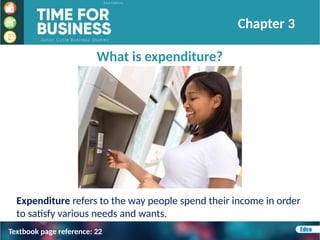
Expenditurerefers to the way people spend their income in order
to satisfy various needs and wants.
Chapter 3
Textbook page reference: 22
4.
Types of expenditure
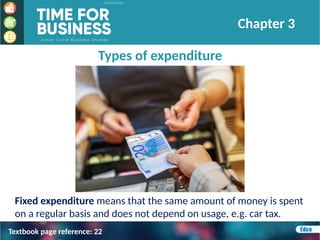
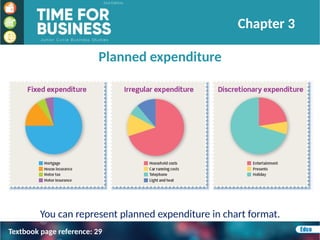
Fixedexpenditure means that the same amount of money is spent
on a regular basis and does not depend on usage, e.g. car tax.
Chapter 3
Textbook page reference: 22
5.
Types of expenditure
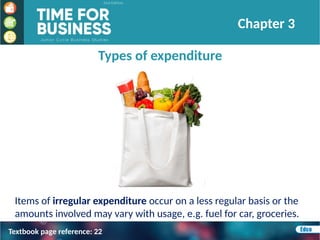
Itemsof irregular expenditure occur on a less regular basis or the
amounts involved may vary with usage, e.g. fuel for car, groceries.
Chapter 3
Textbook page reference: 22
6.
Types of expenditure
Discretionaryexpenditure is spending on non-essential items that
we choose to buy, e.g. holidays and gifts.
Chapter 3
Textbook page reference: 23
7.
Current expenditure vscapital expenditure
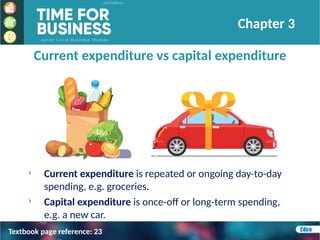
› Current expenditure is repeated or ongoing day-to-day
spending, e.g. groceries.
› Capital expenditure is once-off or long-term spending,
e.g. a new car.
Chapter 3
Textbook page reference: 23
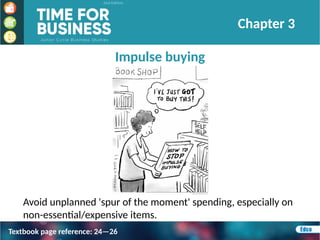
Impulse buying
Avoid unplanned'spur of the moment' spending, especially on
non-essential/expensive items.
Chapter 3
Textbook page reference: 24—26
13.
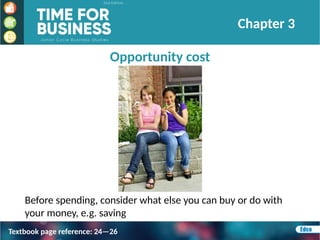
Opportunity cost
Before spending,consider what else you can buy or do with
your money, e.g. saving
Chapter 3
Textbook page reference: 24—26
14.
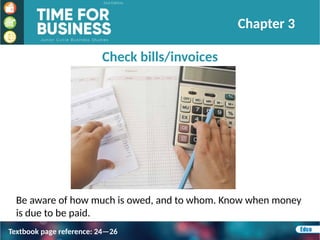
Check bills/invoices
Be awareof how much is owed, and to whom. Know when money
is due to be paid.
Chapter 3
Textbook page reference: 24—26
15.
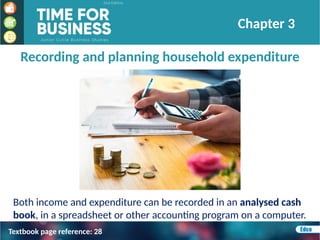
Recording and planninghousehold expenditure
Both income and expenditure can be recorded in an analysed cash
book, in a spreadsheet or other accounting program on a computer.
Chapter 3
Textbook page reference: 28
16.
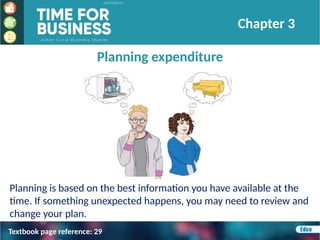
Planning expenditure
Planning isbased on the best information you have available at the
time. If something unexpected happens, you may need to review and
change your plan.
Chapter 3
Textbook page reference: 29
17.
Planned expenditure
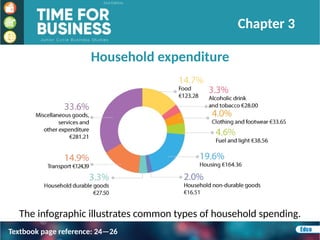
You canrepresent planned expenditure in chart format.
Chapter 3
Textbook page reference: 29
18.
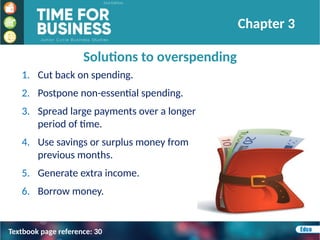
Solutions to overspending
1.Cut back on spending.
2. Postpone non-essential spending.
3. Spread large payments over a longer
period of time.
4. Use savings or surplus money from
previous months.
5. Generate extra income.
6. Borrow money.
Chapter 3
Textbook page reference: 30
19.
Recap and Review
Chapter3
Can you?
› Explain the difference between fixed, irregular and discretionary
spending?
› Appreciate the need to prioritise expenditure?
› Explain the difference between current and capital expenditure?
› Define the terms ‘impulse buying’ and ‘false economy’?
› Prepare a household expenditure plan?