Expectancy-Value
Theories
Unnimaya
Theories of motivation
Cognitive motivation &
Cognitive theories of motivation assume that behaviour is directed as a
result of the active processing and interpretation of information.
Motivation is not seen as a mechanical or innate set of processes but as
a purposive and persistent set of behaviours based on the information
available.
curiosity, cognitive dissonance, achievement motivation etc
are different forms of cognitive motivation.
Cognitive motivation
Expectancy-value theories permits the systematic integration of person
and situation factors in models that yield predictions about behavior.
Although the expectancy of being able to attain a particular goal is largely
dependent on situation factors, its value is very much "in the eye of the
beholder and thus conditional on the individual's implicit and explicit
motivational sate. People are most likely to perform an action when the
product of expectancy and value is at its highest.
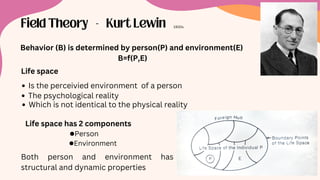
Field Theory - Kurt Lewin
Life space
Is the perceivied environment of a person
The psychological reality
Which is not identical to the physical reality
Behavior (B) is determined by person(P) and environment(E)
B=f(P,E)
Life space has 2 components
●Person
●Environment
Both person and environment has
structural and dynamic properties
1930s
Person
•Person is a point or region in lifespace
•Within a person there are sub regions ,which are like
containers/vessels with walls.
•Those vessels contain tensions arising out of needs.
•Walls of these vessels have different permeability.
Structure
Dynamic
•When there is a need particular region is in state of tension
•Amount of tension varies depending on the strength of the need
•When boundary between two regions are permeable, tension flow
from one region to another
•Each tense region is associated with particular goal and tension is
reduced by realizing the goal or consuming it
A need or an intention creates tension in a region of the person.
The disequilibrium in tense states between regions causes tension to
flow from one region to another if the walls are permeable.
If the boundaries are not completely permeable, then a region can
remain in a relatively fixed tense state.
Tension is postulated to dissipate following goal at- tainment, which
re-establishes equilibrium between the regions.
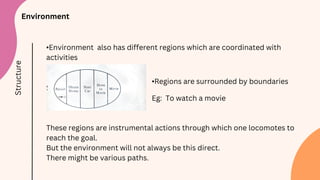
Environment
•Environment also has different regions which are coordinated with
activities
Structure
•Regions are surrounded by boundaries
Eg: To watch a movie
These regions are instrumental actions through which one locomotes to
reach the goal.
But the environment will not always be this direct.
There might be various paths.
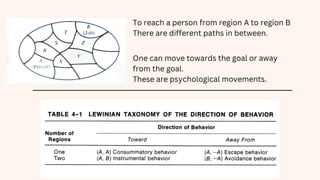
To reach a person from region A to region B
There are different paths in between.
One can move towards the goal or away
from the goal.
These are psychological movements.
Dynamic
Environment
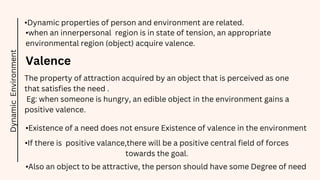
•Dynamic properties of person and environment are related.
•when an innerpersonal region is in state of tension, an appropriate
environmental region (object) acquire valence.
Valence
The property of attraction acquired by an object that is perceived as one
that satisfies the need .
Eg: when someone is hungry, an edible object in the environment gains a
positive valence.
•Existence of a need does not ensure Existence of valence in the environment
•Also an object to be attractive, the person should have some Degree of need
•If there is positive valance,there will be a positive central field of forces
towards the goal.
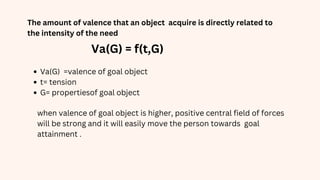
The amount of valence that an object acquire is directly related to
the intensity of the need
Va(G) = f(t,G)
Va(G) =valence of goal object
t= tension
G= propertiesof goal object
when valence of goal object is higher, positive central field of forces
will be strong and it will easily move the person towards goal
attainment .
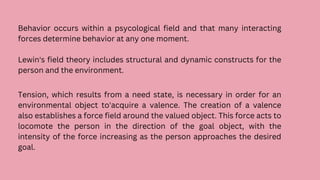
Behavior occurs within a psycological field and that many interacting
forces determine behavior at any one moment.
Lewin's field theory includes structural and dynamic constructs for the
person and the environment.
Tension, which results from a need state, is necessary in order for an
environmental object to'acquire a valence. The creation of a valence
also establishes a force field around the valued object. This force acts to
locomote the person in the direction of the goal object, with the
intensity of the force increasing as the person approaches the desired
goal.
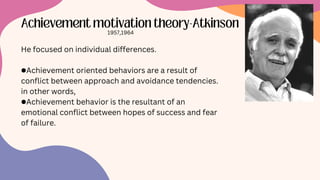
Achievement motivation theory-Atkinson
He focused on individual differences.
●Achievement oriented behaviors are a result of
conflict between approach and avoidance tendencies.
in other words,
●Achievement behavior is the resultant of an
emotional conflict between hopes of success and fear
of failure.
1957,1964
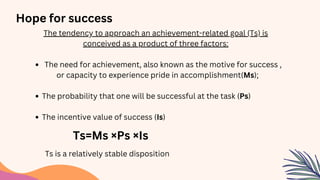
The tendency to approach an achievement-related goal (Ts) is
conceived as a product of three factors:
The need for achievement, also known as the motive for success ,
or capacity to experience pride in accomplishment(Ms);
The probability that one will be successful at the task (Ps)
The incentive value of success (Is)
Hope for success
Ts=Ms ×Ps ×Is
Ts is a relatively stable disposition
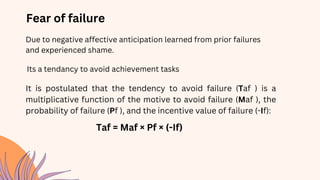
Fear of failure
Due to negative affective anticipation learned from prior failures
and experienced shame.
Its a tendancy to avoid achievement tasks
It is postulated that the tendency to avoid failure (Taf ) is a
multiplicative function of the motive to avoid failure (Maf ), the
probability of failure (Pf ), and the incentive value of failure (-If):
Taf = Maf × Pf × (-If)
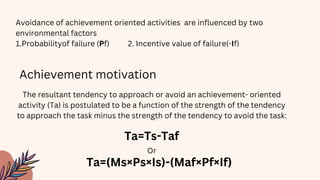
Avoidance of achievement oriented activities are influenced by two
environmental factors
1.Probabilityof failure (Pf) 2. Incentive value of failure(-If)
Achievement motivation
The resultant tendency to approach or avoid an achievement- oriented
activity (Ta) is postulated to be a function of the strength of the tendency
to approach the task minus the strength of the tendency to avoid the task:
Ta=Ts-Taf
Ta=(Ms×Ps×Is)-(Maf×Pf×If)
Or
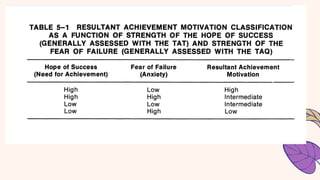
The theory specifies that achievement-related behavior
is a result of a conflict between a hope of success (approach motivation)
and a fear of failure (avoidance motivation). The approach and avoidance
tendencies, in turn, are a function of achievement-related needs (need for
achievement and anxiety about failure), the expectancy of success and
failure, and the incentive value of success and failure.
Incentive value of achievement task is determined by the probability of
success.
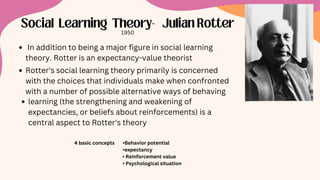
Social Learning Theory- Julian Rotter
4 basic concepts •Behavior potential
•expectancy
• Reinforcement value
• Psychological situation
1950
In addition to being a major figure in social learning
theory. Rotter is an expectancy-value theorist
Rotter's social learning theory primarily is concerned
with the choices that individuals make when confronted
with a number of possible alternative ways of behaving
learning (the strengthening and weakening of
expectancies, or beliefs about reinforcements) is a
central aspect to Rotter's theory
Behavior potential = f( expectancy of reward and reward value of the goal)
1.Behavior potential
It is the likelihood for any given behavior to occur "as calculated in relation to
any single reinforcement or set of reinforcements" (Rotter, 1972)
The probability that the person will exhibit a particular behavior in a situation.
In any given situation, there are multiple behaviors one can engage in.
For each possible behavior, there is a behavior potential.
The individual will exhibit whichever behavior has the highest potential.
2.Expectancy
"probability held by the individual that a particular reinforcement will occur
as a function of a specific behavior on his part in a specific situation" (Rotter,
1954, p. 107).
Rotter considers expectancy to be a subjective probability: It may or may
not be identical with the true or objective likelihood of reaching one's goal.
For example, a person's beliefs about making a friend at a party will be
influenced by prior experiences at parties and by the outcome of friendship
attempts made in a wide variety of social settings
3.Reinforcement value
Reinforcement value refers to "the degree of preference for any
reinforcement " (Rotter, 1954)
The reinforcement value of a goal is clearly linked with the needs of an
individual
4.Psychological situation
psychological situation represents Rotter's idea that each individual's
experience of the environment is unique.
Rotter believes it is always important to keep in mind that different
people interpret the same situation differently. Different people will have
different expectancies and reinforcement values in the same situation.
Thus, it is people's subjective interpretation of the environment, rather
than an objective array of stimuli, that is meaningful to them and that
determines how they behave.
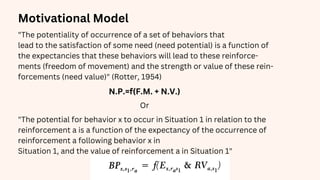
Motivational Model
N.P.=f(F.M. + N.V.)
"The potentiality of occurrence of a set of behaviors that
lead to the satisfaction of some need (need potential) is a function of
the expectancies that these behaviors will lead to these reinforce-
ments (freedom of movement) and the strength or value of these rein-
forcements (need value)" (Rotter, 1954)
Or
"The potential for behavior x to occur in Situation 1 in relation to the
reinforcement a is a function of the expectancy of the occurrence of
reinforcement a following behavior x in
Situation 1, and the value of reinforcement a in Situation 1"
Julian Rotter has formulated an expectancy-value theory of behavior
from the perspective of social learning. He postulates that behavior poten-
tial is determined by the expectancy of goal attainment and the value of
the goal or Teinforcer. Expectancy. in turn. is believed to be a product of
the prior reinforcement history in a specific stimulus situation and a
generalized belief about reinforcers learned from behaviors in similar situ-
ations. Although expectancy and value are independent, the interrelation-
ships between these constructs greatly affect personal adjustment. A low
expectancy of success coupled with a highly valued goal is particularly
likely to generate behavioral problems.
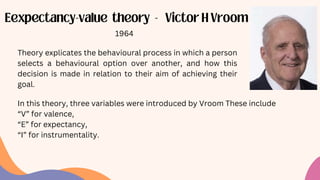
Eexpectancy-value theory - Victor H Vroom
1964
Theory explicates the behavioural process in which a person
selects a behavioural option over another, and how this
decision is made in relation to their aim of achieving their
goal.
In this theory, three variables were introduced by Vroom These include
“V” for valence,
“E” for expectancy,
“I” for instrumentality.
Expectancy
Expectancy is a variable that represents the belief that the effort (E) of an
individual is an outcome of a a need to attain the performance (P) goals
that he desires. The theory states that there are three factors that
influence the expectancy perception of a person, which include:
• Self efficacy – the individual’s belief regarding his own ability to perform
a specific behaviour successfully.
• Goal difficulty – occurs when the desired performance goals are too
high that might result to low expectancy perceptions.
• Control – the degree of a person’s perceived control over his
performance.
Valence
Valence refers to the value that a person sets on the reinforcements or
rewards. Setting values are usually based on an individual’s values,
needs, goals and intrinsic or extrinsic sources of motivation. Valence
include -1, which means the person is trying to avoid the outcome, 0,
which means the person feels indifferent towards the results, and +1,
which means that he welcomes the results.
Instrumentality
Instrumentality refers to the notion that a person will get a reward upon
the satisfaction of the expected performance. The reward may present in
various forms – it can be intrinsic or extrinsic, monetary or non-
monetary. If this reward is similar for all the activities that a person must
perform, instrumentality is said to be low. There are three factors
influencing instrumentality: policies, control and trust.
Motivational Force
The product of the three aforementioned variables – expectancy,
valence and instrumentality – is called the motivational force.
Motivational Force (MF) = Expectancy x Instrumentality x Valence
If these three variables are “high” or strong in an individual, then his
motivation is also greater
Expectancy-value-theories.cognitive-motivation.pdf

Expectancy-value-theories.cognitive-motivation.pdf

  • 1.
  • 2.
    Cognitive theories ofmotivation assume that behaviour is directed as a result of the active processing and interpretation of information. Motivation is not seen as a mechanical or innate set of processes but as a purposive and persistent set of behaviours based on the information available. curiosity, cognitive dissonance, achievement motivation etc are different forms of cognitive motivation. Cognitive motivation
  • 3.
    Expectancy-value theories permitsthe systematic integration of person and situation factors in models that yield predictions about behavior. Although the expectancy of being able to attain a particular goal is largely dependent on situation factors, its value is very much "in the eye of the beholder and thus conditional on the individual's implicit and explicit motivational sate. People are most likely to perform an action when the product of expectancy and value is at its highest.
  • 4.
    Field Theory -Kurt Lewin Life space Is the perceivied environment of a person The psychological reality Which is not identical to the physical reality Behavior (B) is determined by person(P) and environment(E) B=f(P,E) Life space has 2 components ●Person ●Environment Both person and environment has structural and dynamic properties 1930s
  • 5.
    Person •Person is apoint or region in lifespace •Within a person there are sub regions ,which are like containers/vessels with walls. •Those vessels contain tensions arising out of needs. •Walls of these vessels have different permeability. Structure Dynamic •When there is a need particular region is in state of tension •Amount of tension varies depending on the strength of the need •When boundary between two regions are permeable, tension flow from one region to another •Each tense region is associated with particular goal and tension is reduced by realizing the goal or consuming it
  • 6.
    A need oran intention creates tension in a region of the person. The disequilibrium in tense states between regions causes tension to flow from one region to another if the walls are permeable. If the boundaries are not completely permeable, then a region can remain in a relatively fixed tense state. Tension is postulated to dissipate following goal at- tainment, which re-establishes equilibrium between the regions.
  • 7.
    Environment •Environment also hasdifferent regions which are coordinated with activities Structure •Regions are surrounded by boundaries Eg: To watch a movie These regions are instrumental actions through which one locomotes to reach the goal. But the environment will not always be this direct. There might be various paths.
  • 8.
    To reach aperson from region A to region B There are different paths in between. One can move towards the goal or away from the goal. These are psychological movements.
  • 9.
    Dynamic Environment •Dynamic properties ofperson and environment are related. •when an innerpersonal region is in state of tension, an appropriate environmental region (object) acquire valence. Valence The property of attraction acquired by an object that is perceived as one that satisfies the need . Eg: when someone is hungry, an edible object in the environment gains a positive valence. •Existence of a need does not ensure Existence of valence in the environment •Also an object to be attractive, the person should have some Degree of need •If there is positive valance,there will be a positive central field of forces towards the goal.
  • 10.
    The amount ofvalence that an object acquire is directly related to the intensity of the need Va(G) = f(t,G) Va(G) =valence of goal object t= tension G= propertiesof goal object when valence of goal object is higher, positive central field of forces will be strong and it will easily move the person towards goal attainment .
  • 11.
    Behavior occurs withina psycological field and that many interacting forces determine behavior at any one moment. Lewin's field theory includes structural and dynamic constructs for the person and the environment. Tension, which results from a need state, is necessary in order for an environmental object to'acquire a valence. The creation of a valence also establishes a force field around the valued object. This force acts to locomote the person in the direction of the goal object, with the intensity of the force increasing as the person approaches the desired goal.
  • 12.
    Achievement motivation theory-Atkinson Hefocused on individual differences. ●Achievement oriented behaviors are a result of conflict between approach and avoidance tendencies. in other words, ●Achievement behavior is the resultant of an emotional conflict between hopes of success and fear of failure. 1957,1964
  • 13.
    The tendency toapproach an achievement-related goal (Ts) is conceived as a product of three factors: The need for achievement, also known as the motive for success , or capacity to experience pride in accomplishment(Ms); The probability that one will be successful at the task (Ps) The incentive value of success (Is) Hope for success Ts=Ms ×Ps ×Is Ts is a relatively stable disposition
  • 14.
    Fear of failure Dueto negative affective anticipation learned from prior failures and experienced shame. Its a tendancy to avoid achievement tasks It is postulated that the tendency to avoid failure (Taf ) is a multiplicative function of the motive to avoid failure (Maf ), the probability of failure (Pf ), and the incentive value of failure (-If): Taf = Maf × Pf × (-If)
  • 15.
    Avoidance of achievementoriented activities are influenced by two environmental factors 1.Probabilityof failure (Pf) 2. Incentive value of failure(-If) Achievement motivation The resultant tendency to approach or avoid an achievement- oriented activity (Ta) is postulated to be a function of the strength of the tendency to approach the task minus the strength of the tendency to avoid the task: Ta=Ts-Taf Ta=(Ms×Ps×Is)-(Maf×Pf×If) Or
  • 17.
    The theory specifiesthat achievement-related behavior is a result of a conflict between a hope of success (approach motivation) and a fear of failure (avoidance motivation). The approach and avoidance tendencies, in turn, are a function of achievement-related needs (need for achievement and anxiety about failure), the expectancy of success and failure, and the incentive value of success and failure. Incentive value of achievement task is determined by the probability of success.
  • 18.
    Social Learning Theory-Julian Rotter 4 basic concepts •Behavior potential •expectancy • Reinforcement value • Psychological situation 1950 In addition to being a major figure in social learning theory. Rotter is an expectancy-value theorist Rotter's social learning theory primarily is concerned with the choices that individuals make when confronted with a number of possible alternative ways of behaving learning (the strengthening and weakening of expectancies, or beliefs about reinforcements) is a central aspect to Rotter's theory
  • 19.
    Behavior potential =f( expectancy of reward and reward value of the goal) 1.Behavior potential It is the likelihood for any given behavior to occur "as calculated in relation to any single reinforcement or set of reinforcements" (Rotter, 1972) The probability that the person will exhibit a particular behavior in a situation. In any given situation, there are multiple behaviors one can engage in. For each possible behavior, there is a behavior potential. The individual will exhibit whichever behavior has the highest potential.
  • 20.
    2.Expectancy "probability held bythe individual that a particular reinforcement will occur as a function of a specific behavior on his part in a specific situation" (Rotter, 1954, p. 107). Rotter considers expectancy to be a subjective probability: It may or may not be identical with the true or objective likelihood of reaching one's goal. For example, a person's beliefs about making a friend at a party will be influenced by prior experiences at parties and by the outcome of friendship attempts made in a wide variety of social settings
  • 21.
    3.Reinforcement value Reinforcement valuerefers to "the degree of preference for any reinforcement " (Rotter, 1954) The reinforcement value of a goal is clearly linked with the needs of an individual
  • 22.
    4.Psychological situation psychological situationrepresents Rotter's idea that each individual's experience of the environment is unique. Rotter believes it is always important to keep in mind that different people interpret the same situation differently. Different people will have different expectancies and reinforcement values in the same situation. Thus, it is people's subjective interpretation of the environment, rather than an objective array of stimuli, that is meaningful to them and that determines how they behave.
  • 23.
    Motivational Model N.P.=f(F.M. +N.V.) "The potentiality of occurrence of a set of behaviors that lead to the satisfaction of some need (need potential) is a function of the expectancies that these behaviors will lead to these reinforce- ments (freedom of movement) and the strength or value of these rein- forcements (need value)" (Rotter, 1954) Or "The potential for behavior x to occur in Situation 1 in relation to the reinforcement a is a function of the expectancy of the occurrence of reinforcement a following behavior x in Situation 1, and the value of reinforcement a in Situation 1"
  • 24.
    Julian Rotter hasformulated an expectancy-value theory of behavior from the perspective of social learning. He postulates that behavior poten- tial is determined by the expectancy of goal attainment and the value of the goal or Teinforcer. Expectancy. in turn. is believed to be a product of the prior reinforcement history in a specific stimulus situation and a generalized belief about reinforcers learned from behaviors in similar situ- ations. Although expectancy and value are independent, the interrelation- ships between these constructs greatly affect personal adjustment. A low expectancy of success coupled with a highly valued goal is particularly likely to generate behavioral problems.
  • 25.
    Eexpectancy-value theory -Victor H Vroom 1964 Theory explicates the behavioural process in which a person selects a behavioural option over another, and how this decision is made in relation to their aim of achieving their goal. In this theory, three variables were introduced by Vroom These include “V” for valence, “E” for expectancy, “I” for instrumentality.
  • 26.
    Expectancy Expectancy is avariable that represents the belief that the effort (E) of an individual is an outcome of a a need to attain the performance (P) goals that he desires. The theory states that there are three factors that influence the expectancy perception of a person, which include: • Self efficacy – the individual’s belief regarding his own ability to perform a specific behaviour successfully. • Goal difficulty – occurs when the desired performance goals are too high that might result to low expectancy perceptions. • Control – the degree of a person’s perceived control over his performance.
  • 27.
    Valence Valence refers tothe value that a person sets on the reinforcements or rewards. Setting values are usually based on an individual’s values, needs, goals and intrinsic or extrinsic sources of motivation. Valence include -1, which means the person is trying to avoid the outcome, 0, which means the person feels indifferent towards the results, and +1, which means that he welcomes the results.
  • 28.
    Instrumentality Instrumentality refers tothe notion that a person will get a reward upon the satisfaction of the expected performance. The reward may present in various forms – it can be intrinsic or extrinsic, monetary or non- monetary. If this reward is similar for all the activities that a person must perform, instrumentality is said to be low. There are three factors influencing instrumentality: policies, control and trust.
  • 29.
    Motivational Force The productof the three aforementioned variables – expectancy, valence and instrumentality – is called the motivational force. Motivational Force (MF) = Expectancy x Instrumentality x Valence If these three variables are “high” or strong in an individual, then his motivation is also greater