qwertyuiopasdfghjklzxcvbnmqw
ertyuiopasdfghjklzxcvbnmqwert
yuiopasdfghjklzxcvbnmqwertyui
opasdfghjklzxcvbnmqwertyuiopa
sdfghjklzxcvbnmqwertyuiopasdf
ghjklzxcvbnmqwertyuiopasdfghj
klzxcvbnmqwertyuiopasdfghjklz
xcvbnmqwertyuiopasdfghjklzxcv
bnmqwertyuiopasdfghjklzxcvbn
mqwertyuiopasdfghjklzxcvbnmq
wertyuiopasdfghjklzxcvbnmqwe
rtyuiopasdfghjklzxcvbnmqwerty
uiopasdfghjklzxcvbnmqwertyuio
pasdfghjklzxcvbnmqwertyuiopas
dfghjklzxcvbnmqwertyuiopasdfg
hjklzxcvbnmqwertyuiopasdfghjk
Managerial Accounting Paper
Submitted by : Asim Javed
12/30/2013
Submitted to : Sir tariq Javed
1
Q # 01 : (Theory Part) (20 Marks)
1. Briefly define total cost and marginal cost.
2. Briefly explain the concept of economic profit maximizing price.
3. What is product cost distortion?
4. List and briefly describe four major influences on price decision.
5. Describe three limitations of the economic, profit maximizing model of pricing.
Q # 02 : (15 MARKS)
Direct Labor and Manufacturing Overhead Budgets
The Production Department of Zan Corporation has submitted the following forecast of units to
be produced by quarter for the upcoming fiscal year.
1st Quarter 2nd Quarter 3rd Quarter 4th Quarter
Units to be produced . . . . 5000 8000 7,000 6,000
Each unit requires 1 direct labor-hour and direct laborers are paid $10.00 per hour.
In addition, the variable manufacturing overhead rate is $2 per direct labor-hour. The fixed
Manufacturing overhead is $90,000 per quarter. The only noncash element of manufacturing
overhead is depreciation, which is $25,000 per quarter.
Required:
1. Prepare the company’s direct labor budget for the upcoming fiscal year, assuming that the
direct labor work force is adjusted each quarter to match the number of hours required to produce
the forecasted number of units produced.
2. Prepare the company’s manufacturing overhead budget.
Q # 03 : (10 MARKS)
Schedules of Expected Cash Collections and Disbursements You have been asked to prepare a
December cash budget for Ashton Company, a distributor of exercise equipment. The following
information is available about the company’s operations:
a. The cash balance on December 1 is $50,000.
b. Actual sales for October and November and expected sales for December are as follows:
October November December
Cash sales . . . . . . . . . . . $70,000 $80,000 $75,000
Sales on account . . . . . . $500,000 $555,000 $700,000
2
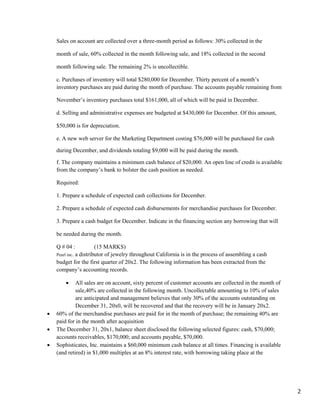
Sales on account are collected over a three-month period as follows: 30% collected in the
month of sale, 60% collected in the month following sale, and 18% collected in the second
month following sale. The remaining 2% is uncollectible.
c. Purchases of inventory will total $280,000 for December. Thirty percent of a month’s
inventory purchases are paid during the month of purchase. The accounts payable remaining from
November’s inventory purchases total $161,000, all of which will be paid in December.
d. Selling and administrative expenses are budgeted at $430,000 for December. Of this amount,
$50,000 is for depreciation.
e. A new web server for the Marketing Department costing $76,000 will be purchased for cash
during December, and dividends totaling $9,000 will be paid during the month.
f. The company maintains a minimum cash balance of $20,000. An open line of credit is available
from the company’s bank to bolster the cash position as needed.
Required:
1. Prepare a schedule of expected cash collections for December.
2. Prepare a schedule of expected cash disbursements for merchandise purchases for December.
3. Prepare a cash budget for December. Indicate in the financing section any borrowing that will
be needed during the month.
Q # 04 : (15 MARKS)
Pearl inc. a distributor of jewelry throughout California is in the process of assembling a cash
budget for the first quarter of 20x2. The following information has been extracted from the
company’s accounting records.
 All sales are on account, sixty percent of customer accounts are collected in the month of
sale,40% are collected in the following month. Uncollectable amounting to 10% of sales
are anticipated and management believes that only 30% of the accounts outstanding on
December 31, 20x0, will be recovered and that the recovery will be in January 20x2.
 60% of the merchandise purchases are paid for in the month of purchase; the remaining 40% are
paid for in the month after acquisition
 The December 31, 20x1, balance sheet disclosed the following selected figures: cash, $70,000;
accounts receivables, $170,000; and accounts payable, $70,000.
 Sophisticates, Inc. maintains a $60,000 minimum cash balance at all times. Financing is available
(and retired) in $1,000 multiples at an 8% interest rate, with borrowing taking place at the
3
beginning of the month and repayments occurring at the end of the month. Interest is paid at the
time of repaying principal repaid at that time.
 Additional data
January February March
 Sales Revenue . . . . . . . $450,000 $540,000 $555,000
 Merchandise Purchase. . . . . . $270,000 $300,000 420,000
 Cash Operating Cost. . . . . . 93,000 72,000 135,000
 Proceeds from sales of - - 15,000
equipment
Required:
1. Prepare a schedule that discloses the firm’s total cash collection for January through March
2. Prepare a schedule that discloses the firm’s total cash disbursements for January through March
3. Prepare a schedule that discloses the firm’s cash needs for January through March. The schedule
should present the following information in the order cited; Beginning cash balance, total receipts
(from equipment), total payments (from equipment 2). The cash excess (deficiency) before
financing, borrowing needed to maintain minimum balance, loan principal, loan interest paid, and
ending cash balance.
Q # 05 : (10 MARKS)
Direct Labor Variances
MPC, Inc., prepares in-flight meals for a number of major airlines. One of the company’s
products is grilled salmon in dill sauce with baby new potatoes and spring vegetables. During the
most recent week, the company prepared 4,000 of these meals using 960 direct labor-hours. The
company paid these direct labor workers a total of $9,600 for this work, or $10.00 per hour.
According to the standard cost card for this meal, it should require 0.25 direct labor-hours at a
cost of $9.75 per hour.
Required:
1. What direct labor cost should have been incurred to prepare 4,000 meals? How much does this
differ from the actual direct labor cost?
2. Break down the difference computed in (1) above into a labor rate variance and a labor
efficiency variance.
Q # 06 : (10 MARKS)
Direct Materials Variances
Bandar Industries Berhad of Malaysia manufactures sporting equipment. One of the company’s
Products, a football helmet for the North American market, require a special plastic. During the
quarter ending June 30, the company manufactured 35,000 helmets, using 22,500 kilograms of
plastic. The plastic cost the company RM 171,000. (The currency in Malaysia is the ringgit,
which
is denoted here by RM.)
4
According to the standard cost card, each helmet should require 0.6 kilograms of plastic, at a
cost of RM 8 per kilogram.
Required:
1. What cost for plastic should have been incurred to make 35,000 helmets? How much greater
or less is this than the cost that was incurred?
2. Break down the difference computed in (1) above into a materials price variance and a
materials quantity variance.
Q # 07 : (20 MARKS)
Kitchenware Corporation manufactures high-quality copper pots and pans. Gretta Cooke, one of
the company’s price analysts, is involved in setting a price for the company’s new Starter Set.
This set consists of seven of the most commonly used pots and pans. During the next year, the
company plans to produce 10,000 Starter Sets, and the controller has provided Cooke with the
following cost data.
Predicted costs of 10,000 Starter Sets
Direct material per set . . . . . . . . . . . . . . . . . . . . . . . . .. . . . . . .. . . . . . $60
Direct labor per set, 2 hours at $10,000 per hr. . . . . . .. . . . . . .. . . . . 20
Variable selling cost per set . . . . . . .. . . . . . .. . . . . . .. . . . . . .. . . . . . . . . 5
Total . . . . . . .. . . . . . .. . . . . . .. . . . . . .. . . . . . .. . . . . . .. . . . . . .. . . . . . $85
Variable-Overhead rate. . . . . . .. . . . . . .. . . . . . .. . . . . . .. . . . $8.00 per direct-labor hour
Fixed-Overhead rate. . . . . . .. . . . . . .. . . . . . .. . . . . . .. . . . . . .$12.00 per direct-labor hour
In addition, the controller indicated that the Accounting Department would allocate $20,000 of
fixed administrative expenses to the Starter Set product line.
Required:
1. Compute the cost of Starter Set using each of the four cost definition commonly used in cost plus
pricing formulas.
2. Determine the markup percentage required for the Starter Set product line to earn a target profit
of $317,000 before taxes during the next year. Use the total cost as the cost definition in the cost
plus pricing formula.

Accounting paper final

  • 1.
  • 2.
    1 Q # 01: (Theory Part) (20 Marks) 1. Briefly define total cost and marginal cost. 2. Briefly explain the concept of economic profit maximizing price. 3. What is product cost distortion? 4. List and briefly describe four major influences on price decision. 5. Describe three limitations of the economic, profit maximizing model of pricing. Q # 02 : (15 MARKS) Direct Labor and Manufacturing Overhead Budgets The Production Department of Zan Corporation has submitted the following forecast of units to be produced by quarter for the upcoming fiscal year. 1st Quarter 2nd Quarter 3rd Quarter 4th Quarter Units to be produced . . . . 5000 8000 7,000 6,000 Each unit requires 1 direct labor-hour and direct laborers are paid $10.00 per hour. In addition, the variable manufacturing overhead rate is $2 per direct labor-hour. The fixed Manufacturing overhead is $90,000 per quarter. The only noncash element of manufacturing overhead is depreciation, which is $25,000 per quarter. Required: 1. Prepare the company’s direct labor budget for the upcoming fiscal year, assuming that the direct labor work force is adjusted each quarter to match the number of hours required to produce the forecasted number of units produced. 2. Prepare the company’s manufacturing overhead budget. Q # 03 : (10 MARKS) Schedules of Expected Cash Collections and Disbursements You have been asked to prepare a December cash budget for Ashton Company, a distributor of exercise equipment. The following information is available about the company’s operations: a. The cash balance on December 1 is $50,000. b. Actual sales for October and November and expected sales for December are as follows: October November December Cash sales . . . . . . . . . . . $70,000 $80,000 $75,000 Sales on account . . . . . . $500,000 $555,000 $700,000
  • 3.
    2 Sales on accountare collected over a three-month period as follows: 30% collected in the month of sale, 60% collected in the month following sale, and 18% collected in the second month following sale. The remaining 2% is uncollectible. c. Purchases of inventory will total $280,000 for December. Thirty percent of a month’s inventory purchases are paid during the month of purchase. The accounts payable remaining from November’s inventory purchases total $161,000, all of which will be paid in December. d. Selling and administrative expenses are budgeted at $430,000 for December. Of this amount, $50,000 is for depreciation. e. A new web server for the Marketing Department costing $76,000 will be purchased for cash during December, and dividends totaling $9,000 will be paid during the month. f. The company maintains a minimum cash balance of $20,000. An open line of credit is available from the company’s bank to bolster the cash position as needed. Required: 1. Prepare a schedule of expected cash collections for December. 2. Prepare a schedule of expected cash disbursements for merchandise purchases for December. 3. Prepare a cash budget for December. Indicate in the financing section any borrowing that will be needed during the month. Q # 04 : (15 MARKS) Pearl inc. a distributor of jewelry throughout California is in the process of assembling a cash budget for the first quarter of 20x2. The following information has been extracted from the company’s accounting records.  All sales are on account, sixty percent of customer accounts are collected in the month of sale,40% are collected in the following month. Uncollectable amounting to 10% of sales are anticipated and management believes that only 30% of the accounts outstanding on December 31, 20x0, will be recovered and that the recovery will be in January 20x2.  60% of the merchandise purchases are paid for in the month of purchase; the remaining 40% are paid for in the month after acquisition  The December 31, 20x1, balance sheet disclosed the following selected figures: cash, $70,000; accounts receivables, $170,000; and accounts payable, $70,000.  Sophisticates, Inc. maintains a $60,000 minimum cash balance at all times. Financing is available (and retired) in $1,000 multiples at an 8% interest rate, with borrowing taking place at the
  • 4.
    3 beginning of themonth and repayments occurring at the end of the month. Interest is paid at the time of repaying principal repaid at that time.  Additional data January February March  Sales Revenue . . . . . . . $450,000 $540,000 $555,000  Merchandise Purchase. . . . . . $270,000 $300,000 420,000  Cash Operating Cost. . . . . . 93,000 72,000 135,000  Proceeds from sales of - - 15,000 equipment Required: 1. Prepare a schedule that discloses the firm’s total cash collection for January through March 2. Prepare a schedule that discloses the firm’s total cash disbursements for January through March 3. Prepare a schedule that discloses the firm’s cash needs for January through March. The schedule should present the following information in the order cited; Beginning cash balance, total receipts (from equipment), total payments (from equipment 2). The cash excess (deficiency) before financing, borrowing needed to maintain minimum balance, loan principal, loan interest paid, and ending cash balance. Q # 05 : (10 MARKS) Direct Labor Variances MPC, Inc., prepares in-flight meals for a number of major airlines. One of the company’s products is grilled salmon in dill sauce with baby new potatoes and spring vegetables. During the most recent week, the company prepared 4,000 of these meals using 960 direct labor-hours. The company paid these direct labor workers a total of $9,600 for this work, or $10.00 per hour. According to the standard cost card for this meal, it should require 0.25 direct labor-hours at a cost of $9.75 per hour. Required: 1. What direct labor cost should have been incurred to prepare 4,000 meals? How much does this differ from the actual direct labor cost? 2. Break down the difference computed in (1) above into a labor rate variance and a labor efficiency variance. Q # 06 : (10 MARKS) Direct Materials Variances Bandar Industries Berhad of Malaysia manufactures sporting equipment. One of the company’s Products, a football helmet for the North American market, require a special plastic. During the quarter ending June 30, the company manufactured 35,000 helmets, using 22,500 kilograms of plastic. The plastic cost the company RM 171,000. (The currency in Malaysia is the ringgit, which is denoted here by RM.)
  • 5.
    4 According to thestandard cost card, each helmet should require 0.6 kilograms of plastic, at a cost of RM 8 per kilogram. Required: 1. What cost for plastic should have been incurred to make 35,000 helmets? How much greater or less is this than the cost that was incurred? 2. Break down the difference computed in (1) above into a materials price variance and a materials quantity variance. Q # 07 : (20 MARKS) Kitchenware Corporation manufactures high-quality copper pots and pans. Gretta Cooke, one of the company’s price analysts, is involved in setting a price for the company’s new Starter Set. This set consists of seven of the most commonly used pots and pans. During the next year, the company plans to produce 10,000 Starter Sets, and the controller has provided Cooke with the following cost data. Predicted costs of 10,000 Starter Sets Direct material per set . . . . . . . . . . . . . . . . . . . . . . . . .. . . . . . .. . . . . . $60 Direct labor per set, 2 hours at $10,000 per hr. . . . . . .. . . . . . .. . . . . 20 Variable selling cost per set . . . . . . .. . . . . . .. . . . . . .. . . . . . .. . . . . . . . . 5 Total . . . . . . .. . . . . . .. . . . . . .. . . . . . .. . . . . . .. . . . . . .. . . . . . .. . . . . . $85 Variable-Overhead rate. . . . . . .. . . . . . .. . . . . . .. . . . . . .. . . . $8.00 per direct-labor hour Fixed-Overhead rate. . . . . . .. . . . . . .. . . . . . .. . . . . . .. . . . . . .$12.00 per direct-labor hour In addition, the controller indicated that the Accounting Department would allocate $20,000 of fixed administrative expenses to the Starter Set product line. Required: 1. Compute the cost of Starter Set using each of the four cost definition commonly used in cost plus pricing formulas. 2. Determine the markup percentage required for the Starter Set product line to earn a target profit of $317,000 before taxes during the next year. Use the total cost as the cost definition in the cost plus pricing formula.