Exercise 2
: Cash Flows from Operating Activities: Indirect Method
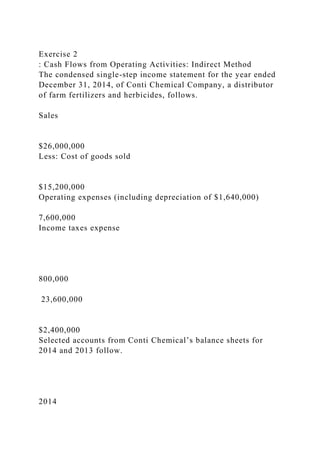
The condensed single-step income statement for the year ended
December 31, 2014, of Conti Chemical Company, a distributor
of farm fertilizers and herbicides, follows.
Sales
$26,000,000
Less: Cost of goods sold
$15,200,000
Operating expenses (including depreciation of $1,640,000)
7,600,000
Income taxes expense
800,000
23,600,000
$2,400,000
Selected accounts from Conti Chemical’s balance sheets for
2014 and 2013 follow.
2014
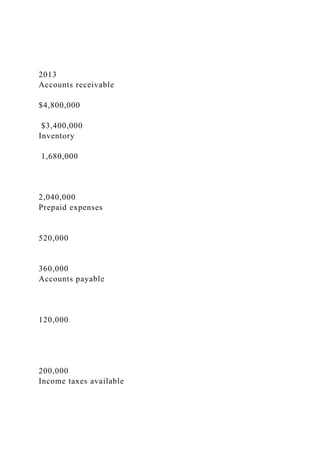
2013
Accounts receivable
$4,800,000
$3,400,000
Inventory
1,680,000
2,040,000
Prepaid expenses
520,000
360,000
Accounts payable
120,000
200,000
Income taxes available
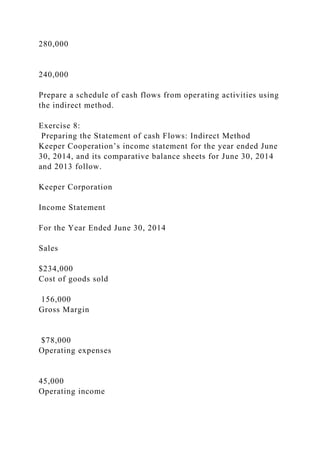
280,000
240,000
Prepare a schedule of cash flows from operating activities using
the indirect method.
Exercise 8:
Preparing the Statement of cash Flows: Indirect Method
Keeper Cooperation’s income statement for the year ended June
30, 2014, and its comparative balance sheets for June 30, 2014
and 2013 follow.
Keeper Corporation
Income Statement
For the Year Ended June 30, 2014
Sales
$234,000
Cost of goods sold
156,000
Gross Margin
$78,000
Operating expenses
45,000
Operating income
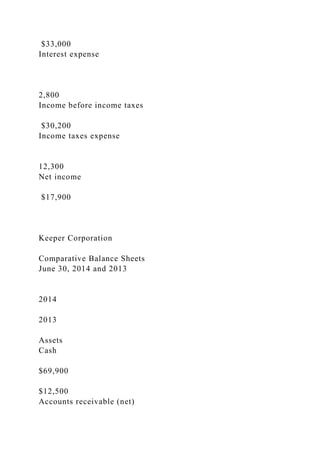
$33,000
Interest expense
2,800
Income before income taxes
$30,200
Income taxes expense
12,300
Net income
$17,900
Keeper Corporation
Comparative Balance Sheets
June 30, 2014 and 2013
2014
2013
Assets
Cash
$69,900
$12,500
Accounts receivable (net)
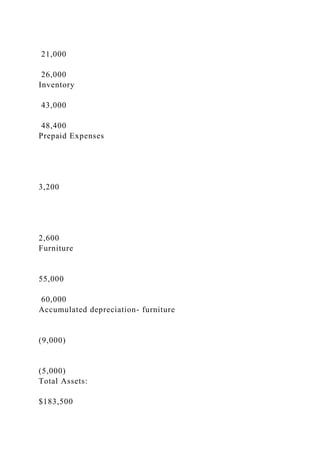
21,000
26,000
Inventory
43,000
48,400
Prepaid Expenses
3,200
2,600
Furniture
55,000
60,000
Accumulated depreciation- furniture
(9,000)
(5,000)
Total Assets:
$183,500
$144,500
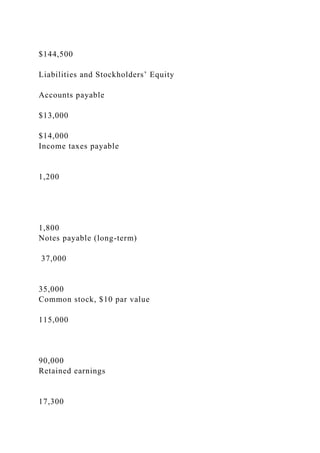
Liabilities and Stockholders’ Equity
Accounts payable
$13,000
$14,000
Income taxes payable
1,200
1,800
Notes payable (long-term)
37,000
35,000
Common stock, $10 par value
115,000
90,000
Retained earnings
17,300
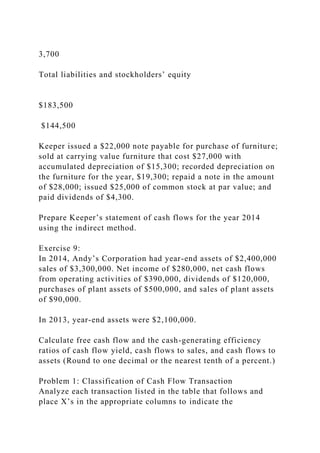
3,700
Total liabilities and stockholders’ equity
$183,500
$144,500
Keeper issued a $22,000 note payable for purchase of furniture;
sold at carrying value furniture that cost $27,000 with
accumulated depreciation of $15,300; recorded depreciation on
the furniture for the year, $19,300; repaid a note in the amount
of $28,000; issued $25,000 of common stock at par value; and
paid dividends of $4,300.
Prepare Keeper’s statement of cash flows for the year 2014
using the indirect method.
Exercise 9:
In 2014, Andy’s Corporation had year-end assets of $2,400,000
sales of $3,300,000. Net income of $280,000, net cash flows
from operating activities of $390,000, dividends of $120,000,
purchases of plant assets of $500,000, and sales of plant assets
of $90,000.
In 2013, year-end assets were $2,100,000.
Calculate free cash flow and the cash-generating efficiency
ratios of cash flow yield, cash flows to sales, and cash flows to
assets (Round to one decimal or the nearest tenth of a percent.)
Problem 1: Classification of Cash Flow Transaction
Analyze each transaction listed in the table that follows and
place X’s in the appropriate columns to indicate the
transaction’s classification and its effect on cash flows using
the indirect method.
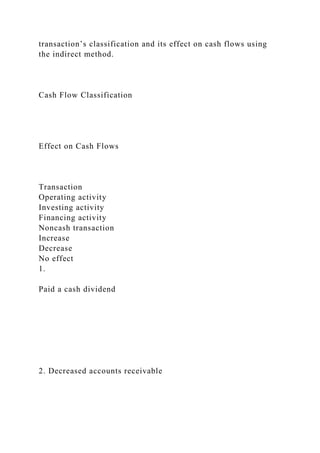
Cash Flow Classification
Effect on Cash Flows
Transaction
Operating activity
Investing activity
Financing activity
Noncash transaction
Increase
Decrease
No effect
1.
Paid a cash dividend
2. Decreased accounts receivable
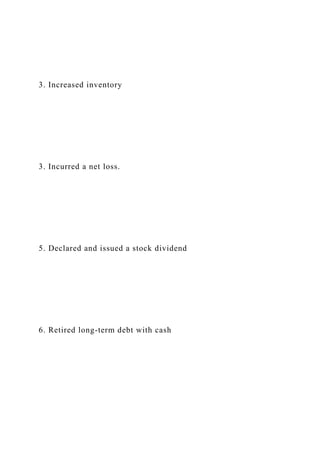
3. Increased inventory
3. Incurred a net loss.
5. Declared and issued a stock dividend
6. Retired long-term debt with cash
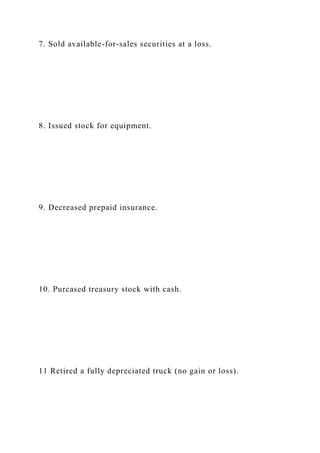
7. Sold available-for-sales securities at a loss.
8. Issued stock for equipment.
9. Decreased prepaid insurance.
10. Purcased treasury stock with cash.
11 Retired a fully depreciated truck (no gain or loss).
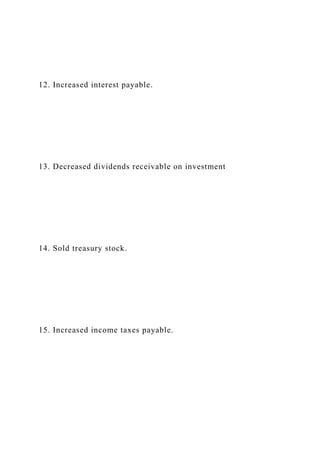
12. Increased interest payable.
13. Decreased dividends receivable on investment
14. Sold treasury stock.
15. Increased income taxes payable.
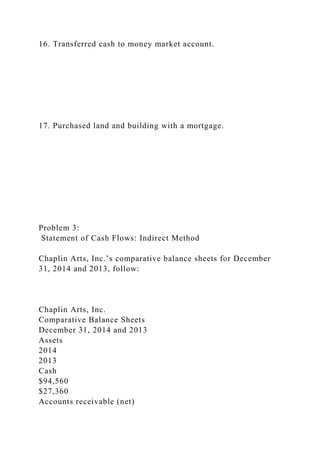
16. Transferred cash to money market account.
17. Purchased land and building with a mortgage.
Problem 3:
Statement of Cash Flows: Indirect Method
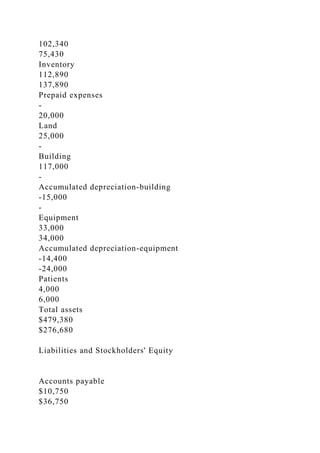
Chaplin Arts, Inc.’s comparative balance sheets for December
31, 2014 and 2013, follow:
Chaplin Arts, Inc.
Comparative Balance Sheets
December 31, 2014 and 2013
Assets
2014
2013
Cash
$94,560
$27,360
Accounts receivable (net)
102,340
75,430
Inventory
112,890
137,890
Prepaid expenses
-
20,000
Land
25,000
-
Building
117,000
-
Accumulated depreciation-building
-15,000
-
Equipment
33,000
34,000
Accumulated depreciation-equipment
-14,400
-24,000
Patients
4,000
6,000
Total assets
$479,380
$276,680
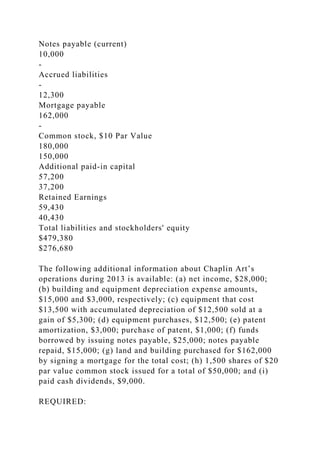
Liabilities and Stockholders' Equity
Accounts payable
$10,750
$36,750
Notes payable (current)
10,000
-
Accrued liabilities
-
12,300
Mortgage payable
162,000
-
Common stock, $10 Par Value
180,000
150,000
Additional paid-in capital
57,200
37,200
Retained Earnings
59,430
40,430
Total liabilities and stockholders' equity
$479,380
$276,680
The following additional information about Chaplin Art’s
operations during 2013 is available: (a) net income, $28,000;
(b) building and equipment depreciation expense amounts,
$15,000 and $3,000, respectively; (c) equipment that cost
$13,500 with accumulated depreciation of $12,500 sold at a
gain of $5,300; (d) equipment purchases, $12,500; (e) patent
amortization, $3,000; purchase of patent, $1,000; (f) funds
borrowed by issuing notes payable, $25,000; notes payable
repaid, $15,000; (g) land and building purchased for $162,000
by signing a mortgage for the total cost; (h) 1,500 shares of $20
par value common stock issued for a total of $50,000; and (i)
paid cash dividends, $9,000.
REQUIRED:
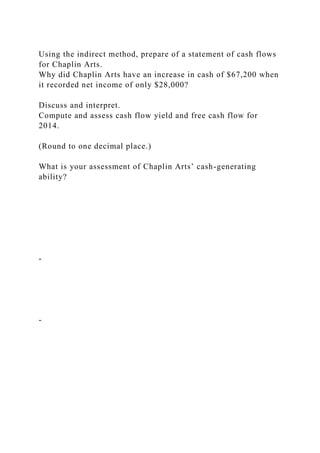
Using the indirect method, prepare of a statement of cash flows
for Chaplin Arts.
Why did Chaplin Arts have an increase in cash of $67,200 when
it recorded net income of only $28,000?
Discuss and interpret.
Compute and assess cash flow yield and free cash flow for
2014.
(Round to one decimal place.)
What is your assessment of Chaplin Arts’ cash-generating
ability?
-
-
Exercise 2 Cash Flows from Operating Activities Indirect Method.docx

Exercise 2 Cash Flows from Operating Activities Indirect Method.docx

  • 1.
    Exercise 2 : CashFlows from Operating Activities: Indirect Method The condensed single-step income statement for the year ended December 31, 2014, of Conti Chemical Company, a distributor of farm fertilizers and herbicides, follows. Sales $26,000,000 Less: Cost of goods sold $15,200,000 Operating expenses (including depreciation of $1,640,000) 7,600,000 Income taxes expense 800,000 23,600,000 $2,400,000 Selected accounts from Conti Chemical’s balance sheets for 2014 and 2013 follow. 2014
  • 2.
  • 3.
    280,000 240,000 Prepare a scheduleof cash flows from operating activities using the indirect method. Exercise 8: Preparing the Statement of cash Flows: Indirect Method Keeper Cooperation’s income statement for the year ended June 30, 2014, and its comparative balance sheets for June 30, 2014 and 2013 follow. Keeper Corporation Income Statement For the Year Ended June 30, 2014 Sales $234,000 Cost of goods sold 156,000 Gross Margin $78,000 Operating expenses 45,000 Operating income
  • 4.
    $33,000 Interest expense 2,800 Income beforeincome taxes $30,200 Income taxes expense 12,300 Net income $17,900 Keeper Corporation Comparative Balance Sheets June 30, 2014 and 2013 2014 2013 Assets Cash $69,900 $12,500 Accounts receivable (net)
  • 5.
  • 6.
    $144,500 Liabilities and Stockholders’Equity Accounts payable $13,000 $14,000 Income taxes payable 1,200 1,800 Notes payable (long-term) 37,000 35,000 Common stock, $10 par value 115,000 90,000 Retained earnings 17,300
  • 7.
    3,700 Total liabilities andstockholders’ equity $183,500 $144,500 Keeper issued a $22,000 note payable for purchase of furniture; sold at carrying value furniture that cost $27,000 with accumulated depreciation of $15,300; recorded depreciation on the furniture for the year, $19,300; repaid a note in the amount of $28,000; issued $25,000 of common stock at par value; and paid dividends of $4,300. Prepare Keeper’s statement of cash flows for the year 2014 using the indirect method. Exercise 9: In 2014, Andy’s Corporation had year-end assets of $2,400,000 sales of $3,300,000. Net income of $280,000, net cash flows from operating activities of $390,000, dividends of $120,000, purchases of plant assets of $500,000, and sales of plant assets of $90,000. In 2013, year-end assets were $2,100,000. Calculate free cash flow and the cash-generating efficiency ratios of cash flow yield, cash flows to sales, and cash flows to assets (Round to one decimal or the nearest tenth of a percent.) Problem 1: Classification of Cash Flow Transaction Analyze each transaction listed in the table that follows and place X’s in the appropriate columns to indicate the
  • 8.
    transaction’s classification andits effect on cash flows using the indirect method. Cash Flow Classification Effect on Cash Flows Transaction Operating activity Investing activity Financing activity Noncash transaction Increase Decrease No effect 1. Paid a cash dividend 2. Decreased accounts receivable
  • 9.
    3. Increased inventory 3.Incurred a net loss. 5. Declared and issued a stock dividend 6. Retired long-term debt with cash
  • 10.
    7. Sold available-for-salessecurities at a loss. 8. Issued stock for equipment. 9. Decreased prepaid insurance. 10. Purcased treasury stock with cash. 11 Retired a fully depreciated truck (no gain or loss).
  • 11.
    12. Increased interestpayable. 13. Decreased dividends receivable on investment 14. Sold treasury stock. 15. Increased income taxes payable.
  • 12.
    16. Transferred cashto money market account. 17. Purchased land and building with a mortgage. Problem 3: Statement of Cash Flows: Indirect Method Chaplin Arts, Inc.’s comparative balance sheets for December 31, 2014 and 2013, follow: Chaplin Arts, Inc. Comparative Balance Sheets December 31, 2014 and 2013 Assets 2014 2013 Cash $94,560 $27,360 Accounts receivable (net)
  • 13.
    102,340 75,430 Inventory 112,890 137,890 Prepaid expenses - 20,000 Land 25,000 - Building 117,000 - Accumulated depreciation-building -15,000 - Equipment 33,000 34,000 Accumulateddepreciation-equipment -14,400 -24,000 Patients 4,000 6,000 Total assets $479,380 $276,680 Liabilities and Stockholders' Equity Accounts payable $10,750 $36,750
  • 14.
    Notes payable (current) 10,000 - Accruedliabilities - 12,300 Mortgage payable 162,000 - Common stock, $10 Par Value 180,000 150,000 Additional paid-in capital 57,200 37,200 Retained Earnings 59,430 40,430 Total liabilities and stockholders' equity $479,380 $276,680 The following additional information about Chaplin Art’s operations during 2013 is available: (a) net income, $28,000; (b) building and equipment depreciation expense amounts, $15,000 and $3,000, respectively; (c) equipment that cost $13,500 with accumulated depreciation of $12,500 sold at a gain of $5,300; (d) equipment purchases, $12,500; (e) patent amortization, $3,000; purchase of patent, $1,000; (f) funds borrowed by issuing notes payable, $25,000; notes payable repaid, $15,000; (g) land and building purchased for $162,000 by signing a mortgage for the total cost; (h) 1,500 shares of $20 par value common stock issued for a total of $50,000; and (i) paid cash dividends, $9,000. REQUIRED:
  • 15.
    Using the indirectmethod, prepare of a statement of cash flows for Chaplin Arts. Why did Chaplin Arts have an increase in cash of $67,200 when it recorded net income of only $28,000? Discuss and interpret. Compute and assess cash flow yield and free cash flow for 2014. (Round to one decimal place.) What is your assessment of Chaplin Arts’ cash-generating ability? - -