Executive Level KPIs for Asset
Integrity Management System
Prepared for Senior Management of
a Multinational Oil & Gas Company
Introduction: KPIs Overview
• Objective: To provide senior management with high-level visibility of Asset
Integrity Management KPIs. These KPIs are aligned with global standards such as
API RP 754, ISO 55000, and OGP 456.
• This presentation includes:
– Leading Indicators for proactive monitoring
– Lagging Indicators for reactive tracking
– Visualizations for executive decision-making
Leading Indicators
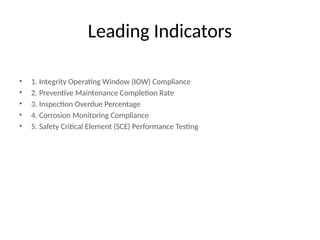
• 1. Integrity Operating Window (IOW) Compliance
• 2. Preventive Maintenance Completion Rate
• 3. Inspection Overdue Percentage
• 4. Corrosion Monitoring Compliance
• 5. Safety Critical Element (SCE) Performance Testing
Lagging Indicators
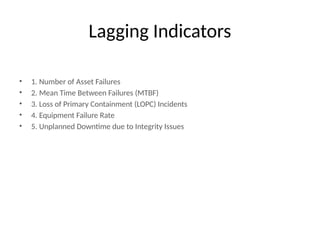
• 1. Number of Asset Failures
• 2. Mean Time Between Failures (MTBF)
• 3. Loss of Primary Containment (LOPC) Incidents
• 4. Equipment Failure Rate
• 5. Unplanned Downtime due to Integrity Issues
Visualizing KPIs on the Dashboard
– - IOW Compliance: Color-coded visualization (Green ≥ 95%, Yellow 85-94%,
Red < 85%)
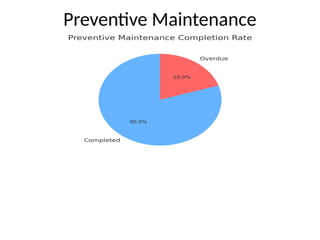
– - Preventive Maintenance Completion: Pie chart showing completion vs
overdue tasks
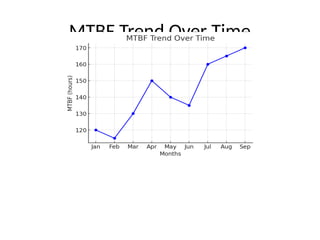
– - MTBF & Equipment Failure Rate: Line graph showing trends over time
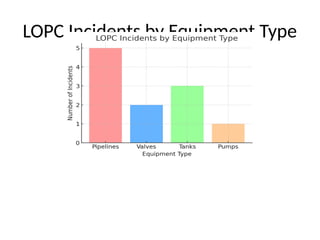
– - LOPC Incidents: Bar chart highlighting incidents by equipment type
– - Unplanned Downtime: Trendline showing year-over-year downtime
comparison
Preventive Maintenance
Completion Rate
MTBF Trend Over Time
LOPC Incidents by Equipment Type

Executive_Level_Asset_Integrity_Presentation.pptx

  • 1.
    Executive Level KPIsfor Asset Integrity Management System Prepared for Senior Management of a Multinational Oil & Gas Company
  • 2.
    Introduction: KPIs Overview •Objective: To provide senior management with high-level visibility of Asset Integrity Management KPIs. These KPIs are aligned with global standards such as API RP 754, ISO 55000, and OGP 456. • This presentation includes: – Leading Indicators for proactive monitoring – Lagging Indicators for reactive tracking – Visualizations for executive decision-making
  • 3.
    Leading Indicators • 1.Integrity Operating Window (IOW) Compliance • 2. Preventive Maintenance Completion Rate • 3. Inspection Overdue Percentage • 4. Corrosion Monitoring Compliance • 5. Safety Critical Element (SCE) Performance Testing
  • 4.
    Lagging Indicators • 1.Number of Asset Failures • 2. Mean Time Between Failures (MTBF) • 3. Loss of Primary Containment (LOPC) Incidents • 4. Equipment Failure Rate • 5. Unplanned Downtime due to Integrity Issues
  • 5.
    Visualizing KPIs onthe Dashboard – - IOW Compliance: Color-coded visualization (Green ≥ 95%, Yellow 85-94%, Red < 85%) – - Preventive Maintenance Completion: Pie chart showing completion vs overdue tasks – - MTBF & Equipment Failure Rate: Line graph showing trends over time – - LOPC Incidents: Bar chart highlighting incidents by equipment type – - Unplanned Downtime: Trendline showing year-over-year downtime comparison
  • 6.
  • 7.
  • 8.
    LOPC Incidents byEquipment Type

Editor's Notes

  • #2 This slide sets the stage for the KPIs discussion. It introduces the objective of high-level asset integrity monitoring through leading and lagging indicators.
  • #3 The leading indicators give a proactive view of asset integrity. They help us identify issues before they turn into failures. For instance, IOW compliance monitors if equipment is operating within safety limits.
  • #4 Lagging indicators provide us with a reactive view, capturing past performance and failures. They help assess whether asset integrity programs are effective. For example, MTBF measures the reliability of our assets.
  • #5 This slide summarizes how the KPIs will be visualized on the executive dashboard. Clear, color-coded charts and graphs will give senior management an at-a-glance understanding of the asset integrity performance.