Endoplasmic reticulum
• The primary intracellular Ca2+ storage
and release organelle in most cells is the
endoplasmic reticulum
• In muscles, it is sarcoplasmic reticulum
Calcium
• A common second messenger
• Regulate many processes in cells (e.g., contraction,
secretion, synaptic transmission, fertilization, nuclear pore
regulation, transcription)
• Cells are bathed a relatively high Ca2+ conc and the
cytoplasm of cells have much lower resting Ca2+ conc
• Ca2+ entry across the surface membrane can substantially
elevate cytosolic Ca2+ levels
Relatively small amounts of calcium
ions enter and leave the cell during
each cardiac cycle
But much larger amounts move in
and out of the SR
Ca2+ release channels
Two families
The ryanodine receptors (RyR) and
Inositol trisphosphate receptors (IP3R)
• Calcium released by the SR increases the
intracellular calcium conc from 10-7 to 10-5 M
• Results in ratcheting movement between the
myosin heads and the actin
• Actin and myosin filaments slide past each other
shortening sarcomere length
• Ratcheting cycles occur as long as the cytosolic
calcium remains elevated
Ryanodine receptor
• Binds with ryanodine a potential insecticide
• A calcium release channel
• A macromolecular signaling complex
• Rigid paralysis in skeletal muscle and
flaccid paralysis in cardiac muscle.
Calcium fluxes in the myocardium
How contraction ends
• Release of Ca is linked tightly to the L type-Ca channel
• Rising Ca inhibit calcium induced calcium release- perhaps
acting through calmodulin
• Rising cytosolic Ca ion concentration activates SERCA
• Ca release continues only for the duration of AP
Cytosolic calcium falls - binding with troponin
C lessens - tropomyosin again starts to
inhibit actin - myosin interaction - relaxation
Transport of Ca2+ out cytosol
By 4 pathways
SR Ca2+-ATPase (SERCA) pump
A sarcolemmal Na/Ca exchanger
A sarcolemmal Ca2+-ATPase
A mitochondrial uniporter
Calcium uptake into the sarcoplasmic reticulum
SERCA pump
• Most important cellular mechanism for Ca2+ removal
• Account for 70% of Ca2+ removal,
• Na/Ca exchanger - 28% of Ca2+ removal
• Most important cellular mediator of relaxation,
Phospholamban
• Means "phosphate receiver"
• The major regulator of calcium uptake pump
• Crucial role in beta-adrenergic response of the myocardium
• Activity governed by its state of phosphorylation
• Has two major protein kinases, the one activated by
calcium ions and the other by c-AMP
Phospholamban
• Responds to beta-adrenergic stimulation by enhancing (de-
inhibiting) the uptake of calcium by SERCA
• Thyroxine mediates the action via phospholamban -
SERCA system
• Transgenic mouse model deficient in phospholamban –
– rates of contraction and relaxation are maximal and
– do not vary with added beta-adrenergic stimulation
CALCIUM SPARKS
• Very small quantities of calcium released spontaneously and
locally from SR with out L-channel opening
• Fails to activate the neighbouring calcium release channels -
contraction not initiated
• Summation of sparks could produce a normally propagating
calcium wave that triggers excitation-contraction coupling
• Catecholamine toxicity or during early reperfusion - SR
overloaded with Ca - sparks can lead to propagated calcium
waves - risk of serious arrhythmias or impaired contractility
In Heart Failure
• Cardiac contraction and relaxation is impaired
• Rate of Ca uptake by SERCA 2a is depressed
• Impaired expression of certain genes encoding specific
SR proteins
• mRNA for RYR2, SERCA and phospholamban are deficient
• Regulation of SERCA 2a is upset, perhaps the
phosphorylation
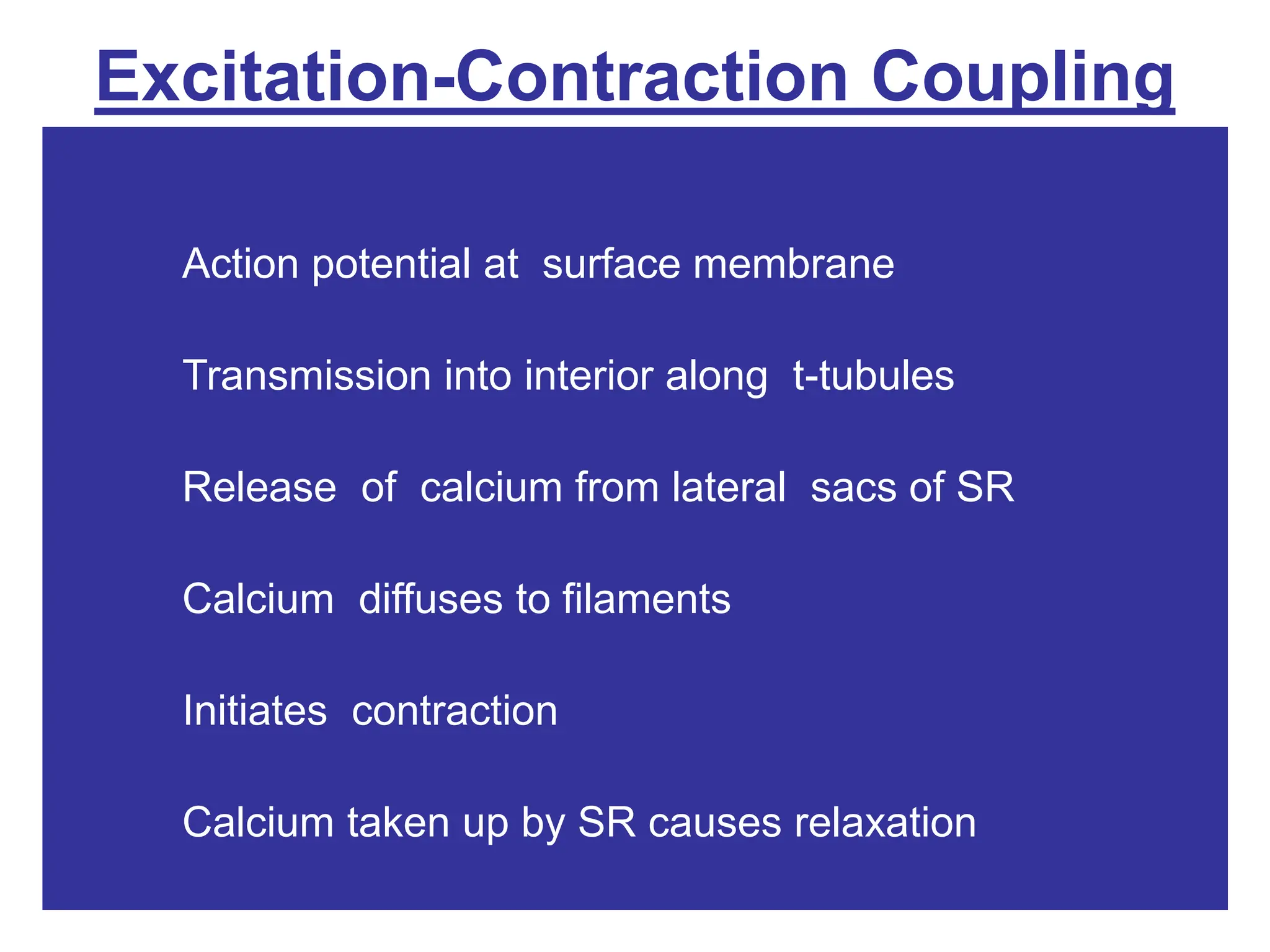
Excitation-Contraction Coupling
Action potential at surface membrane
Transmission into interior along t-tubules
Release of calcium from lateral sacs of SR
Calcium diffuses to filaments
Initiates contraction
Calcium taken up by SR causes relaxation

Excitation contraction coupling.ppt

  • 4.
    Endoplasmic reticulum • Theprimary intracellular Ca2+ storage and release organelle in most cells is the endoplasmic reticulum • In muscles, it is sarcoplasmic reticulum
  • 9.
    Calcium • A commonsecond messenger • Regulate many processes in cells (e.g., contraction, secretion, synaptic transmission, fertilization, nuclear pore regulation, transcription) • Cells are bathed a relatively high Ca2+ conc and the cytoplasm of cells have much lower resting Ca2+ conc • Ca2+ entry across the surface membrane can substantially elevate cytosolic Ca2+ levels
  • 11.
    Relatively small amountsof calcium ions enter and leave the cell during each cardiac cycle But much larger amounts move in and out of the SR
  • 12.
    Ca2+ release channels Twofamilies The ryanodine receptors (RyR) and Inositol trisphosphate receptors (IP3R)
  • 18.
    • Calcium releasedby the SR increases the intracellular calcium conc from 10-7 to 10-5 M • Results in ratcheting movement between the myosin heads and the actin • Actin and myosin filaments slide past each other shortening sarcomere length • Ratcheting cycles occur as long as the cytosolic calcium remains elevated
  • 20.
    Ryanodine receptor • Bindswith ryanodine a potential insecticide • A calcium release channel • A macromolecular signaling complex • Rigid paralysis in skeletal muscle and flaccid paralysis in cardiac muscle.
  • 22.
    Calcium fluxes inthe myocardium
  • 24.
    How contraction ends •Release of Ca is linked tightly to the L type-Ca channel • Rising Ca inhibit calcium induced calcium release- perhaps acting through calmodulin • Rising cytosolic Ca ion concentration activates SERCA • Ca release continues only for the duration of AP Cytosolic calcium falls - binding with troponin C lessens - tropomyosin again starts to inhibit actin - myosin interaction - relaxation
  • 25.
    Transport of Ca2+out cytosol By 4 pathways SR Ca2+-ATPase (SERCA) pump A sarcolemmal Na/Ca exchanger A sarcolemmal Ca2+-ATPase A mitochondrial uniporter
  • 26.
    Calcium uptake intothe sarcoplasmic reticulum
  • 27.
    SERCA pump • Mostimportant cellular mechanism for Ca2+ removal • Account for 70% of Ca2+ removal, • Na/Ca exchanger - 28% of Ca2+ removal • Most important cellular mediator of relaxation,
  • 28.
    Phospholamban • Means "phosphatereceiver" • The major regulator of calcium uptake pump • Crucial role in beta-adrenergic response of the myocardium • Activity governed by its state of phosphorylation • Has two major protein kinases, the one activated by calcium ions and the other by c-AMP
  • 29.
    Phospholamban • Responds tobeta-adrenergic stimulation by enhancing (de- inhibiting) the uptake of calcium by SERCA • Thyroxine mediates the action via phospholamban - SERCA system • Transgenic mouse model deficient in phospholamban – – rates of contraction and relaxation are maximal and – do not vary with added beta-adrenergic stimulation
  • 33.
    CALCIUM SPARKS • Verysmall quantities of calcium released spontaneously and locally from SR with out L-channel opening • Fails to activate the neighbouring calcium release channels - contraction not initiated • Summation of sparks could produce a normally propagating calcium wave that triggers excitation-contraction coupling • Catecholamine toxicity or during early reperfusion - SR overloaded with Ca - sparks can lead to propagated calcium waves - risk of serious arrhythmias or impaired contractility
  • 34.
    In Heart Failure •Cardiac contraction and relaxation is impaired • Rate of Ca uptake by SERCA 2a is depressed • Impaired expression of certain genes encoding specific SR proteins • mRNA for RYR2, SERCA and phospholamban are deficient • Regulation of SERCA 2a is upset, perhaps the phosphorylation
  • 35.
    Excitation-Contraction Coupling Action potentialat surface membrane Transmission into interior along t-tubules Release of calcium from lateral sacs of SR Calcium diffuses to filaments Initiates contraction Calcium taken up by SR causes relaxation