20 | PROCESS ENGINEERING | APRIL 05
THE advent of modern computer
programmes has enabled many of us to
thermally rate heat exchangers quickly and
accurately. But how do we decide which
design of heat exchanger for a given
application will satisfy the operating
conditions, all the mechanical/thermal
criteria, and give a cost-effective solution?
Many customers have asked what forms
the basis of a heat exchanger design for their
particular enquiry. I well recall in my earlier
years as a junior applications engineer, my
mentor of the time showing me how to
make a selection, saying that the enquiry we
were looking at ‘was leading him by the
nose’ to a certain type of heat exchanger
design. His experience gained over the years
enabled him to do this, but what was the
thought process that went into selecting the
right type of heat exchanger? In some cases
there can be more than one solution.
Obviously it is not possible to cover all
aspects of design or all available TEMA
types of heat exchanger in just a few short
lines, but the table and diagrams overleaf
show some of the more commonly used
types of TEMA heat exchangers [TEMA is
the Tubular Exchanger Manufacturers
Association — see panel opposite].
All the types shown in the table can be
designed in accordance with TEMA B, C
and R codes. The table is intended as a
general guide only and does not purport to
Specifying that workhorse of the process
industries, the shell-and-tube heat
exchanger, is usually a straightforward
exercise in these days of computer-aided
design packages, but you do need to ask
the right questions. David Knightbridge
offers a brief guide to that common one:
‘which type of TEMA exchanger?’
Take the TEMA test
AEW
BEW
AEP
BEP
AEL
BEM
NEN
AEU
BEU
AET
BET
AES
BET
Typical
TEMA
type heat
exchanger
Description
of TEMA
type heat
exchanger
Removable
tube
bundle
Tubes can
be cleaned
internally
by rodding
Non-hazardous
liquids & gases
below 40barg
Non-hazardous
liquids & gases
above 40barg
Hazardous
liquids
and gases
No gaskets
in contact
with
process side
Ability
to resist
thermal
shock
Externally
sealed
Floating
tube sheet
Outside
packed
floating
head
Fixed tube
sheet
Fixed
tubesheet,
channel
integral with
tubesheet
U tube
Pull-through
floating
head
Floating
head with
backing
device
Yes
Yes
No
No
Yes
Yes
Yes
Yes
Yes
Yes
Yes
No
Yes
Yes
Yes
Yes
Yes1
Yes1
Yes
Yes
Yes
No
Yes
Yes1
Yes1
Yes
Yes
Yes
Below
190 º C
Above
190 º C
No
Yes2
Yes
Yes
Yes
Yes
Yes
No
No
Yes
Yes
Yes
Yes
Yes
No
No
Yes3
Yes3
Yes4
No
No
No
No
No
No
Yes
Yes
Yes
Notes: 1. Expansion bellows may be required. 2. Tube side only. 3. Shell side only.
4. Shell side only if tube bundle welded into shell and therefore not removable.
Which type of TEMA Heat Exchanger ?
PRENed200504011.qxd 6~4~05 13:32 Page 20
cover all aspects of design. Full technical advice can be
given by a heat exchanger applications engineer.
Another question that is often asked is ‘what is the
difference between the three types of TEMA B, C and R
codes?’ To answer that in detail would require a full
review of TEMA standards, but the following guide
lines may be useful:
G TEMA B — generally for chemical process services,
more stringent than TEMA C, but not as stringent as R;
G TEMA C — for generally moderate commercial and
process application requirements. Probably the most
commonly used in our industry;
G TEMA R — the highest integrity design.
The decision as to which class of TEMA to use does
not lie with the heat exchanger manufacturer, but with
the design authority responsible for that part of the
project. The manufacturer must then consider all the
thermal and mechanical requirements of the requested
design code when making the selection. PE
David Knightbridge FInstSM is UK sales manager for
the German heat exchanger manufacturer Funke
HEAT TRANSFER
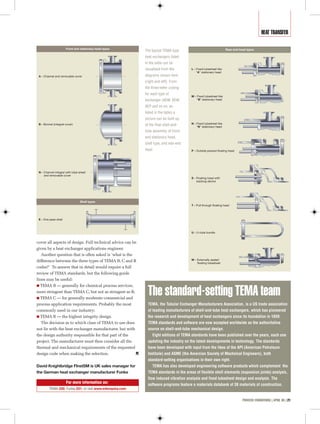
Rear end head types
L - Fixed tubesheet like
“A” stationary head
M - Fixed tubesheet like
“B” stationary head
N - Fixed tubesheet like
“N” stationary head
P - Outside packed floating head
S - Floating head with
backing device
T - Pull through floating head
U - U-tube bundle
W - Externally sealed
floating tubesheet
Front end stationary head types
A - Channel and removable cover
B - Bonnet (integral cover)
N - Channel integral with tube-sheet
and removable cover
E - One pass shell
Shell types
TEMA, the Tubular Exchanger Manufacturers Association, is a US trade association
of leading manufacturers of shell-and-tube heat exchangers, which has pioneered
the research and development of heat exchangers since its foundation in 1939.
TEMA standards and software are now accepted worldwide as the authoritative
source on shell-and-tube mechanical design.
Eight editions of TEMA standards have been published over the years, each one
updating the industry on the latest developments in technology. The standards
have been developed with input from the likes of the API (American Petroleum
Institute) and ASME (the Amercian Society of Mechnical Engineers), both
standard-setting organisations in their own right.
TEMA has also developed engineering software products which complement the
TEMA standards in the areas of flexible shell elements (expansion joints) analysis,
flow induced vibration analysis and fixed tubesheet design and analysis. The
software programs feature a materials databank of 38 materials of construction.
The standard-setting TEMA team
The typical TEMA type
heat exchangers listed
in the table can be
visualised from the
diagrams shown here
(right and left). From
the three-letter coding
for each type of
exchanger (AEW, BEW,
AEP and so on, as
listed in the table) a
picture can be built up
of the final shell-and-
tube assembly of front-
end stationary head,
shell type, and rear-end
head
TEMA 230; Funke 231; or visit www.e4enquiry.com
For more information on:
PROCESS ENGINEERING | APRIL 05 | 21

Exchanger types

  • 1.
    20 | PROCESSENGINEERING | APRIL 05 THE advent of modern computer programmes has enabled many of us to thermally rate heat exchangers quickly and accurately. But how do we decide which design of heat exchanger for a given application will satisfy the operating conditions, all the mechanical/thermal criteria, and give a cost-effective solution? Many customers have asked what forms the basis of a heat exchanger design for their particular enquiry. I well recall in my earlier years as a junior applications engineer, my mentor of the time showing me how to make a selection, saying that the enquiry we were looking at ‘was leading him by the nose’ to a certain type of heat exchanger design. His experience gained over the years enabled him to do this, but what was the thought process that went into selecting the right type of heat exchanger? In some cases there can be more than one solution. Obviously it is not possible to cover all aspects of design or all available TEMA types of heat exchanger in just a few short lines, but the table and diagrams overleaf show some of the more commonly used types of TEMA heat exchangers [TEMA is the Tubular Exchanger Manufacturers Association — see panel opposite]. All the types shown in the table can be designed in accordance with TEMA B, C and R codes. The table is intended as a general guide only and does not purport to Specifying that workhorse of the process industries, the shell-and-tube heat exchanger, is usually a straightforward exercise in these days of computer-aided design packages, but you do need to ask the right questions. David Knightbridge offers a brief guide to that common one: ‘which type of TEMA exchanger?’ Take the TEMA test AEW BEW AEP BEP AEL BEM NEN AEU BEU AET BET AES BET Typical TEMA type heat exchanger Description of TEMA type heat exchanger Removable tube bundle Tubes can be cleaned internally by rodding Non-hazardous liquids & gases below 40barg Non-hazardous liquids & gases above 40barg Hazardous liquids and gases No gaskets in contact with process side Ability to resist thermal shock Externally sealed Floating tube sheet Outside packed floating head Fixed tube sheet Fixed tubesheet, channel integral with tubesheet U tube Pull-through floating head Floating head with backing device Yes Yes No No Yes Yes Yes Yes Yes Yes Yes No Yes Yes Yes Yes Yes1 Yes1 Yes Yes Yes No Yes Yes1 Yes1 Yes Yes Yes Below 190 º C Above 190 º C No Yes2 Yes Yes Yes Yes Yes No No Yes Yes Yes Yes Yes No No Yes3 Yes3 Yes4 No No No No No No Yes Yes Yes Notes: 1. Expansion bellows may be required. 2. Tube side only. 3. Shell side only. 4. Shell side only if tube bundle welded into shell and therefore not removable. Which type of TEMA Heat Exchanger ? PRENed200504011.qxd 6~4~05 13:32 Page 20
  • 2.
    cover all aspectsof design. Full technical advice can be given by a heat exchanger applications engineer. Another question that is often asked is ‘what is the difference between the three types of TEMA B, C and R codes?’ To answer that in detail would require a full review of TEMA standards, but the following guide lines may be useful: G TEMA B — generally for chemical process services, more stringent than TEMA C, but not as stringent as R; G TEMA C — for generally moderate commercial and process application requirements. Probably the most commonly used in our industry; G TEMA R — the highest integrity design. The decision as to which class of TEMA to use does not lie with the heat exchanger manufacturer, but with the design authority responsible for that part of the project. The manufacturer must then consider all the thermal and mechanical requirements of the requested design code when making the selection. PE David Knightbridge FInstSM is UK sales manager for the German heat exchanger manufacturer Funke HEAT TRANSFER Rear end head types L - Fixed tubesheet like “A” stationary head M - Fixed tubesheet like “B” stationary head N - Fixed tubesheet like “N” stationary head P - Outside packed floating head S - Floating head with backing device T - Pull through floating head U - U-tube bundle W - Externally sealed floating tubesheet Front end stationary head types A - Channel and removable cover B - Bonnet (integral cover) N - Channel integral with tube-sheet and removable cover E - One pass shell Shell types TEMA, the Tubular Exchanger Manufacturers Association, is a US trade association of leading manufacturers of shell-and-tube heat exchangers, which has pioneered the research and development of heat exchangers since its foundation in 1939. TEMA standards and software are now accepted worldwide as the authoritative source on shell-and-tube mechanical design. Eight editions of TEMA standards have been published over the years, each one updating the industry on the latest developments in technology. The standards have been developed with input from the likes of the API (American Petroleum Institute) and ASME (the Amercian Society of Mechnical Engineers), both standard-setting organisations in their own right. TEMA has also developed engineering software products which complement the TEMA standards in the areas of flexible shell elements (expansion joints) analysis, flow induced vibration analysis and fixed tubesheet design and analysis. The software programs feature a materials databank of 38 materials of construction. The standard-setting TEMA team The typical TEMA type heat exchangers listed in the table can be visualised from the diagrams shown here (right and left). From the three-letter coding for each type of exchanger (AEW, BEW, AEP and so on, as listed in the table) a picture can be built up of the final shell-and- tube assembly of front- end stationary head, shell type, and rear-end head TEMA 230; Funke 231; or visit www.e4enquiry.com For more information on: PROCESS ENGINEERING | APRIL 05 | 21