5.Handling Errors and Exceptions
Dr.Narayana Swamy Ramaiah
Assoc.Prof, Dept of Electrical and
Computer Engineering,
Arba Minch University
What is an Exception
• Exception is an event that occurs during execution of a program that disrupts
normal flow of instruction.
• Let's take a scenario:
instruction 1;
instruction 2;
instruction 3;
instruction 4;
instruction 5; //exception occurs
instruction 6;
instruction 7;
instruction 8;
instruction 9;
instruction 10;
• Suppose there is 10 instructions in your program and there occurs an exception at
instruction 5, rest of the code will not be executed i.e. instruction 6 to 10 will not
run.
• When an error occurs within a method, the method creates an exception object and hands it off to the
runtime system, this is called throwing an exception.
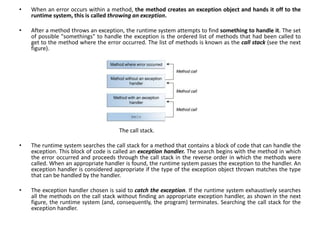
• After a method throws an exception, the runtime system attempts to find something to handle it. The set
of possible "somethings" to handle the exception is the ordered list of methods that had been called to
get to the method where the error occurred. The list of methods is known as the call stack (see the next
figure).
The call stack.
• The runtime system searches the call stack for a method that contains a block of code that can handle the
exception. This block of code is called an exception handler. The search begins with the method in which
the error occurred and proceeds through the call stack in the reverse order in which the methods were
called. When an appropriate handler is found, the runtime system passes the exception to the handler. An
exception handler is considered appropriate if the type of the exception object thrown matches the type
that can be handled by the handler.
• The exception handler chosen is said to catch the exception. If the runtime system exhaustively searches
all the methods on the call stack without finding an appropriate exception handler, as shown in the next
figure, the runtime system (and, consequently, the program) terminates. Searching the call stack for the
exception handler.
Exception Types
• There are two types of exceptions
– Checked exceptions (checked at compile time)
• DivideByZero exception
• ClassNotFoundException
• IllegalAccessException
• NoSuchFieldException
• EOFException etc.
– Unchecked exceptions (checked at runtime)
• ArithmeticException
• ArrayIndexOutOfBoundsException
• NullPointerException
• NegativeArraySizeException etc.
• Error (irrecoverable-Thread Death)
• OutOfMemoryError,
• VirtualMachineError,
• AssertionError etc.
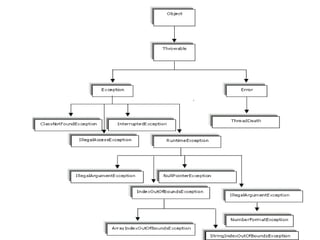
• All exception classes are subtypes of the
java.lang. Exception class.
• The exception class is a subclass of the
Throwable class. Other than the exception
class there is another subclass called Error
which is derived from the Throwable class.
• The Exception class has two main subclasses:
IOException class and RuntimeException Class.
• There are given some scenarios where unchecked exceptions can occur. They
are as follows:
• Scenario where ArithmeticException occurs
If we divide any number by zero, there occurs an ArithmeticException.
int a=50/0; //ArithmeticException
• Scenario where NullPointerException occurs
If we have null value in any variable, performing any operation by the
variable occurs an NullPointerException.
String s=null;
System.out.println(s.length()); //NullPointerException
• Scenario where NumberFormatException occurs
The wrong formatting of any value, may occur NumberFormatException.
Suppose I have a string variable that have characters, converting this
variable into digit will occur NumberFormatException.
String s="abc";
int i=Integer.parseInt(s); //NumberFormatException
• Scenario where ArrayIndexOutOfBoundsException occurs
If you are inserting any value in the wrong index, it would result
ArrayIndexOutOfBoundsException as shown below:
int a[]=new int[5];
a[10]=50; //ArrayIndexOutOfBoundsException

Exceptions

  • 1.
    5.Handling Errors andExceptions Dr.Narayana Swamy Ramaiah Assoc.Prof, Dept of Electrical and Computer Engineering, Arba Minch University
  • 2.
    What is anException • Exception is an event that occurs during execution of a program that disrupts normal flow of instruction. • Let's take a scenario: instruction 1; instruction 2; instruction 3; instruction 4; instruction 5; //exception occurs instruction 6; instruction 7; instruction 8; instruction 9; instruction 10; • Suppose there is 10 instructions in your program and there occurs an exception at instruction 5, rest of the code will not be executed i.e. instruction 6 to 10 will not run.
  • 3.
    • When anerror occurs within a method, the method creates an exception object and hands it off to the runtime system, this is called throwing an exception. • After a method throws an exception, the runtime system attempts to find something to handle it. The set of possible "somethings" to handle the exception is the ordered list of methods that had been called to get to the method where the error occurred. The list of methods is known as the call stack (see the next figure). The call stack. • The runtime system searches the call stack for a method that contains a block of code that can handle the exception. This block of code is called an exception handler. The search begins with the method in which the error occurred and proceeds through the call stack in the reverse order in which the methods were called. When an appropriate handler is found, the runtime system passes the exception to the handler. An exception handler is considered appropriate if the type of the exception object thrown matches the type that can be handled by the handler. • The exception handler chosen is said to catch the exception. If the runtime system exhaustively searches all the methods on the call stack without finding an appropriate exception handler, as shown in the next figure, the runtime system (and, consequently, the program) terminates. Searching the call stack for the exception handler.
  • 4.
    Exception Types • Thereare two types of exceptions – Checked exceptions (checked at compile time) • DivideByZero exception • ClassNotFoundException • IllegalAccessException • NoSuchFieldException • EOFException etc. – Unchecked exceptions (checked at runtime) • ArithmeticException • ArrayIndexOutOfBoundsException • NullPointerException • NegativeArraySizeException etc. • Error (irrecoverable-Thread Death) • OutOfMemoryError, • VirtualMachineError, • AssertionError etc.
  • 5.
    • All exceptionclasses are subtypes of the java.lang. Exception class. • The exception class is a subclass of the Throwable class. Other than the exception class there is another subclass called Error which is derived from the Throwable class. • The Exception class has two main subclasses: IOException class and RuntimeException Class.
  • 7.
    • There aregiven some scenarios where unchecked exceptions can occur. They are as follows: • Scenario where ArithmeticException occurs If we divide any number by zero, there occurs an ArithmeticException. int a=50/0; //ArithmeticException • Scenario where NullPointerException occurs If we have null value in any variable, performing any operation by the variable occurs an NullPointerException. String s=null; System.out.println(s.length()); //NullPointerException
  • 8.
    • Scenario whereNumberFormatException occurs The wrong formatting of any value, may occur NumberFormatException. Suppose I have a string variable that have characters, converting this variable into digit will occur NumberFormatException. String s="abc"; int i=Integer.parseInt(s); //NumberFormatException • Scenario where ArrayIndexOutOfBoundsException occurs If you are inserting any value in the wrong index, it would result ArrayIndexOutOfBoundsException as shown below: int a[]=new int[5]; a[10]=50; //ArrayIndexOutOfBoundsException