1
An Exception is…
An unusual, often unpredictable event,
detectable by software or hardware, that
requires special processing
An exception handler is a section of program
code
that is executed when a particular exception
occurs.
2
Why have exception handlers?
 With no exception handler for an
exception, your program ends at the
point of the exception (with no user
understandable data from the O/S)
 With an exception handler, you can
handle the unusual condition in an
understandable way
3
Try/Catch/Throw
 Try: The block of code monitored for
exceptions
 Catch: The block of code following
the try block handles an exception
type
 Throw: When an exception is
detected, you throw an exception
type
4
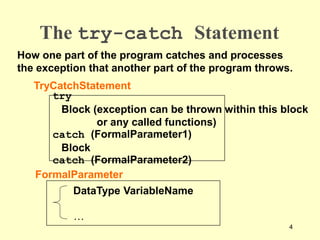
The try-catch Statement
try
Block (exception can be thrown within this block
or any called functions)
catch (FormalParameter1)
Block
catch (FormalParameter2)
TryCatchStatement
How one part of the program catches and processes
the exception that another part of the program throws.
FormalParameter
DataType VariableName
…
5
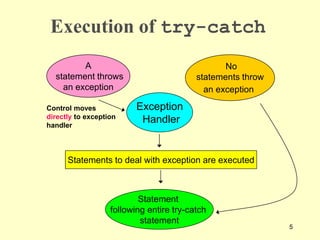
Execution of try-catch
No
statements throw
an exception
Statement
following entire try-catch
statement
A
statement throws
an exception
Exception
Handler
Statements to deal with exception are executed
Control moves
directly to exception
handler
6
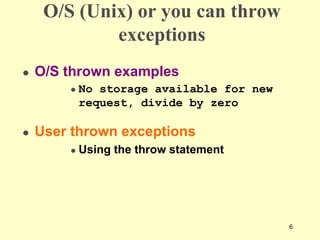
O/S (Unix) or you can throw
exceptions
 O/S thrown examples
 No storage available for new
request, divide by zero
 User thrown exceptions
 Using the throw statement

Exception handling

  • 1.
    1 An Exception is… Anunusual, often unpredictable event, detectable by software or hardware, that requires special processing An exception handler is a section of program code that is executed when a particular exception occurs.
  • 2.
    2 Why have exceptionhandlers?  With no exception handler for an exception, your program ends at the point of the exception (with no user understandable data from the O/S)  With an exception handler, you can handle the unusual condition in an understandable way
  • 3.
    3 Try/Catch/Throw  Try: Theblock of code monitored for exceptions  Catch: The block of code following the try block handles an exception type  Throw: When an exception is detected, you throw an exception type
  • 4.
    4 The try-catch Statement try Block(exception can be thrown within this block or any called functions) catch (FormalParameter1) Block catch (FormalParameter2) TryCatchStatement How one part of the program catches and processes the exception that another part of the program throws. FormalParameter DataType VariableName …
  • 5.
    5 Execution of try-catch No statementsthrow an exception Statement following entire try-catch statement A statement throws an exception Exception Handler Statements to deal with exception are executed Control moves directly to exception handler
  • 6.
    6 O/S (Unix) oryou can throw exceptions  O/S thrown examples  No storage available for new request, divide by zero  User thrown exceptions  Using the throw statement