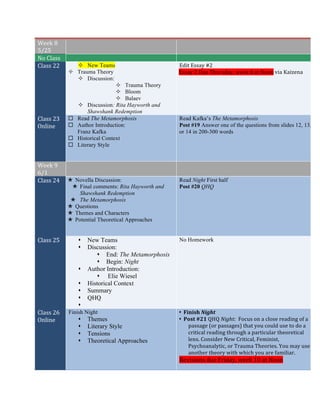
Week	
   In-­‐Class	
  Activities	
   Homework	
  
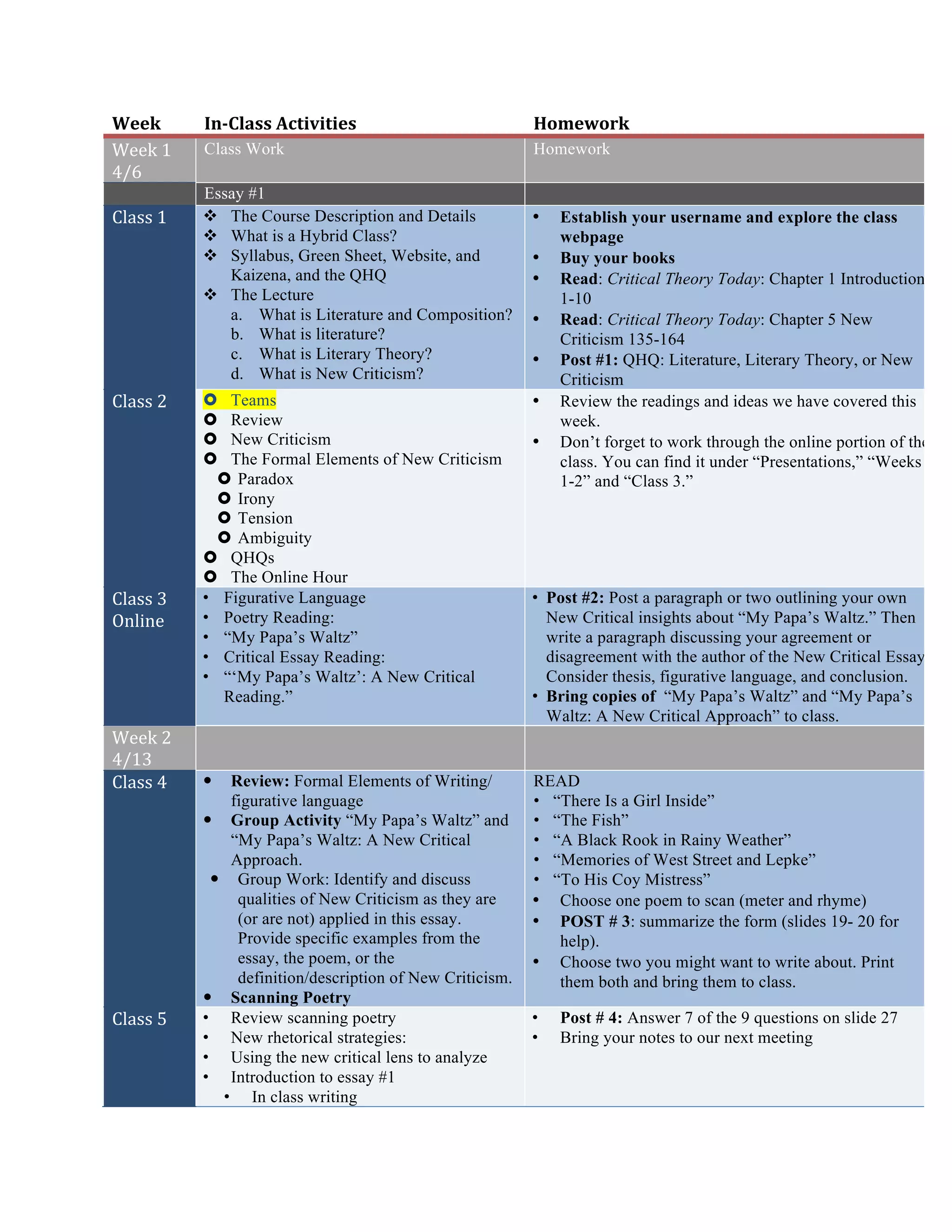
Week	
  1	
  
4/6	
  
Class Work	
   Homework


   Essay #1
Class	
  1	
   v The Course Description and Details
v What is a Hybrid Class?
v Syllabus, Green Sheet, Website, and
Kaizena, and the QHQ
v The Lecture
a. What is Literature and Composition?
b. What is literature?
c. What is Literary Theory?
d. What is New Criticism?
• Establish your username and explore the class
webpage
• Buy your books
• Read: Critical Theory Today: Chapter 1 Introduction
1-10
• Read: Critical Theory Today: Chapter 5 New
Criticism 135-164
• Post #1: QHQ: Literature, Literary Theory, or New
Criticism
Class	
  2	
   › Teams
› Review
› New Criticism
› The Formal Elements of New Criticism
› Paradox
› Irony
› Tension
› Ambiguity
› QHQs
› The Online Hour
• Review the readings and ideas we have covered this
week.
• Don’t forget to work through the online portion of the
class. You can find it under “Presentations,” “Weeks
1-2” and “Class 3.”
Class	
  3	
  
Online	
  
• Figurative Language
• Poetry Reading:
• “My Papa’s Waltz”
• Critical Essay Reading:
• “‘My Papa’s Waltz’: A New Critical
Reading.”
• Post #2: Post a paragraph or two outlining your own
New Critical insights about “My Papa’s Waltz.” Then
write a paragraph discussing your agreement or
disagreement with the author of the New Critical Essay.
Consider thesis, figurative language, and conclusion.
• Bring copies of “My Papa’s Waltz” and “My Papa’s
Waltz: A New Critical Approach” to class.
Week	
  2	
  
4/13	
  
Class	
  4	
   — Review: Formal Elements of Writing/
figurative language
— Group Activity “My Papa’s Waltz” and
“My Papa’s Waltz: A New Critical
Approach.
— Group Work: Identify and discuss
qualities of New Criticism as they are
(or are not) applied in this essay.
Provide specific examples from the
essay, the poem, or the
definition/description of New Criticism.
— Scanning Poetry
READ
• “There Is a Girl Inside”
• “The Fish”
• “A Black Rook in Rainy Weather”
• “Memories of West Street and Lepke”
• “To His Coy Mistress”
• Choose one poem to scan (meter and rhyme)
• POST # 3: summarize the form (slides 19- 20 for
help).
• Choose two you might want to write about. Print
them both and bring them to class.
Class	
  5	
   • Review scanning poetry
• New rhetorical strategies:
• Using the new critical lens to analyze
• Introduction to essay #1
• In class writing
• Post # 4: Answer 7 of the 9 questions on slide 27
• Bring your notes to our next meeting
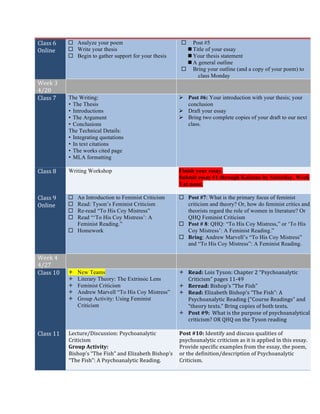
Class	
  6	
  
Online	
  
¨ Analyze your poem
¨ Write your thesis
¨ Begin to gather support for your thesis
¨ Post #5
n Title of your essay
n Your thesis statement
n A general outline
¨ Bring your outline (and a copy of your poem) to
class Monday
Week	
  3	
  
4/20	
  
Class	
  7	
   The Writing:
• The Thesis
• Introductions
• The Argument
• Conclusions
The Technical Details:
• Integrating quotations
• In text citations
• The works cited page
• MLA formatting
Ø Post #6: Your introduction with your thesis; your
conclusion
Ø Draft your essay
Ø Bring two complete copies of your draft to our next
class.
Class	
  8	
   Writing Workshop Finish your essay.
Submit essay #1 through Kaizena by Saturday, Week
3 at noon.
Class	
  9	
  
Online	
  
¨ An Introduction to Feminist Criticism
¨ Read: Tyson’s Feminist Criticism
¨ Re-read “To His Coy Mistress”
¨ Read “‘To His Coy Mistress’: A
Feminist Reading.”
¨ Homework
¨ Post #7: What is the primary focus of feminist
criticism and theory? Or, how do feminist critics and
theorists regard the role of women in literature? Or
QHQ Feminist Criticism
¨ Post # 8: QHQ: “To His Coy Mistress,” or ‘To His
Coy Mistress’: A Feminist Reading.”
¨ Bring: Andrew Marvell’s “To His Coy Mistress”
and “To His Coy Mistress”: A Feminist Reading.
Week	
  4	
  
4/27	
  
Class	
  10	
   ò New Teams
ò Literary Theory: The Extrinsic Lens
ò Feminist Criticism
ò Andrew Marvell “To His Coy Mistress”
ò Group Activity: Using Feminist
Criticism
ò Read:	
  Lois	
  Tyson:	
  Chapter	
  2	
  “Psychoanalytic	
  
Criticism”	
  pages	
  11-­‐49	
  
ò Reread:	
  Bishop’s	
  “The	
  Fish”	
  
ò Read:	
  Elizabeth	
  Bishop’s	
  “The	
  Fish”:	
  A	
  
Psychoanalytic	
  Reading	
  (“Course	
  Readings”	
  and	
  
“theory	
  texts.”	
  Bring	
  copies	
  of	
  both	
  texts.	
  	
  
ò Post	
  #9:	
  	
  What	
  is	
  the	
  purpose	
  of	
  psychoanalytical	
  
criticism?	
  OR	
  QHQ	
  on	
  the	
  Tyson	
  reading	


Class	
  11	
   Lecture/Discussion:	
  Psychoanalytic	
  
Criticism	
  	
  
Group	
  Activity:	
  	
  
Bishop’s	
  “The	
  Fish”	
  and	
  Elizabeth	
  Bishop’s	
  
“The	
  Fish”:	
  A	
  Psychoanalytic	
  Reading.	
  	
  
Post	
  #10:	
  Identify	
  and	
  discuss	
  qualities	
  of	
  
psychoanalytic	
  criticism	
  as	
  it	
  is	
  applied	
  in	
  this	
  essay.	
  	
  
Provide	
  specific	
  examples	
  from	
  the	
  essay,	
  the	
  poem,	
  
or	
  the	
  definition/description	
  of	
  Psychoanalytic	
  
Criticism.	
  
Class	
  12	
  
Online	
  
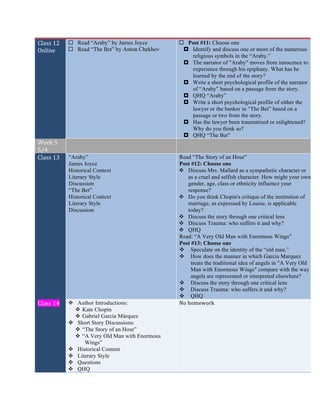
¨ Read “Araby” by James Joyce
¨ Read “The Bet” by Anton Chekhov
¨ Post #11: Choose one
¤ Identify and discuss one or more of the numerous
religious symbols in the “Araby.”
¤ The narrator of "Araby" moves from innocence to
experience through his epiphany. What has he
learned by the end of the story?
¤ Write a short psychological profile of the narrator
of “Araby” based on a passage from the story.
¤ QHQ “Araby”
¤ Write a short psychological profile of either the
lawyer or the banker in “The Bet” based on a
passage or two from the story.
¤ Has the lawyer been traumatized or enlightened?
Why do you think so?
¤ QHQ “The Bet”
Week	
  5	
  
5/4	
  
Class	
  13	
   “Araby”
James Joyce
Historical Context
Literary Style
Discussion
“The Bet”
Historical Context
Literary Style
Discussion
Read “The Story of an Hour”
Post #12: Choose one
v Discuss Mrs. Mallard as a sympathetic character or
as a cruel and selfish character. How might your own
gender, age, class or ethnicity influence your
response?
v Do you think Chopin's critique of the institution of
marriage, as expressed by Louise, is applicable
today?
v Discuss the story through one critical lens
v Discuss Trauma: who suffers it and why?
v QHQ
Read: “A Very Old Man with Enormous Wings”
Post #13: Choose one
v Speculate on the identity of the “old man.”
v How does the manner in which Garcia Marquez
treats the traditional idea of angels in "A Very Old
Man with Enormous Wings" compare with the way
angels are represented or interpreted elsewhere?
v Discuss the story through one critical lens
v Discuss Trauma: who suffers it and why?
v QHQ
Class	
  14	
   v Author Introductions:
v Kate Chopin
v Gabriel García Márquez
v Short Story Discussions:
v “The Story of an Hour”
v “A Very Old Man with Enormous
Wings”
v Historical Content
v Literary Style
v Questions
v QHQ
No	
  homework	
  
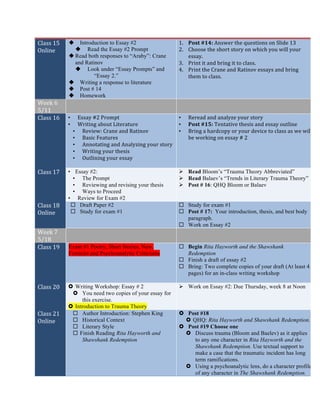
Class	
  15	
  
Online	
  
u Introduction to Essay #2
u Read the Essay #2 Prompt
u Read both responses to “Araby”: Crane
and Ratinov
u Look under “Essay Prompts” and
“Essay 2.”
u Writing a response to literature
u Post # 14
u Homework
1. Post	
  #14:	
  Answer	
  the	
  questions	
  on	
  Slide	
  13	
  
2. Choose	
  the	
  short	
  story	
  on	
  which	
  you	
  will	
  your	
  
essay.	
  
3. Print	
  it	
  and	
  bring	
  it	
  to	
  class.	
  
4. Print	
  the	
  Crane	
  and	
  Ratinov	
  essays	
  and	
  bring	
  
them	
  to	
  class.	


Week	
  6	
  
5/11	


Class	
  16	
   • Essay	
  #2	
  Prompt	
  
• Writing	
  about	
  Literature	
  
• Review:	
  Crane	
  and	
  Ratinov	
  
• Basic	
  Features	
  
• Annotating	
  and	
  Analyzing	
  your	
  story	
  
• Writing	
  your	
  thesis	
  
• Outlining	
  your	
  essay	


• Reread	
  and	
  analyze	
  your	
  story	
  
• Post	
  #15:	
  Tentative	
  thesis	
  and	
  essay	
  outline	
  
• Bring	
  a	
  hardcopy	
  or	
  your	
  device	
  to	
  class	
  as	
  we	
  will	
  
be	
  working	
  on	
  essay	
  #	
  2	


Class	
  17	
   • Essay #2:
• The Prompt
• Reviewing and revising your thesis
• Ways to Proceed
• Review for Exam #2
Ø Read Bloom’s “Trauma Theory Abbreviated”
Ø Read Balaev’s “Trends in Literary Trauma Theory”
Ø Post # 16: QHQ Bloom or Balaev
Class	
  18	
  
Online	
  
¨ Draft Paper #2
¨ Study for exam #1
¨ Post # 17: Your introduction, thesis, and best body
paragraph.
¨ Work on Essay #2
Week	
  7	
  
5/18	


Class	
  19	
   Exam #1 Poetry, Short Stories, New,
Feminist and Psychoanalytic Criticisms
¨ Begin Rita Hayworth and the Shawshank
Redemption
¨ Finish a draft of essay #2
¨ Bring: Two complete copies of your draft (At least 4
pages) for an in-class writing workshop
Class	
  20	
   › Writing Workshop: Essay # 2
› You need two copies of your essay for
this exercise.
› Introduction to Trauma Theory
Ø Work on Essay #2: Due Thursday, week 8 at Noon
Class	
  21	
  
Online	
  
¨ Author Introduction: Stephen King
¨ Historical Context
¨ Literary Style
¨ Finish Reading Rita Hayworth and
Shawshank Redemption
› Post #18
› QHQ: Rita Hayworth and Shawshank Redemption.
› Post #19 Choose one
› Discuss trauma (Bloom and Baelev) as it applies
to any one character in Rita Hayworth and the
Shawshank Redemption. Use textual support to
make a case that the traumatic incident has long
term ramifications.
› Using a psychoanalytic lens, do a character profile
of any character in The Shawshank Redemption.
Week	
  8	
  
5/25	


No	
  Class	


Class	
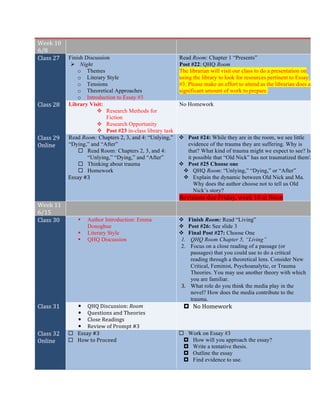
  22	
   ² New Teams
² Trauma Theory
² Discussion:
² Trauma Theory
² Bloom
² Balaev
² Discussion: Rita Hayworth and
Shawshank Redemption
Edit	
  Essay	
  #2	
  	
  
Essay	
  2	
  Due	
  Thursday,	
  week	
  8	
  at	
  Noon	
  via	
  Kaizena	


Class	
  23	
  
Online	
  
¨ Read The Metamorphosis
¨ Author Introduction:
Franz Kafka
¨ Historical Context
¨ Literary Style
Read Kafka’s The Metamorphosis
Post #19 Answer one of the questions from slides 12, 13,
or 14 in 200-300 words
Week	
  9	
  
6/1	
  
Class	
  24	
   × Novella Discussion:
× Final comments: Rita Hayworth and
Shawshank Redemption
× The Metamorphosis
× Questions
× Themes and Characters
× Potential Theoretical Approaches
Read Night First half
Post #20 QHQ
Class	
  25	
   s New Teams
s Discussion:
s End: The Metamorphosis
s Begin: Night
s Author Introduction:
s Elie Wiesel
s Historical Context
s Summary
s QHQ
s
No Homework
Class	
  26	
  
Online	
  
Finish Night
s Themes
s Literary Style
s Tensions
s Theoretical Approaches
s Finish	
  Night	
  
s Post	
  #21	
  QHQ	
  Night:	
  	
  Focus	
  on	
  a	
  close	
  reading	
  of	
  a	
  
passage	
  (or	
  passages)	
  that	
  you	
  could	
  use	
  to	
  do	
  a	
  
critical	
  reading	
  through	
  a	
  particular	
  theoretical	
  
lens.	
  Consider	
  New	
  Critical,	
  Feminist,	
  
Psychoanalytic,	
  or	
  Trauma	
  Theories.	
  You	
  may	
  use	
  
another	
  theory	
  with	
  which	
  you	
  are	
  familiar.	
  	
  
Revisions	
  due	
  Friday,	
  week	
  10	
  at	
  Noon	
  
Week	
  10	
  
6/8	


Class	
  27	
   Finish Discussion
Ø Night
o Themes
o Literary Style
o Tensions
o Theoretical Approaches
o Introduction to Essay #3
Read Room: Chapter 1 “Presents”
Post #22: QHQ Room
The librarian will visit our class to do a presentation on
using the library to look for resources pertinent to Essay
#3. Please make an effort to attend as the librarian does a
significant amount of work to prepare.
Class	
  28	
   Library Visit:
v Research Methods for
Fiction
v Research Opportunity
v Post #23 in-class library task
No Homework	
  
Class	
  29	
  
Online	
  
Read Room: Chapters 2, 3, and 4: “Unlying,”
“Dying,” and “After”
¨ Read Room: Chapters 2, 3, and 4:
“Unlying,” “Dying,” and “After”
¨ Thinking about trauma
¨ Homework
Essay	
  #3	
  
v Post #24: While they are in the room, we see little
evidence of the trauma they are suffering. Why is
that? What kind of trauma might we expect to see? Is
it possible that “Old Nick” has not traumatized them?
v Post #25 Choose one
v QHQ Room: “Unlying,” “Dying,” or “After”
v Explain the dynamic between Old Nick and Ma.
Why does the author choose not to tell us Old
Nick’s story?
Revisions	
  due	
  Friday,	
  week	
  10	
  at	
  Noon	
  
Week	
  11	
  
6/15	


Class	
  30	
   § Author Introduction: Emma
Donoghue
§ Literary Style
§ QHQ Discussion
v Finish Room: Read “Living”
v Post #26: See slide 3
v Final Post #27: Choose One
1. QHQ Room Chapter 5, “Living”
2. Focus on a close reading of a passage (or
passages) that you could use to do a critical
reading through a theoretical lens. Consider New
Critical, Feminist, Psychoanalytic, or Trauma
Theories. You may use another theory with which
you are familiar.
3. What role do you think the media play in the
novel? How does the media contribute to the
trauma.	
  
Class	
  31	
   — QHQ	
  Discussion:	
  Room	
  
— Questions	
  and	
  Theories	
  
— Close	
  Readings	
  
— Review	
  of	
  Prompt	
  #3	
  
¤ No	
  Homework	
  
Class	
  32	
  
Online	
  
¨ Essay	
  #3	
  
¨ How	
  to	
  Proceed	
  
¨ Work on Essay #3
¤ How will you approach the essay?
¤ Write a tentative thesis.
¤ Outline the essay
¤ Find evidence to use.
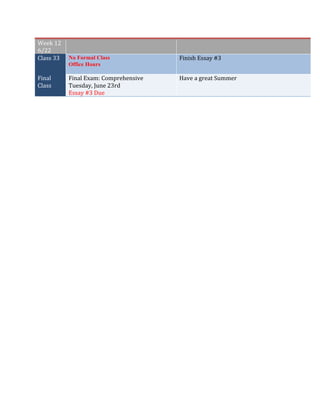
Week	
  12	
  
6/22	


Class	
  33	
   No Formal Class
Office Hours
Finish	
  Essay	
  #3	
  
Final	
  
Class	


Final	
  Exam:	
  Comprehensive	
  
Tuesday,	
  June	
  23rd	
  
Essay	
  #3	
  Due	
  
Have	
  a	
  great	
  Summer	


Ewrt 1 c spring 2015 basic

  • 1.
    Week   In-­‐Class  Activities   Homework   Week  1   4/6   Class Work   Homework     Essay #1 Class  1   v The Course Description and Details v What is a Hybrid Class? v Syllabus, Green Sheet, Website, and Kaizena, and the QHQ v The Lecture a. What is Literature and Composition? b. What is literature? c. What is Literary Theory? d. What is New Criticism? • Establish your username and explore the class webpage • Buy your books • Read: Critical Theory Today: Chapter 1 Introduction 1-10 • Read: Critical Theory Today: Chapter 5 New Criticism 135-164 • Post #1: QHQ: Literature, Literary Theory, or New Criticism Class  2   › Teams › Review › New Criticism › The Formal Elements of New Criticism › Paradox › Irony › Tension › Ambiguity › QHQs › The Online Hour • Review the readings and ideas we have covered this week. • Don’t forget to work through the online portion of the class. You can find it under “Presentations,” “Weeks 1-2” and “Class 3.” Class  3   Online   • Figurative Language • Poetry Reading: • “My Papa’s Waltz” • Critical Essay Reading: • “‘My Papa’s Waltz’: A New Critical Reading.” • Post #2: Post a paragraph or two outlining your own New Critical insights about “My Papa’s Waltz.” Then write a paragraph discussing your agreement or disagreement with the author of the New Critical Essay. Consider thesis, figurative language, and conclusion. • Bring copies of “My Papa’s Waltz” and “My Papa’s Waltz: A New Critical Approach” to class. Week  2   4/13   Class  4   — Review: Formal Elements of Writing/ figurative language — Group Activity “My Papa’s Waltz” and “My Papa’s Waltz: A New Critical Approach. — Group Work: Identify and discuss qualities of New Criticism as they are (or are not) applied in this essay. Provide specific examples from the essay, the poem, or the definition/description of New Criticism. — Scanning Poetry READ • “There Is a Girl Inside” • “The Fish” • “A Black Rook in Rainy Weather” • “Memories of West Street and Lepke” • “To His Coy Mistress” • Choose one poem to scan (meter and rhyme) • POST # 3: summarize the form (slides 19- 20 for help). • Choose two you might want to write about. Print them both and bring them to class. Class  5   • Review scanning poetry • New rhetorical strategies: • Using the new critical lens to analyze • Introduction to essay #1 • In class writing • Post # 4: Answer 7 of the 9 questions on slide 27 • Bring your notes to our next meeting
  • 2.
    Class  6   Online   ¨ Analyze your poem ¨ Write your thesis ¨ Begin to gather support for your thesis ¨ Post #5 n Title of your essay n Your thesis statement n A general outline ¨ Bring your outline (and a copy of your poem) to class Monday Week  3   4/20   Class  7   The Writing: • The Thesis • Introductions • The Argument • Conclusions The Technical Details: • Integrating quotations • In text citations • The works cited page • MLA formatting Ø Post #6: Your introduction with your thesis; your conclusion Ø Draft your essay Ø Bring two complete copies of your draft to our next class. Class  8   Writing Workshop Finish your essay. Submit essay #1 through Kaizena by Saturday, Week 3 at noon. Class  9   Online   ¨ An Introduction to Feminist Criticism ¨ Read: Tyson’s Feminist Criticism ¨ Re-read “To His Coy Mistress” ¨ Read “‘To His Coy Mistress’: A Feminist Reading.” ¨ Homework ¨ Post #7: What is the primary focus of feminist criticism and theory? Or, how do feminist critics and theorists regard the role of women in literature? Or QHQ Feminist Criticism ¨ Post # 8: QHQ: “To His Coy Mistress,” or ‘To His Coy Mistress’: A Feminist Reading.” ¨ Bring: Andrew Marvell’s “To His Coy Mistress” and “To His Coy Mistress”: A Feminist Reading. Week  4   4/27   Class  10   ò New Teams ò Literary Theory: The Extrinsic Lens ò Feminist Criticism ò Andrew Marvell “To His Coy Mistress” ò Group Activity: Using Feminist Criticism ò Read:  Lois  Tyson:  Chapter  2  “Psychoanalytic   Criticism”  pages  11-­‐49   ò Reread:  Bishop’s  “The  Fish”   ò Read:  Elizabeth  Bishop’s  “The  Fish”:  A   Psychoanalytic  Reading  (“Course  Readings”  and   “theory  texts.”  Bring  copies  of  both  texts.     ò Post  #9:    What  is  the  purpose  of  psychoanalytical   criticism?  OR  QHQ  on  the  Tyson  reading     Class  11   Lecture/Discussion:  Psychoanalytic   Criticism     Group  Activity:     Bishop’s  “The  Fish”  and  Elizabeth  Bishop’s   “The  Fish”:  A  Psychoanalytic  Reading.     Post  #10:  Identify  and  discuss  qualities  of   psychoanalytic  criticism  as  it  is  applied  in  this  essay.     Provide  specific  examples  from  the  essay,  the  poem,   or  the  definition/description  of  Psychoanalytic   Criticism.  
  • 3.
    Class  12   Online   ¨ Read “Araby” by James Joyce ¨ Read “The Bet” by Anton Chekhov ¨ Post #11: Choose one ¤ Identify and discuss one or more of the numerous religious symbols in the “Araby.” ¤ The narrator of "Araby" moves from innocence to experience through his epiphany. What has he learned by the end of the story? ¤ Write a short psychological profile of the narrator of “Araby” based on a passage from the story. ¤ QHQ “Araby” ¤ Write a short psychological profile of either the lawyer or the banker in “The Bet” based on a passage or two from the story. ¤ Has the lawyer been traumatized or enlightened? Why do you think so? ¤ QHQ “The Bet” Week  5   5/4   Class  13   “Araby” James Joyce Historical Context Literary Style Discussion “The Bet” Historical Context Literary Style Discussion Read “The Story of an Hour” Post #12: Choose one v Discuss Mrs. Mallard as a sympathetic character or as a cruel and selfish character. How might your own gender, age, class or ethnicity influence your response? v Do you think Chopin's critique of the institution of marriage, as expressed by Louise, is applicable today? v Discuss the story through one critical lens v Discuss Trauma: who suffers it and why? v QHQ Read: “A Very Old Man with Enormous Wings” Post #13: Choose one v Speculate on the identity of the “old man.” v How does the manner in which Garcia Marquez treats the traditional idea of angels in "A Very Old Man with Enormous Wings" compare with the way angels are represented or interpreted elsewhere? v Discuss the story through one critical lens v Discuss Trauma: who suffers it and why? v QHQ Class  14   v Author Introductions: v Kate Chopin v Gabriel García Márquez v Short Story Discussions: v “The Story of an Hour” v “A Very Old Man with Enormous Wings” v Historical Content v Literary Style v Questions v QHQ No  homework  
  • 4.
    Class  15   Online   u Introduction to Essay #2 u Read the Essay #2 Prompt u Read both responses to “Araby”: Crane and Ratinov u Look under “Essay Prompts” and “Essay 2.” u Writing a response to literature u Post # 14 u Homework 1. Post  #14:  Answer  the  questions  on  Slide  13   2. Choose  the  short  story  on  which  you  will  your   essay.   3. Print  it  and  bring  it  to  class.   4. Print  the  Crane  and  Ratinov  essays  and  bring   them  to  class.         Week  6   5/11       Class  16   • Essay  #2  Prompt   • Writing  about  Literature   • Review:  Crane  and  Ratinov   • Basic  Features   • Annotating  and  Analyzing  your  story   • Writing  your  thesis   • Outlining  your  essay     • Reread  and  analyze  your  story   • Post  #15:  Tentative  thesis  and  essay  outline   • Bring  a  hardcopy  or  your  device  to  class  as  we  will   be  working  on  essay  #  2     Class  17   • Essay #2: • The Prompt • Reviewing and revising your thesis • Ways to Proceed • Review for Exam #2 Ø Read Bloom’s “Trauma Theory Abbreviated” Ø Read Balaev’s “Trends in Literary Trauma Theory” Ø Post # 16: QHQ Bloom or Balaev Class  18   Online   ¨ Draft Paper #2 ¨ Study for exam #1 ¨ Study for exam #1 ¨ Post # 17: Your introduction, thesis, and best body paragraph. ¨ Work on Essay #2 Week  7   5/18       Class  19   Exam #1 Poetry, Short Stories, New, Feminist and Psychoanalytic Criticisms ¨ Begin Rita Hayworth and the Shawshank Redemption ¨ Finish a draft of essay #2 ¨ Bring: Two complete copies of your draft (At least 4 pages) for an in-class writing workshop Class  20   › Writing Workshop: Essay # 2 › You need two copies of your essay for this exercise. › Introduction to Trauma Theory Ø Work on Essay #2: Due Thursday, week 8 at Noon Class  21   Online   ¨ Author Introduction: Stephen King ¨ Historical Context ¨ Literary Style ¨ Finish Reading Rita Hayworth and Shawshank Redemption › Post #18 › QHQ: Rita Hayworth and Shawshank Redemption. › Post #19 Choose one › Discuss trauma (Bloom and Baelev) as it applies to any one character in Rita Hayworth and the Shawshank Redemption. Use textual support to make a case that the traumatic incident has long term ramifications. › Using a psychoanalytic lens, do a character profile of any character in The Shawshank Redemption.
  • 5.
    Week  8   5/25       No  Class       Class  22   ² New Teams ² Trauma Theory ² Discussion: ² Trauma Theory ² Bloom ² Balaev ² Discussion: Rita Hayworth and Shawshank Redemption Edit  Essay  #2     Essay  2  Due  Thursday,  week  8  at  Noon  via  Kaizena     Class  23   Online   ¨ Read The Metamorphosis ¨ Author Introduction: Franz Kafka ¨ Historical Context ¨ Literary Style Read Kafka’s The Metamorphosis Post #19 Answer one of the questions from slides 12, 13, or 14 in 200-300 words Week  9   6/1   Class  24   × Novella Discussion: × Final comments: Rita Hayworth and Shawshank Redemption × The Metamorphosis × Questions × Themes and Characters × Potential Theoretical Approaches Read Night First half Post #20 QHQ Class  25   s New Teams s Discussion: s End: The Metamorphosis s Begin: Night s Author Introduction: s Elie Wiesel s Historical Context s Summary s QHQ s No Homework Class  26   Online   Finish Night s Themes s Literary Style s Tensions s Theoretical Approaches s Finish  Night   s Post  #21  QHQ  Night:    Focus  on  a  close  reading  of  a   passage  (or  passages)  that  you  could  use  to  do  a   critical  reading  through  a  particular  theoretical   lens.  Consider  New  Critical,  Feminist,   Psychoanalytic,  or  Trauma  Theories.  You  may  use   another  theory  with  which  you  are  familiar.     Revisions  due  Friday,  week  10  at  Noon  
  • 6.
    Week  10   6/8       Class  27   Finish Discussion Ø Night o Themes o Literary Style o Tensions o Theoretical Approaches o Introduction to Essay #3 Read Room: Chapter 1 “Presents” Post #22: QHQ Room The librarian will visit our class to do a presentation on using the library to look for resources pertinent to Essay #3. Please make an effort to attend as the librarian does a significant amount of work to prepare. Class  28   Library Visit: v Research Methods for Fiction v Research Opportunity v Post #23 in-class library task No Homework   Class  29   Online   Read Room: Chapters 2, 3, and 4: “Unlying,” “Dying,” and “After” ¨ Read Room: Chapters 2, 3, and 4: “Unlying,” “Dying,” and “After” ¨ Thinking about trauma ¨ Homework Essay  #3   v Post #24: While they are in the room, we see little evidence of the trauma they are suffering. Why is that? What kind of trauma might we expect to see? Is it possible that “Old Nick” has not traumatized them? v Post #25 Choose one v QHQ Room: “Unlying,” “Dying,” or “After” v Explain the dynamic between Old Nick and Ma. Why does the author choose not to tell us Old Nick’s story? Revisions  due  Friday,  week  10  at  Noon   Week  11   6/15       Class  30   § Author Introduction: Emma Donoghue § Literary Style § QHQ Discussion v Finish Room: Read “Living” v Post #26: See slide 3 v Final Post #27: Choose One 1. QHQ Room Chapter 5, “Living” 2. Focus on a close reading of a passage (or passages) that you could use to do a critical reading through a theoretical lens. Consider New Critical, Feminist, Psychoanalytic, or Trauma Theories. You may use another theory with which you are familiar. 3. What role do you think the media play in the novel? How does the media contribute to the trauma.   Class  31   — QHQ  Discussion:  Room   — Questions  and  Theories   — Close  Readings   — Review  of  Prompt  #3   ¤ No  Homework   Class  32   Online   ¨ Essay  #3   ¨ How  to  Proceed   ¨ Work on Essay #3 ¤ How will you approach the essay? ¤ Write a tentative thesis. ¤ Outline the essay ¤ Find evidence to use.
  • 7.
    Week  12   6/22       Class  33   No Formal Class Office Hours Finish  Essay  #3   Final   Class     Final  Exam:  Comprehensive   Tuesday,  June  23rd   Essay  #3  Due   Have  a  great  Summer