Why restorative practice?
Consider this..
“If a child doesn’t know how to read, we teach
If a child doesn’t know how to swim, we teach
If a child doesn’t know how to multiply, we teach
If a child doesn’t know how to drive, we teach
If a child doesn’t know how to behave we …
Teach? Or punish?”
We are in the business of relationship
building not behaviour management.
• Therefore we should be teaching and
modeling pro social behaviour.
Relational bank account
Deposits Withdrawals
Seeks first to understand Seeks first to be understood
Keeping promises Breaking promises
Clarifying expectations Violating expectations
Kindnesses and courtesies Unkindnesses and discourtesies
Loyalty to the absent Disloyalty duplicity
Apologies Pride/ conceit/ arrogance
Open to feedback Rejecting feedback
• Time spent on relationships is time invested in our school
• We need to teach connections that are face to face because they are so much more
meaningful than online connections.
• We have to get relationships right first so there is something right to resort to.
• Our job in the classroom is to get the relationships in the room to the point where our
akonga care about the impact of their behavior on others.
Fundamental concepts of Restorative
Practice
• Misconduct is a violation of people and
relationships that leads to disconnectivity.
• Violations create obligations and liabilities
• Restorative Practice seeks to heal and put
things right.
Changing our mindsets
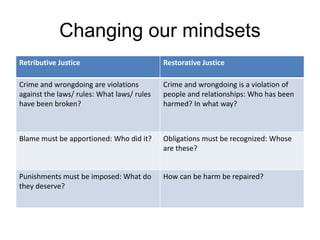
Retributive Justice Restorative Justice
Crime and wrongdoing are violations
against the laws/ rules: What laws/ rules
have been broken?
Crime and wrongdoing is a violation of
people and relationships: Who has been
harmed? In what way?
Blame must be apportioned: Who did it? Obligations must be recognized: Whose
are these?
Punishments must be imposed: What do
they deserve?
How can be harm be repaired?
Golden rules of Restorative Practice
• Listen first- be quiet, what’s the story behind the story?
• Don’t tell what you can ask
• Think about outcomes before deciding on strategy- consequence
should teach what we want the child to learn, must be designed to
build social capital.
• Develop empathy by helping them to understand what harm has
been done.
• Work on making things right rather than punishment.
• Contact parents early and ask for their support, i.e. what they want
for their child.
• Kids brains are a work in progress.
• Don’t assume all children come to school with the ability to de code
value systems.
• Never make home wrong.
Developing
social/emotional
capacity
Restoring
relationships
Managing difficulties and disruptions
Key questions (person harmed)
Key questions (person responsible)
Scenario
• Scenario 1:
Lisa is approached by a tearful middle school
student in the playground who states that her
lunch is missing from her lunchbox again. Lisa
notices David peering around the corner
watching proceedings. Several children say they
saw David taking the lunch and Lisa knows there
is a history of similar behaviour.
Do’s and don’ts
Do:
• Calm voice
• Calm, relaxed and connected.
• Sit or walk along side during discussions
• Going down to the child’s level
• Give child something to play with if appropraite
• Insist on person responsible for talking first, person harmed second, no one can interrupt.
• Keep restorative meeting to 20 minutes or less
• Ask of both partipants is there anything else youd like to say
• Make a time to check in with all parties ( follow up with children, parents)
Don’t:
• Be angry this leads to distress and hyper vigilance
• Tell children to look at you when you’re talking to them, too confronting, leads to child shutting
down.
• Dogged pursue restorative mediation if all parties are not calm and willing to participate.
• Ask why, stick to the script
Scenario 2
• Ben takes his class rugby ball outside to play.
Jacob is told he can’t play as the game is full.
He picks up the ball and runs away with it. Ben
follows and asks for the ball back and is
verbally abused by Jacob. The duty teacher
comes across the boys on top of each other
fighting.
Discuss and Role play this in your groups

Restorative practice

  • 1.
    Why restorative practice? Considerthis.. “If a child doesn’t know how to read, we teach If a child doesn’t know how to swim, we teach If a child doesn’t know how to multiply, we teach If a child doesn’t know how to drive, we teach If a child doesn’t know how to behave we … Teach? Or punish?”
  • 2.
    We are inthe business of relationship building not behaviour management. • Therefore we should be teaching and modeling pro social behaviour.
  • 3.
    Relational bank account DepositsWithdrawals Seeks first to understand Seeks first to be understood Keeping promises Breaking promises Clarifying expectations Violating expectations Kindnesses and courtesies Unkindnesses and discourtesies Loyalty to the absent Disloyalty duplicity Apologies Pride/ conceit/ arrogance Open to feedback Rejecting feedback • Time spent on relationships is time invested in our school • We need to teach connections that are face to face because they are so much more meaningful than online connections. • We have to get relationships right first so there is something right to resort to. • Our job in the classroom is to get the relationships in the room to the point where our akonga care about the impact of their behavior on others.
  • 4.
    Fundamental concepts ofRestorative Practice • Misconduct is a violation of people and relationships that leads to disconnectivity. • Violations create obligations and liabilities • Restorative Practice seeks to heal and put things right.
  • 5.
    Changing our mindsets RetributiveJustice Restorative Justice Crime and wrongdoing are violations against the laws/ rules: What laws/ rules have been broken? Crime and wrongdoing is a violation of people and relationships: Who has been harmed? In what way? Blame must be apportioned: Who did it? Obligations must be recognized: Whose are these? Punishments must be imposed: What do they deserve? How can be harm be repaired?
  • 6.
    Golden rules ofRestorative Practice • Listen first- be quiet, what’s the story behind the story? • Don’t tell what you can ask • Think about outcomes before deciding on strategy- consequence should teach what we want the child to learn, must be designed to build social capital. • Develop empathy by helping them to understand what harm has been done. • Work on making things right rather than punishment. • Contact parents early and ask for their support, i.e. what they want for their child. • Kids brains are a work in progress. • Don’t assume all children come to school with the ability to de code value systems. • Never make home wrong.
  • 7.
  • 8.
  • 9.
  • 10.
    Scenario • Scenario 1: Lisais approached by a tearful middle school student in the playground who states that her lunch is missing from her lunchbox again. Lisa notices David peering around the corner watching proceedings. Several children say they saw David taking the lunch and Lisa knows there is a history of similar behaviour.
  • 11.
    Do’s and don’ts Do: •Calm voice • Calm, relaxed and connected. • Sit or walk along side during discussions • Going down to the child’s level • Give child something to play with if appropraite • Insist on person responsible for talking first, person harmed second, no one can interrupt. • Keep restorative meeting to 20 minutes or less • Ask of both partipants is there anything else youd like to say • Make a time to check in with all parties ( follow up with children, parents) Don’t: • Be angry this leads to distress and hyper vigilance • Tell children to look at you when you’re talking to them, too confronting, leads to child shutting down. • Dogged pursue restorative mediation if all parties are not calm and willing to participate. • Ask why, stick to the script
  • 12.
    Scenario 2 • Bentakes his class rugby ball outside to play. Jacob is told he can’t play as the game is full. He picks up the ball and runs away with it. Ben follows and asks for the ball back and is verbally abused by Jacob. The duty teacher comes across the boys on top of each other fighting. Discuss and Role play this in your groups

Editor's Notes

  • #4 Restorative values to be embedded in our relationships are: participation, respect, honesty, humility, interconnectedness, accountability, empowerment – ‘Power of One’ Agreements -
  • #7 I.e. a working lunch is a direct consequence of not doing work, rather than writing out lines for pushing someone over. Make sure you have all facts before speaking to parents, don’t make judgements based on previous behaviours. Code switching, learning to behavd differently in different settings, learning to use different register, Different registers: frozen, formal, consultative, casual, intimate
  • #12 May need to wait till child or teacher is calm