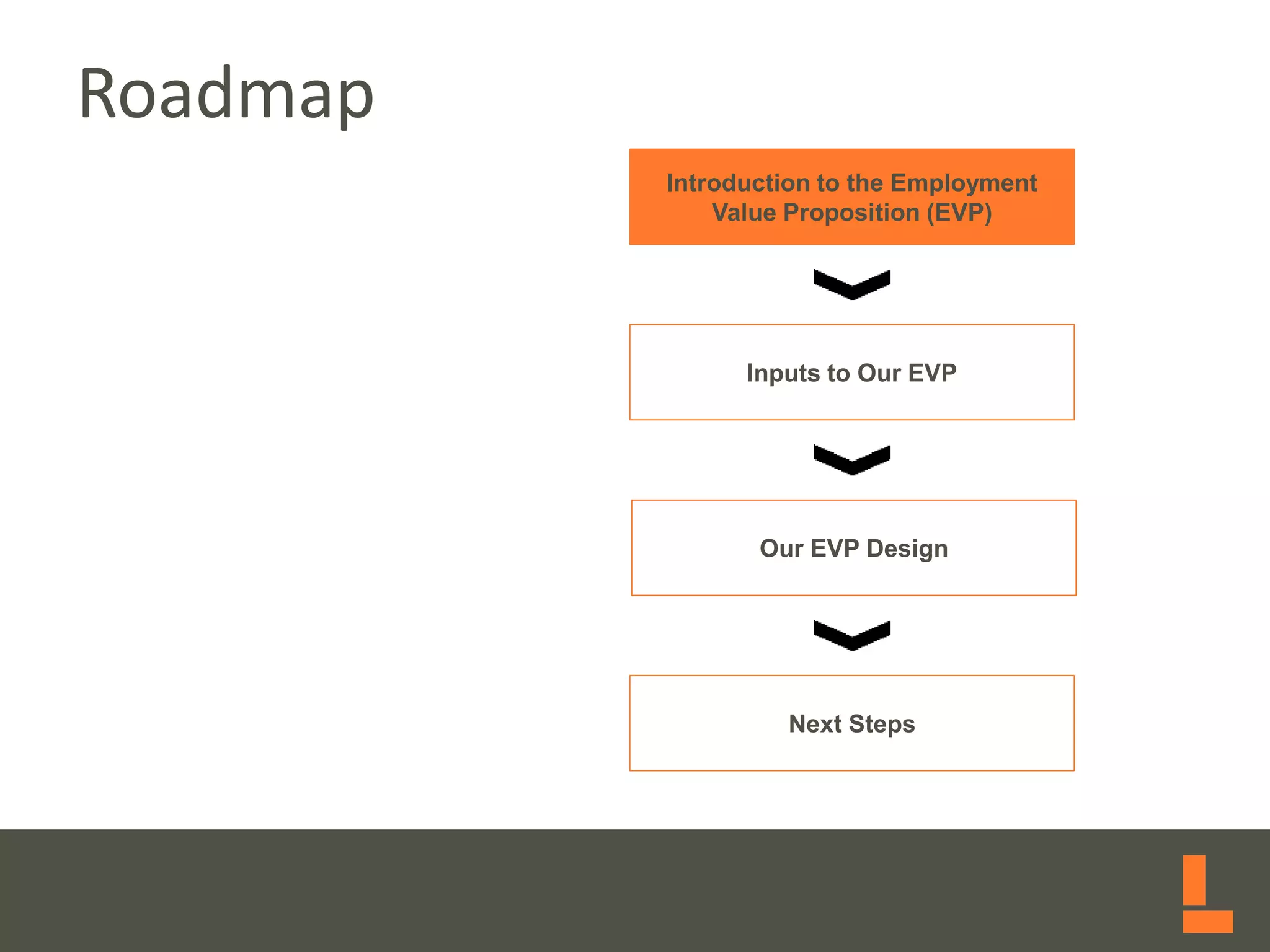
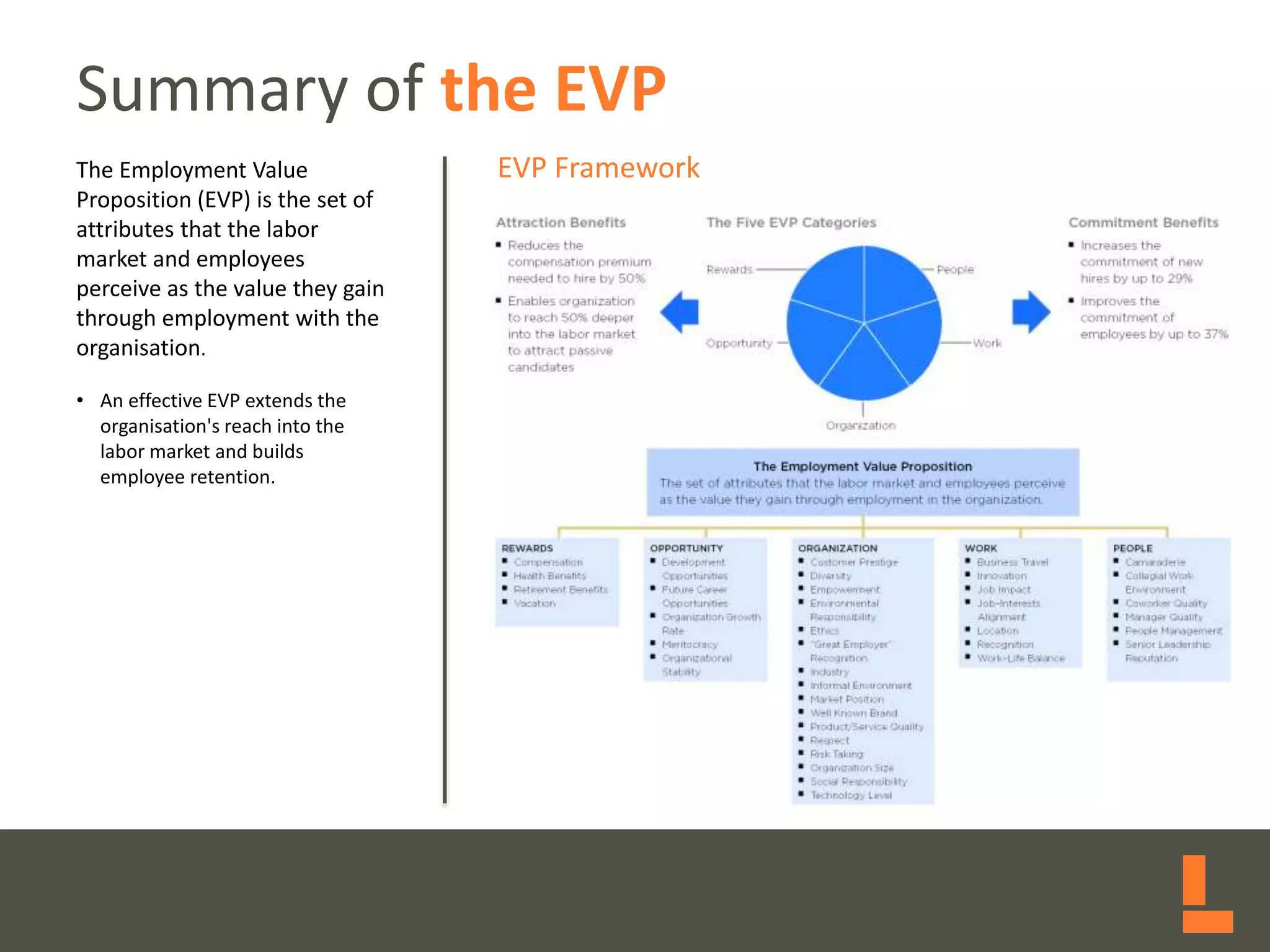
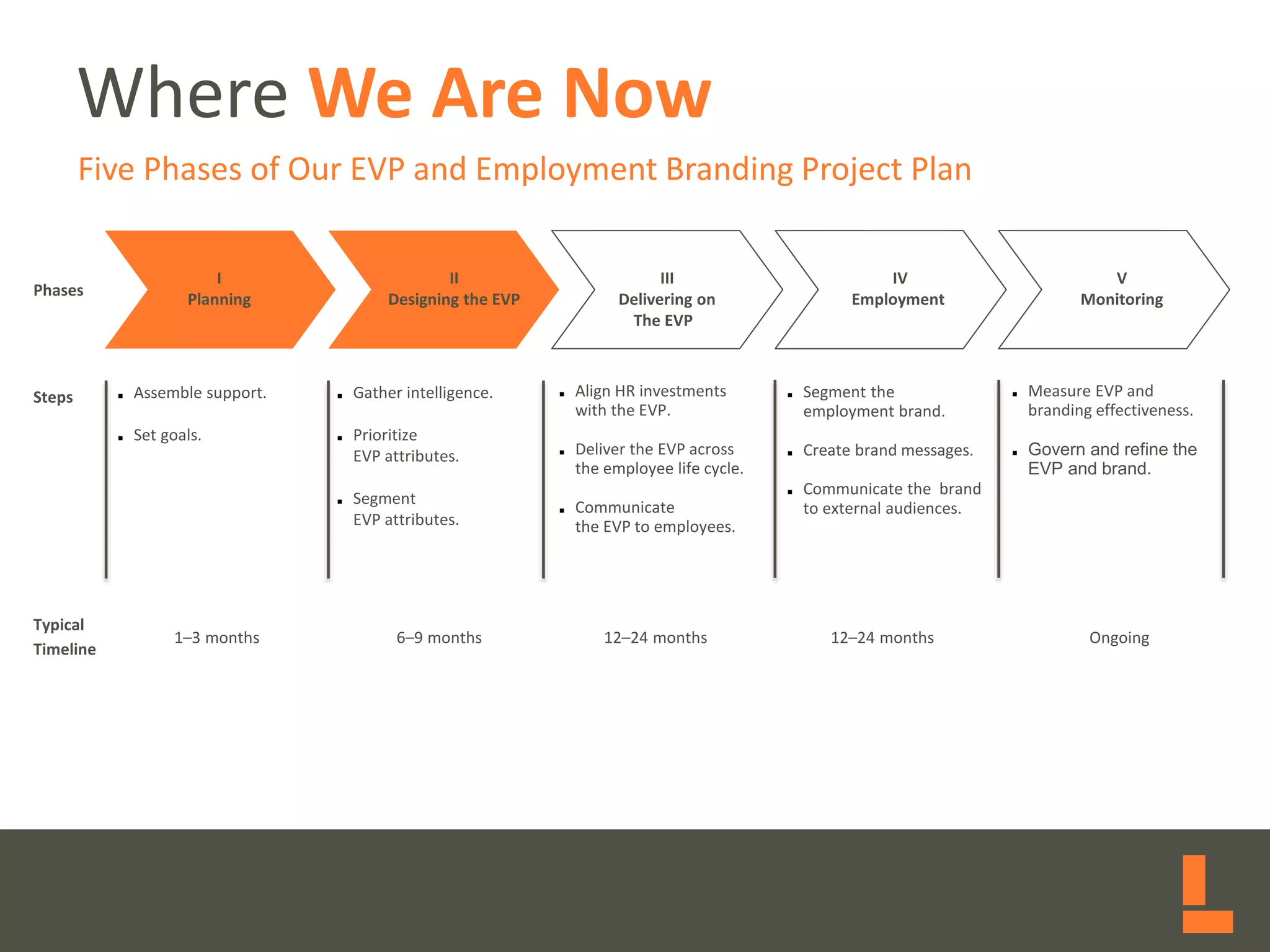
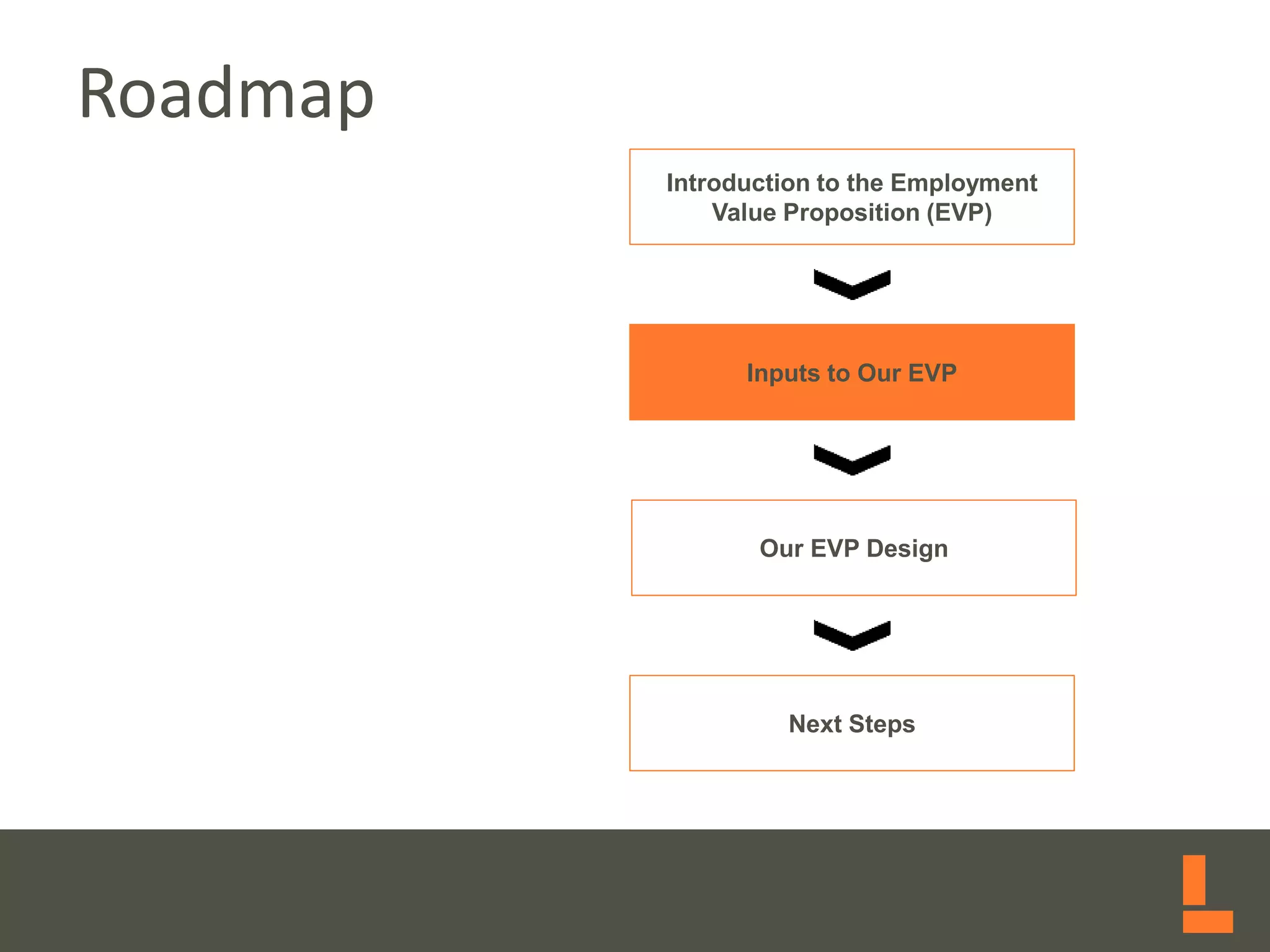
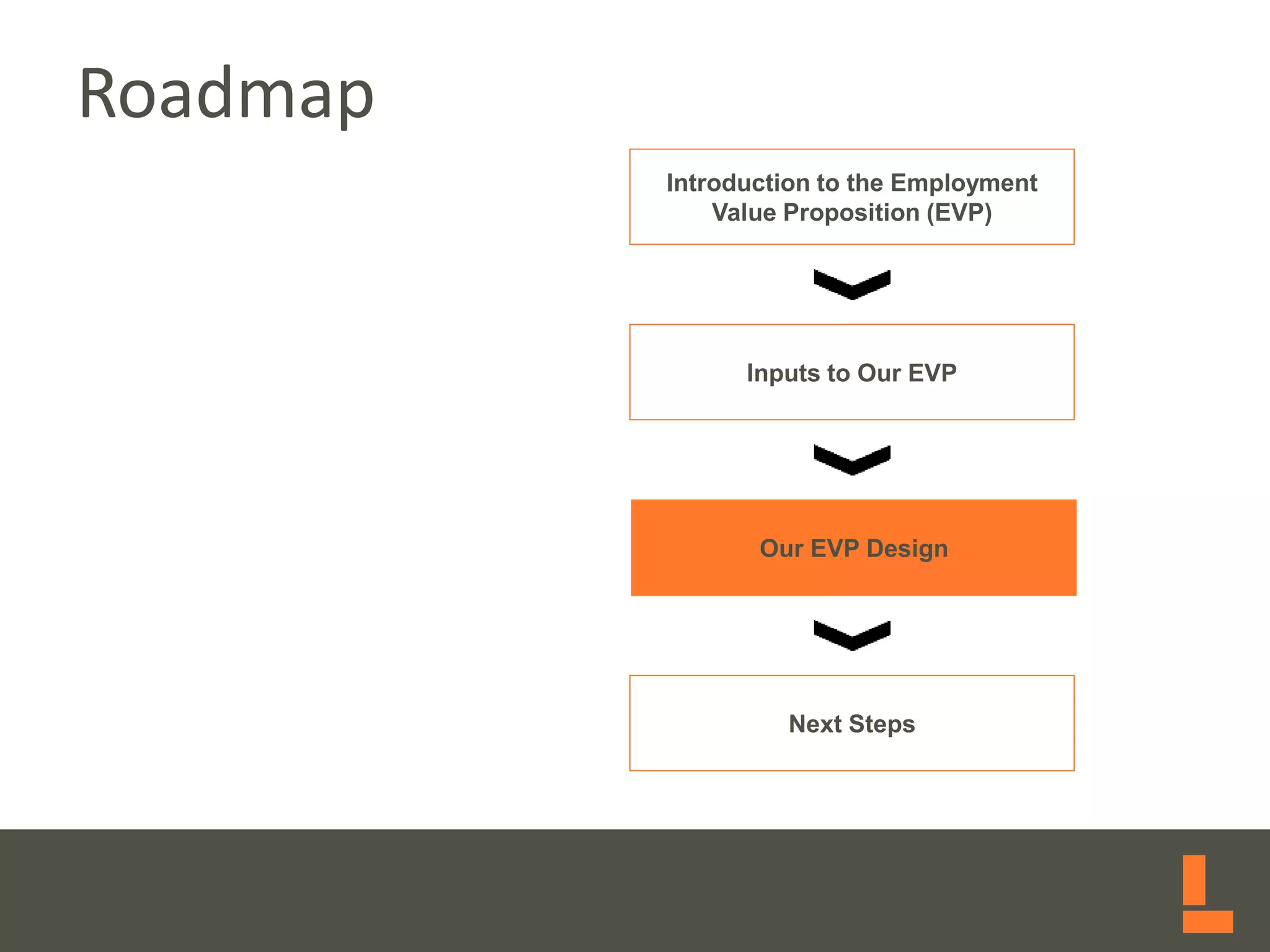
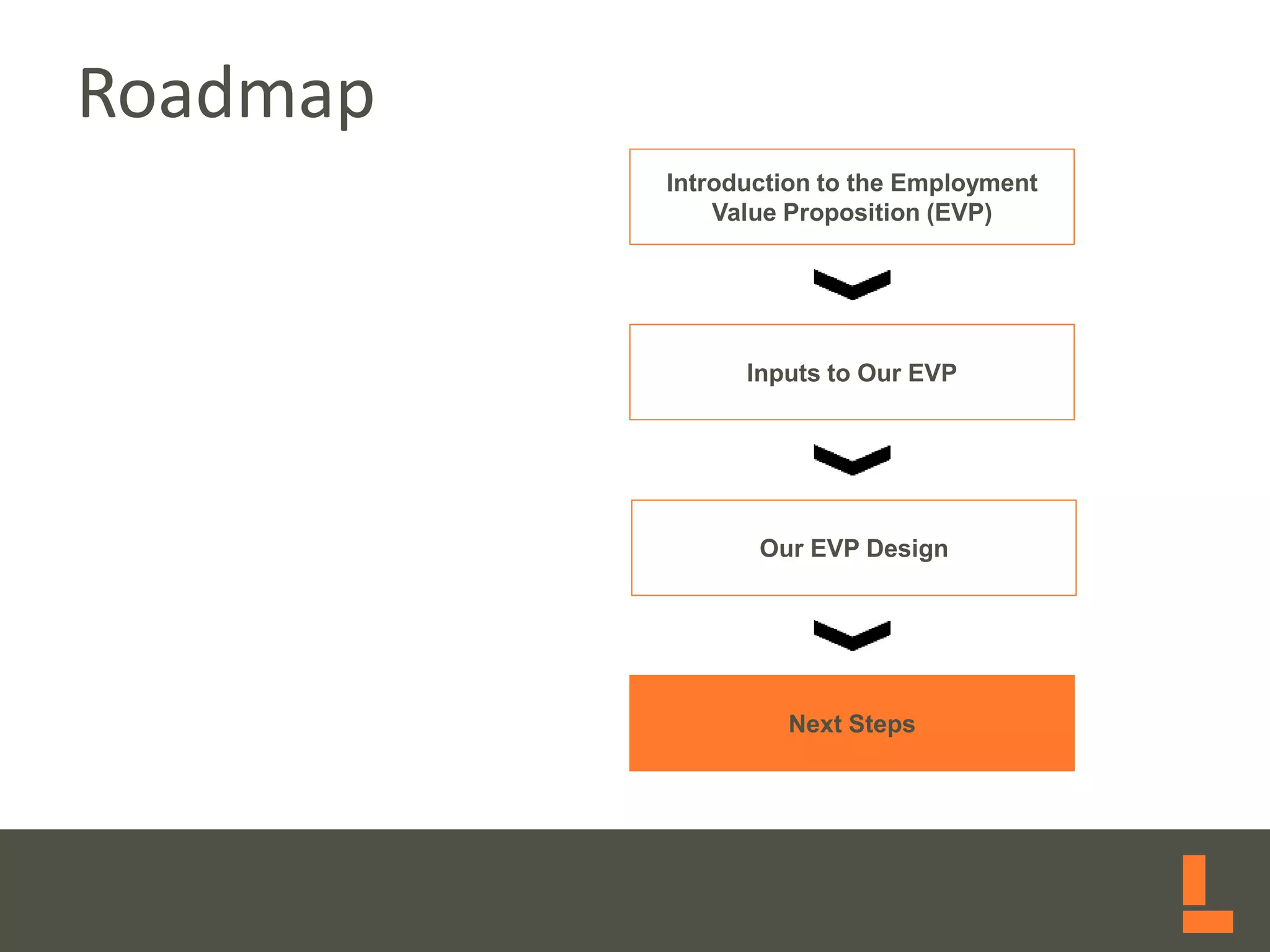
This template is used to present an organization's employment value proposition (EVP) design to stakeholders. It provides an introduction to the EVP framework and outlines a five-phase EVP and employment branding project plan. The presentation template then guides the user to fill in relevant information on the organization's labor market inputs, talent competitors, business strategies, core EVP design, segmented EVP design, and next steps to communicate and deliver the EVP.
![What it does: This template helps you summarize and present your
employment value proposition (EVP) design to key stakeholders.
Introduction
How to use it: Use these slides to present your EVP to internal
stakeholders, or to preserve your final EVP design for use when you are
communicating and delivering on your EVP.
Instructions:
Complete this template by filling in relevant information for the text
marked in [red brackets]. You can change any text in this template as
necessary.
Delete the first two slides of this document before presenting.](https://image.slidesharecdn.com/evp-design-presentation-220417021550/75/EVP-Design-Presentation-pptx-2-2048.jpg)
![The Labor Market
Top Attraction Drivers
1. [Attraction Driver #1]
2. [Attraction Driver #2]
3. [Attraction Driver #3]
4. [Attraction Driver #4]
5. [Attraction Driver #5]
Segment-Specific Variations
Top Attrition Drivers
1. [Attrition Driver #1]
2. [Attrition Driver #2]
3. [Attrition Driver #3]
4. [Attrition Driver #4]
5. [Attrition Driver #5]
Top Perceptions of
Our organisation
1. [Perception #1]
2. [Perception #2]
3. [Perception #3]
4. [Perception #4]
5. [Perception #5]
[Name of Talent
Segment #1]
[Name of Talent
Segment #2]
[Name of Talent
Segment #3]
[Name of Talent
Segment #4]
[Name of Talent
Segment #5]
• [Difference from
overall labor market
preferences or
perceptions]
• [Difference from
overall labor market
preferences or
perceptions]
• [Difference from
overall labor market
preferences or
perceptions]
• [Difference from
overall labor market
preferences or
perceptions]
• [Difference from
overall labor market
preferences or
perceptions]
Note: Copy these tables
from the ‘Summary of
Inputs to EVP Design’ and
reformat as necessary.](https://image.slidesharecdn.com/evp-design-presentation-220417021550/75/EVP-Design-Presentation-pptx-7-2048.jpg)
![Our Talent Competitors
EVP Summary of Talent Competitors
[Name of
Talent Competitor A]
[Name of
Talent Competitor B]
[Name of
Talent Competitor B]
Primary EVP Attributes 1. EVP Attribute #1
2. EVP Attribute #2
3. EVP Attribute #3
1. EVP Attribute #1
2. EVP Attribute #2
3. EVP Attribute #3
1. EVP Attribute #1
2. EVP Attribute #2
3. EVP Attribute #3
Percentage of Our
Employees Leaving to &
Coming from the
Competitor
[x% of our employees leave to
this talent competitor]
[y% of our new hires worked
for this talent competitor]
[x% of our employees leave to
this talent competitor]
[y% of our new hires worked
for this talent competitor]
[x% of our employees leave to
this talent competitor]
[y% of our new hires worked
for this talent competitor]
Our Competitive
Advantage
[We excel in…] [We excel in…] [We excel in…]
Note: Copy these tables
from the ‘Summary of
Inputs to EVP Design’ and
reformat as necessary.](https://image.slidesharecdn.com/evp-design-presentation-220417021550/75/EVP-Design-Presentation-pptx-8-2048.jpg)
![Our Business & HR Strategies
Note: Copy these tables
from the ‘Summary of
Inputs to EVP Design’ and
reformat as necessary.
organisation Strategic Mission:
[Our organisation strategic mission]
organisational Values:
[Our organisational values]
Strategic Business Objectives:
[3–5 main objectives of our organisation within the next few years]
HR Strategic Mission:
[Our HR organisation’s strategic mission]
HR Objectives:
[3–5 main objectives of our HR organisation within the next few years]
HR Capabilities:
[5–10 core strengths of the HR team ]](https://image.slidesharecdn.com/evp-design-presentation-220417021550/75/EVP-Design-Presentation-pptx-9-2048.jpg)
![Our “Core”
organisation-wide EVP
Note: Copy these tables
from the ‘Summary of
Inputs to EVP Design’ and
reformat as necessary.
Our Core EVP:
[Core EVP Attribute #1]
[Core EVP Attribute #2]
[Core EVP Attribute #3]
[Core EVP Attribute #4]
[Core EVP Attribute #5]](https://image.slidesharecdn.com/evp-design-presentation-220417021550/75/EVP-Design-Presentation-pptx-11-2048.jpg)
![Our EVP Segmentation
Our Talent Segments
Our Core EVP [Talent Segment #1] [Talent Segment #2] [Talent Segment #3] [Talent Segment #4] [Talent Segment #5]
[Core EVP Attribute
#1]
[Alteration] [Alteration] [Alteration] [Alteration] [Alteration]
[Core EVP Attribute
#2]
[Alteration] [Alteration] [Alteration] [Alteration] [Alteration]
[Core EVP Attribute
#3]
[Alteration] [Alteration] [Alteration] [Alteration] [Alteration]
[Core EVP Attribute
#4]
[Alteration] [Alteration] [Alteration] [Alteration] [Alteration]
[Core EVP Attribute
#5]
[Alteration] [Alteration] [Alteration] [Alteration] [Alteration]
Custom EVP
Attributes:
Custom EVP
Attributes:
Custom EVP
Attributes:
Custom EVP
Attributes:
Custom EVP
Attributes:
[Custom Attribute #1] [Custom Attribute #1] [Custom Attribute #1] [Custom Attribute #1] [Custom Attribute #1]
[Custom Attribute #2] [Custom Attribute #2] [Custom Attribute #2] [Custom Attribute #2] [Custom Attribute #2]
[Custom Attribute #3] [Custom Attribute #3] [Custom Attribute #3] [Custom Attribute #3] [Custom Attribute #3]
Note: Copy these tables
from the ‘Summary of
Inputs to EVP Design’ and
reformat as necessary.](https://image.slidesharecdn.com/evp-design-presentation-220417021550/75/EVP-Design-Presentation-pptx-12-2048.jpg)
![Moving Forward
Note: Copy these tables
from the ‘Summary of
Inputs to EVP Design’ and
reformat as necessary.
Next Steps for the EVP Initiative
EVP Communication
• Communicate EVP to senior
leadership, managers, and
employees
• Communicate EVP to the labor
market via employment branding
• [Insert other next steps relevant to
your organisation]
• [Insert other next steps relevant to
your organisation]
• [Insert other next steps relevant to
your organisation]
EVP Delivery
• Integrate EVP attributes into HR
strategic planning process
• Create and deliver talent
management policies and
processes to support the EVP
• Measure how well we are delivering
on our EVP promises
• [Insert other next steps relevant to
your organisation]
• [Insert other next steps relevant to
your organisation]](https://image.slidesharecdn.com/evp-design-presentation-220417021550/75/EVP-Design-Presentation-pptx-14-2048.jpg)


![[DSC Europe 25] Jim Sterne - Adopting Generative AI Capabilities Into the Ent...](https://cdn.slidesharecdn.com/ss_thumbnails/sxhpofuorcagxsaulkmt-3-251204082258-7e66bc48-thumbnail.jpg?width=640&height=640&fit=bounds)


![[DSC Europe 25] Vid Stimac - Policy Parsimony: Between Oversimplifying and Ov...](https://cdn.slidesharecdn.com/ss_thumbnails/eqlepagzqp2rhg3gbluh-dsc-stimac-251120-251205090438-059e7f54-thumbnail.jpg?width=640&height=640&fit=bounds)


![[DSC Europe 25] Marija Vlajkovic & Andrea Radonjanin - Integration of AI tool...](https://cdn.slidesharecdn.com/ss_thumbnails/qf1jrglttoc3bm8s3aop-final-integration-of-ai-tools-251208151905-394f3a6a-thumbnail.jpg?width=640&height=640&fit=bounds)

![[DSC Europe 25] Goran Obradovic - The Rise of Sovereign AI: Building the Regi...](https://cdn.slidesharecdn.com/ss_thumbnails/7nw2xxixrxqdxvrb5wca-6-251205085714-ab09a2ac-thumbnail.jpg?width=640&height=640&fit=bounds)


![[DSC Europe 25] Dragana Ilic - AI for Big Data in Astronomy.pptx](https://cdn.slidesharecdn.com/ss_thumbnails/8palya86qaatvjhva1ms-2-dragana-ilic-ai-ilic-251208151906-652b819c-thumbnail.jpg?width=640&height=640&fit=bounds)


