Evolutionary Computation Wellington Pinheiro Dos Santos Editor
1.
Evolutionary Computation WellingtonPinheiro Dos
Santos Editor download
https://ebookbell.com/product/evolutionary-computation-
wellington-pinheiro-dos-santos-editor-2251348
Explore and download more ebooks at ebookbell.com
2.
Here are somerecommended products that we believe you will be
interested in. You can click the link to download.
Evolutionary Computation In Combinatorial Optimization 23rd European
Conference Evocop 2023 Held As Part Of Evostar 2023 Brno Czech
Republic April 1214 2023 Proceedings Leslie Prez Cceres
https://ebookbell.com/product/evolutionary-computation-in-
combinatorial-optimization-23rd-european-conference-evocop-2023-held-
as-part-of-evostar-2023-brno-czech-republic-
april-1214-2023-proceedings-leslie-prez-cceres-49453298
Evolutionary Computation A Unified Approach Kenneth A De Jong
https://ebookbell.com/product/evolutionary-computation-a-unified-
approach-kenneth-a-de-jong-56389124
Evolutionary Computation In Combinatorial Optimization 9th European
Conference Evocop 2009 Tbingen Germany April 1517 2009 Proceedings 1st
Edition Zhipeng L
https://ebookbell.com/product/evolutionary-computation-in-
combinatorial-optimization-9th-european-conference-
evocop-2009-tbingen-germany-april-1517-2009-proceedings-1st-edition-
zhipeng-l-2039518
Evolutionary Computation Machine Learning And Data Mining In
Bioinformatics 7th European Conference Evobio 2009 Tbingen Germany
April 1517 2009 Proceedings 1st Edition Zhenyu Jia
https://ebookbell.com/product/evolutionary-computation-machine-
learning-and-data-mining-in-bioinformatics-7th-european-conference-
evobio-2009-tbingen-germany-april-1517-2009-proceedings-1st-edition-
zhenyu-jia-2039520
3.
Evolutionary Computation TowardA New Philosophy Of Machine
Intelligence 3rd Edition David B Fogel
https://ebookbell.com/product/evolutionary-computation-toward-a-new-
philosophy-of-machine-intelligence-3rd-edition-david-b-fogel-2134076
Evolutionary Computation In Combinatorial Optimization 11th European
Conference Evocop 2011 Torino Italy April 2729 2011 Proceedings 1st
Edition Sadaf Naseem Jat
https://ebookbell.com/product/evolutionary-computation-in-
combinatorial-optimization-11th-european-conference-
evocop-2011-torino-italy-april-2729-2011-proceedings-1st-edition-
sadaf-naseem-jat-2223220
Evolutionary Computation Machine Learning And Data Mining In
Bioinformatics 9th European Conference Evobio 2011 Torino Italy April
2729 2011 Proceedings 1st Edition Faisal Rezwan
https://ebookbell.com/product/evolutionary-computation-machine-
learning-and-data-mining-in-bioinformatics-9th-european-conference-
evobio-2011-torino-italy-april-2729-2011-proceedings-1st-edition-
faisal-rezwan-2475622
Evolutionary Computation With Intelligent Systems A Multidisciplinary
Approach To Society 50 R S Chauhan Editor
https://ebookbell.com/product/evolutionary-computation-with-
intelligent-systems-a-multidisciplinary-approach-to-society-50-r-s-
chauhan-editor-40666452
Evolutionary Computation In Combinatorial Optimization 11th European
Conference Evocop 2011 Torino Italy April 2729 2011 Proceedings 1st
Edition Sadaf Naseem Jat
https://ebookbell.com/product/evolutionary-computation-in-
combinatorial-optimization-11th-european-conference-
evocop-2011-torino-italy-april-2729-2011-proceedings-1st-edition-
sadaf-naseem-jat-4141668
Preface
This book presentsseveral recent advances on Evolutionary Computation, specially
evolution-based optimization methods and hybrid algorithms for several applications, from
optimization and learning to pattern recognition and bioinformatics. Concerning evolution-
based optimization methods, this book presents diverse versions of genetic algorithms,
genetic programming, and performance studies and analyses, as well as several particle
swarm optimizers and hybrid approaches using neural networks and artificial
immunological systems for multi-objective optimization. This book also presents new
algorithms based on several analogies and metafores, where one of them is based on
philosophy, specifically on the philosophy of praxis and dialectics. In this book it is also
presented interesting applications on bioinformatics, specially the use of particle swarms to
discover gene expression patterns in DNA microarrays. Therefore, this book features
representative work on the field of evolutionary computation and applied sciences. The
intended audience is graduate, undergraduate, researchers, and anyone who wishes to
become familiar with he latest research work on this field. The contents of this book allow
the reader to know more both theoretical and technical aspects and applications of
evolutionary computation.
Editor
Wellington Pinheiro dos Santos
Escola Politécnica de Pernambuco,
Universidade de Pernambuco
Brazil
11.
Contents
Preface V
1. Studyof Genetic Algorithms Behavior for High Epitasis
and High Dimensional Deceptive Functions
001
Gras Robin
2. Interactive Genetic Algorithms with Individual’s Uncertain Fitness 021
Dun-wei Gong, Xiao-yan Sun and Jie Yuan
3. A Genetic Algorithm for Optimizing Hierarchical Menus 045
Shouichi Matsui and Seiji Yamada
4. Scheduling of Berthing Resources at a Marine Container Terminal
via the use of Genetic Algorithms: Current and Future Research
061
Maria Boile, Mihalis Golias and Sotirios Theofanis
5. Optimization of Oscillation Parameters in Continuous Casting Process
of Steel Manufacturing: Genetic Algorithms versus Differential Evolution
077
Arya K. Bhattacharya and Debjani Sambasivam
6. Genetic Programming and Boosting Technique
to Improve Time Series Forecasting
103
Luzia Vidal de Souza, Aurora T. R. Pozo,
Anselmo C. Neto and Joel M. C. da Rosa
7. Enhancement of Capability in Probabilistic Risk Analysis
by Genetic Algorithms
121
Napat Harnpornchai
8. Evolutionary Computation in Coded Communications:
An Implementation of Viterbi Algorithm
139
Jamal S. Rahhal, Dia I. Abu-Al-Nadi and Mohammed Hawa
12.
VIII
9. Some ModelingIssues for Protein Structure Prediction
using Evolutionary Algorithms
153
Telma Woerle de Lima, Antonio Caliri, Fernando Luís Barroso da Silva,
Renato Tinós, Gonzalo Travieso, Ivan Nunes da Silva, Paulo Sergio Lopes
de Souza, Eduardo Marques, Alexandre Cláudio Botazzo Delbem, Vanderlei
Bonatto, Rodrigo Faccioli, Christiane Regina Soares Brasil, Paulo Henrique
Ribeiro Gabriel, Vinícius Tragante do Ó and Daniel Rodrigo Ferraz Bonetti
10. Surrogate-Assisted Artificial Immune Systems
for Expensive Optimization Problems
179
Heder S. Bernardino, Leonardo G. Fonseca, and Helio J. C. Barbosa
11. Applications of the Differential Ant-Stigmergy Algorithm
on Real-World Continuous Optimization Problems
199
Peter Korošec and Jurij Šilc
12. From Evo to EvoDevo: Mapping and Adaptation in Artificial Development 219
Gunnar Tufte
13. Evolutionary Based Controller Design 239
Ivan Sekaj
14. Backbone Guided Local Search
for the Weighted Maximum Satisfiability Problem
261
He Jiang and Jifeng Xuan
15. Hybrid Differential Evolution – Scatter Search Algorithm
for Permutative Optimization
273
Donald Davendra, Ivan Zelinka and Godfrey Onwubolu
16. Optimization with the Nature-Inspired Intelligent Water Drops Algorithm 297
Hamed Shah-Hosseini
17. Optimization of Structures under Load Uncertainties Based
on Hybrid Genetic Algorithm
321
Nianfeng Wang and Yaowen Yang
18. Optimum Design of Balanced Surface Acoustic Wave Filters
using Evolutionary Computation
341
Kiyoharu Tagawa
19. Characteristics of Contract-Based Task Allocation
by a Large Number of Self-Interested Agents
359
Toshiharu Sugawara, Toshio Hirotsu, Satoshi Kurihara and Kensuke Fukuda
13.
IX
20. The Useof Evolutionary Algorithm in Training Neural Networks
for Hematocrit Estimation
375
Hieu Trung Huynh and Yonggwan Won
21. Applications of Neural-Based Agents in Computer Game Design 385
Joseph Qualls and David J. Russomanno
22. Gravitational Singularities in Particle Swarms. Application to the
Discovery of Gene Expression Patterns in DNA Microarrays.
405
Gerard Ramstein
23. Adaptive Formation of Pareto Front in Evolutionary
Multi-objective Optimization
417
Özer Ciftcioglu and Michael S. Bittermann
24. An Empirical Study of Graph Grammar Evolution 445
Martin Luerssen and David Powers
25. A Dialectical Method to Classify Alzheimer's Magnetic
Resonance Images
473
Wellington Pinheiro dos Santos, Francisco Marcos de Assis,
Ricardo Emmanuel de Souza, Priscilla Batista Mendes,
Henrique Specht de Souza Monteiro and Havana Diogo Alves
26. Simultaneous Topology, Shape and Sizing Optimisation
of Skeletal Structures Using Multiobjective Evolutionary Algorithms
487
Chaid Noilublao and Sujin Bureerat
27. EC Application in Speech Processing - Voice Quality Conversion Using
Interactive Evolution of Prosodic Control
509
Yuji Sato
28. Multi-Ring Particle Swarm Optimization 523
Carmelo J. A. Bastos-Filho, Danilo F. Carvalho, Marcel P. Caraciolo,
Péricles B. C. Miranda and Elliackin M. N. Figueiredo
29. Agent-Based Multi-Objective Evolutionary Algorithms with Cultural
and Immunological Mechanisms
541
Leszek Siwik and Rafał Dreżewski
30. Mobile Robot Navigation using Alpha Level Fuzzy Logic System:
Experimental Investigations
557
S.Parasuraman, Bijan Shirinzadeh and Velappa Ganapathy
15.
1
Study of GeneticAlgorithms Behavior
for High Epitasis and High Dimensional
Deceptive Functions
Gras Robin
University of Windsor
Canada
1. Introduction
Optimization is a widespread notion: a large number of concrete problems require, during
the solving process, optimizing a set of parameters (or variables) with respect to a given
objective function (or fitness function). These variables can take integer or real values. Such
problems for which variables can only take integer values, are called combinatorial
optimization problems. This paper focuses on combinatorial optimization problems. The set
of all possible combinations of values for the variables of the problem represents the search
space of the problem. Constraint combinatorial optimization problems - that is problems which
define a set of constraints on the variables enabling a part of the search space - are not
considered here. Global combinatorial optimization problems - for which the whole search
space is available – are the main focus. In a large number of real problems, in particular in
bioinformatics, the objective function is partially or entirely unknown. In this contest, it is
however possible to calculate the value of the function in each point of the search space.
This kind of problem is called a “black box” problem. Classical techniques of operations
research are weakly or not at all fitted to black box problems. Consequently, evolutionist
approaches of heuristic exploration strategies, have been developed specifically for black
box problems. We are particularly interested in the complexity of such problems and in the
efficiency of evolutionist methods to solve them.
1.1 Definitions and notations
Let X = {x1, x2,…, xn} be a set of n binary variables and C = 2X the set of parts of X. X denotes
an element of C. Let F be a function from C to R. A combinatorial optimization problem O is
a problem of discovery of maxima, for every possible point X of the search space C, of the
objective function F(X). Such a problem is said to be of size n. Its complexity is the minimum
number of X of C for which F(X) has to be calculated in order to guarantee the discovery of
maxima. This number obviously depends on n but also on a large number of other
parameters which influence can be greater than the influence of n.
Let M = {Xm ∈ C | ∀ Xi ∈ C, F(Xm) ≥ F(Xi)} the set of all the solutions of O (also called
global maximums), that is the set of points C for which F is maximal.
Exploration algorithms parse C using one or more operators which, from one or several
points of C, will lead to one or several points of C. Let Ec be a subset (or sample) of C. We
16.
Evolutionary Computation
2
define anoperator o as a function from Ec1 to Ec2. Ec2 is said to be the set of points of C,
which are neighboring points of Ec1 for operator o. We define a function Vo, called
neighborhood function of operator o, such as Vo(Ec1) = Ec2. P = {C,F, Vo} is called a
landscape of O for operator o. Therefore, a landscape depends on the neighborhood
associated to an operator.
It is now possible to define the notion of local maximum which depends on a neighborhood
and consequently on an operator. The set of local maximums for a given operator o is the set
Mo = {Xm ∈ C | ∀ Xi ∈ Vo(Xm), F(Xm) ≥ F(Xi)}.
We define the basin of attraction of a maximum according to an operator as the set Bo(Xm) =
{X0 ∈ C | ∃ X1,…, Xn , Xn = Xm ∈ Mo and Xi+1 ∈ Vo(Xi) ∀ 0 ≤ i ≤ n}, that is the set of points
from which it is possible to reach the maximum repetitively applying the operator o.
We call strict hill-climber a kind of exploration method that only uses operators of the form o:
Ec1 → Ec2 with ∀ Xi ∈ Ec1 and Xj = o(Xi), F(Xj) ≥ F(Xi) and Xj ∈ Vo(Xi). We call stochastic hill-
climber a kind of exploration method that only uses operators of the form o: Ec1 → Ec2 with
∀ Xi ∈ Ec1, Xj ∈ Vo(Xi) and Xj = o(Xi), P(F(Xj) ≥ F(Xi)) = g(Vo(Xi)) where g is a non-uniformly
distributed function on [0..1] with a bias towards high values. In general, we also have |Ec1|
= |o(Ec1)| = 1. The most used neighborhood for hill-climbers is the Hamming
neighborhood. In this case, the neighborhood of a point Xi ∈ C is Vo(Xi) = {Xj ∈ C | H(Xi,Xj)
= 1} with H(Xi,Xj) the Hamming distance between Xi and Xj.
We call evolutionary algorithm an exploration algorithm which maintains a sample Ec (called
population) of points of C and uses an operator os, called selection operator, which, from Ec,
produces another bias sample Ec’ such as Vos(Ec) = Ec and ∀ Xj ∈ Ec’ = os(Ec) and ∀ Xi ∈ Ec,
Xj ∈ Vos(Ec) and P(F(Xj) ≥ F(Xi)) = g(Vos(Ec)) where g is a non-uniformly distributed
function on [0..1] with a bias towards high values. Then, 0, 1 or several operators are
probabilistically applied to each point of Ec’ leading to a new population. The same process
is recursively reapplied to this new population until the end of the algorithm.
1.2 Complexity of problems
The complexity of combinatorial optimization problems has been extensively studied.
Mostly, NP-completion proofs were first realized for classical problems - such as that of the
knapsack, graph coloring, search of a clique of size k…- (Garey & Johnson, 1979;
Papadimitriou & Steiglitz, 1998). These proofs are however not very informative indices.
Indeed, it is well known that for a problem with NP-complete proof, there are, in most cases,
instances of the problem that can be solved in polynomial time. Unfortunately, the problem
properties that contribute to its complexity are not clearly known in most cases. This
information worth discovering since it is often the key to design an efficient solving
algorithm. Notions like the breaking in subproblems or the number of solutions of the
problem have important consequences on its complexity. The complexity of a problem is
also obviously directly linked to the efficiency of the algorithms applied to solve it and to
the capacity of these algorithms to exploit the properties of this problem (Jones, 1995).
The first property influencing the complexity is the number of maxima of F (Kallel et al.,
2001). For example, when |M| is large compared with |C|, an algorithm that evaluates
points of C randomly and which has therefore an average complexity of |M|/|C|, is very
efficient. In the extreme, the problem of “needle-in-a-haystack” (Forrest & Mitchell, 1993;
Goldberg, 1989), in which F(X) is identical for 2n-1 points of C and has a higher value for the
last point, is a problem of maximal complexity since no property can be exploited. A
17.
Study of GeneticAlgorithms Behavior for High Epitasis and High Dimensional Deceptive Functions 3
landscape property that is more precise than the number of maxima is the number and the
size of the basins of attraction. The higher the size of a basin of attraction of a maximum
given an operator o is, the higher the probability of discovering this maximum from a
random point of C and using an algorithm based on o is. Thus, the respective size of the
basins of attraction of local and global maxima in a given landscape strongly influences the
complexity of the exploration of this landscape.
A second property is the epistasie level of a problem. It corresponds to the maximum
number of other variables each of the n variables depends on. For example, a problem with
zero epistasie is a problem in which all variables are independent1. The epistasie is a more
general concept than that of decomposability. Indeed, an epistasie level of k does not imply
that the problem is decomposable into n/k completely independent sub-problems. The sub-
problems can share variables, and there can be, for example, n sub-problems of size k. k
dependent variables are called a block. Blocks can overlap if they share some variables. A
classical problem of size n, of epistasie level k with overlapping is the NK-landscape
(Kauffman, 1989; Kauffman, 1993). The idea of the NK-landscape, or of its extensions the
NKp-landscape (Barnett, 1998) and the NKq-landscape (Newman & Engelhardt, 1998), is to
allow the easy building of problems with scalable difficulty and epistasie level. It has been
demonstrated that the problem is NP-complete2 as soon as k is equal to two or more and
when the problem is not decomposable into independent sub-problems (Thompson &
Wright, 1996).
Deceptive (or trap) functions are functions that have been defined to be difficult for hill-
climber algorithms. Ackley has suggested one of these functions and has shown that it
produces an exponential number of local maxima in the landscape (with a Hamming
neighborhood) (Ackley, 1987). Deceptive functions have been intensively studied and are
often used as benchmark functions to validate exploration algorithms (Goldberg, 2002; Gras
et al., 2004; Gras, 2004; Martin et al., 2003; Pelikan, 2002; Sastry et al., 2004; van Nimwegen et
al., 1997). They can be viewed as a special case of the problem of the local maxima number.
Knowing that local maxima are, by definition, linked to the chosen neighborhood, the
notion of deceptive function is also linked to the neighborhood. It is possible to give an
informal definition of deceptive function. An entirely ordered landscape can be obtained
considering the set of all the possible values of F(X) for all X ∈ C sorted by growing value. If
all the points of M, that is all global maxima, are execluded from this set and assuming C’ is
the new set, a deceptive function can be informally defined by : a function for which the
instantiation of variables xi of the points of the sub-set of C’ points with the higher values3 is
the most different from the instantiation of the variables xi of M points. In case of a binary
function, the notion of “different” corresponds to the Hamming distance. This definition is
linked to the Hamming neighborhood but it does not involve the notion of local maximum
and is therefore almost independent of the chosen landscape. Then, it is possible to define
intrinsically complex functions since this definition of complexity does not directly refer to a
1 The onemax problem, in which one searches the maximum of F(X), where F(X) is the sum
of the value of variables X, is a classical problem with zero epistasie.
2 Indeed, the problem can be transformed into MAX-2-SAT which is NP-complete.
3 The size of this sub-set is not specified but the higher it is, the more deceptive the function
is.
18.
Evolutionary Computation
4
specific landscape.Among classical deceptive function, we can cite the Ackley trap5 function
(Ackley, 1987) or the Mitchell, Forrest and Holland royal road function (Mitchell et al., 1992).
2. Genetic algorithms
The complexity of combinatorial optimization problems is hard to define and to measure
since numerous properties are involved and that these properties need a large amount of
computation to be evaluated. The neighborhood, which produces a specific landscape for a
function, is a major component of the complexity. It means that there is a great correlation
between the exploration algorithm that is used (and then several neighborhoods) and the
function to optimize: a given algorithm is efficient for a given class of function and vice
versa a given function has a low complexity if an algorithm using its intrinsic properties is
discovered. In this section, we are interested in the study of this link while uniquely
considering evolutionary explorative methods (Michalewicz & Fogel, 2000; Baluja, 1996). For
a wider study, including all the major exploration methods see (Gras, 2004).
2.1 The cannonical approach
The initiation step of a standard genetic algorithm is the random generation of a population,
of a given size Tp of vectors X (the chromosomes). Each vector corresponds to a point of the
search space and therefore to a given instantiation of all the variables. The algorithm
consists in a repetition of three successive steps: (1) a fitness value equal to F(X) is associated
to each vector X; (2) Tp vectors are randomly selected in the population with a probability
depending on the fitness value of each vectors; (3) a series of genetic operators is applied
stochastically to these vectors and the transformed vectors are then inserted in a new
population. The three steps (called generations) are re-applied to this new population of size
Tp.
There are a large number of selection operators. The most frequent ones are the fitness
proportionate selection, the elitist selection and the tournament selection. They allow the
modulation of the selection pressure that is put on the population, that is the importance of
the statistical bias towards the best solutions. Genetic operators of step (2) are also very
varied. The most classical are the punctual mutation of a gene (the change of the
instantiation of a variable) and the uniform one or two points crossovers (the instantiations
of a series of variables are exchanged between two vectors). These operators allow the
exploration of the search space by transforming one point into another.
Numerous operators are necessary for genetic algorithms, for example the size of the
population, the probabilities that are associated with the genetic operators, the selection
pressure, etc. A lot of experimental studies have been carried out to evaluate the influence of
each parameter. The conclusions show that the influences vary considerably depending on
the class of problem that is considered. Other studies focus on the comparison of exploration
capacities of genetic algorithms and more specifically of crossover operators with those of
multi-start strict hill-climbers (Jones, 1995; Baluja, 1996; Goldberg & Segrest, 1987; Sharpe,
2000). Results show that in most cases, and more specifically in deceptive problems,
standard genetic algorithms do not have better and even sometimes worse results results
than hill-climber algorithms. However, we present more complete results in section 3,
showing in which circumstances genetic algorithms are efficient.
Several theoretical studies have been carried out to understand the behavior of genetic
algorithms during the exploration process. They are based on either a modelization by a
19.
Study of GeneticAlgorithms Behavior for High Epitasis and High Dimensional Deceptive Functions 5
Markovian process (Goldberg & Segrest, 1987; Moey C.J., Rowe, 2004), or on the study of the
cumulants (average, standard deviation…) of the fitness value of the population of
chromosomes during the successive generations (Prugel-Bennett & Rogers, 2001). These
works are still limited to simple problems and it hardly seems realistic to apply them to
more complex non-zero epistasie problems. The first attempt to analyze the convergence
behavior of classical genetic algorithms involving the epistasie concept is linked to the
notion of schemes (Holland, 1968). Goldberg (Goldberg, 1989) uses this notion to explain the
behavior of classical genetic algorithms4. The idea is that the function to be optimized is
composed of sub-functions, each of them based on a sub-set of variables that are represented
by a scheme. The genetic algorithm selects and combines the best schemes to discover a
good solution faster. Goldberg shows that a genetic algorithm handles Tp3 schemes in
parallel and that is why it is efficient to solve such problems.
Thierens et Goldberg have published several works on the evaluation of the capacities of
genetic algorithms to solve deceptive problems (Thierens & Goldberg, 1993; Thierens &
Goldberg, 1994; Sastry & Goldberg, 2002; Thierens, 1999). When functions that are
composed of a juxtaposition of deceptive sub-functions of size k are considered, they have
evaluated the time t (number of generations) that is needed for the schemes corresponding
to variables of sub-functions to mix correctly and to build the complete solution. They
deduce from these evaluations the size of the population that is needed to assure the
convergence of the exploration process towards the global maximum. These calculations
show that the time of convergence and the size of the population of the genetic algorithm
with one or two points crossovers is exponential with the number of dependences and the
number of sub-functions. They conclude from these results that classical genetic algorithms
are not able to solve these difficult problems. These studies have initiated the development
of a new evolutionary approach aiming at discovering dependences between variables and
solving the corresponding problem. We present this approach in the next section.
2.2 The statisticall approach
In parallel with the continuous developments of the canonical approach, a new kind of
genetic algorithm appeared: probabilistic model-building genetic algorithms (PMBGA)
(Muhlenbein & Mahnig, 2001; Larranaga & Lozano, 2002). On principle the population of
chromosomes is considered as a sample of the search space, and the algorithm builds a
probabilistic model of this sample and uses the model to generate a new population. The
general algorithm is:
1. t = 0
Generate the initial population P(t)
2. Select S(t) a set of promising solutions (chromosomes)
3. Construct M a statistical model of this set
4. Generate O(t) a new set of solutions from this model
5. Create a new population P(t+1) by replacing some solutions from P(t) by solutions from
O(t)
t = t + 1
6. If the stop criterion is not reached then go to (2)
4 In this case the used genetic algorithm consists in a fitness proportionate selection, a
punctual mutation and a one point crossover.
20.
Evolutionary Computation
6
The firstworks in this domain are the Bit Based Simulated Crossover (BSC) (Syswerda,
1993), the Population Based Incremental Learning (PBIL) (Baluja, 1994) and the Univariate
Marginal Distribution Algorithm (UMDA) (Muhlenbein & Voigt, 1996). The idea of the last
one was to replace the recombination step by a global recombination over the complete
population. All these algorithms extract some statistics from the population for each
variable independently. As a consequence, their performances are very poor (in particular
less than the performances of a strict hill-climber) when the epistasis level of the problem is
above zero. To get around this difficulty, others PMBGA have been proposed taking into
account the probability distribution of more than two variables simultaneously. The
factorized distribution algorithm (FDA) (Muhlenbein et al., 1999) for example, is based on
the construction of a model M of the dependences between variables using a Bayesian
network (Frez, 1998). It turns out that this algorithm is very efficient if it is fed with a sample
of adequate size (function of k as we present later) and if the problem decomposition is
already known (the network structure is an input of the algorithm). This efficiency is not
surprising since when a problem is decomposable in independent sub-problems its
complexity is considerably lowered. The main difficulty lies precisely in the discovery of
these dependences for further exploitation.
The approach called linkage learning has been devised to treat this difficulty (Harik, 1997).
We focus on a sub-class called probabilistic linkage learning (Pelikan, 2002) or learning a
Bayesian network (LFDA) (Muhlenbein & Mahnig, 2001). The principle is to learn a bayesian
network representing the dependences between the problem variables during the
exploration of the search space by the genetic algorithm. It is the approach chosen for the
Bayesian Optimization Algorithm (BOA) (Pelikan et al., 1999). Learning a Bayesian network
implies two things: to discover the network structure, that is, to discover the dependences,
and to determine the conditional probabilities associated to the edges. The conditional
probabilities are easily estimated from the observed frequencies in the sample (the
population) of the simultaneous occurrences of each instance of each variable. Learning the
network is much more complex since it involves determining which one of
2
2n
possible
networks best represents the data (the sample). It is a NP-complete problem (Chickering et
al., 1997) and a non-exact heuristic method must be used to build the network. Therefore it
is not possible to guarantee the quality of the network obtained. BOA uses a greedy strategy
to build the network by adding edges successively, beginning with the empty network. The
algorithm needs a metric to measure the quality of the network (how good the network to
model the data is) at each step of the construction. Then the algorithm is: (1) Initialize the
network without any edge; (2) Between the basic operations (add, remove or inverse) for all
the possible edges, choose the operation which best increases the quality of the network; (3)
If the stop criterion is not reached, go to (2). The metric used in BOA is the Bayesian
Information Criterion (BIC) (Schwarz, 1978). There is no perfect measure of network quality.
The BIC measure is sensitive to noisy data and can overestimate the number of
dependences. The Bayesian network learning process is a non-exact heuristic based on a
measure likely to produce errors, therefore it is not possible to guarantee that the final
network is composed of all and only all the real dependences of the problem.
The global complexity is )
2
( 3
2
n
k
Tp
n
k
O k
⋅
+
⋅
⋅
⋅ (Sastry et al., 2004). It implies that the
choice of the edge to add at each step is not made through computing the gain in measure
for the global network for each possible edge but is only made through the value of gain
from the empty network to the network with one edge (the values are pre-calculated
21.
Study of GeneticAlgorithms Behavior for High Epitasis and High Dimensional Deceptive Functions 7
in )
( 2
Tp
n
O ⋅ ). In this case, the choices are made only according to dependences between
couples of variables and are therefore likely to be biased by deceptive problems in which
dependences can be discovered only when k variables are observed simultaneously. Then,
the Bayesian network is used to generate the new population. The total complexity of the
generation of a new population is in )
( Tp
n
k
O ⋅
⋅ .
Pelikan and Goldberg (Goldberg , 2002; Pelikan, 2002) propose a convergence proof for BOA
based on the calculation of the size of the population. The size Tp of the population can be
deduced: )
2
( 05
.
1
n
O k
⋅ . However, these calculations are performed with several
approximations. The value of Fi(X)5 is supposed to have a normal distribution in the
population. The probabilistic model is supposed to be exact, that is being a perfect model of
the population statistics, but it is built with a drastic heuristic (greedy) algorithm. The
quality measure is the BIC measure, but the BD measure is used in the complexity
calculation. Finally, and this is also true for the calculation done on the canonical genetic
algorithm, the mutation operator is never taken into account6. However, from these
calculations, they give the convergence proof of BOA in )
( n
O generations. Associated with
the values reported about the building of the Bayesian network, the global complexity of
BOA can be deduced: ))
1
2
(
( 2
2
7
+
⋅
⋅ k
n
k
O . Pelikan and Goldberg have proposed an
extension of BOA called hierarchical bayesian optimization algorithm (hBOA) (Pelikan et al.,
2001). Its goal is to solve multi-level deceptive problems in which there are blocks of blocks,
each level having its own fitness sub-function. hBOA principle is similar to that of BOA
except that hBOA uses decision graphs to store the frequency table of the dependent
variables and uses ecological niches system within its populations.
Recent works bring several improvements to hBOA and others PMBGA (Sastry et al..,
2004a). A first one bears on the mutation Building-Block-Wise concept (Sastry et al.., 2004b;
Sastry & Goldberg., 2004a; Sastry & Goldberg., 2004b). Its principle consists in the discovery
of blocks from the probabilistic model of the population. Then, it uses a mutation operator
acting as a strict hill-climber on the sub-space of all the possible instantiations of each block.
Therefore, a total of
k
m 2
⋅ evaluations are needed if the problem is composed of m blocks
of size k. They have extend recently this approach to the BOA method (Lima et al., 2006).
This approach is in fact strictly equivalent to the principle of dividing a problem into
independent sub-problems and to solve each of them independently. This is, of course,
much faster than solving directly the global problem. For that purpose, there is still a need
for a population that should be large enough to discover the right model and a guarantee
that the problem is decomposable into independent sub-problems. Another work is about
the notion of fitness inheritance (Pelikan & Sastry, 2004). Here, the idea is to avoid explicit
computing of the fitness of each new explored point of the search space using estimation.
This estimation is done by inheritance of information from the previous populations. The
probabilistic model is used to determine what the schemes are, then, for each of them, their
contribution to the total fitness is estimated. This estimation is realized by studying the
5 Which is the value of the sub-function corresponding to the block of i.
6 The mutation operator does not explicitly exist in BOA but it has its equivalent. The
process of generation of solution from the model is able to generate block instantiations that
are not present in the initial population.
22.
Evolutionary Computation
8
fitness distribution,in the previous population, of the solutions containing these schemes.
The estimated values are used to calculate the fitness for a fraction of the new population. In
spite of the loss in precision due to the estimation, the global improvement in total
computing time can be significant.
3. Efficiency of genetic algorithms
3.1 Definition of the Problem
We have carried out a study on the effects of the different properties presented in section 1.2
on the efficiency of several evolutionary algorithms. We focus on the epistasie level, the
relative position of variables in the representation of the problem and deceptive functions.
We have studied the classical genetic algorithm behavior on these problems, of hBOA and of
several simple PMBGAs using different probabilistic models. The functions that we have
used in our study are all built according to a simple model: the sum of independent sub-
functions deceptive or not. Thus, the fitness function F is defined by :
)
(
)
(
1
i
m
i
i X
F
X
F ∑
=
= (1)
with m the number of sub-functions Fi of size k = n / m and Xi the k variables of X involved
in the sub-function Fi. Therefore, k corresponds to the epistasie level of F. There are two
kinds of Fi sub-functions:
∑
∈
=
i
i X
x
i
i
i x
X
F )
( (2)
if Fi is not deceptive and :
⎪
⎪
⎪
⎩
⎪
⎪
⎪
⎨
⎧
=
=
<
+
⎟
⎟
⎠
⎞
⎜
⎜
⎝
⎛
−
=
∑
∑
∑
∈
∈
∈
k
x
if
X
F
k
x
if
k
x
X
F
i
i
i
i
i
i
X
x
i
i
t
i
X
x
i
X
x
i
i
t
i
1
)
(
1
1
)
( (3)
if
t
i
F is deceptive.
The position of variables of each sub-function in the complete representation of a solution
(chromosome) can be in two different configurations: adjacent and non-adjacent. In the first
configuration the numbering of variables of Fi is as follows:
{ } { }
m
i
with
x
x
x
X k
k
i
k
i
k
i
i ,
,
1
,
,
, )
1
(
2
)
1
(
1
)
1
( …
… ∈
= +
⋅
−
+
⋅
−
+
⋅
− (4)
In the non-adjacent configuration, the numbering of variables of Fi is as follows:
{ } { }
m
i
with
x
x
x
X m
k
i
m
i
i
i ,
,
1
,
,
, )
1
( …
… ∈
= ⋅
−
+
+ (5)
All tests have been realized with Athlon 1.5 Ghz processors.
23.
Study of GeneticAlgorithms Behavior for High Epitasis and High Dimensional Deceptive Functions 9
3.2 The canonical genetic algorithm
The genetic algorithm we have used contains a punctual mutation with a probability of
occurrence of 0.05, a one point crossover with a probability of occurrence of 0.45 and a two
points crossover with a probability of occurrence of 0.5. One operator at most is applied to a
given chromosome. It uses also a tournament selection of size 10. The value of these
parameters has few consequences on the results. The first test function is composed of 120
variables (|X| =120) and of m = 120/k deceptive sub-functions t
i
F of size k. The values of k
vary from 4 to 12. We use the adjacent configuration. The size of the population is calculated
with the formula proposed by Pelikan and Goldberg, 05
.
1
2 n
Tp k
⋅
= , in order to compare
the performances of each algorithm in the same condition. For each k value, the presented
results correspond to the number of run, over 60 performed each time, for which the global
maximum has been reached in less than 100 generations. Table 1 gives the number of
failures over 60 runs.
k 4 6 8 10 12
Nb
failures
58 7 0 0 0
Table. 1. Number of failures of the classical genetic algorithm among 60 runs for each k
value and for the adjacent deceptive function.
The results that are obtained in term of computation time and number of generations are
given in figure 1. Because of the huge memory that is needed to store the population for the
higher k value (Tp = 622 592 for k = 12), we limited the size of the population to Tp = 480 000.
We observe that the classical genetic algorithm can easily discover the right solution even in
problems that are considered to be very difficult ones (n = 120, k ≥ 10) if the population is
large enough. It seems also that for high epistasie level the size of the population that is
necessary to find the maximum is smaller than the size that is required by hBOA. However
the population size of 2400 that is used for k = 4 is too small to discover the maximum in
most cases.
Fig. 1. Average time in seconds (plain line) and average number of generations (dot line) to
discover the global maximum depending on the size k of the sub-functions (epistasie level).
24.
Evolutionary Computation
10
The secondtest function is the same as the first one but with a non-adjacent configuration.
The results that are obtained are very different from those of the first function. Indeed, the
classical genetic algorithm is unable to discover the solution (100% fails) for k values, even if
the population size is much more important than the necessary size for hBOA. For example,
when k = 4 the population size should be 2432 and we have used a size of 480 000! It can be
deduced that the operators that are used to explore the search space (mutation and
crossover) are unsuited to the structure of the problem. They produce a neighborhood that
makes the landscape particularly hard to explore. Crossovers destroy every block, or parts
of blocks, that were previously built since the operator inevitably separates the variables of a
given block. Thus, two neighboring points of the landscape, that is distant of one operator
application, are totally different considering the function to optimize. On the other hand, in
the adjacent configuration, crossovers are optimal neighborhood operators since they
preserve and mix most of the blocks. That explains why classical genetic algorithm
performances are extremely good for this problem. In general, it can be concluded that, if
the problem has unknown dependences, the configurations used are very likely to be non-
adjacent and therefore the problem is unsolvable for classical genetic algorithm. Solvable
problems for classical genetic algorithm are those that have no or few dependences, or those
for which a deep knowledge about the problem structure can be used to design specifically
adapted and efficient operators. (a) The manuscript must be written in English, (b) use
common technical terms, (c) avoid abbreviations, don't try to create new English words,
(d) spelling: Follow Merriam Webster´s Collegiate Dictionary, Longman or Oxford
Dictionaries.
3.2 The hBOA algorithm
The population size is computed with 05
.
1
2 n
Tp k
⋅
= and the maximum number of
generations is 100. All the other parameters are hBOA default parameters. The first test
function is composed of 100 or 96 variables and of m = 100/k or m = 96/k (in order that m is
an integer) deceptive sub-functions t
i
F of size k. The k value varies from 4 to 12 and the
variables are in an adjacent configuration. The running time of hBOA is much higher than
the one of the classical genetic algorithm, so only 12 runs have been performed for each
problem. The results vary much more, so each result is detailed independently.
1. n = 100, k = 4, Tp = 2 016. The global maximum (25) has been reached for each run with
an average number of generations of 25 and an average running time of 20 seconds.
2. n = 96, k = 6, Tp = 7 720. The global maximum (16) has never been reached during the 12
runs. The average value is 15.7, which is much higher than the “trap” value (14.4) and
close to the global maximum. It is reasonable to suppose that the maximum should
have been reached with a few more generations. The average running time was 13
minutes.
3. n = 96, k = 8, Tp = 30 720. The global maximum (12) has never been reached during the
12 runs. The value that has been reached was 10.8 for each run, which is the “trap”
value. It is reasonable to suppose that the exploration process was trapped for a long
time in a local maximum and was not able to reach the global maximum. The average
running time was 1 hour and 53 minutes. A second experimentation (12 runs) has been
done with the same function but with a double size population (Tp = 61 440). The
25.
Study of GeneticAlgorithms Behavior for High Epitasis and High Dimensional Deceptive Functions 11
average running time was 4 hour and 50 minutes. The global maximum has never been
reached during the 12 runs and the “trap” value has been slightly overtopped with a
value of 10.9 each time.
4. n = 100, k = 10, Tp = 129 000. The global maximum (10) has never been reached during
the 12 runs. The value that has been reached was 9.1 for each run, which is the “trap”
value. It is reasonable to suppose that the exploration process was trapped for a long
time in a local maximum and was not able to reach the global maximum. The average
running time was 12 hours 40 minutes.
5. n = 96, k = 12, Tp = 491 520. The average running time was 61 hours, so we have only
done 6 runs. The global maximum (8) has never been reached during the 6 runs. The
value that has been reached was 7.4, which is slightly above the “trap” value (7.2). It
reasonable to suppose that the process was not definitively trapped in a local maximum
and that the result should have been slightly improved with more generations.
One can already observe that, contrary to what has been published, in each situation in
which it is supposed to be efficient, hBOA cannot discover the global maximum using the
parameters established in the convergence proofs. hBOA results, presented in the literature,
have always been obtained with function containing few dependences (maximum 6 or 8).
The running time became prohibitive when the level of epistasie increased and there is no
guarantee that the global maximum is discovered or that local maximum traps can be
escaped. Heuristics that are used during the construction of the Bayesian network and not
evaluated in the convergence proofs possibly have dramatic consequences on the efficiency
of the exploration process.
During our tests, we have observed a particular sensitiveness of hBOA to the structure of
the fitness function. To our knowledge, this phenomenon is not described in the literature
and does not appear in the convergence calculation of Pelikan and Goldberg. We have
therefore carried out another series of tests (12 in each case) in order to have a better
understanding of this phenomenon. In the previous tests, the function t
i
F for n=96, k=8 and
Tp=30 720 was the function presented in figure 2. We have done several tests in which we
change this function by those which are presented in figure 3 to 5. These new functions
correspond to change in the value of the difference between the global maximum value and
the “trap” value of the function. Once we have changed this function but with the same
n=96, k=8 and Tp=30 720, very different results are obtained. For the function of the figure 3,
the same results were obtained, that is the global maximum was never reached and the
process was trapped in a local maximum corresponding to the “trap” value 10.8. For the
function, of the figure 4, five global maxima were obtained for twelve runs with an average
56 generations. For the seven failed runs the average score was 11.8, which is close to the
global maximum. For the function, of the figure 5, the global maximum was obtained for the
twelve runs with an average 15 generations.
During our tests, we have observed a particular sensitiveness of hBOA to the structure of
the fitness function. To our knowledge, this phenomenon is not described in the literature
and does not appear in the convergence calculation of Pelikan and Goldberg. We have
therefore carried out another series of tests in order to have a better understanding of this
phenomenon. In the previous tests, the function t
i
F for n = 96, k = 8 and Tp = 30 720 was the
following the one of figure 2.
Study of GeneticAlgorithms Behavior for High Epitasis and High Dimensional Deceptive Functions 13
Even though these results need to be confirmed with more of experiments, the phenomenon
seems to be relatively clear. It seems that a too large difference value between the global
maximum and the solutions the most similar to the global maximum (in Hamming distance)
makes the probabilistic model harder to construct and disables the discovery of the right
dependences. Even though the heuristic for the bayesian network of hBOA construction has
not been described in detail, results that are obtained tend to show that it rests in, at least in
part, univariate frequencies. Indeed, the previous series of functions increasingly favor the
selection of vectors that are composed of a majority of ‘1’. The global maximum is the vector
entirely composed of ‘1’. Since the functions that favor the selection of ‘1’ also favor the
construction of a model that predicts ‘1’ at each position, these functions are logically easier
to solve. Another possible explanation for this phenomenon can be linked to the system that
is used in hBOA to generate the population from the model. As it is emphasized in section
2.2, Pelikan and Goldberg’s algorithm that generates the new population is not clear as it
does not give any clue about the initialization process. It is therefore possible that this
initialization is done from uni or bivariate frequencies and consequently introduces a bias in
the population in favor of the values that are instantiated in the previous generation.
Fig. 5. The fourth trap function.
All these experimentations have been realized with the adjacent configuration. We have
done the same experimentations with the non-adjacent configuration and the results are
practically identical. That means that hBOA is not disrupted by the relative position of
variables that are involved in a same block. It is to be expected because the position of
variable in the chromosome/vector in the hBOA concept is not taken into account. It is an
important result, which has not been published, because, as we have seen in the previous
section, the classical genetic algorithm is totally unable to escape from the local maximum
traps. The result demonstrates that hBOA is able to discover and exploit the problem
dependences in a complex situation if the epistasie level is reasonable and if the structure of
the function does not prevent the heuristics of the probabilistic model building and that of
population generation from guiding the exploration towards the global maximum.
28.
Evolutionary Computation
14
4. Tablesand figures
We have tried to understand what is possible to discover if only one piece of information
about the problem is exploited. We have studied other probabilistic models to discover the
dependences and designed new operators based on these models. We have limited our
model to the representation of dependences of maximum size two and we have designed an
algorithm, a variant of a classical genetic algorithm with a tournament selection, using
specific operators based on our model. Then, we have tested our approach on problems
with epistasie level above two (the problems presented in section 3.1 and 3.2). The principle
of our algorithm is as follows. The frequencies of occurrence of all the couples of variables
instantiations that are encountered in the population are computed at each generation.
Then, we use these statistics to measure correlations between instantiations of variables.
Operators that are based on these measurements are used to generate new solutions for the
new population.
We have compared different measures to study their capacities to discover the couples of
dependent variables among the blocks of size above two (in our test problems, the sizes of
the blocks range from 4 to 12). We have used the following measures:
• The conjoint frequencies of two variables instantiations:
}
1
,
0
{
,
}
,
,
1
{
,
)
,
( 2
1
2
1 ∈
∈
∀
=
= φ
φ
φ
φ and
n
j
i
x
x
f j
i (6)
• The conditional probability:
}
1
,
0
{
}
,
,
1
{
,
)
|
( 1
1 ∈
∈
∀
= φ
φ and
n
j
i
x
x
P j
i … (7)
• The mutual information )
,
( j
i x
x
M :
}
1
,
0
{
,
}
,
,
1
{
,
log
)
,
(
2
1
, 2
1
2
2
1
2
∈
∈
∀
⋅
⋅
=
=
=
=
=
=
=
=
=
∑
φ
φ
φ
φ
φ
φ
φ
φ
φ
φ
and
n
j
i
f
f
f
f
x
x
M
j
i
j
i
j
i
j
i
x
x
x
x
x
x
x
x
j
i
(8)
• The statistical implication (Blanchard et al., 2003; Kuntz et al., 2002)
1 2
1 2
1 2
1 2
( , ) , {1, , }
i j
i j
i j
x x
x x
i j
x x
n n
n
Tp
q x x i j n
n n
Tp
φ φ
φ φ
φ φ
φ φ
= =
= ∩ =
= =
×
−
= = = ∀ ∈
×
(9)
with
1
φ
=
i
x
n et
2
φ
=
j
x
n the number of times where xi is instantiated to φ1 and xj is
instantiated to non φ2 respectively in the whole sample of size Tp and:
29.
Study of GeneticAlgorithms Behavior for High Epitasis and High Dimensional Deceptive Functions 15
( )
2
1 2
2
1 2 ( , )
1
,
2 i j
t
i j q x x
x x e dt
φ φ
ϕ φ φ
π
∞ −
= =
= = = ∫ (10)
This last measure is a value of the degree of implication between two variable instantiations.
It has been shown as being much more sensitive than the conditional probability.
These tests have shown that none of these four measures is able to detect the instantiations
of two variables corresponding to their instantiation in their own block in the global
maximum. For example, in the case of blocks of size 8, if the variables x1 to x8 belong to the
same block and have an instantiation of ‘1’ in the global maximum and an instantiation of ‘0’
in the local deceptive maximum, the four measures detect the strongest dependences for
couples of variables instantiated to ‘00’ and the weakest for those instantiated to ‘11’. Thus,
we confirm that it seems to be impossible to discover the right dependences when all the
variables of a same block are not considered together (in the example, it would be necessary
to measure dependences between the 8 variables simultaneously). When dependences of a
problem are not known, it is therefore necessary to discover them completely to find the
global maximum. The number of combination corresponding to the total number of possible
dependences is the number of partitions of n variables and is therefore exponential with n.
Consequently, either a heuristic is needed, for example the one that is used in hBOA for the
construction of the bayesian network, or some information known about the problem
structure has to be used to determine the dependences and then solve the problem (for
example, sort variables so that they are in adjacent configuration).
In this perspective, we have chosen to use an information about the problem structure, i.e.
the fact that the sub-functions are deceptive, to try to build an efficient algorithm for theses
problems. We use a PMBGA based on the four previously defined measures. We have
designed an extremely simple operator to generate the new population. Knowing that the
sub-functions to be optimized are deceptive, we have chosen to favour the less frequent
instantiations in the population after a tournament selection. Indeed, with deceptive sub-
functions, instantiations corresponding to or similar to those of the deceptive local maxima
are present in the population and selected with higher probabilities. Consequently,
instantiations corresponding to or similar to those of the global maxima are largely under
represented in the sample population. Therefore, our operator consists in the random
selection of two variables xi and xj, then in choosing among the four possible instantiations
of these two variables the one, φiφj, with the lowest value for the measure (that is the one
with the lowest correlation). Finally, for the instantiation φi of the variable xi, the
instantiation of all other variables xk are chosen in the following way:
i
k
x
x
measure
x
choice k
k
i
i
k
k
≠
∀
=
=
= )
,
(
min
arg
)
( φ
φ
φ
(11)
with )
,
( k
k
i
i x
x
measure φ
φ =
= one of the four measures previously defined. A new
solution is then built from these instantiations. We have used this algorithm for all the
problems that are presented in section 3.1. We have observed that, using the same
30.
Evolutionary Computation
16
population sizethan the one that is calculated for hBOA7, the global maximum is found in
only one generation (that is, the computation of the first random population and its fitness
evaluation, the tournament selection, the computation of the value of one of the four
measures and the construction of one new solution) for all the tested problems, even those
of size 120 with blocks of size 12 ! The optimal solution is therefore discovered in few
minutes (few seconds for the smallest problem and 5 minutes for the largest ones, the global
complexity is in O(n2) ) for problems for which hBOA does not find the solution in several
days of computation! Thus, with no information about the dependences and their number,
but uniquely using the information that the function is deceptive, we have designed a
strategy that discovers the solution in 100% of the cases in few minutes even for very
complex problems.
To establish the limits of our approach, we have constructed a problem composed of half
deceptive sub-functions and half non-deceptive sub-functions. In this case, our approach is
totally unable to discover the solution. We have modified our method to handle such mixed
problems. We have used several operators: classical mutation and crossover, our previously
defined operator, and several operators doing mixed instantiation choices between high and
low value of the measures (that is choosing very highly or very lowly correlated
instantiations). Even with these new operators our method fails to discover the optimal
solution. It can be easily understood because the discovery of the variables that participate
to deceptive sub-functions and those that participate to non-deceptive sub-functions is it-self
an NP-complete problem. We have verified that those kinds of mixed problem do not
perturb hBOA. Indeed, hBOA reaches the same performances with this kind of function as
with complete deceptive function in section 3.2.
5. Conclusion
A large number of properties are involved in the intrinsic complexity of a global
combinatorial optimization problem. We have focused our studies on two particularly
important properties: epistasis and deceptiveness. We first show that the canonical genetic
algorithm is unable to solve problems (even simple ones) with epistasie when no
information is available on the nature of the dependencies. We then propose to distinguish
two classes of strategies: (1) those based on an algorithm that is dedicated to a unique
problem using expert knowledge on the structure of this problem - we call it the expert
strategy - and (2) those based on the discovery, through modeling a bias sample of the
search space, of the structure of the function to be optimized to determine a pertinent
neighborhood for exploration - we call it the automated strategy. We study the capability of
these two strategies using one representative of each class: hBOA for the automated class
and a very simple algorithm, exploiting the unique knowledge that the problem is
deceptive, for the expert class. Depending on the nature of the problem, either one or the
other of these classes can be efficient. If the first one is highly dependent to the information
exploited and therefore to the expert’s knowledge, the second one is limited if the number of
7 We have as well noticed that these results are still true with population of size 2 or 4 times
smaller.
31.
Study of GeneticAlgorithms Behavior for High Epitasis and High Dimensional Deceptive Functions 17
dependences between the problem variables is high. However we have shown that hBOA
can really discover dependences even in non-adjacent and mixed configurations. We have
also shown how the use of partial information on the problem structure can lead to the
definition of a highly efficient algorithm, solving very complex problems in a few minutes.
Future work should focus on the study of new heuristic strategies building an informative
probabilistic model of the problem and incorporating new probabilistic measures in this
model and on how they can be coupled with an expert strategy. Such approaches should be
applied to real complex problems, in particular in bioinformatics (Hernandez et al., 2008;
Armañanzas et al., 2008), to assess their efficiency to solve real problems and to examine
what new knowledge about the problem itself the probabilistic model is able to reveal.
6. References
Ackley, D.H. (1887). An empirical study of bit vector function optimization, In Genetic
Algorithms and Simulated Annealing. pp 170-204, Morgan Kaufmann
Armañanzas, R.; Inza, I.; Santana, R.; Saeys, Y.; Flores, J.L.; Lozano, J.A.; Van de Peer, Y.;
Blanco, R.; Robles, V.; Bielza, C. & Larrañaga P. (2008). A review of estimation of
distribution algorithms in bioinformatics. BioData Mining, 1, 6
Baluja, S. (1994). Population-Based Incremental Learning: A Method for Integrating Genetic
Search Based Function Optimization and Competitive Learning. CMU-CS-94-163,
Carnegie Mellon University
Baluja, S. (1996). An Empirical Comparison of Seven Iterative and Evolutionary Function
Optimization Heuristics. Proceedings of the Eleventh International Conference on
Systems Engineering
Barnett, L. (1998). Ruggedness and neutrality - the NKp family of fitness landscapes,
Proceedings of the sixth international conference on artificial life, pp 18-27
Blanchard, J.; Kuntz, P.; Guillet, F. & Gras, R. (2003). Implication intensity: from the basic
statistical definition to the entropic version. In Statistical data Mining and Knowledge
Discovery. Chapman H. (Ed.), Washington, pp 473-485
Chickering, D.M.; Heckerman, D. & Meek, C. (1997). Learning Bayesian Network is NP-
Hard, MSR-TR-97-07. Redmond, Microsoft Research
Forrest, S. & Mitchell, M. (1993). Relative building-block fitness and building-block
hypothesis, In Foundations of Genetic Algorithms 2, pp 109-126, Whitley L.D. (Ed.),
Morgan Kaufmann
Frez, B.J. (1998). Graphical Models for Machine Learning and Digital Communication, MIT Press
Garey, M.R. & Johnson, D.S. (1979). Computers and Intractability: a Guide to the Theory of NP-
Completeness. Freeman
Goldberg, D.E. & Segrest, P. (1987). Finite Markov chain analysis of genetic algorithms,
Proceedings of the Second International Conference on Genetic Algorithms, Grefenstette,
J.J. (Ed.)
Goldberg, D.E. (1989). Genetic Algorithm in Search, Optimization and Machine Learning.,
Addison-Wesley. 1989
Goldberg, D.E. (2002). The Design of Innovation: Lessons from and for Competent Genetic
Algorithms, Kluwer Academic Publishers
32.
Evolutionary Computation
18
Gras, R.;Hernandez, D.; Hernandez, P.; Zangger, N.; Mescam, Y.; Frey, J.; Martin, O.;
Nicolas, J. & Appel, R.D. (2004). Cooperative metaheuristics for exploring
proteomic data, In Artificial Intelligence Methods and Tools for Systems Biology.
Dubitzky, W.; Azuaje, F. (Ed.), Springer
Gras, R. (2004). Structure des espaces de recherche, complexité des algorithmes
d'optimisation combinatoire stochastique et application à la bioinformatique,
Habilitation à diriger les recherches, University of Rennes, Thesis/Dissertation
Harik, G.R. (1997). Learning gene linkage to efficiently solve problems of bounded difficulty
using genetic algorithms, PhD Thesis, University of Michigan
Hernandez, D.; Gras, R. & Appel, R. (2008). Neighborhood Functions and Hill-Climbing
Strategies dedicated to the Generalized Ungapped Local Multiple Alignment,
European Journal of Operational Research, 185(3), pp 1276-1284
Holland, J.H. (1968). Hierarchical descriptions of universal spaces and adaptive systems,
Report, University of Michigan
Jones, T. (1995). Evolutionary Algorithms, Fitness Landscapes and Search, PhD Thesis,
University of New Mexico.
Kallel, L.; Naudts, B. & Reeves, C.R. (2001). Properties of Fitness Functions and Search
Landscape. In Theoretical Aspects of Evolutionary Computing, pp 175-206, Kallel L.,
Naudts B., Rogers A. (Ed.), Springer
Kauffman, S.A. (1989). Adaptation on rugged fitness landscapes, Lecture in Sciences of
Complexity, 1, pp 527-618
Kauffman, S.A. (1993). The Origins of Order. In Self-Organization and selection in Evolution,
New York: Oxford University Press
Kuntz, P.; Gras, R. & Blanchard, L. (2002). Discovering Extend Rules with Implicative
Hierarchies. Proceedings of the conference on the new frontiers of statistical data mining
and knowledge discovery. Knoxville Tennesse
Larranaga, P. & Lozano, J.A. (2002). Estimation of Distribution Algorithms: A new tool for
evolutionary computation, Kluwer Academic Publishers
Lima, C.; Pelikan, M.; Sastry, K.; Butz, M. & Goldberg, D.E. (2006). Structural neighborhoods
for local search in Bayesian optimization algorithm, proceeding of the Parallel Problem
Solving from Nature, pp 232-241
Martin, O.; Gras, R.; Hernandez, D. & Appel, R.D. (2003). Optimizing Genetic
Algorithms Using Self-Adaptation And Explored Space Modelization, pp 291-294,
proceedings of 5th International Workshop on Frontiers in Evolutionary Algorithms, North
Carolina
Michalewicz, Z. & Fogel, D. (2000). How to Solve It: Modern Heuristics. Springer-Verlag
Mitchell, M.; Forrest, S. & Holland J.H. (1992). The royal road for genetic algorithms: Fitness
landscapes and GA performance. Proceedings of the First European Conference on
Artificial Life, pp 245-254, Varela, F.J. & Bourgine P. (Ed.), MIT Press
Moey, C.J. & Rowe, J.E. (2004). Population aggregation based on fitness. Natural Computing,
3, pp 5-19
Muhlenbein, H. & Voigt, H.M. (1996). Gene pool recombination in genetic algorithms, In
Metaheuritics: Theory and Applications, pp 53-62, Kelly, J.P. & Osman, I.H. (Ed.),
Kluwer Academic
33.
Study of GeneticAlgorithms Behavior for High Epitasis and High Dimensional Deceptive Functions 19
Muhlenbein, H.; Mahnig, T. & Rodriguez. A.O. (1999). Schemata, distributions and
graphical models in evolutionary optimization, Journal of Heuristics, 5, pp 215-47
Muhlenbein, H. & Mahnig, T. (2001). Evolutionary Algoritms: From Recombination to
Search Distributions, In Theoretical Aspects of Evolutionary Computing, pp 135-173,
Kallel, L.; Naudts, B. & Rogers, A. (Ed.), Springer
Newman, M. & Engelhardt R. (1998). Effect of neutral selection on the evolution of
molecular species, Proc. R. Soc. London, 256, pp 1333-1338
Papadimitriou, C.H. & Steiglitz, K. (1998). Combinatorial Optimization: Algorithms and
Complexity, Dover
Pelikan, M.; Goldberg, D.E. & Cantu-Paz, E. (1999). The Bayesian Optimization Algorithm,
Proceedings of the Genetic and Evolutionary Computation Conference I, pp 525-532, San
Francisco, CA, Morgan Kaufmann
Pelikan, M.; Goldberg, D.E. & Cantu-Paz, E. (2000). Linkage Problem, Distribution
Estimation, and Bayesian Networks, Evolutionary Computation, 8, pp 311-340
Pelikan, M. (2002). Bayesian Optimization Algorithm: From Single Level to Hierarchy, PhD
thesis, University of Illinois
Pelikan, M. & Sastry, K. (2004). Fitness Inheritance in the Baysian Optimization Algorithm,
Proceedings of the Genetic and Evolutionary Computation Conference, pp 48-59
Prugel-Bennett, A. & Rogers, A. (2001). Modelling Genetic Algorithm Dynamics. In
Theoretical Aspects of Evolutionary Computing, pp 59-85
Sastry, K. & Goldberg, D.E. (2002). Analysis of Mixing in Genetic Algorithms: A survey,
2002017 IlliGAL report
Sastry, K.; Goldberg, D.E. & Pelikan, M. (2004a). Efficiency Enhancement of Probabilistic
Model Building Genetic Algorithms, proceeding of Genetic and Evolutionary
Computation Conference
Sastry, K.; Pelikan, M. & Goldberg, D.E. (2004b). Efficiency Enhancement of Genetic
Algorithms via building-block-wise fitness estimation, proceeding of IEEE Conference
on Evolutionary Computation, pp 720 -727
Sastry, K. & Goldberg, D.E. (2004a). Designing Competent Mutation Operators via
Probabilistic Model Building of Neighborhoods, Proceedings of the Genetic and
Evolutionary Computation Conference
Sastry, K. & Goldberg, D.E. (2004b). Let's Get Ready to Rumble: Crossover Versus
Mutation Head to Head, Proceedings of the Genetic and Evolutionary Computation
Conference
Schwarz, G. (1978). Estimating the dimension of a model, The Annals of Statistics, 6, pp 461-
464
Sharpe, O.J. (2000). Towards a Rational Methodology for Using Evolutionary Search
Algorithms, PhD Thesis, University of Sussex
Syswerda, G. (1993). Simulated Crossover in genetic algorithms, In Foundations of Genetic
Algorithms 2, pp 239-255, Whitley, L.D. (Ed.), Morgan Kaufmann
Thierens, D. & Goldberg, D.E. (1993). Mixing in genetic algorithms, Proceedings of the
International Conference on Genetic Algorithms, pp 38-45
Thierens, D. & Goldberg, D.E. (1994). Convergence models of genetic algorithm selection
schemes. Proceedings of Parallel Problem Solving from Nature, pp 116-121
34.
Evolutionary Computation
20
Thierens, D.(1999). Scalability Problems of Simple Genetic Algorithms. Evolutionary
Computation, 7, pp 331-352
Thompson, R.K. & Wright, A.H. (1996). Additively decomposable fitness functions,
University of Montana, Computer Science department, Report
van Nimwegen, E.; Crutchfield, J.P. & Mitchell M. (1997). Finite populations induce
metastability in evolutionary search, Physics Letters A, 229, pp 144-150
35.
2
Interactive Genetic Algorithms
withIndividual’s Uncertain Fitness
Dun-wei Gong, Xiao-yan Sun and Jie Yuan
China University of Mining & Technology
China
1. Introduction
Interactive genetic algorithms (IGAs), proposed in mid 1980s, are effective methods to solve
an optimization problem with implicit or fuzzy indices (Dawkins, 1986). These algorithms
combine traditional evolution mechanism with a user’s intelligent evaluation, and the user
assigns an individual’s fitness rather than a function that is difficult or even impossible to
explicitly express. Up to now, they have been successfully applied in many fields, e.g. face
identification (Caldwell & Johnston, 1991), fashion design (Kim & Cho, 2000), music
composition (Tokui & Iba, 2000), hearing aid fitting (Takagi & Ohsaki, 2007).
The obvious character of IGAs, compared with traditional genetic algorithms (TGAs), is that
the user assigns an individual’s fitness. The user compares different individuals in the same
generation and assigns fitness based on their phenotypes through a human-computer
interface. The frequent interaction results in user fatigue. Therefore, IGAs often have small
population size and a small number of evolutionary generations (Takagi, 2001), which
influences these algorithms’ performance to some degree and restricts their applications in
complicated optimization problems. Accordingly, how to evaluate an individual and
express its fitness becomes one of the key problems in IGAs.
Since user fatigue results from the user’s evaluation on an individual and expression of its
fitness, in order to alleviate user fatigue, a possible alternative is to change the approach to
express an individual’s fitness. The goal of this chapter is to alleviate user fatigue by
adopting some appropriate approaches to express an individual’s fitness.
An accurate number is a commonly used approach to express an individual’s fitness. As is
well known, the user’s cognitive is uncertain and gradual, therefore the evaluation of an
individual by the user and the expression of its fitness should also be uncertain and gradual.
It is difficult to reflect the above character if we adopt an accurate number to express an
individual’s fitness.
We will present two kinds of uncertain numbers to express an individual’s fitness in this
chapter, one is an interval described with the lower limit and the upper limit, the other is a
fuzzy number described with a Gaussian membership function. These expressions of an
individual’s uncertain fitness well accord with the user’s fuzzy cognitive on the evaluated
object.
In addition, we will propose some effective strategies to compare different individuals in the
same generation on condition of an individual’s uncertain fitness. We will obtain the
probability of an individual dominance by use of the probability of interval dominance, and
36.
Evolutionary Computation
22
translate afuzzy number into an interval based on α -cut set. We will determine the
dominant individual in tournament selection with size being two based on the probability of
an individual dominance.
We will apply these proposed algorithms to a fashion evolutionary design system, a typical
optimization problem with an implicit index, and compare them with a traditional
interactive genetic algorithm (TIGA), i.e. an interactive genetic algorithm with an
individual’s accurate fitness (Gong et al., 2007), to show their advantages in alleviating user
fatigue and looking for user’s satisfactory individuals.
In the next section, we will review some related work on methods to alleviate user fatigue,
and some basic knowledge on interval analysis as well as fuzzy numbers. The emphasis of
this chapter is section 3 and 4 where we will present an IGA with an individual’s interval
fitness and an IGA with an individual’s fuzzy fitness. Their applications in a fashion
evolutionary design system and some experimental results are given in section 5. Finally, we
will draw some conclusions and provide possible opportunities for future researches in
section 6.
2. Related work
2.1 Approaches to evaluate individuals
Generally speaking, there are two approaches to evaluate an individual. One is that the user
directly evaluates an individual based on his/her preference, e.g. Takagi proposed a fitness
assignment method which combines a continuous fitness with a discrete one (Takagi &
Ohya, 1996). The other is that surrogate-assisted models evaluate a part of or even all
individuals in some generations, e.g. Sugimoto et al. presented a method to estimate an
individual’s fitness using fuzzy logic based on the distance and the angle between the
evaluated individual and the optima being found (Sugimoto & Yoneyama, 2001). Biles and
Zhou et al. adopted neural networks (NNs) to learn the user’s intelligent evaluation, and the
number of individuals being evaluated by the user decreases by use of NNs evaluating an
individual in an appropriate time (Biles et al., 1996)( Zhou et al., 2005). In order to improve
learning precision and reduce network complexity, we ever adopted multiple surrogate-
assisted models (Gong et al., 2008), in which a single surrogate-assisted model only learns
the user’s evaluation in a part of the search space. Wang et al. transformed the user’s
evaluation into an absolute rating fitness and adopted it to train a support vector machine
(SVM) to evaluate an individual (Wang et al., 2006). Hao et al. did it based on “the fitness”
of a gene sense unit (Hao et al., 2006). The common character of the above methods is that
an accurate number expresses an individual’s fitness.
In order to conveniently understand the proposed algorithms, we will introduce some basic
knowledge on interval analysis and fuzzy numbers.
2.2 Interval analysis
Interval analysis is the mathematic foundation of this chapter. Therefore, we introduce some
definitions of interval analysis in this subsection.
Interval (Liu, 2005) For any ,
x x R
∈ and x x
≤ , a set X satisfying [ , ] { , }
X x x x x x x x R
= ≤ ≤ ∈
is
called a limited and closed interval, where x and x are called the lower limit and the upper
limit of the interval, respectively. In case that x x
= , X is called a point interval. The
midpoint and the width of X are defined as follows.
37.
Interactive Genetic Algorithmswith Individual’s Uncertain Fitness 23
( )
2
( )
x x
m X
w X x x
+
=
= −
Interval dominance (Limbourg Aponte, 2005) For any two intervals [ , ]
i i i
X x x
=
and [ , ]
j j j
X x x
= , there are 2 cases of their dominance relations,shown as follows.
If i j
x x
≥ and i j
x x
≥ , then we call that i
X dominates over j
X in interval, and denote i in j
X X
; ,
which is shown as Fig. 1.
P P
j
X i
X
P
j
X
i
X
N
i
x
i
x
j
x
j
x
i
x
i
x
j
x
j
x
x
x
Fig. 1. i
X dominates over j
X in interval
If ' '
, : , and , :
j i i j
x X x X x X x X
∃ ∈ ∋ ∈ ∃ ∈ ∋ ∈ , then we call that i
X and j
X is incomparable in
interval, and denote ||
i j
X X , which is shown as Fig. 2.
Pj
X
i
X
N
j
x i
x
i
x j
x
x
Fig. 2. i
X and j
X is incomparable in interval
2.3 Fuzzy numbers
A fuzzy number is a number with fuzzy meaning. There are many fuzzy numbers in real
world, e.g. “about 10“, “close to 48“, “around 95“. It is easy to observe that a fuzzy number
is usually composed of a fuzzy operator and an accurate (or a precise) number. The fuzzy
operator is to “fuzzify“ a word with crisp meaning or to make a word with fuzzy meaning
fuzzier. Some commonly used fuzzy operators are “about“, “near“, “close to“, “around“,
etc. Some modal operators, e.g. “very“, “quite“, “greatly“ can also match with these fuzzy
operators. In fuzzy mathematics, we often define a fuzzy number with a fuzzy set as
follows.
Fuzzy number (Wei, 2004) A fuzzy number f
is a normalized, convex fuzzy set in domain
U.
We call a fuzzy set f
normalized if there exists at least an element u belonging to U whose
membership degree ( )
f
u
μ
is equal to 1, i.e. max ( ) 1
f
u U
u
μ
∈
=
.
We call a fuzzy set f
convex if its membership function satisfies that
[ , ] , : ( ) min{ ( ), ( )}
i j i j
f f f
u u u U u u u
μ μ μ
∀ ∈ ⊆ ∋ ≥
.
38.
Evolutionary Computation
24
Therefore, wecan also define a fuzzy set f
as follows:
: [0,1],
max ( ) 1,
[ , ] , : ( ) min{ ( ), ( )}.
f
f
u U
i j i j
f f f
U
u
u u u U u u u
μ
μ
μ μ μ
∈
→
=
∀ ∈ ⊆ ∋ ≥
There are many kinds of membership functions, and some typical ones are Gaussian,
triangular, and trapezoidal. If describing f
with a Gaussian membership function, we have:
2
1
( )
2
( )
u c
f
u e σ
μ
−
−
=
.
where c and σ are the center and the width of f
, respectively.
A single-point fuzzy number f
is special in that except one element 0
u belonging to U
with 0
( ) 1
f
u
μ =
, the membership degree of other elements is 0, i.e.
0
0
1
( )
0
f
u u
u
u u
μ
=
⎧
= ⎨
≠
⎩
.
α -cut set For (0,1)
α
∀ ∈ , the α -cut set of f
, denoted as fα
, is a subset of U satisfying that
the membership degree of its element u is larger than or equal to α , i.e.
{ }
( ) ,
f
f u u u U
α μ α
= ≥ ∈
It is easy to observe from the definition of α -cut set that fα
, obtained from a line ( )
f
u
μ α
=
intercepting f
, is a crisp set, and the degree of its element belonging to f
is not less than α .
It is easy to understand that if the membership function of f
is Gaussian, fα
is a closed
interval, i.e.
{ }
( ) , [ , ]
f
f u u u U f f
α α α
μ α
= ≥ ∈ =
.
where fα
and fα
are the lower limit and the upper limit of fα
, respectively. In particular,
if f
is a single-point fuzzy number, we have f f
α α
=
, and therefore fα
is a point interval, a
special interval.
We consider the following general optimization problem in this chapter:
max ( )
s.t. D
f x
x S R
∈ ⊆
(1)
where ( )
f x is a performance index to be optimized, and cannot be expressed with an explicit
function, x is a decision variable belonging to a domain S. On condition of not causing
39.
Interactive Genetic Algorithmswith Individual’s Uncertain Fitness 25
confusion, we also denote x and S as corresponding individual and the search space,
respectively.
3. IGA with individual’s interval fitness
3.1 Methodology of algorithms
By applying interval analysis to evaluate an individual in IGAs, an interactive genetic
algorithm with an individual’s interval fitness (IGA-IIF) is presented in this section. An
individual’s fitness is an interval in this algorithm, and the width of the interval decreases
gradually along with the evolution which embodies that the user’s cognitive on the
evaluated object is fuzzy and gradual. In addition, the dominance among different
individuals is based on interval dominance and probability dominance, which makes the
comparison among different individuals more objective.
3.2 Individual’s interval fitness
Let the i-th individual of a population in some generation be i
x , 1, 2, ,
i N
= , and the
population size be N. Because of the user’s fuzzy cognitive on i
x , he/she hardly assigns
i
x ’s exact fitness, but easily assigns its range which is expressed with an interval. Therefore
i
x ’s fitness can be described as ( ) [ ( ), ( )]
i i i
f x f x f x
= , where ( )
i
f x and ( )
i
f x are the lower limit
and the upper limit of the user’s evaluation on i
x , respectively.
It is easy to observe that the larger the lower limit of ( )
i
f x together with the smaller of its
width is, the higher and the more exact the evaluation on i
x assigned by the user is;
otherwise, the smaller the upper limit of ( )
i
f x together with the larger its width is, the
lower and the rougher the evaluation on i
x assigned by the user is. In general, the user’s
cognitive on i
x is fuzzy at early stage of the evolution, therefore ( ( ))
i
w f x is large. This
cognitive will become clearer and clearer along with the evolution, and hence ( ( ))
i
w f x will
become narrower and narrower. Therefore, compared with the accurate fitness, it more
approximates the mode of the user’s thought that an interval is adopted to express an
individual’s fitness, which embodies the user’s fuzzy and gradual cognitive on the
evaluated object validly.
3.3 Comparison between two Individuals with interval fitness
Generally speaking, the user has different preferences to different individuals, hence
assigning them different interval fitness. As we all know, the quality of an individual is
much crucial information in TGAs, which has close relation with genetic operation, hence
determining that of offspring. Then how to compare the priority of different individuals in
case of interval fitness? In this subsection, we will present the strategy of comparing two
individuals with interval fitness.
Considering two individuals i
x and j
x , , 1, 2, ,
i j N
= , their interval fitness are
( ) [ ( ), ( )]
i i i
f x f x f x
= and ( ) [ ( ), ( )]
j j j
f x f x f x
= , respectively. To determine which one is dominant,
the following 2 cases are considered.
Case 1 ( ) ( )
i in j
f x f x
; , in which case there are 2 possibilities.
(I) ( ) ( )
i j
f x f x
≥ , which indicates that the lower limit of evaluation on i
x assigned by the
user is not less than the upper limit of evaluation on j
x . Therefore, it is reasonable that i
x
40.
Evolutionary Computation
26
dominates overj
x with the probability of 1, and it is impossible for j
x to dominate over i
x .
In this case i
x is the dominant individual in tournament selection.
(II) ( ) ( )
i j
f x f x
, which indicates that ( )
i
f x dominates over ( )
j
f x , but the lower limit of
evaluation on i
x assigned by the user is less than the upper limit of evaluation on j
x , i.e.
their interval fitness have superposition, and the superposition interval denotes the
commonness of evaluation on these two individuals. It is easy to understand that the larger
the superposition interval is, the smaller the difference of the user’s preference to
individuals is, and vice versa. First, we consider an interval [ ( ), ( )]
j i
f x f x , the probability
of i
x ’s fitness falling into this interval is ( ) ( )
( ( ))
i j
i
f x f x
w f x
− , where i
x dominates over j
x with the
probability of 1. And then we consider an interval [ ( ), ( )]
i j
f x f x , the probability of i
x ’s fitness
falling into this interval is ( ) ( )
( ( ))
j i
i
f x f x
w f x
− , where i
x dominates over j
x with the probability of
( ) ( ) ( ) ( )
0.5
( ( )) ( ( ))
j i i j
j j
f x f x f x f x
w f x w f x
− −
⋅ + . Therefore i
x dominates over j
x with the probability of
( ) ( ) ( ) ( ) ( ) ( )
( ) ( )
( , ) 0.5
( ( )) ( ( )) ( ( )) ( ( ))
j i j i i j
i j
i j
i i j j
f x f x f x f x f x f x
f x f x
p x x
w f x w f x w f x w f x
⎛ ⎞
− − −
−
= + ⋅ ⋅ +
⎜ ⎟
⎜ ⎟
⎝ ⎠
(2)
Then the probability that i
x becomes the dominant individual in tournament selection is
( , )
i j
p x x .
Similarly, we can obtain the following probability with which j
x dominates over i
x
( ) ( ) ( ) ( )
( , ) 0.5
( ( )) ( ( ))
j i j i
j i
j i
f x f x f x f x
p x x
w f x w f x
− −
= ⋅ ⋅ (3)
That is to say, the probability that j
x becomes the dominant individual in tournament
selection is ( , )
j i
p x x .
At early stage of the evolution, the difference of different individuals’ interval fitness is
much obvious, which is common as case (I). Along with the evolution, the difference of
different individuals decreases gradually, and so does their interval fitness. In addition, the
width of these intervals decreases gradually too, resulting in the superposition intervals of
different individuals increasing gradually, which is common as case (II). In this case, the
probabilities that different individuals are dominant ones in tournament selection are nearer
and nearer.
Case 2 ( )|| ( )
i j
f x f x , i.e. ( ) ( ), ( ) ( )
i j i j
f x f x f x f x
≤ ≥ or ( ) ( ), ( ) ( )
j i j i
f x f x f x f x
≤ ≥ . Because of i
x ’s
randomicity, only the former is considered in this subsection, i.e. ( ) ( ), ( ) ( )
i j i j
f x f x f x f x
≤ ≥ . In
the case above, it is shown that the evaluation on i
x assigned by the user is incomparable
with that on j
x , but the former is more exact. First, an interval [ ( ), ( )]
i j
f x f x is considered. The
probability of j
x ’s fitness falling into this interval is ( ) ( )
( ( ))
j i
j
f x f x
w f x
− , where j
x dominates over
41.
Interactive Genetic Algorithmswith Individual’s Uncertain Fitness 27
i
x with the probability of 1. Then we consider an interval [ ( ), ( )]
i i
f x f x , the probability of
j
x ’s fitness falling into this interval is ( ) ( )
( ( ))
i i
j
f x f x
w f x
− , where j
x dominates over i
x with the
probability of 0.5. Therefore, j
x dominates over i
x with the following probability
( ) ( ) ( ( ))
( , ) 0.5
( ( )) ( ( ))
j i i
j i
j j
f x f x w f x
p x x
w f x w f x
−
= + ⋅ (4)
Hence the probability that j
x becomes the dominant individual in tournament selection is
( , )
j i
p x x .
Similarly, we can obtain the following probability with which i
x dominates over j
x
( ) ( )
( ( ))
( , ) 0.5
( ( )) ( ( ))
i j
i
i j
j j
f x f x
w f x
p x x
w f x w f x
−
= ⋅ + . (5)
That is to say, the probability that i
x becomes the dominant individual in tournament
selection is ( , )
i j
p x x .
It is easy to obtain through simple deduction that ( , ) ( , ) 1
i j j i
p x x p x x
+ = in the 2 cases above.
The results above are obtained on condition that the fitness of these 2 individuals are both
ordinary intervals. If their fitness are both point intervals, then the method to compare their
quality degenerates as the traditional one. If only ( )
i
f x is a point interval and dominates
over ( )
j
f x , we have ( , ) 1, ( , ) 0
i j j i
p x x p x x
= = . If only ( )
i
f x is a point interval and incomparable
with ( )
j
f x , we have ( ) ( )
( , )
( ( ))
j i
j i
j
f x f x
p x x
w f x
−
= and
( ) ( )
( , )
( ( ))
i j
i j
j
f x f x
p x x
w f x
−
= . Similarly, if only ( )
j
f x
is a point interval and dominated by ( )
i
f x , we have ( , ) 1, ( , ) 0
i j j i
p x x p x x
= = . If only ( )
j
f x is a
point interval and incomparable with ( )
i
f x , we have
( ) ( )
( , )
( ( ))
i j
i j
i
f x f x
p x x
w f x
−
= and
( ) ( )
( , )
( ( ))
j i
j i
i
f x f x
p x x
w f x
−
= .
Here i
x and j
x are dominant individuals in tournament selection with the probability of
( , )
i j
p x x and ( , )
j i
p x x , respectively. The method to perform tournament selection above is as
follows. First, calculate the accumulative probabilities of i
x and j
x , i.e.
( , ), ( , ) 1
i i j j i j i
c p x x c c p x x
= = + = . And then generate a random number r in [0, 1]. At last,
compare r with i
c . If i
r c
≤ , then i
x is the dominant individual in tournament selection;
otherwise, j
x is the dominant one.
3.4 Steps of algorithm
The steps of the proposed algorithms in this section can be described as follows.
Step 1. Set the values of control parameters in the algorithms. Let 0
t = , and initialize a
population.
42.
Evolutionary Computation
28
Step 2.Decode and assign an individual’s interval fitness based on the user’s evaluation.
Step 3. Determine whether the algorithm stops or not, if yes, go to Step 6.
Step 4. Select two candidates ( )
i
x t and ( )
j
x t , , 1,2, ,
i j N
= for tournament selection,
calculate ( ( ), ( ))
i j
p x t x t and ( ( ), ( ))
j i
p x t x t according to formula (2) to (5), and generate
the dominant individual in tournament selection.
Step 5. Perform genetic operation and generate offspring. Let 1
t t
= + , go to Step 2.
Step 6. Output the optima and stop the algorithm.
3.5 Further explanations
Compared with TIGAs, an obvious character of the proposed algorithm in this section is
that an individual’s fitness is an interval not an accurate value, resulting in the comparison
of different individuals not being based on their fitness. What to be obtained is a probability
with which an individual is the dominant one in tournament selection based on interval
dominance. It is remarkable that an individual is the dominant one in tournament selection
with some probability, but not the absolutely dominant one.
An individual’s interval fitness proposed in this section reflects the user’s cognitive law on
the evaluated object. On the one hand, it embodies that the user’s cognitive on the evaluated
object is fuzzy. The user’s fuzzy cognitive process makes the evaluation on an individual is
also fuzzy, which cannot be appropriately described by an accurate value, but by an
interval. An individual’s interval fitness expresses that an individual’s fitness falls into an
interval, not exact evaluation on the individual by the user, which reflects that the user’s
cognitive is fuzzy. On the other hand, it embodies that the user’s cognitive on the evaluated
object is gradual. It is a gradual process from fuzzy to clear to evaluate an object by the user.
Along with deep cognitive on the evaluated object during the evolution, the user evaluates
individuals clearer and clearer, and the width of an individual’s interval fitness is narrower
and narrower, which is a gradual process, reflecting the development of the user’s cognitive.
4. IGA with individual’s fuzzy fitness
An IGA with an individual’s fuzzy fitness (IGA-IFF) is an IGA which expresses the result of
the user’s evaluation on an individual with a fuzzy number, and adopts traditional genetic
operation. Some new problems will result from the fuzzy expression of an individual’s
fitness, in which the primary one is how to compare different individuals in the same
generation. It will directly influence selection operation adopted in the algorithm. In
addition, it will also influence the human-computer interface.
4.1 Methodology of algorithms
The methodology of the proposed algorithm is as follows. First, we adopt a fuzzy number to
express the result of the user’s evaluation on an individual, which is different from all
existing IGAs. Then, in order to compare two individuals in the same generation, we
generate two crisp sets of individuals’ fitness based on α -cut sets, and obtain the
dominance probability of an individual on the basis of the composition of these crisp sets.
Finally, considering tournament selection with size being two, we generate the superior
individual based on these dominance probabilities, and then perform the subsequent
genetic operation after generating all parents.
43.
Interactive Genetic Algorithmswith Individual’s Uncertain Fitness 29
Our contributions in this section mainly embody the following two aspects. First, we adopt
a novel expression of an individual’s fitness, which much accords with the user’s fuzzy
cognitive on the evaluated object. Second, we present an effective method to compare
different individuals when an individual’s fitness is expressed with a fuzzy number, which
is necessary for a population to evolve. These contributions can improve the performance of
existing IGAs in alleviating user fatigue and looking for the optimal solutions of an
optimization problem, therefore it is beneficial to solve complicated problems with implicit
or fuzzy indices.
4.2 Individual's fuzzy fitness
In the initial phase of the evolution, the user’s preference is fuzzy and his/her cognitive
degree to the evaluated object is low. Along with the evolution, the number of individuals
being evaluated by the user increases, hence he/she is gradually familiar with the evaluated
object. Therefore, the user’s cognitive on the evaluated object is fuzzy and gradual. In
addition, the evaluation process is influenced by an individual’s phenotype and user
fatigue. So it is difficult for an individual’s accurate fitness to accurately reflect the process
and the user’s cognitive result, while an individual’s fuzzy fitness can.
We consider an individual x, and express its fitness as ( )
f x
. We define a function in
min max
[ , ]
f f as follows
min max
( )
: [ , ] [0,1]
f x
f f
μ →
.
to express the degree of a min max
[ , ]
f f f
∈ belonging to ( )
f x
, where min
f and max
f are the
smallest and the largest fitness of an individual. It is easy to observe that an individual’s
fitness should lie in the range of min max
[ , ]
f f , i.e. there exists at least one number in min max
[ , ]
f f
which is x’s real fitness, i.e. its membership degree w.r.t. ( )
f x
is 1. Therefore, ( )
f x
is
normalized. In addition, the further a number in min max
[ , ]
f f from x’s real fitness is, the
smaller its membership degree w.r.t. ( )
f x
should be. Therefore, ( )
f x
is convex. According to
the definition of fuzzy number, ( )
f x
is a fuzzy number.
For not losing generality, we adopt a Gaussian membership function to express an
individual’s fuzzy fitness, and define the membership function of ( )
f x
as follows:
2
1 ( )
( )
2 ( )
( )
( )
f c x
x
f x
f e σ
μ
−
−
=
. (6)
where ( )
c x is ( )
f x
’s center, it is the fitness whose membership degree w.r.t. ( )
f x
is 1. ( )
x
σ is
( )
f x
’s width satisfying that the membership degree of fitness within [ ( ) ( ), ( ) ( )]
c x x c x x
σ σ
− +
w.r.t. ( )
f x
is not less than 1 0.6
e ≈ .
We now further explain the above x’s fuzzy fitness as follows.
In general, for different individuals, the membership functions of their fitness have different
centers and width, i.e. for , ,
i j i j
x x S x x
∈ ≠ , we have ( ) ( ), ( ) ( )
i j i j
c x c x x x
σ σ
≠ ≠ .
The user’s cognitive on the evaluated object is influenced by an individual’s phenotype and
user fatigue, therefore for the same individual in different generations, the center and the
44.
Evolutionary Computation
30
width ofits membership function may be different, i.e. the center and the width of a
membership function are also relative to generation t, i.e. for 0 , ,
i j i j
t t T t t
≤ ≤ ≠ , we may have
( , ) ( , )
i j
c x t c x t
≠ , ( , ) ( , )
i j
x t x t
σ σ
≠ , where T is the maximum generation. Whereas in TGAs, an
individual’s fitness is uniquely determined by its phenotype, and does not change along
with the evolution. Therefore, we think it an essential difference between IGAs and TGAs.
Generally speaking, along with the evolution, the user is gradually familiar with the
evaluated object, and assigns an individual’s fitness with high confidence. Therefore, the
sum of all width of the membership functions of these individuals’ fitness in the same
generation will be narrower and narrower, at the same time, the sum of all their centers will
be larger and larger as a result of more superior individuals being reserved as well as more
inferior ones being eliminated, i.e. for 0 i j
t t T
≤ ≤ , we have
( , ) ( , ),
i j
x x
x t x t
σ σ
≥
∑ ∑ ( , ) ( , )
i j
x x
c x t c x t
≤
∑ ∑ .
If ( )
f c x
= , we have
2
1 ( )
( )
2 ( )
( )
( ) 1
f c x
x
f x
f e σ
μ
−
−
= =
, whereas if ( )
f c x
≠ and ( ) 0
x
σ → , we have
2
1 ( )
( )
2 ( )
( )
( ) 0
f c x
x
f x
f e σ
μ
−
−
= =
, which indicates that the fuzzy number degenerates as an accurate
one. Therefore, it is rational to regard an individual’s fuzzy fitness as the extension of an
accurate one, whereas an individual’s accurate fitness as a special case of a fuzzy one.
When we adopt an accurate number to express an individual’s fitness, it often takes the user
very much time to assign an individual’s appropriate fitness, and the user bears
considerable mental pressure during evaluation. Whereas when we adopt a fuzzy number,
described with a Gaussian membership function, to express an individual’s fitness, it seems
that we require two parameters, i.e. ( )
c x and ( )
x
σ , but ( )
c x need not be very precise, and we
can determine ( )
x
σ beforehand or change it with selected fuzzy modal words. Therefore, the
user only assigns an individual’s approximate fitness, which greatly decreases his/her
pressure during evaluation.
It is easy to understand that the proposed algorithm requires a new human-computer
interface when adopting a fuzzy number to express an individual’s fitness. In comparison
with TIGAs whose individual’s fitness is expressed with an accurate number, the obvious
difference lies in the approach to input an individual’s fitness. In addition to input ( )
c x ’s
value through a text box or a scroll bar, the user also selects a fuzzy modal word, e.g.
“about“, “close to“, “very close to“, etc., in order to determine ( )
x
σ . Besides, the proposed
algorithm calculates ( , ), ( , )
x x
x t c x t
σ
∑ ∑ , and displays their change curves through the interface
to reflect the progress of the evolution.
4.3 Comparison between two Individuals with fuzzy fitness
It is very easy to compare individuals when we adopt an accurate number to express an
individual’s fitness. We only determine the relationship of their fitness, therefore, it is a case
of comparing some accurate numbers. When we adopt a fuzzy number to express an
individual’s fitness, the comparison of individuals will become a case of comparing some
fuzzy sets. It will be a case of comparing some sets. Therefore, it is very difficult to compare
individuals in this case.
45.
Interactive Genetic Algorithmswith Individual’s Uncertain Fitness 31
In this subsection, we consider the comparison of two individuals based on α -cut set whose
idea is as follows. First, we choose a fuzzy level α , and obtain two α -cut sets of these
individuals’ fuzzy fitness. They are crisp sets and often intervals. Then, we determine two
dominance probabilities by use of the relationship of two intervals. Finally, considering
tournament selection with size being two, we determine the dominant individual by use of
the roulette wheel method based on these dominance probabilities.
We will expound the proposed strategy in detail as follows.
Let two fuzzy fitness of individuals i
x and j
x be ( )
i
f x
and ( )
j
f x
, and their membership
functions be
2
( )
1
( )
2 ( )
( )
( )
i
i
i
f c x
x
f x
f e σ
μ
−
−
=
and
2
( )
1
( )
2 ( )
( )
( )
j
j
j
f c x
x
f x
f e
σ
μ
−
−
=
, respectively. The α -cut sets of
( )
i
f x
and ( )
j
f x
are
{ }
{ }
min max
( )
min max
( )
( ) ( ) , [ , ] [ ( ), ( )],
( ) ( ) , [ , ] [ ( ), ( )],
i
j
i i i
f x
j j j
f x
f x f f f f f f x f x
f x f f f f f f x f x
α α α
α α α
μ α
μ α
= ≥ ∈
= ≥ ∈
respectively, where both ( )
i
f x
α
and ( )
j
f x
α
are crisp sets, and reflect that the fitness lying in
which belongs to ( )
i
f x
and ( )
j
f x
respectively with the membership degree being not less
than α , or the value lying in ( )
i
f x
α
and ( )
j
f x
α
is the fitness of i
x and j
x respectively with
the confidence degree being not less than α .
According to the positions of
( )
i
f x
μ and
( )
j
f x
μ , there are two cases when i
x compares with j
x .
Case 1 ( ) ( )
i j
c x c x
= , in which case there are two possibilities.
The first one is ( ) ( )
i j
c x c x
= and ( ) ( )
i j
x x
σ σ
= , which indicates that ( ) ( )
i j
f x f x
=
, i.e. the
fitness of i
x is the same as that of j
x . Therefore, i
x dominates j
x with the probability of 0.5,
and so does j
x .
1
α
( )
c x
( )
i
f x
α
( )
i
f x
α
( )
j
f x
α
( )
j
f x
α
f
( )
( )
f x
f
μ
Fig. 3. Two individuals’ fitness on condition of )
(
)
( j
i x
c
x
c = but )
(
)
( j
i x
x σ
σ .
46.
Evolutionary Computation
32
The secondone is ( ) ( )
i j
c x c x
= but ( ) ( )
i j
x x
σ σ
≠ . For not losing generality, we only consider
the case that ( ) ( )
i j
c x c x
= but ( ) ( )
i j
x x
σ σ
, shown as Fig. 3. The comparison between i
x and
j
x at α level is equal to the comparison between ( )
i
f x
α
and ( )
j
f x
α
.
Similar to the deduction in subsection 3.3, we can easily obtain that j
x dominates over i
x
with the probability of
( ) ( ) 0.5 ( ( ))
( , ) 0.5
( ( ))
j i i
j i
j
f x f x w f x
p x x
w f x
α α α
α
− + ⋅
= =
. (7)
And i
x dominates over j
x with the following probability
0.5 ( ( )) ( ) ( )
( , ) 0.5
( ( ))
i i j
i j
j
w f x f x f x
p x x
w f x
α α α
α
⋅ + −
= =
. (8)
Case 2 ( ) ( )
i j
c x c x
≠ . For not losing generality, we only consider the case that ( ) ( )
i j
c x c x
.
Let
min max
0 ( ) ( )
[ , ]
max ( )
i j
f x f x
f f f
f
α μ ∩
∈
=
. We will discuss the following two cases based on the
relationship between α and 0
α .
If 0
α α
, shown as Fig. 4, we have ( ) ( )
j i
f x f x
α α
, which indicates that at α level the lower
limit of evaluation on j
x is larger than the upper limit of evaluation on i
x . Therefore it is
reasonable that j
x dominates over i
x with the probability of 1, and it is impossible that i
x
dominates over j
x .
1
α
( )
i
f x
α
( )
i
f x
α
( )
j
f x
α
( )
j
f x
α
( )
i
c x ( )
j
c x
0
α
f
( )
( )
f x
f
μ
Fig. 4. Two individuals’ fitness on condition of ( ) ( )
i j
c x c x
and 0
α α
.
If 0
α α
≤ , shown as Fig. 5, we have ( ) ( )
j i
f x f x
α α
≤
, which indicates that though ( )
j
f x
α
dominates over ( )
i
f x
α
, at α level the lower limit of evaluation on j
x is less than or equal to
the upper limit of evaluation on i
x . Adopting the same method as that in subsection 3.3, we
can easily obtain that j
x dominates over i
x with the probability of
47.
Interactive Genetic Algorithmswith Individual’s Uncertain Fitness 33
( ) ( ) ( ) ( )
( ) ( )
( , ) 1 0.5
( ( )) ( ( )) ( ( ))
i j i j
j i
j i
j j i
f x f x f x f x
f x f x
p x x
w f x w f x w f x
α α α α
α α
α α α
− −
−
= + ⋅ − ⋅
⎛ ⎞
⎜ ⎟
⎜ ⎟
⎝ ⎠
. (9)
And i
x dominates over j
x with the following probability
2
0.5 ( ( ) ( ))
( , )
( ( )) ( ( ))
i j
i j
i j
f x f x
p x x
w f x w f x
α α
α α
⋅ −
=
⋅
. (10)
The above results are obtained based on both individuals’ fitness being ordinary fuzzy
numbers. If their fitness are both single-point fuzzy numbers, the approach to compare these
two individuals degenerates to the traditional one. If only one individual’s fitness is a
single-point fuzzy number, for not losing generality, we assume that ( )
i
f x
is a single-point
fuzzy number, i.e. ( ) ( )
i i
f x f x
α α
=
. If ( ) ( ) ( )
i i j
f x f x f x
α α α
= ≥
, we have ( , ) 1, ( , ) 0
i j j i
p x x p x x
= = ; If
( ) ( ) ( ) ( )
j i i j
f x f x f x f x
α α α α
≤ = ≤
, we have ( ) ( )
( ) ( )
( , ) , ( , )
( ( )) ( ( ))
i j
j i
j i i j
j j
f x f x
f x f x
p x x p x x
w f x w f x
α α
α α
α α
−
−
= =
; If
( ) ( ) ( )
i i j
f x f x f x
α α α
= ≤
, we have ( , ) 0, ( , ) 1
i j j i
p x x p x x
= = .
1
α
( )
i
f x
α
( )
i
f x
α
( )
j
f x
α
( )
j
f x
α
( )
i
c x ( )
j
c x
0
α
( )
( )
f x
f
μ
f
Fig. 5. Two individuals’ fitness on condition of ( ) ( )
i j
c x c x
and 0
α α
≤ .
Also, we adopt the same method as that in subsection 3.3 to select the dominant individual
in tournament selection.
It is easy to observe from the process of comparison between i
x and j
x that what
determines an individual to be the dominant one in tournament selection is ( , )
i j
p x x and
( , )
i j
p x x . For case 2 both dominance probabilities have close relation with α -cut set. Even if
we have the same fuzzy set, different α will lead to different α -cut sets. That is, α directly
influences the comparison result.
Generally speaking, at the initial phase of the evolution, we expect a population with good
diversity so as to search in exploration. It requires an inferior individual having some
opportunities as the parent one. We can achieve it by choosing a small value of α ; on the
contrary, at the later phase of the evolution, we expect a population with good convergence
48.
Evolutionary Computation
34
in orderto converge in a timely manner. It requires a superior individual having more
opportunities as the parent one. We can do it by choosing a large value of α .
In addition, it can be seen from the user’s fuzzy and gradual cognitive that at the initial
phase of the evolution, we usually require a small value of α so as to make up the deviation
of the user’s evaluation by reserving some potential individuals. Whereas at the later phase
of the evolution, the user has been familiar with the evaluated object, we often require a
large value of α to select the superior individual with large confidence.
Based on these, an approach to change α is as follows:
min
( ) min{ ,1}
t
t t T
T
α α
= + ≤ (11)
where min
α is the minimum of ( )
t
α set by the user in prior.
4.4 Steps of algorithms
Similar to that of IGA with an individual’s interval fitness, the steps of the proposed
algorithm in this section can be described as follows.
Step 1. Set the values of control parameters in the algorithm. Let 0
t = , and initialize a
population.
Step 2. Decode and assign an individual’s fuzzy fitness based on the user’s evaluation.
Step 3. Determine whether the algorithm stops or not, if yes, go to Step 6.
Step 4. Select two candidates ( )
i
x t and ( )
j
x t , , 1,2, ,
i j N
= for tournament selection,
calculate ( ( ), ( ))
i j
p x t x t and ( ( ), ( ))
j i
p x t x t according to formula (7) to (10), and
generate the dominant individual in tournament selection.
Step 5. Perform genetic operation and generate offspring. Let 1
t t
= + , go to Step 2.
Step 6. Output the optima and stop the algorithm.
It can be observed from the above steps that except for Step 2 and Step 4, the rest have no
difference with those of TIGAs. For Step 2, different from TIGAs in which we adopt an
accurate number to express an individual’s fitness, in IGA-IFF we adopt a fuzzy number,
described with a center and width, to express an individual’s fitness. In Step 4, the core of
IGA-IFF, we give the process of generating the dominant individual in tournament selection
based on an individual’s fuzzy fitness. Comparing with TIGAs, the above process is
obviously complicated as a result of the fuzzy fitness, but can be automatically achieved
through the computer. Therefore in contrast with time taken to evaluate an individual, we
can ignore time taken during the above process, which implies that it does not take the
proposed algorithm much additional time to select the dominant individual; on the
contrary, as a result of alleviating the user’s pressure in evaluating an individual, time to
evaluate an individual will sharply decrease, and so will the whole running time.
4.5 Fuzzy fitness and interval fitness
Both Fuzzy fitness (FF) and interval fitness (IF) are uncertain fitness, and reflect the user’s
fuzzy and gradual cognitive on the evaluated object, which are their common character.
But there are some differences between them. The first one is that they emphasize different
aspects. IF emphasizes the range that an individual’s fitness lies in, reflecting the uncertainty
of an individual’s fitness; while FF emphasizes the fuzziness degree, reflecting the diversity
49.
Interactive Genetic Algorithmswith Individual’s Uncertain Fitness 35
of the fuzziness degree of an individual’s fitness. The second one is that different kinds of
uncertain fitness require different parameters. IF requires the lower limit and the upper
limit; while FF described with a Gaussian membership function requires the center and the
width.
Besides, the comparison of two FF is based on the comparison of two IF. Therefore, we say
from this point that IF is the base and a special case of FF; while FF is the extension and a
generalization of IF.
Which kind of uncertain fitness should be adopted in an IGA is determined by the acquired
knowledge in prior. When having acquired the fuzzy knowledge on an individual’s fitness,
we should choose FF; otherwise, when having acquired the range in which an individual’s
fitness lies, it would be better to choose IF.
5. Applications in fashion evolutionary design system
5.1 Backgrounds
Fashion design is a very popular vocation, for everyone likes to wear satisfactory fashions
but few can design a satisfactory one. In fact, fashion design is a very complicated process
and often completed by designers who have been systematically trained. Although there is
some software available for fashion design, they are often too professional for an ordinary
person to use. With the development of society pursuing personality becomes a fad. That is
to say, people often like to wear fashions with some personalities. It is much necessary for a
fashion design system available for an ordinary person to design his/her satisfactory
fashions.
We aim to establish a fashion design system for an ordinary person to generate a suit by
combining all parts from different databases. That is to say, all parts of a suit are stored in
databases in advance. What a person does is to combine different parts into his/her most
satisfactory suit by using the system. In fact, the above is a typical combinational
optimization problem and solved by evolutionary optimization methods.
But what is “the most satisfactory suit“? Different persons may have different opinions on it
because of different personalities, and these opinions are often fuzzy and implicit. Therefore
it is impossible to get a uniform and explicit index to be optimized. It is infeasible for TGAs
to deal with it, whereas suitable for IGAs to do.
We develop two fashion evolutionary design systems based on IGA-IIF and IGA-IFF,
respectively by using Visual Basic 6.0. We also develop a fashion evolutionary design
systems based on TIGA by using the same development tool, and conduct some
experiments to compare their performances.
5.2 Individual codes
The same individual code is adopted in these systems. For simplification, the phenotype of
an individual is a suit composed of coat and skirt, and its genotype is a binary string of 18
bits, where the first 5 bits expresses the style of coat, the 6th to 10th bits expresses the style
of skirt, the 11th to 14th bits expresses the color of coat, and the last 4 bits expresses the color
of skirt. There are 32 styles of coats and skirts respectively, and their names correspond to
the integers from 0 to 31, which are also their decimals of these binary codes. The colors and
their codes are listed as Table 1. They are all stored in different databases. According to the
user’s preference, these systems look for “the most satisfactory suit“ in the design space
with 5 5 4 4
2 2 2 2 262144
× × × = suits during evolutionary optimization.
50.
Evolutionary Computation
36
color codecolor code
black 0000 gray 1000
blue 0001 bright blue 1001
green 0010 bright green 1010
cyan 0011 bright cyan 1011
red 0100 bright red 1100
carmine 0101 bright carmine 1101
yellow 0110 bright yellow 1110
white 0111 bright white 1111
Table 1. Colors and their codes
5.3 Parameter settings
In order to compare the performances of these three algorithms, the same genetic operation
and parameters but different approaches to evaluate an individual during running are
adopted. The population size N is equal to 8. In order to express an individual’s fuzzy
fitness, a scroll bar is adopted to set ( )
c x , and its range is restricted between 0 and 1000, i.e.
min
f and max
f are 0 and 1000, respectively. Besides, tournament selection with size being
two, one-point crossover and one-point mutation operators are adopted, and their
probabilities c
p and m
p are 0.6 and 0.02, respectively. In addition, min
α and T are 0.5 and 20,
respectively. That is to say, if the evolution does not converge after 20 generations, the
system will automatically stop it. When the evolution converges, i.e. there are at least 6
individuals with the same phenotype in some generation, the system will also automatically
stop it. Also, when the user is satisfied with the optimal results, he/she can manually stop
the evolution.
5.4 Human-computer interface and individual evaluation
The human-computer interface of IGA-IIF, shown as Fig. 6, includes 3 parts. The first one is
individuals’ phenotypes and their evaluations. In order to assign a suit’s fitness, the user
drags two scroll bars under it. Of the two scroll bars, the upper one stands for the lower
limit of the fitness, and the lower one stands for its upper limit. The values of the lower limit
and the upper limit are also displayed under these scroll bars. The second one is some
command buttons for a population evolving, e.g. “Initialize“, “Next Generation“, “End“ and
“Exit“. And the third one is some statistic information of the evolution, including the
number of individuals being evaluated (distinct ones), the current generation and time-
consuming. Having evaluated all suits, if the user clicks “Next Generation“, the system will
perform genetic operation described as subsection 5.3 to generate offspring, and then
display them to the user. The system will cycle the above procedure until automatically or
manually stops the evolution.
The human-computer interface of IGA-IFF, shown as Fig. 7, includes 3 parts. The first one is
individuals’ phenotypes and their fitness. The user evaluates a suit through selecting one of
these modal words in the list box, i.e. “about“, “close to“ or “very close to“ with their
corresponding values of ( )
x
σ being 60, 40 and 20, respectively, and dragging the scroll bar.
The second one is the same as that of IGA-IIF. And the third one is also some statistic
51.
Interactive Genetic Algorithmswith Individual’s Uncertain Fitness 37
information of the evolution, including ( , ), ( , )
x x
x t c x t
σ
∑ ∑ , the number of individuals being
evaluated, the current generation and time-consuming.
Fig. 6. Human-computer interface of IGA-IIF.
Fig. 7. Human-computer interface of IGA-IFF.
During the evolution, the user evaluates a suit through dragging the scroll bar under it to
provide the membership function’s center of its fitness, and clicking the corresponding
52.
Evolutionary Computation
38
modal wordin the list box to provide the membership function’s width. For example, the
user drags the scroll bar to “938“ and clicks “very close to“ to obtain the fuzzy fitness “very
close to 938“ of the first individual, shown as Fig. 7. Having evaluated all individuals, if the
user clicks “Next Generation“, the system will look for the dominant individual in
tournament selection based on the proposed method in subsection 4.3. After that, the system
will perform genetic operation described as subsection 5.3 to generate offspring, and then
display them to the user. The system will cycle the above procedure until automatically or
manually stops the evolution.
Similarly, the human-computer interface of TIGA, shown as Fig. 8, also includes 3 parts. The
first one is individuals’ phenotypes and their evaluations. In order to assign a suit’s fitness,
the user drags the scroll bar under it only once. The second and the third parts are the same
as those of IGA-IIF. Having evaluated all suits, if the user clicks “Next Generation“, the
system will perform genetic operators described as subsection 5.3 to generate offspring, and
then display them to the user. The system will cycle the above procedure until automatically
or manually stops the evolution. The interested reader can refer to our newly published
book for detail (Gong et al., 2007).
Fig. 8. Human-computer interface of TIGA.
5.5 Results and analysis
First, we run the system based on IGA-IIF 20 times independently, calculate the sum of the
width of interval fitness and that of the midpoints of interval fitness in each generation.
Their averages of the 20 runs in 15 generations are listed as Table 2.
It can be observed from Table 2 that the sum of the width of individuals’ interval fitness
gradually decreases along with the evolution, which reflects that the user’s cognitive on the
evaluated object is from fuzzy to clear, i.e. the user’s cognitive is gradual. In addition, the
sum of the midpoints of individuals’ interval fitness increases along with the evolution,
which indicates that the quality of optimal solutions gradually improves.
53.
Interactive Genetic Algorithmswith Individual’s Uncertain Fitness 39
We then run the system based on IGA-IFF 8 times independently, and calculate ( , )
x
x t
σ
∑
and ( , )
x
c x t
∑ in each generation. Their averages of the 8 runs are shown as Fig. 9.
generations sum of width of interval fitness sum of midpoints of interval fitness
1 5012 4100
2 4970 4404
3 4075 4437
4 3791 4265
5 3854 4870
6 3067 5167
7 2997 5411
8 2373 5268
9 2647 5031
10 2707 5923
11 2071 5966
12 1925 6148
13 1797 6264
14 1577 6629
15 1173 6611
Table 2. Sum of width and midpoints of interval fitness
Fig. 9. Trends of ( , )
x
x t
σ
∑ and ( , )
x
c x t
∑ .
It is obvious from Fig. 9 that the trends of
( , )
x
x t
σ
∑ and
( , )
x
c x t
∑ change with t.
( , )
x
x t
σ
∑
changes from 390 in the 1st generation to 210 in the 9th generation. In general, it gradually
decreases along with the evolution, reflecting that the user’s cognitive is from fuzzy to clear,
i.e. the user’s cognitive is gradual. On the other hand,
( , )
x
c x t
∑ changes from 2603.25 in the
1st generation to 6434.5 in the 9th generation, and increases along with the evolution,
54.
Evolutionary Computation
40
indicating thatindividuals’ quality gradually improves, which is the result of more and
more superior individuals being reserved and inferior individuals being eliminated.
Therefore, an individual’s fuzzy fitness described with a Gaussian membership function can
correctly and clearly reflect the user’s cognitive.
Now we compare the performance of three systems based on IGA-IIF, IGA-IFF and TIGA
respectively. To achieve this, we run three systems 8 times independently, record time-
consuming for evaluating individuals, the number of distinct individuals being evaluated in
each run, and calculate their sums. The results are listed as Table 3 and Table 4.
It can be observed from Table 3 that for IGA-IIF, IGA-IFF and TIGA, the longest time-
consuming for evaluating individuals in each run is 5’11“, 8’33“ and 7’44“ ,respectively.
They are all less than 10 minutes, which is acceptable because the user often does not feel
fatigue within 10 minutes. This means that it often takes the user less time to design a
satisfactory suit by using these systems.
It is easy to observe from Table 4 that for IGA-IFF, the largest number of individuals being
evaluated is 93, which is equivalent to the population evolving about 12 generations. That is
to say, the user finds “the most satisfactory suit“ in small generations by using IGA-IFF. For
IGA-IIF, all runs find “the most satisfactory suit“ in also about 12 generations. For TIGA, all
runs find “the most satisfactory suit“ in about 11 generations. In the three algorithms, the
number of generations required by the user is less than the given maximum generations, i.e.
20, which indicates the three algorithms are feasible to deal with fashion design.
No. of run IGA-IIF IGA-IFF TIGA
1 7’48“ 3’42“ 5’40“
2 3’00“ 4’15“ 4’02“
3 6’10“ 3’34“ 6’58“
4 8’33“ 5’11“ 7’44“
5 3’44“ 3’53“ 3’10“
6 3’41“ 4’50“ 5’02“
7 3’53“ 3’02“ 5’49“
8 5’17“ 3’47“ 6’15“
sum 42’06“ 32’14“ 44’40“
Table 3. Time-consuming for evaluating individuals
No. of run IGA-IIF IGA-IFF TIGA
1 81 45 59
2 28 59 42
3 65 46 63
4 96 93 86
5 35 65 39
6 38 68 45
7 39 41 56
8 62 62 69
sum 444 479 459
Table 4. Number of individuals being evaluated
cut our cables,and our ships had gone ashore; but in the end he
concluded to our request, bringing the twelve hostages to ten, which
with all speed on either part were received, with a writing from the
viceroy, signed with his hand and sealed with his seal, of all the
conditions concluded, and forthwith a trumpet blown, with
commandment that none of either part should inviolate the peace
upon pain of death; and, further, it was concluded that the two
generals of the fleet should meet, and give faith each to other for
the performance of the promises, which was so done.
Thus, at the end of three days, all was concluded, and the fleet
entered the port, saluting one another as the manner of the sea
doth require. Thus, as I said before, Thursday we entered the port,
Friday we saw the fleet, and on Monday, at night, they entered the
port; then we laboured two days, placing the English ships by
themselves and the Spanish ships by themselves, the captains of
each part, and inferior men of their parts, promising great amity of
all sides; which, even as with all fidelity was meant of our part,
though the Spanish meant nothing less of their parts, but from the
mainland had furnished themselves with a supply of men to the
number of one thousand, and meant the next Thursday, being
September 23rd, at dinner-time, to set upon us of all sides. The
same Thursday, the treason being at hand, some appearance
showed, as shifting of weapons from ship to ship, planting and
bending of ordnance from the ship to the island where our men
were, passing to and fro of companies of men more than required
for their necessary business, and many other ill likelihoods, which
caused us to have a vehement suspicion, and therewithal sent to the
viceroy to inquire what was meant by it, which sent immediately
straight commandment to unplant all things suspicious, and also
sent word that he, in the faith of a viceroy, would be our defence
from all villainies. Yet we, not being satisfied with this answer,
because we suspected a great number of men to be hid in a great
ship of nine hundred tons, which was moored next unto the Minion,
sent again unto the viceroy the master of the Jesus, which had the
Spanish tongue, and required to be satisfied if any such thing were
57.
or not; onwhich the viceroy, seeing that the treason must be
discovered, forthwith stayed our master, blew the trumpet, and of all
sides set upon us. Our men which were on guard ashore, being
stricken with sudden fear, gave place, fled, and sought to recover
succour of the ships; the Spaniards, being before provided for the
purpose, landed in all places in multitudes from their ships, which
they could easily do without boats, and slew all our men ashore
without mercy, a few of them escaping aboard the Jesus. The great
ship which had, by the estimation, three hundred men placed in her
secretly, immediately fell aboard the Minion, which, by God's
appointment, in the time of the suspicion we had, which was only
one half-hour, the Minion was made ready to avoid, and so, loosing
her headfasts, and hailing away by the sternfasts, she was gotten
out; thus, with God's help, she defended the violence of the first
brunt of these three hundred men. The Minion being passed out,
they came aboard the Jesus, which also, with very much ado and
the loss of many of our men, were defended and kept out. Then
were there also two other ships that assaulted the Jesus at the same
instant, so that she had hard work getting loose; but yet, with some
time, we had cut our headfasts, and gotten out by the sternfasts.
Now, when the Jesus and the Minion were gotten two ship-lengths
from the Spanish fleet, the fight began hot on all sides, so that
within one hour the admiral of the Spaniards was supposed to be
sunk, their vice-admiral burned, and one other of their principal
ships supposed to be sunk, so that the ships were little to annoy us.
Then is it to be understood that all the ordnance upon the
island was in the Spaniards' hands, which did us so great annoyance
that it cut all the masts and yards of the Jesus in such sort, that
there was no hope to carry her away; also it sank our small ships,
whereupon we determined to place the Jesus on that side of the
Minion, that she might abide all the battery from the land, and so be
a defence for the Minion till night, and then to take such relief of
victual and other necessaries from the Jesus as the time would
suffer us, and to leave her. As we were thus determining, and had
placed the Minion from the shot of the land, suddenly the Spaniards
58.
had fired twogreat ships which were coming directly to us, and
having no means to avoid the fire, it bred among our men a
marvellous fear, so that some said, 'Let us depart with the Minion;'
others said, 'Let us see whether the wind will carry the fire from us.'
But to be short, the Minion's men, which had always their sails in
readiness, thought to make sure work, and so without either consent
of the captain or master, cut their sail, so that very hardly I was
received into the Minion.
The most part of the men that were left alive in the Jesus made
shift and followed the Minion in a small boat, the rest, which the
little boat was not able to receive, were enforced to abide the mercy
of the Spaniards (which I doubt was very little); so with the Minion
only, and the Judith (a small barque of fifty tons) we escaped, which
barque the same night forsook us in our great misery. We were now
removed with the Minion from the Spanish ships two bow-shots, and
there rode all that night. The next morning we recovered an island a
mile from the Spaniards, where there took us a north wind, and
being left only with two anchors and two cables (for in this conflict
we lost three cables and two anchors), we thought always upon
death, which ever was present; but God preserved us to a longer
time.
The weather waxed reasonable, and the Saturday we set sail,
and having a great number of men and little victual, our hope of life
waxed less and less. Some desired to yield to the Spaniards, some
rather desired to obtain a place where they might give themselves to
the infidels; and some had rather abide, with a little pittance, the
mercy of God at sea. So thus, with many sorrowful hearts, we
wandered in an unknown sea by the space of fourteen days, till
hunger enforced us to seek the land; for hides were thought very
good meat; rats, cats, mice, and dogs, none escaped that might be
gotten; parrots and monkeys that were had in great prize, were
thought there very profitable if they served the turn of one dinner.
Thus in the end, on October 8th, we came to the land in the bottom
of the same bay of Mexico, in twenty-three degrees and a half,
59.
where we hopedto have found habitations of the Spaniards, relief of
victuals, and place for the repair of our ship, which was so sore
beaten with shot from our enemies, and bruised with shooting of our
own ordnance, that our weary and weak arms were scarce able to
defend and keep out the water. But all things happened to the
contrary, for we found neither people, victual, nor haven of relief,
but a place where, having fair weather, with some peril we might
land a boat. Our people, being forced with hunger, desired to be set
aland, whereunto I concluded.
And such as were willing to land I put apart, and such as were
desirous to go homewards I put apart, so that they were
indifferently parted, a hundred of one side and a hundred of the
other side. These hundred men were set on land with all diligence,
in this little place aforesaid, which being landed, we determined
there to refresh our water, and so with our little remain of victuals to
take the sea.
The next day, having on land with me fifty of our hundred men
that remained, for the speedier preparing of our water aboard, there
arose an extreme storm, so that in three days we could by no means
repair our ships. The ship also was in such peril that every hour we
looked for shipwreck.
But yet God again had mercy on us, and sent fair weather. We
got aboard our water, and departed October 16th, after which day
we had fair and prosperous weather till November 16th, which day,
God be praised, we were clear from the coast of the Indians and out
of the channel and gulf of Bahama, which is between the Cape of
Florida and the Islands of Cuba. After this, growing near to the cold
country, our men, being oppressed with famine, died continually, and
they that were left grew into such weakness that we were scarcely
able to manœuvre our ship; and the wind being always ill for us to
recover England, determined to go to Galicia, in Spain, with intent
there to relieve our company and other extreme wants. And being
arrived the last day of December, in a place near unto Vigo, called
60.
Pontevedra, our men,with excess of fresh meat, grew into miserable
diseases, and died a great part of them. This matter was borne out
as long as it might be, but in the end, although there was none of
our men suffered to go on land, yet by access of the Spaniards our
feebleness was known to them. Whereupon they ceased not to seek
by all means to betray us; but with all speed possible we departed to
Vigo, where we had some help of certain English ships, and twelve
fresh men, wherewith we repaired our wants as we might, and
departing January 20th, 1568, arrived in Mounts Bay in Cornwall the
25th of the same month, praised be God therefore.
If all the misery and troublesome affairs of this sorrowful voyage
should be perfectly and thoroughly written, there should need a
painful man with his pen, and as great time as he had that wrote the
Lives and Deaths of the Martyrs.
Sir John Hawkins rendered great service under Lord Howard in
1588, against the Spanish Armada, acting as rear admiral on board
H.M.S. Victory, where we are told he had as large a share of the
danger and honour of the day as any man in the fleet; for which he
deservedly received the honour of knighthood, and was particularly
commended by Queen Elizabeth. In 1590 he was sent, in
conjunction with Sir Martin Frobisher—each having a squadron of
men-of-war—to infest the coast of Spain, where they met with many
adventures but not much success. Later, a proposition was made to
the queen by Sir John Hawkins and Sir Francis Drake, to fit out an
expedition for the West Indies to harry the Spaniards, a proposition
which they backed with an offer to bear the greater part of the
expense themselves. The queen favoured the design, and the two
ablest seamen of the time sailed from Plymouth on August 28th,
1595, with a squadron of twenty-seven ships and barques, and a
force of two thousand five hundred men. Divided counsels seem to
have interfered with the success of this expedition, Sir John and Sir
Francis not agreeing as to the course to be pursued. A few days
before their departure they received notice from the queen that the
Plate fleet had safely arrived in Spain, with the exception of a single
61.
galleon, which, havinglost a mast, had been obliged to return to
Porto Rico; the capture of which she recommended to them as
practical without interfering with the general design of the
expedition. Sir John was for immediately executing the queen's
commands, but Sir Francis inclined first to go to the Canaries, in
which he prevailed over his friend and colleague, but not over his
enemies. In the meantime the Spaniards had sent five stout frigates
to bring away the damaged galleon from Porto Rico, which convoy,
falling in with the Francis, the sternmost of Sir John's ships, captured
her before she could receive assistance from the admiral. This is said
to have so affected the veteran Sir John, that he died on November
21st, 1595, soon after his vessel had sighted the island of Porto
Rico.
Sir John Hawkins, says Dr. Campbell, was the author of more
useful inventions, and introduced into the navy better regulations
than any officer who had borne command therein before his time.
One instance of this was the institution of that noble fund the Chest
of Chatham, which was the humane and wise contrivance of this
gentleman and Sir Francis Drake, and their scheme that seamen,
safe and successful, should, by a voluntary deduction from their pay,
give relief to the wants, and reward to those who are maimed in the
service of their country, was approved by the queen, and has been
adopted by posterity.
62.
THE WORTHY ENTERPRISEOF
JOHN FOX,
AN ENGLISHMAN, IN DELIVERING TWO HUNDRED AND SIXTY-
SIX CHRISTIANS OUT OF THE CAPTIVITY OF THE TURKS
AT ALEXANDRIA, THE 3RD OF JANUARY, 1577. BY RICHARD
HAKLUYT.
Richard Hakluyt was born at Eyton in Herefordshire in 1553, and
was educated at Westminster School and Christ Church, Oxford,
where he graduated B.A. in 1574, and M.A. in 1577, and lectured
publicly upon geography, showing both the old imperfectly
composed, and the new lately reformed maps, globes, spheres, and
other instruments of this art.
In 1582 Hakluyt published his Divers Voyages touching the
Discovery of America and the Lands adjacent unto the same, made
first of all by our Englishmen, and afterwards by the Frenchmen and
Bretons; and certain Notes of Advertisements for Observations,
necessary for such as shall hereafter make the like attempt. In
1583, having taken orders, he went to Paris as chaplain to the
English ambassador, Sir Edward Stafford, returning to England for a
short time in 1584, when he laid before the queen a paper entitled
A particular Discourse concerning Western Discoveries, written in
the year 1584 by Richard Hakluyt, of Oxford, at the request and
direction of the right worshipful Mr. Walter Raleigh, before the
coming home of his two barks.
In 1587 he translated and published in London A Notable
History containing Four Voyages made by certain French Captains
63.
into Florida. In1589 he published The Principal Navigations,
Voyages and Discoveries of the English Nation—a work developed
into three volumes folio, published in the years 1598, 1599, and
1600 as The Principal Navigations, Voyages, Traffics, and
Discoveries of the English Nation. Hakluyt became Archdeacon of
Westminster in 1603, and died in 1616. He was buried in
Westminster Abbey.
Four stories from Hakluyt's voyages appear in this book. The
Troublesome Voyage of the Jesus, which is included with The Story
of Sir John Hawkins, p. 43; The Voyage made to Tripolis in
Barbary, p. 79; A True Report of a Worthy Fight, p. 91; and The
Worthy Enterprise of John Fox which here follows.
Among our merchants here in England, it is a common voyage
to traffic to Spain; whereunto a ship called the Three Half Moons,
manned with eight and thirty men, well fenced with munitions, the
better to encounter their enemies withal, and having wind and tide,
set from Portsmouth 1563, and bended her journey towards Seville,
a city in Spain, intending there to traffic with them. And falling near
the Straits, they perceived themselves to be beset round about with
eight galleys of the Turks, in such wise that there was no way for
them to fly or escape away, but that either they must yield or else
be sunk, which the owner perceiving, manfully encouraged his
company, exhorting them valiantly to show their manhood, showing
them that God was their God, and not their enemies', requesting
them also not to faint in seeing such a heap of their enemies ready
to devour them; putting them in mind also, that if it were God's
pleasure to give them into their enemies' hands, it was not they that
ought to show one displeasant look or countenance there against;
but to take it patiently, and not to prescribe a day and time for their
deliverance, as the citizens of Bethulia did, but to put themselves
under His mercy. And again, if it were His mind and good will to
show His mighty power by them, if their enemies were ten times so
many, they were not able to stand in their hands; putting them,
likewise, in mind of the old and ancient worthiness of their
64.
countrymen, who inthe hardest extremities have always most
prevailed, and gone away conquerors; yea, and where it hath been
almost impossible. 'Such,' quoth he, 'hath been the valiantness of
our countrymen, and such hath been the mighty power of our God.'
With such other like encouragements, exhorting them to
behave themselves manfully, they fell all on their knees, making
their prayers briefly unto God; who, being all risen up again,
perceived their enemies, by their signs and defiances, bent to the
spoil, whose mercy was nothing else but cruelty; whereupon every
man took him to his weapon.
Then stood up one Grove, the master, being a comely man,
with his sword and target, holding them up in defiance against his
enemies. So likewise stood up the owner, the master's mate,
boatswain, purser, and every man well appointed. Now likewise
sounded up the drums, trumpets and flutes, which would have
encouraged any man, had he never so little heart or courage in him.
Then taketh him to his charge John Fox, the gunner, in the
disposing of his pieces, in order to the best effect, and, sending his
bullets towards the Turks, who likewise bestowed their pieces thrice
as fast towards the Christians. But shortly they drew near, so that
the bowman fell to their charge in sending forth their arrows so thick
amongst the galleys, and also in doubling their shot so sore upon
the galleys, that there were twice as many of the Turks slain as the
number of the Christians were in all. But the Turks discharged twice
as fast against the Christians, and so long, that the ship was very
sore stricken and bruised under water; which the Turks, perceiving,
made the more haste to come aboard the ship: which, ere they
could do, many a Turk bought it dearly with the loss of their lives.
Yet was all in vain, boarded they were, where they found so hot a
skirmish, that it had been better they had not meddled with the
feast; for the Englishmen showed themselves men indeed in working
manfully with their brown bills and halberds, where the owner,
master, boatswain and their company stood to it so lustily, that the
65.
Turks were halfdismayed. But chiefly the boatswain showed himself
valiant above the rest, for he fared amongst the Turks like a wood
lion; for there was none of them that either could or durst stand in
his face, till at last there came a shot from the Turks which brake his
whistle asunder, and smote him on the breast, so that he fell down,
bidding them farewell, and to be of good comfort, encouraging
them, likewise, to win praise by death, rather than to live captives in
misery and shame, which they, hearing, indeed, intended to have
done, as it appeared by their skirmish; but the press and store of the
Turks were so great, that they were not long able to endure, but
were so overpressed that they could not wield their weapons, by
reason whereof they must needs be taken, which none of them
intended to have been, but rather to have died, except only the
master's mate, who shrunk from the skirmish, like a notable coward,
esteeming neither the value of his name, nor accounting of the
present example of his fellows, nor having respect to the miseries
whereunto he should be put. But in fine, so it was, that the Turks
were victors, whereof they had no great cause to rejoice or triumph.
Then would it have grieved any hard heart to see these infidels so
violently entreating the Christians, not having any respect of their
manhood, which they had tasted of, nor yet respecting their own
state, how they might have met with such a booty as might have
given them the overthrow; but no remorse hereof, or anything else
doth bridle their fierce and tyrannous dealing, but the Christians
must needs to the galleys, to serve in new officer; and they were no
sooner in them, but their garments were pulled over their ears and
torn from their backs, and they set to the oars.
I will make no mention of their miseries, being now under their
enemies' raging stripes. I think there is no man will judge their fare
good, or their bodies unloaden of stripes, and not pestered with too
much heat, and also with too much cold; but I will go to my
purpose, which is to show the end of those being in mere misery,
which continually do call on God with a steadfast hope that He will
deliver them, and with a sure faith that He can do it.
66.
Nigh to thecity of Alexandria, being a haven town, and under
the dominion of the Turks, there is a road, being made very fencible
with strong walls, whereinto the Turks do customably bring their
galleys on shore every year, in the winter season, and there do trim
them, and lay them up against the spring-time; in which road there
is a prison, wherein the captives and such prisoners as serve in the
galleys are put for all that time, until the seas be calm and passable
for the galleys; every prisoner being most grievously laden with irons
on their legs, to their great pain and sore disabling of them to any
labour; into which prison were these Christians put and fast warded
all the winter season. But ere it was long, the master and the owner,
by means of friends, were redeemed, the rest abiding still in the
misery, while that they were all, through reason of their ill-usage and
worse fare, miserably starved, saving one John Fox, who (as some
men can abide harder and more misery than other some can, so can
some likewise make more shift, and work more duties to help their
state and living, than other some can do) being somewhat skilful in
the craft of a barber, by reason thereof made great shift in helping
his fare now and then with a good meal. Insomuch, till at the last
God sent him favour in the sight of the keeper of the prison, so that
he had leave to go in and out to the road at his pleasure, paying a
certain stipend unto the keeper, and wearing a lock about his leg,
which liberty likewise five more had upon like sufferance, who, by
reason of their long imprisonment, not being feared or suspected to
start aside, or that they would work the Turks any mischief, had
liberty to go in and out at the said road, in such manner as this John
Fox did, with irons on their legs, and to return again at night.
In the year of our Lord 1577, in the winter season, the galleys
happily coming to their accustomed harbourage, and being
discharged of all their masts, sails, and other such furnitures as unto
galleys do appertain, and all the masters and mariners of them
being then nested in their own homes, there remained in the prison
of the said road two hundred three score and eight Christian
prisoners who had been taken by the Turks' force, and were of
fifteen sundry nations. Among which there were three Englishmen,
67.
whereof one wasnamed John Fox, of Woodbridge, in Suffolk, the
other William Wickney, of Portsmouth, in the county of
Southampton, and the third Robert Moore, of Harwich, in the county
of Essex; which John Fox, having been thirteen or fourteen years
under their gentle entreatance, and being too weary thereof,
minding his escape, weighed with himself by what means it might be
brought to pass, and continually pondering with himself thereof, took
a good heart unto him, in the hope that God would not be always
scourging His children, and never ceasing to pray Him to further His
intended enterprise, if that it should redound to His glory.
Not far from the road, and somewhat from thence, at one side
of the city, there was a certain victualling house, which one Peter
Vuticaro had hired, paying also a certain fee unto the keeper of the
road. This Peter Vuticaro was a Spaniard born, and a Christian, and
had been prisoner above thirty years, and never practised any
means to escape, but kept himself quiet without touch or suspect of
any conspiracy, until that now this John Fox using much thither, they
brake one to another their minds, concerning the restraint of their
liberty and imprisonment. So that this John Fox, at length opening
unto this Vuticaro the device which he would fain put in practice,
made privy one more to this their intent; which three debated of this
matter at such times as they could compass to meet together;
insomuch that, at seven weeks' end they had sufficiently concluded
how the matter should be, if it pleased God to further them thereto;
who, making five more privy to this their device, whom they thought
that they might safely trust, determined in three nights after to
accomplish their deliberate purpose. Whereupon the same John Fox
and Peter Vuticaro, and the other five appointed to meet all together
in the prison the next day, being the last day of December, where
this John Fox certified the rest of the prisoners what their intent and
device was, and how and when they minded to bring that purpose to
pass, who thereunto persuaded them without much ado to further
their device; which, the same John Fox seeing, delivered unto them
a sort of files, which he had gathered together for this purpose by
the means of Peter Vuticaro, charging them that every man should
68.
be ready, dischargedof his irons, by eight of the clock on the next
day at night.
On the next day at night, the said John Fox, and his five other
companions, being all come to the house of Peter Vuticaro, passing
the time away in mirth for fear of suspect till the night came on, so
that it was time for them to put in practice their device, sent Peter
Vuticaro to the master of the road, in the name of one of the
masters of the city, with whom this keeper was acquainted, and at
whose request he also would come at the first; who desired him to
take the pains to meet him there, promising him that he would bring
him back again. The keeper agreed to go with him, asking the
warders not to bar the gate, saying that he would not stay long, but
would come again with all speed.
In the mean-season, the other seven had provided them of
such weapons as they could get in that house, and John Fox took
him to an old rusty sword-blade without either hilt or pommel, which
he made to serve his turn in bending the hand end of the sword
instead of a pommel; and the other had got such spits and glaves as
they found in the house.
The keeper being now come unto the house, and perceiving no
light nor hearing any noise, straightway suspected the matter; and
returning backward, John Fox, standing behind the corner of the
house, stepped forth unto him; who, perceiving it to be John Fox,
said, 'O Fox, what have I deserved of thee that thou shouldest seek
my death?' 'Thou, villain,' quoth Fox, 'hast been a bloodsucker of
many a Christian's blood, and now thou shalt know what thou hast
deserved at my hands,' wherewith he lift up his bright shining sword
of ten years' rust, and stroke him so main a blow, as therewithal his
head clave asunder so that he fell stark dead to the ground.
Whereupon Peter Vuticaro went in and certified the rest how the
case stood with the keeper, and they came presently forth, and
some with their spits ran him through, and the other with their
69.
glaves hewed himin sunder, cut off his head, and mangled him so
that no man should discern what he was.
Then marched they toward the road, whereinto they entered
softly, where were five warders, whom one of them asked, saying,
who was there? Quoth Fox and his company, 'All friends.' Which
when they were all within proved contrary; for, quoth Fox, 'My
masters, here is not to every man a man, wherefore look you, play
your parts.' Who so behaved themselves indeed, that they had
despatched these five quickly. Then John Fox, intending not to be
barren of his enterprise, and minding to work surely in that which he
went about, barred the gate surely, and planted a cannon against it.
Then entered they into the gaoler's lodge, where they found
the keys of the fortress and prison by his bedside, and there got
they all better weapons. In this chamber was a chest wherein was a
rich treasure, and all in ducats, which this Peter Vuticaro and two
more opening, stuffed themselves so full as they could between their
shirts and their skin; which John Fox would not once touch, and
said, 'that it was his and their liberty which he fought for, to the
honour of his God, and not to make a mart of the wicked treasure of
the infidels.' Yet did these words sink nothing unto their stomachs;
they did it for a good intent. So did Saul save the fattest oxen to
offer unto the Lord, and they to serve their own turn. But neither did
Saul escape the wrath of God therefore, neither had these that thing
which they desired so, and did thirst after. Such is God's justice. He
that they put their trust in to deliver them from the tyrannous hands
of their enemies, he, I say, could supply their want of necessaries.
Now these eight, being armed with such weapons as they
thought well of, thinking themselves sufficient champions to
encounter a stronger enemy, and coming unto the prison, Fox
opened the gates and doors thereof, and called forth all the
prisoners, whom he set, some to ramming up the gate, some to the
dressing up of a certain galley which was the best in all the road,
and was called The Captain of Alexandria, whereinto some carried
70.
masts, sails, oars,and other such furniture as doth belong unto a
galley.
At the prison were certain warders whom John Fox and his
company slew, in the killing of whom there were eight more of the
Turks which perceived them, and got them to the top of the prison,
unto whom John Fox and his company were fain to come by ladders,
where they found a hot skirmish, for some of them were there slain,
some wounded, and some but scarred and not hurt. As John Fox
was thrice shot through his apparel, and not hurt, Peter Vuticaro and
the other two, that had armed them with the ducats, were slain, as
not able to wield themselves, being so pestered with the weight and
uneasy carrying of the wicked and profane treasure; and also divers
Christians were as well hurt about that skirmish as Turks slain.
Amongst the Turks was one thrust through, who (let us not say
that it was ill-fortune) fell off from the top of the prison wall, and
made such a groaning that the inhabitants thereabout (as here and
there stood a house or two) came and questioned him, so that they
understood the case, how that the prisoners were paying their
ransoms; wherewith they raised both Alexandria, which lay on the
west side of the road, and a castle which was at the city's end next
to the road, and also another fortress which lay on the north side of
the road, so that now they had no way to escape but one, which by
man's reason (the two holds lying so upon the mouth of the road)
might seem impossible to be a way for them. So was the Red Sea
impossible for the Israelites to pass through, the hills and rocks lay
so on the one side, and their enemies compassed them on the other.
So was it impossible that the walls of Jericho should fall down, being
neither undermined nor yet rammed at with engines, nor yet any
man's wisdom, policy, or help, set or put thereunto. Such
impossibilities can our God make possible. He that held the lion's
jaws from rending Daniel asunder, yea, or yet from once touching
him to his hurt, cannot He hold the roaring cannons of this hellish
force? He that kept the fire's rage in the hot burning oven from the
71.
three children thatpraised His name, cannot He keep the fire's
flaming blasts from among His elect?
Now is the road fraught with lusty soldiers, labourers, and
mariners, who are fain to stand to their tackling, in setting to every
man his hand, some to the carrying in of victuals, some munitions,
some oars, and some one thing some another, but most are keeping
their enemy from the wall of the road. But to be short, there was no
time mis-spent, no man idle, nor any man's labour ill-bestowed or in
vain. So that in short time this galley was ready trimmed up.
Whereinto every man leaped in all haste, hoisting up the sails lustily,
yielding themselves to His mercy and grace, in Whose hands is both
wind and weather.
Now is this galley afloat, and out of the shelter of the road; now
have the two castles full power upon the galley; now is there no
remedy but to sink. How can it be avoided? The cannons let fly from
both sides, and the galley is even in the middest and between them
both. What man can devise to save it? There is no man but would
think it must needs be sunk.
There was not one of them that feared the shot which went
thundering round about their ears, nor yet were once scarred or
touched with five and forty shot which came from the castles. Here
did God hold forth His buckler, He shieldeth now this galley, and hath
tried their faith to the uttermost. Now cometh His special help; yea,
even when man thinks them past all help, then cometh He Himself
down from Heaven with His mighty power, then is His present
remedy most ready. For they sail away, being not once touched by
the glance of a shot, and are quickly out of the Turkish cannons'
reach. Then might they see them coming down by heaps to the
water's side, in companies like unto swarms of bees, making show to
come after them with galleys, bustling themselves to dress up the
galleys, which would be a swift piece of work for them to do, for that
they had neither oars, masts, sails, nor anything else ready in any
galley. But yet they are carrying into them, some into one galley, and
72.
some into another,so that, being such a confusion amongst them,
without any certain guide, it were a thing impossible to overtake the
Christians; beside that, there was no man that would take charge of
a galley, the weather was so rough, and there was such an
amazedness amongst them. And verily, I think their god was amazed
thereat; it could not be but that he must blush for shame, he can
speak never a word for dulness, much less can he help them in such
an extremity. Well, howsoever it is, he is very much to blame to
suffer them to receive such a gibe. But howsoever their god behaved
himself, our God showed Himself a God indeed, and that He was the
only living God; for the seas were swift under His faithful, which
made the enemies aghast to behold them; a skilfuller pilot leads
them, and their mariners bestir them lustily; but the Turks had
neither mariners, pilot, nor any skilful master, that was in readiness
at this pinch.
When the Christians were safe out of the enemy's coast, John
Fox called to them all, telling them to be thankful unto Almighty God
for their delivery, and most humbly to fall down upon their knees,
beseeching Him to aid them to their friends' land, and not to bring
them into another danger, since He had most mightily delivered
them from so great a thraldom and bondage.
Thus when every man had made his petition, they fell
straightway to their labour with the oars, in helping one another
when they were wearied, and with great labour striving to come to
some Christian land, as near as they could guess by the stars. But
the winds were so contrary, one while driving them this way, another
while that way, so that they were now in a new maze, thinking that
God had forsaken them and left them to a greater danger. And
forasmuch as there were no victuals now left in the galley, it might
have been a cause to them (if they had been the Israelites) to have
murmured against their God; but they knew how that their God, who
had delivered Egypt, was such a loving and merciful God, as that He
would not suffer them to be confounded in whom He had wrought
so great a wonder, but what calamity soever they sustained, they
73.
knew it wasbut for their further trial, and also (in putting them in
mind of their further misery) to cause them not to triumph and glory
in themselves therefor. Having, I say, no victuals in the galley, it
might seem one misery continually to fall upon another's neck; but
to be brief the famine grew to be so great that in twenty-eight days,
wherein they were on the sea, there died eight persons, to the
astonishment of all the rest.
So it fell out that upon the twenty-ninth day after they set from
Alexandria, they fell on the Isle of Candia, and landed at Gallipoli,
where they were made much of by the abbot and monks there, who
caused them to stay there while they were well refreshed and eased.
They kept there the sword wherewith John Fox had killed the keeper,
esteeming it as a most precious relic, and hung it up for a
monument.
When they thought good, having leave to depart from thence,
they sailed along the coast till they arrived at Tarento, where they
sold their galley, and divided it, every man having a part thereof.
And then they came afoot to Naples, where they departed asunder,
every man taking him to his next way home. From whence John Fox
took his journey unto Rome, where he was well entertained by an
Englishman who presented his worthy deed unto the pope, who
rewarded him liberally, and gave him letters unto the King of Spain,
where he was very well entertained of him there, who for this his
most worthy enterprise gave him in fee twenty pence a day. From
whence, being desirous to come into his own country, he came
thither at such time as he conveniently could, which was in the year
of our Lord God 1579; who being come into England went unto the
court, and showed all his travel unto the council, who considering of
the state of this man, in that he had spent and lost a great part of
his youth in thraldom and bondage, extended to him their liberality
to help to maintain him now in age, to their right honour and to the
encouragement of all true-hearted Christians.
THE STORY OFSIR FRANCIS
DRAKE.
BY JOHN CAMPBELL.
Francis Drake is said to have been born at Crowndale, near
Tavistock, about the year 1540. Both his birth and his parentage are
involved in obscurity; but it is probable that he was born of good
family in reduced circumstances, for he was declared by the King of
Arms in 1551 to have the right by just descent and progeniture of
birth to bear the arms of the Drakes of Ash; while it is clear that he
began life in a humble capacity. According to Camden, he was
apprenticed at an early age to the master of a small coasting vessel,
who, dying without issue, left the barque to him. We find also that at
the age of eighteen he was purser on board a ship trading to Biscay,
and at twenty he made a voyage to Guinea. At twenty-two he had
the honour to be appointed captain of the Judith, in the harbour of
St. John de Ullua, in the Gulf of Mexico, where he behaved most
gallantly in the glorious action, fought there under his kinsman, Sir
John Hawkins, described in the story of Sir John Hawkins, and
afterwards returned with him into England with a great reputation,
but not worth a single groat.
Upon this he conceived a design of making reprisals on the King
of Spain, which, some say, was put into his head by the minister of
his ship; and, to be sure, in sea-divinity, the case was clear; the King
of Spain's subjects had undone Mr. Drake, and therefore Mr. Drake
was at liberty to take the best satisfaction he could on the subjects
of the King of Spain. This doctrine, how rudely soever preached, was
76.
very taking inEngland; and therefore he no sooner published his
design than he had numbers of volunteers ready to accompany him,
though they had no such pretence even as he had to colour their
proceedings. In 1570 he made his first expedition with two ships,
the Dragon and the Swan, and the next year in the Swan alone,
wherein he returned safe, with competent advantages, if not rich;
and, having now means sufficient to perform greater matters, as
well as skill to conduct them, he laid the plan of a more important
design with respect to himself and to his enemies.
This he put in execution on May 24th, 1572, on which day he
sailed from Plymouth, himself in a ship called the Pascha, of the
burden of seventy tons, and his brother, John Drake, in the Swan, of
twenty-five tons burden, their whole strength consisting of no more
than twenty-three men and boys; and, with this inconsiderable force,
on July 22nd he attacked the town of Nombre de Dios, which he
took in a few hours by storm, notwithstanding a dangerous wound
he received early in the action; yet upon the whole he was no great
gainer, for after a very brisk action he was obliged to betake himself
to his ships with very little booty. His next attempt was to plunder
the mules laden with silver which passed from Vera Cruz to Nombre
de Dios; but in this scheme too he was disappointed. However, he
attacked the town of Vera Cruz, carried it, and got some little booty.
In returning, he met unexpectedly with a string of fifty mules laden
with plate, of which he carried off as much as he could, and buried
the rest. In these expeditions he was greatly assisted by the
Simerons, a nation of Indians who were engaged in a perpetual war
with the Spaniards. The prince, or captain of these people, whose
name was Pedro, was presented by Captain Drake with a fine
cutlass, which he at that time wore, and to which he saw the Indian
had a mind. Pedro, in return, gave him four large wedges of gold,
which Drake threw into the common stock, saying, that he thought
it but just that such as bore the charge of so uncertain a voyage on
his credit should share the utmost advantages that voyage
produced. Then embarking his men with all the wealth he had
obtained, which was very considerable, he bore away for England,
77.
and was sofortunate as to sail in twenty-three days from Cape
Florida to the isles of Scilly, and thence without any accident to
Plymouth, where he arrived August 9th, 1573.
His success in this expedition, joined to his honourable behaviour
towards his owners, gained him a high reputation, and the use he
made of his riches still a greater; for, fitting out three stout frigates
at his own expense, he sailed with them to Ireland, where, under
Walter, Earl of Essex (the father of the unfortunate earl who was
beheaded), he served as a volunteer, and did many glorious actions.
After the death of his noble patron he returned to England, where
Sir Christopher Hatton, who was then vice-chamberlain to Queen
Elizabeth, and a great favourite, took him under his protection,
introduced him to Her Majesty, and procured him her countenance.
By this means he acquired facilities for undertaking that glorious
expedition which will render his name immortal. His first proposal
was to voyage into the South Seas through the Straits of Magellan,
an enterprise which hitherto no Englishman had ever attempted.
This project was well received at court, and in a short time Captain
Drake saw himself at the height of his wishes; for in his former
voyage, having had a distant prospect of the South Seas from the
top of a tree which he ascended for the purpose, he framed an
ardent prayer to God that he might sail an English ship in them,
which he found now an opportunity of attempting; the queen's
permission furnishing him with the means, and his own fame quickly
drawing to him a force sufficient.
The squadron with which he sailed on this extraordinary
undertaking consisted of the following ships: the Pelican,
commanded by himself, of the burden of one hundred tons; the
Elizabeth, vice-admiral, eighty tons, under Captain John Winter; the
Marygold, a barque of thirty tons, commanded by Captain John
Thomas; the Swan, a fly-boat of fifty tons, under Captain John
Chester; and the Christopher, a pinnace of fifteen tons, under
Captain Thomas Moon. In this fleet were embarked no more than
one hundred and sixty-four able men, and all the necessary
78.
provisions for solong and dangerous a voyage; the intent of which,
however, was not openly declared. Thus equipped, on November
15th, 1577, about three in the afternoon, he sailed from Plymouth;
but a heavy storm taking him as soon as he was out of port, forced
him, in a very bad condition, into Falmouth, to refit; which, being
expeditiously performed, he again put to sea on the 13th of
December following. On the 25th of the same month he fell in with
the coast of Barbary; and on the 29th with Cape Verd; the 13th of
March he passed the equinoctial; the 5th of April he made the coast
of Brazil in 30° N. Lat. and entered the river De la Plata, where he
lost the company of two of his ships; but meeting them again, and
having taken out of them all the provisions they had on board, he
turned them adrift.
On August 20th, with his squadron reduced to three ships, he
entered the Straits of Magellan; on September 25th he passed them;
having then only his own ship, which, in the South Seas, he re-
named the Golden Hind. It may not be amiss to take notice here of a
fact very little known, as appearing in no relation of this famous
voyage. Sir Francis Drake himself reported to Sir Richard, son to Sir
John Hawkins, that meeting with a violent tempest, in which his ship
could bear no sail, he found, when the storm sank, he was driven
through or round the Straits into the latitude of fifty degrees. Here,
lying close under an island, he went on shore, and, leaning his body
over a promontory as far as he could safely, told his people, when he
came on board, he had been farther south than any man living. This
we find confirmed by one of our old chronicle writers, who farther
informs us that he bestowed on this island the name of Elizabetha,
in honour of his royal mistress. On November 25th he came to
Machao, in the latitude of thirty degrees, where he had appointed a
rendezvous in case his ships separated; but the Marygold had gone
down with all hands, and Captain Winter, having repassed the
Straits, had returned to England. Thence he continued his voyage
along the coasts of Chili and Peru, taking all opportunities of seizing
Spanish ships, or of landing and attacking them on shore, till his
crew were sated with plunder. While off the island of Mocha Drake
79.
landed with someof his men to seek water; but the inhabitants,
mistaking them for Spaniards, attacked them, killed two of their
number and wounded several others, including Drake himself, who
was shot in the face with an arrow. As the surgeon of the Golden
Hind was dead, Drake had to be his own doctor as well as surgeon
to his crew. Realising that the attack had been made in mistake, and
not wishing to risk more casualties, Drake did not attempt to punish
the natives, but put to sea and made his way to Valparaiso, where
he made free with the stores and valuables he found, and then
proceeded further in search of his missing vessels, and finding
others which added to his booty; from one of which he took a
number of charts of seas then utterly unknown to the English
mariners. While pursuing this course he gained intelligence of a rich
ship laden with gold and silver for Panama, which he fell in with off
Cape Francisco on March 1st, 1579, and captured. The booty in this
case amounted to twenty-six tons of silver, eighty pounds of gold,
thirteen chests of money and a quantity of jewels and precious
stones; valued in all at nearly £200,000. Coasting North America to
the height of forty-eight degrees, he endeavoured to find a passage
back into our seas on that side, but being disappointed of what he
sought, he landed, and called the country New Albion, taking
possession of it in the name, and for the use of Queen Elizabeth;
and, having trimmed his ship, set sail thence, on September 29th,
1579, for the Moluccas; choosing this passage round, rather than
returning by the Straits of Magellan, owing to the danger of being
attacked at a great disadvantage by the Spaniards, and the lateness
of the season, whence dangerous storms and hurricanes were to be
apprehended.
On November 4th he sighted the Moluccas, and on December
10th made Celebes, where his ship unfortunately ran on a rock on
the 9th of January; whence, beyond all expectation, and in a manner
miraculously, they got off, and continued their course. On March
16th he arrived at Java, where he determined on returning directly
home. On March 25th, 1580, he put this design in execution, and on
June 15th doubled the Cape of Good Hope, having then on board his
80.
Welcome to ourwebsite – the perfect destination for book lovers and
knowledge seekers. We believe that every book holds a new world,
offering opportunities for learning, discovery, and personal growth.
That’s why we are dedicated to bringing you a diverse collection of
books, ranging from classic literature and specialized publications to
self-development guides and children's books.
More than just a book-buying platform, we strive to be a bridge
connecting you with timeless cultural and intellectual values. With an
elegant, user-friendly interface and a smart search system, you can
quickly find the books that best suit your interests. Additionally,
our special promotions and home delivery services help you save time
and fully enjoy the joy of reading.
Join us on a journey of knowledge exploration, passion nurturing, and
personal growth every day!
ebookbell.com











![Evolutionary Computation
2
define an operator o as a function from Ec1 to Ec2. Ec2 is said to be the set of points of C,
which are neighboring points of Ec1 for operator o. We define a function Vo, called
neighborhood function of operator o, such as Vo(Ec1) = Ec2. P = {C,F, Vo} is called a
landscape of O for operator o. Therefore, a landscape depends on the neighborhood
associated to an operator.
It is now possible to define the notion of local maximum which depends on a neighborhood
and consequently on an operator. The set of local maximums for a given operator o is the set
Mo = {Xm ∈ C | ∀ Xi ∈ Vo(Xm), F(Xm) ≥ F(Xi)}.
We define the basin of attraction of a maximum according to an operator as the set Bo(Xm) =
{X0 ∈ C | ∃ X1,…, Xn , Xn = Xm ∈ Mo and Xi+1 ∈ Vo(Xi) ∀ 0 ≤ i ≤ n}, that is the set of points
from which it is possible to reach the maximum repetitively applying the operator o.
We call strict hill-climber a kind of exploration method that only uses operators of the form o:
Ec1 → Ec2 with ∀ Xi ∈ Ec1 and Xj = o(Xi), F(Xj) ≥ F(Xi) and Xj ∈ Vo(Xi). We call stochastic hill-
climber a kind of exploration method that only uses operators of the form o: Ec1 → Ec2 with
∀ Xi ∈ Ec1, Xj ∈ Vo(Xi) and Xj = o(Xi), P(F(Xj) ≥ F(Xi)) = g(Vo(Xi)) where g is a non-uniformly
distributed function on [0..1] with a bias towards high values. In general, we also have |Ec1|
= |o(Ec1)| = 1. The most used neighborhood for hill-climbers is the Hamming
neighborhood. In this case, the neighborhood of a point Xi ∈ C is Vo(Xi) = {Xj ∈ C | H(Xi,Xj)
= 1} with H(Xi,Xj) the Hamming distance between Xi and Xj.
We call evolutionary algorithm an exploration algorithm which maintains a sample Ec (called
population) of points of C and uses an operator os, called selection operator, which, from Ec,
produces another bias sample Ec’ such as Vos(Ec) = Ec and ∀ Xj ∈ Ec’ = os(Ec) and ∀ Xi ∈ Ec,
Xj ∈ Vos(Ec) and P(F(Xj) ≥ F(Xi)) = g(Vos(Ec)) where g is a non-uniformly distributed
function on [0..1] with a bias towards high values. Then, 0, 1 or several operators are
probabilistically applied to each point of Ec’ leading to a new population. The same process
is recursively reapplied to this new population until the end of the algorithm.
1.2 Complexity of problems
The complexity of combinatorial optimization problems has been extensively studied.
Mostly, NP-completion proofs were first realized for classical problems - such as that of the
knapsack, graph coloring, search of a clique of size k…- (Garey & Johnson, 1979;
Papadimitriou & Steiglitz, 1998). These proofs are however not very informative indices.
Indeed, it is well known that for a problem with NP-complete proof, there are, in most cases,
instances of the problem that can be solved in polynomial time. Unfortunately, the problem
properties that contribute to its complexity are not clearly known in most cases. This
information worth discovering since it is often the key to design an efficient solving
algorithm. Notions like the breaking in subproblems or the number of solutions of the
problem have important consequences on its complexity. The complexity of a problem is
also obviously directly linked to the efficiency of the algorithms applied to solve it and to
the capacity of these algorithms to exploit the properties of this problem (Jones, 1995).
The first property influencing the complexity is the number of maxima of F (Kallel et al.,
2001). For example, when |M| is large compared with |C|, an algorithm that evaluates
points of C randomly and which has therefore an average complexity of |M|/|C|, is very
efficient. In the extreme, the problem of “needle-in-a-haystack” (Forrest & Mitchell, 1993;
Goldberg, 1989), in which F(X) is identical for 2n-1 points of C and has a higher value for the
last point, is a problem of maximal complexity since no property can be exploited. A](https://image.slidesharecdn.com/1125674-250519103958-2e33e3b9/75/Evolutionary-Computation-Wellington-Pinheiro-Dos-Santos-Editor-16-2048.jpg)


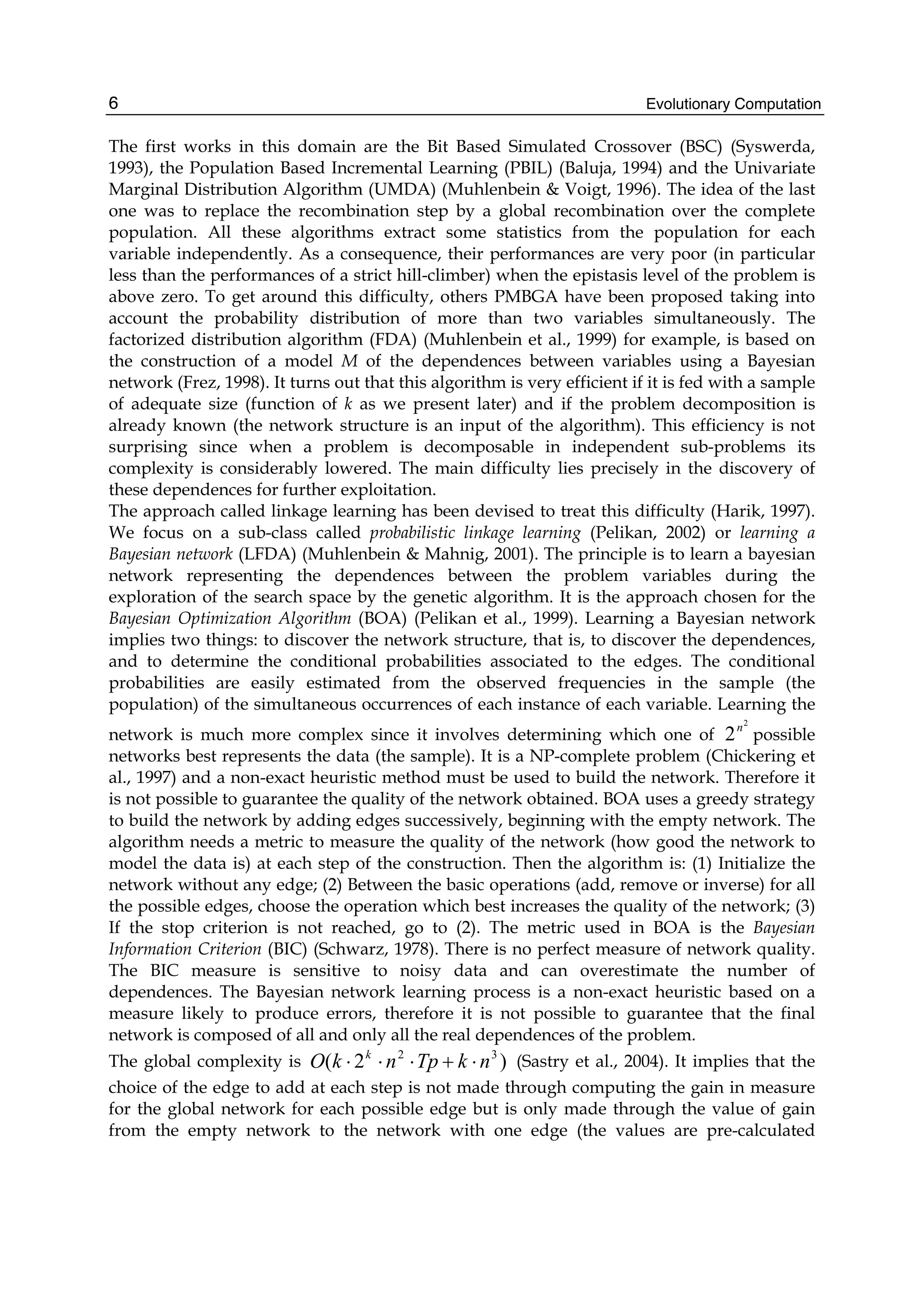
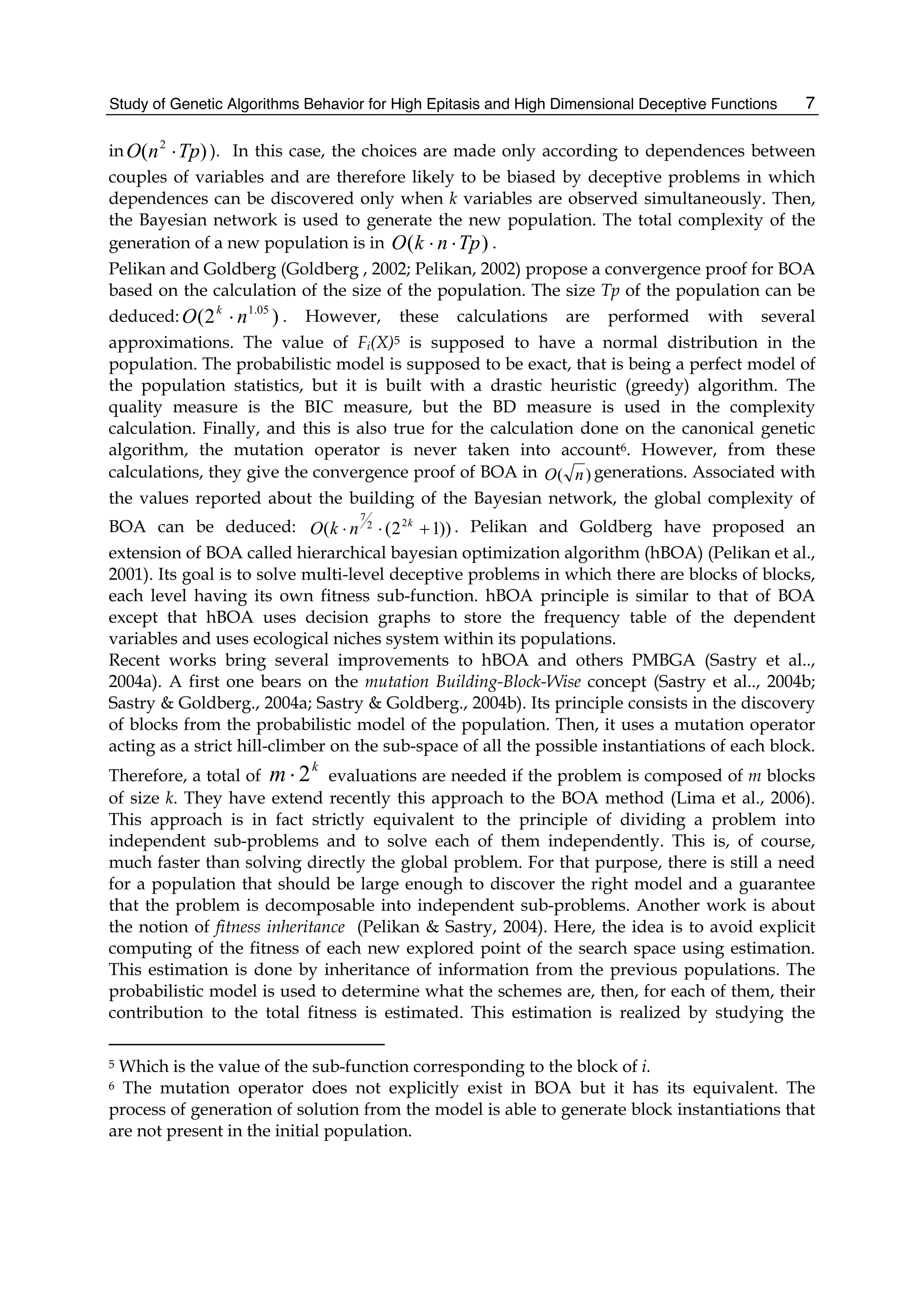
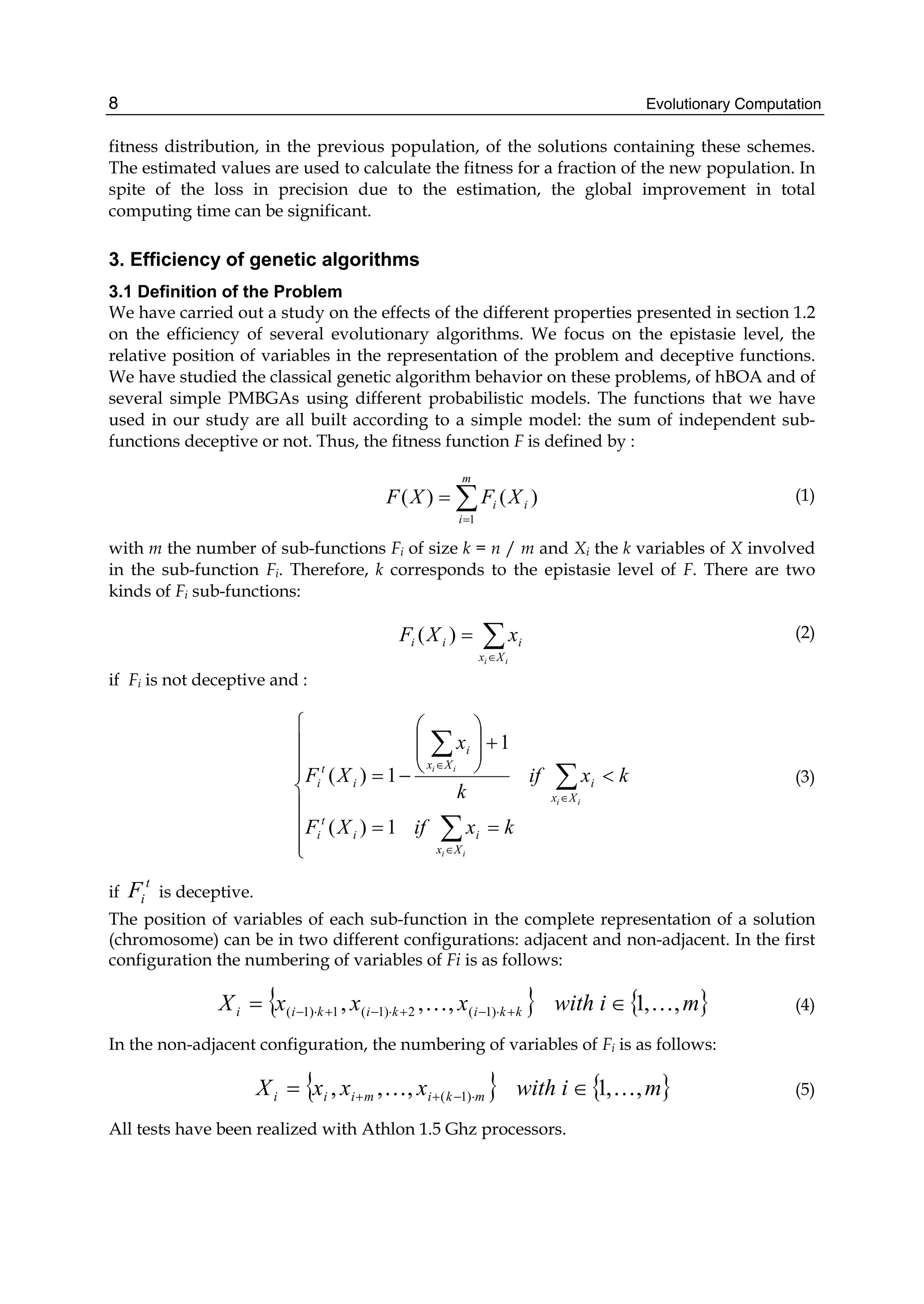



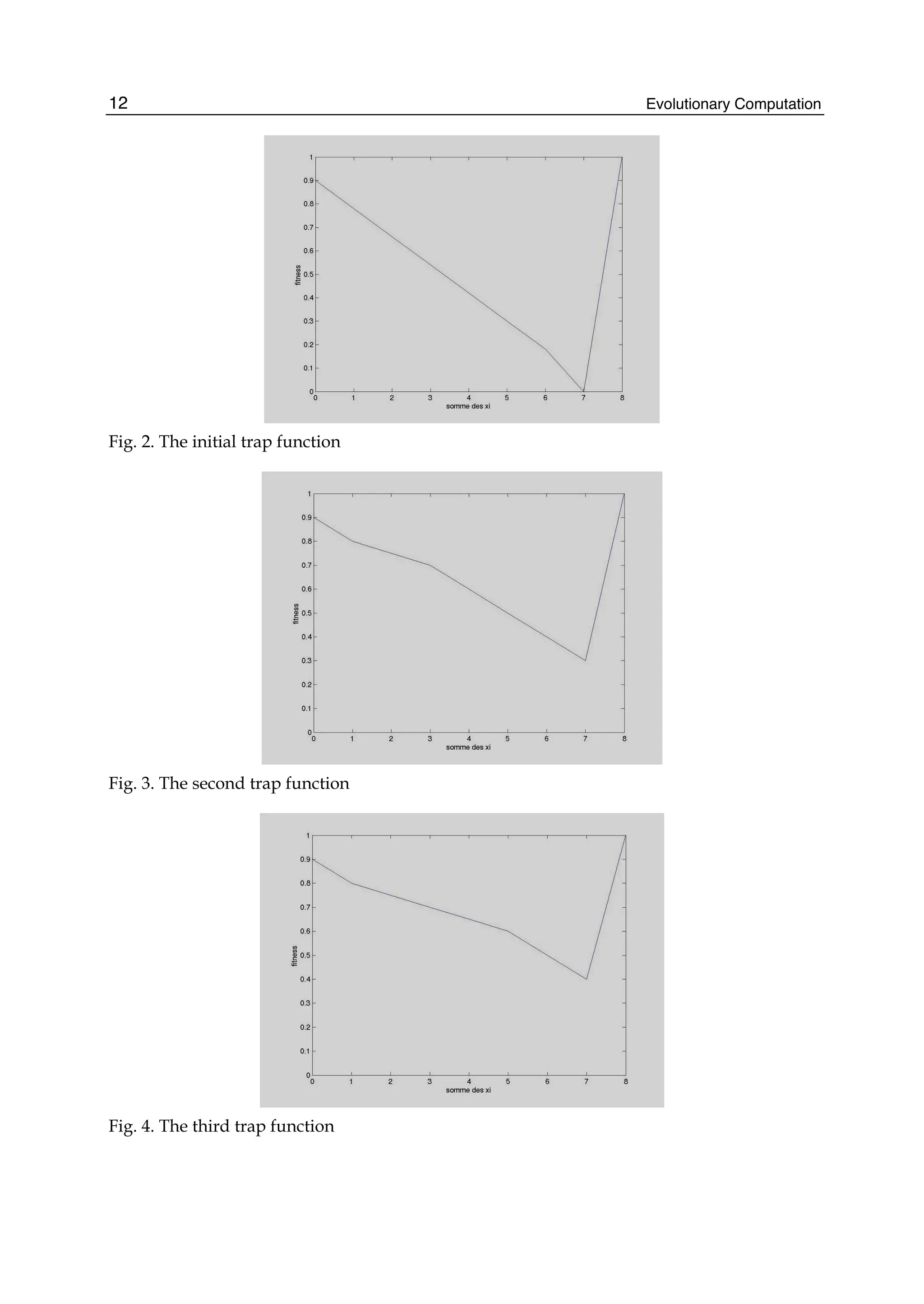
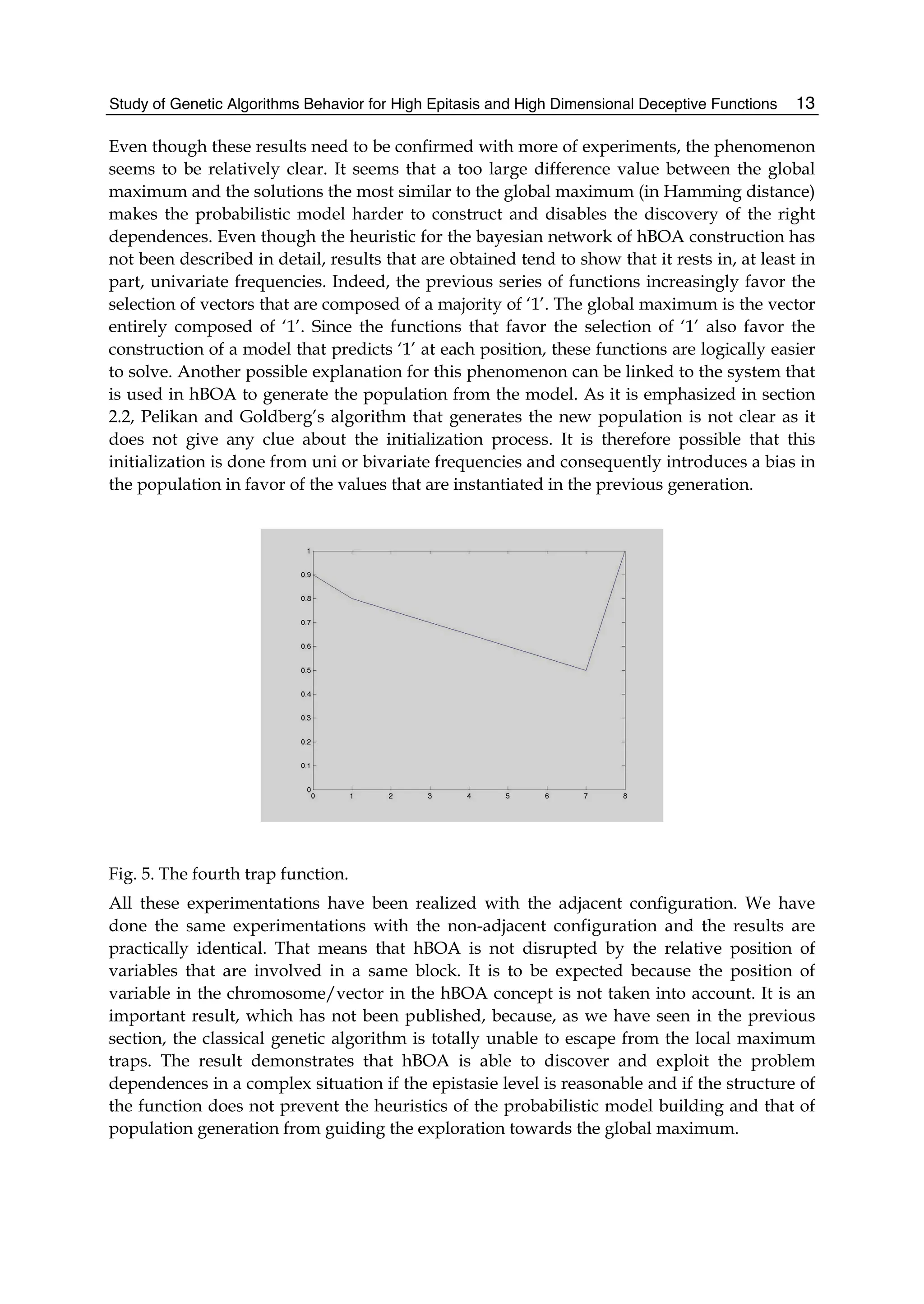


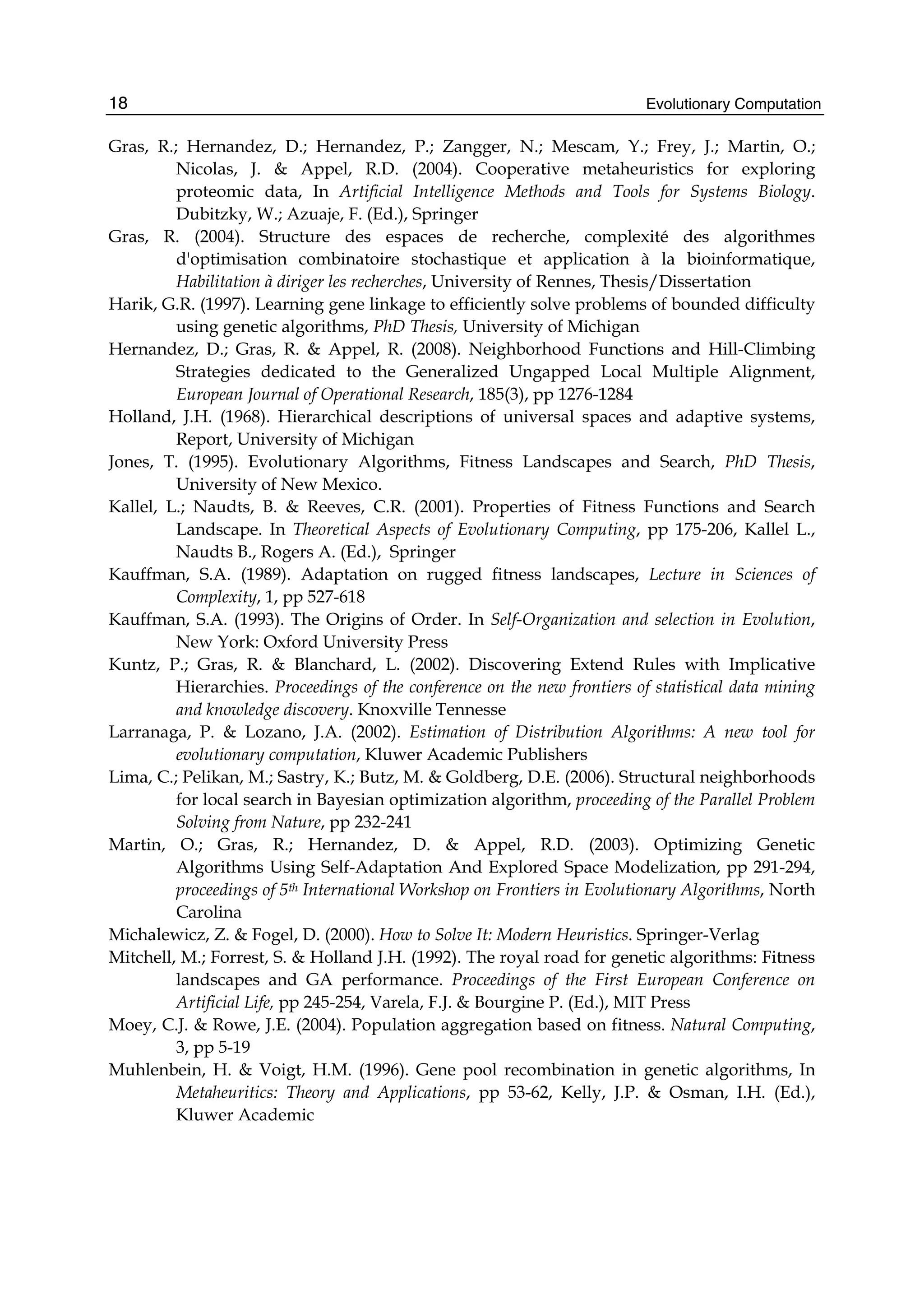



![Evolutionary Computation
22
translate a fuzzy number into an interval based on α -cut set. We will determine the
dominant individual in tournament selection with size being two based on the probability of
an individual dominance.
We will apply these proposed algorithms to a fashion evolutionary design system, a typical
optimization problem with an implicit index, and compare them with a traditional
interactive genetic algorithm (TIGA), i.e. an interactive genetic algorithm with an
individual’s accurate fitness (Gong et al., 2007), to show their advantages in alleviating user
fatigue and looking for user’s satisfactory individuals.
In the next section, we will review some related work on methods to alleviate user fatigue,
and some basic knowledge on interval analysis as well as fuzzy numbers. The emphasis of
this chapter is section 3 and 4 where we will present an IGA with an individual’s interval
fitness and an IGA with an individual’s fuzzy fitness. Their applications in a fashion
evolutionary design system and some experimental results are given in section 5. Finally, we
will draw some conclusions and provide possible opportunities for future researches in
section 6.
2. Related work
2.1 Approaches to evaluate individuals
Generally speaking, there are two approaches to evaluate an individual. One is that the user
directly evaluates an individual based on his/her preference, e.g. Takagi proposed a fitness
assignment method which combines a continuous fitness with a discrete one (Takagi &
Ohya, 1996). The other is that surrogate-assisted models evaluate a part of or even all
individuals in some generations, e.g. Sugimoto et al. presented a method to estimate an
individual’s fitness using fuzzy logic based on the distance and the angle between the
evaluated individual and the optima being found (Sugimoto & Yoneyama, 2001). Biles and
Zhou et al. adopted neural networks (NNs) to learn the user’s intelligent evaluation, and the
number of individuals being evaluated by the user decreases by use of NNs evaluating an
individual in an appropriate time (Biles et al., 1996)( Zhou et al., 2005). In order to improve
learning precision and reduce network complexity, we ever adopted multiple surrogate-
assisted models (Gong et al., 2008), in which a single surrogate-assisted model only learns
the user’s evaluation in a part of the search space. Wang et al. transformed the user’s
evaluation into an absolute rating fitness and adopted it to train a support vector machine
(SVM) to evaluate an individual (Wang et al., 2006). Hao et al. did it based on “the fitness”
of a gene sense unit (Hao et al., 2006). The common character of the above methods is that
an accurate number expresses an individual’s fitness.
In order to conveniently understand the proposed algorithms, we will introduce some basic
knowledge on interval analysis and fuzzy numbers.
2.2 Interval analysis
Interval analysis is the mathematic foundation of this chapter. Therefore, we introduce some
definitions of interval analysis in this subsection.
Interval (Liu, 2005) For any ,
x x R
∈ and x x
≤ , a set X satisfying [ , ] { , }
X x x x x x x x R
= ≤ ≤ ∈
is
called a limited and closed interval, where x and x are called the lower limit and the upper
limit of the interval, respectively. In case that x x
= , X is called a point interval. The
midpoint and the width of X are defined as follows.](https://image.slidesharecdn.com/1125674-250519103958-2e33e3b9/75/Evolutionary-Computation-Wellington-Pinheiro-Dos-Santos-Editor-36-2048.jpg)
![Interactive Genetic Algorithms with Individual’s Uncertain Fitness 23
( )
2
( )
x x
m X
w X x x
+
=
= −
Interval dominance (Limbourg Aponte, 2005) For any two intervals [ , ]
i i i
X x x
=
and [ , ]
j j j
X x x
= , there are 2 cases of their dominance relations,shown as follows.
If i j
x x
≥ and i j
x x
≥ , then we call that i
X dominates over j
X in interval, and denote i in j
X X
; ,
which is shown as Fig. 1.
P P
j
X i
X
P
j
X
i
X
N
i
x
i
x
j
x
j
x
i
x
i
x
j
x
j
x
x
x
Fig. 1. i
X dominates over j
X in interval
If ' '
, : , and , :
j i i j
x X x X x X x X
∃ ∈ ∋ ∈ ∃ ∈ ∋ ∈ , then we call that i
X and j
X is incomparable in
interval, and denote ||
i j
X X , which is shown as Fig. 2.
Pj
X
i
X
N
j
x i
x
i
x j
x
x
Fig. 2. i
X and j
X is incomparable in interval
2.3 Fuzzy numbers
A fuzzy number is a number with fuzzy meaning. There are many fuzzy numbers in real
world, e.g. “about 10“, “close to 48“, “around 95“. It is easy to observe that a fuzzy number
is usually composed of a fuzzy operator and an accurate (or a precise) number. The fuzzy
operator is to “fuzzify“ a word with crisp meaning or to make a word with fuzzy meaning
fuzzier. Some commonly used fuzzy operators are “about“, “near“, “close to“, “around“,
etc. Some modal operators, e.g. “very“, “quite“, “greatly“ can also match with these fuzzy
operators. In fuzzy mathematics, we often define a fuzzy number with a fuzzy set as
follows.
Fuzzy number (Wei, 2004) A fuzzy number f
is a normalized, convex fuzzy set in domain
U.
We call a fuzzy set f
normalized if there exists at least an element u belonging to U whose
membership degree ( )
f
u
μ
is equal to 1, i.e. max ( ) 1
f
u U
u
μ
∈
=
.
We call a fuzzy set f
convex if its membership function satisfies that
[ , ] , : ( ) min{ ( ), ( )}
i j i j
f f f
u u u U u u u
μ μ μ
∀ ∈ ⊆ ∋ ≥
.](https://image.slidesharecdn.com/1125674-250519103958-2e33e3b9/75/Evolutionary-Computation-Wellington-Pinheiro-Dos-Santos-Editor-37-2048.jpg)
![Evolutionary Computation
24
Therefore, we can also define a fuzzy set f
as follows:
: [0,1],
max ( ) 1,
[ , ] , : ( ) min{ ( ), ( )}.
f
f
u U
i j i j
f f f
U
u
u u u U u u u
μ
μ
μ μ μ
∈
→
=
∀ ∈ ⊆ ∋ ≥
There are many kinds of membership functions, and some typical ones are Gaussian,
triangular, and trapezoidal. If describing f
with a Gaussian membership function, we have:
2
1
( )
2
( )
u c
f
u e σ
μ
−
−
=
.
where c and σ are the center and the width of f
, respectively.
A single-point fuzzy number f
is special in that except one element 0
u belonging to U
with 0
( ) 1
f
u
μ =
, the membership degree of other elements is 0, i.e.
0
0
1
( )
0
f
u u
u
u u
μ
=
⎧
= ⎨
≠
⎩
.
α -cut set For (0,1)
α
∀ ∈ , the α -cut set of f
, denoted as fα
, is a subset of U satisfying that
the membership degree of its element u is larger than or equal to α , i.e.
{ }
( ) ,
f
f u u u U
α μ α
= ≥ ∈
It is easy to observe from the definition of α -cut set that fα
, obtained from a line ( )
f
u
μ α
=
intercepting f
, is a crisp set, and the degree of its element belonging to f
is not less than α .
It is easy to understand that if the membership function of f
is Gaussian, fα
is a closed
interval, i.e.
{ }
( ) , [ , ]
f
f u u u U f f
α α α
μ α
= ≥ ∈ =
.
where fα
and fα
are the lower limit and the upper limit of fα
, respectively. In particular,
if f
is a single-point fuzzy number, we have f f
α α
=
, and therefore fα
is a point interval, a
special interval.
We consider the following general optimization problem in this chapter:
max ( )
s.t. D
f x
x S R
∈ ⊆
(1)
where ( )
f x is a performance index to be optimized, and cannot be expressed with an explicit
function, x is a decision variable belonging to a domain S. On condition of not causing](https://image.slidesharecdn.com/1125674-250519103958-2e33e3b9/75/Evolutionary-Computation-Wellington-Pinheiro-Dos-Santos-Editor-38-2048.jpg)
![Interactive Genetic Algorithms with Individual’s Uncertain Fitness 25
confusion, we also denote x and S as corresponding individual and the search space,
respectively.
3. IGA with individual’s interval fitness
3.1 Methodology of algorithms
By applying interval analysis to evaluate an individual in IGAs, an interactive genetic
algorithm with an individual’s interval fitness (IGA-IIF) is presented in this section. An
individual’s fitness is an interval in this algorithm, and the width of the interval decreases
gradually along with the evolution which embodies that the user’s cognitive on the
evaluated object is fuzzy and gradual. In addition, the dominance among different
individuals is based on interval dominance and probability dominance, which makes the
comparison among different individuals more objective.
3.2 Individual’s interval fitness
Let the i-th individual of a population in some generation be i
x , 1, 2, ,
i N
= , and the
population size be N. Because of the user’s fuzzy cognitive on i
x , he/she hardly assigns
i
x ’s exact fitness, but easily assigns its range which is expressed with an interval. Therefore
i
x ’s fitness can be described as ( ) [ ( ), ( )]
i i i
f x f x f x
= , where ( )
i
f x and ( )
i
f x are the lower limit
and the upper limit of the user’s evaluation on i
x , respectively.
It is easy to observe that the larger the lower limit of ( )
i
f x together with the smaller of its
width is, the higher and the more exact the evaluation on i
x assigned by the user is;
otherwise, the smaller the upper limit of ( )
i
f x together with the larger its width is, the
lower and the rougher the evaluation on i
x assigned by the user is. In general, the user’s
cognitive on i
x is fuzzy at early stage of the evolution, therefore ( ( ))
i
w f x is large. This
cognitive will become clearer and clearer along with the evolution, and hence ( ( ))
i
w f x will
become narrower and narrower. Therefore, compared with the accurate fitness, it more
approximates the mode of the user’s thought that an interval is adopted to express an
individual’s fitness, which embodies the user’s fuzzy and gradual cognitive on the
evaluated object validly.
3.3 Comparison between two Individuals with interval fitness
Generally speaking, the user has different preferences to different individuals, hence
assigning them different interval fitness. As we all know, the quality of an individual is
much crucial information in TGAs, which has close relation with genetic operation, hence
determining that of offspring. Then how to compare the priority of different individuals in
case of interval fitness? In this subsection, we will present the strategy of comparing two
individuals with interval fitness.
Considering two individuals i
x and j
x , , 1, 2, ,
i j N
= , their interval fitness are
( ) [ ( ), ( )]
i i i
f x f x f x
= and ( ) [ ( ), ( )]
j j j
f x f x f x
= , respectively. To determine which one is dominant,
the following 2 cases are considered.
Case 1 ( ) ( )
i in j
f x f x
; , in which case there are 2 possibilities.
(I) ( ) ( )
i j
f x f x
≥ , which indicates that the lower limit of evaluation on i
x assigned by the
user is not less than the upper limit of evaluation on j
x . Therefore, it is reasonable that i
x](https://image.slidesharecdn.com/1125674-250519103958-2e33e3b9/75/Evolutionary-Computation-Wellington-Pinheiro-Dos-Santos-Editor-39-2048.jpg)
![Evolutionary Computation
26
dominates over j
x with the probability of 1, and it is impossible for j
x to dominate over i
x .
In this case i
x is the dominant individual in tournament selection.
(II) ( ) ( )
i j
f x f x
, which indicates that ( )
i
f x dominates over ( )
j
f x , but the lower limit of
evaluation on i
x assigned by the user is less than the upper limit of evaluation on j
x , i.e.
their interval fitness have superposition, and the superposition interval denotes the
commonness of evaluation on these two individuals. It is easy to understand that the larger
the superposition interval is, the smaller the difference of the user’s preference to
individuals is, and vice versa. First, we consider an interval [ ( ), ( )]
j i
f x f x , the probability
of i
x ’s fitness falling into this interval is ( ) ( )
( ( ))
i j
i
f x f x
w f x
− , where i
x dominates over j
x with the
probability of 1. And then we consider an interval [ ( ), ( )]
i j
f x f x , the probability of i
x ’s fitness
falling into this interval is ( ) ( )
( ( ))
j i
i
f x f x
w f x
− , where i
x dominates over j
x with the probability of
( ) ( ) ( ) ( )
0.5
( ( )) ( ( ))
j i i j
j j
f x f x f x f x
w f x w f x
− −
⋅ + . Therefore i
x dominates over j
x with the probability of
( ) ( ) ( ) ( ) ( ) ( )
( ) ( )
( , ) 0.5
( ( )) ( ( )) ( ( )) ( ( ))
j i j i i j
i j
i j
i i j j
f x f x f x f x f x f x
f x f x
p x x
w f x w f x w f x w f x
⎛ ⎞
− − −
−
= + ⋅ ⋅ +
⎜ ⎟
⎜ ⎟
⎝ ⎠
(2)
Then the probability that i
x becomes the dominant individual in tournament selection is
( , )
i j
p x x .
Similarly, we can obtain the following probability with which j
x dominates over i
x
( ) ( ) ( ) ( )
( , ) 0.5
( ( )) ( ( ))
j i j i
j i
j i
f x f x f x f x
p x x
w f x w f x
− −
= ⋅ ⋅ (3)
That is to say, the probability that j
x becomes the dominant individual in tournament
selection is ( , )
j i
p x x .
At early stage of the evolution, the difference of different individuals’ interval fitness is
much obvious, which is common as case (I). Along with the evolution, the difference of
different individuals decreases gradually, and so does their interval fitness. In addition, the
width of these intervals decreases gradually too, resulting in the superposition intervals of
different individuals increasing gradually, which is common as case (II). In this case, the
probabilities that different individuals are dominant ones in tournament selection are nearer
and nearer.
Case 2 ( )|| ( )
i j
f x f x , i.e. ( ) ( ), ( ) ( )
i j i j
f x f x f x f x
≤ ≥ or ( ) ( ), ( ) ( )
j i j i
f x f x f x f x
≤ ≥ . Because of i
x ’s
randomicity, only the former is considered in this subsection, i.e. ( ) ( ), ( ) ( )
i j i j
f x f x f x f x
≤ ≥ . In
the case above, it is shown that the evaluation on i
x assigned by the user is incomparable
with that on j
x , but the former is more exact. First, an interval [ ( ), ( )]
i j
f x f x is considered. The
probability of j
x ’s fitness falling into this interval is ( ) ( )
( ( ))
j i
j
f x f x
w f x
− , where j
x dominates over](https://image.slidesharecdn.com/1125674-250519103958-2e33e3b9/75/Evolutionary-Computation-Wellington-Pinheiro-Dos-Santos-Editor-40-2048.jpg)
![Interactive Genetic Algorithms with Individual’s Uncertain Fitness 27
i
x with the probability of 1. Then we consider an interval [ ( ), ( )]
i i
f x f x , the probability of
j
x ’s fitness falling into this interval is ( ) ( )
( ( ))
i i
j
f x f x
w f x
− , where j
x dominates over i
x with the
probability of 0.5. Therefore, j
x dominates over i
x with the following probability
( ) ( ) ( ( ))
( , ) 0.5
( ( )) ( ( ))
j i i
j i
j j
f x f x w f x
p x x
w f x w f x
−
= + ⋅ (4)
Hence the probability that j
x becomes the dominant individual in tournament selection is
( , )
j i
p x x .
Similarly, we can obtain the following probability with which i
x dominates over j
x
( ) ( )
( ( ))
( , ) 0.5
( ( )) ( ( ))
i j
i
i j
j j
f x f x
w f x
p x x
w f x w f x
−
= ⋅ + . (5)
That is to say, the probability that i
x becomes the dominant individual in tournament
selection is ( , )
i j
p x x .
It is easy to obtain through simple deduction that ( , ) ( , ) 1
i j j i
p x x p x x
+ = in the 2 cases above.
The results above are obtained on condition that the fitness of these 2 individuals are both
ordinary intervals. If their fitness are both point intervals, then the method to compare their
quality degenerates as the traditional one. If only ( )
i
f x is a point interval and dominates
over ( )
j
f x , we have ( , ) 1, ( , ) 0
i j j i
p x x p x x
= = . If only ( )
i
f x is a point interval and incomparable
with ( )
j
f x , we have ( ) ( )
( , )
( ( ))
j i
j i
j
f x f x
p x x
w f x
−
= and
( ) ( )
( , )
( ( ))
i j
i j
j
f x f x
p x x
w f x
−
= . Similarly, if only ( )
j
f x
is a point interval and dominated by ( )
i
f x , we have ( , ) 1, ( , ) 0
i j j i
p x x p x x
= = . If only ( )
j
f x is a
point interval and incomparable with ( )
i
f x , we have
( ) ( )
( , )
( ( ))
i j
i j
i
f x f x
p x x
w f x
−
= and
( ) ( )
( , )
( ( ))
j i
j i
i
f x f x
p x x
w f x
−
= .
Here i
x and j
x are dominant individuals in tournament selection with the probability of
( , )
i j
p x x and ( , )
j i
p x x , respectively. The method to perform tournament selection above is as
follows. First, calculate the accumulative probabilities of i
x and j
x , i.e.
( , ), ( , ) 1
i i j j i j i
c p x x c c p x x
= = + = . And then generate a random number r in [0, 1]. At last,
compare r with i
c . If i
r c
≤ , then i
x is the dominant individual in tournament selection;
otherwise, j
x is the dominant one.
3.4 Steps of algorithm
The steps of the proposed algorithms in this section can be described as follows.
Step 1. Set the values of control parameters in the algorithms. Let 0
t = , and initialize a
population.](https://image.slidesharecdn.com/1125674-250519103958-2e33e3b9/75/Evolutionary-Computation-Wellington-Pinheiro-Dos-Santos-Editor-41-2048.jpg)
![Interactive Genetic Algorithms with Individual’s Uncertain Fitness 29
Our contributions in this section mainly embody the following two aspects. First, we adopt
a novel expression of an individual’s fitness, which much accords with the user’s fuzzy
cognitive on the evaluated object. Second, we present an effective method to compare
different individuals when an individual’s fitness is expressed with a fuzzy number, which
is necessary for a population to evolve. These contributions can improve the performance of
existing IGAs in alleviating user fatigue and looking for the optimal solutions of an
optimization problem, therefore it is beneficial to solve complicated problems with implicit
or fuzzy indices.
4.2 Individual's fuzzy fitness
In the initial phase of the evolution, the user’s preference is fuzzy and his/her cognitive
degree to the evaluated object is low. Along with the evolution, the number of individuals
being evaluated by the user increases, hence he/she is gradually familiar with the evaluated
object. Therefore, the user’s cognitive on the evaluated object is fuzzy and gradual. In
addition, the evaluation process is influenced by an individual’s phenotype and user
fatigue. So it is difficult for an individual’s accurate fitness to accurately reflect the process
and the user’s cognitive result, while an individual’s fuzzy fitness can.
We consider an individual x, and express its fitness as ( )
f x
. We define a function in
min max
[ , ]
f f as follows
min max
( )
: [ , ] [0,1]
f x
f f
μ →
.
to express the degree of a min max
[ , ]
f f f
∈ belonging to ( )
f x
, where min
f and max
f are the
smallest and the largest fitness of an individual. It is easy to observe that an individual’s
fitness should lie in the range of min max
[ , ]
f f , i.e. there exists at least one number in min max
[ , ]
f f
which is x’s real fitness, i.e. its membership degree w.r.t. ( )
f x
is 1. Therefore, ( )
f x
is
normalized. In addition, the further a number in min max
[ , ]
f f from x’s real fitness is, the
smaller its membership degree w.r.t. ( )
f x
should be. Therefore, ( )
f x
is convex. According to
the definition of fuzzy number, ( )
f x
is a fuzzy number.
For not losing generality, we adopt a Gaussian membership function to express an
individual’s fuzzy fitness, and define the membership function of ( )
f x
as follows:
2
1 ( )
( )
2 ( )
( )
( )
f c x
x
f x
f e σ
μ
−
−
=
. (6)
where ( )
c x is ( )
f x
’s center, it is the fitness whose membership degree w.r.t. ( )
f x
is 1. ( )
x
σ is
( )
f x
’s width satisfying that the membership degree of fitness within [ ( ) ( ), ( ) ( )]
c x x c x x
σ σ
− +
w.r.t. ( )
f x
is not less than 1 0.6
e ≈ .
We now further explain the above x’s fuzzy fitness as follows.
In general, for different individuals, the membership functions of their fitness have different
centers and width, i.e. for , ,
i j i j
x x S x x
∈ ≠ , we have ( ) ( ), ( ) ( )
i j i j
c x c x x x
σ σ
≠ ≠ .
The user’s cognitive on the evaluated object is influenced by an individual’s phenotype and
user fatigue, therefore for the same individual in different generations, the center and the](https://image.slidesharecdn.com/1125674-250519103958-2e33e3b9/75/Evolutionary-Computation-Wellington-Pinheiro-Dos-Santos-Editor-43-2048.jpg)

![Interactive Genetic Algorithms with Individual’s Uncertain Fitness 31
In this subsection, we consider the comparison of two individuals based on α -cut set whose
idea is as follows. First, we choose a fuzzy level α , and obtain two α -cut sets of these
individuals’ fuzzy fitness. They are crisp sets and often intervals. Then, we determine two
dominance probabilities by use of the relationship of two intervals. Finally, considering
tournament selection with size being two, we determine the dominant individual by use of
the roulette wheel method based on these dominance probabilities.
We will expound the proposed strategy in detail as follows.
Let two fuzzy fitness of individuals i
x and j
x be ( )
i
f x
and ( )
j
f x
, and their membership
functions be
2
( )
1
( )
2 ( )
( )
( )
i
i
i
f c x
x
f x
f e σ
μ
−
−
=
and
2
( )
1
( )
2 ( )
( )
( )
j
j
j
f c x
x
f x
f e
σ
μ
−
−
=
, respectively. The α -cut sets of
( )
i
f x
and ( )
j
f x
are
{ }
{ }
min max
( )
min max
( )
( ) ( ) , [ , ] [ ( ), ( )],
( ) ( ) , [ , ] [ ( ), ( )],
i
j
i i i
f x
j j j
f x
f x f f f f f f x f x
f x f f f f f f x f x
α α α
α α α
μ α
μ α
= ≥ ∈
= ≥ ∈
respectively, where both ( )
i
f x
α
and ( )
j
f x
α
are crisp sets, and reflect that the fitness lying in
which belongs to ( )
i
f x
and ( )
j
f x
respectively with the membership degree being not less
than α , or the value lying in ( )
i
f x
α
and ( )
j
f x
α
is the fitness of i
x and j
x respectively with
the confidence degree being not less than α .
According to the positions of
( )
i
f x
μ and
( )
j
f x
μ , there are two cases when i
x compares with j
x .
Case 1 ( ) ( )
i j
c x c x
= , in which case there are two possibilities.
The first one is ( ) ( )
i j
c x c x
= and ( ) ( )
i j
x x
σ σ
= , which indicates that ( ) ( )
i j
f x f x
=
, i.e. the
fitness of i
x is the same as that of j
x . Therefore, i
x dominates j
x with the probability of 0.5,
and so does j
x .
1
α
( )
c x
( )
i
f x
α
( )
i
f x
α
( )
j
f x
α
( )
j
f x
α
f
( )
( )
f x
f
μ
Fig. 3. Two individuals’ fitness on condition of )
(
)
( j
i x
c
x
c = but )
(
)
( j
i x
x σ
σ .](https://image.slidesharecdn.com/1125674-250519103958-2e33e3b9/75/Evolutionary-Computation-Wellington-Pinheiro-Dos-Santos-Editor-45-2048.jpg)
![Evolutionary Computation
32
The second one is ( ) ( )
i j
c x c x
= but ( ) ( )
i j
x x
σ σ
≠ . For not losing generality, we only consider
the case that ( ) ( )
i j
c x c x
= but ( ) ( )
i j
x x
σ σ
, shown as Fig. 3. The comparison between i
x and
j
x at α level is equal to the comparison between ( )
i
f x
α
and ( )
j
f x
α
.
Similar to the deduction in subsection 3.3, we can easily obtain that j
x dominates over i
x
with the probability of
( ) ( ) 0.5 ( ( ))
( , ) 0.5
( ( ))
j i i
j i
j
f x f x w f x
p x x
w f x
α α α
α
− + ⋅
= =
. (7)
And i
x dominates over j
x with the following probability
0.5 ( ( )) ( ) ( )
( , ) 0.5
( ( ))
i i j
i j
j
w f x f x f x
p x x
w f x
α α α
α
⋅ + −
= =
. (8)
Case 2 ( ) ( )
i j
c x c x
≠ . For not losing generality, we only consider the case that ( ) ( )
i j
c x c x
.
Let
min max
0 ( ) ( )
[ , ]
max ( )
i j
f x f x
f f f
f
α μ ∩
∈
=
. We will discuss the following two cases based on the
relationship between α and 0
α .
If 0
α α
, shown as Fig. 4, we have ( ) ( )
j i
f x f x
α α
, which indicates that at α level the lower
limit of evaluation on j
x is larger than the upper limit of evaluation on i
x . Therefore it is
reasonable that j
x dominates over i
x with the probability of 1, and it is impossible that i
x
dominates over j
x .
1
α
( )
i
f x
α
( )
i
f x
α
( )
j
f x
α
( )
j
f x
α
( )
i
c x ( )
j
c x
0
α
f
( )
( )
f x
f
μ
Fig. 4. Two individuals’ fitness on condition of ( ) ( )
i j
c x c x
and 0
α α
.
If 0
α α
≤ , shown as Fig. 5, we have ( ) ( )
j i
f x f x
α α
≤
, which indicates that though ( )
j
f x
α
dominates over ( )
i
f x
α
, at α level the lower limit of evaluation on j
x is less than or equal to
the upper limit of evaluation on i
x . Adopting the same method as that in subsection 3.3, we
can easily obtain that j
x dominates over i
x with the probability of](https://image.slidesharecdn.com/1125674-250519103958-2e33e3b9/75/Evolutionary-Computation-Wellington-Pinheiro-Dos-Santos-Editor-46-2048.jpg)