EVOLUTION OF
MANAGEMENT
THROUGH
PRINCIPLES
EVOLUTION OF
MANAGEMENT
THROUGH
PRINCIPLES
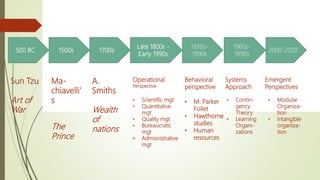
500 BC 1500s 1700s
Late 1800s -
Early 1990s
1930s-
1990s
1960s-
1990s
2000-2020
Sun Tzu
Art of
War
Ma-
chiavelli’
s
The
Prince
A.
Smiths
Wealth
of
nations
Operational
Perspective
• Scientific mgt
• Quantitative
mgt
• Quality mgt
• Bureaucratic
mgt
• Admisnistrative
mgt
Behavioral
perspective
• M. Parker
Follet
• Hawthorne
studies
• Human
resources
Systems
Approach
• Contin-
gency
Theory
• Learning
Organi-
zations
Emergent
Perspectives
• Modular
Organiza-
tion
• Intangible
organiza-
tion
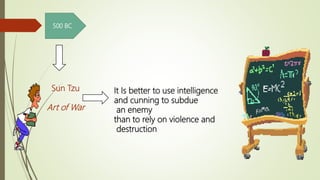
500 BC
Sun Tzu
Art of War
It Is better to use intelligence
and cunning to subdue
an enemy
than to rely on violence and
destruction
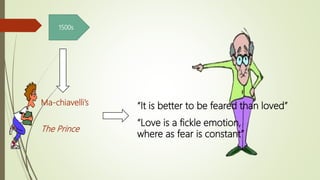
1500s
Ma-chiavelli’s
The Prince
“It is better to be feared than loved”
“Love is a fickle emotion,
where as fear is constant”
1700s
A. Smiths
Wealth of
nations
Division of Labor
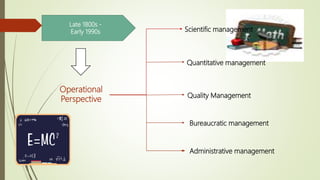
Late 1800s -
Early 1990s
Operational
Perspective
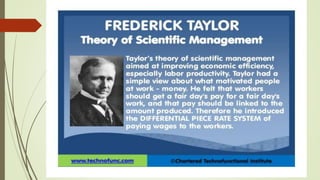
Scientific management
Quantitative management
Quality Management
Bureaucratic management
Administrative management
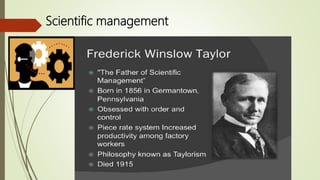
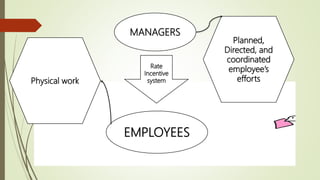
Scientific management
MANAGERS
Planned,
Directed, and
coordinated
employee’s
efforts
Rate
Incentive
system
EMPLOYEES
Physical work
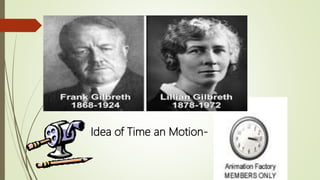
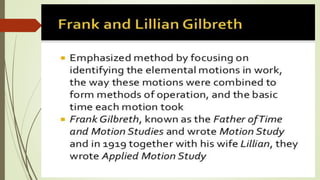
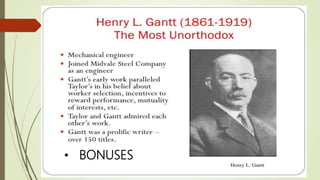
Idea of Time an Motion-
• BONUSES
Quantitative management
• The focus is on the development
of various statistical tools
and techniques to improve efficiency
and allow management to make
informed decisions regarding the costs
and benefits of alternative courses of action.
FOUR QUANTITAVE METHODS
• Break-even analysis – provides formulas which assess
the total fixed costs associated
with producing a product,the
variable costs for each unit,
the contribution made by the sale
of each unit to recovering both
fixed and variable costs.
FOUR QUANTITAVE METHODS
• Economic order quantity( EOQ ) model –
- to minimize the total costs of inventory
- it demonstrates that the optimal reorder
point occurs when the total setup
cost is equal to the total holding cost
FOUR QUANTITAVE METHODS
• Material requirements planning (MRP)–
- it helps a company reduce inventory costs
and ensures that all items will be available
when needed
Quality Management
- Walter A. Shewart – develop a set of
methods that were designed to ensure
standardization and reduce quality
defects.
- Feigenbaum – total quality control
- Edward Deming - Total Quality Management (TQM)
a)- Focus on the costumer
b)- Employee involvement
c)- Continous improvement
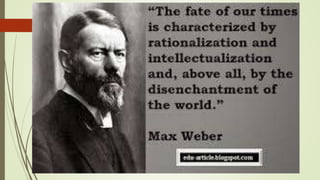
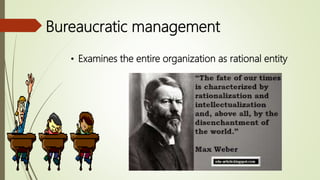
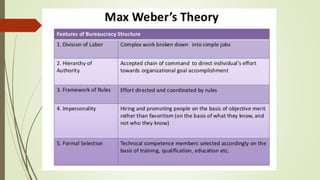
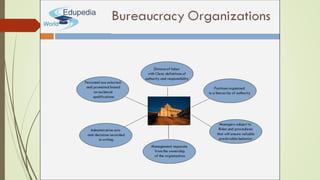
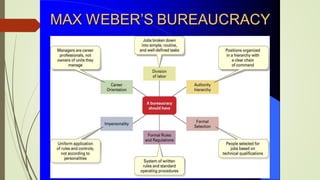
Bureaucratic management
• Examines the entire organization as rational entity
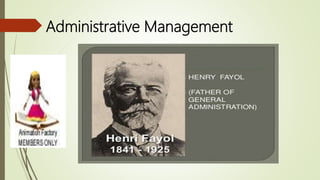
Administrative Management
Evolution of management through principles

Evolution of management through principles