Evolution of
Information System
Introduction
 The first business application of computers (in the
mid- 1950s) performed repetitive, high-volume,
transaction-computing tasks.
 The computers” crunched numbers” summarizing
and organizing transactions and data in the
accounting, finance, and human resources areas.
 Such systems are generally called transaction
processing systems (TPSs)
„ Management Information Systems (MISs): These systems
access, organize, summarize and display information for
supporting routine decision making in the functional areas.
„ Office Automation Systems( OASs): Such as word
processing systems were developed to support office and
clerical workers.
Decision Support Systems: were developed to
provide computer based support for complex,
Non routine decision.
End- user computing: The use or development of
information systems by the principal users of the
systems’ outputs, such as analysts,
managers, and other professionals.
Intelligent Support System (ISSs): Include expert systems
which provide the stored knowledge of experts to non
experts, and a new type of intelligent system with
machine- learning capabilities that can learn from
historical cases
Knowledge Management Systems: Support the creating,
gathering, organizing, integrating and disseminating of
organizational knowledge.
Data Warehousing: A data warehouse is a database
designed to support DSS, ESS and other analytical and
end-user activities.
Mobile Computing: Information systems that support
employees who are working with customers or business
partners outside the physical boundaries of their
company; can be done over wire or wireless networks.
Kinds of Information Systems
1. Organizational Hierarchy
2. Organizational Levels
3. Information Systems
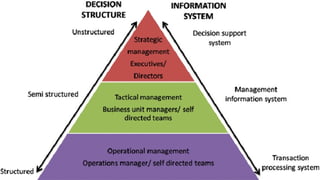
General Kinds of IS
 Operational-level systems
 Knowledge-level systems
 Management-level systems
Operational-level systems
Support operational managers by monitoring the
day-to-day‘s elementary activities and
transactions of the organization
e.g. TPS.
Knowledge-level systems
Support knowledge and data workers in designing
products, distributing information, and coping with
paperwork in an organization.
 e.g. KWS(CAD)
CMS
OAS
Management-level systems
 Support the monitoring, controlling, decision-
making, and administrative activities of middle
managers.
 e.g. MIS, DSS
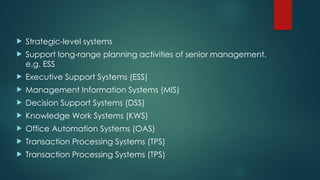
 Strategic-level systems
 Support long-range planning activities of senior management.
e.g. ESS
 Executive Support Systems (ESS)
 Management Information Systems (MIS)
 Decision Support Systems (DSS)
 Knowledge Work Systems (KWS)
 Office Automation Systems (OAS)
 Transaction Processing Systems (TPS)

EVOLUTION of information management sysytem.pptx

  • 1.
  • 2.
    Introduction  The firstbusiness application of computers (in the mid- 1950s) performed repetitive, high-volume, transaction-computing tasks.  The computers” crunched numbers” summarizing and organizing transactions and data in the accounting, finance, and human resources areas.  Such systems are generally called transaction processing systems (TPSs)
  • 3.
    „ Management InformationSystems (MISs): These systems access, organize, summarize and display information for supporting routine decision making in the functional areas. „ Office Automation Systems( OASs): Such as word processing systems were developed to support office and clerical workers.
  • 4.
    Decision Support Systems:were developed to provide computer based support for complex, Non routine decision. End- user computing: The use or development of information systems by the principal users of the systems’ outputs, such as analysts, managers, and other professionals.
  • 5.
    Intelligent Support System(ISSs): Include expert systems which provide the stored knowledge of experts to non experts, and a new type of intelligent system with machine- learning capabilities that can learn from historical cases Knowledge Management Systems: Support the creating, gathering, organizing, integrating and disseminating of organizational knowledge.
  • 6.
    Data Warehousing: Adata warehouse is a database designed to support DSS, ESS and other analytical and end-user activities. Mobile Computing: Information systems that support employees who are working with customers or business partners outside the physical boundaries of their company; can be done over wire or wireless networks.
  • 8.
    Kinds of InformationSystems 1. Organizational Hierarchy 2. Organizational Levels 3. Information Systems
  • 9.
    General Kinds ofIS  Operational-level systems  Knowledge-level systems  Management-level systems
  • 10.
    Operational-level systems Support operationalmanagers by monitoring the day-to-day‘s elementary activities and transactions of the organization e.g. TPS.
  • 11.
    Knowledge-level systems Support knowledgeand data workers in designing products, distributing information, and coping with paperwork in an organization.  e.g. KWS(CAD) CMS OAS
  • 12.
    Management-level systems  Supportthe monitoring, controlling, decision- making, and administrative activities of middle managers.  e.g. MIS, DSS
  • 13.
     Strategic-level systems Support long-range planning activities of senior management. e.g. ESS  Executive Support Systems (ESS)  Management Information Systems (MIS)  Decision Support Systems (DSS)  Knowledge Work Systems (KWS)  Office Automation Systems (OAS)  Transaction Processing Systems (TPS)  Transaction Processing Systems (TPS)