COOKERY
reallygreatsite.com
PREPARED BY:
JO-ANN A. ABAD , MBMBA
TABLE OF CONTENTS
Evolution of Culinary Culture-
Cooking Technology
Fire, Smoke and Embers
Early Cooking and Fermenting:
Evolution of the 5 Basic Taste
Qualities
Cooking as a Cultural Achievement
The Culinary Triangle: Cultural and
Physical Structuralism
The Alienation and
Deculturalization of Food
reallygreatsite.com
OBJECTIVES
01. TO KNOW THE EVOLUTION
OF CULINARY CULTURE
02. DETERMINING THE
EVOLUTION OF THE 5 BASIC
TASTE QUALITIES
reallygreatsite.com
EVOLUTION – CULINARY
CULTURE – COOKING
TECHNOLOGY
The history of humankind has always been, in addition
to countless wars, a history of culture and scientific
progress resulting in new technical possibilities. All
people in all periods have had to eat in order to
preserve the species. Food was and is a matter of
survival.
FIRE AND COOKING: THE FIRST EVOLUTIONARY MILESTONES
READ MORE
reallygreatsite.com
EVOLUTION – CULINARY
CULTURE – COOKING
TECHNOLOGY
Before the systematic use of fire, the food supply comprised
raw foods such as raw vegetables, roots, berries, fruits, early
vegetables, nuts, seeds, as well as birds’ eggs and carrion as
protein sources, carrion from animals killed by other
predators.1 Indeed, carrion, scavennging was despite aversion
of great importance because meat and eggs, has supplied the
early man with readily bioavailable nutrition down to the
present: proteins and the amino acids they contain have always
been essential for muscle development in humans.
FIRE AND COOKING: THE FIRST EVOLUTIONARY MILESTONES
READ MORE
reallygreatsite.com
Some early human species developed enzymes that facilitated
alcohol consumption.3 This expanded the food pallet, since this
genetic modification also opened up another nutrition source:
fermented, slightly rotten fruits and fermented vegetables.
Another source of fermented food was the stomach contents of
hunted or carrion animals. During gastrointestinal passage in
ruminants, enzymes are present that can also break down cell
materials such as cellulose into nutritionally valuable starch
fragments and glucose. Pre-digested and hydrolysed proteins
(split to fragments and essential aminoacids) also provided
nutrients that were too valuable do without
READ MORE
reallygreatsite.com
In order to eat and digest raw foods, humans had developed a different
head shape, jaw muscles, greater intestinal length and intestinal flora over
millions of years. Hard roots had to be chewed to obtain the nutrients they
contained, it was only possible to break down and utilize the nutrient
structures during longer gastrointestinal passages if ancient humans were
equipped with an enzyme status and intestinal flora that were up to the
task. A variety of germs, fungi and bacteria also contaminated all food,
which was thus anything but “safe”. Early humans had to rely on their taste
buds. The species-adapted senses of humans and other animals provided
the only way to test food for safety, edibility and nutritional value. Early
humans obviously succeeded in all of this, since otherwise we would not be
here today. READ MORE
reallygreatsite.com
FIRE, SMOKE AND EMBERS
reallygreatsite.com
A number of new preparation techniques developed centred
around fire. This required development of equipment,
skewers, containers, cooking utensils, etc. Cooking by grilling,
boiling, in earth ovens, on and with hot stones or steam are
among the early techniques that differ but little from the
supposedly modern methods in use today, aside from
accurate temperature control.
EARLY COOKING AND FERMENTING:
EVOLUTION OF THE FIVE BASIC TASTE
QUALITIES
reallygreatsite.com
seasoning food with sweetness, salts or glutamate was not
around early in the history of mankind, but the sense of taste
did provide orientation, particularly in the case of the two
extremes bitter and sweet, on which basis poisonous and
edible are quickly differentiated. There has never been a food
that is both sweet and poisonous (although imprecise and
populistic sources have tried to characterize sugar in this
way).
EARLY COOKING AND FERMENTING:
EVOLUTION OF THE FIVE BASIC TASTE
QUALITIES
reallygreatsite.com
Every food with a slightly salty taste, rock salt, a mixed crystal
of the cations sodium, calcium, magnesium and the
corresponding anions (mainly chloride), and many (vegetable)
products from salted water, have always been good for the
mineral balance in the diets of humans and other animals.
reallygreatsite.com
reallygreatsite.com
THE CULINARY TRIANGLE: CULTUR AL
AND PHYSICAL STRUCTURALISM
reallygreatsite.com
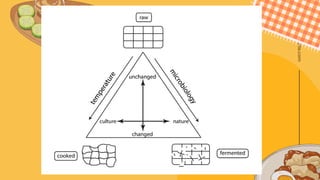
The abstract considerations on which the culinary triangle is
based can be scientifically justified by taking into account the
changes in molecular structures brought about by specific
process techniques.13 The techniques of fermenting and
cooking involve different processes. Cooking is usually done
by changing typical “thermodynamic” parameters such as
temperature, pressure, or volume.
THE CULINARY TRIANGLE: CULTUR AL
AND PHYSICAL STRUCTURALISM
reallygreatsite.com
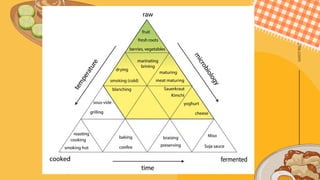
Despite modern techniques and technological progress, the
methods of preparation learned and defined in the early
years of evolution, the basis of food consumption remains the
triangle formed by the basic states raw, cooked and
fermented.
reallygreatsite.com
THE CULINARY TRIANGLE: CULTUR AL
AND PHYSICAL STRUCTURALISM
reallygreatsite.com
The culinary triangle contains all of the preparation
techniques so far developed by humans. A distinction
between “old” techniques and “modern techniques” is not
absolutely necessary from a “structuralist” and natural
scientific point of view. Pseudo-raw (shaded area) reflects
cultural acts such as washing or cleaning, whereby the
molecular structures do not change significantly, but
ethnologists categorize these acts also under “cooking” (Vilgis
and Tzschirner 2014).
reallygreatsite.com
ALL ROADS LE AD TO UMAMI
reallygreatsite.com
The culinary triangle as a “triangle of states” for proteins
during the cooking and fermentation process. The
hydrolysed state is the result of the cooking process and
of the fermentation. Long cooked foods thus have
modified taste “umami” and please with “kokumi” as well
as the fermented state.
The “raw” becomes the “cooked” by raising the
temperature.
ALL ROADS LE AD TO UMAMI
reallygreatsite.com
This results in “umami”, whereas some small fragments of two or
three amino acids account for “kokumi” (mouth-filling sensation) if
they are still carrying a glutamic acid. Fermented sauces, fish
sauces, soy sauces (as well as Maggi-type seasonings) are therefore
always umami, savoury and mouth-filling. Long cooking, as in gravy
or sauce stocks results, after denaturing, in protein fragments and
free glutamic acids, and therefore also in umami and kokumi. This
is also the case in cooking stocks, broths, stews. Long cooking splits
proteins, producing umami, savoury and mouth-filling sensations,
as in fermented sauces and miso pastes. Different approaches,
different cultures, one goal: the depth of good taste.
THE ALIENATION AND DECULTUR
ALIZ ATION OF FOOD
reallygreatsite.com
things need not be cooked and eaten, like vacuum
packed.
technology is invested in vegetarian alternatives to
derive quasi-meat from the “tofu animal”. Vegan
“sausages”, vegi-meat and vegi-fish from plant and
insect proteins as replacements for more natural
sources
kind of convenience products artificial analogue
“cheese” made from cheap ingredients.
to buy “paleo-food”
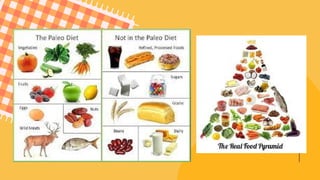
A modern paleo diet includes fruits,
vegetables, lean meats, fish, eggs, nuts and
seeds.
A paleo diet is an eating plan based on foods
humans might have eaten during the
Paleolithic Era. The Paleolithic Era dates
from around 2.5 million to 10,000 years ago.
THANK YOU
FOR YOUR
ATTENTION
reallygreatsite.com

Evolution of Culinary.pdf

  • 1.
  • 2.
    TABLE OF CONTENTS Evolutionof Culinary Culture- Cooking Technology Fire, Smoke and Embers Early Cooking and Fermenting: Evolution of the 5 Basic Taste Qualities Cooking as a Cultural Achievement The Culinary Triangle: Cultural and Physical Structuralism The Alienation and Deculturalization of Food reallygreatsite.com
  • 3.
    OBJECTIVES 01. TO KNOWTHE EVOLUTION OF CULINARY CULTURE 02. DETERMINING THE EVOLUTION OF THE 5 BASIC TASTE QUALITIES reallygreatsite.com
  • 4.
    EVOLUTION – CULINARY CULTURE– COOKING TECHNOLOGY The history of humankind has always been, in addition to countless wars, a history of culture and scientific progress resulting in new technical possibilities. All people in all periods have had to eat in order to preserve the species. Food was and is a matter of survival. FIRE AND COOKING: THE FIRST EVOLUTIONARY MILESTONES READ MORE reallygreatsite.com
  • 5.
    EVOLUTION – CULINARY CULTURE– COOKING TECHNOLOGY Before the systematic use of fire, the food supply comprised raw foods such as raw vegetables, roots, berries, fruits, early vegetables, nuts, seeds, as well as birds’ eggs and carrion as protein sources, carrion from animals killed by other predators.1 Indeed, carrion, scavennging was despite aversion of great importance because meat and eggs, has supplied the early man with readily bioavailable nutrition down to the present: proteins and the amino acids they contain have always been essential for muscle development in humans. FIRE AND COOKING: THE FIRST EVOLUTIONARY MILESTONES READ MORE reallygreatsite.com
  • 6.
    Some early humanspecies developed enzymes that facilitated alcohol consumption.3 This expanded the food pallet, since this genetic modification also opened up another nutrition source: fermented, slightly rotten fruits and fermented vegetables. Another source of fermented food was the stomach contents of hunted or carrion animals. During gastrointestinal passage in ruminants, enzymes are present that can also break down cell materials such as cellulose into nutritionally valuable starch fragments and glucose. Pre-digested and hydrolysed proteins (split to fragments and essential aminoacids) also provided nutrients that were too valuable do without READ MORE reallygreatsite.com
  • 7.
    In order toeat and digest raw foods, humans had developed a different head shape, jaw muscles, greater intestinal length and intestinal flora over millions of years. Hard roots had to be chewed to obtain the nutrients they contained, it was only possible to break down and utilize the nutrient structures during longer gastrointestinal passages if ancient humans were equipped with an enzyme status and intestinal flora that were up to the task. A variety of germs, fungi and bacteria also contaminated all food, which was thus anything but “safe”. Early humans had to rely on their taste buds. The species-adapted senses of humans and other animals provided the only way to test food for safety, edibility and nutritional value. Early humans obviously succeeded in all of this, since otherwise we would not be here today. READ MORE reallygreatsite.com
  • 8.
    FIRE, SMOKE ANDEMBERS reallygreatsite.com A number of new preparation techniques developed centred around fire. This required development of equipment, skewers, containers, cooking utensils, etc. Cooking by grilling, boiling, in earth ovens, on and with hot stones or steam are among the early techniques that differ but little from the supposedly modern methods in use today, aside from accurate temperature control.
  • 9.
    EARLY COOKING ANDFERMENTING: EVOLUTION OF THE FIVE BASIC TASTE QUALITIES reallygreatsite.com seasoning food with sweetness, salts or glutamate was not around early in the history of mankind, but the sense of taste did provide orientation, particularly in the case of the two extremes bitter and sweet, on which basis poisonous and edible are quickly differentiated. There has never been a food that is both sweet and poisonous (although imprecise and populistic sources have tried to characterize sugar in this way).
  • 10.
    EARLY COOKING ANDFERMENTING: EVOLUTION OF THE FIVE BASIC TASTE QUALITIES reallygreatsite.com Every food with a slightly salty taste, rock salt, a mixed crystal of the cations sodium, calcium, magnesium and the corresponding anions (mainly chloride), and many (vegetable) products from salted water, have always been good for the mineral balance in the diets of humans and other animals.
  • 11.
  • 12.
  • 13.
    THE CULINARY TRIANGLE:CULTUR AL AND PHYSICAL STRUCTURALISM reallygreatsite.com The abstract considerations on which the culinary triangle is based can be scientifically justified by taking into account the changes in molecular structures brought about by specific process techniques.13 The techniques of fermenting and cooking involve different processes. Cooking is usually done by changing typical “thermodynamic” parameters such as temperature, pressure, or volume.
  • 14.
    THE CULINARY TRIANGLE:CULTUR AL AND PHYSICAL STRUCTURALISM reallygreatsite.com Despite modern techniques and technological progress, the methods of preparation learned and defined in the early years of evolution, the basis of food consumption remains the triangle formed by the basic states raw, cooked and fermented.
  • 15.
  • 16.
    THE CULINARY TRIANGLE:CULTUR AL AND PHYSICAL STRUCTURALISM reallygreatsite.com The culinary triangle contains all of the preparation techniques so far developed by humans. A distinction between “old” techniques and “modern techniques” is not absolutely necessary from a “structuralist” and natural scientific point of view. Pseudo-raw (shaded area) reflects cultural acts such as washing or cleaning, whereby the molecular structures do not change significantly, but ethnologists categorize these acts also under “cooking” (Vilgis and Tzschirner 2014).
  • 17.
  • 18.
    ALL ROADS LEAD TO UMAMI reallygreatsite.com The culinary triangle as a “triangle of states” for proteins during the cooking and fermentation process. The hydrolysed state is the result of the cooking process and of the fermentation. Long cooked foods thus have modified taste “umami” and please with “kokumi” as well as the fermented state. The “raw” becomes the “cooked” by raising the temperature.
  • 19.
    ALL ROADS LEAD TO UMAMI reallygreatsite.com This results in “umami”, whereas some small fragments of two or three amino acids account for “kokumi” (mouth-filling sensation) if they are still carrying a glutamic acid. Fermented sauces, fish sauces, soy sauces (as well as Maggi-type seasonings) are therefore always umami, savoury and mouth-filling. Long cooking, as in gravy or sauce stocks results, after denaturing, in protein fragments and free glutamic acids, and therefore also in umami and kokumi. This is also the case in cooking stocks, broths, stews. Long cooking splits proteins, producing umami, savoury and mouth-filling sensations, as in fermented sauces and miso pastes. Different approaches, different cultures, one goal: the depth of good taste.
  • 20.
    THE ALIENATION ANDDECULTUR ALIZ ATION OF FOOD reallygreatsite.com things need not be cooked and eaten, like vacuum packed. technology is invested in vegetarian alternatives to derive quasi-meat from the “tofu animal”. Vegan “sausages”, vegi-meat and vegi-fish from plant and insect proteins as replacements for more natural sources kind of convenience products artificial analogue “cheese” made from cheap ingredients. to buy “paleo-food”
  • 22.
    A modern paleodiet includes fruits, vegetables, lean meats, fish, eggs, nuts and seeds. A paleo diet is an eating plan based on foods humans might have eaten during the Paleolithic Era. The Paleolithic Era dates from around 2.5 million to 10,000 years ago.
  • 23.