






Evolution of Camera &
It’s Impact to the World
By : Ainin Sofiya &
Nik Addam
Introduction
WHAT IS A CAMERA ?
According to Wikipedia:
A camera is a device that records/stores images. These images may be still photographs or moving
images such as videos or movies. The term camera comes from the camera obscura (Latin for "dark
chamber"), an early mechanism for projecting images. The modern camera evolved from the camera
obscura.The still camera takes one photo each time the user presses the shutter button. A typical
movie camera continuously takes 24 film frames per second as long as the user holds down the
shutter button, or until the shutter button is pressed a second time.
From its inception, the camera has been instrumental in the recording of still images from then-
present surroundings, and further modifications led to the development of motion picture sequences
in the late 19th century. Cameras and the exhibition of camera-captured images are widely used in
both professional and consumer settings in the 21st century for both mass and interpersonal
communication purposes.
Introduction
WHAT IS A CAMERA ?
According to Wikipedia:
A camera is a device that records/stores images. These images may be still photographs or moving
images such as videos or movies. The term camera comes from the camera obscura (Latin for "dark
chamber"), an early mechanism for projecting images. The modern camera evolved from the camera
obscura.The still camera takes one photo each time the user presses the shutter button. A typical
movie camera continuously takes 24 film frames per second as long as the user holds down the
shutter button, or until the shutter button is pressed a second time.
From its inception, the camera has been instrumental in the recording of still images from then-
present surroundings, and further modifications led to the development of motion picture sequences
in the late 19th century. Cameras and the exhibition of camera-captured images are widely used in
both professional and consumer settings in the 21st century for both mass and interpersonal
communication purposes.
In short,
A camera is anything
that can record/store
images.
The Evolution
Let’s start with the first set of slides
1
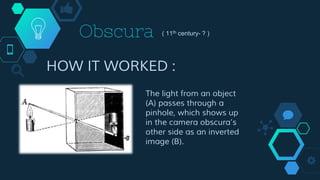
HOW IT WORKED :
Obscura ( 11th century- ? )
The light from an object
(A) passes through a
pinhole, which shows up
in the camera obscura’s
other side as an inverted
image (B).
The very first
TRUE
CAMERA
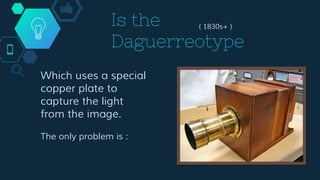
Is the
Daguerreotype
( 1830s+ )
Which uses a special
copper plate to
capture the light
from the image.
The only problem is :
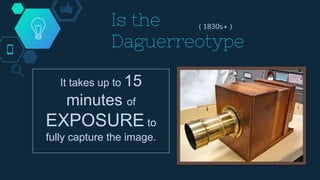
Is the
Daguerreotype
( 1830s+ )
Which uses a special
copper plate to
capture the light
from the image.
The only problem is :
It takes up to 15
minutes of
EXPOSURE to
fully capture the image.
Makes you feel sorry for these guys
Then the EMULSION
PLATES were INVENTED.
( 1850s+ )
Which only takes
2-3 seconds of
exposure time.
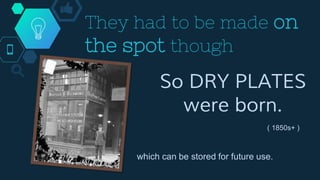
They had to be made on
the spot though
So DRY PLATES
were born.
( 1850s+ )
which can be stored for future use.
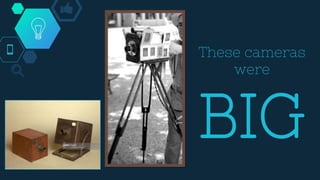
These cameras
were
BIG
The world needed
PORTABLE
CAMERAS
( 1880s+ )
Hi, I’m
George
Eastman
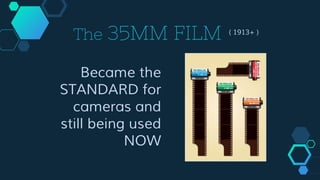
The 35MM FILM ( 1913+ )
Became the
STANDARD for
cameras and
still being used
NOW
UR-LEICA ( 1914 )
The FIRST
35mm film
camera
Over 30 years later …
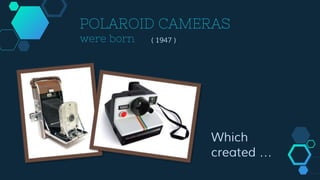
POLAROID CAMERAS
were born ( 1947 )
Which
created …
INSTANT IMAGES
SLR cameras
were created ( 1948 )
Which were the FIRST
WYSIWYG
( what you see is what you get )
CAMERAS
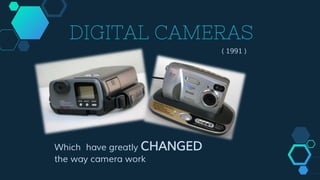
DIGITAL CAMERAS
( 1991 )
Which have greatly CHANGED
the way camera work
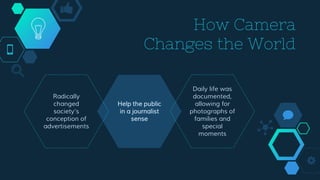
How Camera
Changes the World
Help the public
in a journalist
sense
Daily life was
documented,
allowing for
photographs of
families and
special
moments
Radically
changed
society’s
conception of
advertisements
How Camera
Changes the World
Security were
upgraded at
another level
The existence of
anti-social
people
Selfie culture
were invented
Conclusion
After all these years of advancement, cameras
now have superb power, portability and are
packed with numerous features to allow us to
shoot a moment and share it with the world in a
matter of seconds.
Moreover, now billions of people have a camera
with them and are capturing their best moments
every day. It has become a part of our daily life.
References
Wikipedia
Flickr
Google Images
HowStuffWorks.com
Youtube
Thanks!Irgendeine Frage?

Evolution of Camera

  • 1.
    Evolution of Camera& It’s Impact to the World By : Ainin Sofiya & Nik Addam
  • 2.
    Introduction WHAT IS ACAMERA ? According to Wikipedia: A camera is a device that records/stores images. These images may be still photographs or moving images such as videos or movies. The term camera comes from the camera obscura (Latin for "dark chamber"), an early mechanism for projecting images. The modern camera evolved from the camera obscura.The still camera takes one photo each time the user presses the shutter button. A typical movie camera continuously takes 24 film frames per second as long as the user holds down the shutter button, or until the shutter button is pressed a second time. From its inception, the camera has been instrumental in the recording of still images from then- present surroundings, and further modifications led to the development of motion picture sequences in the late 19th century. Cameras and the exhibition of camera-captured images are widely used in both professional and consumer settings in the 21st century for both mass and interpersonal communication purposes.
  • 3.
    Introduction WHAT IS ACAMERA ? According to Wikipedia: A camera is a device that records/stores images. These images may be still photographs or moving images such as videos or movies. The term camera comes from the camera obscura (Latin for "dark chamber"), an early mechanism for projecting images. The modern camera evolved from the camera obscura.The still camera takes one photo each time the user presses the shutter button. A typical movie camera continuously takes 24 film frames per second as long as the user holds down the shutter button, or until the shutter button is pressed a second time. From its inception, the camera has been instrumental in the recording of still images from then- present surroundings, and further modifications led to the development of motion picture sequences in the late 19th century. Cameras and the exhibition of camera-captured images are widely used in both professional and consumer settings in the 21st century for both mass and interpersonal communication purposes. In short, A camera is anything that can record/store images.
  • 4.
    The Evolution Let’s startwith the first set of slides 1
  • 5.
    HOW IT WORKED: Obscura ( 11th century- ? ) The light from an object (A) passes through a pinhole, which shows up in the camera obscura’s other side as an inverted image (B).
  • 6.
  • 7.
    Is the Daguerreotype ( 1830s+) Which uses a special copper plate to capture the light from the image. The only problem is :
  • 8.
    Is the Daguerreotype ( 1830s+) Which uses a special copper plate to capture the light from the image. The only problem is : It takes up to 15 minutes of EXPOSURE to fully capture the image.
  • 9.
    Makes you feelsorry for these guys
  • 10.
    Then the EMULSION PLATESwere INVENTED. ( 1850s+ ) Which only takes 2-3 seconds of exposure time.
  • 11.
    They had tobe made on the spot though So DRY PLATES were born. ( 1850s+ ) which can be stored for future use.
  • 12.
  • 13.
  • 14.
  • 15.
    The 35MM FILM( 1913+ ) Became the STANDARD for cameras and still being used NOW
  • 16.
    UR-LEICA ( 1914) The FIRST 35mm film camera
  • 17.
    Over 30 yearslater …
  • 18.
    POLAROID CAMERAS were born( 1947 ) Which created …
  • 19.
  • 20.
    SLR cameras were created( 1948 ) Which were the FIRST WYSIWYG ( what you see is what you get ) CAMERAS
  • 21.
    DIGITAL CAMERAS ( 1991) Which have greatly CHANGED the way camera work
  • 22.
    How Camera Changes theWorld Help the public in a journalist sense Daily life was documented, allowing for photographs of families and special moments Radically changed society’s conception of advertisements
  • 23.
    How Camera Changes theWorld Security were upgraded at another level The existence of anti-social people Selfie culture were invented
  • 24.
    Conclusion After all theseyears of advancement, cameras now have superb power, portability and are packed with numerous features to allow us to shoot a moment and share it with the world in a matter of seconds. Moreover, now billions of people have a camera with them and are capturing their best moments every day. It has become a part of our daily life.
  • 25.
  • 26.