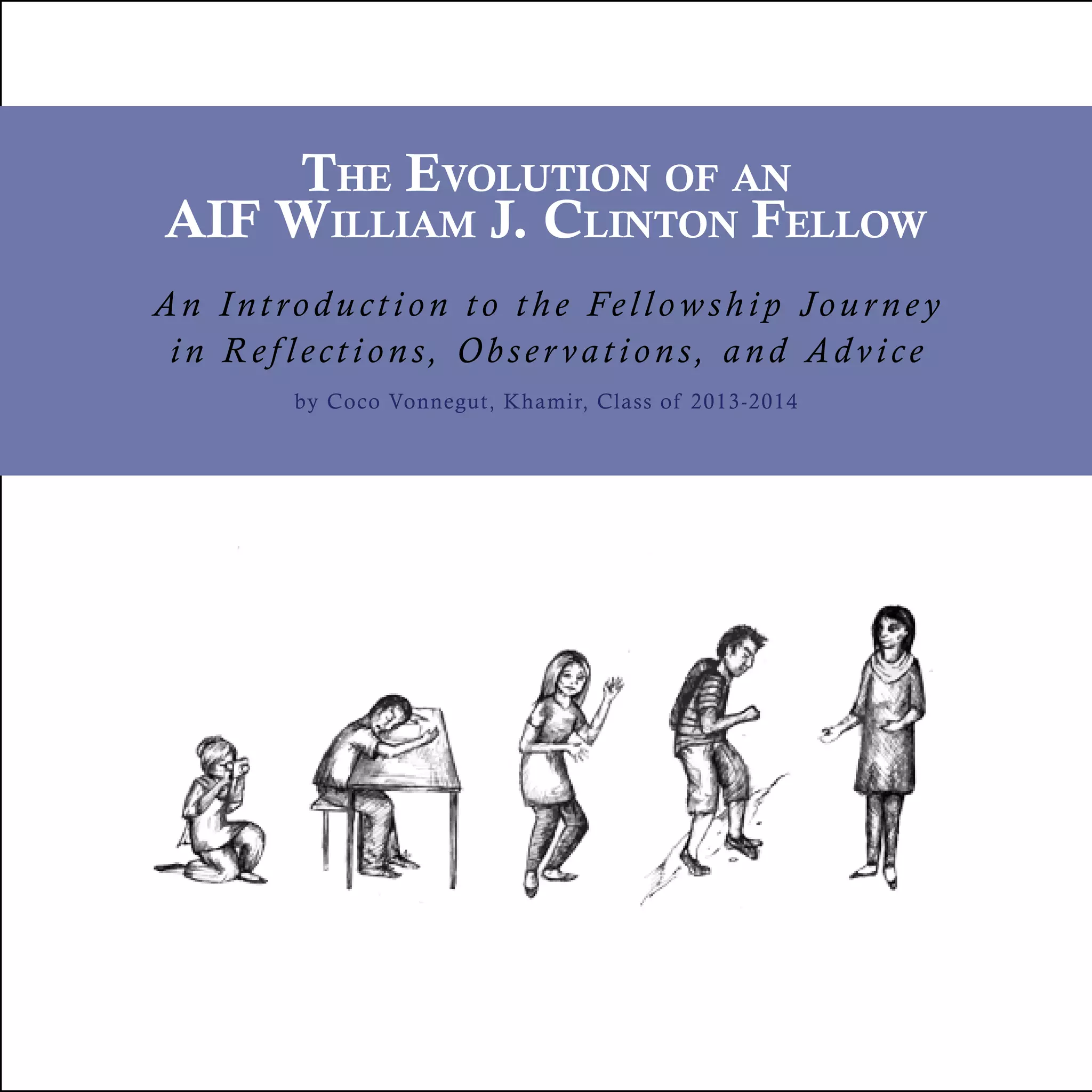
The Evolution of an
AIF William J. Clinton Fellow
An Introduction to the Fellowship Jour ney
in Ref lections, Obser vations, and Advice
by Coco Vonnegut, Khamir, Class of 2013-2014
We are all products of our experiences. Over the course of the 10 months
of being an AIF William J. Clinton Fellow for Service in India, I talked
with my co-fellows often about their placements and about their work.
What emerged was a clear, shared experience between myself and the other
fellows in far-flung parts of the country. While we all had different
challenges, we all seemed to react to them in very similar ways. These
commonalities led to the following reflections of my time at Khamir in
Kachchh, Gujarat in the context of the different “stages of evolution” a
fellow goes through.
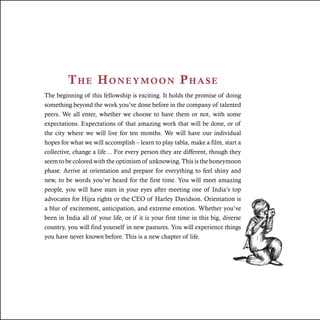
The Honeymoon Phase
The beginning of this fellowship is exciting. It holds the promise of doing
something beyond the work you’ve done before in the company of talented
peers. We all enter, whether we choose to have them or not, with some
expectations. Expectations of that amazing work that will be done, or of
the city where we will live for ten months. We will have our individual
hopes for what we will accomplish – learn to play tabla, make a film, start a
collective, change a life… For every person they are different, though they
seem to be colored with the optimism of unknowing. This is the honeymoon
phase. Arrive at orientation and prepare for everything to feel shiny and
new, to be words you’ve heard for the first time. You will meet amazing
people, you will have stars in your eyes after meeting one of India’s top
advocates for Hijra rights or the CEO of Harley Davidson. Orientation is
a blur of excitement, anticipation, and extreme emotion. Whether you’ve
been in India all of your life, or if it is your first time in this big, diverse
country, you will find yourself in new pastures. You will experience things
you have never known before. This is a new chapter of life.
Personal Reflections
The AIF William J Clinton Fellowship for Service in India marks my fourth time living
in India, A recent graduate of Colgate University, it was the perfect juncture in my life to
work in the development sector. Leaving a life of academia to the side for a year to focus on
people-to-people interactions and livelihoods issues, I expected this Fellowship to teach me
an incomparable amount of things about being a leader. What I could not expect where the
other lessons this Fellowship has given me. The practical things – insights into how to scale an
organization and structure a nonprofit with the community in mind – and the personal things
– an improved sense of confidence and vision for the shape of my life (as many of the fellows
will attest, I am a serial planner).
Orientation was overwhelming, in a good way. I arrive to the welcome of thirty-two people
who I am exceedingly humbled to call my peers. Beyond the brilliant speakers and the rush of
workshops and speeches promising a chance to make an impact, I was amazed by the stories
of the other Fellows and what led them here. Their enthusiasm for development gave me drive
and optimism as I moved on to my placement in Kachchh, Gujarat.
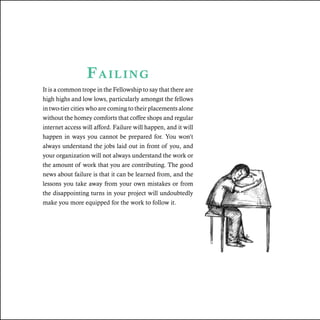
Failing
It is a common trope in the Fellowship to say that there are
high highs and low lows, particularly amongst the fellows
in two-tier cities who are coming to their placements alone
without the homey comforts that coffee shops and regular
internet access will afford. Failure will happen, and it will
happen in ways you cannot be prepared for. You won’t
always understand the jobs laid out in front of you, and
your organization will not always understand the work or
the amount of work that you are contributing. The good
news about failure is that it can be learned from, and the
lessons you take away from your own mistakes or from
the disappointing turns in your project will undoubtedly
make you more equipped for the work to follow it.
Personal Reflections
I arrived at Khamir, an NGO in Kachchh, Gujarat, unsure of my place in the organization and
how I would best make a difference. My Fellowship project was to help curate an exhibition
in December of block printed textiles and oral histories of the communities who made them,
which involved a mixture of field interviews in rural Kachchhi villages and days spent typing
furiously to meet writing deadlines. Eventually, I would scale this exhibition into a short book
with more field work and research, to be published by Khamir once my Fellowship came to
an end. Along this journey, like anyone, I had my fair share of mistakes.
My failures manifested themselves, generally, in day to day examples. My writing for the
exhibition sounded “too American,” a miscommunication between five of us on a team led to
misinformation being publicized, a field interview produced none of the information we all so
desperately wanted… Some failures you have to fight for and work to fix. If miscommunication
leads to a mess, you must clean it up. If you cannot learn something from your first interview,
schedule more. If you are “too American” in your approach, make observations of what
works in the context around you, and change your approach. These were the little lessons
I learned along the way. While I failed in my own ways, sometimes due to external factors
and sometimes not, there was invariable a take away from every mishap. Some failures, you
have to accept. I failed to convince people that I was a “Fellow” and not an “Intern,” and the
glamour of my title was a small price to pay because I was still doing the work of a Fellow.
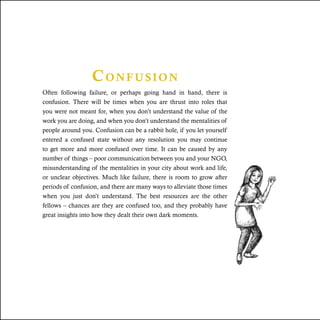
Confusion
Often following failure, or perhaps going hand in hand, there is
confusion. There will be times when you are thrust into roles that
you were not meant for, when you don’t understand the value of the
work you are doing, and when you don’t understand the mentalities of
people around you. Confusion can be a rabbit hole, if you let yourself
entered a confused state without any resolution you may continue
to get more and more confused over time. It can be caused by any
number of things – poor communication between you and your NGO,
misunderstanding of the mentalities in your city about work and life,
or unclear objectives. Much like failure, there is room to grow after
periods of confusion, and there are many ways to alleviate those times
when you just don’t understand. The best resources are the other
fellows – chances are they are confused too, and they probably have
great insights into how they dealt their own dark moments.
Personal Reflections
While my main project was to complete two research based projects about block printing
communities (the exhibition and the book), undoubtedly there were times when I wore other
hats at Khamir. This is to be expected. NGO’s with limited resources and manpower often
need people to fill multiple niches, and I sometimes found myself facilitating school visits,
showing guests around, or writing various publicity-related material. These things came with
the territory. While a primary, main project is a must, I found that I needed to be ready for the
surprising mornings when I would be informed that I’d be taking a school group to a nearby
village, or when I’d be asked to make a pamphlet for an upcoming event. (Some fellows will
find themselves, I’m sure, doing only this – running back and forth on small projects instead
of having an individual project to call their own. That was not my experience, but that is
definitely a time to speak up.)
What caused the greatest confusion, in my experience, was a lack of communication between
different chains of people. Over the first few months, we learned how to communicate with
each other, each individual on our team having a slightly different style. I prefer to be spoken
to directly about a task or agenda, while another co-worker would like an email so that there is
a digital reminder for him to keep returning to. It is important to catch on to the ways in which
your co-workers communicate to avoid confusion. Especially if you are uncomfortable with
the language in your placement, it is good to double and triple check that you understand what
your coworkers expect of you, and make your expectations clear too. When I was confused
about my shifting role or the communication gaps in my office, my best decision was to talk to
the other fellows in my class. While a friend from home would say, “maybe it’s just an Indian
thing,” the other fellows knew better and could give me concrete resolutions for my problems.
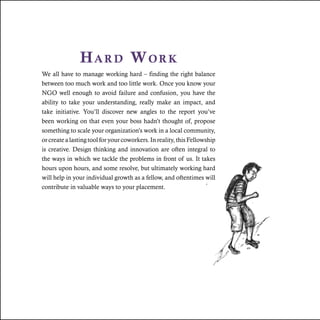
Hard Work
We all have to manage working hard – finding the right balance
between too much work and too little work. Once you know your
NGO well enough to avoid failure and confusion, you have the
ability to take your understanding, really make an impact, and
take initiative. You’ll discover new angles to the report you’ve
been working on that even your boss hadn’t thought of, propose
something to scale your organization’s work in a local community,
or create a lasting tool for your coworkers. In reality, this Fellowship
is creative. Design thinking and innovation are often integral to
the ways in which we tackle the problems in front of us. It takes
hours upon hours, and some resolve, but ultimately working hard
will help in your individual growth as a fellow, and oftentimes will
contribute in valuable ways to your placement.
Personal Reflections
How many nights have I been awake at 2am with a gchat with my sahelis open in one window
and a word document open in the other? There are times when you, simply put, have to work
hard. At Khamir, I had a unique project in that the work didn’t have lulls. While some fellows
wait a few months before really knowing what they’ll be doing at their NGO, I jumped right
in, and the nature of the exhibition and the book that followed was ten months with a very
full plate. That served my working style very well. Someone who lives best with a long to-do
list, I welcomed the atmosphere of my life at Khamir.
Perhaps it is obvious to say that the Fellowship involves hard work, but it is worth noting (in
my opinion) that this relates to your outlook. Being proactive, completing the tasks in front of
you, your co-workers will begin to appreciate you in a way they didn’t before. There came a
point in my ten month run at Khamir where I felt more confident. Once tackling the hurdles of
failure and confusion, I could move forward understanding my organization, understanding
their work, and understanding my place in it. That was empowering.
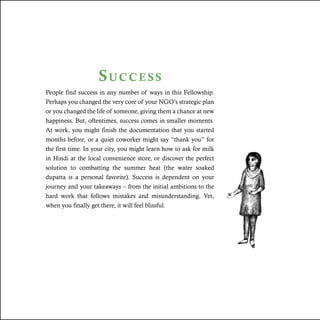
Success
People find success in any number of ways in this Fellowship.
Perhaps you changed the very core of your NGO’s strategic plan
or you changed the life of someone, giving them a chance at new
happiness. But, oftentimes, success comes in smaller moments.
At work, you might finish the documentation that you started
months before, or a quiet coworker might say “thank you” for
the first time. In your city, you might learn how to ask for milk
in Hindi at the local convenience store, or discover the perfect
solution to combatting the summer heat (the water soaked
dupatta is a personal favorite). Success is dependent on your
journey and your takeaways – from the initial ambitions to the
hard work that follows mistakes and misunderstanding. Yet,
when you finally get there, it will feel blissful.
Personal Reflections
People measure success in many ways. Not gravitating towards numbers, I tend to measure
success in my interactions with others and their impressions of me. On my last day at
Khamir, my coworker told me, “We’ve decided to give Fellows more responsibility because
of you.” That, to me, was the highest compliment, and I left feeling like I had won an award.
Ultimately, I wasn’t sure how much change I would make – I think it is hard to measure
impact. But knowing that my coworkers appreciated the contributions I did make was an
extremely rewarding feeling.
My biggest success was not what I gave to Khamir, but what Khamir gave to me. Over 10
months I learned an invaluable amount. I learned about the landscape of Kachchh – the
people, the complex community structures, and the history, I learned about how to improve
myself – to be adaptable to the people around me, to strive and to communicate skillful, I
learned about what I want – not necessarily in completely concrete terms but to the point
where I am more passionate about development work, excited to return to Kachchh, and to
continue learning and serving through storytelling and field based projects. I am returning to
the US for graduate school with a bolder sense of self.
Conclusion
No fellow evolves in quite the same way. We all live different
lives, experience different experiences, and learn different lessons.
But, undoubtedly, we all evolve. We all walk away changed in
some way or another – sometimes they are small changes and
sometimes they are big ones. Sometimes it is simply that you can
finally navigate the way from the old city back to your apartment,
having memorized the twisty roads along the way. Sometimes, you
have new ambition, new goals, and new contributions to make in
the development sector – a new organization or cooperative.
Personal Reflections
One thing I really admire about Khamir is that it is an organization that uses the talents of its
employees to their fullest advantage. If there is an educator on staff, they encourage them to
start a crafts-based education program. If there is a research, they encourage them to create
a documentation or publication of a local community. It works as a collective watering pool
for talent, and the talents that exist there can flourish into something mutually beneficial for
Khamir and for the individual. Seeing this, I began to question how I could use my talents in
a way that created something. Cue my collaboration with co-fellow Angela Kohama, wherein
she wrote a book and I illustrated it to teach inclusion in Indian schools. Moving forward, I
see the many avenues for expanding on my interests and skills in the development sector, and
I am incredibly grateful to AIF for making that possible.

Evolution of a Fellow - And Introduction to the William J. Clinton Fellowship Journey

  • 1.
    The Evolution ofan AIF William J. Clinton Fellow An Introduction to the Fellowship Jour ney in Ref lections, Obser vations, and Advice by Coco Vonnegut, Khamir, Class of 2013-2014
  • 2.
    We are allproducts of our experiences. Over the course of the 10 months of being an AIF William J. Clinton Fellow for Service in India, I talked with my co-fellows often about their placements and about their work. What emerged was a clear, shared experience between myself and the other fellows in far-flung parts of the country. While we all had different challenges, we all seemed to react to them in very similar ways. These commonalities led to the following reflections of my time at Khamir in Kachchh, Gujarat in the context of the different “stages of evolution” a fellow goes through.
  • 3.
    The Honeymoon Phase Thebeginning of this fellowship is exciting. It holds the promise of doing something beyond the work you’ve done before in the company of talented peers. We all enter, whether we choose to have them or not, with some expectations. Expectations of that amazing work that will be done, or of the city where we will live for ten months. We will have our individual hopes for what we will accomplish – learn to play tabla, make a film, start a collective, change a life… For every person they are different, though they seem to be colored with the optimism of unknowing. This is the honeymoon phase. Arrive at orientation and prepare for everything to feel shiny and new, to be words you’ve heard for the first time. You will meet amazing people, you will have stars in your eyes after meeting one of India’s top advocates for Hijra rights or the CEO of Harley Davidson. Orientation is a blur of excitement, anticipation, and extreme emotion. Whether you’ve been in India all of your life, or if it is your first time in this big, diverse country, you will find yourself in new pastures. You will experience things you have never known before. This is a new chapter of life.
  • 4.
    Personal Reflections The AIFWilliam J Clinton Fellowship for Service in India marks my fourth time living in India, A recent graduate of Colgate University, it was the perfect juncture in my life to work in the development sector. Leaving a life of academia to the side for a year to focus on people-to-people interactions and livelihoods issues, I expected this Fellowship to teach me an incomparable amount of things about being a leader. What I could not expect where the other lessons this Fellowship has given me. The practical things – insights into how to scale an organization and structure a nonprofit with the community in mind – and the personal things – an improved sense of confidence and vision for the shape of my life (as many of the fellows will attest, I am a serial planner). Orientation was overwhelming, in a good way. I arrive to the welcome of thirty-two people who I am exceedingly humbled to call my peers. Beyond the brilliant speakers and the rush of workshops and speeches promising a chance to make an impact, I was amazed by the stories of the other Fellows and what led them here. Their enthusiasm for development gave me drive and optimism as I moved on to my placement in Kachchh, Gujarat.
  • 5.
    Failing It is acommon trope in the Fellowship to say that there are high highs and low lows, particularly amongst the fellows in two-tier cities who are coming to their placements alone without the homey comforts that coffee shops and regular internet access will afford. Failure will happen, and it will happen in ways you cannot be prepared for. You won’t always understand the jobs laid out in front of you, and your organization will not always understand the work or the amount of work that you are contributing. The good news about failure is that it can be learned from, and the lessons you take away from your own mistakes or from the disappointing turns in your project will undoubtedly make you more equipped for the work to follow it.
  • 6.
    Personal Reflections I arrivedat Khamir, an NGO in Kachchh, Gujarat, unsure of my place in the organization and how I would best make a difference. My Fellowship project was to help curate an exhibition in December of block printed textiles and oral histories of the communities who made them, which involved a mixture of field interviews in rural Kachchhi villages and days spent typing furiously to meet writing deadlines. Eventually, I would scale this exhibition into a short book with more field work and research, to be published by Khamir once my Fellowship came to an end. Along this journey, like anyone, I had my fair share of mistakes. My failures manifested themselves, generally, in day to day examples. My writing for the exhibition sounded “too American,” a miscommunication between five of us on a team led to misinformation being publicized, a field interview produced none of the information we all so desperately wanted… Some failures you have to fight for and work to fix. If miscommunication leads to a mess, you must clean it up. If you cannot learn something from your first interview, schedule more. If you are “too American” in your approach, make observations of what works in the context around you, and change your approach. These were the little lessons I learned along the way. While I failed in my own ways, sometimes due to external factors and sometimes not, there was invariable a take away from every mishap. Some failures, you have to accept. I failed to convince people that I was a “Fellow” and not an “Intern,” and the glamour of my title was a small price to pay because I was still doing the work of a Fellow.
  • 7.
    Confusion Often following failure,or perhaps going hand in hand, there is confusion. There will be times when you are thrust into roles that you were not meant for, when you don’t understand the value of the work you are doing, and when you don’t understand the mentalities of people around you. Confusion can be a rabbit hole, if you let yourself entered a confused state without any resolution you may continue to get more and more confused over time. It can be caused by any number of things – poor communication between you and your NGO, misunderstanding of the mentalities in your city about work and life, or unclear objectives. Much like failure, there is room to grow after periods of confusion, and there are many ways to alleviate those times when you just don’t understand. The best resources are the other fellows – chances are they are confused too, and they probably have great insights into how they dealt their own dark moments.
  • 8.
    Personal Reflections While mymain project was to complete two research based projects about block printing communities (the exhibition and the book), undoubtedly there were times when I wore other hats at Khamir. This is to be expected. NGO’s with limited resources and manpower often need people to fill multiple niches, and I sometimes found myself facilitating school visits, showing guests around, or writing various publicity-related material. These things came with the territory. While a primary, main project is a must, I found that I needed to be ready for the surprising mornings when I would be informed that I’d be taking a school group to a nearby village, or when I’d be asked to make a pamphlet for an upcoming event. (Some fellows will find themselves, I’m sure, doing only this – running back and forth on small projects instead of having an individual project to call their own. That was not my experience, but that is definitely a time to speak up.) What caused the greatest confusion, in my experience, was a lack of communication between different chains of people. Over the first few months, we learned how to communicate with each other, each individual on our team having a slightly different style. I prefer to be spoken to directly about a task or agenda, while another co-worker would like an email so that there is a digital reminder for him to keep returning to. It is important to catch on to the ways in which your co-workers communicate to avoid confusion. Especially if you are uncomfortable with the language in your placement, it is good to double and triple check that you understand what your coworkers expect of you, and make your expectations clear too. When I was confused about my shifting role or the communication gaps in my office, my best decision was to talk to the other fellows in my class. While a friend from home would say, “maybe it’s just an Indian thing,” the other fellows knew better and could give me concrete resolutions for my problems.
  • 9.
    Hard Work We allhave to manage working hard – finding the right balance between too much work and too little work. Once you know your NGO well enough to avoid failure and confusion, you have the ability to take your understanding, really make an impact, and take initiative. You’ll discover new angles to the report you’ve been working on that even your boss hadn’t thought of, propose something to scale your organization’s work in a local community, or create a lasting tool for your coworkers. In reality, this Fellowship is creative. Design thinking and innovation are often integral to the ways in which we tackle the problems in front of us. It takes hours upon hours, and some resolve, but ultimately working hard will help in your individual growth as a fellow, and oftentimes will contribute in valuable ways to your placement.
  • 10.
    Personal Reflections How manynights have I been awake at 2am with a gchat with my sahelis open in one window and a word document open in the other? There are times when you, simply put, have to work hard. At Khamir, I had a unique project in that the work didn’t have lulls. While some fellows wait a few months before really knowing what they’ll be doing at their NGO, I jumped right in, and the nature of the exhibition and the book that followed was ten months with a very full plate. That served my working style very well. Someone who lives best with a long to-do list, I welcomed the atmosphere of my life at Khamir. Perhaps it is obvious to say that the Fellowship involves hard work, but it is worth noting (in my opinion) that this relates to your outlook. Being proactive, completing the tasks in front of you, your co-workers will begin to appreciate you in a way they didn’t before. There came a point in my ten month run at Khamir where I felt more confident. Once tackling the hurdles of failure and confusion, I could move forward understanding my organization, understanding their work, and understanding my place in it. That was empowering.
  • 11.
    Success People find successin any number of ways in this Fellowship. Perhaps you changed the very core of your NGO’s strategic plan or you changed the life of someone, giving them a chance at new happiness. But, oftentimes, success comes in smaller moments. At work, you might finish the documentation that you started months before, or a quiet coworker might say “thank you” for the first time. In your city, you might learn how to ask for milk in Hindi at the local convenience store, or discover the perfect solution to combatting the summer heat (the water soaked dupatta is a personal favorite). Success is dependent on your journey and your takeaways – from the initial ambitions to the hard work that follows mistakes and misunderstanding. Yet, when you finally get there, it will feel blissful.
  • 12.
    Personal Reflections People measuresuccess in many ways. Not gravitating towards numbers, I tend to measure success in my interactions with others and their impressions of me. On my last day at Khamir, my coworker told me, “We’ve decided to give Fellows more responsibility because of you.” That, to me, was the highest compliment, and I left feeling like I had won an award. Ultimately, I wasn’t sure how much change I would make – I think it is hard to measure impact. But knowing that my coworkers appreciated the contributions I did make was an extremely rewarding feeling. My biggest success was not what I gave to Khamir, but what Khamir gave to me. Over 10 months I learned an invaluable amount. I learned about the landscape of Kachchh – the people, the complex community structures, and the history, I learned about how to improve myself – to be adaptable to the people around me, to strive and to communicate skillful, I learned about what I want – not necessarily in completely concrete terms but to the point where I am more passionate about development work, excited to return to Kachchh, and to continue learning and serving through storytelling and field based projects. I am returning to the US for graduate school with a bolder sense of self.
  • 13.
    Conclusion No fellow evolvesin quite the same way. We all live different lives, experience different experiences, and learn different lessons. But, undoubtedly, we all evolve. We all walk away changed in some way or another – sometimes they are small changes and sometimes they are big ones. Sometimes it is simply that you can finally navigate the way from the old city back to your apartment, having memorized the twisty roads along the way. Sometimes, you have new ambition, new goals, and new contributions to make in the development sector – a new organization or cooperative.
  • 14.
    Personal Reflections One thingI really admire about Khamir is that it is an organization that uses the talents of its employees to their fullest advantage. If there is an educator on staff, they encourage them to start a crafts-based education program. If there is a research, they encourage them to create a documentation or publication of a local community. It works as a collective watering pool for talent, and the talents that exist there can flourish into something mutually beneficial for Khamir and for the individual. Seeing this, I began to question how I could use my talents in a way that created something. Cue my collaboration with co-fellow Angela Kohama, wherein she wrote a book and I illustrated it to teach inclusion in Indian schools. Moving forward, I see the many avenues for expanding on my interests and skills in the development sector, and I am incredibly grateful to AIF for making that possible.