Evolution and growth of Agartala Municipal corporation
TRIPURA UNIVERSITY
(A CENTRAL UNIVERSITY)
GEOGRAPHY AND DISASTER MANAGEMENT
PAPER CODE- GEDM 1004E
ENROLLMENT NO-1806100012
DATE-
SUBMITED BY-
UTPAL BARMAN
Agartala municipal at a glance
• Origin and history:The Municipal Administration in Agartala was
established in 1874 A.D and the city became a planned city by the then
Maharaja Bir Bikra Manikya Bahadur in 1940s. This erstwhile Princely
State Capital of Tripura merged with India on 15th October 1949. The city
has become the nerve center of all political, administrative, cultural and
commercial activities of the state.
• Latitudinal and longitudinal extension: 23°45’- 23°55’ N latitude and
91°15’- 91°20’ E longitude.
• Population:400,004 of which 200,132 are males while 199,872 are females
as per report released by Census India 2011.
• Area:16.0162 sq.km.
• Wards: 49 wards.
• Major connectivity: Connected by NH-44, Domestic airport, Indian rail.
• Education status: Average 94.5% of which Male 96.2% Female 92.8%.
• Social status: Total families-104240, Sc-18114,St-4232,OBC-19080,
Minorities-5869,Others-56942
 1838: Maharaja Krishna Kishore Manikya set up the ‘Old Haveli’ at the other side
of the river Howrah .The area used to be identified upto Kunjaban tilla at the north
Jagaharimura and Rashman tilla to the south,the British India at the west and the
river Howrah at the east. Due to frequent invasion of the Kukis and also to keep
easy communication with the British Bengal, the Maharaja started the process of
shifting of the Capital from Old Haveli to New Haveli (present Agartala) in the year
1849 A.D.
The next Maharaja Iswar Chandra Manikya on assuming throne on 1st February 1850
A.D constructed a Palace thereon.
 1862: Bir Chandra Manikya started the urbanisation of the New Haveli (Agartala)
 1871: The Agartala Municipality was established within area of 3 sq. miles having
population 875 only by a royal proclamation. Mr. A.W.S. Power, the 1st British
Political Agent for Tipperch was appointed as the Chairman of the Agartala
Municipality in the year 1872 A.D. As suggested by the 2nd Political Agent Capt.
W.L. Samwell, Maharaja becomes the President of the Municipal Committee. And
on behalf of the Maharaja Bir Chandra manikya, Prince Radhakishore took an
active role in supervising the Municipal works.
Evolution of Agartala municipal corporation(Pre-Independence)
 1874: Municipal regulations were introduced with provision of taxation. The main
source of income was from water tax levied on tanks and water bodies, realised fine
amount of judiciary and state grant. The main task was to look after the
development and maintenance of roads /paths.,drainage, bridges and markets and
sanitation. During the period, the Akhaura Khal was excavated for drainage.
 1897: Maharaja Radha Kishore Manikya re-organised the entire administration and
the officer-in-charge of the Political Department was entrusted with the Municipal
affairs. During the period,. The work of Census, birth and death registration, regular
sweeping and cleaning of roads and drains used to be made.
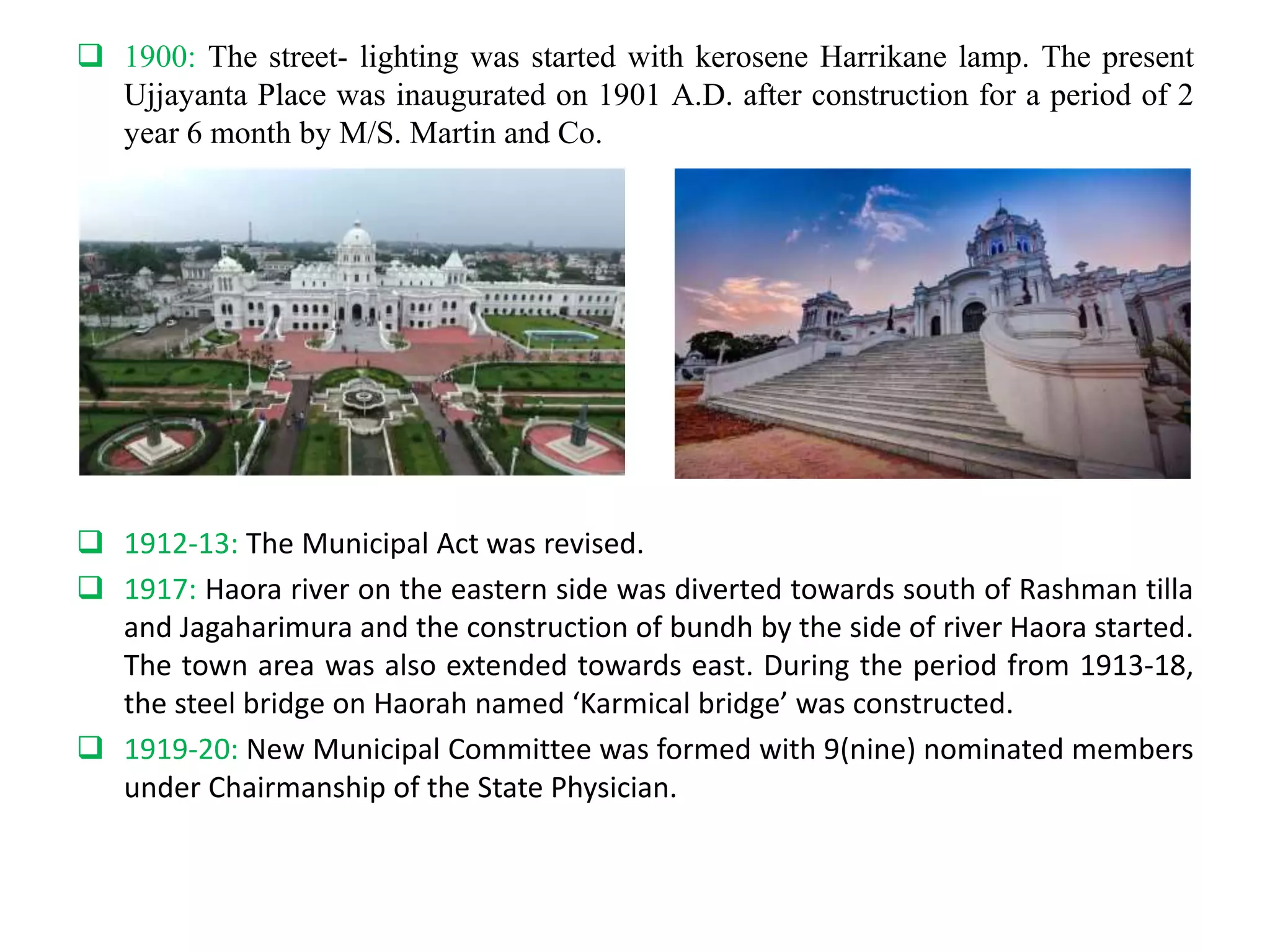
 1900: The street- lighting was started with kerosene Harrikane lamp. The present
Ujjayanta Place was inaugurated on 1901 A.D. after construction for a period of 2
year 6 month by M/S. Martin and Co.
 1912-13: The Municipal Act was revised.
 1917: Haora river on the eastern side was diverted towards south of Rashman tilla
and Jagaharimura and the construction of bundh by the side of river Haora started.
The town area was also extended towards east. During the period from 1913-18,
the steel bridge on Haorah named ‘Karmical bridge’ was constructed.
 1919-20: New Municipal Committee was formed with 9(nine) nominated members
under Chairmanship of the State Physician.
 1943: The provision of new committee of 12 members was introduced and
for the Ist time, the system of election to the Municipal body started. Out of
12 members, 6 were to be elected by the tax payers and 7 were to be
nominated by the Maharaja. The Municipality was also divided into 12
wards. The Deputy Superintendent of Police was entrusted as Chairman of
the committee due to special circumstances of Second World War period.
The committee continued up to 3rd week of November 1945 A.D.
 1945: Further 10 members were nominated to the committee making it to
22, but within a period of 1(one) month, the said committee was also
dissolved and the entire Municipal administration was taken under direct
control of the State Administration.
Post –independence :
 1951: The Municipal Committee was further re-organised with 18
Commissioners. The 1st General Municipal election was held on 5th November
1951 for electing 18 members of the municipal committee. Shri Sukhamoy
Sengupta and Shri Hem Chandra Dutta were elected as Chairman and Vice-
Chairman respectively
 1955 to 1978: Agartala Municipality was under government nominated
administrator. By a notification of the Ministry of Home Affairs, Govt.of India, the
Bengal Municipal Act, 1932 with some modifications, was extended to the Union
Territory of Tripura with effect from 15th August 1961.
 1978: Agartala Municipality was divided into 10 wards for the purpose of election
of commissioners for the municipality by enlarging the municipal area to 10.94
sq.km.
The second general municipal election was held in June 1978, Shri Amal Dasgupta
was elected chairman of the 10 members elected municipal board.
The municipality was further extended to an area of 15.81 sq.k.m and was divided
in to 13 wards. The 3rd general municipal election was held in July 1983.
 1988 to 1996: The municipality was placed under government nominated
administrator.
 26 October 1994: The Tripura Municipal Act.1994 was passed as per 74th
amendment of the Constitution of India, The 4th general Municipal election was
held in December, 1995, and municipal council of 17 elected members and 3
nominated members was formed.
After the 5th general municipal election held in the month of December 2000
another municipal council with 17 elected members and 3 nominated members
came to power. The municipal area was 16.012 sq. k.m. with population of 1,89,998
as per 2001 census.
 2004: The Agartala Municipal Council has further been extended from 16.012 sq
km to 62.02 sq km in 2004 with a population of 368493 persons. The total GAPA
area comprises of 92 sq km.

Evolution and growth of agartala municipal corporation

  • 1.
    Evolution and growthof Agartala Municipal corporation TRIPURA UNIVERSITY (A CENTRAL UNIVERSITY) GEOGRAPHY AND DISASTER MANAGEMENT PAPER CODE- GEDM 1004E ENROLLMENT NO-1806100012 DATE- SUBMITED BY- UTPAL BARMAN
  • 2.
    Agartala municipal ata glance • Origin and history:The Municipal Administration in Agartala was established in 1874 A.D and the city became a planned city by the then Maharaja Bir Bikra Manikya Bahadur in 1940s. This erstwhile Princely State Capital of Tripura merged with India on 15th October 1949. The city has become the nerve center of all political, administrative, cultural and commercial activities of the state. • Latitudinal and longitudinal extension: 23°45’- 23°55’ N latitude and 91°15’- 91°20’ E longitude. • Population:400,004 of which 200,132 are males while 199,872 are females as per report released by Census India 2011. • Area:16.0162 sq.km. • Wards: 49 wards. • Major connectivity: Connected by NH-44, Domestic airport, Indian rail. • Education status: Average 94.5% of which Male 96.2% Female 92.8%. • Social status: Total families-104240, Sc-18114,St-4232,OBC-19080, Minorities-5869,Others-56942
  • 3.
     1838: MaharajaKrishna Kishore Manikya set up the ‘Old Haveli’ at the other side of the river Howrah .The area used to be identified upto Kunjaban tilla at the north Jagaharimura and Rashman tilla to the south,the British India at the west and the river Howrah at the east. Due to frequent invasion of the Kukis and also to keep easy communication with the British Bengal, the Maharaja started the process of shifting of the Capital from Old Haveli to New Haveli (present Agartala) in the year 1849 A.D. The next Maharaja Iswar Chandra Manikya on assuming throne on 1st February 1850 A.D constructed a Palace thereon.  1862: Bir Chandra Manikya started the urbanisation of the New Haveli (Agartala)  1871: The Agartala Municipality was established within area of 3 sq. miles having population 875 only by a royal proclamation. Mr. A.W.S. Power, the 1st British Political Agent for Tipperch was appointed as the Chairman of the Agartala Municipality in the year 1872 A.D. As suggested by the 2nd Political Agent Capt. W.L. Samwell, Maharaja becomes the President of the Municipal Committee. And on behalf of the Maharaja Bir Chandra manikya, Prince Radhakishore took an active role in supervising the Municipal works. Evolution of Agartala municipal corporation(Pre-Independence)
  • 4.
     1874: Municipalregulations were introduced with provision of taxation. The main source of income was from water tax levied on tanks and water bodies, realised fine amount of judiciary and state grant. The main task was to look after the development and maintenance of roads /paths.,drainage, bridges and markets and sanitation. During the period, the Akhaura Khal was excavated for drainage.  1897: Maharaja Radha Kishore Manikya re-organised the entire administration and the officer-in-charge of the Political Department was entrusted with the Municipal affairs. During the period,. The work of Census, birth and death registration, regular sweeping and cleaning of roads and drains used to be made.
  • 5.
     1900: Thestreet- lighting was started with kerosene Harrikane lamp. The present Ujjayanta Place was inaugurated on 1901 A.D. after construction for a period of 2 year 6 month by M/S. Martin and Co.  1912-13: The Municipal Act was revised.  1917: Haora river on the eastern side was diverted towards south of Rashman tilla and Jagaharimura and the construction of bundh by the side of river Haora started. The town area was also extended towards east. During the period from 1913-18, the steel bridge on Haorah named ‘Karmical bridge’ was constructed.  1919-20: New Municipal Committee was formed with 9(nine) nominated members under Chairmanship of the State Physician.
  • 6.
     1943: Theprovision of new committee of 12 members was introduced and for the Ist time, the system of election to the Municipal body started. Out of 12 members, 6 were to be elected by the tax payers and 7 were to be nominated by the Maharaja. The Municipality was also divided into 12 wards. The Deputy Superintendent of Police was entrusted as Chairman of the committee due to special circumstances of Second World War period. The committee continued up to 3rd week of November 1945 A.D.  1945: Further 10 members were nominated to the committee making it to 22, but within a period of 1(one) month, the said committee was also dissolved and the entire Municipal administration was taken under direct control of the State Administration. Post –independence :  1951: The Municipal Committee was further re-organised with 18 Commissioners. The 1st General Municipal election was held on 5th November 1951 for electing 18 members of the municipal committee. Shri Sukhamoy Sengupta and Shri Hem Chandra Dutta were elected as Chairman and Vice- Chairman respectively
  • 7.
     1955 to1978: Agartala Municipality was under government nominated administrator. By a notification of the Ministry of Home Affairs, Govt.of India, the Bengal Municipal Act, 1932 with some modifications, was extended to the Union Territory of Tripura with effect from 15th August 1961.  1978: Agartala Municipality was divided into 10 wards for the purpose of election of commissioners for the municipality by enlarging the municipal area to 10.94 sq.km. The second general municipal election was held in June 1978, Shri Amal Dasgupta was elected chairman of the 10 members elected municipal board. The municipality was further extended to an area of 15.81 sq.k.m and was divided in to 13 wards. The 3rd general municipal election was held in July 1983.  1988 to 1996: The municipality was placed under government nominated administrator.  26 October 1994: The Tripura Municipal Act.1994 was passed as per 74th amendment of the Constitution of India, The 4th general Municipal election was held in December, 1995, and municipal council of 17 elected members and 3 nominated members was formed. After the 5th general municipal election held in the month of December 2000 another municipal council with 17 elected members and 3 nominated members came to power. The municipal area was 16.012 sq. k.m. with population of 1,89,998 as per 2001 census.
  • 8.
     2004: TheAgartala Municipal Council has further been extended from 16.012 sq km to 62.02 sq km in 2004 with a population of 368493 persons. The total GAPA area comprises of 92 sq km.