

Evidence and Evidence Handling Techniques
Being a Lecture Paper Presented on Friday, June 14, 2024.
Prof. Godwin Emmanuel
Oyedokun
Professor of Accounting and Financial
Development
Department of Management & Accounting
Faculty of Management and Social Sciences
Lead City University, Ibadan, Nigeria
Principal Partner; Oyedokun Godwin Emmanuel &
Co
(Accountants, Tax Practitioners & Forensic Auditors)
ND (Fin), HND (Acct.), BSc. (Acct. Ed), BSc (Fin.), LLB., LLM, MBA (Acct. & Fin.), MSc. (Acct.), MSc. (Bus &Econs), MSc. (Fin), MSc.
(Econs), Ph.D. (Acct), Ph.D. (Fin), Ph.D. (FA), CICA, CFA, CFE, CIPFA, CPFA, CertIFR, ACS, ACIS, ACIArb, ACAMS, ABR, IPA, IFA,
MNIM, FCA, FCTI, FCIB, FCNA, FCFIP, FCE, FERP, FFAR, FPD-CR, FSEAN, FNIOAIM, FCCrFA, FCCFI, FICA, FCECFI, JP
Prof. Godwin Emmanuel
Oyedokun
Professor of Accounting and Financial
Development
Department of Management & Accounting
Faculty of Management and Social Sciences
Lead City University, Ibadan, Nigeria
Principal Partner; Oyedokun Godwin Emmanuel &
Co
(Accountants, Tax Practitioners & Forensic Auditors)
Evidence and Evidence
Handling Techniques
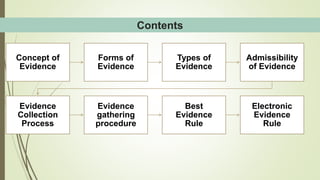
Contents
Concept of
Evidence
Forms of
Evidence
Types of
Evidence
Admissibility
of Evidence
Evidence
Collection
Process
Evidence
gathering
procedure
Best
Evidence
Rule
Electronic
Evidence
Rule
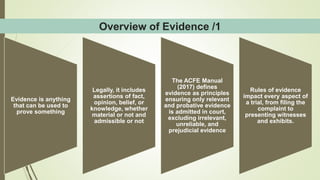
Overview of Evidence /1
Evidence is anything
that can be used to
prove something
Legally, it includes
assertions of fact,
opinion, belief, or
knowledge, whether
material or not and
admissible or not
The ACFE Manual
(2017) defines
evidence as principles
ensuring only relevant
and probative evidence
is admitted in court,
excluding irrelevant,
unreliable, and
prejudicial evidence
Rules of evidence
impact every aspect of
a trial, from filing the
complaint to
presenting witnesses
and exhibits.
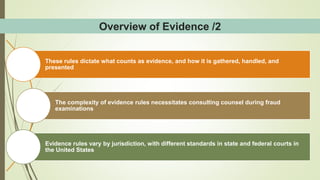
Overview of Evidence /2
These rules dictate what counts as evidence, and how it is gathered, handled, and
presented
The complexity of evidence rules necessitates consulting counsel during fraud
examinations
Evidence rules vary by jurisdiction, with different standards in state and federal courts in
the United States
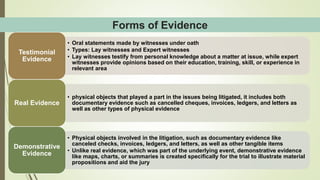
Forms of Evidence
• Oral statements made by witnesses under oath
• Types: Lay witnesses and Expert witnesses
• Lay witnesses testify from personal knowledge about a matter at issue, while expert
witnesses provide opinions based on their education, training, skill, or experience in
relevant area
Testimonial
Evidence
• physical objects that played a part in the issues being litigated, it includes both
documentary evidence such as cancelled cheques, invoices, ledgers, and letters as
well as other types of physical evidence
Real Evidence
• Physical objects involved in the litigation, such as documentary evidence like
canceled checks, invoices, ledgers, and letters, as well as other tangible items
• Unlike real evidence, which was part of the underlying event, demonstrative evidence
like maps, charts, or summaries is created specifically for the trial to illustrate material
propositions and aid the jury
Demonstrative
Evidence
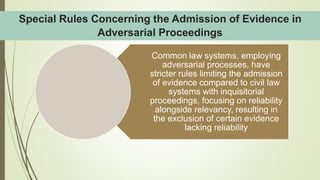
Common law systems, employing
adversarial processes, have
stricter rules limiting the admission
of evidence compared to civil law
systems with inquisitorial
proceedings, focusing on reliability
alongside relevancy, resulting in
the exclusion of certain evidence
lacking reliability
Special Rules Concerning the Admission of Evidence in
Adversarial Proceedings
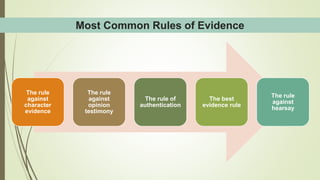
Most Common Rules of Evidence
The rule
against
character
evidence
The rule
against
opinion
testimony
The rule of
authentication
The best
evidence rule
The rule
against
hearsay
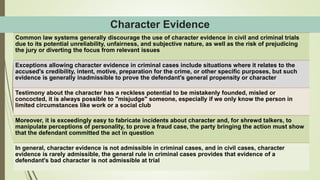
Character Evidence
Common law systems generally discourage the use of character evidence in civil and criminal trials
due to its potential unreliability, unfairness, and subjective nature, as well as the risk of prejudicing
the jury or diverting the focus from relevant issues
Exceptions allowing character evidence in criminal cases include situations where it relates to the
accused's credibility, intent, motive, preparation for the crime, or other specific purposes, but such
evidence is generally inadmissible to prove the defendant's general propensity or character
Testimony about the character has a reckless potential to be mistakenly founded, misled or
concocted, it is always possible to "misjudge" someone, especially if we only know the person in
limited circumstances like work or a social club
Moreover, it is exceedingly easy to fabricate incidents about character and, for shrewd talkers, to
manipulate perceptions of personality, to prove a fraud case, the party bringing the action must show
that the defendant committed the act in question
In general, character evidence is not admissible in criminal cases, and in civil cases, character
evidence is rarely admissible, the general rule in criminal cases provides that evidence of a
defendant's bad character is not admissible at trial
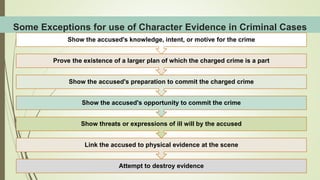
Some Exceptions for use of Character Evidence in Criminal Cases
Attempt to destroy evidence
Link the accused to physical evidence at the scene
Show threats or expressions of ill will by the accused
Show the accused's opportunity to commit the crime
Show the accused's preparation to commit the charged crime
Prove the existence of a larger plan of which the charged crime is a part
Show the accused's knowledge, intent, or motive for the crime
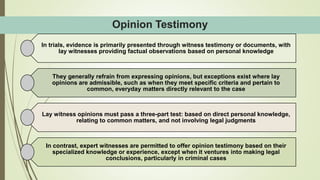
Opinion Testimony
In trials, evidence is primarily presented through witness testimony or documents, with
lay witnesses providing factual observations based on personal knowledge
They generally refrain from expressing opinions, but exceptions exist where lay
opinions are admissible, such as when they meet specific criteria and pertain to
common, everyday matters directly relevant to the case
Lay witness opinions must pass a three-part test: based on direct personal knowledge,
relating to common matters, and not involving legal judgments
In contrast, expert witnesses are permitted to offer opinion testimony based on their
specialized knowledge or experience, except when it ventures into making legal
conclusions, particularly in criminal cases
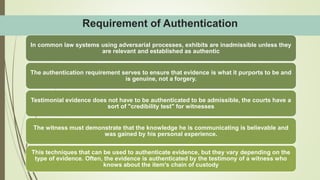
Requirement of Authentication
In common law systems using adversarial processes, exhibits are inadmissible unless they
are relevant and established as authentic
The authentication requirement serves to ensure that evidence is what it purports to be and
is genuine, not a forgery.
Testimonial evidence does not have to be authenticated to be admissible, the courts have a
sort of "credibility test" for witnesses
The witness must demonstrate that the knowledge he is communicating is believable and
was gained by his personal experience.
This techniques that can be used to authenticate evidence, but they vary depending on the
type of evidence. Often, the evidence is authenticated by the testimony of a witness who
knows about the item's chain of custody
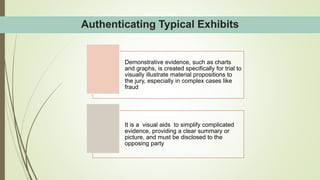
Authenticating Typical Exhibits
Demonstrative evidence, such as charts
and graphs, is created specifically for trial to
visually illustrate material propositions to
the jury, especially in complex cases like
fraud
It is a visual aids to simplify complicated
evidence, providing a clear summary or
picture, and must be disclosed to the
opposing party
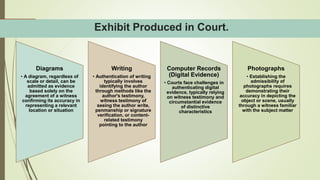
Diagrams
• A diagram, regardless of
scale or detail, can be
admitted as evidence
based solely on the
agreement of a witness
confirming its accuracy in
representing a relevant
location or situation
Writing
• Authentication of writing
typically involves
identifying the author
through methods like the
author's testimony,
witness testimony of
seeing the author write,
penmanship or signature
verification, or content-
related testimony
pointing to the author
Computer Records
(Digital Evidence)
• Courts face challenges in
authenticating digital
evidence, typically relying
on witness testimony and
circumstantial evidence
of distinctive
characteristics
Photographs
• Establishing the
admissibility of
photographs requires
demonstrating their
accuracy in depicting the
object or scene, usually
through a witness familiar
with the subject matter
Exhibit Produced in Court.
In adversarial processes, once an exhibit is properly admitted into the record, either side
can use it regardless of who entered it into evidence
The timing of exhibit admission does not matter it can be introduced during direct
examination, where opposing counsel can inspect the exhibit before the witness
confirms it
Exhibits are marked for identification before being offered into evidence to ensure they
are recognizable in the transcript of the proceedings
Exhibits are typically marked sequentially and identified by the party who offered them,
such as "Plaintiff exhibits
Both sides in a lawsuit can stipulate agreements to simplify trial proceedings by
narrowing disputes to key issues
General Points about Exhibits
Authentication of an exhibit
does not guarantee its
admission if it violates other
evidence rules like hearsay,
prejudice, or relevance
Parties can dispute the
admissibility of an exhibit by
saying "objection," upon which
the judge will rule
If the judge overrules the
objection, the evidence is
admitted; if the judge sustains
the objection, the evidence is
excluded
Judges can admit exhibits as
they are, with alterations, or
deny them entirely
Some objections may require a
separate hearing, and fraud
trials can be prolonged by
challenges to large volumes of
evidence
Objections to Exhibits
Civil law systems do not require evidence authentication for admission
Authentication affects the evidential value or weight given by the fact-
finder
Non-authentic evidence is considered less reliable and given less weight
by the fact-finder
Authentic and relevant evidence is deemed reliable and helpful in
ascertaining the truth
Authenticity in Civil Law Systems
Practices in Evidence Gathering
Best Evidence Rule
Hearsay
• Common law countries
generally prohibit hearsay
statements at trial, which are
out-of-court statements
offered to prove the truth of
the matter asserted, to ensure
the credibility of testimony
and preserve the right to
cross-examine witnesses,
though there are numerous
exceptions to this rule
Rules Relating to Evidence
Content
• Evidence must be shown to
be relevant to be introduced
in court, but judges may
exclude relevant evidence if it
is overly prejudicial; attorneys
must object to the inclusion of
irrelevant evidence, otherwise
it is admitted, while personal
knowledge rules limit
witnesses to testify only to
what they have directly
experienced, with exceptions
for expert witnesses, and
numerous exceptions exist to
the hearsay rule, such as
dying declarations and
excited utterances
Rules relating to the Manner of
Testimony
• Attorneys are prohibited from
asking leading questions
during direct examination but
may do so during cross-
examination, and certain
questions, such as those that
badger witnesses, assume
facts not in evidence,
misquote witnesses, or ask
for speculation, are entirely
forbidden; witnesses can
protect themselves from
improper questions by
restating previous testimony if
the attorney fails to object
Types of Evidence
Physical
Evidence
Physical evidence
includes all items
with physical
existence, such as
fingerprints and
trace evidence, and
also documents,
even those stored
digitally
Document
Evidence
Document evidence
encompasses both
collected
documents and
those created for
the trial, such as
charts, graphs, and
exhibits used in
expert testimony
Observation
Evidence
Observation
evidence, gathered
by monitoring
suspects, can
include eyewitness
testimony or
recordings, and is
often very powerful,
such as a videotape
showing a clerk
stealing money,
which can be more
compelling than
expert analysis of
accounting records
Interviews
Recorded interviews
and signed
confessions are the
most potent
evidence, especially
when witnesses
provide firsthand
knowledge relevant
to the alleged fraud,
making interviews
invaluable for both
trial evidence and
investigative focus
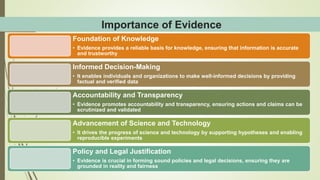
Importance of Evidence
Foundation of Knowledge
• Evidence provides a reliable basis for knowledge, ensuring that information is accurate
and trustworthy
Informed Decision-Making
• It enables individuals and organizations to make well-informed decisions by providing
factual and verified data
Accountability and Transparency
• Evidence promotes accountability and transparency, ensuring actions and claims can be
scrutinized and validated
Advancement of Science and Technology
• It drives the progress of science and technology by supporting hypotheses and enabling
reproducible experiments
Policy and Legal Justification
• Evidence is crucial in forming sound policies and legal decisions, ensuring they are
grounded in reality and fairness
Admissibility Rules
Evidence must meet certain requirements to be admissible, with judges having significant
discretion over its admissibility
Civil law systems, lacking juries, impose fewer restrictions on evidence compared to common
law systems, which have more limitations
Evidence is considered relevant if it makes a fact at issue more or less likely, depending on
what it is intended to prove
Even relevant evidence can be excluded if it is overly prejudicial, confusing, misleading, time-
wasting, cumulative, or privileged
Direct evidence proves facts directly, such as through eyewitness testimony, while
circumstantial evidence proves facts indirectly through inference
In common law systems, objections to evidence are decided by the judge, who determines its
admissibility
Fraud cases often rely on circumstantial evidence to prove intent, as direct evidence of a
defendant's state of mind is usually unavailable
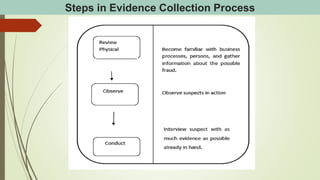
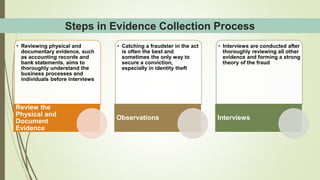
Steps in Evidence Collection Process
• Reviewing physical and
documentary evidence, such
as accounting records and
bank statements, aims to
thoroughly understand the
business processes and
individuals before interviews
Review the
Physical and
Document
Evidence
• Catching a fraudster in the act
is often the best and
sometimes the only way to
secure a conviction,
especially in identity theft
Observations
• Interviews are conducted after
thoroughly reviewing all other
evidence and forming a strong
theory of the fraud
Interviews
Steps in Evidence Collection Process
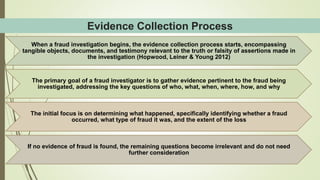
Evidence Collection Process
When a fraud investigation begins, the evidence collection process starts, encompassing
tangible objects, documents, and testimony relevant to the truth or falsity of assertions made in
the investigation (Hopwood, Leiner & Young 2012)
The primary goal of a fraud investigator is to gather evidence pertinent to the fraud being
investigated, addressing the key questions of who, what, when, where, how, and why
The initial focus is on determining what happened, specifically identifying whether a fraud
occurred, what type of fraud it was, and the extent of the loss
If no evidence of fraud is found, the remaining questions become irrelevant and do not need
further consideration
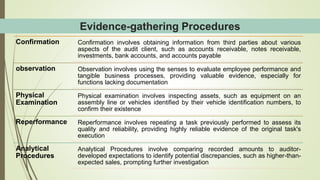
Evidence-gathering Procedures
Confirmation Confirmation involves obtaining information from third parties about various
aspects of the audit client, such as accounts receivable, notes receivable,
investments, bank accounts, and accounts payable
observation Observation involves using the senses to evaluate employee performance and
tangible business processes, providing valuable evidence, especially for
functions lacking documentation
Physical
Examination
Physical examination involves inspecting assets, such as equipment on an
assembly line or vehicles identified by their vehicle identification numbers, to
confirm their existence
Reperformance Reperformance involves repeating a task previously performed to assess its
quality and reliability, providing highly reliable evidence of the original task's
execution
Analytical
Procedures
Analytical Procedures involve comparing recorded amounts to auditor-
developed expectations to identify potential discrepancies, such as higher-than-
expected sales, prompting further investigation
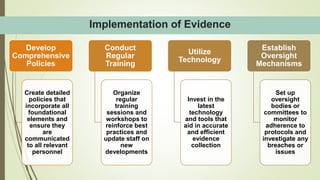
Develop
Comprehensive
Policies
Create detailed
policies that
incorporate all
foundational
elements and
ensure they
are
communicated
to all relevant
personnel
Conduct
Regular
Training
Organize
regular
training
sessions and
workshops to
reinforce best
practices and
update staff on
new
developments
Utilize
Technology
Invest in the
latest
technology
and tools that
aid in accurate
and efficient
evidence
collection
Establish
Oversight
Mechanisms
Set up
oversight
bodies or
committees to
monitor
adherence to
protocols and
investigate any
breaches or
issues
Implementation of Evidence
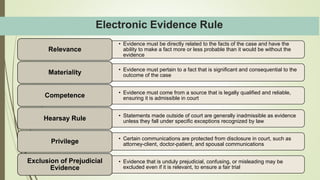
• Evidence must be directly related to the facts of the case and have the
ability to make a fact more or less probable than it would be without the
evidence
Relevance
• Evidence must pertain to a fact that is significant and consequential to the
outcome of the case
Materiality
• Evidence must come from a source that is legally qualified and reliable,
ensuring it is admissible in court
Competence
• Statements made outside of court are generally inadmissible as evidence
unless they fall under specific exceptions recognized by law
Hearsay Rule
• Certain communications are protected from disclosure in court, such as
attorney-client, doctor-patient, and spousal communications
Privilege
• Evidence that is unduly prejudicial, confusing, or misleading may be
excluded even if it is relevant, to ensure a fair trial
Exclusion of Prejudicial
Evidence
Electronic Evidence Rule
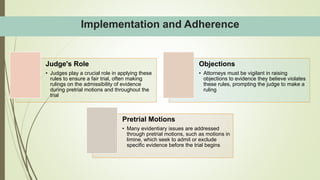
Judge's Role
• Judges play a crucial role in applying these
rules to ensure a fair trial, often making
rulings on the admissibility of evidence
during pretrial motions and throughout the
trial
Objections
• Attorneys must be vigilant in raising
objections to evidence they believe violates
these rules, prompting the judge to make a
ruling
Pretrial Motions
• Many evidentiary issues are addressed
through pretrial motions, such as motions in
limine, which seek to admit or exclude
specific evidence before the trial begins
Implementation and Adherence
Prof. Godwin Emmanuel Oyedokun
Professor of Accounting & Financial Development
Lead City University, Ibadan, Nigeria
Principal Partner; Oyedokun Godwin Emmanuel & Co
(Accountants, Tax Practitioners & Forensic Auditors)
godwinoye@yahoo.com; godwinoye@oyedokungodwin.com
+2348033737184 & 2348055863944

Evidence and Evidence Handling Techniques

  • 1.
    Evidence and EvidenceHandling Techniques Being a Lecture Paper Presented on Friday, June 14, 2024. Prof. Godwin Emmanuel Oyedokun Professor of Accounting and Financial Development Department of Management & Accounting Faculty of Management and Social Sciences Lead City University, Ibadan, Nigeria Principal Partner; Oyedokun Godwin Emmanuel & Co (Accountants, Tax Practitioners & Forensic Auditors)
  • 2.
    ND (Fin), HND(Acct.), BSc. (Acct. Ed), BSc (Fin.), LLB., LLM, MBA (Acct. & Fin.), MSc. (Acct.), MSc. (Bus &Econs), MSc. (Fin), MSc. (Econs), Ph.D. (Acct), Ph.D. (Fin), Ph.D. (FA), CICA, CFA, CFE, CIPFA, CPFA, CertIFR, ACS, ACIS, ACIArb, ACAMS, ABR, IPA, IFA, MNIM, FCA, FCTI, FCIB, FCNA, FCFIP, FCE, FERP, FFAR, FPD-CR, FSEAN, FNIOAIM, FCCrFA, FCCFI, FICA, FCECFI, JP Prof. Godwin Emmanuel Oyedokun Professor of Accounting and Financial Development Department of Management & Accounting Faculty of Management and Social Sciences Lead City University, Ibadan, Nigeria Principal Partner; Oyedokun Godwin Emmanuel & Co (Accountants, Tax Practitioners & Forensic Auditors)
  • 3.
  • 4.
    Contents Concept of Evidence Forms of Evidence Typesof Evidence Admissibility of Evidence Evidence Collection Process Evidence gathering procedure Best Evidence Rule Electronic Evidence Rule
  • 6.
    Overview of Evidence/1 Evidence is anything that can be used to prove something Legally, it includes assertions of fact, opinion, belief, or knowledge, whether material or not and admissible or not The ACFE Manual (2017) defines evidence as principles ensuring only relevant and probative evidence is admitted in court, excluding irrelevant, unreliable, and prejudicial evidence Rules of evidence impact every aspect of a trial, from filing the complaint to presenting witnesses and exhibits.
  • 7.
    Overview of Evidence/2 These rules dictate what counts as evidence, and how it is gathered, handled, and presented The complexity of evidence rules necessitates consulting counsel during fraud examinations Evidence rules vary by jurisdiction, with different standards in state and federal courts in the United States
  • 8.
    Forms of Evidence •Oral statements made by witnesses under oath • Types: Lay witnesses and Expert witnesses • Lay witnesses testify from personal knowledge about a matter at issue, while expert witnesses provide opinions based on their education, training, skill, or experience in relevant area Testimonial Evidence • physical objects that played a part in the issues being litigated, it includes both documentary evidence such as cancelled cheques, invoices, ledgers, and letters as well as other types of physical evidence Real Evidence • Physical objects involved in the litigation, such as documentary evidence like canceled checks, invoices, ledgers, and letters, as well as other tangible items • Unlike real evidence, which was part of the underlying event, demonstrative evidence like maps, charts, or summaries is created specifically for the trial to illustrate material propositions and aid the jury Demonstrative Evidence
  • 9.
    Common law systems,employing adversarial processes, have stricter rules limiting the admission of evidence compared to civil law systems with inquisitorial proceedings, focusing on reliability alongside relevancy, resulting in the exclusion of certain evidence lacking reliability Special Rules Concerning the Admission of Evidence in Adversarial Proceedings
  • 10.
    Most Common Rulesof Evidence The rule against character evidence The rule against opinion testimony The rule of authentication The best evidence rule The rule against hearsay
  • 11.
    Character Evidence Common lawsystems generally discourage the use of character evidence in civil and criminal trials due to its potential unreliability, unfairness, and subjective nature, as well as the risk of prejudicing the jury or diverting the focus from relevant issues Exceptions allowing character evidence in criminal cases include situations where it relates to the accused's credibility, intent, motive, preparation for the crime, or other specific purposes, but such evidence is generally inadmissible to prove the defendant's general propensity or character Testimony about the character has a reckless potential to be mistakenly founded, misled or concocted, it is always possible to "misjudge" someone, especially if we only know the person in limited circumstances like work or a social club Moreover, it is exceedingly easy to fabricate incidents about character and, for shrewd talkers, to manipulate perceptions of personality, to prove a fraud case, the party bringing the action must show that the defendant committed the act in question In general, character evidence is not admissible in criminal cases, and in civil cases, character evidence is rarely admissible, the general rule in criminal cases provides that evidence of a defendant's bad character is not admissible at trial
  • 12.
    Some Exceptions foruse of Character Evidence in Criminal Cases Attempt to destroy evidence Link the accused to physical evidence at the scene Show threats or expressions of ill will by the accused Show the accused's opportunity to commit the crime Show the accused's preparation to commit the charged crime Prove the existence of a larger plan of which the charged crime is a part Show the accused's knowledge, intent, or motive for the crime
  • 13.
    Opinion Testimony In trials,evidence is primarily presented through witness testimony or documents, with lay witnesses providing factual observations based on personal knowledge They generally refrain from expressing opinions, but exceptions exist where lay opinions are admissible, such as when they meet specific criteria and pertain to common, everyday matters directly relevant to the case Lay witness opinions must pass a three-part test: based on direct personal knowledge, relating to common matters, and not involving legal judgments In contrast, expert witnesses are permitted to offer opinion testimony based on their specialized knowledge or experience, except when it ventures into making legal conclusions, particularly in criminal cases
  • 14.
    Requirement of Authentication Incommon law systems using adversarial processes, exhibits are inadmissible unless they are relevant and established as authentic The authentication requirement serves to ensure that evidence is what it purports to be and is genuine, not a forgery. Testimonial evidence does not have to be authenticated to be admissible, the courts have a sort of "credibility test" for witnesses The witness must demonstrate that the knowledge he is communicating is believable and was gained by his personal experience. This techniques that can be used to authenticate evidence, but they vary depending on the type of evidence. Often, the evidence is authenticated by the testimony of a witness who knows about the item's chain of custody
  • 15.
    Authenticating Typical Exhibits Demonstrativeevidence, such as charts and graphs, is created specifically for trial to visually illustrate material propositions to the jury, especially in complex cases like fraud It is a visual aids to simplify complicated evidence, providing a clear summary or picture, and must be disclosed to the opposing party
  • 16.
    Diagrams • A diagram,regardless of scale or detail, can be admitted as evidence based solely on the agreement of a witness confirming its accuracy in representing a relevant location or situation Writing • Authentication of writing typically involves identifying the author through methods like the author's testimony, witness testimony of seeing the author write, penmanship or signature verification, or content- related testimony pointing to the author Computer Records (Digital Evidence) • Courts face challenges in authenticating digital evidence, typically relying on witness testimony and circumstantial evidence of distinctive characteristics Photographs • Establishing the admissibility of photographs requires demonstrating their accuracy in depicting the object or scene, usually through a witness familiar with the subject matter Exhibit Produced in Court.
  • 17.
    In adversarial processes,once an exhibit is properly admitted into the record, either side can use it regardless of who entered it into evidence The timing of exhibit admission does not matter it can be introduced during direct examination, where opposing counsel can inspect the exhibit before the witness confirms it Exhibits are marked for identification before being offered into evidence to ensure they are recognizable in the transcript of the proceedings Exhibits are typically marked sequentially and identified by the party who offered them, such as "Plaintiff exhibits Both sides in a lawsuit can stipulate agreements to simplify trial proceedings by narrowing disputes to key issues General Points about Exhibits
  • 18.
    Authentication of anexhibit does not guarantee its admission if it violates other evidence rules like hearsay, prejudice, or relevance Parties can dispute the admissibility of an exhibit by saying "objection," upon which the judge will rule If the judge overrules the objection, the evidence is admitted; if the judge sustains the objection, the evidence is excluded Judges can admit exhibits as they are, with alterations, or deny them entirely Some objections may require a separate hearing, and fraud trials can be prolonged by challenges to large volumes of evidence Objections to Exhibits
  • 20.
    Civil law systemsdo not require evidence authentication for admission Authentication affects the evidential value or weight given by the fact- finder Non-authentic evidence is considered less reliable and given less weight by the fact-finder Authentic and relevant evidence is deemed reliable and helpful in ascertaining the truth Authenticity in Civil Law Systems
  • 21.
    Practices in EvidenceGathering Best Evidence Rule Hearsay • Common law countries generally prohibit hearsay statements at trial, which are out-of-court statements offered to prove the truth of the matter asserted, to ensure the credibility of testimony and preserve the right to cross-examine witnesses, though there are numerous exceptions to this rule Rules Relating to Evidence Content • Evidence must be shown to be relevant to be introduced in court, but judges may exclude relevant evidence if it is overly prejudicial; attorneys must object to the inclusion of irrelevant evidence, otherwise it is admitted, while personal knowledge rules limit witnesses to testify only to what they have directly experienced, with exceptions for expert witnesses, and numerous exceptions exist to the hearsay rule, such as dying declarations and excited utterances Rules relating to the Manner of Testimony • Attorneys are prohibited from asking leading questions during direct examination but may do so during cross- examination, and certain questions, such as those that badger witnesses, assume facts not in evidence, misquote witnesses, or ask for speculation, are entirely forbidden; witnesses can protect themselves from improper questions by restating previous testimony if the attorney fails to object
  • 22.
    Types of Evidence Physical Evidence Physicalevidence includes all items with physical existence, such as fingerprints and trace evidence, and also documents, even those stored digitally Document Evidence Document evidence encompasses both collected documents and those created for the trial, such as charts, graphs, and exhibits used in expert testimony Observation Evidence Observation evidence, gathered by monitoring suspects, can include eyewitness testimony or recordings, and is often very powerful, such as a videotape showing a clerk stealing money, which can be more compelling than expert analysis of accounting records Interviews Recorded interviews and signed confessions are the most potent evidence, especially when witnesses provide firsthand knowledge relevant to the alleged fraud, making interviews invaluable for both trial evidence and investigative focus
  • 23.
    Importance of Evidence Foundationof Knowledge • Evidence provides a reliable basis for knowledge, ensuring that information is accurate and trustworthy Informed Decision-Making • It enables individuals and organizations to make well-informed decisions by providing factual and verified data Accountability and Transparency • Evidence promotes accountability and transparency, ensuring actions and claims can be scrutinized and validated Advancement of Science and Technology • It drives the progress of science and technology by supporting hypotheses and enabling reproducible experiments Policy and Legal Justification • Evidence is crucial in forming sound policies and legal decisions, ensuring they are grounded in reality and fairness
  • 24.
    Admissibility Rules Evidence mustmeet certain requirements to be admissible, with judges having significant discretion over its admissibility Civil law systems, lacking juries, impose fewer restrictions on evidence compared to common law systems, which have more limitations Evidence is considered relevant if it makes a fact at issue more or less likely, depending on what it is intended to prove Even relevant evidence can be excluded if it is overly prejudicial, confusing, misleading, time- wasting, cumulative, or privileged Direct evidence proves facts directly, such as through eyewitness testimony, while circumstantial evidence proves facts indirectly through inference In common law systems, objections to evidence are decided by the judge, who determines its admissibility Fraud cases often rely on circumstantial evidence to prove intent, as direct evidence of a defendant's state of mind is usually unavailable
  • 25.
    Steps in EvidenceCollection Process
  • 26.
    • Reviewing physicaland documentary evidence, such as accounting records and bank statements, aims to thoroughly understand the business processes and individuals before interviews Review the Physical and Document Evidence • Catching a fraudster in the act is often the best and sometimes the only way to secure a conviction, especially in identity theft Observations • Interviews are conducted after thoroughly reviewing all other evidence and forming a strong theory of the fraud Interviews Steps in Evidence Collection Process
  • 27.
    Evidence Collection Process Whena fraud investigation begins, the evidence collection process starts, encompassing tangible objects, documents, and testimony relevant to the truth or falsity of assertions made in the investigation (Hopwood, Leiner & Young 2012) The primary goal of a fraud investigator is to gather evidence pertinent to the fraud being investigated, addressing the key questions of who, what, when, where, how, and why The initial focus is on determining what happened, specifically identifying whether a fraud occurred, what type of fraud it was, and the extent of the loss If no evidence of fraud is found, the remaining questions become irrelevant and do not need further consideration
  • 28.
    Evidence-gathering Procedures Confirmation Confirmationinvolves obtaining information from third parties about various aspects of the audit client, such as accounts receivable, notes receivable, investments, bank accounts, and accounts payable observation Observation involves using the senses to evaluate employee performance and tangible business processes, providing valuable evidence, especially for functions lacking documentation Physical Examination Physical examination involves inspecting assets, such as equipment on an assembly line or vehicles identified by their vehicle identification numbers, to confirm their existence Reperformance Reperformance involves repeating a task previously performed to assess its quality and reliability, providing highly reliable evidence of the original task's execution Analytical Procedures Analytical Procedures involve comparing recorded amounts to auditor- developed expectations to identify potential discrepancies, such as higher-than- expected sales, prompting further investigation
  • 29.
    Develop Comprehensive Policies Create detailed policies that incorporateall foundational elements and ensure they are communicated to all relevant personnel Conduct Regular Training Organize regular training sessions and workshops to reinforce best practices and update staff on new developments Utilize Technology Invest in the latest technology and tools that aid in accurate and efficient evidence collection Establish Oversight Mechanisms Set up oversight bodies or committees to monitor adherence to protocols and investigate any breaches or issues Implementation of Evidence
  • 30.
    • Evidence mustbe directly related to the facts of the case and have the ability to make a fact more or less probable than it would be without the evidence Relevance • Evidence must pertain to a fact that is significant and consequential to the outcome of the case Materiality • Evidence must come from a source that is legally qualified and reliable, ensuring it is admissible in court Competence • Statements made outside of court are generally inadmissible as evidence unless they fall under specific exceptions recognized by law Hearsay Rule • Certain communications are protected from disclosure in court, such as attorney-client, doctor-patient, and spousal communications Privilege • Evidence that is unduly prejudicial, confusing, or misleading may be excluded even if it is relevant, to ensure a fair trial Exclusion of Prejudicial Evidence Electronic Evidence Rule
  • 31.
    Judge's Role • Judgesplay a crucial role in applying these rules to ensure a fair trial, often making rulings on the admissibility of evidence during pretrial motions and throughout the trial Objections • Attorneys must be vigilant in raising objections to evidence they believe violates these rules, prompting the judge to make a ruling Pretrial Motions • Many evidentiary issues are addressed through pretrial motions, such as motions in limine, which seek to admit or exclude specific evidence before the trial begins Implementation and Adherence
  • 32.
    Prof. Godwin EmmanuelOyedokun Professor of Accounting & Financial Development Lead City University, Ibadan, Nigeria Principal Partner; Oyedokun Godwin Emmanuel & Co (Accountants, Tax Practitioners & Forensic Auditors) godwinoye@yahoo.com; godwinoye@oyedokungodwin.com +2348033737184 & 2348055863944